Ieltxu

Variations: Iditxu, Iritxu

Ieltxu

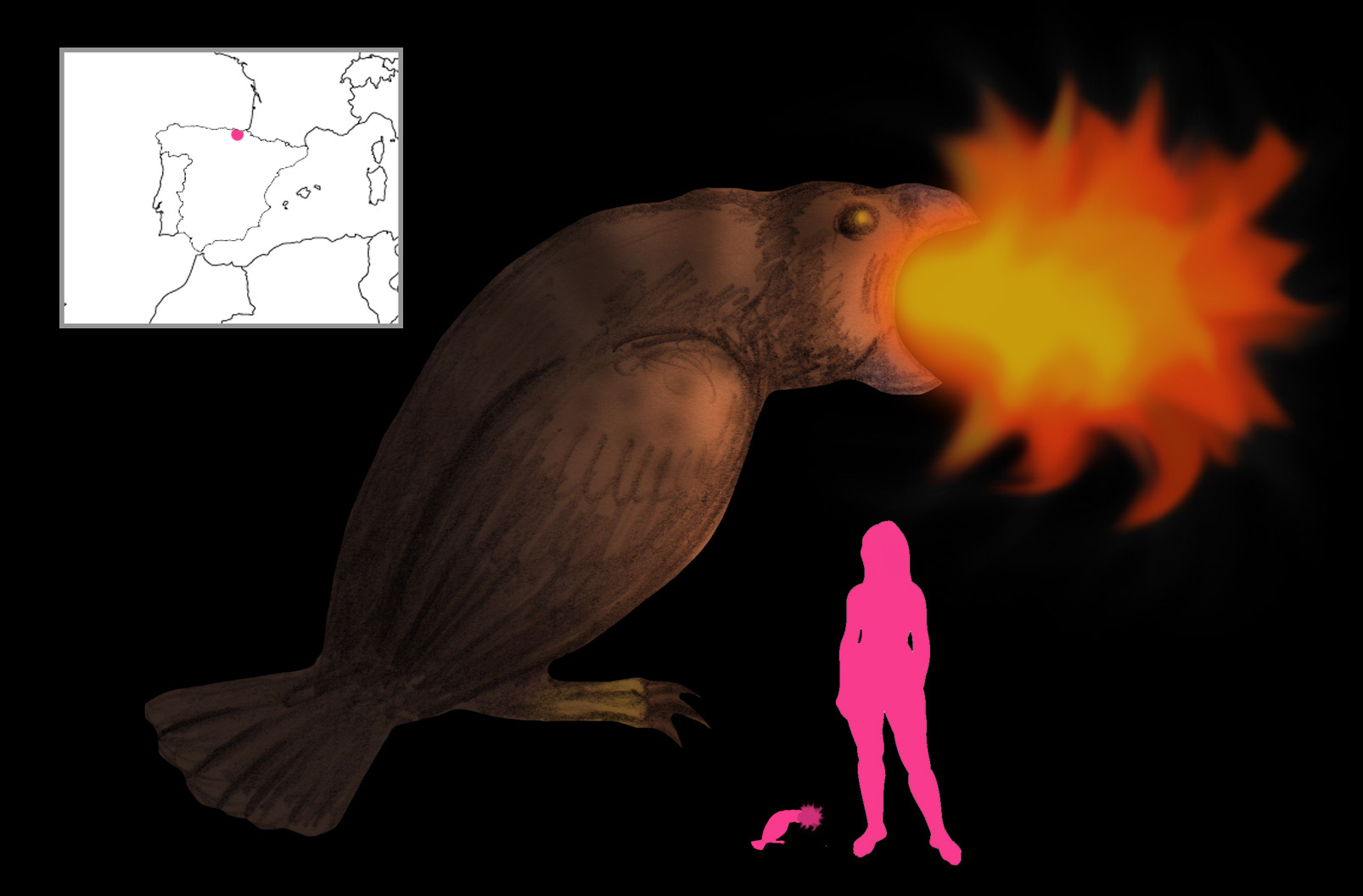
Ieltxu is a Basque creature found in the caverns and wells of Gernika. Notable haunts include a pit in Nabarrizmendi and the Busturia well.

Ieltxu appears either as a human or as a bird shooting flames from its mouth. At night only its burning fire is seen. While its appearances are sudden and terrifying, an ieltxu is not evil, merely mischievous. It enjoys leading people astray and getting them lost, especially if they can get lost near a cliff.

Around Bermeo it is Iditxu or Iritxu who appears as a small pig. It leads people on a merry chase through the night only to return them to where they started, exhausted and empty-handed.

References

Altuna, J.; Fornoff, F. H., White, L., and Evans-Corrales, C. trans. (2007) Selected Writings of Jose Miguel de Barandiaran: Basque Prehistory and Ethnography. Center for Basque Studies, Reno.

Trebius

Variations: Trebius Niger (Black Trebius), Trebeus, Swordfish

Trebius

Within his discussion of the echeneis or remora, Pliny digresses briefly to mention the murex, a seashell that also can adhere to ships and prevent them from moving. He then credits Trebius Niger with the knowledge that the echeneis is a foot long, five fingers thick, and capable of hindering the movement of a ship; if preserved in salt, it can draw up gold that has fallen down a deep well.

The next paragraph addresses a miscellany of fishes. The mena changes color, becoming white in winter and black in summer. The phycis (a goby or lamprey) also changes color; it is also the only fish that builds a nest of seaweed to spawn in.

Thomas de Cantimpré combines all those accounts and misreads the name of Pliny’s source for the name of a fish. This miraculous textual transformation is the origin of the trebius niger or black trebius. This composite fish is a foot long, black in color and changing to white depending on the season. It can hinder ships like a remora, and even a small salted piece of it can draw gold out of wells. Unlike other fishes, the trebius builds a nest to lay its eggs in.

After having decided that the trebius is a fish, Thomas sticks to his interpretation. A later passage cites Trebius Niger and describes swordfish attacks on boats. This is again read to be an allusion to the trebius, and, as a result, it becomes armed with a sharp beak that it uses to sink ships (despite its size, apparently).

The trebius is shown nesting in a tree in the Hortus Sanitatis. Albertus Magnus gives us the most memorable depiction of the fish, giving it a pointed nose, a beard, clawed feet, and a nest with an egg inside.

References

Aiken, P. (1947) The Animal History of Albertus Magnus and Thomas of Cantimpré. Speculum, 22(2), pp. 205-225.

de Cantimpré, T. (1280) Liber de natura rerum. Bibliothèque municipale de Valenciennes.

Cuba, J. (1539) Le iardin de santé. Philippe le Noir, Paris.

Magnus, A. (1545) Thierbuch. Jacob, Frankfurt.

Magnus, A. (1920) De Animalibus Libri XXVI. Aschendorffschen Verlagbuchhandlung, Münster.

Pliny; Holland, P. trans. (1847) Pliny’s Natural History. George Barclay, Castle Street, Leicester Square.

Unknown. (1538) Ortus Sanitatis. Joannes de Cereto de Tridino.

Boiúna

Variations: Anaconda, Boi-úna, Cobra Grande, Cobra-grande, Eunectes murinus, Mae-d’agua, Mae-do-rio, Mboia-açu (“Large Snake”), Mboiúna; Mru-kra-o (Kayapo); Vai-bogo (Desana)

Boiuna

Boiúna or Cobra Grande is one of the most widespread and polymorphic myths of the Amazon basin. The name is applied to concepts and creatures ranging from a goddess of the water to a synonym of the green anaconda (Eunectes murinus).

In lingua geral the term boi denotes a snake (such as jiboia, the boa constrictor). Una means black. Thus a boiúna or mboiúna is a black snake, a name it shares with the mussurana. Its other name of cobra grande (“big snake”) is even less descriptive.

But a cobra grande is nothing if not big. It grows up to two hundred meters long and ten meters wide. Its enormous eyes, 0.5 to 1 m apart, glow like searchlights, with colors including orange-yellow and blue. Sometimes it has large, sharp canines on its lower jaw that stick out through holes in its upper jaw like horns. It has a powerful stench that can make people dizzy, and it makes loud rumbling sounds. Its massive bulk easily hides in the underwater holes it digs. Sometimes it appears as a ghost ship, a steamboat or a sailboat.

Boiúna can be found at the bottom of streams, rivers, lakes, and ponds, but it usually avoids the rainforest and dry land. When water levels fall in the dry season boiúnas slither out in search of deeper water, gouging out new stream channels and troughs. Its mere presence in the water can impregnate women.

When it swims a boiúna leaves a distinctive, huge, v-shaped bow wave. It protects the fish of its waters. It has a magnetic power that allows it to immobilize ships in the middle of the river, and release them at its discretion; inexplicable boat malfunctions can be ascribed to a meddling boiúna. The glowing eyes of a boiúna can mesmerize anyone who looks at them, rendering the victim enchanted (encantado). The snakes can also kill people by stealing their shadows. A de-shadowed person (assombrado) wastes away and dies in a few days. It can take a more direct approach by attacking small boats and eating the passengers, although it may also take its captives to its underwater kingdom, a sort of watery afterlife, to live with it as river snakes.

Boiúnas are intelligent. They can be summoned in séances, where they are quite talkative. They can also take on human form and mingle with people. Norato was a boiúna who would leave the Tocantins river and head into Carolina at night to party. He was an avid dancer who swapped his scaly hide for a dashing white jacket. A man once saw a giant snake leave the river and turn into a man, leaving his skin behind. Horrified, the onlooker decided to burn the skin. Norato returned to find that he was stuck as a human.

Sometimes a boa constrictor that grows too big becomes a boiúna. Sometimes a boiúna is spawned from human behavior. The boiúna of the Itacaiunas River was conceived by a girl who became pregnant and hid her condition from her parents. When she gave birth she was too scared to tell her parents, and threw the baby into the Itacaiunas. There it metamorphosed into a huge snake that terrorized river traffic. The boiúna revealed in a séance that it wanted to be disenchanted; the way to do so involved luring it with hot milk, slashing its throat, and turning around without looking back. Nobody took it up on the offer.

Tales of giant snakes are common throughout the Amazon. These include the mru-kra-o of the Kayapo and the vai-bogo of the Desana. In the Peruvian Amazon the giant anaconda is known as the Yakumama, the Mother of Water.

References

Barbosa, A. L. (1951) Pequeno Vocabulario Tupi-Portugues. Livraria Sao Jose, Rio de Janeiro.

Cascudo, L. C. (2000) Dicionario do Folclore Brasileiro. Global Editora, Sao Paolo.

Fonseca, F. (1949) Animais Peconhentos. Instituto Butantan, Sao Paolo.

Galeano, J. G.; Morgan, R. and Watson, K. trans. (2009) Folktales of the Amazon. Libraries Unlimited, Westport.

Osborne, H. (1986) South American Mythology. Peter Bedrick Books, New York.

Smith, N. J. H. (1981) Man, Fishes, and the Amazon. Columbia University Press, New York.

Smith, N. J. H. (1996) The Enchanted Amazon Rain Forest. University Press of Florida, Gainesville.

Physeter

Variations: Physeterus, Physalus, Pistris, Pistrix, Prister. Pristes, Pristis, Capax (“roomy”, referring to its huge mouth), Capidolio (Italy), Mular, Peis Mular (Languedoc), Senedectes, Senedette (Saintonge), Spouter, Whirlpool, Whirl-pool, Whirlepoole
Physeter

The Physeter, “blower”, Prister, or Whirlpool, is an enormous, monstrous whale. The name, originally associated with a spouting sea monster, has today become the scientific name of the sperm whale or cachalot (Physeter macrocephalus).

Pliny states that the largest animals in the Indian Sea are the Pristis (shark) and the Balaena (whale). The largest animal in the Ocean of Gaul is the physeter. It lifts itself up like an enormous column, towering higher than the masts of ships, and spouts a flood of water.

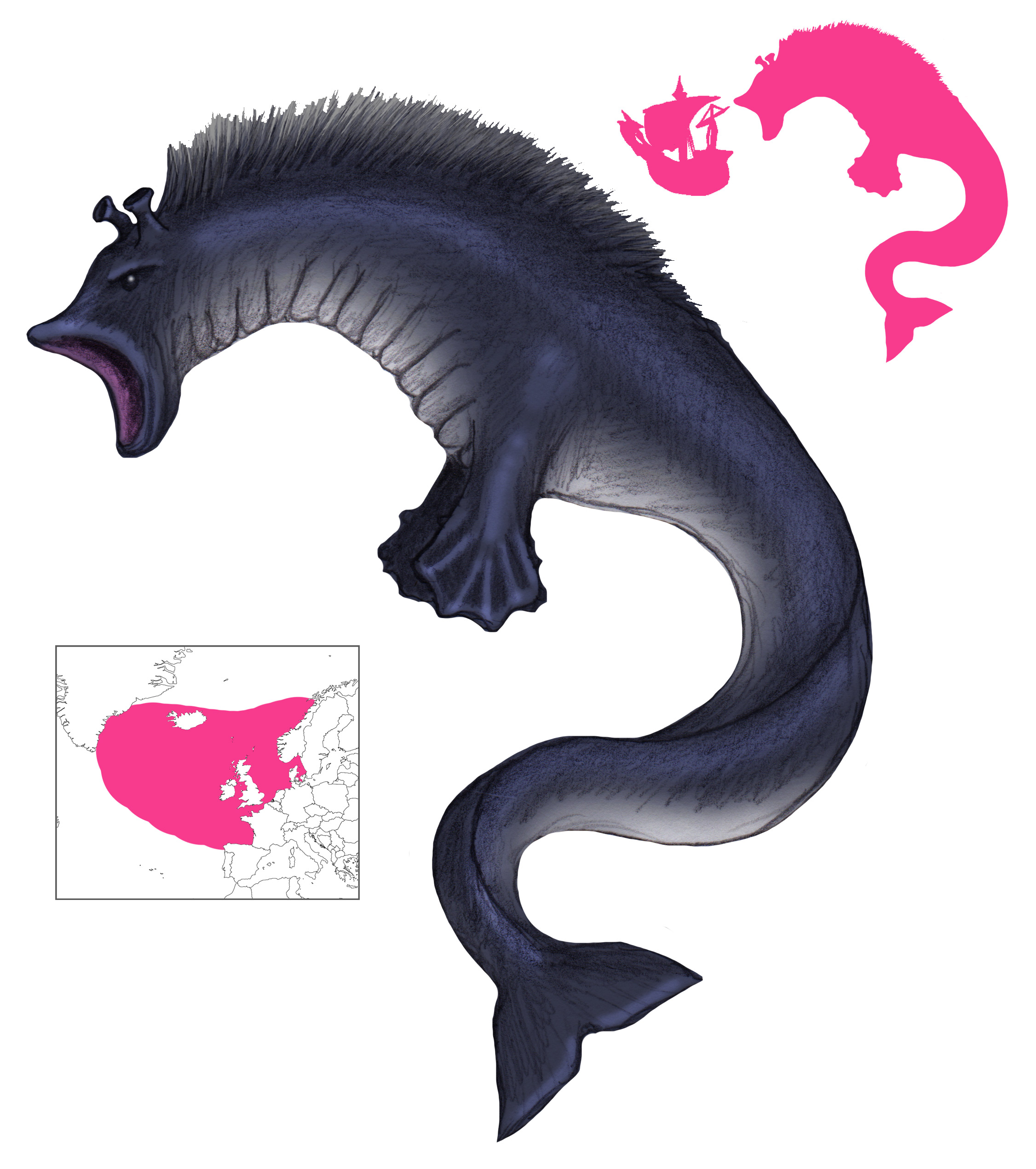
The most notable reference to the physeter as a monster comes from Olaus Magnus. He describes the physeter as two hundred cubits long, with a large, round mouth like that of a lamprey, a tough black hide, and a prehensile tail about 15 or 20 feet wide. It uses its mouth to suck in massive quantities of water which it then spouts violently onto its prey from the blowholes on its head. Its tail can coil around ships and crush them.

Two different images are given by Olaus for the physeter. One is an upright, spouting monster with a horselike head, a gaping, toothless mouth, an erect mane running down its long neck, and a ribbed belly. The other is the tusked, frilled whale which appears in multiple places on the Carta Marina. Münster copies the first version and gives it more canine features, including large fangs and floppy ears; the second he refers to as the trolual or teuffelwal, the “devil-whale”.

Physeters are cruel, malicious creatures that will sink ships for sport. As a physeter’s hide and thick fat are too thick for conventional weapons to penetrate, sailors must resort to other means to ward off the whale’s attentions. One way is to blow trumpets or fire artillery; the loud noises can startle and scare off the physeter. Another is to throw barrels or smaller boats in the path of the whale to distract it.

Rondelet describes the physeter as so named because when it blows it projects a massive amount of water like a mist, which can fill and overturn smaller boats. It is spectacularly large, with a huge mouth, sharp teeth, a large fleshy tongue, and a breathing tract much larger than that of any other animal. It differs from the orca in that it is longer and lacks a fin on its back. One physeter was taken in Italy was placed by the Duke of Florence in front of his palace, but it had to be removed due to its stench. By this point the draconic seahorse of Olaus Magnus has been abandoned; this is the sperm whale as we know it today.

The greatest contribution the physeter has made to literature is in the pages of Rabelais’ epic tale of giants. In Pantagruel, the titular giant and his friends encounter a massive physeter roaring and spouting water, rising higher than the masts of the ship. Panurge immediately wails, comparing it to the Leviathan and the monster that attacked Andromeda, and fears that “it will swallow us all, men and ships, like pills”! But Pantagruel chides him, saying he is better off fearing the horses of the Sun, which snort fire, instead of this monster, which merely blows water. Pantagruel duly peppers the physeter with arrows until it expires and “turned belly up, as do all dead fish”.

De Montfort believed Olaus Magnus’ physeter (apart from the sperm whale) to be a colossal octopus.

References

Aldrovandi, U. (1613) De Piscibus, Libri V. Bologna.

Kitchell, K. F. (2014) Animals in the Ancient World from A to Z. Routledge, Milton Park, Abingdon, Oxon.

Magnus, O. (1555) Historia de gentibus septentrionalibus. Giovanni M. Viotto, Rome.

Magnus, O. (1561) Histoire des pays septentrionaus. Christophle Plantin, Antwerp.

Magnus, O. (1658) A compendious history of the Goths, Swedes, and Vandals, and other Northern nations. J. Streater, London.

de Montfort, P. D. (1801) Histoire Naturelle, Générale et Particuliere des Mollusques, Tome Second. F. Dufart, Paris.

Münster, S. (1552) La Cosmographie Universelle. Henry Pierre.

Nigg, J. (2013) Sea Monsters: A Voyage around the World’s Most Beguiling Map. University of Chicago Press.

Pliny; Holland, P. trans. (1847) Pliny’s Natural History. George Barclay, Castle Street, Leicester Square.

Rabelais, F. (1858) Oeuvres de Rabelais, t. II. Firmin Didot Freres, Fils, et Cie, Paris.

Rondelet, G. (1558) L’Histoire Entiere des Poissons. Mace Bonhome, Lyon.

Sainéan, L. (1921) L’histoire naturelle et les branches connexes dans l’oeuvre de Rabelais. E. Champion, Paris.
Musca Macedda

Variations: Musca Macèdda, Musca Machèdda, Musca Maghèdda, Musca Manchèdda da Mancu

Musca Macedda

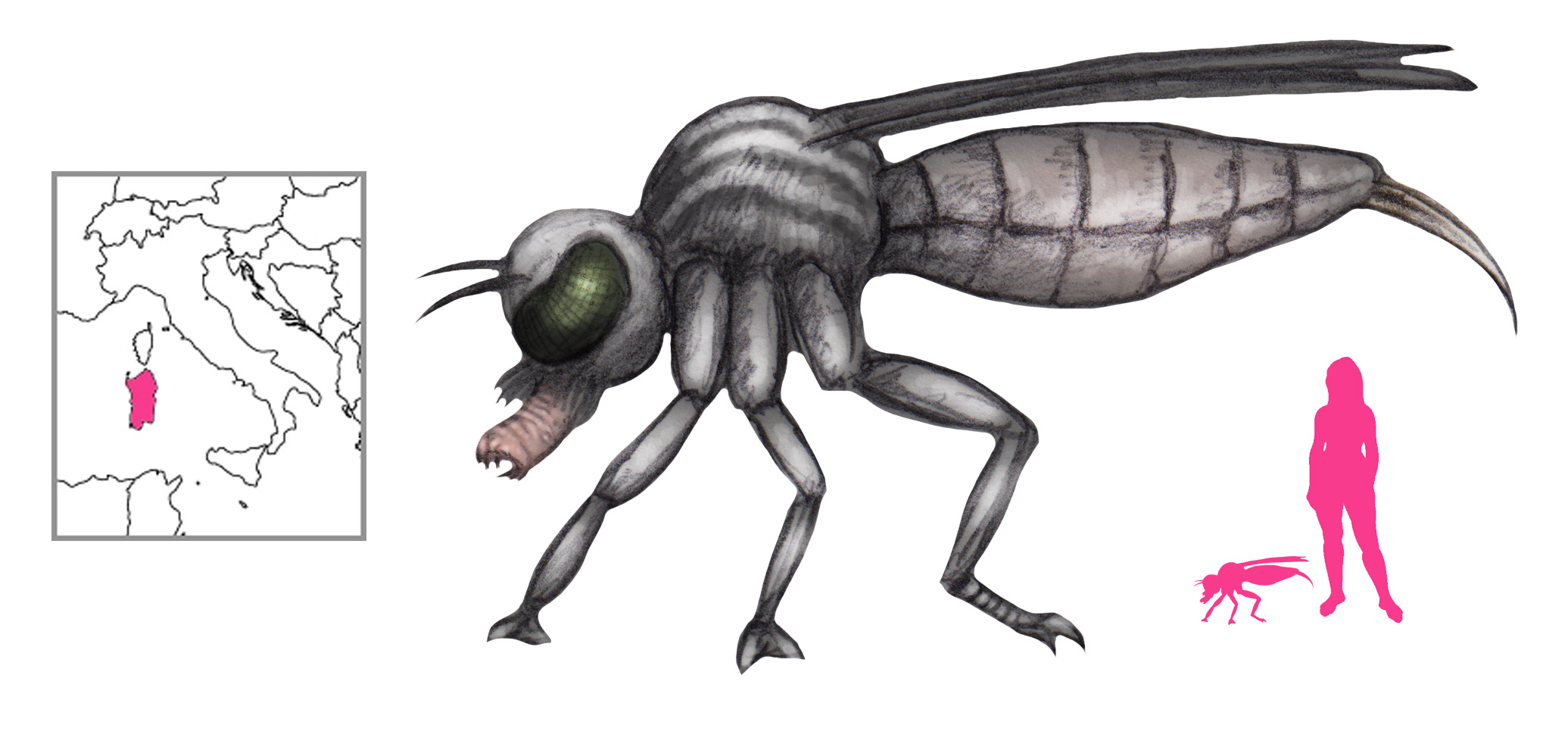
A fabulous treasure awaits discovery in Sardinia. This treasure takes the form of two barrels, identical in appearance. One of those barrels contains riches beyond imagination. The other barrel is full of deadly flies – the Musca Macedda. Anyone opening the barrel full of flies brings about not only their own death, but the destruction of the world. This treasure may be found all over Sardinia, including near Alghero, Esterzili, Sorgono, the church of Valenza, and many other places. Nobody has dared open it.

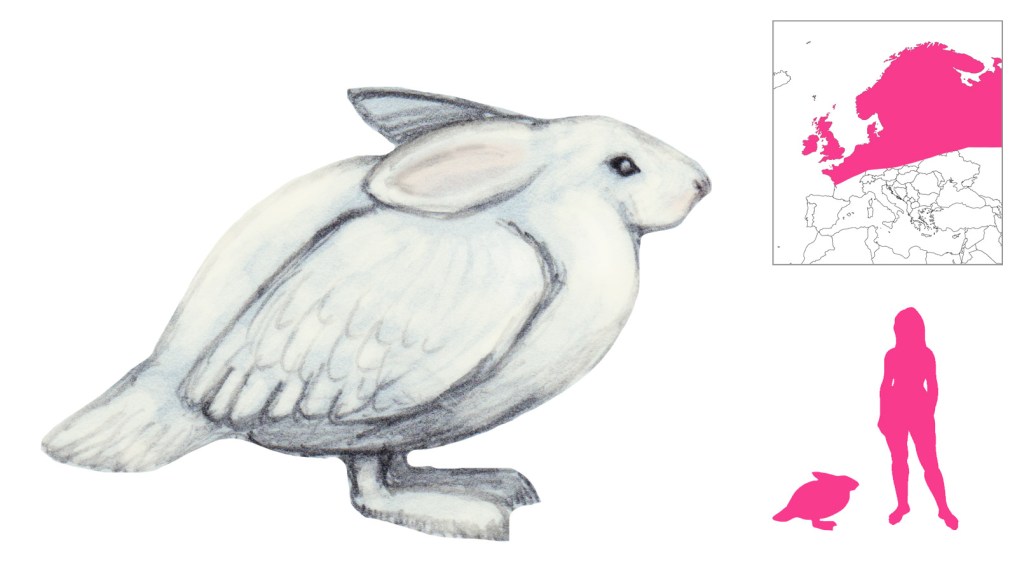
The musca macedda’s name refers to the slaughter and massacre it brings about; it is also known as the musca manchèdda da mancu, i.e. of the left hand, for if the right hand is the hand of God, the left hand is that of the Devil. A musca macedda resembles a common fly but can be up to the size of a sheep. The one reported from Nuchis was as big as an ox’s head. A musca macedda has powerful wings, and in places where these flies are buried one can hear their infernal buzzing. The stinger is huge and deadly.

Only the local priest is spiritually strong enough to ward off a musca macedda. At Iglesias it was said that a holy man delivered the country from demonic flies that had already destroyed multiple towns such as Galte in Nuorese, Ilani near Orotelli, Oddini, and Thiddorai. The musca macedda at Nuchis tore the region apart before dying between the Church of San Cosimo and the Parish of the Holy Spirit, between two black boulders of volcanic rock.

Belief in the musca macedda appears to be an ancient one. It has been suggested that the flies arose with the Spanish invasion of Sardinia, since at least one tale says that they issued from the tomb of a Spanish saint. It is more likely that they are a personification of the diseases and epidemics that ravaged Sardinia at various points in its history.

References

Bottiglione, G. (1922) Leggende e Tradizioni di Sardegna. Leo S. Olschki, Geneva.

Fad Felen

Variations: Fall Felen

Fad Felen

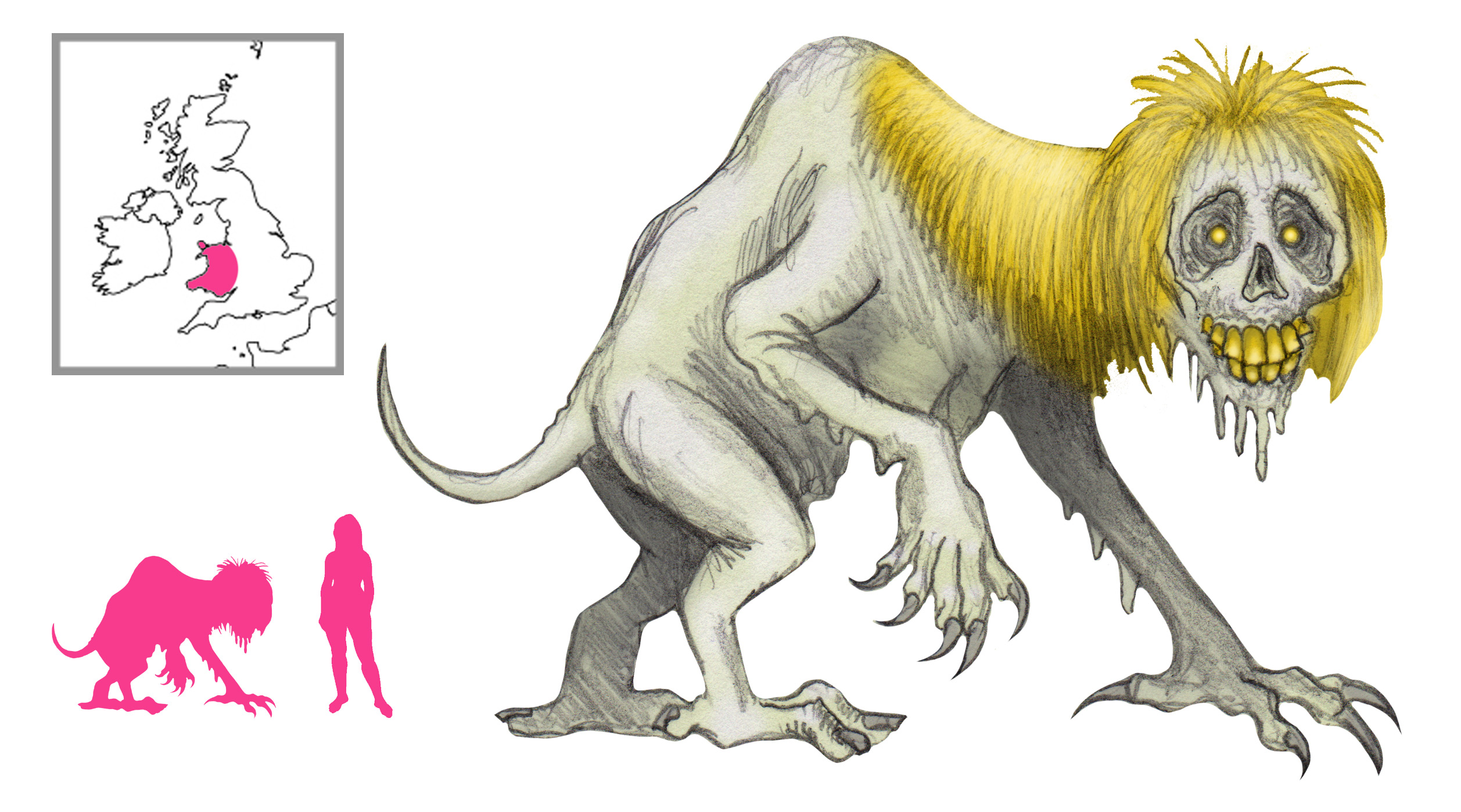
When the Fad Felen, the “Yellow Pestilence”, “Yellow Death”, or “Yellow Plague”, came to Wales in the 540s, it took the form of a column of watery cloud, one end on the ground and the other high in the air. Any living creature caught in the pestiferous pillar died or sickened to death. It was called the Yellow Pestilence because of the livid, bloodless complexion of those stricken by it. Those physicians who tried to cure the afflicted themselves took ill and died.

Taliesin the poet prophesied the death of Maelgwn Gwynedd, King of North Wales. “A strange creature will come from the marsh of Rhianedd”, he said, “to punish the crimes of Maelgwn Gwynedd; its hair, its teeth, and its eyes are yellow, and this will destroy Maelgwn Gwynedd”. This manifestation of the Fad Felen was perhaps a hideous hag with baleful eyes, in the same way as the ague is referred to as the wrach or hen wrach (the “hag” or “old hag” respectively). Other accounts speak of it as a basilisk; the poet Rhys Tenganwy mentions a scaly monster with claws and pestiferous breath.

Maelgwn Gwynedd saw the Fad Felen through the key-hole of Rhos Church, and died as a result – presumably a poetic way of saying that he died of plague in the church.

References

Llwyd, R. (1837) The Poetical Works of Richard Llwyd. Whittaker & Co., London.

Rees, W. J. (1840) The Liber Landavensis, Llyfr Teilo. The Welsh MSS Society, Llandovery.

Rhys, J. (1884) Celtic Britain. Society for Promoting Christian Knowledge, London.

Rhys, J. (1892) Lectures on the Origin and Growth of Religion. Williams and Norgate, London.

Sikes, W. (1880) British Goblins. Sampson Low, Marston, Searle, & Rivington, London.

Geluchart

Variations: Animal Monstrueux (Monstrous Animal) (Paré); Testudo Polypus (Gesner)

Geluchart

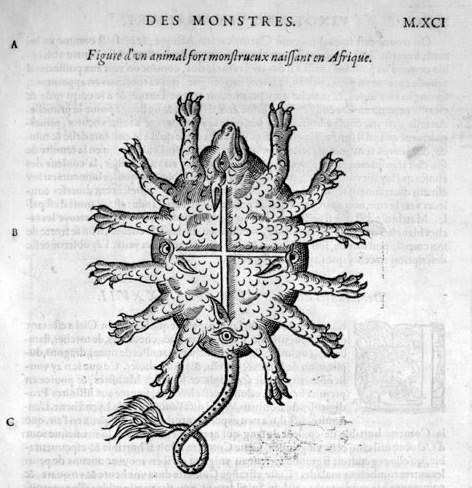
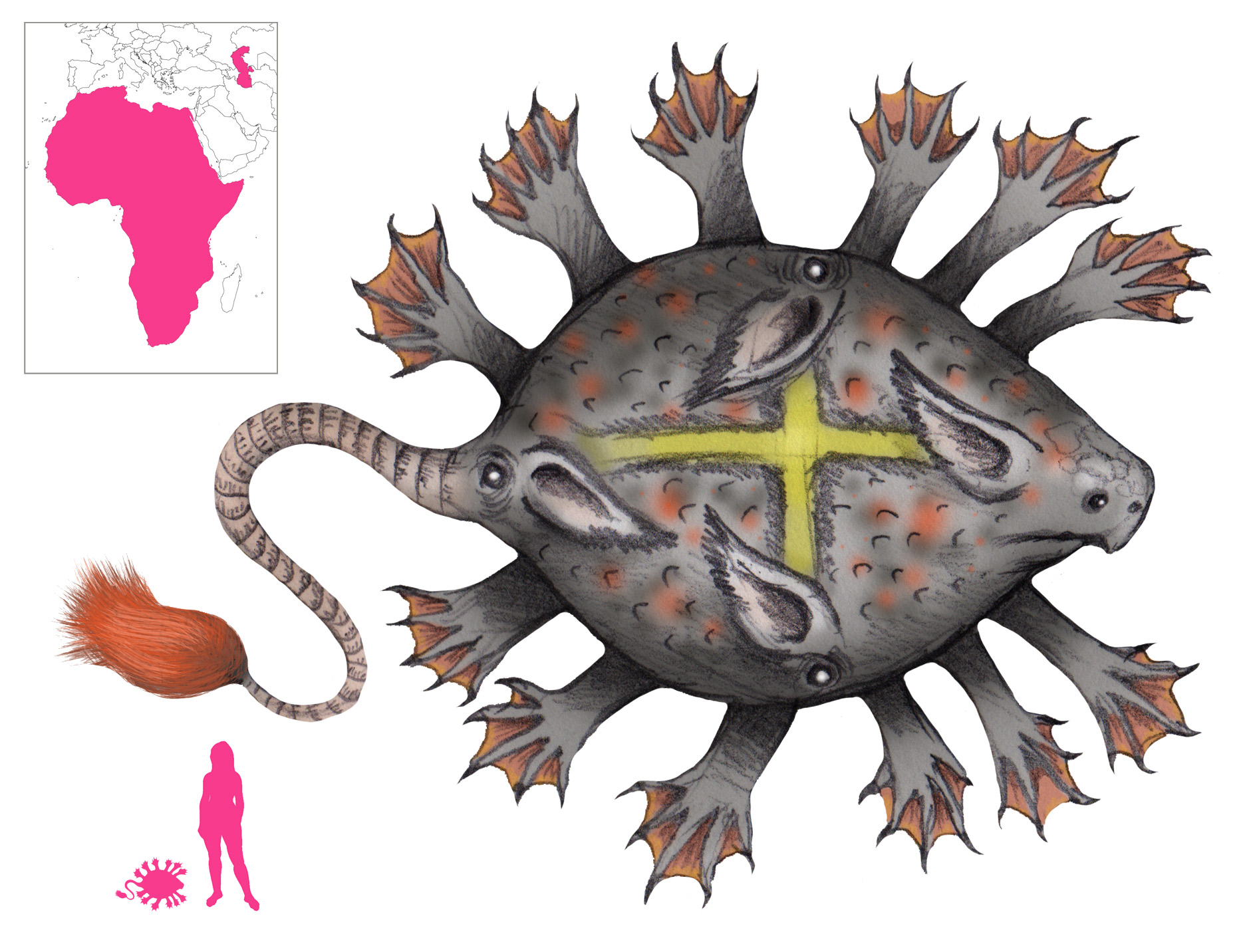
Iambulus the Greek sailor saw many marvels on the Islands of the Sun. One of those is an unnamed animal, small, round, and similar to a tortoise. It has two diagonal yellow stripes on its body, with an eye and a mouth at each end of the stripes, giving it four eyes and four mouths around its body. It eats with all four mouths, which all lead into a single gullet and stomach; its inner organs are likewise single. This creature also has many feet which allow it to move in any direction it wishes. Most miraculous of all is its blood, which is endowed with such healing power that it can instantly reattach severed body parts. As long as the cut is fresh and the body part is not vital (a hand, a foot, a limb, and so on), the animal’s blood will glue it back on again.

The adventures of Iambulus were recalled by Diodorus Siculus and cheerfully dismissed by Lucian as “obviously quite untrue” but a highly entertaining story nonetheless.

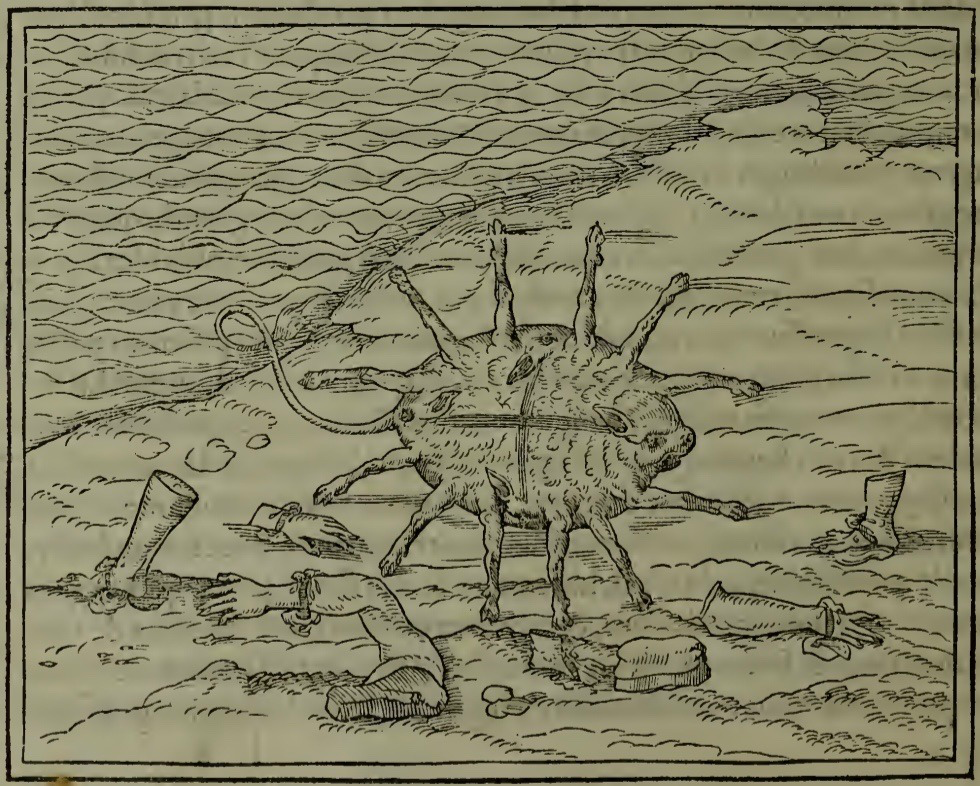
Temporal’s 1556 French translation of Leo Africanus’ works appends the travels of Iambulus and other seafaring yarns, lending them more credibility by association (or giving Leo’s accounts less credibility in the same manner). Translation errors have already set in, considering the adventures of Iambulus were translated into French by way of Tuscan. In Temporal’s version, the unnamed round animal now has two lines on its back in the form of a golden cross, and one eye and one ear at the end of each line, allowing it to hear and see in four directions. There is only one mouth through which the animal feeds. Its blood can cause any dismembered, still living body to come back together. The account is accompanied with a memorable image of the creature, with a long, thin tail ending in a tuft; the number of legs is fixed at twelve in the picture. Severed limbs surround the animal.

Is this the same as the Geluchart of the Caspian Sea? Thevet’s Cosmographie describes an animal called the geluchart, named after a nearby lake where it is also found in abundance. It has a head like a turtle’s (but much bigger), a small rat’s tail, and eight legs (four on each side). It is covered with scales and mottled with red and black spots. Thevet affirms that it is the tastiest fish in existence.

Thevet may have had the Iambulus creature in mind – specifically the illustration in the Temporal translation, as Thevet mentions the rat’s tail present in the image but not in the text. Either way, Vallot lumps them together, along with Gesner’s Testudo Polypus (“Many-legged Turtle”). For lack of a better term “geluchart” has been adopted as a title for this entry.

Paré’s unnamed “monstrous animal” is taken directly from Temporal’s Iambulus, with an image copied from that account. Paré erroneously credits Leo Africanus with describing the “very monstrous animal” but otherwise repeats the attributes given to it, including blood capable of sealing any wound. The description mentions several legs as well as establishing a “rather long” tail, “the end of which is heavily tufted with hair”. Its location is moved from Iambulus’ mythical island; it is now “born in Africa”.

Vallot attributes the ocellated pufferfish as the origin of this creature, but surely its origin in ancient Greek utopian fiction makes such association futile? Its wondrous properties cause Paré to wax poetic. “But who is it who would not marvel greatly on contemplating this beast, having so many eyes, ears, and feet, and each doing its office? Where can be the instruments dedicated to such operations? Truly, as for myself I lose my mind, and would not know what else to say, other than that Nature has played a trick to make the grandeur of its works be admired”.

References

Diodorus; Oldfather, C. H. trans. (1967) Diodorus of Sicily in Twelve Volumes, v. II. Harvard University Press, Cambridge.

Gessner, C. (1586) Historiae Animalium Liber II: Quadrupedibus Oviparis. Johannes Wecheli, Frankfurt.

Leo Africanus; Temporal, J. trans. (1556) De l’Afrique. Jean Temporal, Lyon.

Leo Africanus; Temporal, J. trans. (1830) De l’Afrique. Gouvernement de France, Paris.

Lucian; Turner, P. trans. (1961) Satirical Sketches. Penguin Books, London.

Paré, A. (1614) Les Oeuvres d’Ambroise Paré. Nicolas Buon, Paris.

Paré, A. (1996) Des Monstres et Prodiges. Fleuron, Paris.

Thevet, A. (1575) La Cosmographie Universelle. Guillaume Chaudiere, Paris.

Vallot, D. M. (1834) Mémoire sur le Limacon de la Mer Sarmatique. Mémoires de L’Académie des Sciences, Arts, et Belles-Lettres de Dijon, Partie des Sciences, Frantin, Dijon.

Songòmby

Variations: Songomby, Songaomby, Tsiombiomby, Tsongomby, Bibiaombe; Brech, Brek (probably); Habeby, Fotsiandre (probably); Mangarsahoc (probably); Tòkantòngotra, Tòkandìa. Tokatomboka (probably)

Songomby

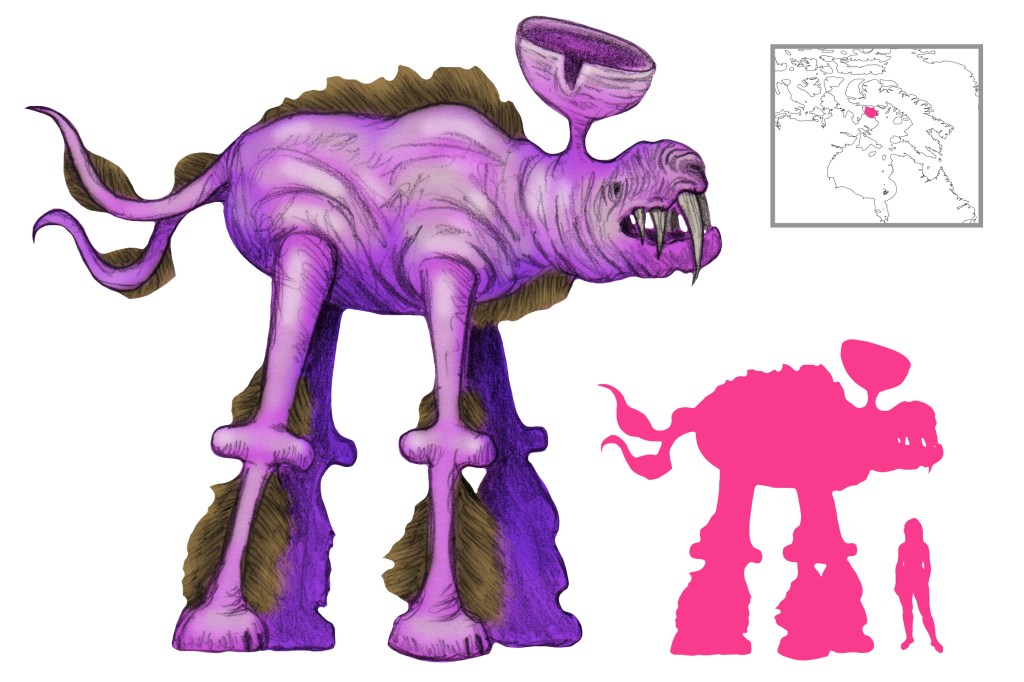
The Songòmby is an unusual carnivorous animal from the folklore of Madagascar. The name may be derived from sònga, “having the upper lip turned upwards”, and òmby, “ox” according to Sibree. The word songòmby is taken to mean “lion-hearted” or “courageous”. Another name, bibiaombe , means “ox-animal”. Molet offers two derivations for songòmby:  from the Swahili songo ngomby, “snake ox”, or a corruption of the alternative name tsiombiomby (“looks like an ox”). Domenichini-Ramiaramanana gives a popular etymology as derived from the question many ask when seeing it: Sangoa omby re izany? (“Isn’t that just an ox?”), and a more serious one from songo and omby where songo refers to virgin land allowed to go wild; in this case, the reference is to a feral ox.

Consistent across the descriptions is that the songòmby is the size of an ox or a horse, exceedingly fast, burdened with floppy ears, and a man-eater. It looks something like a horse, a mule, or an ox. It has flaring nostrils and terrible incisors. Its prominent ears dangle over its eyes and can distract it at crucial moments.

Gabriel Ferrand says it has the body of an ox and a hornless horse’s head. It lives in forests and eats plants, insects, and humans. Its speed is beyond compare – a distant songòmby can reach its prey immediately. If its human prey tries to escape by climbing a tree, it will wait at the base of the tree and try to bring the human down by ruse. If that fails it directs a jet of urine at its prey. The victim loses their grip, falls, and is devoured by the songòmby.

R. P. Callet says the songòmby looks like a donkey with spots. It eats grass but if it sees people it chases them. It comes out at night to graze. When climbing mountains they are fast as horses, but when they go down they move slowly because their ears flop over their eyes.

Domenichini-Ramiaramanana describes the songòmby as white in color, very fast, like both a horse and an ox, and with a single horn. It sprinkles itchy hair (lay) from its nostrils. If its prey tries to escape by climbing a tree, the itchiness brought on by the lay will make the victim try to scratch itself, falling out of the tree. Thus, if climbing a tree to avoid a songomby, one must be sure to tie oneself to the branches with lianas. The creature is patient though and will wait till morning at the foot of the tree.

In northern Madagascar the songòmby is like the donkey or the mouflon. It has tufts of hair at its feet. It may have backswept horns or no horns at all. Its hooves are so hard they strike sparks from the ground. Most unusually of all, “it is only seen in profile and looking behind it”. This final clue suggests to Molet that the songòmby evolved from the decorative ch’i-lin on Chinese plates, which is often depicted in profile and looking backwards. The people of Madagascar would have seen those on Chinese plates brought by Arab traders – a trade which was stopped by the Portuguese, leaving the origin of the songòmby to distant history.

To catch a songòmby, a child is tied up in front of the songòmby’s den while a net is put over the entrance. The child’s crying attracts the songòmby, which is snared in the net. Worse than that, children were punished by putting them outside and telling them the songòmby would eat them. But this was not without its risks. A child was once put outside, and the parents called out “Here’s your share, Mr. Songòmby!” As luck would have it, a songòmby was passing by. “Oh, he really is here!” cried the child, but the parents ignored him, replying “Let him eat you!” thinking the child was mistaken. After a while they opened the door to find their child was gone. They followed the trail of blood all the way to the entrance of the songòmby’s cave.

Fortunately the songòmby is not invincible. A man going out by night once met a songòmby, but as he was strong and brave, fought it all night without being hurt. The hero Imbahitrila once defeated a songòmby by arming himself with two magical eggs from the angavola bird. They answered his wish to overcome the songòmby by causing it to trip and fall. Once on the ground the songòmby was easily slain by Imbatrihila’s spear.

The Tòkantòngotra or Tòkandìa (“single-hoof”) is very similar to the songòmby. It is white in color, large (but smaller than the songòmby). Its feet are single hooves, like those of a horse (but not one foot in front and one in the back, as some authors have interpreted). Like the songòmby, it is very fast, travels by night, and is a man-eater.

Flacourt describes an animal called the Mangarsahoc. It is a large beast with a horse’s round hooves and long dangling ears. When it comes down from the mountains, the ears cover its eyes and impair its vision. It brays like a donkey – and, indeed, Flacourt decides that it must be some kind of wild donkey. A mountain 20 leagues from Fort Dauphin is named Mangarsahoc after the animal. Flacourt also mentions an animal called the Brech or Brek, about the size of a goat kid and with a single horn on its forehead. It is very wild in nature. Flacourt determines that “it must be a unicorn”. Both of those seem close enough to the songòmby to be worth mentioning.

The Habeby or Fotsiandre (“white sheep”) looks like a white sheep with long, dangling ears, staring eyes, and short wool. Reclusive and shy, it is not carnivorous, but the description once again recalls the songòmby.

When the horse was first brought to Madagascar, it was believed to be a songòmby (it was eventually saddled with the name soavaly, derived from the French cheval).

References

Domenichini-Ramiaramanana, B. (1983) Du ohabolana au hainteny: langue, littérature et politique à Madagascar. Karthala, Paris.

de Flacourt, E. (1661) Histoire de la Grande Isle Madagascar. Francois Clouzier, Paris.

Molet, L. (1974) Origine Chinoise Possible de Quelques Animaux Fantastiques de Madagascar. Journal de la Soc. des Africanistes, XLIV(2), pp. 123-138.

Sibree, J. (1896) Madagascar Before the Conquest. Macmillan, New York.

I have been requested (by someone who I hire to request) to explain how, exactly, something like “Leviathan” could end up misread and corrupted into “Kuyūtha” or even “Rakaboûna”. And I’m sure there are some people out there (presumably countable on one hand missing several fingers) who are interested in etymology, language, and how monsters evolve based on those.

Well, fear not, for here’s where it gets technical.

Arabic is tricky to read. Why? Well, for a start there’s different ways of writing it, different types, texts, font sizes (as it were). Look at this, for instance.

Nice and legible text, modern printing of al-Wardi. Easy peasy. Then you get older copies like this version of al-Qazwini.

Slightly less legible, but still readable. But then you get to this version of al-Damiri, and, well, you need to see the whole page to get the full impact.

Your eyes aren’t deceiving you. The text in the box is al-Damiri. The text in the margins is the Wonders of Creation by al-Qazwini. That’s right, two books for the price of one, all in lovely tiny crabbed handwriting!

And then of course there’s the lovely manuscripts with the flowery text which I can barely decipher.

Let’s put those aside for now and stick to more legible things.

The next issue is the language itself. There are few vowel letters in Arabic. Most vowel sounds are represented with diacritics.

And guess what? Most times they don’t even write the diacritics! So just based on that, Kuyutha, Kiyutha, Kayutha, Kuyuthan, Kayuthan, Kiyuthan are all equally valid based on the vowels assigned. The “an” at the end can be either a letter or a diacritic – if it’s a letter it’s definitely there, if it’s a diacritic it’s debatably there.

Not only that, but based on the quality of the writing, K and L can look identical, Y and B can look identical (hence Kuyuban), T and TH and N can look identical… So combine that with the average vowel movements (haw haw) and you can piece together how Leviathan could get garbled into Kuyūtha.

name 2

“But what about Rakaboûna?” I hear you say. “You even describe it as “hilarious but understandable” in your entry!”

Well, yes. Yes it is. This misreading is unique to Perron, and he attributes his translation to al-Damiri, which you may remember as being teeny-tiny-textual. I’ll admit I couldn’t figure out how he got “Rakaboûna” out of “Kuyūtha”, until I saw it in context and it all made sense. Here’s the actual part:

I’ve highlighted “and the name of the bull [is] Kuyūtha”. See how cramped the text is? Turns out Perron glued the last letter of “bull” (thawr), which is an R, to the name of the bull. Then he proceeded to read the Y as B and the TH as N, giving “Rakaboûna”. Here’s how the magic happened:

name 3

And there you have it. The poor cosmic bull got saddled with increasingly bizarre monikers, when in reality it should have just been called Behemoth, poor bovine.