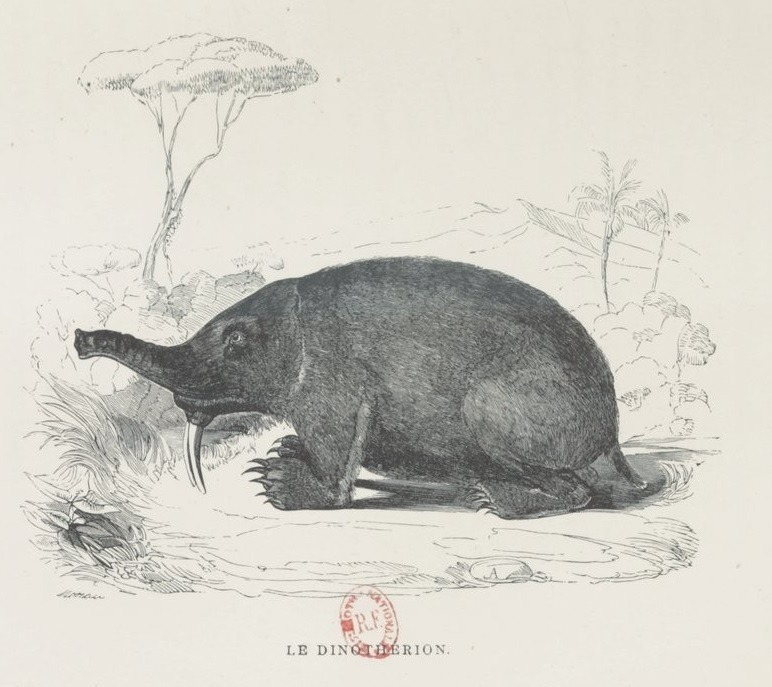
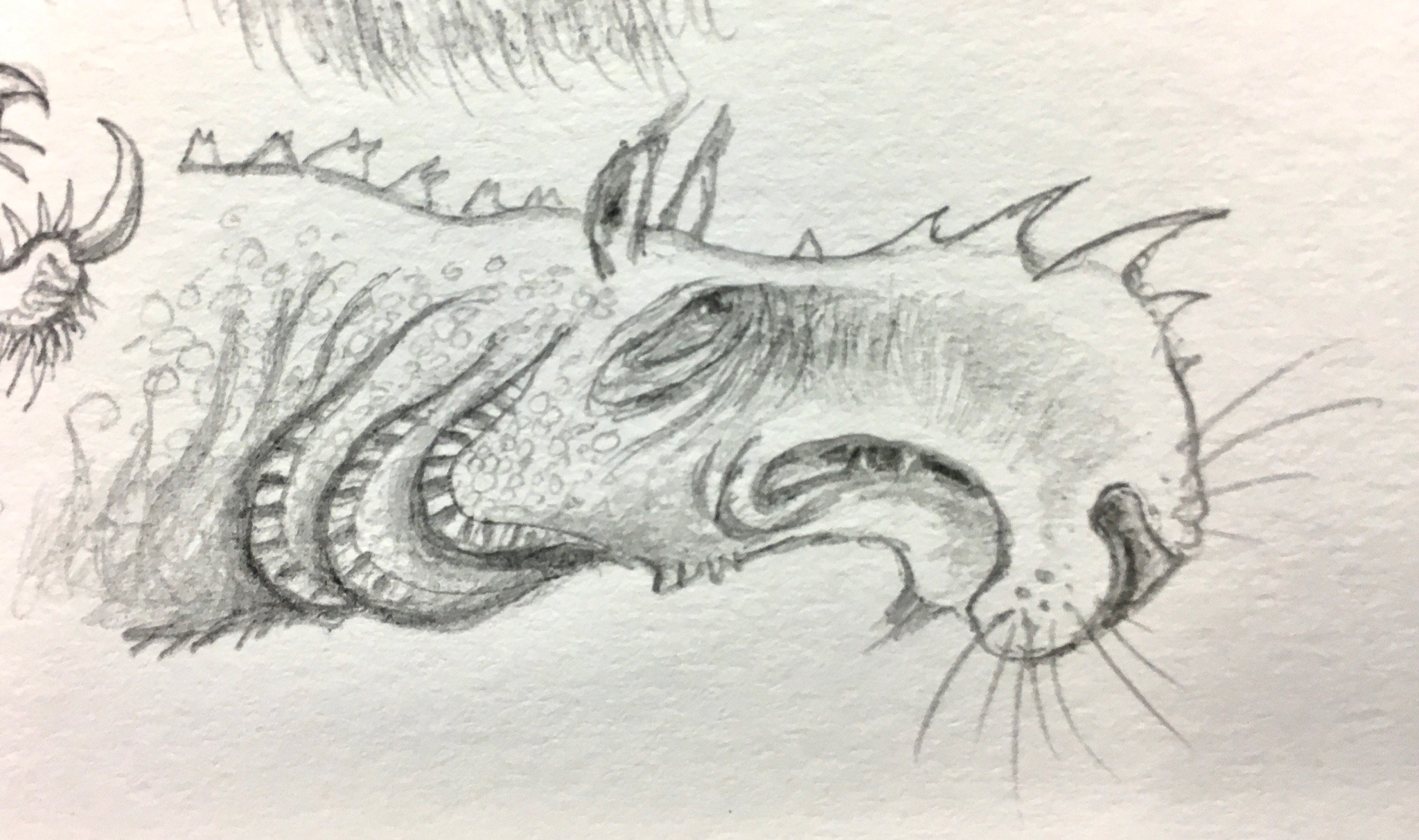
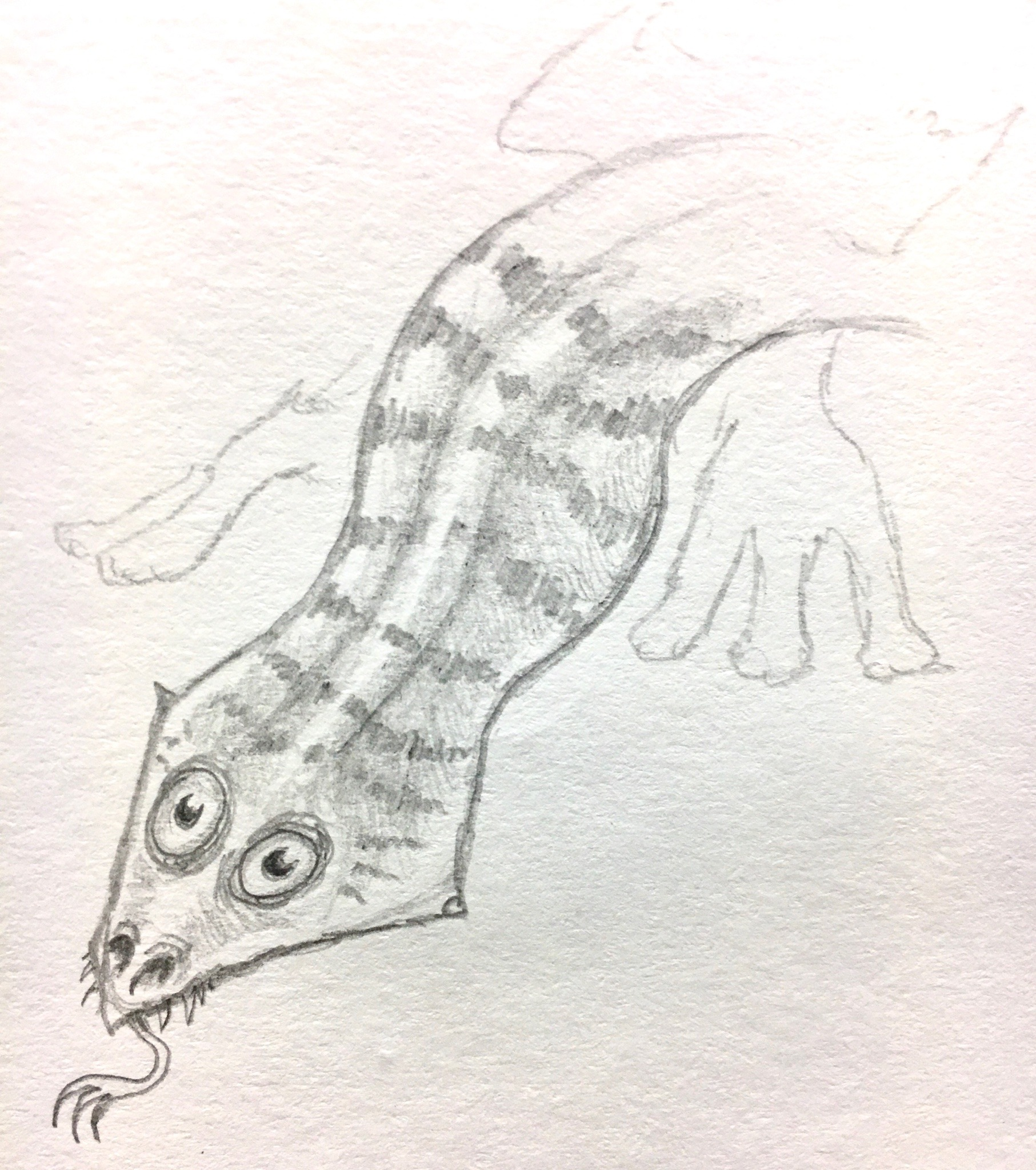
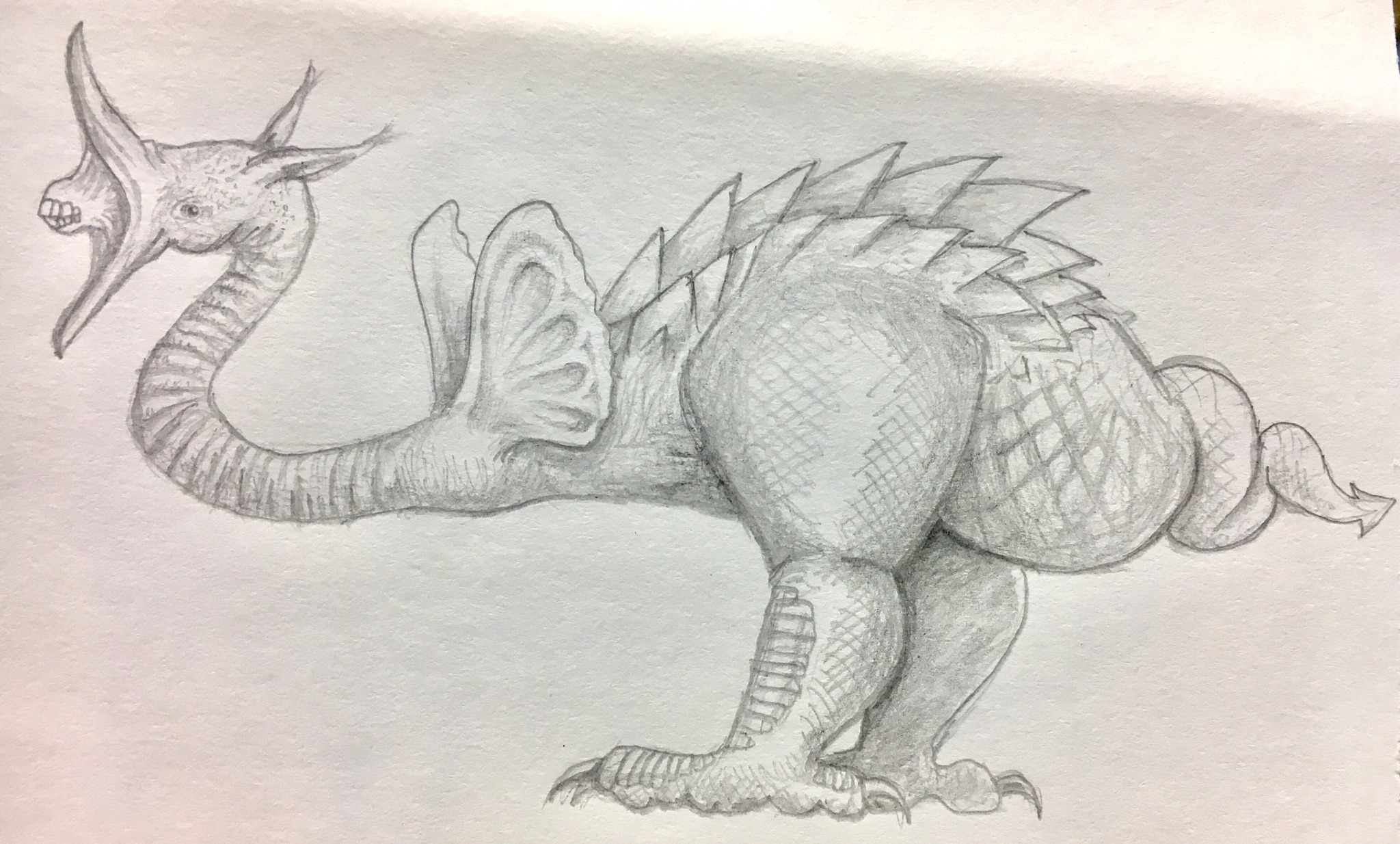
This translation of the Deinotherium segment of Paris avant les hommes (by Pierre Boitard, 1861) was requested by glarnboudin on tumblr. The book, which can be found online (e.g. here) presents what is probably the most idiosyncratic interpretation of Deinotherium. We know it now to be a primitive proboscidean, but the author reconstructs it as a giant mole!
The story itself is fun – the narrator is being shown around prehistory by a friendly devil.
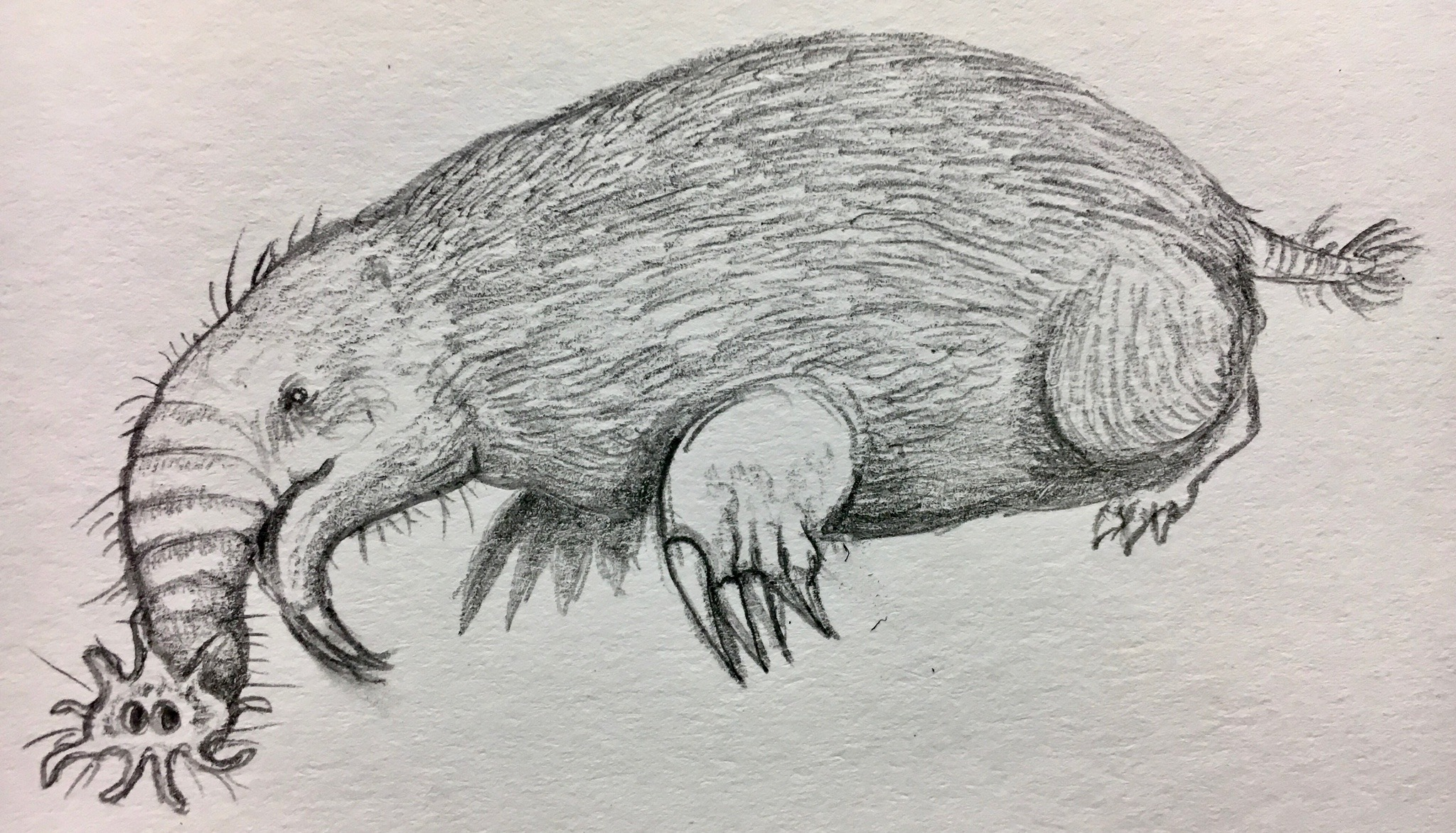
Art is from the original book (first image) and by myself (second image).
*****
“Since we are on the chapter of singular animals, I shall let you see another one from the quaternary epoch, whose history is no less strange. It shall serve as an introduction to antediluvian mammals, although it belongs, I believe, to the molasse which, according to Beudant, succeeded the Parisian chalk wherever it is missing. Look, there it is showing up; but it disappeared behind that hillock. Let’s see, let us sit beneath this tree and it might come back. In the meantime, let us chat”.
“Parbleu, I recognized it perfectly: it is the dinotherium giganteum. I had seen in the Rue Vivienne, its bones shown to the public for a bit of money, for scientists have to be industrious, one way or another, to avoid dying of hunger. Whatever the case, they showed me an enormous fossil head, 1.30 meters long and 1 meter wide, that is to say bigger than the biggest Indian elephants. It had two tusks located, against all analogy of what we know of animals alive or fossil, not in the upper jaw, but in the lower; not in the place of the canines, but in the place of the incisors; not pointing skyward, but lowered towards the ground; not sticking out of the mouth, but emerging from two holes that had to have been in the lower lip. Truly, I said to myself, this is enough to embarrass a wiser man than I, and, after many contradictory thoughts for half an hour, I finally took a side. Well, I said to myself, the die is cast: despite all my misgivings, one must have to make of this dinotherium giganteum a walrus or a seal, like Mr. Buckland said; or an elephant, as presumed Mr. de Blainville; a tapir or a pangolin, as G. Cuvier wrote; or a whale, as some German paleontologists think, and yet these animals have no analogy among them. Let’s see, let’s decide, I said to myself: this shall be…”
“A mole”, said the genie in a small, acerbic, and mocking voice, and accompanied these words with a long peal of laughter that disconcerted me.
“A mole! But good sir, a mole hasn’t the least connection, the least resemblance with a tapir, a whale, an elephant; and what would the authors I just cited say of this?”
“Your authors can say what they want; but I shall insist that the carcass that you had seen was that of a mole”.
“That’s impossible! See, here are the engravings they gave me at the door, judge for yourself”.
The devil put his walking stick between his legs, put his glasses on his nose, took my images with his thumb and the other fingers of his left hand; then, running the index finger of his right hand on the figure representing the animal’s head, he said:
“And first of all, my dear scholar, you will see that this head is 1 meter 60 centimeters at its greatest length, and 92 centimeters wide; so therefore it could not be less than 1.32 m long and 1 meter wide when it was covered with muscle and skin. But the average size of the head of a mammalian quadruped is at least a quarter of the length of its body. The dinotherium therefore was at least 5 to 6 meters long, which equals the size of the largest elephants. I am being conservative in choosing those dimensions; and I suppose that this carcass found on the banks of the Rhine by Professor Klipstein is not the biggest dinotherium the species provided, which is more than probable, since we have a few other fragments that are proportionally larger, and which suggest that the animal keeping us busy must have been longer than 6 meters”.
“And you conclude from there that it should have been a mole?”
“One moment! Notice the enormous cavity destined to receive the bones of the nose”.
“Yes, of the trunk”.
“Who said anything about a trunk? Where do you see a trunk?”
“Scientists…”
“Why do you want to see a trunk instead of a nose? Take the skeleton of a pig or that of a mole, you will find at the same place enormous muscle impressions. Would you then conclude that the pig or the mole has a trunk? So the dinotherium has a nose, but a long nose, mobile, thick, powerful, good for searching in the earth; in short, a mole’s nose. Do you deny that? Is it more unrealistic that an animal has a nose like any other animal’s, than to have an anomaly instead?”
“It is true that by coldly calculating probability, one must believe more easily in analogies than anomalies, this seems more logical; but a mole!”
“Notice, my dear, that the orbits or holes of the eyes are extremely small in comparison to those of all known animals, and that they do not close in the posterior part; and, in fact, why would the dinotherium have eyes proportionally larger than those of a mole since, having to live in the darkness of a subterranean home, these organs would have been no more use to it than to the mole. As animals who are forced to push soil in front of them and by digging with their head, the frontal bones are short, but strong and very thick; the face of the occiput, of great dimension, forms with them a 130-140 degree angle, which you only see in whales. The prodigious muscles that move this colossal head gave it crushing strength. The chrysochlore, or Cape golden mole (talpa asiatica, L.) alone can offer you some analogy with the dinotherium in this aspect. You conceive that an animal forced to fray itself an underground passage, three or four meters in diameter, will need that prodigious strength in the neck muscles, strength that can conly compare, as I said, with that of a whale. And despite that it must have often encountered obstacles, stones, tree roots, despite living in the soft and deep soils, and the earth that the rivers, such as the Rhine, and the great flows of water carry and accumulate with the centuries in the basins that they run through and inundate every year. It would have been stopped dead in its tracks if nature had not given it a pickaxe to tear out those obstacles. This pickaxe, there it is: these are the tusks emerging from the lower jaw and directed earthward. They resemble, my word, those forked hoes that vineyard-keepers use in rocky or freshly cleared earth. There, look, they must have had terrifying strength, if we can judge by the deep depressions carved in the temporal bones to lodge the muscles that moved and directed the lower jaw. Besides, these tusks or teeth offered, relative to their shape, and especially in the place that they occupy, an example of a structure unique in all creation”.
“As for its other teeth”, added the demon, pointing his finger at the figure depicting them, “you will see that they are five in number. The first is cutting at its anterior part, the third has three hills, and the other two; from that one must conclude that the animal lived on roots, rhizomes, and tubers that lived underground. But, I ask you, what good would a trunk be for it? It would have certainly been a hindrance, and that is all”.
“I concede that this head is very good for digging in the ground, but that does not prove that the animal lived underground”.
“Let us examine the other fragments”, said the genie. “The scapula is long, narrow, and looks entirely like that of a mole. Observation has proven that all animals who have it in this shape use their forelegs in constant, painstaking motions, requiring great muscular strength. Thus this form of scapula, rare in mammals, is very common in birds, because the latter need great wing strength to remain aloft.
Now on to the second phalange of the front foot. You will notice that the articular facet of this bone is completely different from that of other animals. As an indispensable result of this very superficial articulation, the dinotherion could not walk on the tips of its fingers, and it would have to drag itself on the exterior edges of the hand, like the mole. This last animal is still is still the only one that presents in this phalange an analogy of form with our fossil monster”.
But here is an even more conclusive fragment; it is the first phalange, or inguinal phalange of this same front foot. Look how it is deeply notched in its anterior part. This incision exists in mammals only in three kinds of animals, all three of which dig in the ground and live in burrows; it gives their claws the prodigious strength that they need. The pangolin, the chrysochloris or Cape mole, and the common mole are the only living animals that have the same conformation, and, remarkably in the mole, the character is less pronounced than in the dinotherion.
And so, my dear, what must we conclude of all this? It is that, as naturalists have sworn, the dinotherion has no analogy with any animals other than those I have cited and, having the head of a mole, the scapula of a mole, and the hands of a mole, must, it seems to me, resemble a mole more than a whale. It is true that the great anatomist Cuvier made of it a giant pangolin, but he hadn’t seen the head”.
“I admit, lord demon, that most analogies are in favor of your opinion, and yet, here are teeth that…”
“That look nothing like a mole’s, I agree, because the jaws of the dinotherion lack incisors and canines, but they are no less suited for grinding roots and even mollusks and insects that it could find in its excavations. Besides, my dear, this anomaly, if it is one, has many examples in living animals. For example, if you ever go to New Holland, you will find a large family of marsupial mammals whose species have so many analogies that it is difficult to separate one from the group it forms, and who differ as much as possible by their dental system. Among these heterogeneously-toothed species, the opossum (the only genus not from Australia) represents insectivorous carnivores, like tenrecs and moles; the rat-kangaroo has teeth adapted for a frugivorous diet, like the hedgehog; the giant kangaroo lives on vegetation, lacks the upper canines that characterize the preceding and only has canines that are transverse to its jaws, which bring it closer to our herbivorous pachyderms; finally, the wombat is, like the hare, a veritable rodent by the teeth and by the intestines. And yet no naturalist has tried to separate these marsupials to put them in the great divisions where their teeth would have rigorously classified them. I intend therefore to make of the dinotherion, if it is not a mole, at least a related genus that I would place with the desmans, the moles, the chrysochlores and the tenrecs, all subterranean animals like it. And besides, if you aren’t content, you can place it elsewhere, but in this case you would have to, according to your principles, create not a genus, a family, or even an order, but a separate class that it would occupy by itself, and this necessity would be the bloodiest critique that you could make of the so-called natural method of your scientists”.
Despite the high opinion I had of my irascible demon’s merit, he had so filled my head with pangolins, seals, tapirs, whales, and elephants, that I could not in any way accept his mole, and a small smile of vanity and disapprobation came over my lips. He noticed, and cried out!
“Ah! Ah! Mister Incredulous! Have I not employed to convince you the same analogic arguments that your sagest paleontology professors use every day; but it will take more than reason to convince you, from what I see. Well then, morbleu! I will convince you with your own eyes or I shall lose my devilry”. He pounced upon me and seized me by the arm, which took away my desire to laugh; he threw me behind him astride his crutch, like a witch heading to the Sabbath on a broomstick, and together we flew into the air, we took off like a crossbow bolt. The speed of our voyage dizzied me so, that I cannot positively say how much time we took to make our way, nor where we passed to find ourselves on the borders of the Rhine, but what is certain is that we were traveling faster than on a train or on a steamboat.
When I came to, I was laid out on a bed of moss shaded by a tree at least thirty to thirty-five meters tall. I asked the genie which country we were in.
“We are”, he told me, “in this country that will be named, in a few thousand years, the Rhenish province of the grand duchy of Hesse-Darmstadt. This great lake that you see there in the East will dry out, and on of the most beautiful rivers of Europe, the Rhine, will cross its ancient bed in its entire length. The place where we are now will be the burg of Eppelsheim and further the city of Alzéi. If you remember the first voyages we made during the other periods, you will notice how much the vegetation has changed, and you will recognize the tree under which we are as a walnut tree quite similar to the common walnut tree, but with more angular nuts that end in a sharp point”.
Suddenly a low but horrible roar made me shiver to the very bone. I looked around in fear, but saw nothing. This horrible cry resonated in my ears a second time and I felt the earth shake under my feet. The idea of underground noises that you hear before an earthquake or rather before mountain upheaval, following Élie de Beaumont, or the sinking of a province according to Beudant, brought terror to my heart, and I thought for a moment that I would be lifted up at the top of a new chain of Alps raising from the depths of the Earth, or sinking into the central fire of the globe in a collapse. I got up quickly and started to run as fast as I was able. But I hadn’t made two hundred paces before my demon grabbed me by my arm, sat me down on a fragment of rock, and, with his finger, indicated the place under the tree where I had been where the most extraordinary scene unfolded.
The earth shook convulsively, and its movement was communicated by the shaking foliage of the walnut tree, which shook and balanced in the air as if a whirlwind had gone into its thousand branches. The tree bent over and straightened several times, then finally, it fell over with a crash, and the earth rose in a great cone seven meters high, opening up at the top of this singular molehill.
“Parbleu”, I told the genie, “I could swear you’re showing me the formation of the new Pyrenees in miniature”.
“In miniature!” he answered, “by my word, that’s quite the miniature! There, there it comes out of its hole”.
Indeed, I saw, coming out of the hole that had opened at the top of the cone like a volcanic crater, a monstrous head three times bigger than a barrel, then an even thicker neck; then a massive body, about three meters in diameter, that is to say as big as the biggest elephant; and finally, a strange animal, five to six meters long, with a terrifying appearance, and dragging itself clumsily on four very short, very thick legs. Its whole body was covered in long, silky hairs, green and shifting in hue from copper to bronze, offering, like the Cape chrysochlore, beautiful metallic reflections. Its very large nose, about sixty centimeters long, ended in a sort of mobile snout, bristling all over with sharp and keratinous tubercles, suitable for opening up the inside of the earth. Under this nose was an enormous lower jaw, prolonged anteriorly in a long chin pointing downwards. At the end of this chin, two tusks almost touching at the base, more than two feet long, emerged through the skin of the lip and directed their points perpendicularly earthwards, yet with a light curvature towards the forelegs. I saw that this monster was using them to help it crawl, by stretching its head out, sinking them into the soil, and pulling its body forward. Its eyes were so small that you would not have seen them through the long hairs surrounding them, if they did not gleam with a dark and red fire like two sparks. Its ears were very small and the concha was barely apparent. Its hindlegs were rather short and armed with very strong claws, but its forelegs ended in two enormous hands absolutely similar to those of a mole, and they were used to push the earth to the right or left as it used its nose to dig an underground tunnel.
The formidable animal descended from atop the monticule it had created; with a lot of agility, it crawled a few meters, then made a cry so sharp, so noisy, so extraordinary that I cannot compare it to anything that human ears have ever heard. The demon saw me shudder and reassured me, telling me that it was calling another animal of its species, and it would move away from us if it heard a response. It continued to make a sharp cry from time to time, moving to the edge of a great forest covering the flanks of a hill, and where I saw a few monticules similar to its own. Meanwhile, I observed a few of those animals a bit smaller in size, and I pointed them out to the genie.
“You are not mistaken”, he told me, “for the paleontologists know in fact, under the name dinotherium bavaricum, another species of this kind, but a bit smaller. What is most unusual in the history of these two dinotherions is that the scientist, G. Cuvier, took the bones of the great dinotherion to be those of a giant tapir, equal in size to the greatest Indian elephant”.
References
Boitard, P. (1861). Paris avant les hommes. Passard.


._Okapi.jpg)