[A version of this post was posted on tumblr on September 30, 2025. It has been modified slightly.]

On Marvellous Things Heard, a collection of anecdotes ascribed to Aristotle, reports an unusual event involving metal-eating mice.

25. In Cyprus they say that mice eat iron. 26. And they say that the Chalybes, in one of the islands lying above them, collect gold from many of these creatures. For this reason apparently they cut up the mice which they catch in mines. (Aristotle, 1955, p. 249)

What are we to make of this? There seems to be two separate events here, both connected by the idea of rodents eating metal. Let’s take a bit of a dive into these metallophagic murines.

Now, if you subscribe to the theory that giant gold-digging ants were in fact marmots who dug gold up and brought it to the surface (Peissel, 1984), then the second one may be another expression of rodents as gold-diggers. Emphasis on the may. Without further evidence, this is no better than deducing that dinosaur fossils inspired griffins and dragons. It may just as easily represent a miner’s superstition that mice in mines might have possibly eaten some of their precious metal (Zucker, 2024).

But what about the Cypriot mice who eat iron? While both observations are about metal-eating mice, they seem to be otherwise unrelated.

The origin of the story of metal-eating mice, and a bunch of other swarming animals, appears to be a lost work by Theophrastus (Zucker, 2024). The story is repeated by Aelian (5.12)

In the island of Gyarus Aristotle says that there are Rats and that they actually eat iron ore. And Amyntas says that the Rats of Teredon (this is in Babylonia) adopt the same food. (Aelian, 1959, p. 307)

and by Pliny (8.43 and 8.82)

M. Varro informs us… that the inhabitants of Gyarus, one of the Cyclades, were driven away by mice… (Pliny, 1855, p. 295)

We are informed by Theophrastus, that after the mice had driven the inhabitants of Gyara from their island, they even gnawed the iron; which they also do, by a kind of natural instinct, in the iron forges among the Chalybes. (Pliny, 1855, p. 350)

The anecdote of metal-eating mice as a historical event is also told by Antigonus, Heracleides, and Livy (Papademetriou, 1970).

First of all… where are they exactly? Cyprus and Gyaros are two very different islands. It appears likely that the Cyprus reading is a corruption in the existing manuscripts of the Marvelous Things Heard, where Γυάρῳ was misread as Κύπρῳ (Giacomelli, 2023). Indeed, a more recent translation of the Marvelous Things Heard gives this.

25 · It is said that in the island of Gyaros the mice eat iron. (Aristotle, 1984, p. 2783)

The distinction is important, because this is what Gyaros looks like.
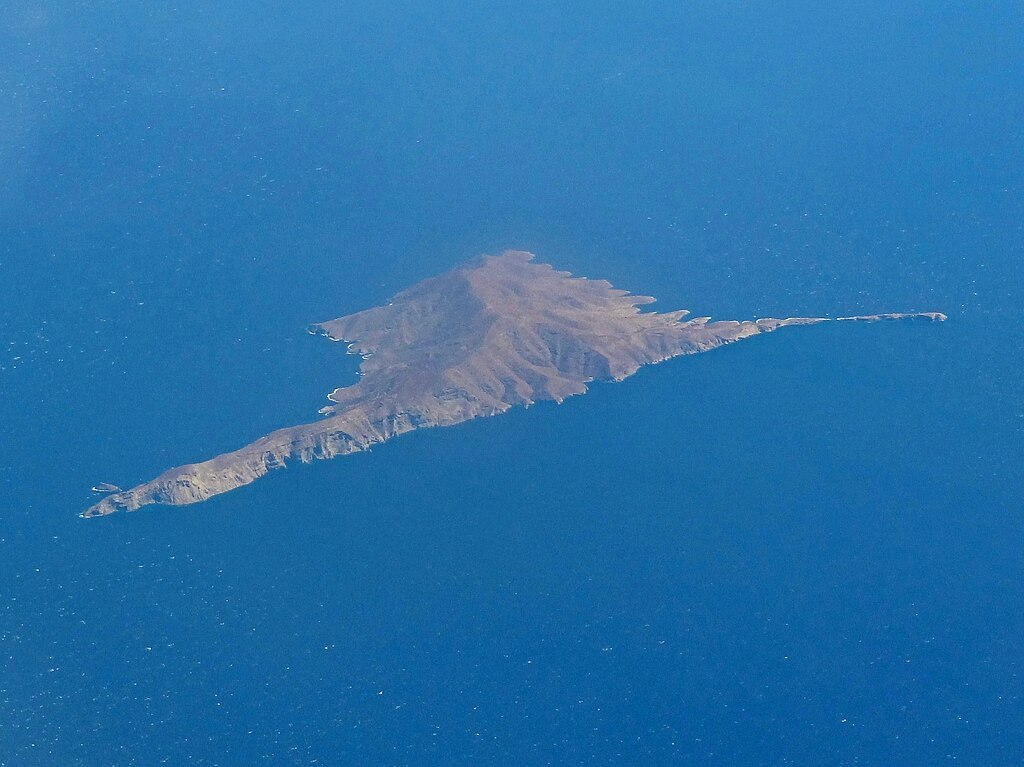
It’s a barren, desert island in the Aegean, about 23 sq km in area, a far cry from populous Cyprus.

So… at face value, it would seem that this started out as a tale about how an island got overrun by mice who ate everything, which evolved into “mice eat iron on this island”.

I say seem because I’m just making up explanations after the fact, given what’s available. No better than using dinosaur fossils to explain belief in dragons.

… but wait, there’s more. You didn’t think there was more?

“Where mice eat iron” exists on its own as an expression. It was used, for instance, by Herodas.

But you’re a bad boy, Kottalos, so bad that none could find a good word for you even were he selling you, not even in the land where mice throughout eat iron. (Herodas, 1922, p. 115)

In other words, “you’re so worthless that, even in the places where they’re desperate, nobody would want you”. “Mice eating iron” here suggests hardship and scarcity. Perhaps the mice ate everything on the island and, having exhausted all available food, had nothing left to gnaw but iron?

However! It has been suggested that “where mice throughout eat iron” is a misreading, and it would be more correct as “where mice eat iron just as slag [i.e. metallurgical waste]”. The sense of the sentence would be the same (a place with low standards) but it would imply that “mice eating iron” is to be taken as something that happens quite often (Stamoulakis, 2023). In fact, mice chewing on metal didn’t just happen on Gyaros. It was seen as a portent of war at Lanuvium when the mice gnawed on metal shields, since they would soon be reduced to famine as a result of the war (Marcovich, 1977).

Which adds another dimension to metal-eating mice: that of something extraordinary happening. A place where mice eat iron is a place where the unexpected happens, for better or worse (Papademetriou, 1970).

On the other hand, Seneca uses the expression to describe Hades. Here, Hercules addresses Claudius in the ever-delightfully-named Apocolocyntosis (Pumpkinification :3):

Listen to me and stop talking nonsense. You have come to a place where the mice gnaw iron [ubi mures ferrum rodunt]. Tell me the truth, quick, or I’ll knock the silliness out of you. (Seneca, 1902, p. 140)

Here, it reflects how tough and strenuous life is in Hades, although another commentator has suggested that it is a metaphor for a mouse getting caught in a trap (Ball, 1902). Perhaps it’s saying that this is a miraculous place where the impossible happens (Papademetriou, 1970). Or maybe it’s just trying to say that even the mice in Hades are so tough that they chew on metal (Marcovich, 1977).

Making them the equivalent of this guy, really.

But the most likely reason is to indicate scarcity and to criticize Claudius’ lavish lifestyle, which Seneca disapproved of. Like in the example of Lanuvium mentioned previously, the mice in the afterlife are starving, and soon Claudius will too – a terrible fate for the gluttonous emperor (Marcovich, 1977).

Finally, metal-eating mice (as a symbol for scarcity or marvelousness) eventually evolved into the modern Greek proverb “the fly is eating metal” (Papademetriou, 1970).

Ultimately, we need to ask the big question implied by all of this.

Can mice eat iron?

They could.

Iron is a 4 on the Mohs hardness scale. Mouse teeth are 5.5. Metal generally keeps mice away, but perhaps a sufficiently determined mouse – a starving one perhaps – could leave some gnaw marks on iron (Zucker, 2024).

So… perhaps there is some truth to it after all.

References

Aelian, Scholfield, A. F. trans. (1959). On the Characteristics of Animals, vol. I. Harvard University Press.

Aristotle, Hett, W. S. ed. (1955). Aristotle: Minor works. William Heinemann Ltd.

Aristotle, Barnes, J. ed. (1984). The complete works of Aristotle: The revised Oxford translation (one-volume digital edition). Princeton University Press.

Giacomelli, C. (2023). Suspicious toponyms in the De mirabilibus auscultationibus: Textual problems,“ forgeries,” and methodological issues. In Historiography and Mythography in the Aristotelian Mirabilia (pp. 234-257). Routledge.

Herodas, Headlam, W., & Knox, A. D. eds. (1922). The Mimes and Fragments. Cambridge University Press.

Marcovich, M. (1977). UBI MURES FERRUM RODUNT (Seneca,“ Apocolocyntosis” 7.1). Rheinisches Museum für Philologie, 120(H. 1), 85-89.

Papademetriou, J. T. (1970). The Mutations of an Ancient Greek Proverb. Revue des Études Grecques, 94-105.

Peissel, M. (1984). The Ants’ Gold. Harvill Press.

Pliny, Bostock, J. & Riley, H. T. eds. (1855). The natural history of Pliny, vol. II. Henry G. Bohn.

Seneca, Ball, A. P. trans. (1902). The satire of Seneca on the apotheosis of Claudius. Columbia University Press.

Stamoulakis, I. P. (2023). A Critical and Interpretative Proposal on Herodas 3, 75–76. Arctos–Acta Philologica Fennica, 57, 217-228.

Zucker, A. (2024). De mirabilibus auscultationibus 23–28 and Theophrastus’ Lost On Animals That Appear in Swarms 1. In The Aristotelian Mirabilia and Early Peripatetic Natural Science (pp. 86-111). Routledge.

Snawfus

The Snawfus is an albino deer from the folklore of the Ozarks in Arkansas and Missouri. It has supernatural powers but is not dangerous. Some say it can jump into the treetops with ease, while others grant it feathery wings that along with to fly without making a sound, much like an owl. Some accounts give it flowering boughs for antlers.

Leila A. Wade of Republic, Missouri, extensively studied the snawfus, and reported that it gave off spirals of blue smoke. The blue smoke emitted by the snawfus drifted off and cloaked the Ozark hills in a magical blue haze, which can still be seen in autumn.

References

Randolph, V. (1950) Fabulous Monsters in the Ozarks. The Arkansas Historical Quarterly, 9(2), pp. 65-75.

Rayburn, O. E. (1960) Some Fabulous Monsters and Other Folk Beliefs from the Ozarks. Midwest Folklore, 10(1), pp. 27-32.

Witkəś

Mammoth thanks to Schnellegeister Hexenwolf for sharing Mansi Mythology with me and making this entry possible!

Variations: Witkəś-ōkja (male), Witkəś-ēkwa (female); Witkul’, Witkul’-ōkja (male), Witkul’-ēkwa (female)

The Witkəś is a creature from the mythology of the Mansi people of Russia. It is one of the few mythical creatures unquestionably derived from paleontological evidence – in this case, from the remains of woolly mammoths. Witkul’ is a synonym, apparently related to locality – witkul’ are found in lakes, and witkəś in rivers.

The name of the witkəś or witkul’ is derived from wit, “water”. A witkəś lives in the depths of the water, as evidenced by the location of mammoth tusks and bones on riverbanks. The tusks were believed to be antlers, shed by the witkəś much like reindeer and elk do. Since there are witkəś bones in evidence, the witkəś themselves are believed to be mortal creatures that avoid contact with humans. Their shapes are undefined, with some traditions anthropomorphizing them, dividing them into male witkəś-ōkja and female witkəś-ēkwa. They have been known to invite guests underwater to drink tea.

Along the Sos’va River it was believed that old bears and elks would gorge themselves on earth, then sink into the water to become water spirits. In lakes they would become witkul’, while in rivers they became witkəś.

The witkəś and witkul’ are tireless diggers, excavating holes and river channels to direct the course of the water. A witkul’-ēkwa was believed to have dug out the Lyapin River, and a witkul’-ōkja made the big lakes of the Sos’va River. On the other hand, the witkəś on the Tavda River would pull horses into the water, and its appearance was an omen of impending death.

Nobody fishes in lakes where witkul’ live. Even birds fly around them. Any living creature that comes near may be pulled in. A witkəś can be found in every whirlpool in a river, and they enjoy drowning anyone who enters their domain. One way to scare off or kill a witkəś is to fill a boat with salt, pitch, and gunpowder, and set up a scarecrow decoy for good measure before setting the boat on fire and pushing it out to the whirlpool to be swallowed. The witkəś will be fatally maimed by the explosive boat, and when its dying groans are heard, that is when it is safe to return to the water.

Around Berezovo it was traditional to sacrifice a reindeer to the witkəś at the time the ice began to drift, tossing the skin, bones, and blood of the animal into the whirlpool. Elsewhere items such as copper cauldrons would be tossed into whirlpools as offerings to the witkəś. Once an old man stole a silk handkerchief with silver coins that was meant for the witkəś. His boat was immobilized, and a witkəś over ten meters long appeared, accusing the man of theft. The kerchief was thrown into the water, and the boat began moving again immediately.

References

Napolskikh, V., Hoppál, M., and Siikala, A. (2008) Mansi Mythology. Akadémiai Kiadó, Budapest.

Questing Beast

Variations: Beste Glapissante; Beste Glatissant, Bête Glatissante, Glatisant Beast; Beste Diverse, Bête Diverse, Diverse Beste, Diverse Beast; Besta Ladrador, Besta Desasemelhada (Portuguese, from the Demanda); Barking Beast, Yelping Beast

The Questing Beast is a creature of many names, sizes, and appearances. Several features, however, are consistent throughout its appearances in Arthurian legend. First, it very noisy, its offspring within its belly baying and yelping constantly. It is also always a portentous creature, but what it symbolizes has varied from author to author. Finally, it is commonly pursued or hunted, whether by knights or by its own offspring within its belly, and often ends up giving birth in the process.

Although “Questing Beast” has been popularized in the English-speaking world by Malory’s Le Morte d’Arthur, the creature is more commonly known as the Beste Glatissant or Beste Glapissant (in modern French, Bête Glatissante or Bête Glapissante). Glatir or glapir refers to the sound coming from the creature’s belly, a yelping or baying sound like those of hounds chasing prey. This is also the definition of “questing”; a more accurate modern name would be the Yelping Beast or Barking Beast.

The concept of noisy animals in their mother’s womb precedes the Questing Beast. William of Malmesbury describes a dream that was had by King Eadgar. In it, the king sees a pregnant hunting dog lying at his feet. She was silent, but the pups in her womb were barking loudly. This was interpreted as meaning that after King Eadgar’s death, miscreants within his kingdom would bark against the church of God. In the Slavic Twelve Dreams of Sehachi, the titular character dreams of a foal neighing within a mare’s belly, and whelps barking in a dog’s belly; these are interpreted as mothers acting immodestly with their daughters and children rejecting the advice of their parents, respectively.

Another contributor to the genesis of the Questing Beast is the supernatural boar hunt. The most famous examples of those are the boar Twrch Trwyth and the sow Henwen. The latter is even more closely connected to the Questing Beast; like the Beast, Henwen (“Ancient White”) is white in color, and dangerously fecund. Her offspring were to be harmful to Britain, so she was hunted across the country, giving birth along the way to various young. Finally, Henwen disappeared into the sea at Penryn Awstin, similar to the stricken Questing Beast diving into a lake.

The oldest iterations of the Questing Beast have it encountered by Perceval over the course of his search for the Grail. In the Perlesvaus, Perceval finds a beautiful glade, with a red cross at the center of it. A knight dressed in white is seated at the far end of the glade, with a fair young damsel next to him. Soon a snow-white, emerald-eyed creature, between a fox and a hare in size, enters the glade. The whelps in its womb are barking like hounds, and it is terrified and agitated because of that. Perceval tries to take the small Beast onto his horse, but he is cautioned by the knight, who tells him the Beast has a destiny to fulfill. The Beast runs to the cross, where its twelve young are brought forth. They immediately tear their mother to pieces, but can only devour her head. Upon doing so, they go mad and scatter into the forest. King Pelles later explains the significance of the creature to Perceval: it represents Jesus Christ, and the twelve hounds that killed it and scattered are the twelve tribes of Israel.

Gerbert de Montreuil’s continuation of Perceval borrows from the Perlesvaus. We are not given a description of the Beast, but are instead told that it is grant a merveille (“marvelously large”). The Beast’s young are barking and yelping from within its belly, and when it comes up to the cross in the glade, they emerge violently, breaking it in two pieces. The young then devour their mother before going mad, turning on and killing each other. This bloody episode has a far more mundane meaning – Perceval is told that the loud, murderous whelps are the people who disturb church services by talking loudly and complaining about hunger!

In the Estoire du Saint Graal, there is a Beste Diverse (“Diverse Beast”) found beside a cross. No mention is made of its yelping, but it is white as snow, and has the head and neck of an ewe, the legs of a dog, black thighs, the body of a fox, and the tail of a lion. In the prose Merlin, the Diverse Beste or Beste Diverse sounds like 30 or 40 baying hounds and is moult grant (“very big”). Perceval is destined to hunt it.

In the prose Tristan, the Beste Glatissant has the legs of a stag, the thighs and tail of a lion, the body of a leopard, and the head of a snake; its yelping is equal to that of a hundred hunting hounds. The addition of snake, leopard, and lion elements grant it unsavory connotations; the combination of lion and leopard is reminiscent of the Beast of the Apocalypse, and a snake or dragon is always inauspicious.

No longer a creature of purity torn apart by its own offspring, the Questing Beast is now an evil, wretched being spawned from violence. Its mother was the daughter of King Ypomenes, who lusted for her brother. When she could not have him, she instead turned to a devil, who slept with her and convinced her to accuse her brother of attempting to rape her. He was duly sentenced to be torn apart by dogs. As he died, the brother proclaimed that his sister would give birth to a monster, one from whose belly the barking of dogs would forever remind others of his shameful death. As predicted, the daughter gave birth to the Questing Beast, and she was executed for her crimes.

The Saracen knight Palamides had particular reason to hate the Questing Beast, as its horrid shriek had killed eleven of his twelve brothers. In the Portuguese Demanda, the Questing Beast is finally slain during the last years of the Grail quest, when Palamides strikes it and it runs into a lake that immediately starts to boil. The lake has since then become known as the Lake of the Beast.

Malory’s Le Morte d’Arthur, the foremost mention of the Questing Beast in English literature, follows the prose Tristan in its description. The Questing Beast is said to have a head like a serpent’s, a body like a leopard’s, buttocks like a lion’s, and feet like a hart. Its belly made a noise like thirty couple hounds barking. King Arthur first sees the Questing Beast after an illicit tryst with the wife of King Lot of Orkney. Arthur had stopped to rest by a well when the Questing Beast, making a horrid din, came up to drink from it. As it drank, the noise coming from its belly was quelled, but it started up against as soon as the creature had finished and ran off. Arthur then encountered Sir Pellinore, who hunted the Questing Beast. After Pellinore’s death, the task of hunting the Questing Beast was passed on to Sir Palamides.

Merlin later revealed to Arthur the significance of the Questing Beast. The king had seen the beast because he, too, had just done something unforgivable. The wife of King Lot was in fact his sister on his mother’s side, and the child of this adulterous and incestuous union – Mordred – was destined to destroy Arthur’s kingdom.

References

Evans, S. (1903) The High History of the Holy Graal. J. M. Dent & Co., London.

Gaster, M. (1900) The Twelve Dreams of Sehachi. Journal of the Royal Asiatic Society, pp. 623-635.

Löseth, E. (1891) Le Roman en Prose de Tristan, analyse critique. Emile Bouillon, Paris.

Malory, T. (1956) Le Morte d’Arthur, v. I. J. M. Dent & Sons Ltd., London.

Malory, T. (1956) Le Morte d’Arthur, v. II. J. M. Dent & Sons Ltd., London.

Nitze, W. A. (1902) The Old French Grail Romance Perlesvaus, A Study of its Principal Sources. John Murphy Company, Baltimore.

Nitze, W. A. (1936) The Beste Glatissant in Arthurian Romance. Zeitschrift für Romanische Philologie, 56, pp. 409-418.

Paris, G. and Ulrich, J. (1886) Merlin: Roman en Prose du XIIIe Siècle, t. I. Librairie de Firmin Didot et Cie., Paris.

Pickford, C. E. (1959) L’evolution du Roman Arthurien en Prose vers la Fin du Moyen Age. A. G. Nizet, Paris.

Williams, M. (1925) Gerbert de Montreuil: La Continuation de Perceval, t. II. Librairie Ancienne Honoré Champion, Paris.

Wakmangganchi Aragondi

Variations: Wakmabitchi Warak Wakkimbi (“Primordial Head of the Strong-Teethed Swine Family”)

Wakmangganchi Aragondi was the greatest and most terrifying monster in the folklore of the Garo people of India. This primordial demon once lay waste to the Garo Hills before it was slain by the god Goera.

Long before Goera’s birth, his maternal uncles descended into the subterranean region along with the fisherman Gonga Tritpa Rakshanpa and his dog. From there they took the progenitor of all the world’s birds back to the surface. The three uncles also brought with them a little pig, which they named Wakmabitchi Warak Wakkimbi.

The tiny piglet was kept in sty made of rocks, and there it grew and grew, until the sty had to be torn down to set it free. By then the pig was so big it could no longer be controlled; it wandered at will, feeding wherever and whenever it liked. People continued to feed it from a safe distance, until the day when it knocked the three uncles into its feeding trough and ate them alive. From then on, nobody dared approach it, and it continued to grow and increased in power. From then on it became known as Wakmangganchi Aragondi.

The mere mention of Wakmangganchi Aragondi was enough to strike fear into the bravest warrior – and with good reason. The colossal boar was the biggest and mightiest creature in the world, as tall as a mountain. When standing up, Wakmangganchi Aragondi’s snout touched the Dura Hill, while its tail lay in the Songdu River. It had seven heads emerging from its neck, each head with seven tusks like double-edged scimitars, and each head with a single piercing eye in its forehead glowing like the full moon. On Wakmangganchi Aragondi’s back grew seven clumps of bamboo, seven plots of thatch grass, and seven stalks of bulrushes. Seven perennial streams flowed down its back. The microcosm on Wakmangganchi Aragondi’s back was home to a pair of langurs and their offspring, and seven pairs of moles.

Wakmangganchi Aragondi roamed where it pleased, ate anyone it encountered, and destroyed crops at will. It had a particular fondness for gourds, melons, pumpkins, and yams. Nobody could stop it.

Such was the monster that Goera faced. When the hero-god was born, two more of his uncles went to the market to buy a goat, but they were intercepted and devoured by Wakmangganchi Aragondi. Thus Goera, upon coming of age, decided to destroy this plague that terrified his people.

To fight Wakmangganchi Aragondi, Goera sought the aid of the giant crab Songduni Angkorong Sagalni Damohong. He used it to threaten his grandmother into telling him all she knew about Wakmangganchi Aragondi. He then befriended various supernatural beings, including the progenitors of Steel and Dolomite. From Dygkyl Khongshyl, the smith-god, he obtained a magical two-edged milam sword and a magical bow and arrows that could shatter trees and cure disease. He allied with Tengte Kacha, king of the Elfs, and Maal the dwarf god – both barely two cubits tall, but possessed of great magical powers.

Now fully armed, Goera set out to find Wakmangganchi Aragondi. He found the gigantic boar wallowing in mud, asleep, at Ahnima Gruram Chinima Rangsitram. Goera sent his servant Toajeng Abiljeng to strike the boar from behind and awaken it.

Wakmangganchi Aragondi awoke in fury, and charged Goera. But the hero-god stood his ground and fired a hail of burning darts at it. That was too much for the monster, and Wakmangganchi Aragondi ran for the first time. It galloped east, with Goera in pursuit firing volleys of arrows that lacerated its body. Then Wakmangganchi Aragondi turned north, then back, making wild sallies across the region, making the whole world rumble and quake.

Maddened beyond reason by pain and rage, Wakmangganchi Aragondi tried at last to turn on its tormentor, but Goera avoided its charges by creating piles of rock to climb and hide on. Finally, one of Goera’s maternal uncles in the subterranean region shot an arrow through Wakmangganchi Aragondi’s armpit. The monster staggered and finally collapsed at Ahguara Rongpakmare Shohlyng Janthihol. There Goera decapitated it with a triumphant cry.

The battle had taken seven summers and seven winters. When Wakmangganchi Aragondi was cut open, Goera’s two uncles were found inside, alive but blinded. They recovered their eyesight with time. The meat of Wakmangganchi Aragondi was divided among the people of the area, with the rest left to decompose.

The rock piles created during the battle can still be seen. They are known as Goerani Ronggat, the “Stone Piles of Goera”. Wakmangganchi Aragondi’s droppings are rocks in which seeds can still be seen, and red areas of land are where the monster-boar’s blood was spilled.

References

Bhairav, J. F. and Khanna, R. (2020) Ghosts, Monsters, and Demons of India. Blaft Publications, Chennai.

Rongmuthu, D. S. (1960) The Folk-tales of the Garos. University of Gauhati Department of Publication, Guwahati.

Nykur

Variations: Nykur Hestur (Nykur Horse), Nickur; Nennir, Ninnir (Ninny); Flóðhestur (Hippopotamus); Kumbur (Clump); Skolli (Devil); Vatnaskratti (Water Fiend)

The Nykur or Nennir is the water-horse of Iceland. It is found across the island in association with pools, lakes, ponds, rivers, and the sea, and accounts of its misdeeds date as far back as the Book of Settlements. Its name follows the naming tradition of water-creatures across northern Europe, including the Baltic Nixa, the Germanic Nixy, and the Netherlandish Nikker. Suggested etymologies for this naming group include Nick (as in Old Nick, the devil), an Indo-Germanic root meaning “black” or “dark” (compare Latin niger, for instance), or nihhus, an Old High German word for crocodile.

A nykur is a horse, usually grey in color, with reversed hooves. Coat variations include dapple grey and black, but pink, white, yellow, and grey with a dark streak on the back have been reported. Red cheeks are possible, as is a blaze that gives the impression of a single eye. The mane may be of a different color. The neck is short. The hooves are uncloven, and the tufts on the pasterns also point backwards. It will not allow anyone to inspect its hooves. A nykur can change shape at will, although shapeshifting is not a major part of its myth. It has been said to also appear as a wild, unmilkable cow with reversed hooves, or as a giant salmon or other fish. In the Elenarljóð ballad, the nykur takes on the form of a handsome young man to woo the heroine in hopes of drowning her. More monstrous appearances include twelve-legged forms, or massive, stout beasts with dragging bellies, protruding heads, and skin hanging in heavy folds.

Nykurs are malicious and cruel creatures. They present themselves as tame, friendly horses, but anyone who mounts them will find themselves sticking to the nykur’s back, as if held fast by glue. The nykur then gallops wildly off into the sea, plunging its rider into the water and drowning them. Nykurs will also break the ice on lakes to drown people ice-fishing. The booming sound of breaking ice is said to be the neighing of the nykur.

Nykurs beget foals with normal mares, but only if they are in the water. Horses descended from nykurs will lie down and roll over whenever ridden or led through water as high as their bellies.

As long as there is no water within sight, it is safe to ride a nykur. If a nykur is detected in the vicinity of a body of water, it should be scared off to prevent potential disaster. Nykurs hate fire, and keeping a fire burning nearby for a whole day will make it move elsewhere. They also avoid holy water.

With the right approach, a nykur can be caught, tamed, and forced to work. There is a swelling under a nykur’s left shoulder. If the swelling is punctured, the nykur becomes safe to ride, and loses its harmful nature, but the lump may return with time.

Nykurs hate to hear their name. If they hear the word nykur or nennir – or indeed, any word similar to it – they buck and shy and gallop away into the water. They also dread hearing the names of God and the Devil, and the sound of church bells; making the sign of the cross also repels them. A shepherd girl who prepared to mount a nykur exclaimed “Eg nenni ekki á bak!” (“I don’t feel like getting on its back!” Hearing the word nenni, the nennir galloped away and vanished into a lake. In another tale, a group of children mounted a nykur, but the oldest and wisest child held back, saying “I don’t feel like getting on its back”. The nykur ran off with its riders and drowned them, leaving the eldest to tell the sad tale. The heroine of the Elenarljóð ballad has a similar stroke of homophonic luck.

Butter-lake Heath, in the east of Iceland, got its name from a nykur-related incident. A servant girl left a farm to sell butter in the village of Vopnafjörthur. Along the way she grew tired, and was grateful to find a tame grey horse standing unattended. She mounted the horse and continued along her way, but the moment the horse saw the nearest lake, it dashed into it, drowning the girl. Thus the lake earned the name of Butter Lake, and the surrounding heath became Butter-lake Heath.

The nykur of Svarfathardale, near to the northern town of Akureyri, was known to live in deep pools by the river. The inhabitants of the village chased it off by building fires around the pools and throwing burning coals into the river all day. The nykur was scared off, and there have been no drownings since.

In Grimsey it was said that a nykur lived in the sea and neighed every time the islanders returned to the mainland for a cow. The neigh of the nykur drove the cows mad, causing them to jump into the sea and drown. It wasn’t until the mid-19th century that the people of Grimsey dared keep cows on the island.

There are places all over Iceland named for the nykur, from Nykurborg to Nykurvatn.

References

Árnason, J.; Powell, G. E. J. and Magnússon, E. trans. (1864) Icelandic Legends. Richard Bentley, London.

Benwell, G. and Waugh, A. (1961) Sea Enchantress: The Tale of the Mermaid and her Kin. Hutchinson, London.

van Hageland, A. (1973) La Mer Magique. Marabout, Paris.

Hlidberg, J. B. and Aegisson, S.; McQueen, F. J. M. and Kjartansson, R., trans. (2011) Meeting with Monsters. JPV utgafa, Reykjavik.

Rose, C. (2000) Giants, Monsters, and Dragons. W. W. Norton and Co., New York.

Simpson, J. (1972) Icelandic Folktales and Legends. University of California Press, Berkeley and Los Angeles.

Stefánsson, V. (1906) Icelandic Beast and Bird Lore. The Journal of American Folklore, vol. 19, no. 75, pp. 300-308.

Wolpertinger

Variations: Oibadrischl (Germany), Rasselbock (Thuringia), Dilldapp

The Wolpertinger is a taxidermist’s chimera native to Bavaria, known since the 16th century. It has fangs, wings, and deer’s antlers on the body of a hare. Variants across Germany include the oibadrischl, the Thuringian rasselbock, and the dilldapp, all of which may have different combinations of antlers and/or fangs.

The wolpertinger and its many variations may have some biological truth to them. Rabbits and hares infected with papillomavirus develop strange tumors on their bodies. When they grow on the head and face, interpreting those tumors as horns or fangs is not difficult.

References

Panafieu, J. and Renversade, C. (2014) Créatures fantastiques Deyrolle. Plume De Carotte, Toulouse.

Zimmer, C. (2011) A Planet of Viruses. University of Chicago Press.

Lili

Variations: Li-wildcat, Powercat

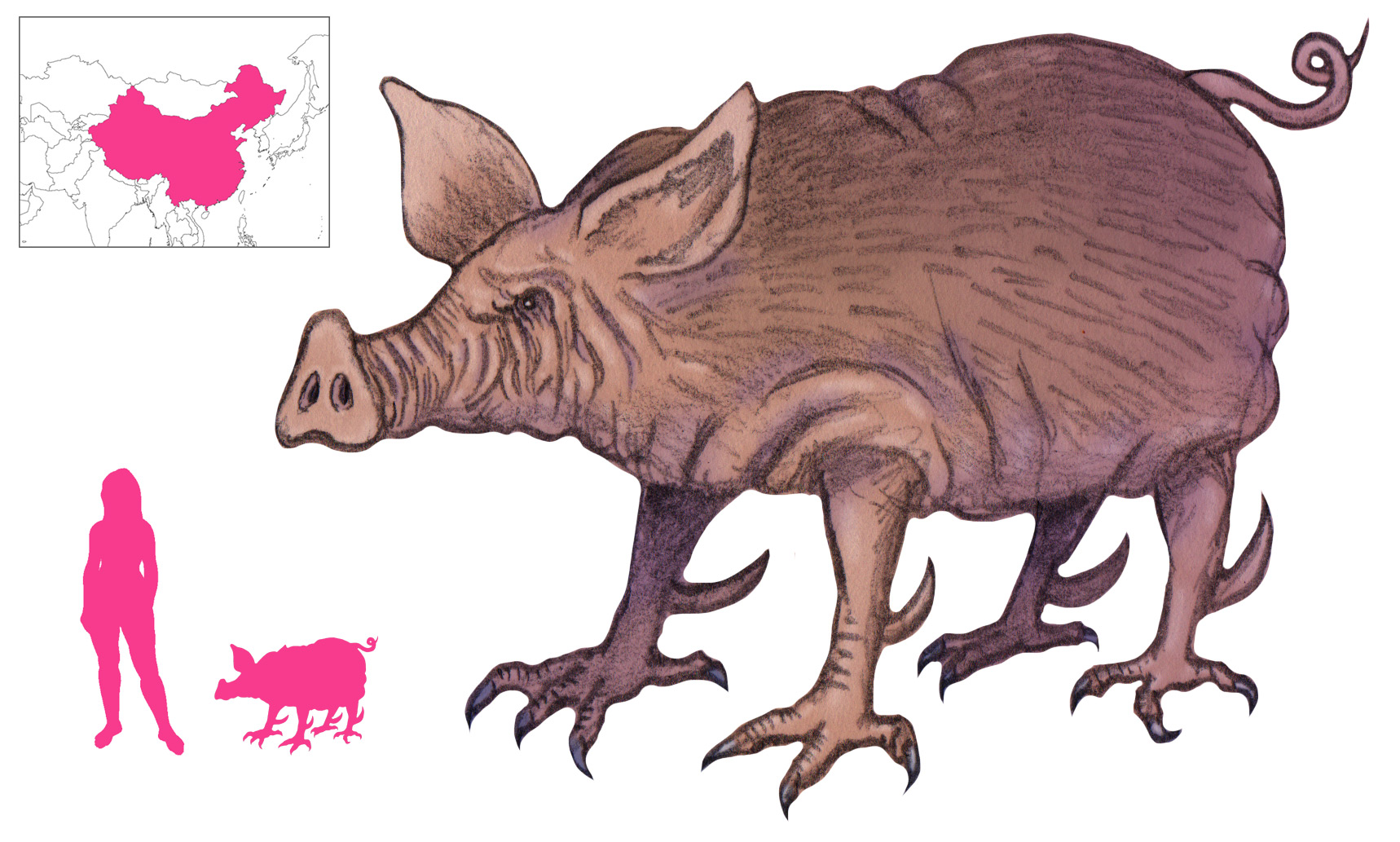
The Lili or Powercat can be found around Willow Mountain in China. It barks like a dog and looks like a pig with spurs on its feet. Its appearance foretells considerable earthwork construction in the district.

References

Mathieu, R. (1983) Étude sur la mythologie et l’ethnologie de la Chine ancienne. Collège de France, Paris.

Strassberg, R. E. (2002) A Chinese Bestiary: Strange Creatures from the Guideways Through Mountains and Seas. University of California Press.

Treesqueak

Variations: Arborexusta stridens (Tryon), Tree-squeak

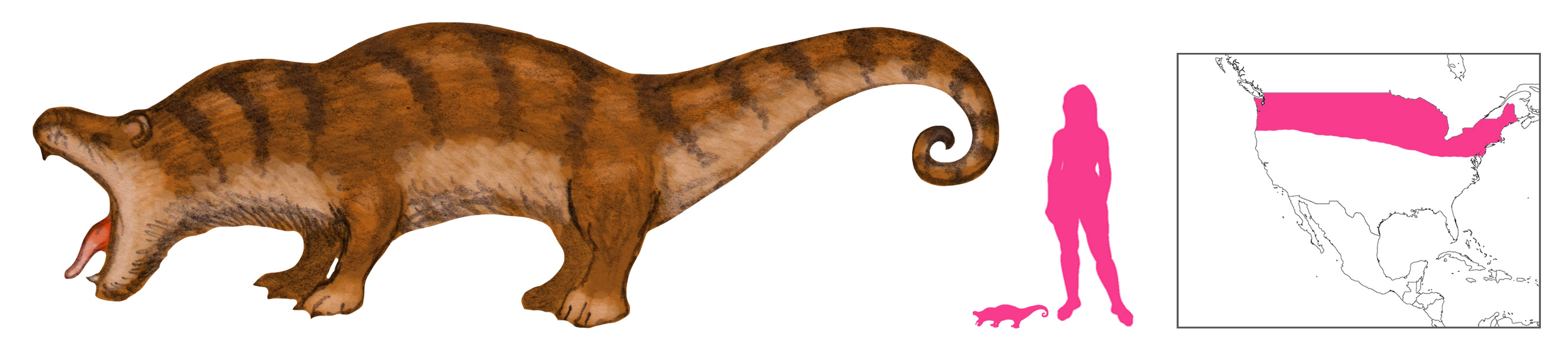
Treesqueaks make a whole variety of sounds, including vocalizations that evoke the wind in the trees, a cougar’s whine, a piglet’s squeal, and firecrackers at a wedding. These critters of the northern woods are small, prehensile-bodied, and can change color to match the tree they’re on. They look like weasels and are about as friendly as weasels.

Unexplained noises are always the work of a treesqueak.

References

Tryon, H. H. (1939) Fearsome Critters. The Idlewild Press, Cornwall, NY.

Billdad

Variations: Saltipiscator falcorostratus (Cox)

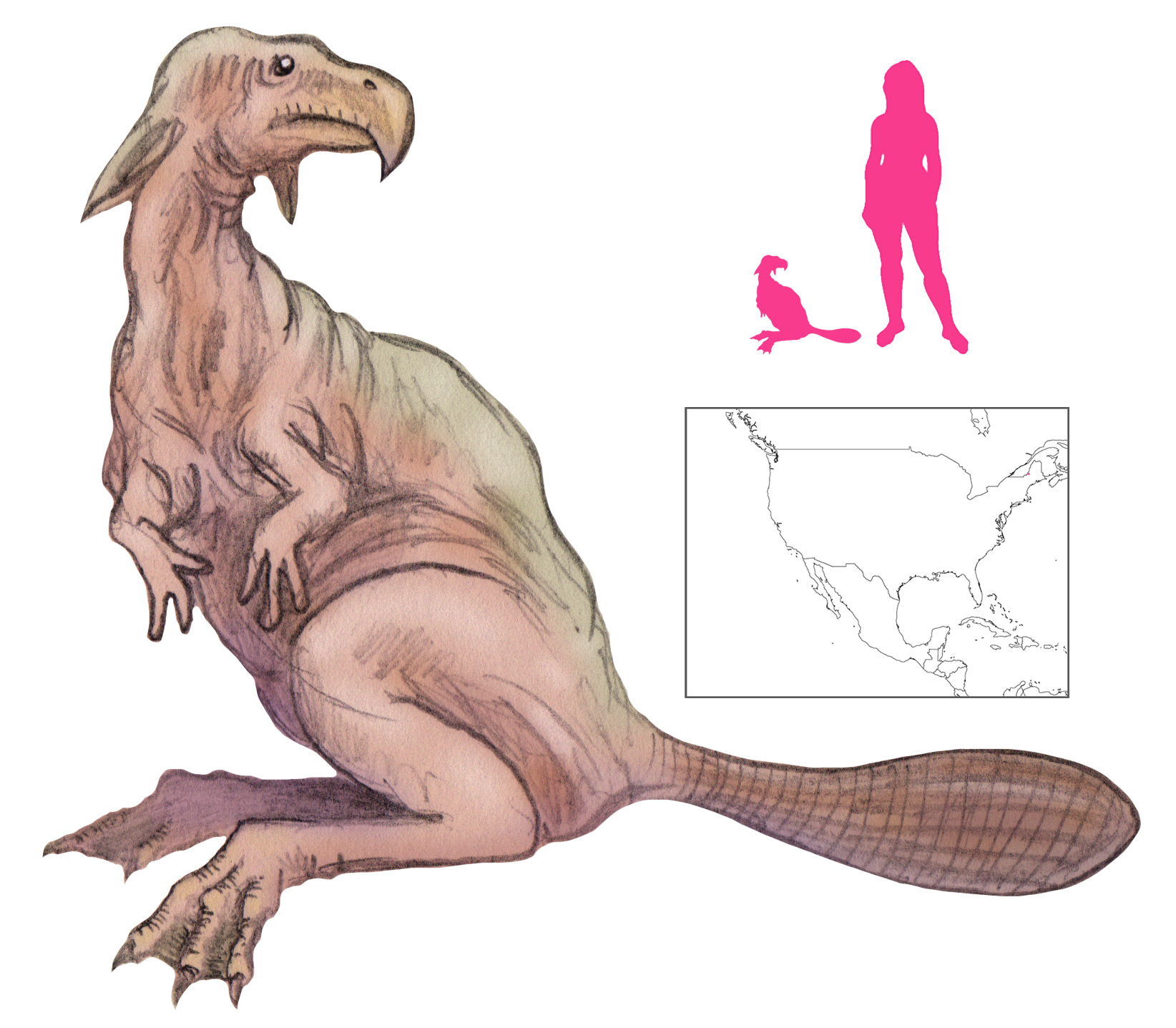
Boundary Pond in Maine, near the Canadian border, is the only spot where Billdads live. These creatures are beaver-sized with long kangaroo-like back legs and short forelegs. The paws are webbed and the beak is strong and hawk-like. The powerful tail is large and flattened, like a beaver’s.

The first hint that a billdad is about is a distinct sound, like a paddle hitting the water. This is caused by the billdad’s method of fishing, which consists of jumping above a surfacing fish and smacking it hard with its flat tail. Adult males can cover over sixty yards in a single leap. The stunned fish can then be collected and eaten at leisure.

The retiring billdads are usually heard and not seen. They are left alone by lumberjacks – and with good reason. The only man known to have eaten billdad meat, the late Bill Murphy, suffered odd symptoms after tasting it. He ran screaming out of the mess hall and leaped over the lake just like a billdad. Alas, he could not swim like one.

Billdad has been off the menu since.

References

Cox, W. T. (1910) Fearsome Creatures of the Lumberwoods with a Few Desert and Mountain Beasts. Judd and Detweiler, Washington D. C.