A-mi’-kuk

Variations: Ă-mi’-kuk, Ä-mi’-kuk

A-mi-kuk

Kayakers in the cold seas of the Arctic Circle are the A-mi’-kuk’s favorite prey. The last thing they see are the a-mi’-kuk’s prehensile tentacles exploding from under the surface and wrapping around them, dragging both kayaker and boat under.

The a-mi’-kuk is large, leathery-skinned, and slimy. Its four long tentacular arms are used for seizing prey and swimming rapidly through the water. There is no escaping it – it will follow prey taking refuge on ice by swimming below it and bursting out onto the surface. Making for land is equally futile, as the a-mi’-kuk can swim through the earth with as much ease as it does through water.

A-mi’-kuks around St. Michael, Alaska, are known to migrate underground to inland lakes. The presence of one is a good sign for the lake. When an a-mi’-kuk leaves its lake, the channel it digs drains it dry, but when it returns the sea returns with it.

Nelson proposed the octopus as the origin of the a-mi’-kuk. He also gives ä-mi’-kuk as the name of the sea otter; what bearing this has on the legendary creature is unknown.

References

Nelson, E. W. (1887) Report upon Natural History Collections Made in Alaska Between the Years 1877 and 1881. Arctic Series of Publications Issued in Connection with the Signal Service, Government Printing Office, Washington.

Nelson, E. W. (1900) The Eskimo about Bering Strait. Extract from the Eighteenth Annual Report of the Bureau of American Ethnology, Government Printing Office, Washington.

Shādawār

Variations: Shadhahvar, Shadhahwar, Shādhahvār, Shad-hawar, Shād-hawār, Shad-havar, Shadhawar, Shadahvar, Shadahwar, Shadawar, Sadahvar, Sadahwar, Sadhavvar, Sadhazar, Sadhazag, Sadhuzag, Aras, ‘rs, ‘rsh
Shad-hawar

The earliest references to the musical-horned unicorn are given by Jabir Ibn Hayyan, around 900 A.D., where it is referred to as the Aras. It was given its most popular incarnation as the Shādawār by Al-Qazwini, which was subsequently copied with modifications by Al-Damiri and Al-Mustawfi. It was found in the farthest reaches of Bilad al-Rum, the Byzantine Empire, a vague location which to Al-Qazwini must have sounded remote.

Exactly how the shādawār’s name should be written and pronounced is unclear. Its writing has varied from author to author and manuscript to manuscript, sometimes starting with a Sā instead of a Shā, with the middle consonant being either a d or a dh (pronounced “the”), and ending in wār (Arabic) or vār (Persian). The spelling chosen here is ultimately arbitrary and based on Ettinghausen and Jayakar’s recommendations, and the most prevalent transliterations. The name is of unknown origin, but Hayyan’s aras is probably derived from “oryx”.

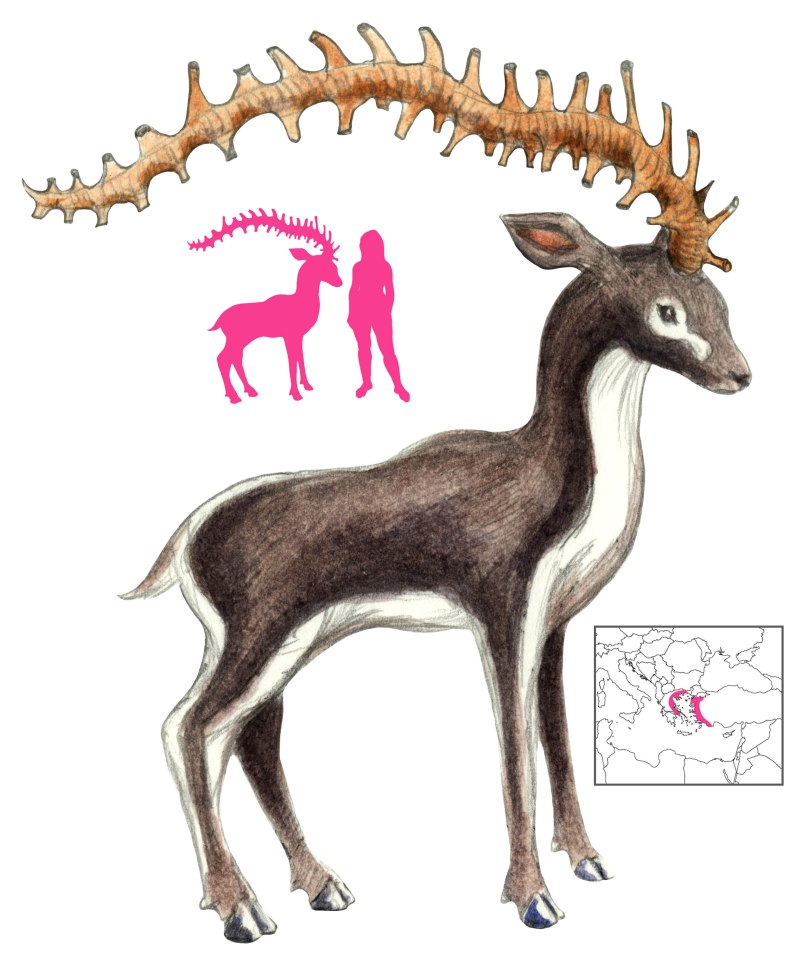
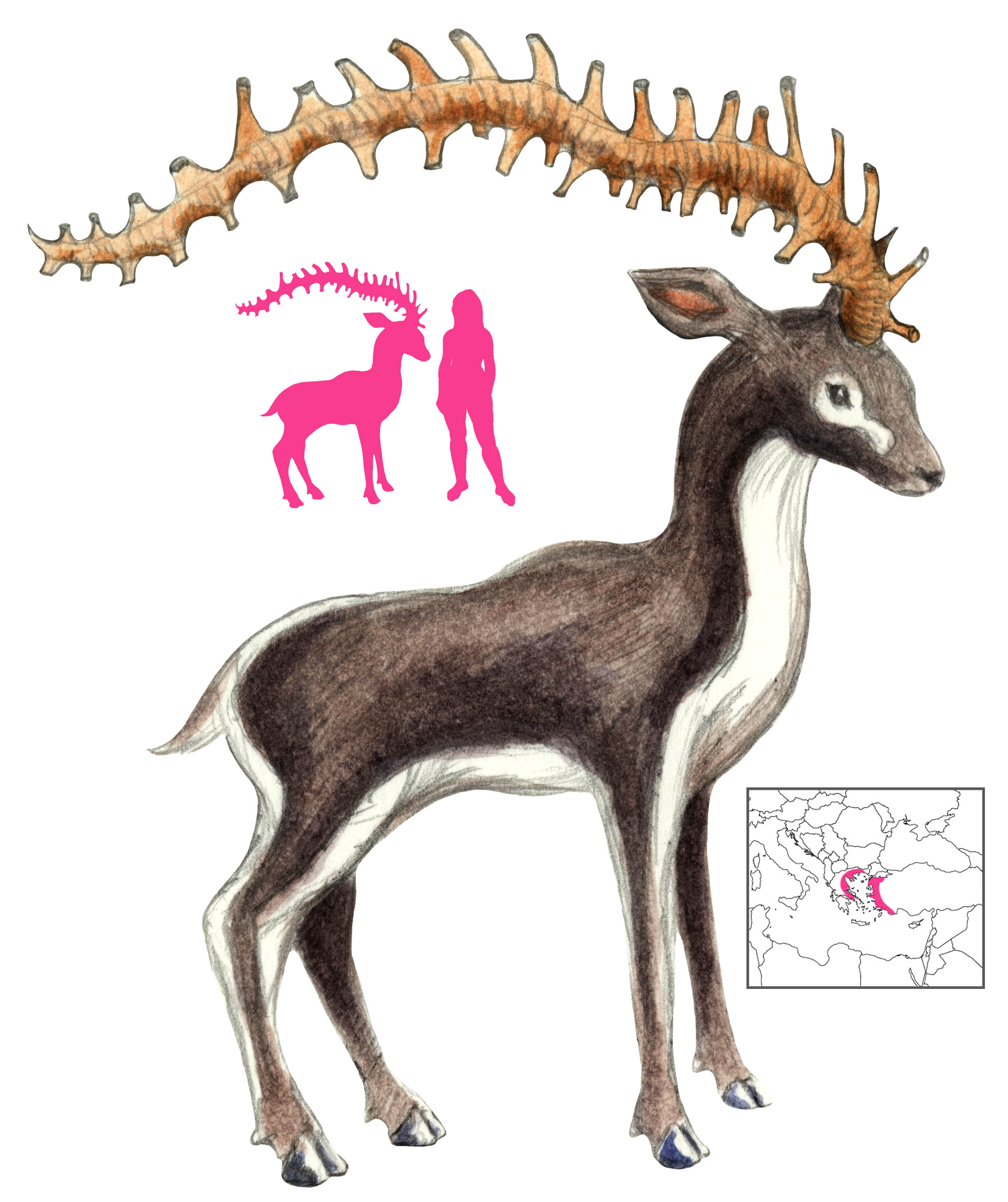
Unlike the more rhinocerine karkadann, the shādawār is an antelope-like ungulate with a single horn, but in this case it is long and hollow. There are forty-two hollow branches in the horn, and wind whistling through these flute-like holes results in beautiful, stirring melodies, so lovely that other animals will gather around to listen. Shādawār horns were offered to kings, who would hang them up as musical intruments. Depending on the angle they were held at, they would produce an enthralling tune or a sad dirge that moved all listeners to tears.

The shādawār has been incorrectly described as a flesh-eater, using its music to attract potential prey. In fact, Al-Qazwini makes no mention of any carnivorous tendencies. Al-Mustawfi, however, combines Al-Qazwini’s account of the shādawār with that of the carnivorous Sirānis immediately preceding it. It is the sirānis that lures prey to it with its music, and not the herbivorous shādawār.

Al-Damiri and Bochart give it seventy-two branches on its horn. Flaubert goes further and describes his “sadhuzag” as a black deer with the head of a bull, and a thicket of white horns on its head. It speaks to Anthony, describing its unique powers. “My seventy-four antlers are hollow as flutes. When I turn towards the South wind, sounds come out that attract enraptured beasts. Snakes coil around my legs, wasps cling to my nostrils, and parrots, doves, and ibises roost in my branches. – Listen! … But when I turn to the North wind, my antlers, thicker than a battalion of lances, exhale a howl; forests shudder, rivers retreat, fruit bulbs burst, and grasses stand on end like the hair of a coward. – Listen!”

References

Bochart, S. (1675) Hierozoicon. Johannis Davidis Zunneri, Frankfurt.

el-Cheikh, N. M. Byzantium through the Islamic Prism from the Twelfth to the Thirteenth Century. In Laiou, A. E. and Mottahedeh, R. P. (2001) The Crusades from the Perspective of Byzantium and the Muslim World. Dumbarton Oaks Research Library and Collection, Washington, D. C.

Contadini, A. Musical Beasts: The Swan-Phoenix in the Ibn Bakhtishu’ Bestiaries. In O, Kane, B. (2005) The Iconography of Islamic Art. Edinburgh University Press.

Contadini, A. (2012) A World of Beasts: A Thirteenth-Century Illustrated Arabic Book on Animals (the Kitab Na’t al-Hayawan) in the Ibn Bakhtishu’ Tradition. Brill, Leiden.

al-Damiri, K. (1891) Hayat al-hayawan al-kubra. Al-Matba’ah al-Khayriyah, Cairo.

Ettinghausen, R. (1950) The Unicorn. Studies in Muslim Iconography, Freer Gallery of Art Occasional Papers Vol. 1, No. 3, Washington.

Flaubert, G. (1885) La Tentation de Saint Antoine. Quantin, Paris.

Jayakar, A. S. G. (1908) ad-Damiri’s Hayat al-Hayawan (A Zoological Lexicon). Luzac and Co., London.

Kraus, P. (1986) Jabir Ibn Hayyan : Contribution à l’historie des idées scientifiques dans l’Islam. Société d’Édition Les Belles Lettres, Paris.

al-Qazwini, Z. (1849) Zakariya ben Muhammed ben Mahmud el-Cazwini’s Kosmographie. Erster Theil: Die Wunder der Schöpfung. Ed. F. Wüstenfeld. Dieterichsche Buchhandlung, Göttingen.

Catoblepas

Variations: Katoblepas, Catablepon, Katoblepon, Catobleponta, Gorgon (erroneously)

Catoblepas

The Catoblepas, “that which looks downwards”, is probably the most hideous and repulsive of living things, so horrid that its mere glance is lethal. Pliny locates it in Ethiopia, around the source of the Nile, Aelian puts it in Libya, and Topsell gives a range of Hesperia and Lybia.

According to Pliny, the body of a catoblepas is of small size, and its limbs are heavy, but its massive head is too heavy to be held up and always looks downwards. This is a good thing, as anyone who saw the eyes of a catoblepas died.

Aelian gives more detail, describing it as the size of a bull, but with a grim expression, shaggy eyebrows, and small bloodshot eyes. It looks downwards, and has a horselike mane that starts on its head and covers its face. The catoblepas feeds on poisonous plants; when threatened, it shudders and raises its mane in warning before opening its mouth and belching a foul, toxic gas. This gas poisons the air around it, and anything that breathes it loses its voice, collapses in convulsions, and dies. Other animals give it a wide berth because of this. There is no mention of a deadly gaze.

Topsell combines the catoblepas with the Gorgon, stating that the myth of Perseus originated from a war with African Amazons led by Medusa. The snake-hair of the gorgons was inspired by the catoblepas’ messy mane. His fanciful description borrows liberally from gorgons and adds thick eyelids, scales like a dragon, tusks like a boar, no hair on the head, wings, human hands, and a size between that of a bull and a calf. He also denies that a catoblepas can kill with its breath, which is unheard of in the animal world; it is far more likely to kill with its eyes like the well-known cockatrice. He gives as proof an anecdote of Marius’ soldiers encountering a catoblepas and thinking it a sheep, only to die immediately when it looked up at them. It was eventually killed in an ambush by spear-men, and its skin was sent to the temple of Hercules in Rome.

It is in Flaubert’s Temptation that we get the most nightmarish vision of the catoblepas. Here it is a sprawling, long-maned black buffalo with the head of a pig dragging on the ground. Its neck is long and thin like an emptied intestine. It is also granted the power of speech, addressing Anthony. “Fat, melancholy, wild, I perpetually feel the warmth of mud under my belly, hiding infinite rot under my armpit. My skull is so heavy that I cannot lift it. I roll it around me, slowly; – and, jaws opened, I tear with my tongue poisonous herbs watered with my breath. Once, I ate my paws by accident. No-one, Anthony, has ever seen my eyes, or those who have seen them are dead. If I lifted my eyelids – my pink and swollen eyelids, straight away, you would die”.

Cuvier suggested that this maned, hoofed, and downward-looking abomination of nature was inspired by the harmless gnu or wildebeest.

References

Aelian, trans. Scholfield, A. F. (1959) On the Characteristics of Animals, vol. II. Harvard University Press, Cambridge, Massachusetts.

Borges, J. L.; trans. Hurley, A. (2005) The Book of Imaginary Beings. Viking.

Flaubert, G. (1885) La Tentation de Saint Antoine. Quantin, Paris.

Pliny; Holland, P. trans. (1847) Pliny’s Natural History. George Barclay, Castle Street, Leicester Square.

Topsell, E. (1658) The History of Four-footed Beasts. E. Cotes, London.

Raudkembingur

Variations: Rauðkembingur, Raudkembingr, Rauðkembingr, Raudkempingur, Red-comb, Red-crest; Raudkembir (Red-crester); Raudkinni (Red-cheek); Raudkinnung, Raudkinnungur (Red-cheeker); Raudgrani (Red-snout); Raudhofdi (Redhead); Kembingur (Crest); Kembir (Crester); Faxi (Maned)

Raudkembingur

Of all the illhveli, or evil whales that ply Icelandic waters, the Raudkembingur (“red comb” or “red crest”) is the most savage and bloodthirsty. It may not have the size or raw power of some of the other whales, but it is unmatched in ferocity and determination to harm boats. As with all illhveli, the raudkembingur is an abomination, and eating its inedible flesh is forbidden. Boiling its meat causes it to disappear from the pot.

The nature of the red comb or crest that gives the raudkembingur its name is unclear. Accounts refer to a crest of bristly hair, a mane like a horse, or even a row of finlets; its extent varies from depiction to depiction, but Jon Gudmundsson restricts it to the neck. The crest is a bright red on a coffee-brown body with a pink belly; other accounts say it is reddish all over, or has red cheeks or a red head. Sometimes there are red streaks from the mouth to the trunk, as if drawn in blood. The head itself, as depicted by Gudmundsson, is almost saurian in appearance, with sharp teeth in both jaws. It either has a small dorsal fin or none at all.

Raudkembingurs grow to twenty to forty cubits (10-20 m) in length. They are elongate, streamlined, and very fast swimmers. Their movement is accompanied by massive amounts of foam and the whale’s ominous neighing. This, along with the red mane, makes the raudkembingur confusable with the hrosshvalur, and the two have become interchangeable over time. Hrosshvalurs, however, can be easily distinguished by their dappled coloration, horse’s tail, and enormous eyes.

There is no limit to the malice and evil of the raudkembingur. Its mere presence is enough to dissuade fishermen from an area. It will play dead for half a month, floating innocuously on the surface of the water until someone is foolish enough to approach it. Once a boat is within range, the whale puts its bulk and teeth to use, leaping onto the vessel, destroying it, and drowning all aboard. Much like a shark is followed by pilotfish, the raudkembingur regularly has a beluga whales or narwhals (nahvalur – “corpse whale”) following in its wake. These smaller, harmless whales clean up after the raudkembingur and eat its plentiful leftovers.

If anything, the whale’s single-minded love of destruction represents the best hope of foiling it. If a boat escapes it, and it does not destroy another within the same day, it will die of frustration. One raudkembingur destroyed eighteen boats in the course of one day, but a nineteenth boat managed to escape by dressing a piece of wood in clothes and tossing it overboard. The raudkembingur, believing it to be a human, kept trying fruitlessly to drown it while the boat made its escape.

Raudkembingurs will also overexert themselves to death when pursuing prey. A boat captained by Eyvindur Jónsson off Fljót ran into a raudkembingur, and the crewmen reacted by rowing for land as fast as possible until they reached safety at the inlet of Saudanesvik. The sea then turned red as the raudkembingur breathed its last. The boat itself earned the nickname of Hafrenningur (Ocean Runner) after this feat.

Like the hrosshvalur, the demonic raudkembingur is also associated with sorcery and metamorphoses. One tale tells of a callous young man at Hvalsnes who was cursed by the elfs into becoming a monstrous red-headed whale. He wreaked havoc in Faxafjord and Hvalfjordur, until he tried to chase a priest up-river. The red-head died of exhaustion in Hvalvatn Lake, and its bones can still be seen there.

It is generally believed that the raudkembingur and hrosshvalur are monstrous aggrandizements of the walrus (itself derived from hvalhross – “whale-horse”). If the walrus is indeed the origin, however, it has become fully dissociated from its descendants. Gudmundsson realistically depicts both the walrus and the two illhveli, making it very clear that the latter are indeed whales. Otto Fabricius believed the raudkembingur to be inspired by the maned Steller’s sea lion, all the way from Kamchatka.

References

Arnason, J.; Powell, G. E. J. and Magnusson, E. trans. (1864) Icelandic Legends. Richard Bentley, London.

Davidsson, O. (1900) The Folk-lore of Icelandic Fishes. The Scottish Review, October, pp. 312-332.

Fraser, F. C. An Early 17th Century Record of the Californian Grey Whale in Icelandic Waters. In Pilleri, G. (1970) Investigations on Cetacea, vol. II. Benteli AG, Bern.

Hermansson, H. (1924) Jon Gudmundsson and his Natural History of Iceland. Islandica, Cornell University Library, Ithaca.

Hlidberg, J. B. and Aegisson, S.; McQueen, F. J. M. and Kjartansson, R., trans. (2011) Meeting with Monsters. JPV utgafa, Reykjavik.

Kapel, F. O. (2005) Otto Fabricius and the Seals of Greenland. Meddelelser om Grønland Bioscience, Copenhagen.

Larson, L. M. (1917) The King’s Mirror. Twayne Publishers Inc., New York.

Mi-ni-wa-tu

Mi-ni-wa-tu

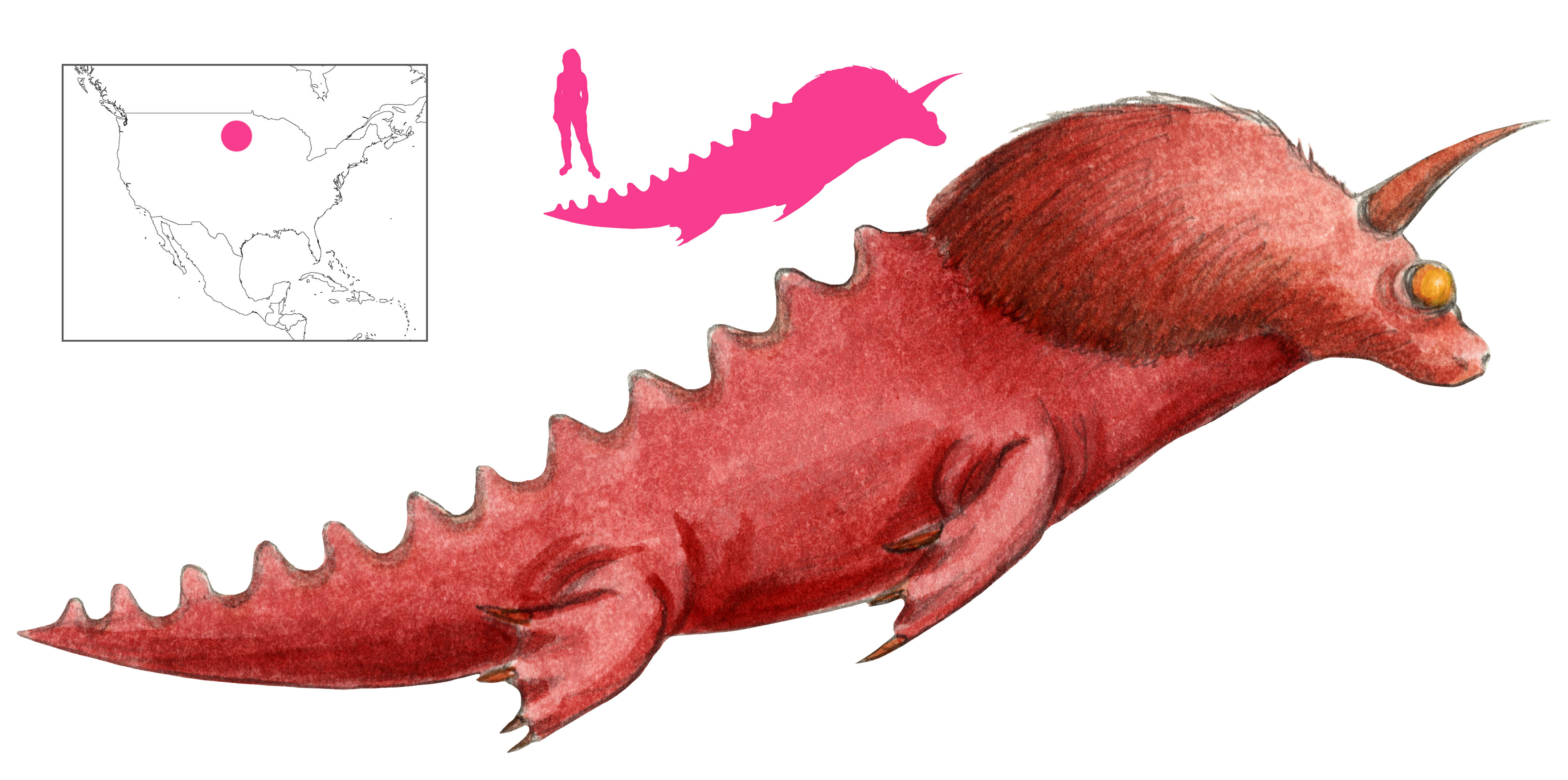
The Mi-ni-wa-tu, or “sea monster”, is known from the folklore of the Tetons, and may be found in the Missouri River.

A mi-ni-wa-tu is an amphibious creature with a body like that of a buffalo, and covered with red hair. It has a single horn in its forehead, and a single eye. Its back is notched like a saw or gear.

The mi-ni-wa-tu may be safely seen at night when it swims powerfully up the river, churning the water and glowing like fire; in the spring, it breaks up river ice. Seeing a mi-ni-wa-tu during the day causes confusion and loss of sight. Madness sets in; after a day of convulsions, the unfortunate victim dies.

References

Dorsey, J. O. (1889) Teton Folklore Notes. Journal of American Folklore, Vol. II, No. IV, pp. 133-139.

Codrille

Variations: Cocadrille, Cocodrille, Coquadrille, Cocatris

Codrille

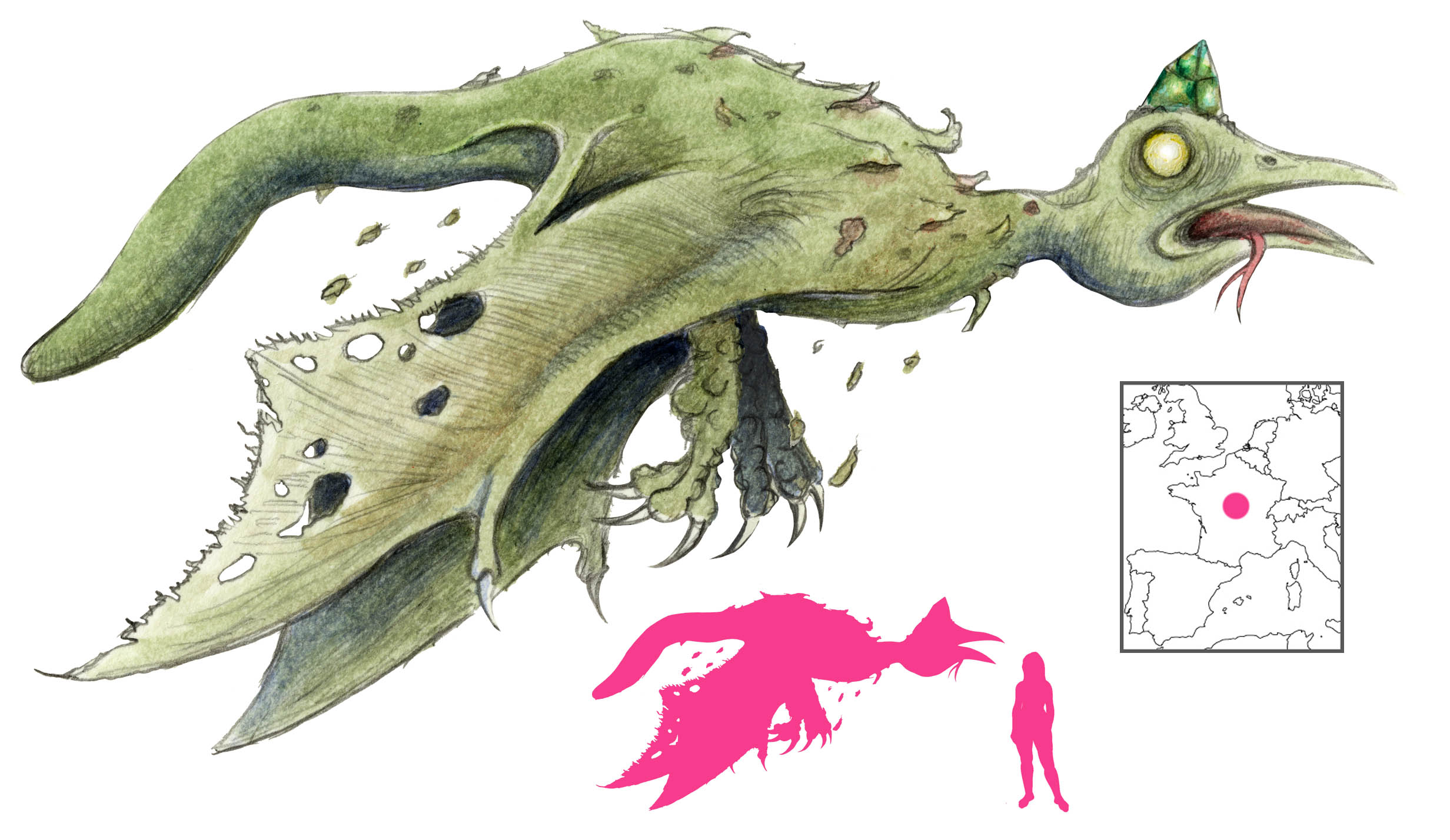
The Codrille, Cocadrille, or Codrille is a variety of basilisk or dragon native to central France, notably Berry, Maine, Poitou, Sologne, and Vendée. It combines features of basilisks and vouivres but without the redeeming aspects of either.

The name of the codrille was derived from the same etymological confusion that spawned the “cockatrice”. Starting with Crocodylus, the crocodile, practically a mythical creature in its own right, the name became progressively more garbled, becoming Cocodrillus, Cocodrille, Cocadrille, and Codrille. However, de la Salle derives it from coco and drille, meaning “rooster’s child”.

Unlike true basilisks, codrilles can grow to impressive size, becoming leathery-winged dragons at the last stage of their life cycle. The “crown” characteristic of basilisks manifests in the form of a brilliant gem on top of the codrille’s head. Codrilles can kill merely by looking at their victims, and emit an aura of disease and plague.

A codrille’s life is a complicated succession of metamorphoses. It hatches from a yolkless egg laid by a rooster, and incubated by the heat of the sun or of manure. To prevent those eggs from hatching, one must plant sprigs of ash in potential codrille breeding grounds. This should be done on the first day of May. Having other roosters around also helps, as they will devour the offspring of a codrille.

The codrille starts out its life as a very long, string-like snake. It is capable of killing right out of the egg – anyone who cracks a codrille egg and is seen by the newborn codrille dies instantly, but if they see the snake first, it dies instead. After a while, the juvenile codrille sprouts legs and becomes a salamander. During this stage of its life it will still die if seen first by humans, so it hides in deep wells, ruined tombs, and the masonry of houses, bringing bad luck to everyone living there and whistling ominously at night. It can debilitate a bull merely by crawling under it.

At the end of seven years the codrille reaches the adult stages. It grows spectacularly, sprouts wings, and metamorphoses into an enormous dragon. It spreads its wings and migrates towards the Tower of Babylon, breathing death and pestilence along its way. Its passage in the air dims the sun, and epidemics and plagues follow in its wake.

References

Sainéan, L. (1921) L’histoire naturelle et les branches connexes dans l’oeuvre de Rabelais. E. Champion, Paris.

de la Salle, L. (1875) Croyances et légendes du centre de la France, Tome Premier. Chaix et Cie., Paris.

Sébillot, P. (1906) Le Folk-lore de France, Tome Troisième: La Faune et la Flore. Librairie Orientale et Américaine, Paris.

Fayette

Fayette

The Fayettes (“little fairies”) live in the Forez region in France, today around the Loire basin. They are believed to be the descendants of the Greek nymphs, having escaped the advance of Christianity in the Mediterranean.

In France they are much tinier versions of their former selves, but their magical powers are undiminished. They guard the caves and forests, and can be seen dancing in the woods of Couroux, in the Beaujolais. Like any self-respecting fairy, they like to abduct children and leave insatiable changelings behind. Those fairy children are best brought to the mouth of a cave and threatened with violence, causing the fayette to return the stolen child. Te, vequio le tio, rends me le mio (“There, here’s yours, return mine”).

During the night, the fayettes do their laundry under the moon. Travellers in the woods are advised to sing at the top of their lungs to make sure they’re not mistaken for threats. At daybreak the fairies dissipate like fog, sometimes leaving behind solid gold washboards that would make anyone’s fortune.

During the day the fayettes take the form of moles, and take pleasure in ravaging gardens. This is why moles have pretty little pink hands.

References

Proth, M. (1868) Au Pays de l’Astrée. Librairie Internationale, Paris.

Sébillot, P. (1904) Le Folk-Lore de France, Tome Premier: Le Ciel et la Terre. Librairie Orientale et Américaine, Paris.

Dodo

Variations: Kadindi, Kaddodi, Kadda, Swallower-of-Men

Dodo

The Dodo is a monstrous humanoid creature from the folklore of the Hausa people. He can be found lurking in the deep forests and swamps of sub-Saharan West Africa, with a range including Sudan, Ghana, Nigeria, and the Côte d’Ivoire. The dodo has nothing in common with the extinct flightless bird of the same name, and probably was derived from tales of giant snakes.

Not much is known about a dodo’s appearance. He – for the dodo is always male – is the King of Beasts, and can just as easily be the lion, the python, the elephant, or the rhinoceros. A dodo is humanoid in appearance and large in size, as he has to stoop to get through doors. He has long, shaggy black hair. He has a keen sense of smell, and can detect meat from far away. He has some degree of magic powers, but cannot cross running water (paradoxically, dodos also live in ponds and streams). Most importantly, the dodo has a vast mouth glowing red from the inside, a seemingly infinite stomach capacity, and a taste for human flesh. As one of the African “swallowing monsters”, a dodo can easily engulf an entire village.

A dodo is often a self-invited guest, eating more and more until there is nothing left. This is not always a bad thing. Once a miser and his son were preparing to butcher a freshly-slaughtered ox in the forest, far from prying eyes. They decided to cook it in a nearby fire – a fire which turned out to be a dodo’s glowing, cavernous mouth.

“Well well”, said the dodo. “Who has invited me?” The miser, hoping to placate him, said “I did!” and gave him a leg of beef, which the dodo put away in his bag. “Does a man invite a friend to a feast for such a small morsel?” said the dodo. In response, the miser gave him another leg. “Does a man invite a friend to a feast for such a small morsel?” The next two legs followed, then half the bull, then the remainder of the bull. “Does a man invite a friend to a feast for such a small morsel?” “But there is nothing left!” protested the man. “You are also meat”, came the response. Terrified, the miser shoved his son forward, and the dodo tossed him into his bag. Finally, he grabbed the miser himself. “What about you?” he said, throwing him into his bag as well. The dodo went to collect firewood, but in the meantime the father and son managed to cut their way out of the bag and made their escape. The dodo returned, shrugged, and got a meal of roast beef. The miser vowed he would never be greedy again, and devoted the rest of his life to sharing his food and wealth with others.

While dodos readily eat meat, they are also fond of taking human women as their wives, sometimes fathering repulsive half-dodo children with them. Dodos like to strike bargains with prospective spouses, promising to help them for the price of marriage; sometimes those “bargains” are more straightforward, consisting of “Would you like me to eat you or marry you?” Such unions are never happy, and the wife will always try to escape her captor.

One dodo story tells of a young woman, pregnant with her first child, drawing water from a stream. Another woman, jealous of her companion and looking to get her scolded, threw dirt in her pot before leaving. But as the pregnant woman tried to carry her water pot, a dodo came out of the water and helped her with her load. Before she could protest, he stated “If you give birth to a boy, he will be my friend. If your child is a girl, she will be my wife”. And with that, he disappeared back into the water.

The mother soon gave birth, and her jealous rival was prompt to report the news to the dodo. “She gave birth to a girl”, she announced, and the dodo was immensely pleased. He was content to wait over the years, until the girl had become a woman as beautiful as her mother. On the day of the girl’s wedding, the jealous woman once more reported the news to the dodo, and he decided to show up uninvited.

“Kadindi has arrived”, he boomed, as everyone stared at him. “I have come to collect the payment I am due”. The daughter was obviously unhappy about marrying the monster, so instead her father gave the dodo a horse, part of the bride’s dowry. “Here is the payment for your debt”, he said, and the dodo swallowed the horse. But that was not enough. Next he ate all of the cattle, all of the wedding feast, all of the guests, and finally the father and mother. There was only the daughter left, and in desperation she prayed to the heavens. “Dodo has come to demand payment”, she implored. In response to her prayer, a knife fell out of the sky, and it was promptly swallowed as well – killing the dodo, cutting open his belly, and causing all the livestock, food, guests, and parents to come out unharmed. The wedding went on as planned.

References

Tremearne, A. J. N. (1913) Hausa Superstitions and Customs. J. Bale and Sons and Danielsson, Ltd., London.

The Book of Imaginary Beings by Jorge Luis Borges is, without a doubt, one of the most important literary contributions to the art of the bestiary. Its litany of obscure creatures laid the groundwork for the modern encyclopedia of mythical beasts, and ensured its citation in hundreds of works to come.

Borges was more interested in making an artistic and creative statement than in writing an exhaustively researched academic paper. As such, his references can be murky, unclear, hard to find, and, in some cases, completely fictitious. Later works came to quote Borges without attempting to track down the veracity of his statements. As Hurley notes with chagrin, it is “simply impossible to ferret out all the originals”, and “some of [Borges’] “quotations” are almost certainly apocryphal, put-ons”. The creatures discussed here are in the latter category.

a bao a quThe A Bao A Qu is said to live in the Tower of Victory in Chitor. Its appearance is uncertain, but we know it has tentacles, can see with its whole body, glows blue, and has skin like that of a peach. It follows pilgrims climbing up the stairs of the tower, but can only reach the top if the climber is a blameless person who has achieved Nirvana. Otherwise, it moans with a sound like rustling silk and tumbles down the stairs to the base, where it waits for the next pilgrim.

This story was originally attributed to Captain Richard Francis Burton (el capitán Burton), in an unverifiable footnote to the Arabian Nights. The original English translation changed that to the fictitious treatise On Malay Witchcraft by one C. C. Iturvuru. Was that believed to sound more mysterious? Were editors were concerned that contemporary readers would not be familiar with Burton? At any rate, searching for this entirely fabricated monograph is futile. Good news! This one has actually been tracked down and proved to be real – albeit, under a different name. It’s the Yam Bhaya Akhoot.
peryton

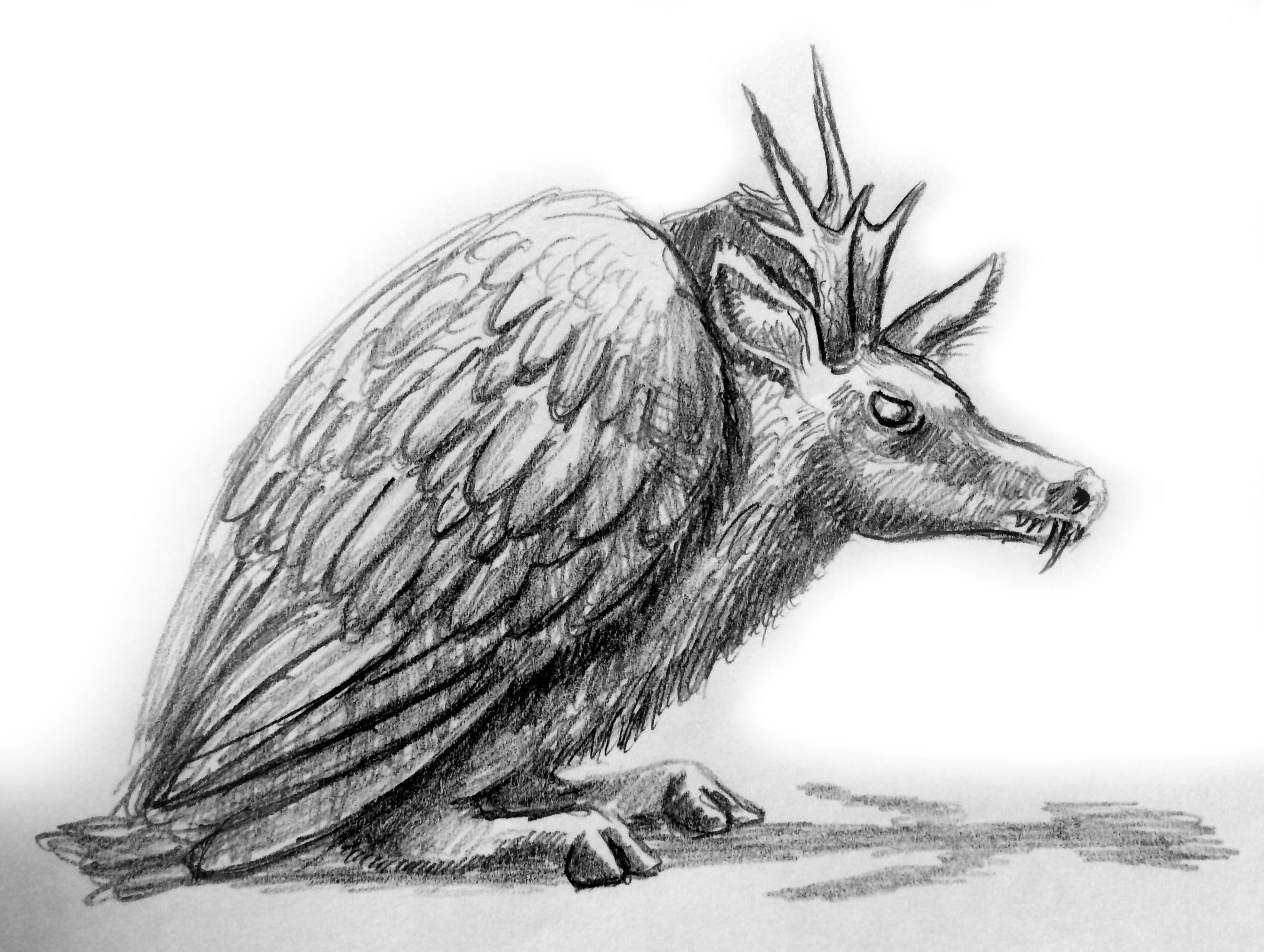
The Peryton, Perytion, or Peritio has achieved even greater fame, stripped of any Borgesian references and included in less discerning bestiaries. This carnivorous monster is a hybrid of deer and bird, with dark green plumage (or blue in Ravenna). Its oddest feature is its shadow, which is human. This is because perytons are believe to be the souls of men that have died away from the blessings of the gods. Perytons seek out humans to kill, but each peryton can only kill one man – after doing so, a peryton’s shadow becomes its own, and it is at peace.

Perytons originated from Atlantis, decimated Scipio’s army, and were foretold to destroy Rome. Borges attributes this to manuscripts written by one Aaron-ben-Chaim from Fez. These manuscripts quoted a nameless Arab author, and all copies conveniently perished in the burning of the Library of Alexandria and the Dresden firebombing.

Are the A Bao a Qu and the Peryton any less real than the basilisk and the unicorn? Repeated countless times, with their origins behind them, they are just as credible as any other nonexistent creature. After all, as told in Tlön, Uqbar, Orbis Tertius, an imagined world can be just as legitimate as the real world. We just have to remember that they remain literary in-jokes born from Borges’ pen.

References

Borges, J. L. (1962) Ficciones. Grove Press, New York.

Borges, J. L.; trans. di Giovanni, N. T. (1969) The Book of Imaginary Beings. Clarke, Irwin, & Co., Toronto.

Borges, J. L. (1978) El Libro de los Seres Imaginarios. Emece Editores, Buenos Aires.

Borges, J. L.; trans. Hurley, A. (2005) The Book of Imaginary Beings. Viking.

Borges, J. L. (2009) Manual de Zoologia Fantastica. Fondo de Cultura Economica, Mexico.

Zhubieyu

Variations: Pearl-turtle

Zhubieyu

The Zhubieyu, or Pearl-turtle, can be found in the Li River and Yu Lake, near Vine Mountain. This unusual fish or reptile looked like a lung (or otherwise a piece of dried meat) with four eyes and six legs. It contains and spits out pearls, and its flesh tastes sweet and sour. Zhubieyus are considered a delicacy, and eating them protects from seasonal epidemics and furunculosis.

Guo Pu marveled at the lot of these “floating lungs… Embodying Heaven, Earth, and Man”, and found irony in the fact that their own usefulness doomed them.

They appear to be softshell turtles. Mathieu describes them as “red softshells” or “pearled softshells”.

References

Mathieu, R. (1983) Étude sur la mythologie et l’ethnologie de la Chine ancienne. Collège de France, Paris.

Strassberg, R. E. (2002) A Chinese Bestiary: Strange Creatures from the Guideways Through Mountains and Seas. University of California Press.