Sarmatian Sea Snail

Variations: Sarmatian Snail, Limaçon de la Mer Sarmatique, Philosmon (Greek, potentially), Aknib (Turkish, potentially), Albakr (Tartar, potentially), Lucrab (Arabic, potentially), Cochlea Sarmatica
Sarmatian Sea Snail

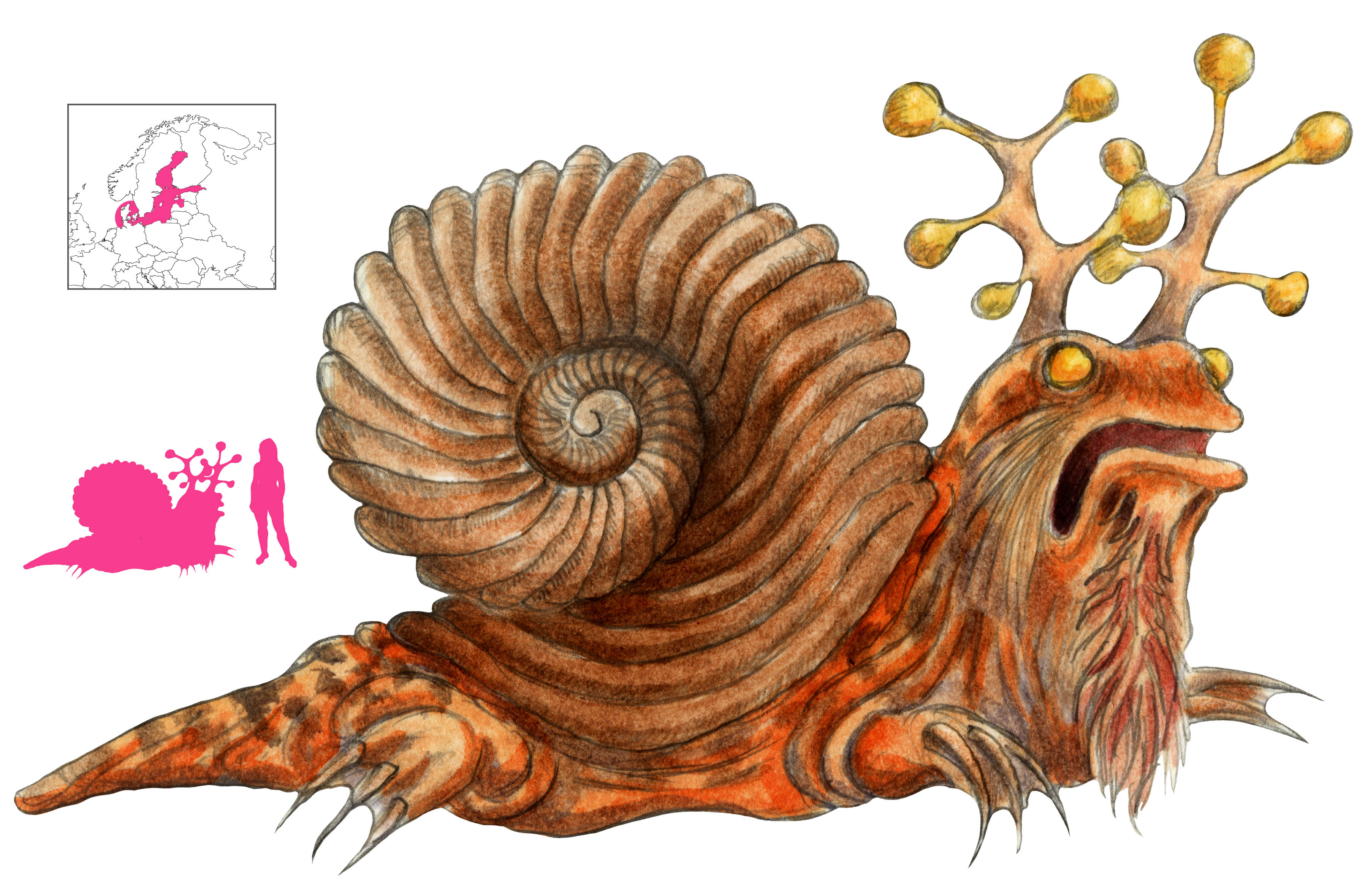
Anyone wishing to make a book on monstrous fishes should head to the Sarmatian Sea, exhorts Thevet. There, in what is now known as the Baltic Sea, may be found enough nightmares to satisfy the most avid teratologist.

One of these is an enormous snail, the size of a barrel. It has antlers like those of a stag, equipped with gleaming, pearl-like tips. It has a rounded cat-like snout with whiskers, and glowing eyes that light its path like candles. Its mouth is deeply slit, and a hideous fleshy excrescence dangles below it. Its neck is thick, and its tail is long, multicolored, and mottled like a tiger’s. Unlike most other snails, it has four feet armed with hooked claws.

While amphibious, the giant snail is usually out in the open sea, and is rarely seen on the coast due to its wariness.  During good weather it will crawl up onto the beach to graze. Its flesh is tasty and good to eat, and helps against liver and lung problems, much like the meat of large Madagascan turtles cures leprosy.

Thevet reports the Sarmatian Sea snail from Denmark, and mentions having seen similar creatures in the Black Sea, where they are known as Philosmon by the Greeks, Aknib by the Turks, Albakr by the Tartars, and Lucrab by the Arabs. These may well be the same animal.

Linnaeus cautiously included the Sarmatian Sea snail as Cochlea Sarmatica in a footnote, admitting that “fabulosa est“.

It is most likely that this giant snail was born of confusion between the shells of turtles and the shells of snails. Thevet was also working with a number of notes taken at different times, and it does not seem implausible that he muddled them together to create chimeras. Turtles were long seen as bizarre creatures, and the Ortus Sanitatis represents them as snails with legs, making them the basis for the giant snail. Further confusion with seals led to the whiskers and large eyes, and the antlers were provided by branching fungi. For all we know, none of these were from the Baltic Sea.

References

Linnaeus, C. (1759) Animalium Specierum. Theodor Haak, Leiden.

Paré, A. (1614) Les Oeuvres d’Ambroise Paré. Nicolas Buon, Paris.

Thevet, A. (1575) La Cosmographie Universelle. Guillaume Chaudiere, Paris.

Unknown. (1538) Ortus Sanitatis. Joannes de Cereto de Tridino.

Vallot, M. (1834) Mémoire sur le Limacon de la Mer Sarmatique. Mémoires de L’Académie des Sciences, Arts, et Belles-Lettres de Dijon, Partie des Sciences, Frantin, Dijon.
Shahmat al-Ard

Variations: Kharȃti

Shahmat-al-ard

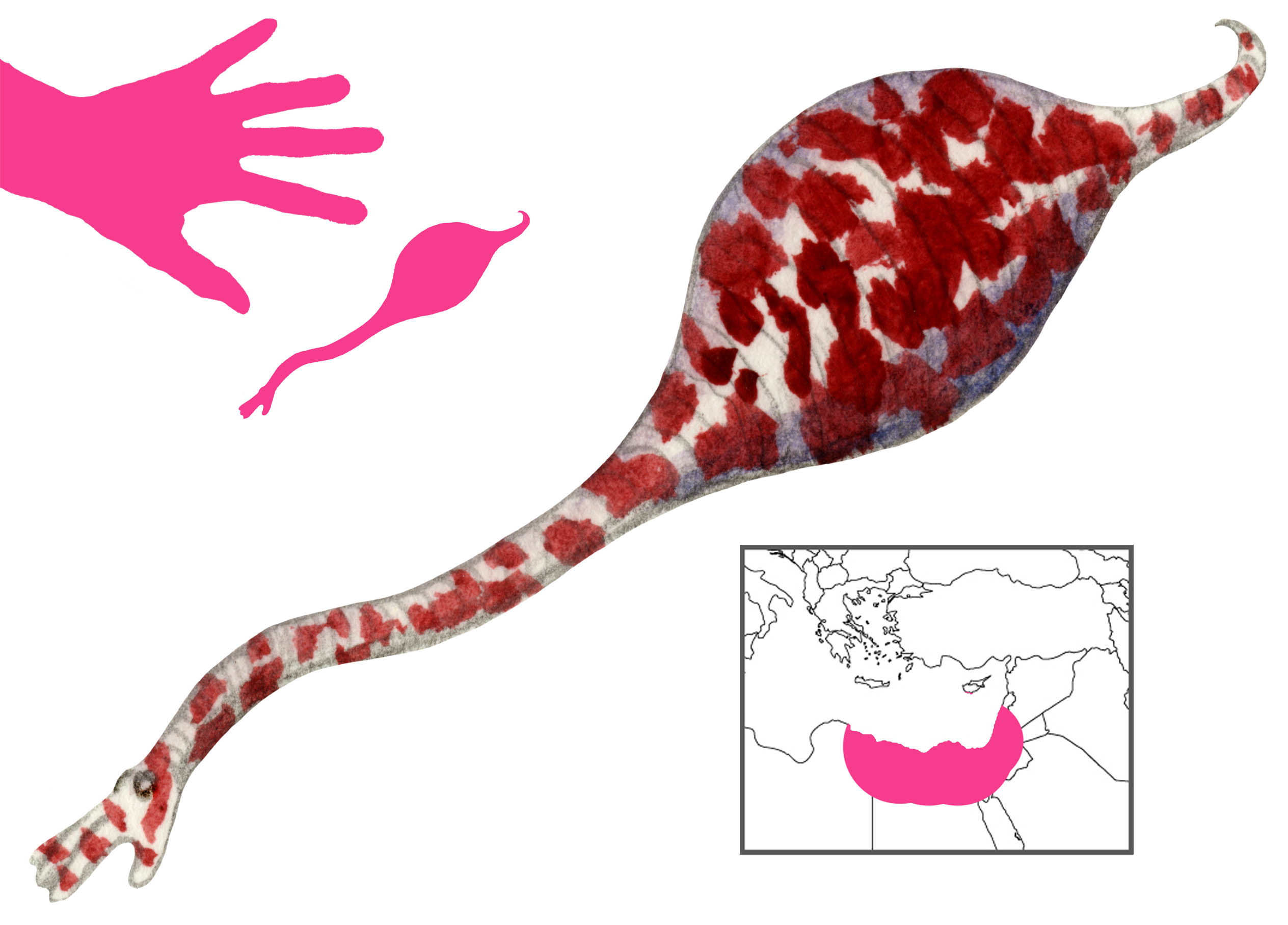
Shahmat al-Ard, the “fat of the earth” or “grease of the earth”, is a worm that contracts into a bead if touched. Al-Qazwini, who called it the Kharȃti, said that it was long, red, and lived in damp areas. On the other hand, al-Zamakshari believed it to be small, white, speckled with red spots, and resembling both a white fish and the hand of a woman. Hurmus said that it smelled good, and was immune to fire, being capable of crawling through a bonfire unharmed.

Its primary value is in the variety of medicinal benefits it provides. Its fat, if painted onto one’s skin, will protect from fire. The entire worm, dried and eaten, cures jaundice and scrofula; dried and taken with water, causes immediate delivery in the case of a difficult birth. Roasted and eaten with bread, it dissolves bladder-stones. A shahmat al-ard reduced to ashes, mixed with oil, and applied to the head will cure alopecia and restore hair growth.

Nonetheless it is not generally eaten, since as a filthy worm it is unclean and unfit for human consumption.

References

al-Damiri, K. (1891) Hayat al-hayawan al-kubra. Al-Matba’ah al-Khayriyah, Cairo.

Jayakar, A. S. G. (1908) Ad-Damiri’s Hayat al-Hayawan (A Zoological Lexicon), vol. II, part I. Luzac and Co., London.

Bo

Variations: Poh

Bo

According to the Guideways through Mountains and Seas, the animal known as Bo can be found around Mount Winding-Center (identified as Mount Xue), where Huai-trees grow and where jade, realgar, and metals are plentiful. It can also be found on the plains of Mongolia and on islands in the Northern Sea. The existence of bo in the district of Shen Su was unknown to its residents, until a man called Leu Chang informed them by quoting the Shan Hai Jing for good measure.

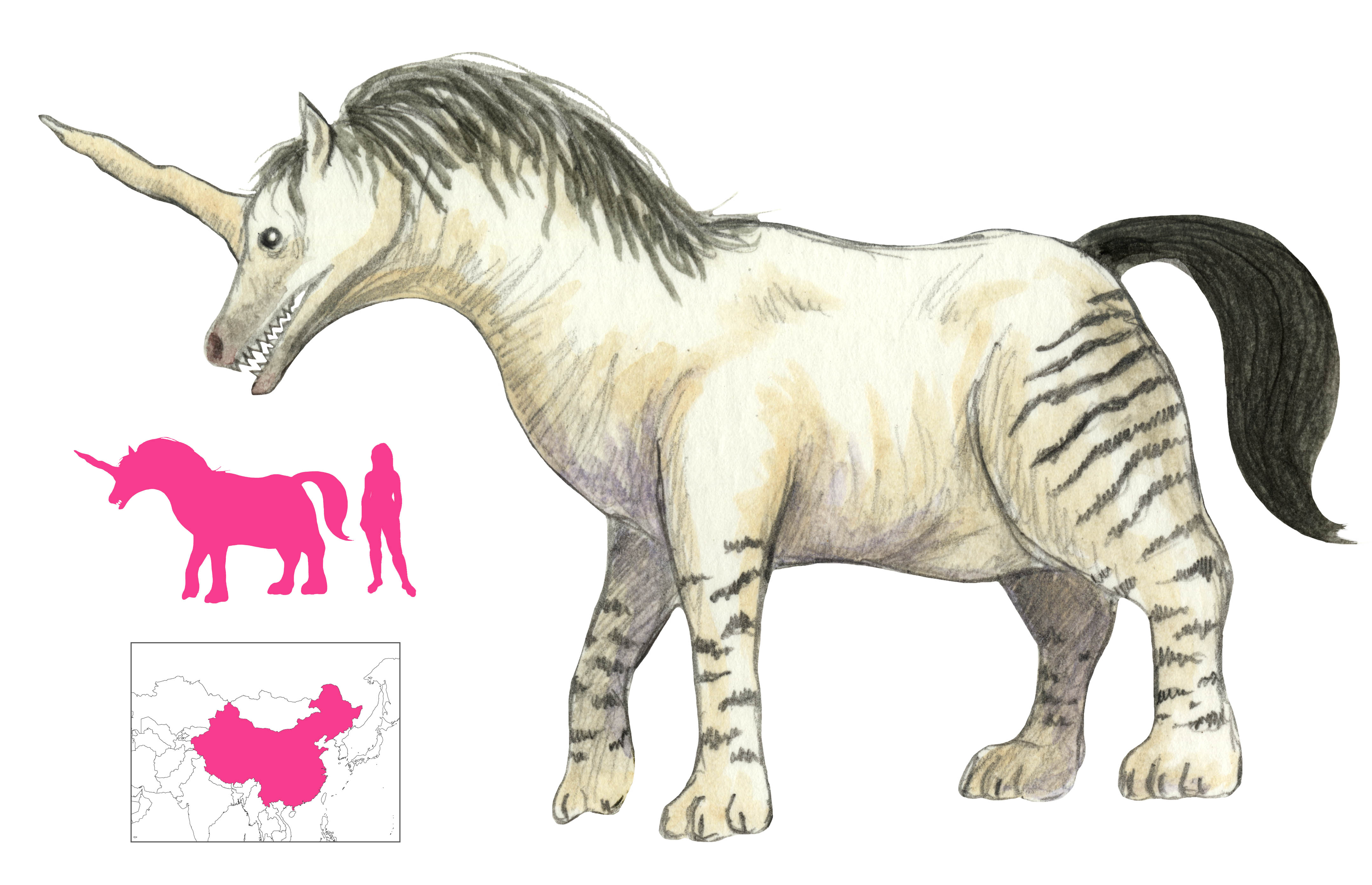
A bo looks like a horse with a white body and a black tail, with a single horn on its head. It has tiger’s feet and saw-like tiger’s teeth, and makes a sound like a rolling drum. Bo are strict carnivores that feed upon tigers and leopards, although other sources state that leopards eat bo, and bo in turn eat tigers. A bo will protect against weapons if its flesh is eaten, or if tamed and used as a soldier.

Bo are just and honorable animals, and will reward virtuous behavior accordingly. When the wise magistrate Chung Wa of the Kingdom of Peh Chi faced an invasion by a large number of carnivorous wild animals, six bo appeared and slaughtered the beasts in thanks for the magistrate’s goodness. Duke Huan of Qi’s horse looked like a bo, according to his prime minister Guan Zhong, but presumably did not eat tigers.

References

Gould, C. (1886) Mythical Monsters. W. H. Allen and Co., London.

Mathieu, R. (1983) Étude sur la mythologie et l’ethnologie de la Chine ancienne. Collège de France, Paris.

Strassberg, R. E. (2002) A Chinese Bestiary: Strange Creatures from the Guideways Through Mountains and Seas. University of California Press.

Aloés

Aloes

The Aloés is a large fish from the Caribbean around Hispaniola, reported by Thevet. It looked like a goose in general shape, with the top of its skull in the shape of a bon-chrétien (Williams) pear. It had four underslung fins, a fish-like tail, and no scales on its plump body. Several could be observed swimming alongside the boats, along with shoals of fish, and they looked remarkably like geese diving in and out of the waves.

References

Paré, A. (1614) Les Oeuvres d’Ambroise Paré. Nicolas Buon, Paris.

Thevet, A. (1575) La Cosmographie Universelle. Guillaume Chaudiere, Paris.

Aíǰe

Variations: Aíge, Spirit-Tadpole

Aige

The Aíǰe is associated with the Bororo of Brazil and Bolivia, and in particular the Páiwoe and Aróroe clans. It is a gigantic tadpole, somewhat like a hippopotamus.

Rubúgu of the Páiwoe first found the aíǰe while walking through a swamp. He liked the little animal and decided to keep it, taking it home in a vessel of water. Rubúgu had great plans for his little pet, and wanted it to become something great and amazing, so before covering its container with a fan he told it “Grow for me; thrive and become an extraordinary creature”.

And grow the aíǰe did. It became larger, and stronger, and it could sing a loud, buzzing song. Rubúgu had to keep switching it to increasingly large containers to support its bulk, and eventually he had nowhere left to put it. He tried doing a dance for the aíǰe, but the tadpole rejected Rubúgu’s mediocre talents. Instead, Chief Baitogógo of the Aróroe took the aíǰe, and honored it with a macaw-feather headdress and a marvelous dance, both of which pleased the tadpole greatly. Baitogógo told the aíǰe that it had to live in ponds, swamps, and lakes away from the Bororo, for it was so big and the magic of its song so powerful, it could pose a serious threat.

The aíǰe accepted, and before leaving it told Baitogógo that if the Bororo missed it, then they should fashion little tadpole sculptures in remembrance. Those figurines could be tied to a stick and swung in the air, making an amphibian buzzing much like aíǰe did. Thus the aíǰe went on to become one of the totems of the Bororo.

References

Albisetti, C.,; Colbacchini, A.; and Venturelli, A. J.; Wilbert, J. and Simoneau, K. eds. (1983) Folk Literature of the Bororo Indians. UCLA Latin American Center Publications, University of California, Los Angeles.

Tiddalik

Variations: Tiddalick, Karaknitt

Tiddalik

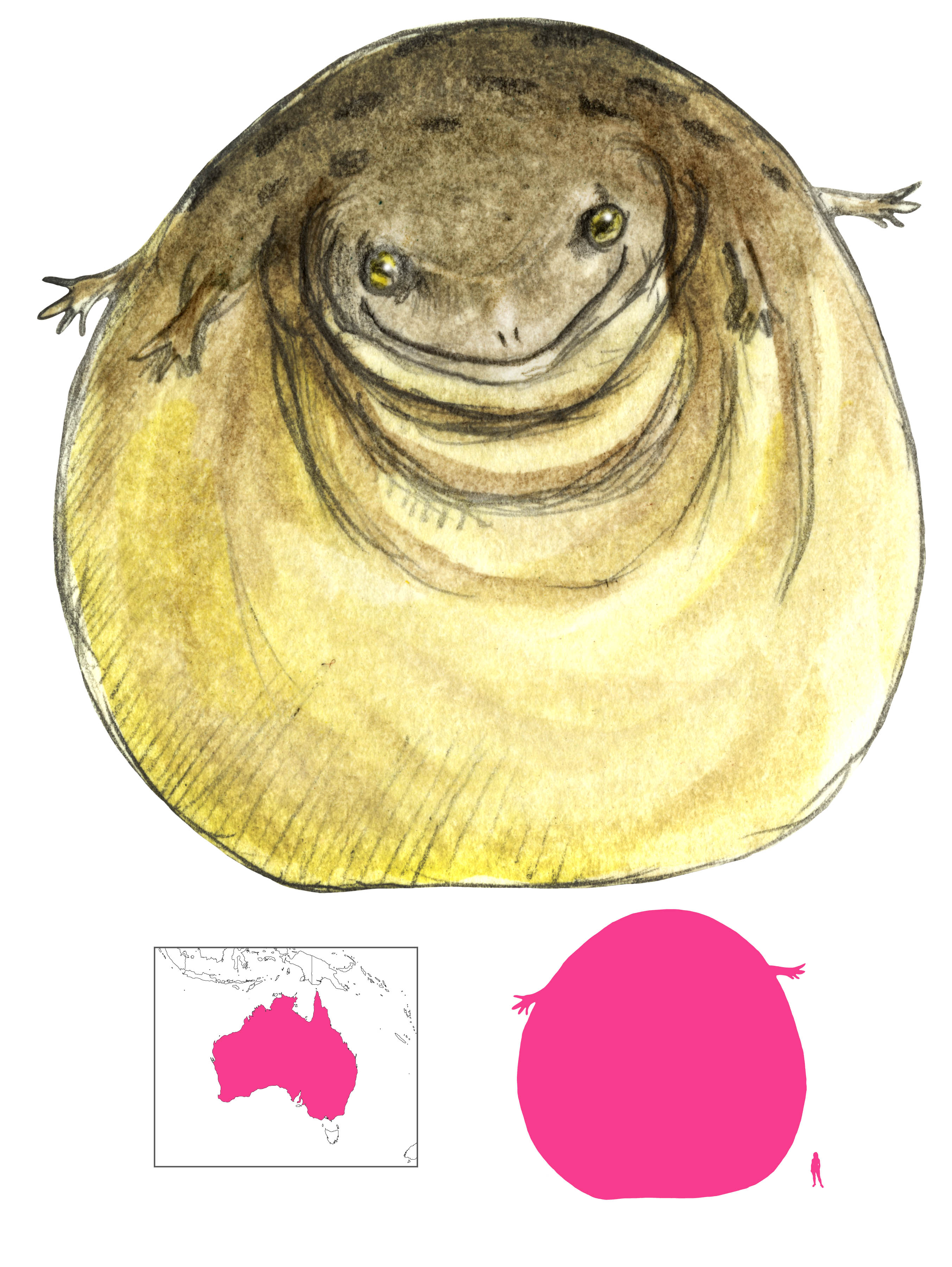
Tiddalik the frog was thirsty. He got up one day in the Australian bush and decided he needed more water. He began by drinking down all the water in his pond. After that, he crawled out of the hole left behind and drained the nearby waterholes. Then he swilled down the closest river, and followed its tributaries, drinking them down one by one. Billabongs and lakes were gobbled up, and Tiddalik grew bigger and bigger. Finally, once there was no water left in sight, Tiddalik stopped. He was now a bloated, mountainous creature filled with water and incapable of moving. He could only sit there and stare, content at last.

Soon, as the lack of water became painfully evident, the animals started to gather around Tiddalik. His size and thick skin made him impervious to anything they could do, and rain was nowhere in sight. It was Goorgourgahgah, the Kookaburra, who hit upon the solution. “We must make him laugh”, he said. “That way he’ll open his mouth and all the water will come out”.

As the champion laugher, Goorgourgahgah went first. He flew in front of Tiddalik’s face, laughing at the top of his lungs. He tumbled in the air, told jokes, and guffawed till he was hoarse. Tiddalik blinked impassively.

All the other animals tried their luck. Kangaroo turned somersaults. Koala made weird noises. Frilled Lizard ran around with his frill open. Wombat rolled around in the dirt. Brolga danced and squawked. But nothing they did seemed to get to Tiddalik, and the more they tried the thirstier they got. The monstrous frog merely continued to observe them with his globular eyes.

Then, as the other animals began to despair, Noyang the Eel stepped solemnly up. Everyone held their breath as Noyang straightened and balanced precariously on his tail. A ripple went through Tiddalik’s bloated body. Noyang began to twist and contort himself, forming hoops, spirals, springs, whirling around like a top… Tiddalik’s smile broadened, and he started to shake. Finally, Noyang tied himself in knots, and Tiddalik started to laugh hysterically – and all the water he held inside poured out, flooding the land before returning to its rightful place. Many died in the flood; Pelican took it upon himself to save as many as he could, but got aggressive when the human woman he wanted for a wife refused him. He painted his black feathers white to go to war, but was accidentally killed by another pelican who didn’t recognize him – pelicans today are both black and white in his honor.

When all had cleared, Tiddalik had shrunken back into a tiny frog once more. He had laughed so hard that he lost his voice, and could only croak hoarsely. Today, his descendants the water-holding frogs (Cyclorana platycephala) still practice every night in the hopes of regaining that voice, and still try to drink large quantities of water on a much smaller scale.

After losing all the water of the world, Tiddalik also came to resent anyone who tried to hoard water for themselves. When Echidna tried to keep a secret cache of water, it was Tiddalik who followed him and dove into the subterranean pond. “This water belongs to everyone!” he snapped. “You have no right to keep it to yourself!” The other animals punished Echidna by tossing him into a thornbush, and to this day he still has the thorns embedded in his back as a painful reminder of his greed.

References

Morton, J. (2006) Tiddalik’s Travels: The Making and Remaking of an Aboriginal Flood Myth. Advances in Ecological Research, vol. 39.

Ragache, C. C. and Laverdet, M. (1991) Les animaux fantastiques. Hachette.

Reed, A. W. (1965) Myths and Legends of Australia. A. H. and A. W. Reed, Sydney.

Reed, A. W. (1978) Aboriginal Legends: Animal Tales. A. H. and A. W. Reed, Sydney.

Binaye Ahani

Variations: Bina’ye Ayani, Nayie A’anyie, Bina’yeagha’ni, Eye Killers, Evil Eyes

Binaye Ahani

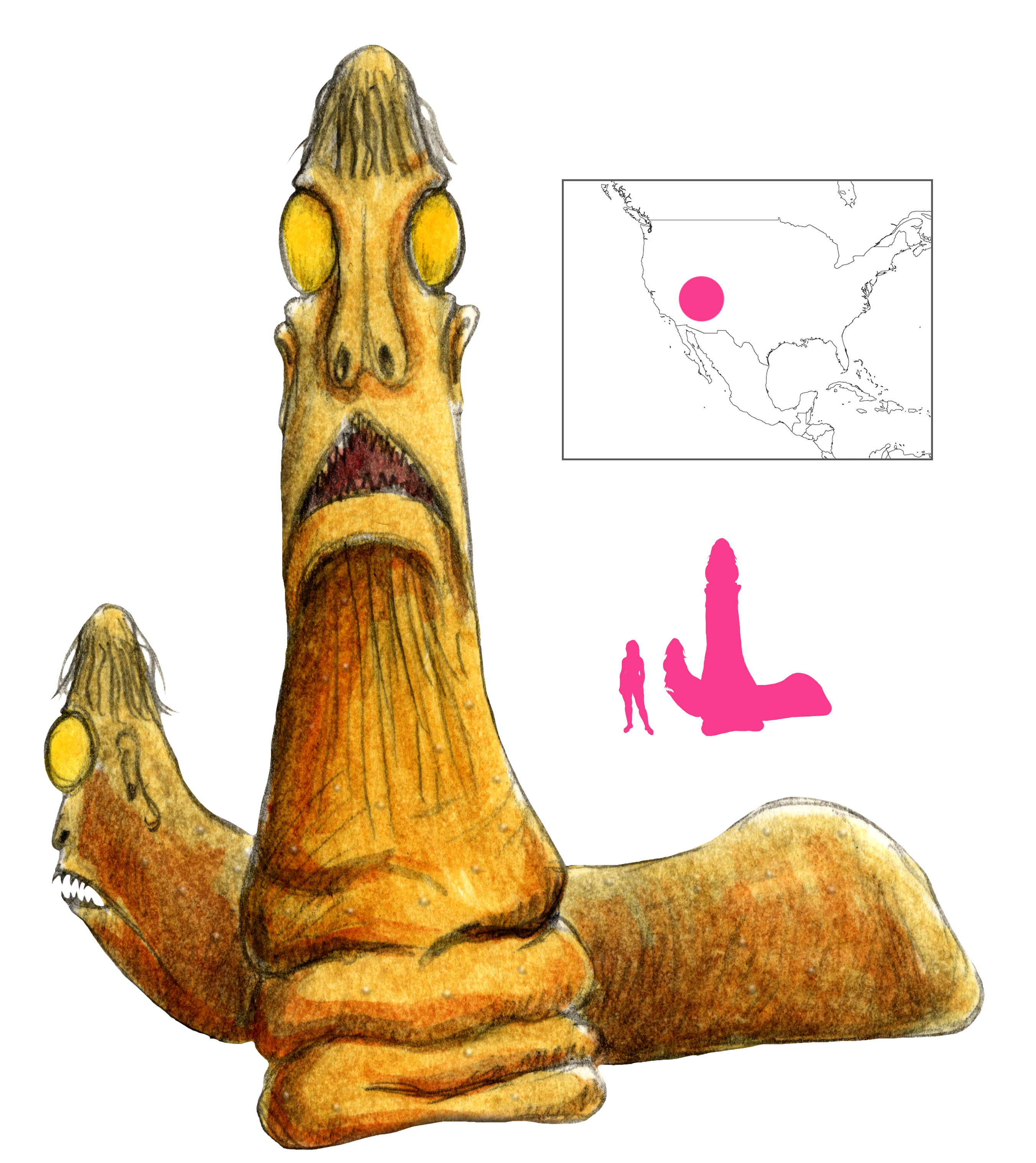
The Binaye Ahani, or “Eye Killers”, were among the many Anaye that were slain by Nayenezgani. As with the other original Anaye or “Alien Gods”, they were born from human women who had resorted to unnatural practices. Their “father” was a sour cactus.

The Binaye Ahani were twins born at Tse’ahalizi’ni, or “Rock With Black Hole”. They were round with a tapering end, no limbs, and depressions that looked like eyes. Their horrified mother abandoned them on the spot, but they survived to grow into monsters; as they were limbless, they remained where they were born. Instead of hunting prey actively, they could fire lightning from their eye sockets and fry anyone who approached them. In time eyes developed in the depressions on their head, and they could kill with their eyes as long as they kept them open. Magpie was their spy, and they had many children who took after them in the worst way.

Nayenezgani prepared for his fight with the Binaye Ahani by taking a bag of salt with him, and found the old twins in a hogan with their offspring. The monsters immediately stared at him, lightning shooting from their bulging eyes, but Nayenezgani’s armor deflected the beams. He responded by throwing salt into the fire, which spluttered and sparked into their eyes, blinding them. With the Binaye Ahani in disarray, Nayenezgani waded in and killed all but the two youngest. He took the eyes of the first Binaye Ahani as trophies.

“If you grew up here, you would only become things of evil”, he told the survivors, “but I shall make you useful to my people in years to come”. To the older one, he said “You will warn men of future events, and tell them of imminent danger”, and it became a screech owl. To the younger he said “You will make things beautiful, and the earth happy”, and it became a whippoorwill.

In other versions the surviving children become a screech owl and an elf owl, while the parents are turned into cacti.

References

Locke, R. F. (1990) Sweet Salt: Navajo folktales and mythology. Roundtable Publishing Company, Santa Monica.

Matthews, W. (1897) Navaho legends. Houghton Mifflin and Company, New York.

O’Bryan, A. (1956) The Diné: Origin Myths of the Navaho Indians. Bulletin 163 of the Smithsonian Institution, Washington, D. C.

Reichard, G. A. (1950) Navaho Religion: A Study of Symbolism. Bollingen Foundation Inc., New York.

Tapirê-iauara

Variations: Tapir Nymph, Onça d’Água (Water Jaguar), Onça Pé de Boi (Cow-legged Jaguar), Paraná Pura Iuraretê (Turtle/Jaguar that Dwells in River Side Channels), Tai-açu-iara (potentially)

Tapire-iauara

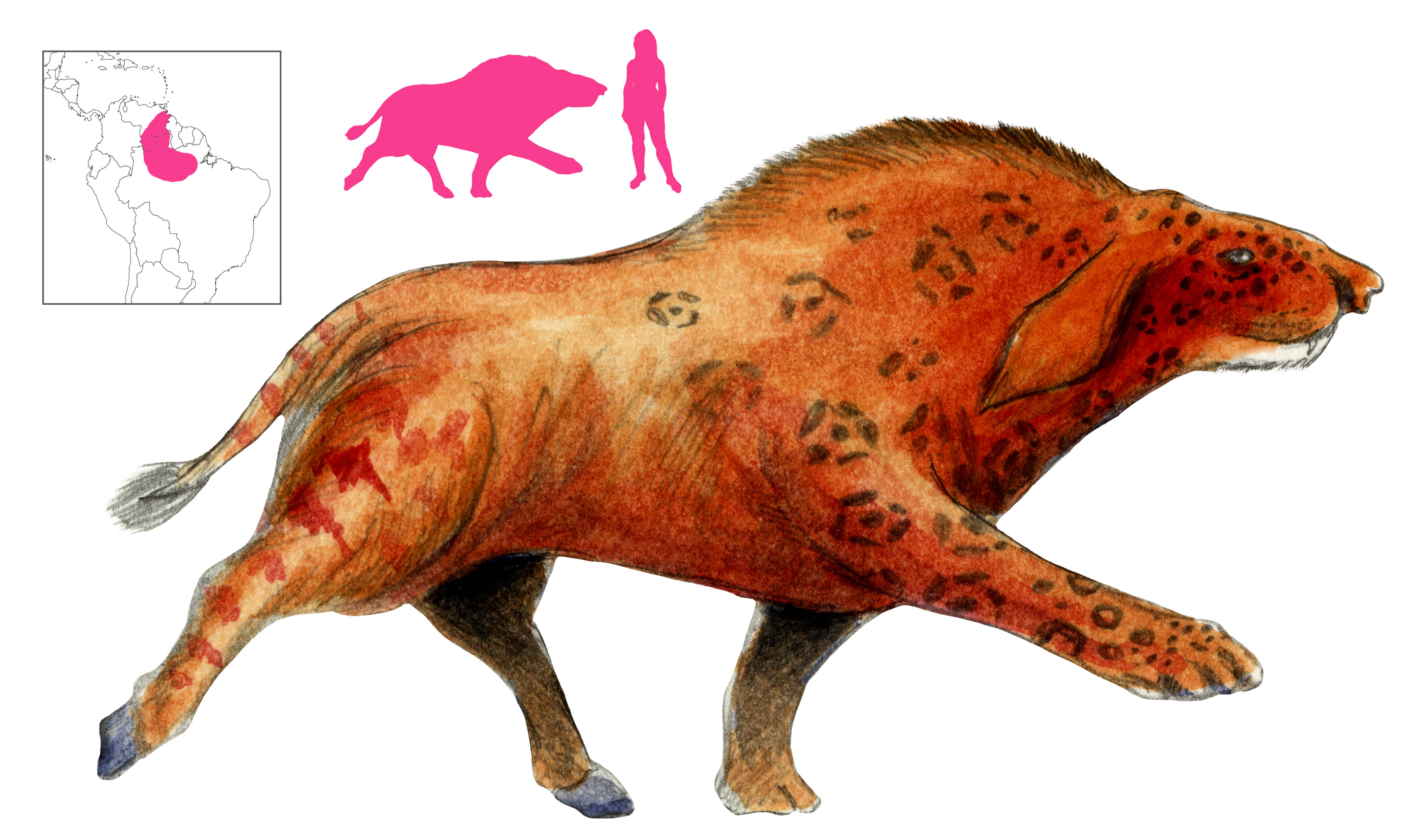
The Tapirê-iauara, or Tapir Nymph, enjoys a wide distribution in the Amazon, from the Orinoco in Venezuela to the Rio Negro, the Madeira, the Tapajós, and the Amazon down to Pará. Sightings have been reported from around Codajás, Fonte Boa, Itacoatiara, Nova Olinda, Oriximiná, Santarém, and Urucurituba. It lives in slower-moving waters, near groves of aninga or palm trees, and avoids human settlements.

The name tapirê-iauara is etymologically complex. Tapiré is Tupi for “tapir”, while y is “water” and ara is “lady” in língua geral; it also draws from the Tupi uara (“dweller”) or yguara (“dweller in water”). Hence, “tapir water-lady” or “tapir nymph” is a rough translation. This same derivation gives us the Amazonian nymphs Yara and Oyoára, the sea monster Hipupiara, and Paraná Pura Iuraretê, which was apparently a giant turtle creature that later was subsumed into the tapirê-iauara (iuraretê meaning either “turtle” or “jaguar”).

Reports of the tapirê-iauara appearance have varied somewhat. Most accounts agree that it resembles a cow-sized jaguar with a reddish waterproof coat, a thick mane, long droopy ears half a meter in length, and an overpowering stench (catinga). It may have jaguar legs, or the forelegs of a jaguar and hooved, donkey-like hindlegs. It may have horse legs with or without catlike paws, duck feet, or large otter paws. Variations in fur color include red, gold, and black with a cream patch in the chest. It notably does not look much like a tapir.

A tapirê-iauara is heard and smelled before it is seen. The large, finlike ears flap noisily against the water as it swims, while its putrid odor precedes it. From a safe distance, it’s merely nauseating; at close quarters the stench of a tapirê-iauara is enough to cause fainting and outright death. Tapirê-iauaras can also mesmerize prey into standing still before pouncing on them.

Tapirê-iauaras have a broad diet that includes large fish, capybaras, caimans, and humans. They are attracted to hauls of fish and the halitosis resulting from eating poorly-cooked fish. They often show up to inspect fishermens’ catches – or the fishermen themselves. When they do, they are fast, persistent, and resilient, relying on their odor to weaken prey before killing it with their sharp teeth and claws. One fisherman had to empty 12 slugs from a .22 rifle into a pursuing tapirê-iauara before the beast expired. Other fishermen have not been so lucky, having their catches stolen at best or being dragged into the river and devoured at worst.

Sometimes the stink of a tapirê-iauara is enough to cause a human’s shadow (and therefore soul) to depart. A person who has lost their shadow in this way is said to be assombrado. They can recover their soul by inhaling the fumes of a fire made with leaves, sticks, and the bones of undercooked piranhas.

Caraña resin (Protium heptaphyllum) is repulsive to tapirê-iauaras, and anyone concerned about tapirê-iauara attack should equip themselves with some before heading into the Amazon. Tapirê-iauaras also cannot climb, and so shelter should be sought in trees. As the tapirê-iauara’s odor will cause fainting and potentially falling out of the tree, secure branches must be found.

The Tai-açu-iara from around Parintins is similar and may be the same animal. It appears as a black piglike creature with jaguar paws.

References

Smith, N. J. H. (1981) Man, Fishes, and the Amazon. Columbia University Press, New York.

Smith, N. J. H. (1996) The Enchanted Amazon Rain Forest. University Press of Florida, Gainesville.

Hrökkáll

Variations: Hrökk-áll

Hrokkall

A malicious Icelandic wizard once revived a dead, half-rotted eel, giving rise to an evil and toxic creature. It was the first Hrökkáll, or “coil-eel”. The wizard may be long dead, but the eel’s descendants went on to infest polluted waters.

A hrökkáll is two feet long, and resembles an eel in appearance. It lives in still ponds and stagnant water, and occasionally in running rivers. It has flexible, iron-hard scales, and sharp saw-toothed fins. As with many Icelandic fishes, it secretes corrosive venom and its meat is poisonous. Captured hrökkálls have been known to melt their way through earth and rock to squirm back into the water.

Hrökkálls lie in wait until someone steps in the water. Then they coil around the person’s leg and constrict it, slicing into flesh and bone alike and amputating the limb. It is unknown whether hrökkálls use their acidic venom or their bladed fins (or both) to do this. They will dismember humans and horses in this way, but sheep are safe as their legs are too narrow for the hrökkáll to gain a hold.

Hrökkáll in common parlance has since evolved to mean electric eels.

References

Davidsson, O. (1900) The Folk-lore of Icelandic Fishes. The Scottish Review, October, pp. 312-332.

Zoëga, G. T. (1911) English-Icelandic Dictionary, Second Edition. Sigurdur Kristjansson, Reykjavik.

Raiju

Variations: Raijū, Thunder-animal, Thunder-beast

Raiju

In Japan, it is said that lightning cannot pass through a mosquito-net – and neither can the Raiju. These creatures also hate the smell of incense.

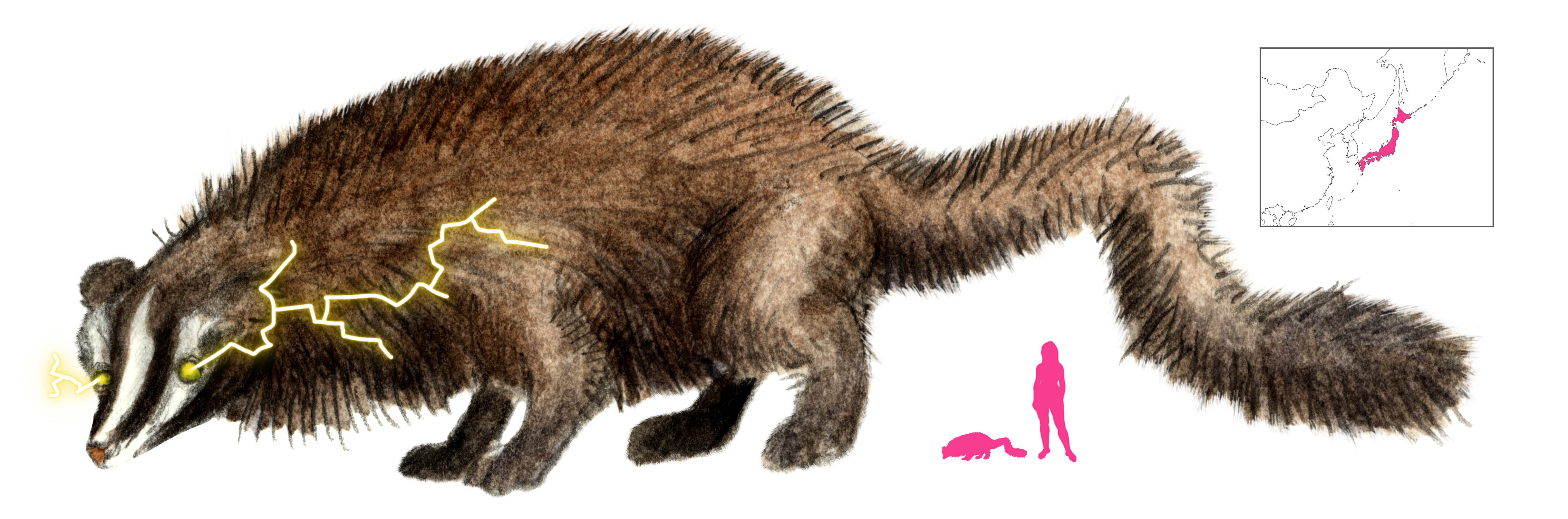
A raiju, or thunder-beast, ranges from dog to squirrel in general appearance, but usually resembles a badger. It falls from the sky with the lightning, and jumps from tree to tree. After the storm has passed, evidence of the raiju’s presence can be seen in the torn, deeply gouged treetrunks and woodwork where a raiju dug its claws in. Such raiju-damaged trees can be harvested for bark that cures toothache.

Raijus will pounce on anyone taking shelter beneath a tree, and will enter any house unprotected by mosquito netting or incense. They also love to eat human navels, and so it is vital to keep one’s navel protected during a thunderstorm, sleeping face-down if necessary.

Despite their elusive nature, raijus have been captured on multiple occasions. The Edo period in particular has many such cases across Japan, and it is believed the Chinese Bencao gangmu text was the inspiration for the raiju craze. One raiju got tangled in the ropes of a well and was taken alive. Another raiju was exhibited (for a fee) in a brass cage in the Temple of Tenjin in Matsue. It looked like a badger, and was said to sleep during fair weather, but during storms it would become active, with its eyes flashing.

The masked palm civet or hakubishin (Paguma larvata) is the most likely contender for the originator of the raiju. This badger-like animal was brought over to Japan from mainland Asia perhaps as early as the Edo period, its unfamiliar nature leading to tales of lightning beasts.

References

Foster, M. D. (2015) The Book of Yokai. University of California Press, Berkeley.

Hearn, L. (1910) Glimpses of Unfamiliar Japan (Second Series). Bernhard Tauchnitz, Leipzig.