Jetin

Variations: J’tin, Crion

Jetin

Jetins (from jeter, “to throw”) are tiny lutins native to the seaside caves of Brittany. Their appearance is uncertain; Dubois suggests they are hirsute and rough-looking, with silver shoes. Despite their size – ranging from thumb-sized to 1.5 feet tall – they are incredibly strong, capable of lifting and tossing huge boulders with ease.

Always looking for a chance to show off their strength, jetins amuse themselves by throwing rocks around, sometimes over great distances. Standing stones, menhirs, all manner of megaliths; such stones are discarded playthings of the jetins.

Rock-throwing was not the only pastime the jetins enjoyed. They were also fond of tying knots in horse tails and releasing livestock, and, like any good fairy, they often exchanged human babies for one of their own. The ugly, wrinkled changelings they leave behind are never weaned and never grow. Jetins can be convinced to return stolen children by carrying the changeling to a jetin hole and threatening to kill it. The human baby will quickly be returned and swapped with the impostor.

The jetins shared their territory with the even tinier Fions and the secretive Fées des Houles (“Fairies of the Sea Caves”). Due to their size and their reclusive natures, none of these have been observed in great detail, although the Fées have been benevolent towards humans. The Crions, perhaps the same as jetins, were tiny dwarfs who carried the stones of Carnac on their shoulders.

Elsewhere, the discobolous function of the jetins is fulfilled by Gargantua and other giants, whose size is more proportionate to their strength, and the fairies known as Fileuses (“Weavers”).

References

Dubois, P.; Sabatier, C.; and Sabatier, R. (1992) La Grande Encyclopédie des Lutins. Hoëbeke, Paris.

Morvan, F. (1998) Vie et mœurs des lutins bretons. Actes Sud.

Sébillot, P. (1905) Le Folk-lore de France, Tome Deuxième: La Mer et les Eaux Douces. Librairie Orientale et Américaine, Paris.

Sébillot, P. (1907) Le Folk-lore de France, Tome Quatrième: Le Peuple et L’Histoire. Librairie Orientale et Américaine, Paris.

Seps

Variations: Sep, Sepedon

Seps

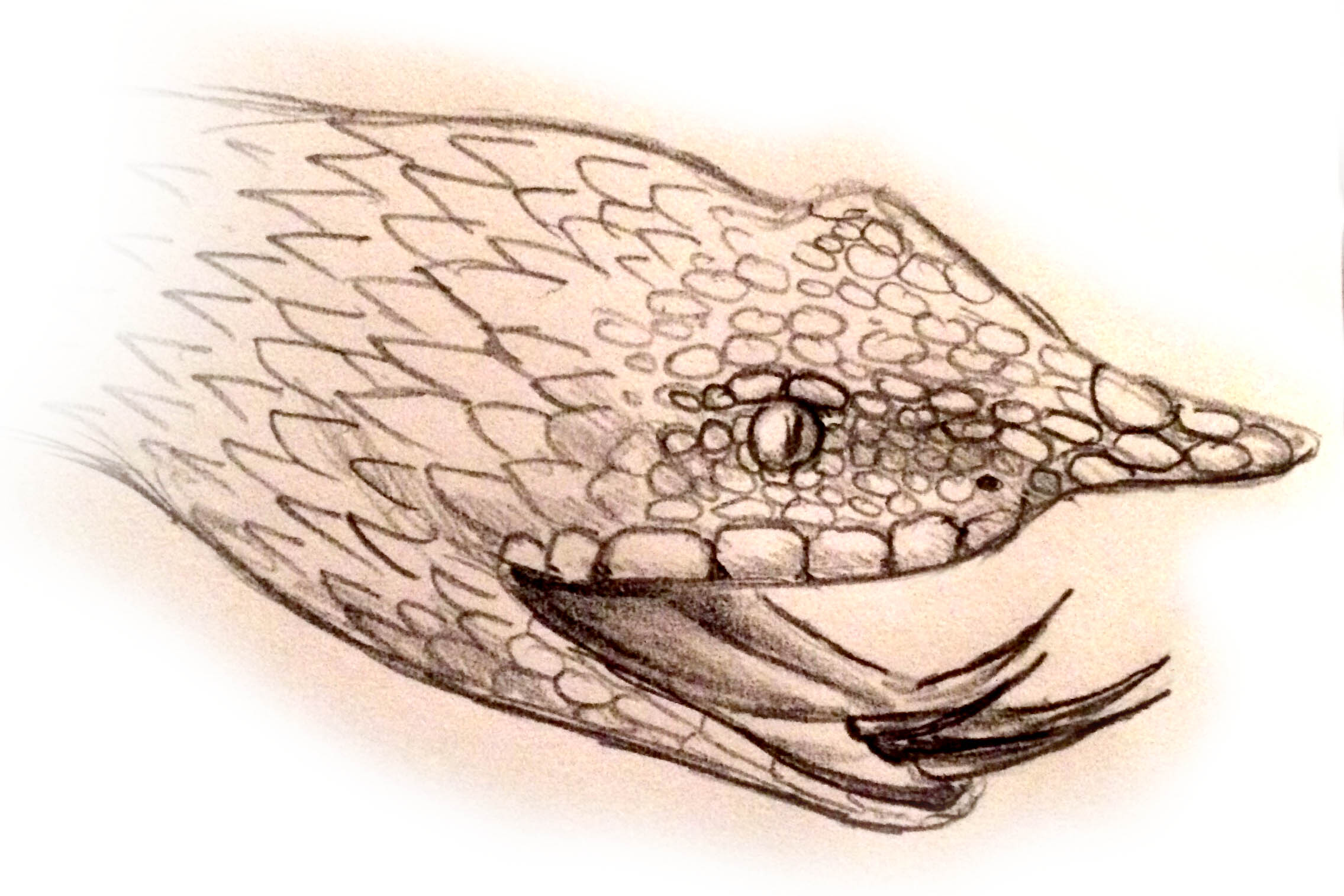
The Seps – “putrefaction” – is a deadly snake found in the deserts of Africa. It is especially feared for its corrosive venom, which melts flesh and bone alike to leave its victim a smear on the ground. Lucan awarded it the title of Libya’s greatest plague.

A seps is about two cubits (about a meter) long, and varicolored along its length; some say it can also change color like a chameleon. It uniquely has four hollow fangs in its lower jaw. Topsell attests to its speed, describing its motion as going “by spires and half-hoops”, possibly a reference to sidewinding. Aldrovandi gives the seps a horn on the nose and large triangular scales. Seps can be found in valleys, deserts, and under rocks. They can survive winters thanks to their natural warmth.

Seps bwSeps venom is highly virulent, causing massive necrosis and putrefaction of tissues. Skin, muscle, blood, bone – everything rots and dissolves away, and if the bite is not treated, the victim literally melts into oblivion, leaving nothing behind. Eldred points out that the original Greek seps killed in the same way as the dipsas – by inducing extreme thirst. Lucan alters that to better suit the snake’s name.

For antivenin, Topsell recommends the same measures as with other venomous snakes, as well as sponges soaked in warm vinegar; a concoction of ashes, butter, and honey; or otherwise millet, honey, bay, oxymel, and purslane.

Lucan describes the fate of a Roman soldier after being bitten by a seps. The unfortunate Sabellus’ skin, flesh, and sinews shriveled away from the bite, exposing bare bones before they, too, succumbed to the venom. The putrefying venom worked its way upward from the bite, and the soldier melted like a candle.

While no snake has venom as powerful as that of the seps, the symptoms of seps bite seem to be an exaggeration of actual necrosis caused by snake bite.

References

Aelian, trans. Scholfield, A. F. (1959) On the Characteristics of Animals, vol. II. Harvard University Press, Cambridge, Massachusetts.

Aldrovandi, U. (1640) Serpentum, et Draconum Historiae. Antonij Bernie, Bologna.

Batinski, E. (1992) Cato and the Battle with the Serpents. Syllecta Classica, Vol. 3, pp. 71-80.

Eldred, K. O. (2000) Poetry in Motion: the Snakes of Lucan. Helios 27.1, p. 63.

Isidore of Seville, trans. Barney, S. A.; Lewis, W. J.; Beach, J. A.; and Berghof, O. (2006) The Etymologies of Isidore of Seville. Cambridge University Press, Cambridge.

Lucan, trans. Rowe, N. (1720) Pharsalia. T. Johnson, London.

Topsell, E. (1658) The History of Serpents. E. Cotes, London.

Ziphius

Variations: Ziph, Ziphio, Ziphij, Xiphia, Xiphias, Zyffwal

Ziphius

The Ziphius is a huge and horrifying sea monster, reportedly found in northern seas and near the Scandinavian coast. It resembles a whale in shape and size, but with a viciously sharp beak and terrifying bulging eyes. The beak and bristly hair around the head and neck combine to give it an owlish appearance. The ziphius also has a pointed dorsal fin, paw-like flippers, and horizontal stripes down its length. It is a carnivore, feeding on seals and sailors alike.

The Ortus Sanitatis gives it four fully-formed legs and tail, making it look more like a beaked lion or even a hedgehog. Olaus Magnus describes its hideous, beaked head, comparing it to an owl (or a toad in the French translation). It has a deep maw, horrid large eyes, and a knife-like dorsal fin used to tear holes in ships. Gessner compared it to the physeterus. Munster showed it swallowing a sea calf, and emphasizes the fact that it is horrible.

Today Ziphius refers to the harmless and rarely seen Cuvier’s beaked whale. Killer whales probably were a more significant contribution to the image of the ziphius, as were swordfishes – ziphius is derived from xiphias, or sword.

De Montfort interpreted the ziphius differently. As it had a hooked beak and blazing eyes, he believed that it must have been a distortion of the giant squid or kraken.

References

van Duzer, C. (2013) Sea Monsters on Medieval and Renaissance Maps. The British Library, London.

Gessner, C. (1560) Nomenclator aquatilium animantium. Christoph Froschoverus.

Magnus, O. (1555) Historia de gentibus septentrionalibus. Giovanni M. Viotto, Rome.

Magnus, O. (1561) Histoire des pays septentrionaus. Christophle Plantin, Antwerp.

de Montfort, P. D. (1801) Histoire Naturelle, Générale et Particuliere des Mollusques, Tome Second. F. Dufart, Paris.

Munster, S. (1552) La Cosmographie Universelle. Henry Pierre.

Unknown. (1538) Ortus Sanitatis. Joannes de Cereto de Tridino.

Palis

Variations: Pālīs, Pa-lis, Pali (erroneously)

Palis

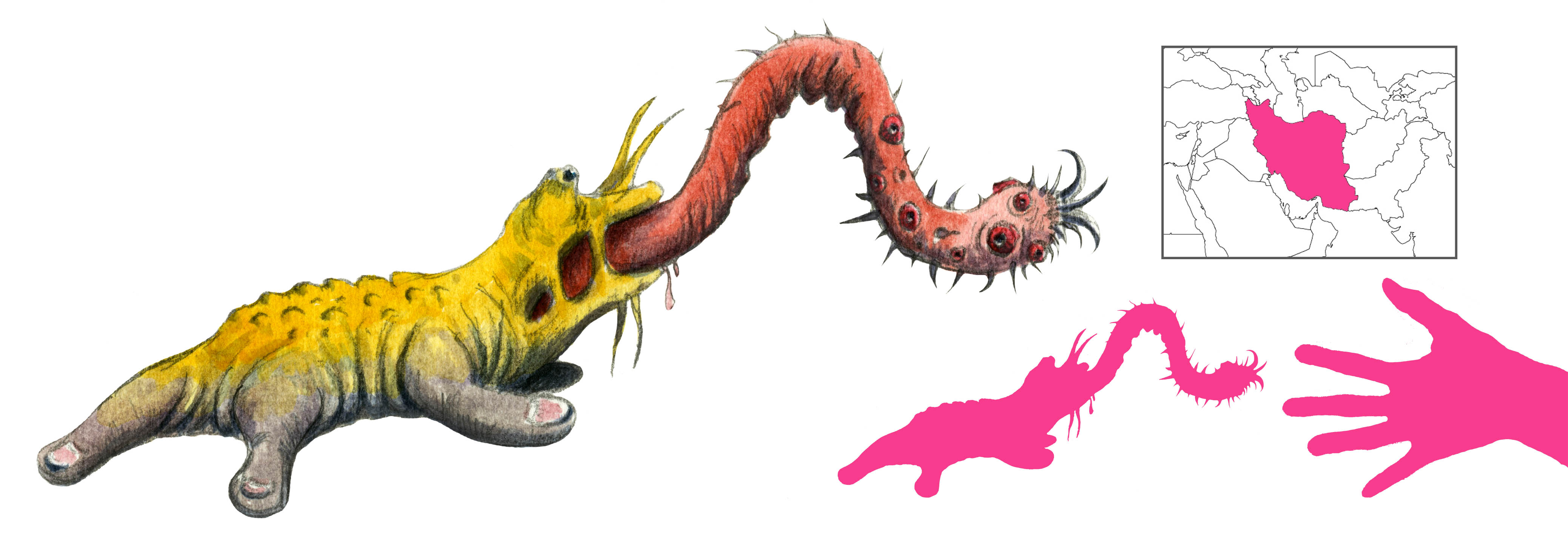
The Palis (“foot-licker”; rhymes with “police”) can be encountered in the deserts of Iran. There is no description given for this creature, but its appearance is presumably as vile as its habits.

A palis is a vampiric creature that preys on sleeping travelers. It locates their feet and proceeds to lick the soles, steadily draining blood away until the host dies.

Most means of thwarting a palis revolve around concealing one’s feet. The palis is thankfully rather stupid, and can be easily convinced to give and go elsewhere. The best-known method of dealing with a palis was pioneered by two muleteers from Isfahan, who went to sleep in the desert with the soles of their feet touching, blanketing themselves so that only their heads were visible. When a palis arrived, it circled for hours, searching vainly for their feet all night long. By daybreak it slunk away, lamenting its bad luck. “I have wandered through a thousand and thirty-three valleys, but I have never seen a man with two heads!”

References

Browne, E. G. (1893) A Year Amongst the Persians. Adam and Charles Black, London.

Christensen, A. (1941) Essai sur la Démonologie Iranienne. Ejnar Munksgaard, Copenhagen.

Dubois, P.; Sabatier, C.; and Sabatier, R. (2005) The Complete Encyclopedia of Elves, Goblins, and Other Little Creatures. Abbeville Press.

Masse, H. (1954) Persian Beliefs and Customs. Behavior Science Translations, Human Relations Area Files, New Haven.

Zabraq

Variations: Zabrak; Rukh (al-Marwazi); Phalmant (Bochart)

Zabraq

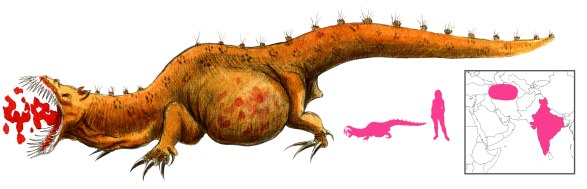
The Zabraq is one of the many exotic animals found in India. Bochart gave its location as the region of Dasht or Dist, the “gateway to Tartary”, and so presumably in the vicinity of Iran. It is also variously known as the Rukh and the Phalmant, although only the last term has seen use.

It is relatively modest in size, smaller than a cheetah, yellowish-red in color with flashing eyes and capable of leaping thirty to fifty cubits or more in one jump. Al-Marwazi makes it look like a camel, with two humps, tusks, and a large, membraneous tail, and adds that it is incredibly fast. Bochart, perhaps confusing its leaping distance with its size, makes it vast, prodigious, hideous, and forty cubits long, with bristling claws and teeth. Most importantly, it has highly acidic, weaponized urine and feces.

Zabraqs prey on animals up to the size of elephants, and kill them by flinging their caustic urine onto them with their tail. The tail of a zabraq can flatten and deform into a shovel shape to hold urine and dung before throwing it. The only animal zabraqs will avoid is the rhinoceros.

They are also fond of eating humans, and the only way to escape one is to climb a teak tree, which the zabraq cannot scale. Even that isn’t necessarily a safe place. When faced with treed prey, a zabraq will try to leap upwards and seize it before spouting its urine skyward, burning anything it touches like fire. However, if it cannot reach its prey through this stratagem, it turns towards the roots of the tree, roars in frustration until clots of blood erupt from its mouth, and expires.

Zabraq bile and testicles make potent poison; coated on weapons, it causes immediate death. Al-Marwazi goes further and specifies that the flesh, blood, saliva, and dung of the zabraq are all deadly.

Bochart reported this creature under the name of Phalmant and attributed it to Al-Damiri, although his account is entirely al-Mas’udi’s. Flaubert mentioned the phalmant it in his Temptation as a leopard howling so hard its belly bursts. The Dictionnaire Universel inexplicably turns it into a sea monster found on the coast of Tartary.

References

Berthelin, M. (1762) Abrégé du Dictionnaire Universel Francais et Latin, Tome III. Libraires Associés, Paris.

Bochart, S. (1675) Hierozoicon. Johannis Davidis Zunneri, Frankfurt.

Flaubert, G. (1885) La Tentation de Saint Antoine. Quantin, Paris.

Kruk, R. (2001) Of Rukhs and Rooks, Camels and Castles. Oriens, vol. 36, pp. 288-298.

al-Mas’udi, A. (1864) Les Prairies d’Or, t. III. Imprimerie Impériale, Paris.

Seznec, J. (1943) Saint Antoine et les Monstres: Essai sur les Sources et la Signification du Fantastique de Flaubert. PMLA, Vol. 58, No. 1, pp. 195-222.

Lavandière de Nuit

Variations: Lavandière, Laveuse de Nuit (French); Kannerez Noz, Cannerez Noz, Gannerez Noz (Breton); Bean nighe, Bhean Nighe, Caoineachag, Nigheag Bheag a Bhroin (Gaelic); Washerwoman, Night Washerwoman, Washer of the Ford, Little Washer of Sorrow (English)
Lavandiere

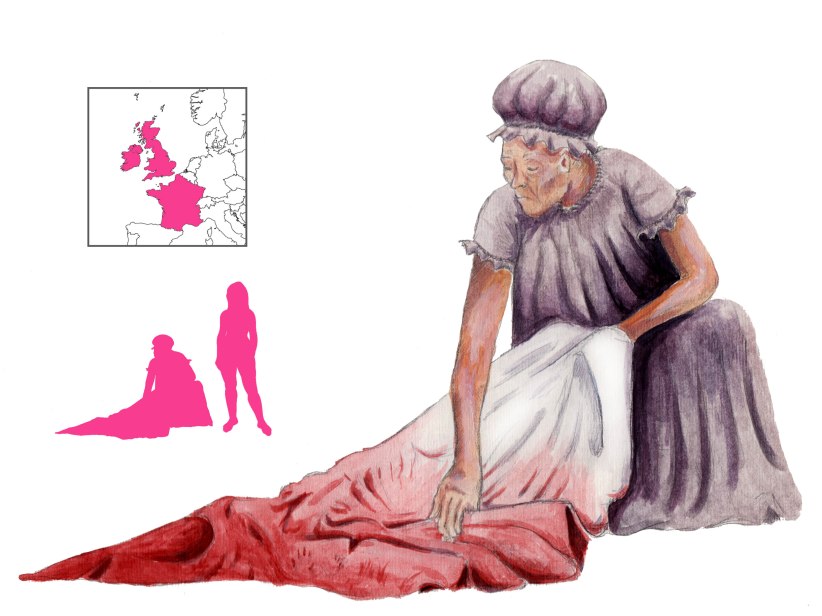
The lavandières de nuit (“washerwomen of the night”) are present in some form or other from Scotland to Provence. Their exact nature is uncertain; sometimes they are ghosts, other times members of the fairy kingdom. Their best-documented haunt is Brittany.

Lavandières are female, and can be seen washing laundry in the odd hours of the night. They usually take the form of tall, gaunt, and withered crones, but the Gollières a Noz of Romandie are as beautiful as they are cruel. Some of them sing as they wash, earning them the name of kannerez noz (night singers). Their song is sadder than a De Profundis. Those of Morbihan have had their song recorded as follows:

Tors la guenille, tors // Le suaire des épouses des morts.

(Wring the rags, wring // the shroud of the wives of the dead).

Often a lavandière is condemned to wash a shroud in atonement for a sin committed in life. Some merely did laundry on Sunday. Others were greedy misers who denied decent clothing to the poor. The grimmest were those guilty of infanticide. The outline of a baby’s corpse could be seen in their blood-soaked sheets; try as they might, the blood never washed out, and the bones never whitened.

The bean nighe of the British Isles are women who died in childbirth before their time, and who are doomed to wash the clothes of those fated to drown until the day when they were meant to die. Their appearance foretells death. Some are aligned with the Morrigan, and wash the corpses of the dead. Cú Chulainn saw one, the daughter of Bodhbh, washing bloodstained clothes and weeping; he died in battle not long after.

In France, especially in Brittany, they call passers-by to help them wring out the laundry. This isn’t a choice – those who accept out of ill will get their arms broken, and those who refuse are drowned. To escape their clutches, one must wring in the same direction they do, turning clockwise when they turn clockwise and vice versa. But this has to be kept up all night, and the lavandières never tire. One false move and the unfortunate victim is crushed, wrung out, their corpse mangled beyond recognition. Even the strongest man is no match for a lavandière, who wrings humans out as easily as a pair of tights.

Another way of escaping their clutches is to tell them Diwasket ho poan ha me diwasko ma hini (“wring out your sins, and I will wring out mine”). Running away at top speed always helps, and lavandières cannot cross recently-ploughed fields. Finally, making the sign of the cross or reciting Biblical verses is always helpful.

The lavandière of Chantepie was a stingy woman who buried her husband in a dirty shroud. She continues to wash it every night.

The lavandières of Fond-de-Fond hold up the bodies of the recently-deceased.

In Landéda, the lavandières are powerless against the goodhearted, but tie the sinful into knots.

The lavandière of Noes Gourdais, near Dinan, appeared early in the morning and had a skull for a head.

The Mille-Lorraines of Lower Normandy form fairy circles around ponds.

Several lavandières gather in the pond of Roc-Reu, and drown anyone who tries to touch them.

Around Dinan, the teurdous (“twister”) is a rare male counterpart. He does not wash, but instead offers to help washerwomen wring out their laundry. If they accept, he breaks their arms.

The true nature of the lavandières is more prosaic. Unfamiliar sounds have been invoked – the croaking of frogs or toads, for instance, might have suggested the sound of washboards. The lavandières themselves may have had nothing supernatural about them. A number of flesh-and-blood women may have had reason to do laundry at night: those who worked during the day, those who did not wish to be seen doing menial work, those who wanted to clean the clothes of their illicit lovers… Anyone coming upon them could be forgiven for seeing them as ghosts.

Others managed to exploit the superstitious fear of lavandières. A garde-champêtre in Vaucluse once stumbled upon a pair of lavandières in spectral white clothes. “Wring the laundry!” they cackled, grabbing him by the collar. And wring he did, all night long. He also noted the fine quality of the cloth they were washing, but did not dare stop until morning, when they left. Only later did the warden find out that a nearby castle had been robbed of various items of clothing. He had spent the whole night helping the thieves wash their ill-gotten gains.

References

Dubois, P.; Sabatier, C.; and Sabatier, R. (1996) La Grande Encyclopédie des Fées. Hoëbeke, Paris.

Giraudon, D. La lavandière de nuit Ar gannerez-noz. In Loddo, D. and Pelen, J. (eds.) (2001) Êtres fantastiques des régions de France. L’Harmattan, Paris.

Kilfeather, A. (2003) Legend and wetland landscape in Ireland. Journal of Wetland Archaeology, 3, pp. 37-50.

Le Quellec, J. (1988) Le légendaire du Sud-Vendée: organisation spatio-mythique. Etuderies 3-4.

MacPhail, M. (1898) Folklore from the Hebrides III. Folklore, Vol. 9, No. 1, pp. 84-93.

Sand, G. (1877) Légendes Rustiques. Ancienne Maison Michel Lévy Frères, Paris.

Sébillot, P. (1881) Littérature orale de la Haute-Bretagne. Maisonneuve et Cie, Paris.

Sébillot, P. (1904) Le Folk-Lore de France, Tome Premier: Le Ciel et la Terre. Librairie Orientale et Américaine, Paris.

Sébillot, P. (1905) Le Folk-Lore de France, Tome Deuxième: La Mer et les Eaux Douces. Librairie Orientale et Américaine, Paris.

Sébillot, P. (1968) Le folklore de la Bretagne. Éditions G. P. Maisonneuve et Larose, Paris.

Mi’raj

Variations: Al-Mi’raj (usually erroneously), Miraj (lacking the ‘ayn), Mirag (see previous, also Egyptian pronunciation)

Miraj

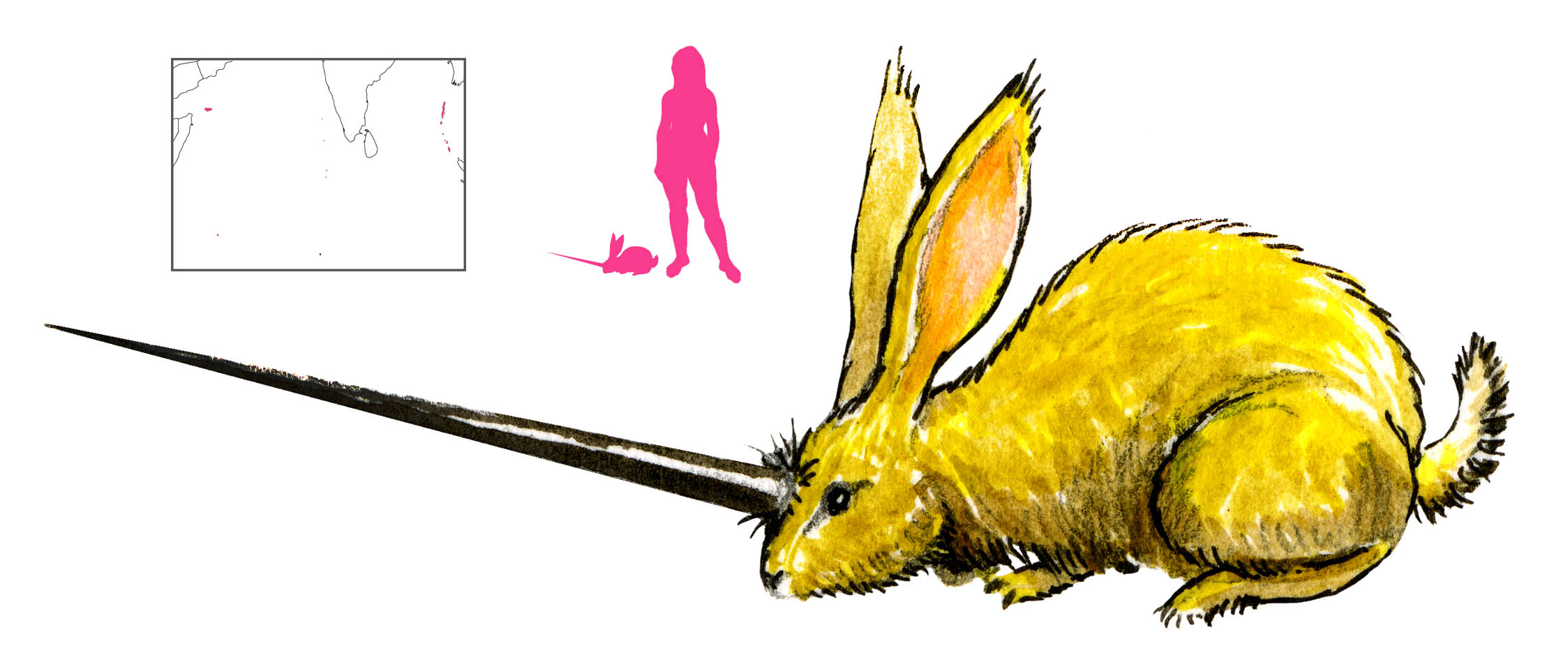
When Alexander the Great visited Jazirat al-Tinnin – the Dragon’s Island – he was immediately presented with an opportunity to play the hero. The inhabitants of this unspecified island in the Indian Ocean were terrorized by a fire-breathing dragon, which would exact a tribute of two oxen a day to be left at the opening of its lair. Ever the tactician, Alexander stuffed two ox-skins with pitch, sulfur, and other unpalatable substances, and had them dropped off for the dragon; the reptile perished soon after eating them.

Among the gifts Alexander was given for this sauroctonous feat was a Mi’raj, a creature resembling a yellow rabbit with a single black horn on its forehead. It was apparently so aggressive that wild animals would flee at the sight of it – a feature it shared with the karkadann, and which may have arisen from confusion between the two unicorns. It certainly wasn’t fierce enough to avoid being captured (alive or dead).

The exact pronunciation of the name is unclear, as with the absence of diacritics, “mi’raj” may as well be “mu’raj”. It is sometimes rendered as Al-mi’raj, literally “The mi’raj”; this is unnecessary in English, and any usage of this term preceded with “the” or “an” is redundant. Bochart (and by extension Flaubert) refers to it as “mirag”, which is correct in Egyptian Arabic but drops the difficult ‘ayn.

Al-Qazwini was the first to report the story of Alexander and the mi’raj. Al-Damiri describes the mi’raj as “great [and] marvelous”.

If there is any factual basis for the existence of the mi’raj, it may well have been a rabbit with facial tumors caused by papillomaviruses. The same has been used to explain the origin of the jackalope, a North American hybrid used to fool tourists and usually created by grafting horns on a jackrabbit skin.

References

Bochart, S. (1675) Hierozoicon. Johannis Davidis Zunneri, Frankfurt.

Al-Damiri, K. (1891) Hayat al-hayawan al-kubra. Al-Matba’ah al-Khayriyah, Cairo.

Ettinghausen, R. (1950) The Unicorn. Studies in Muslim Iconography, Freer Gallery of Art Occasional Papers Vol. 1, No. 3, Washington.

Al-Qazwini, Z. (1849) Zakariya ben Muhammed ben Mahmud el-Cazwini’s Kosmographie. Erster Theil: Die Wunder der Schöpfung. Ed. F. Wüstenfeld. Dieterichsche Buchhandlung, Göttingen.

Seznec, J. (1943) Saint Antoine et les Monstres: Essai sur les Sources et la Signification du Fantastique de Flaubert. PMLA, Vol. 58, No. 1, pp. 195-222.

Zimmer, C. (2011) A Planet of Viruses. University of Chicago Press.

Puaka

Variations: Puwaka, Puaki

Puaka

The Puaka (“Pig”) is a Dusun demon that guards water in eddies, and resembles a pig with a razor-sharp tongue. Puakas like to feed from trees, and stand on each other’s backs until they reach the branches.

When you meet a Puaka, it will attack if you move, and come to a halt if you stop. If it catches up with you, it will lick your bones clean. To lose the Puaka it is recommended to cross a stream; the creature may follow you across the stream, but once on dry land it will pause to lick itself dry, licking the flesh off its bones in the process.

“Puaka” and similar terms have meant pig in a number of languages – puaka in Rarotongan, Mangarevan, Rotuma, and Malay, vuaka in Fiji, puwaka in Malay, pua’a in Samoan, puaa in Tahitian, Marquesan, and Hawaiian, buaka in Tongan, and poaka in Maori. While this has been alternately compared to the Sanskrit sukara, the Latin porcus, and the English porker, the word seems to have had its own unique Polynesian origin. In some areas puaka has come to denote the pig-like demon; sometimes it loses its meaning as “pig” altogether, possibly due to the influence of Islam.

References

Mackenzie, D. A. (1930) Myths from Melanesia and Indonesia. Gresham Publishing Company, Ltd., London.

Dijiang

Variations: Ti-chiang

Dijiang

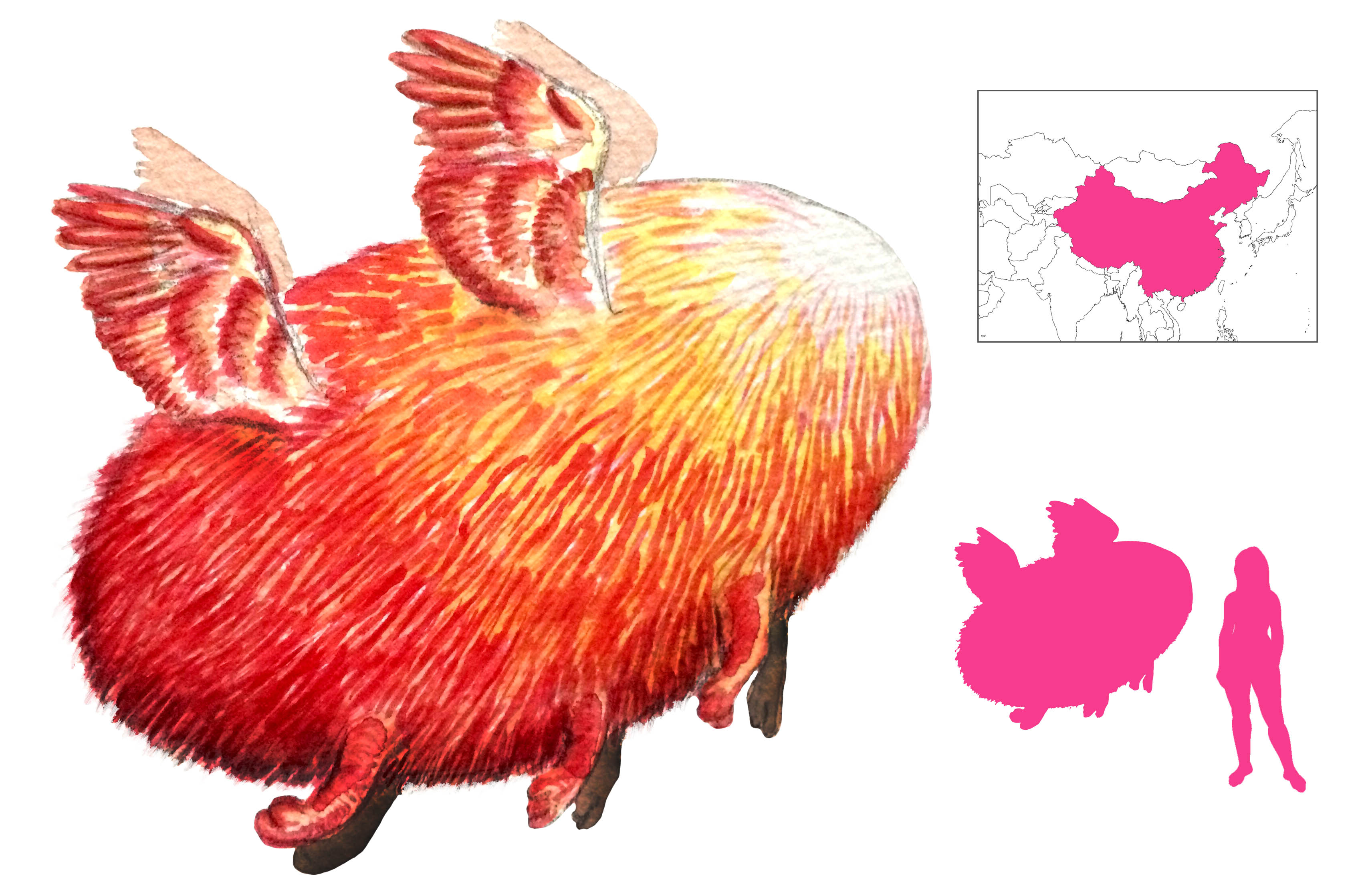
The divine bird known as Dijiang, the “Thearch Long River”, was like a yellow sack with an aura of cinnabar; Borges, calling it the Ti-chiang, described it as bright red. It had six legs and four wings, but no eyes or facial features of any kind, living in a perpetual state of confusion. It was also fond of singing and dancing.

This “state of confusion” led to the association of Dijiang with Hundun, a being of cosmic chaos. The undifferentiated Hundun had no eyes, ears, mouth, or orifices of any sort, and died when his guests tried to drill openings in his body.

Dijiang’s description can be found in the Guideways Through Mountains and Seas, where it is located in the Celestial Mountain along with large quantities of metal and jade. Borges attributes it to the T’ai Kuang Chi.

The four wings and six legs, as well as the lack of apparent head, suggest a magnified insect of some sort.

References

Borges, J. L.; trans. Hurley, A. (2005) The Book of Imaginary Beings. Viking.

Mathieu, R. (1983) Étude sur la mythologie et l’ethnologie de la Chine ancienne. Collège de France, Paris.

Strassberg, R. E. (2002) A Chinese Bestiary: Strange Creatures from the Guideways Through Mountains and Seas. University of California Press.

Dipsas

Variations: Dipsa, Dipsades (pl.), Ammobates (“sand crawler”), Arida (“arid”), Kausone (“burner”), Melanurus (“black-tail”), Prester (“inflater”, erroneously), Situla (“bucket”), Torrida (“torrid”)

Dipsas

The Dipsas – “thirsty” or “thirst-causer”, among its many names – was one of the deadly snakes encountered by Cato’s army in the African desert. It was feared for its venom, which induced unquenchable, desperate thirst in its victims. Aelian and Aldrovandi believed it to be the same as the prester, a conclusion which Topsell disputed.

Aelian points out that the dipsas is white with two black stripes on its tail; Topsell mentions its black tail and black-and-yellow spots on its anterior; Aldrovandi pictures it with longitudinal black and white stripes and prominent scales on its head. Dipsades may be found near sources of water, including springs and marshes, and they will also lie in wait in ostrich nests.

The small size of the dipsas makes it easy to overlook, and its bite is painless; its victims often are oblivious to the cause of their unnatural thirst. The venom seeps into the bones, sets fire to the organs, absorbs vital fluids, and parches the tongue and throat. Sometimes victims are driven to drink so much that their stomachs explode; if there is no water around, they eventually succumb to internal burning.

Lucan describes the effect of a dipsas bite on the Roman standard-bearer Aulus, bitten after he accidentally stepped on a dipsas. No amount of water could quench his thirst, and, after trying in vain to drink up a river, he tore his wrists open in a last-ditch effort to drink his own blood. His suicide was practically a mercy.

Aelian mentions a tale told where a donkey, charged by Zeus with bestowing immortality on mankind, stopped by a spring to drink. That spring was guarded by a dipsas, which refused to allow the donkey to drink until it had given it the secret of immortality – and since then, the snake sheds its skin and rejuvenates itself, while humans, much like the unfortunate Gilgamesh, lost their chance at eternal youth. This story was also told by Sophocles and a number of other authors. Dipsades also guard a spring in the Pharsalia, and Cato (correctly) points out that snake venom is harmless in water. In both of these cases, we have the dipsas causing thirst not by its bite, but by denying access to water.

The descriptions of dipsas venom may be close to the actual effects of some snake venoms, notably the burning sensation and the parched throat. Nowadays Dipsas refers to a genus of New World snakes that only pose a threat to snails and slugs.

References

Aelian, trans. Scholfield, A. F. (1959) On the Characteristics of Animals, vol. II. Harvard University Press, Cambridge, Massachusetts.

Aldrovandi, U. (1640) Serpentum, et Draconum Historiae. Antonij Bernie, Bologna.

Batinski, E. (1992) Cato and the Battle with the Serpents. Syllecta Classica, Vol. 3, pp. 71-80.

Eldred, K. O. (2000) Poetry in Motion: the Snakes of Lucan. Helios 27.1, p. 63.

Isidore of Seville, trans. Barney, S. A.; Lewis, W. J.; Beach, J. A.; and Berghof, O. (2006) The Etymologies of Isidore of Seville. Cambridge University Press, Cambridge.

Lucan, trans. Rowe, N. (1720) Pharsalia. T. Johnson, London.

Topsell, E. (1658) The History of Serpents. E. Cotes, London.