The Sazae-oni was first formally described by Toriyama Sekien in his first volume on “The Illustrated Horde of Haunted Housewares”. He gives it a philosophical origin, stating that if sparrows become shells and moles become quails, surely it was possible for a sazae – a horned turban shell – to become an oni. So he dreamed.
Reference is made to the 72 Seasons, namely a mid-October season where “sparrows become clams” and a mid-April season where “moles emerge as quails”. The former is based on an old wives’ tale that sparrows become clams to hibernate in winter, while the latter is a poetic description of animals coming out of hibernation.
Sekien’s illustration shows a sinuous sluglike creature with humanoid arms emerging from a large horned turban shell. The head is a spiky shell with protruding eyeballs, and seaweed is draped around the neck.
References
Sekien, T.; Alt, M. and Yoda, H. eds. (2017) Japandemonium Illustrated: The Yokai Encyclopedias of Toriyama Sekien. Dover Publications, New York.
The Wolpertinger is a taxidermist’s chimera native to Bavaria, known since the 16th century. It has fangs, wings, and deer’s antlers on the body of a hare. Variants across Germany include the oibadrischl, the Thuringian rasselbock, and the dilldapp, all of which may have different combinations of antlers and/or fangs.
The wolpertinger and its many variations may have some biological truth to them. Rabbits and hares infected with papillomavirus develop strange tumors on their bodies. When they grow on the head and face, interpreting those tumors as horns or fangs is not difficult.
References
Panafieu, J. and Renversade, C. (2014) Créatures fantastiques Deyrolle. Plume De Carotte, Toulouse.
Zimmer, C. (2011) A Planet of Viruses. University of Chicago Press.
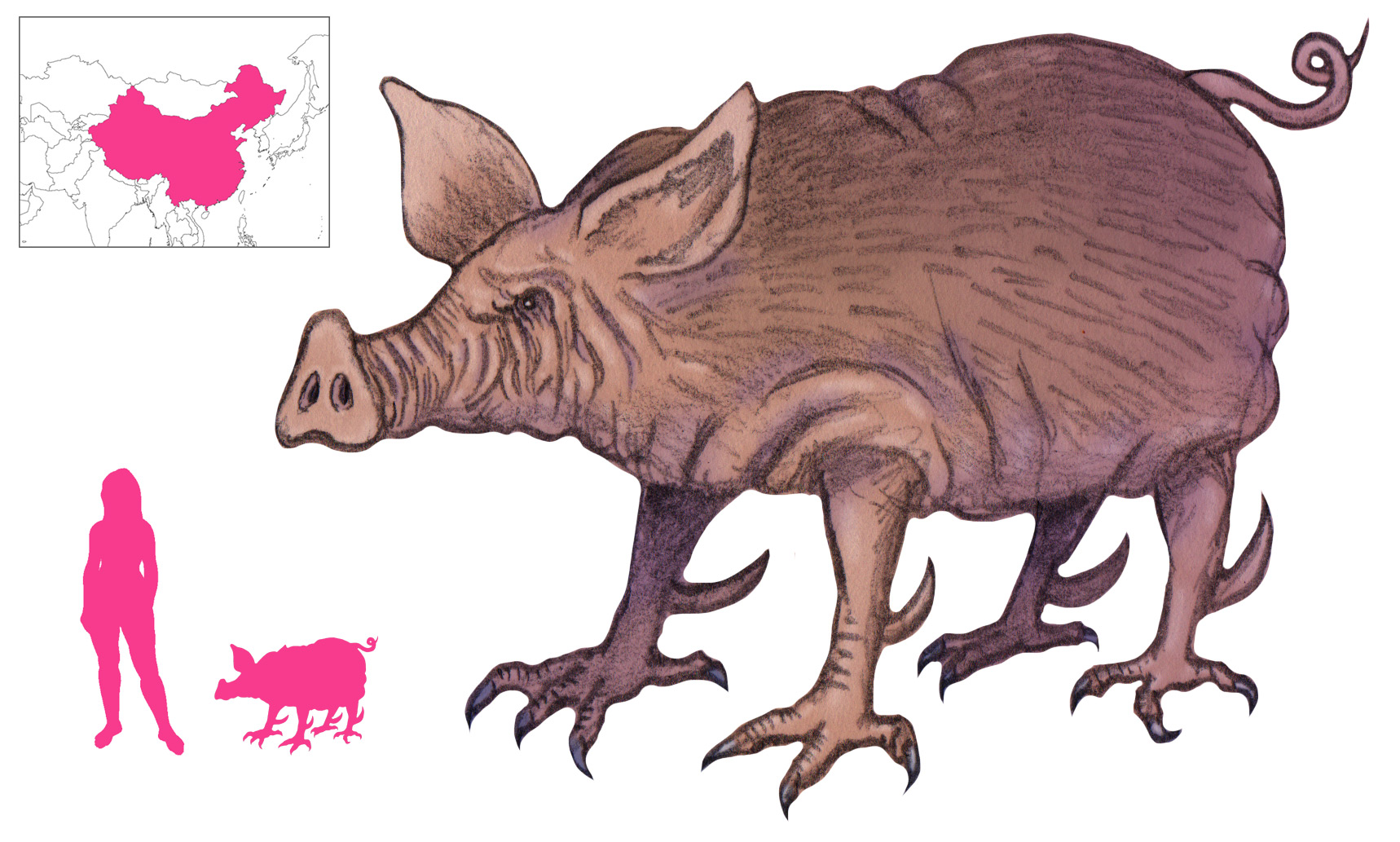
The Lili or Powercat can be found around Willow Mountain in China. It barks like a dog and looks like a pig with spurs on its feet. Its appearance foretells considerable earthwork construction in the district.
References
Mathieu, R. (1983) Étude sur la mythologie et l’ethnologie de la Chine ancienne. Collège de France, Paris.
Strassberg, R. E. (2002) A Chinese Bestiary: Strange Creatures from the Guideways Through Mountains and Seas. University of California Press.
Variations: Groot Slang, Big Snake, Great Snake, Great Snake of the Orange River, Ki-man
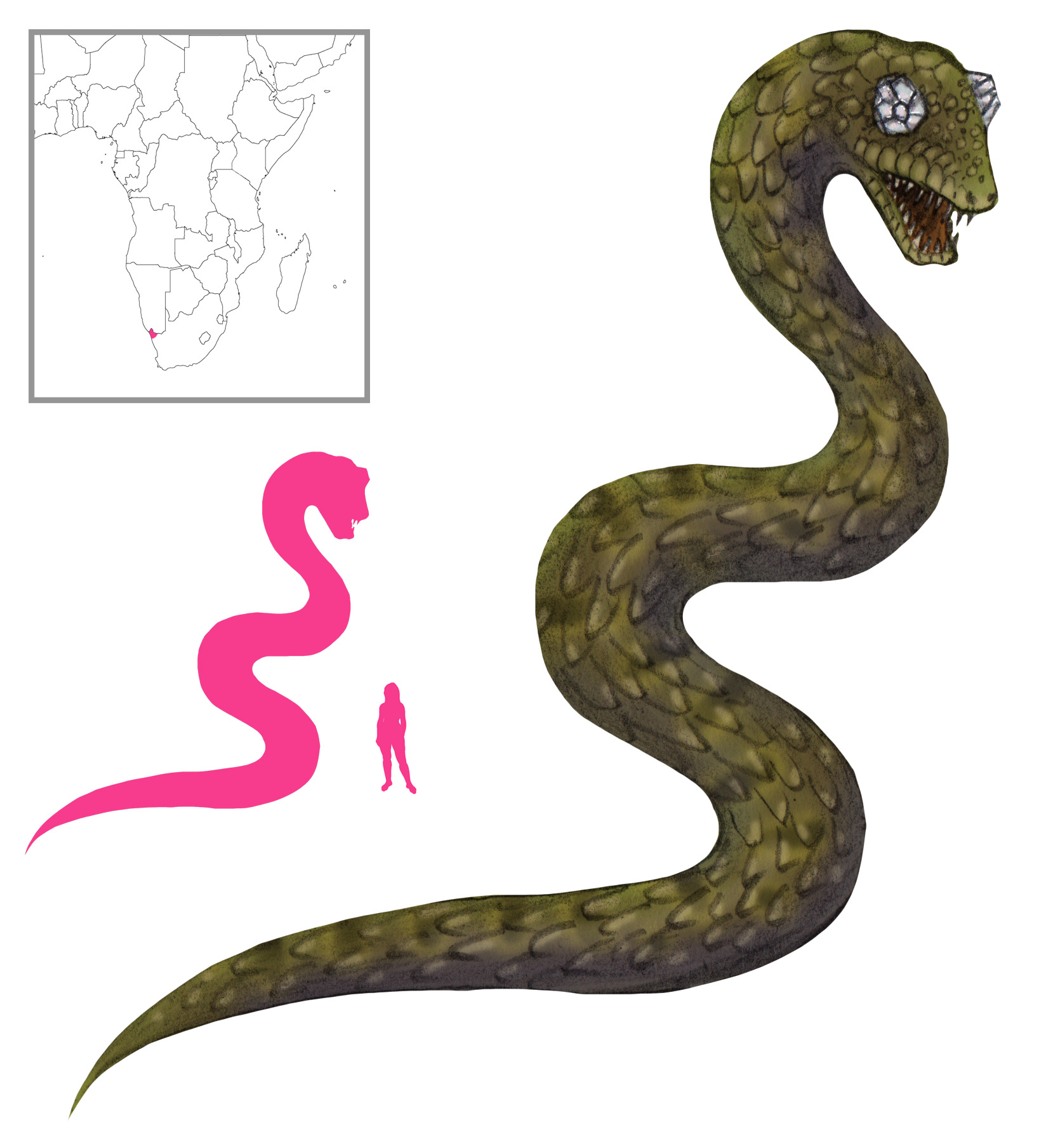
The Grootslang, literally “big snake” or “great snake”, dwells in or around the Orange River in the Richtersveld, South Africa, in association with fabulous diamond deposits. Its home may be in the Orange River itself, a pool underneath the King George Cataract, a big rock, or a semi-mythical cave known as the “Wonder Hole” or the “Bottomless Pit”. The cave is said to be the source of the diamonds of South Africa; from there they move down a pipe to the river, which carries them to the sea.
As its name implies, the grootslang is an enormous snake, big enough to take cattle at the water’s edge. It has huge diamonds in its eye-sockets, and its presence exerts an evil influence on all who see it. It is some forty feet long, and leaves a serpentine spoor on muddy river banks that is 1.5 to 3 feet wide. There are never traces of feet associated with the grootslang’s spoor.
Over time the grootslang has accumulated elephantine features. This stems partly from the cryptozoological desire to connect it to the mokele-mbembe and other such surviving dinosaurs, and partly from Rose’s description of it as “huge, like an elephant, with the tail of a serpent”.
References
Cornell, F. C. (1920) The Glamour of Prospecting. T. Fisher Unwin Ltd., London.
Green, L. G. (1948) Where Men Still Dream. Standard Press Ltd., Cape Town.
Rose, C. (2000) Giants, Monsters, and Dragons. W. W. Norton and Co., New York.
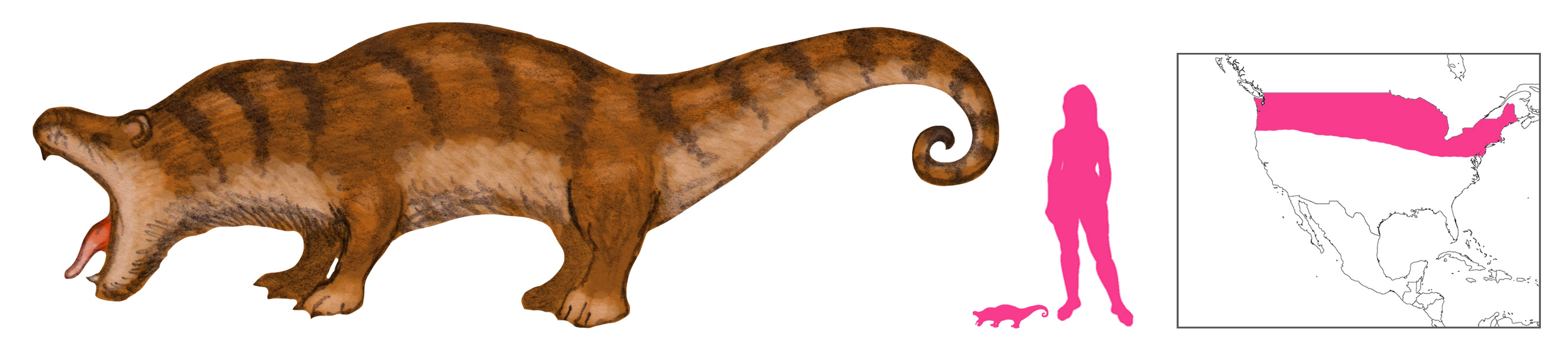
Treesqueaks make a whole variety of sounds, including vocalizations that evoke the wind in the trees, a cougar’s whine, a piglet’s squeal, and firecrackers at a wedding. These critters of the northern woods are small, prehensile-bodied, and can change color to match the tree they’re on. They look like weasels and are about as friendly as weasels.
Unexplained noises are always the work of a treesqueak.
References
Tryon, H. H. (1939) Fearsome Critters. The Idlewild Press, Cornwall, NY.
Variations: Ro, Bete-Rô, Bete-Ro, Bete Rô, Bete Ro (Rô Beast)
The Rô Beast lived in a cavern at the Pointe de Roux, off Aytré near La Rochelle. A hideous dragon with a winged body and a long scaly tail, Rô was also armed with a malign, near-human intelligence. It used its cunning to lay traps for humans and devour them. It was feared across the coastline, and none could stand against it.
But the reign of Rô was ended by seven pagan heroes that arrived on a boat by high tide. They had come to judge Rô. Panicking, the dragon retreated to the Pont de la Pierre, keeping its eyes on its tormentors. There, the heroes loosed seven arrows: two closed its eyes, two pierced its ears, two sealed its nostrils, and one pinned its horrid mouth shut. Roaring and thrashing in agony, Rô was cast into a deep pit, where it will remain until the end of time. The seven pagan heroes took their places as guardians around the pit where Rô thrashed impotently.
Rô still lives, screaming its rage from its prison. When it howls to the north, the gulf of Chevarache in the Breton Pertuis is agitated with waves; when it howls to the south, it’s Maumusson that stirs. The old folk say that it’s a good thing it doesn’t turn to the west, for the islands would turn to dust.
The legend of the Rô beast seems to have grown around the local landscape. The Pont de la Pierre was a ruined cromlech. Seven granite stones (now gone) around a deep pit were said to have been the heroes’ seats of justice. The image of Rô was recognized in the arch of the principal portal of the Church of Talmont, although it may just as well be the lion of Ezekiel.
Who were the pagan heroes? The image of warriors from the sea evokes Vikings, but it may be a relic of an older Gaulish legend of gods arriving from the sea. As for the name Rô, Dontenville saw in it a corruption of an older pagan deity.
References
Dontenville, H. (1966) La France Mythologique. Tchou, Paris.
Lamontellerie, A. (1995) Mythologie de Charente-Maritime. Le Croit Vif, Collection Documentaires.
Sébillot, P. (1905) Le Folk-lore de France, Tome Deuxième: La Mer et les Eaux Douces. Librairie Orientale et Américaine, Paris.
Variations: Moha, Great Barrier Sea-serpent, Great Barrier Reef Sea-serpent, Chelosauria lovelli
The Moha-Moha was seen on a beach on Great Sandy Island by schoolteacher Selina Lovell and a small group of accompanying people on June 8, 1890. It was, however, familiar to the natives of the region by the name moha-moha, “dangerous turtle”. It was known to attack coastal camps and catch people by the leg. By January 3, 1891, details of the encounter were published in Land and Water. This in turn resulted in a more formal description by William Saville-Kent, who requested further details from Lovell and gave the creature the name of Chelosauria lovelli.
A “monster turtle fish”, the moha-moha was 30 feet long, with an enormous dome-shaped body, a long neck, and a twelve-foot-long tail. It allowed Lovell to observe it for half an hour while standing five feet away from it. Then it turned towards the sea, raising its body and tail above the water and tossing a number of fish into the air before dashing off into deeper water.
The moha-moha had a saurian face, with teeth or serrated jaw-bones. The skin was glossy and smooth as satin. It had its mouth open and visible above the water, and no visible nostrils, leading Lovell to conclude that it breathed through its mouth. The rounded jaws were 18 inches long. The head and neck were a greenish white with white spots on the neck and a white band around a very black eye.
The dome-shaped carapace, about 8 feet across by 5 feet high, was slate-grey in color and smooth. The long tail was silver shading to white with thumb-nail sized scales and a chocolate-brown fin. The scales lay perpendicular to the tail, like the tiles of a roof. The head and tail were very different from each other, looking like they had come from two different animals. Lovell was unable to see the feet, but she was told that the moha-moha had feet like an alligator.
Whatever it was that Lovell saw, she was immediately treated with condescension. Buckland, editor of Land and Water, believed the moha-moha to have been a Carettochelys, “a monster turtle” from the Fly River (despite the fact that Carettochelys does not exceed 30 inches in length). He added that “the fair observer must have been mistaken on this very important point”. Lovell responded indignantly, but the editor stood by his statement, making it clear that the moha-moha combined fish and tortoise and thus was scientifically impossible.
To Saville-Kent, Lovell sent a confirming document signed by her and all the witnesses present. But Saville-Kent’s description of the moha-moha takes on a mocking tone, recommending using it as “the chief ingredient… of a new and alderman-enthralling brand of turtle soup”. It won’t be long before moha-moha is on restaurant menus, and the “Queensland brand-new, soup-potential species should possess “a local habitation and a name” that shall separate it decisively from the common herd of sea-serpents that have already had their day”.
Heuvelmans took a very negative view of the moha-moha, which all the more remarkable considering his unquestioning acceptance of far more ambiguous sightings. He refers to the “innocence and ineptitude” of the parties involved, and states that “with all due respect to her sex, [Lovell] can only be an arrant liar, and a bad liar at that”, accusing her of “psychotic behavior” and “mythomania”. He proceeds to discredit her account, pointing out that no animal has scales like the moha-moha. “One pities her poor pupils, for her own style is often so confused as to be incomprehensible”, he adds snidely. He compares its shelled, fish-like appearance to both armored Devonian fishes and the Indian makara. “I find it hard to believe that Miss Lovell was not a dotty old maid who had picked up, but not digested, a smattering of palaeontology and Brahmin legend. Exit Chelosauria lovelli.”
What, then, did Lovell see on that beach in 1890? Most telling is the remark that the head and tail do not seem to belong on the same animal. France suggests a turtle entangled in a fishing net, with the mesh and its contents – broken floats, brown seaweed, and other debris – giving the impression of a long tail. Unfamiliarity and the unreliability of recollection did the rest. Native accounts of moha-moha attacks and ferocity may refer to other animals, perhaps seals.
References
France, R. L. (2016) Historicity of sea turtles misidentified as sea monsters: a case for the early entanglement of marine chelonians in pre-plastic fishing nets and maritime debris. Coriolis, 6(2), pp. 1-25.
France, R. L. (2017) Imaginary sea monsters and real environmental threats: reconsidering the famous Osborne, ‘Moha-Moha’, Valhalla, and ‘Soay Beast’ sightings of unidentified marine objects. International Review of Environmental History, 3(1), pp. 63-100.
Heuvelmans, B.; Garnett, R. trans. (1968) In the Wake of the Sea-Serpents.
Saville-Kent, W. (1893) The Great Barrier Reef of Australia. W. H. Allen & Co., Waterloo Place, London.
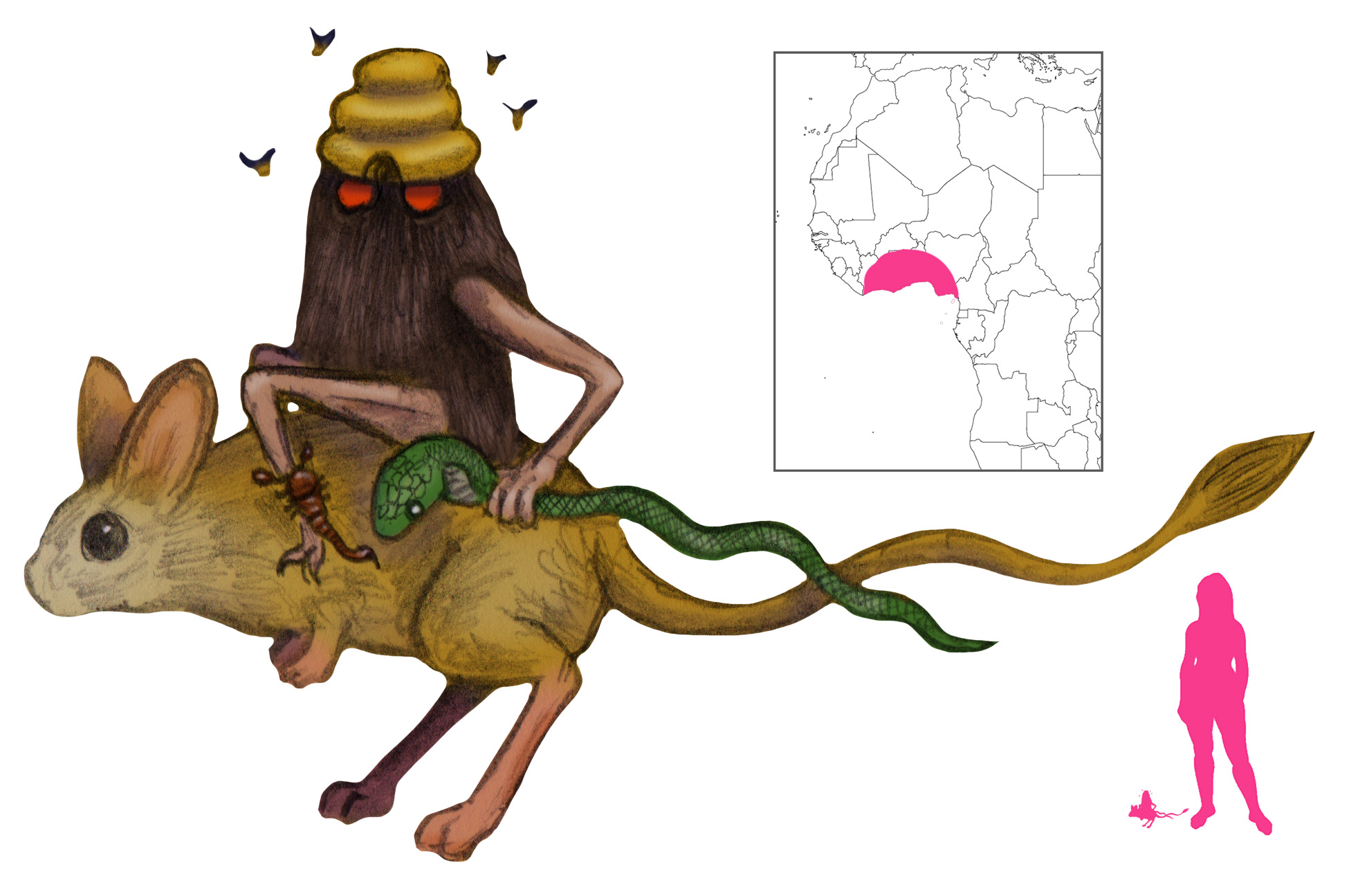
The Zankallala is a terrifyingly mighty creature from the folklore of the Hausa people. He is only the size of two clenched fists, but he wields a snake as a walking-stick, a pair of scorpions as spurs, and a swarm of bees as a hat. His mount is a jerboa. Wherever he goes, he is followed by birds that sing his praises and attack his enemies. He is also implied to have supernatural powers.
Even the dodo, the fearsome monster, the Swallower-of-Men, is powerless before the Zankallala. Once a boy was being chased by a dodo along a riverbank, and he came upon the Zankallala.
“Where are you going?” asked the Zankallala. “I’m running away from Dodo”, said the boy. “Stay”, said the creature. “The Dodo will not harm you”. And immediately a silk-cotton tree grew over the Zankallala, and the birds in it sang in praise.
“The Lion is afraid of the Zankallala,
The Hyena is afraid of the Zankallala,
Dodo is afraid of the Zankallala”.
When the dodo caught up with his quarry, he was nonplussed. “Where is my property?” he demanded. But the Zankallala responded impudently, saying “What property have you given me?” This infuriated the dodo. “If you will not give me my prey, then you will be my meal!”
With that the dodo gobbled up the tiny creature, only for the Zankallala to emerge from his stomach, accompanied by the joyous chorus of the birds. Then the dodo ate him again, but the Zankallala came out of his back, telling the birds to continue singing his praises. The third time the dodo swallowed him, the Zankallala emerged from the monster’s head, killing it.
“You may leave in safety”, the Zankallala told the boy, “you have seen that one is stronger than another, you escaped because you met me”.
This tale of a small trickster creature outwitting the dodo is sometimes told with a centipede or hedgehog replacing the Zankallala.
References
Tremearne, A. J. N. (1913) Hausa Superstitions and Customs. J. Bale and Sons and Danielsson, Ltd., London.
The Floitenthal, near the Ziller Valley in the Tyrol, has two great mountains, the Floitenthurm and the Teufelseck. The latter, the “Devil’s Corner”, is so name because the devil himself is said to descend from it in the form of a great fiery dragon glowing like an electric fire. The dragon flies a narrow hole, the Bleiarzkar, towards the Zillertal. This demonic dragon is known as the Alber, and it brings with it plague, war, and famine.
One time, during a night as black as pitch, two men climbed a cherry tree by the Mission Cross of Algund, near Meran. These men were Hanser, a tailor and a notorious ne’er-do-well, and old Loaserer Sepp, an honest villager.
To be fair to Sepp, he did not mean to participate in any unseeming behavior. Hanser had made a bet with some equally debauched friends to pick cherries from the tree near the cross, but, being an abject coward, he could not do it on his own, so he roped Sepp into accompanying him.
Both men climbed the tree, but Hanser filled his hat by the handful while Sepp could not find a single cherry no matter where he looked. Sepp was beginning to feel uncomfortable when, all of a sudden, the Alber flew by, throwing its burning light upon the scene.
Hanser was so scared he almost fell off the tree, but Sepp held the other man and prevented him from falling. “Are you so far gone, Hanser, that the devil gives you his blessing and lights your way?” said Sepp. “Then may God preserve you!” The honest man then turned to the fiery dragon. “Hi there! Wait a little until I find some cherries too!” The Alber left at once.
Sepp was a good, honest man, and the evil one had no power over him. His bravery was lauded long afterwards.
References
von Günther, A. (1874) Tales and Legends of the Tyrol. Chapman and Hall, London.
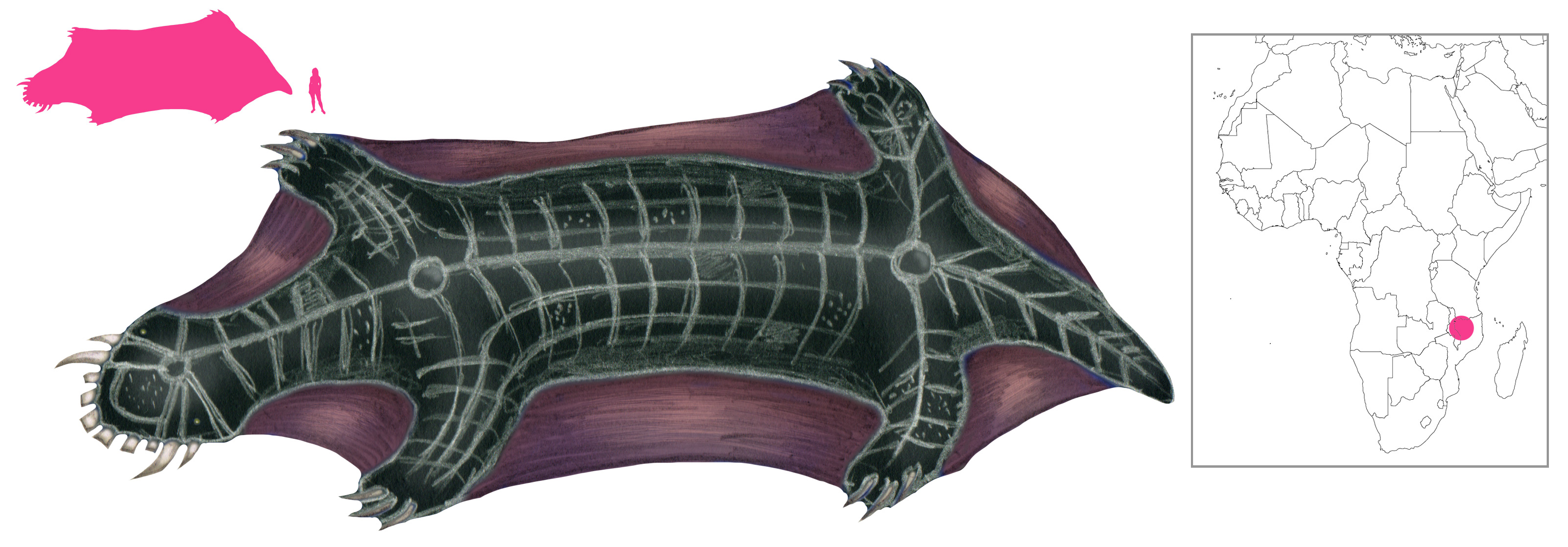
The Namungumi or Nalumgumi, usually translated to “whale”, features in the initiation ceremonies of the Yao people of Malawi, Mozambique, and Tanzania.
Despite the “whale” designation, the namungumi pictured in the inyago ceremonies has four limbs. There is a stylized and ornamental webbing drawn between the limbs, and there are two knobs marking the juncture of the neck with the forelimbs and tail with the hindlimbs respectively. It has prominent tusks around its head. The entire body is crisscrossed with a complex grid pattern.
The namungumi lives in Lake Malawi. It would surface near a village, and the people could come and carve off chunks of meat from its vast body. This action was painless and the wounds healed immediately. The meat itself tasted different depending on where it came from – some areas on the namungumi’s body produced choice cuts, while others were practically inedible.
As an initiatory figure the namungumi represents water and kinship.
A similar creature, the Liporo of the Anyanja, is not as large. Its habits include killing hippos and tipping canoes. It is believed to be extinct. The Napolo is a similar flood-related water serpent.
References
Morris, B. (2000) Animals and Ancestors: An Ethnography. Berg Publishers, Oxford.
Stannus, H. (1919) The Wayao of Nyasaland. Harvard African Studies, Cambridge, Massachusetts.