Zoureg

Zoureg

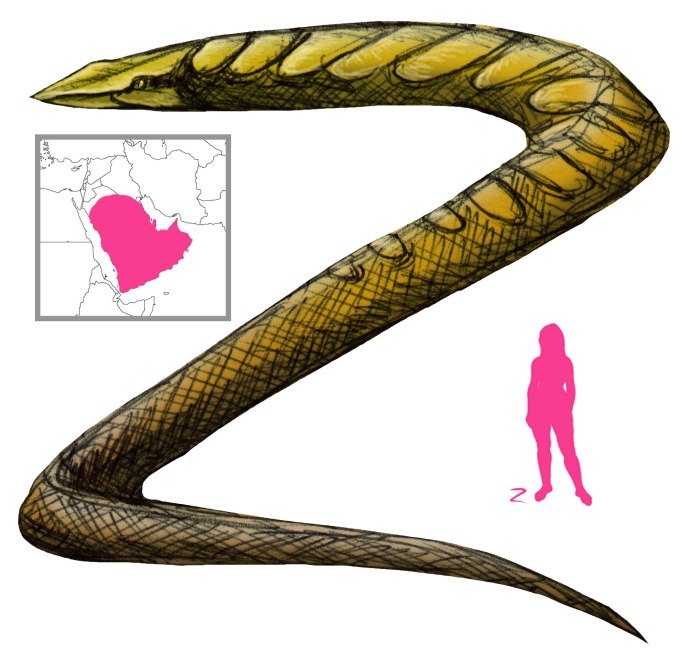
The Zoureg is a snake, one foot in length, that lives in the Arabian desert. When it moves it goes through everything in its path like a hot knife through butter; rocks, trees, walls and human bodies are all equally powerless to stop it. Anyone who a zoureg goes through dies instantly. It can only be killed by decapitating it in its sleep.

It has proven difficult to locate de Plancy’s sources for this purported Arabian legend, considering that “zoureg” is an oddly transliterated word with multiple possible spellings in Arabic.

References

de Plancy, J. C. (1863) Dictionnaire Infernal. Henri Plon, Paris.

Great-hand

Great-hand

The Old Town of Edinburgh is honeycombed with cellars, passages, and tunnels. These subterranean labyrinths are home to ancient horrors long forgotten by the residents. Great-hand is one of these.

Great-hand lives in the tunnel beneath the Royal Mile, stretching from the Castle to the Palace of Holyrood. Once used by soldiers for surprise attacks, it eventually fell into disuse. Then Great-hand moved in and the passage was abandoned completely. Nobody ever left the tunnel alive.

The only thing that has ever been seen of Great-hand is a hand – an enormous grisly hand, with fingernails like the claws of an eagle. If that hand is attached to a body, none have seen it.

After a while of avoiding the tunnel, a piper declared he would cross the tunnel, playing his pipes the whole way to verify his progress. Taking his dog along with him, he entered through the cave near the Castle, and the sound of his pipes could be heard traveling underground as he went down the hill. Then, at the Heart of Midlothian, the music stopped. The attending crowd went back to the entrance of the cave to see the dog running out in abject terror, completely hairless. The passage was blocked up from both ends.

Similar stories are told across Scotland involving haunted caves, foolhardy pipers, and dogs shedding their hair with fright. They are cautionary tales warning of the perils of the underground.

References

Fleming, M. (2002) Not of this World: Creatures of the Supernatural in Scotland. Mercat Press, Edinburgh.

One-Eyed One-Horned Flying Purple People Eater

Happy April Fool’s!

Variations: Flying Purple People Eater, Purple People Eater

OEOHFPPE

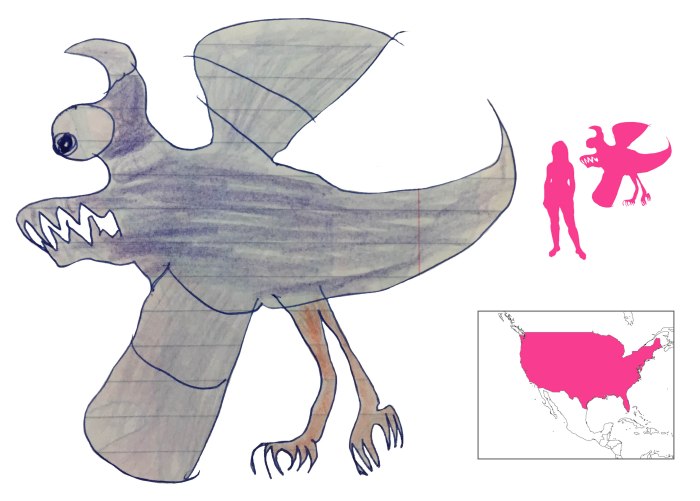
The One-Eyed, One-Horned, Flying Purple People Eater is a creature from North American folklore. The primary source for it comes from Wooley, who describes its activities from a purported first-hand encounter.

Unfortunately descriptions of the purple people eater are vague. It is evident that it is one-eyed, one-horned, and flying (presumably to distinguish it from the dreaded Three-Eyed Two-Horned Swimming Turquoise People Eater), and it may also be pigeon-toed and under-growed, but it is unclear whether the “purple” refers to its coloration or its diet. Equally unclear is whether or not it is a threat to humans. Wooley refers to the purple eater as feeding on purple people, but it also states that it would not eat Wooley due to his “toughness”. Unless Wooley himself is a purple person, it can be safely assumed that the purple people eater’s primary provender includes people and purple people alike. Furthermore, it is not improbable that a diet of high-pigment purple people would render the purple people eater purple itself; after all, flamingos dye themselves pink with shrimp, and the Four-Eyed Three-Horned Crawling Cobalt People Eater is a rich blue color owing to its primary diet of smurfs.

Either way, it is clearly some kind of trickster spirit, as, despite its proclivities for people-eating, it is capable of intelligent speech and desires to play in a rock and roll band. The vaunted horn (still collected to this day for traditional Chinese medicine – the unfortunate Five-Eyed Nineteen-Horned Plodding Orange People Eater was driven to extinction in this way) is actually hollow, and serves as an amplifier for its mellow trumpeting vocalizations. The purple people eater also likes short shorts, but it remains uncertain whether it is referring to its preferred clothing or – more worryingly – its choice in victims.

References

Poisson, A. (1994) Color me surprised: people eaters around the world. Bob’s Printers and Convenience Store, Topeka.

Wooley, S. F. (1958) The Purple People Eater. MGM, New York.

Row

Row 1

Some creatures are too bizarre for even the most credulous and dedicated of cryptozoologists. The Row of Western New Guinea is one of those. Even Bernard Heuvelmans could not accept this particular testimony.

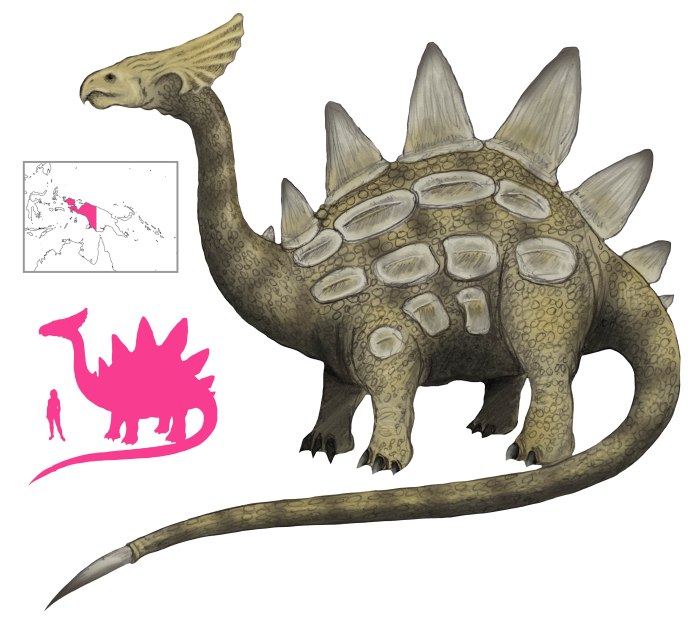
Its name is derived from the sound it makes – rooow, roow, rroow, row! – a hissing roar, or perhaps a roaring hiss. It is a hump-backed, massive reptilian creature forty feet long, with a snaky neck and tail. The small, beaked, turtle-like head is adorned with a bony frill and armed with a sharp beak. The front legs are shorter than the hind legs, allowing the row to rear up. The bulky body is a light brown-yellow, blending in with the reedy swamps it lives in, and is covered with uneven scales like armor plate. Along the back is a line of triangular plates. The long tail is tipped with a single twenty-pound keratinous spike. In cross-section the spike resembles a series of stacked cones; it is 18 inches long and six inches wide at the base. One side of the spike is worn down as it drags along the ground.

The row was encountered by Charles “Cannibal” Miller and his wife Leona during a whirlwind honeymoon in the New Guinean jungle. Considering that they lived with the Kirrirri, an as-yet-undiscovered tribe of cannibals, and were served roasted babies to insure fertility, seeing a living dinosaur was just another event for them.

It started when Leona noticed the Kirrirri using implements that resembled elephants’ tusks. These proved to be row horns, and Charles managed to make it understood that he wanted to see the creature it came from. The Kirrirri obliged, and the journey took a few days to get to the row’s habitat.

They found a row in a swampy, reedy delta between two arid plateaus. The sight of it was enough to paralyze Miller with fear, but not long enough to prevent him from filming. The row’s head rose from the reeds on the end of a long neck, and its tail lashed as it called out. It reared several times, glancing in the direction of the whirring camera, before slithering away and disappearing behind a stand of dwarf eucalyptus.

That was the first and last written account of the fabled row. Miller did not bring back or photograph any of the row’s tail-spikes. The film he took of the row was allegedly shown to select individuals, but there was no word of any saurian creature in it. Even the Kirrirri, to the best of anyone’s knowledge, do not exist. And, taken at face value, the row appears to combine features from sauropods, ceratopsians, and stegosaurs – all unrelated dinosaur lineages.

References

Heuvelmans, B.; Garnett, R. trans. (1958) On the Track of Unknown Animals. Rupert Hart-Davis, London.

Miller, C. (1939) Cannibal Caravan. Lee Furman Inc., New York.
Wako

Variations: Waco

Wako

The Wako are tsawekuri, animal spirits in the folklore of the Cuiva of Colombia and Venezuela. They look like pacas, with spots and long vicious fangs. Wako dig caves with many small exits and hiding-places, and live there in large numbers. Their call sounds like ao, ao, ao, ao.

Wako are carnivorous and anthropophagous. Anyone who ventures into their caves is hunted down and devoured. However, they refuse to chase anyone who is naked.

A Cuiva man who was left by his wife once made the suicidal decision to dig into a wako nest. Despite his son’s entreaties, he dug into the hole where a wako had been seen, feeling around with his hand and pulling it out quickly. His actions startled the wako, who ran out of their burrow calling ao, ao, ao, ao. There was nothing left of him after they were done.

Another man descended into a wako cave to avenge his pregnant wife, who had been eaten by the wako. He successfully exterminated the entire nest of wako.

References

Arcand, B.; Coppens, W.; Kerr, I.; and Gómez, F. O.; Wilbert, J. and Simoneau, K. eds. (1991) Folk Literature of the Cuiva Indians. UCLA Latin American Center Publications, University of California, Los Angeles.

Aderyn y Corph

Variations: Aderyn y Corff, Aderyn y Cyrff, Corpse-bird

Aderyn y Corph

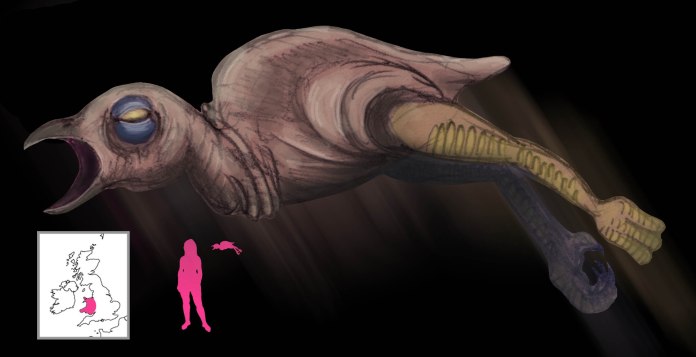
The Aderyn y Corph or corpse-bird chirps at the door of a dying person in Wales. Its call is dewch, dewch (“come, come”). It has no feathers or wings and can soar easily without them. When not presaging death it lives in the land of illusion and fantasy.

It is a variant of the screech owl whose call portends death. Aderyn y corph is also Welsh for the screech owl or brown owl.

References

Evan, D. S. (1858) An English and Welsh Dictionary. Thomas Gee, Denbigh.

Sikes, W. (1880) British Goblins. Sampson Low, Marston, Searle, & Rivington, London.

Trochus

Variations: Rota

Trochus

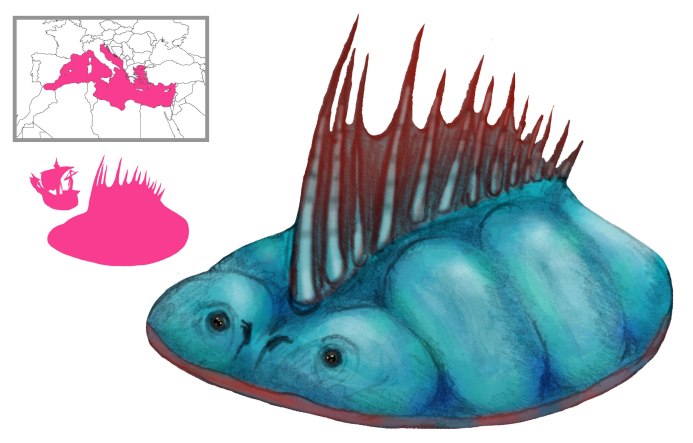
The Trochus, “wheel”, or Rota is a huge sea-monster known to swim close to shore in large groups. Schools (pods?) of these have been seen off Athos and Sigeum.

A trochus is fortunately timid, despite having a crest and spines of great size that show above the water. It revolves and contracts and dives deep, uncoiling and rolling and returning to the surface.

The wheel-like resemblance suggests a jellyfish or ray, but the size and behavior makes it clear that the trochus is a whale surfacing and diving.

References

Aelian, trans. Scholfield, A. F. (1959) On the Characteristics of Animals, vol. III. Harvard University Press, Cambridge, Massachusetts.

Pinaviztli

Pinaviztli

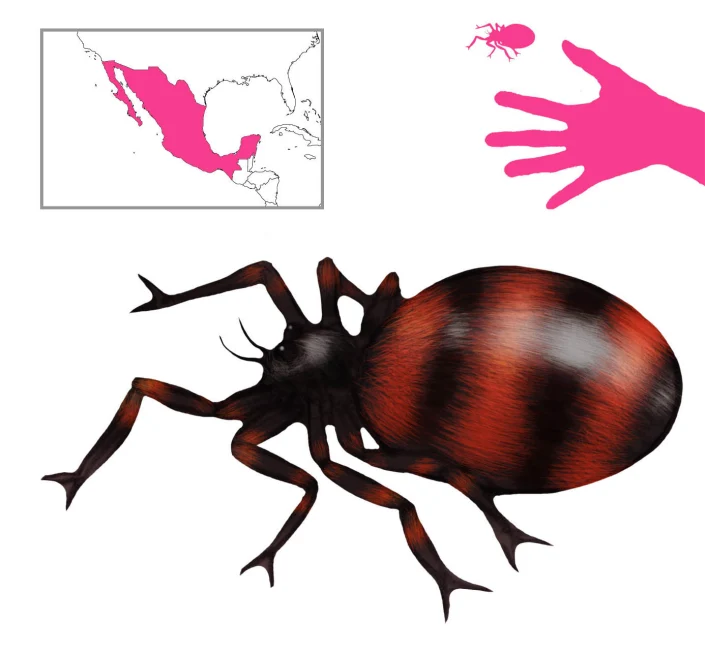
The Pinaviztli is an insect of ill-omen known to the Aztecs. It looks like a spider the size of a mouse, smooth and hairless and fat-bodied, red and black in color.

The entrance of a pinaviztli into a house is a bad omen. It can be countered in one of two ways. The first is to draw a cross on the floor pointing to the four cardinal directions. The pinaviztli is placed in the middle, spat on, and asked, “Why did you come? I want to know, why did you come?” If it goes north, it is a sign of coming death. Any other direction heralds a lesser affliction. The insect is told “Go your way, I don’t care about you”, and it is dropped off at the nearest crossroads.

The second ritual consists of passing a hair through the pinaviztli’s body and tying it to a stick, leaving it dangling for a day. If it is gone by the next day, then harm is sure to befall the household. If it is still there, the people spit on it and are reassured that nothing will happen.

Sometimes a pinaviztli foretells the gift of good food.

References

Nuttall, Z. (1895) A Note on Ancient Mexican Folk-lore. The Journal of American Folklore, v. 8, no. 29, pp. 117-129.

Chang Nam

Variations: Ye Thin (Myanmar); Water Elephant

Chang Nam

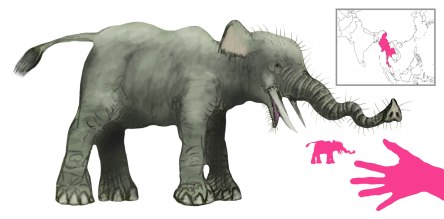
The Chang Nam, or “water elephant”, is native to the jungle streams of Thailand. Its equivalent in Myanmar is called the Ye Thin.

A chang nam looks like a miniature replica of an elephant. It is no bigger than a rat but has a trunk and sharp little tusks and all the hallmarks of elephants.

These water elephants are extremely dangerous. Merely seeing a chang nam’s shadow causes instant death. A chang nam will also stab footprints and reflections in the water with its tusks, bringing about the death to the owner of the footprint or reflection.

It seems uncertain whether the chang nam has a purely supernatural origin or if it has some real animal as its basis. Nonetheless, stuffed chang nam skins are available for sale to gullible tourists; these are manipulated frog or rodent skins with tusks attached.

References

Wood, W. A. R. (1965) Consul in Paradise: Sixty-nine Years in Siam. Souvenir Press, London.

Zulāl

Variations: Snow-worm

Zulal2

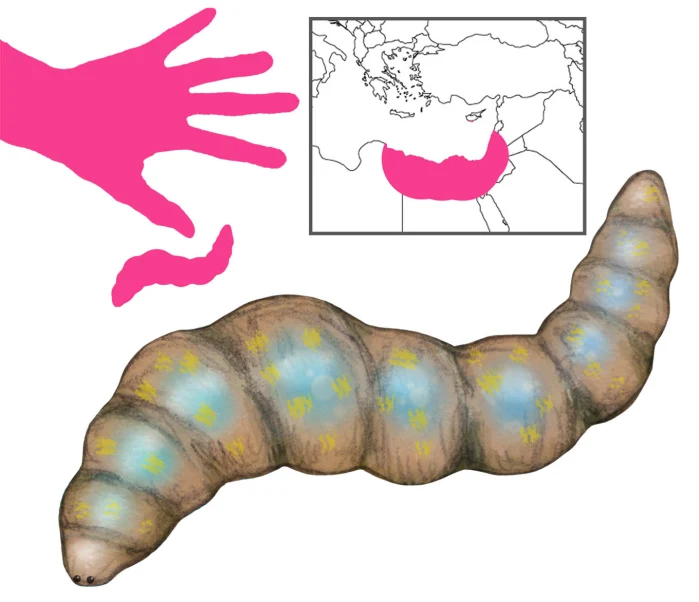
The Zulāl or Snow-worm is a small worm, the length of a human finger, that breeds in snow. It has yellow spots. The water inside of a zulāl is cold, pure, and refreshing, so it is often captured by humans to drink its contents. The term zulāl is also used to mean cold water on its own, without worms involved. This is now the current use of the term in Arabic and the snow-worm is all but forgotten.

While a zulāl is a worm and unclean, the water inside it is of exceptional pureness and is perfectly safe to drink.

References

Al-Damiri, K. (1891) Hayat al-hayawan al-kubra. Al-Matba’ah al-Khayriyah, Cairo.

Jayakar, A. S. G. (1908) ad-Damiri’s Hayat al-Hayawan (A Zoological Lexicon). Luzac and Co., London.