Beast of Barrisdale

Variations: Wild Beast of Barrisdale, Loch Hourn Monster

The Beast of Barrisdale lives near Loch Hourn in Scotland. Unlike other lake monsters, it has three legs, two in front and one in back, which leave distinctive tracks in Barrisdale Bay. It also has huge wings which allow it to fly. It makes its lair in the Knoydart Hills, near the dark cliffs of Ladhar Bheinn.

At the end of the 19th century, a crofter from Barrisdale said he frequently saw it soaring high over the Knoydart hills. Once it chased him with malicious intent, but he made it home safely – slamming the door in its face, no less, as he used to relate. An old man by the name of Ranald MacMaster also claimed to have found the tracks of the monster in the hills and along the sandy beaches around Barrisdale Bay. The monster’s frightful roar is said to be heard by night.

References

Fleming, M. (2002) Not of this World: Creatures of the Supernatural in Scotland. Mercat Press, Edinburgh.

MacGregor, A. A. (1937) The Peat-Fire Flame: Folk-tales and Traditions of the Highlands and Islands. The Moray Press, Edinburgh.

Mitchell, W. R. (1990) It’s a Long Way to Muckle Flugga: Journeys in Northern Scotland. Souvenir Press, London.
Slide-rock Bolter

Variations: Macrostoma saxiperrumptus (Cox)

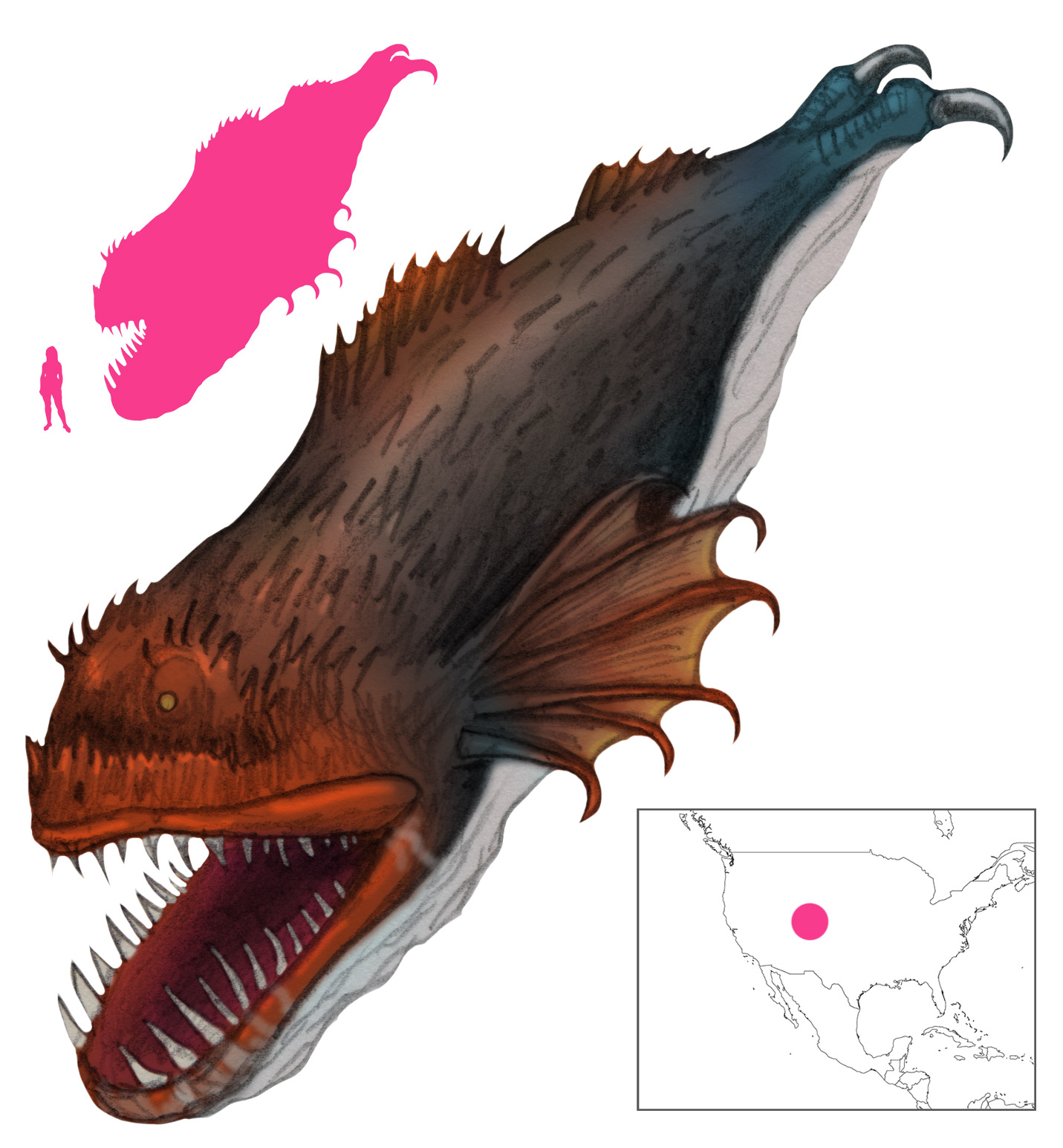
The greatest hazard of the Colorado mountains is not avalanches or bears, but rather the Slide-rock Bolter. This is a colossal creature the size of a whale. Its enormous mouth, something like that of a sculpin, goes behind its small eyes and ears, and drools copious amounts of thin grease from the corners. The flipper-tail is separated into grappling hooks, which allow the slide-rock bolter to cling to the top of a ridge or mountain.

Slide-rock bolters live where the slopes are steeper than 45°. They can wait for days until prey comes within reach – typically a clueless animal such as a tourist. When a slide-rock bolter spots a tourist, it releases its hook-tail and slides down the slope, lubricated by its grease secretion. It slides like a nightmarish toboggan, bulldozing trees and obstacles, snapping up the tourist, and, carried by momentum, traveling back up to the top of another slope. There it sinks its hooks in and goes back to waiting.

Guides have become increasingly reticent about leading treks through bolter country, as entire groups of tourists can be lost to the behemoths. Slide-rock bolters can be lured away with appropriate tourist decoys – scarecrows with Norfolk jackets, knee breeches, and Colorado guidebooks. One ranger near Ophir Peaks rigged such a tourist decoy with powder and blasting caps, luring in the bolter at Lizzard Head. The detonation scattered enough bolter flesh to feed local vultures for the rest of the season.

References

Cox, W. T. (1910) Fearsome Creatures of the Lumberwoods with a Few Desert and Mountain Beasts. Judd and Detweiler, Washington D. C.

Bès Kotak

Variations: Hantu Kotak (Malay), Box Spirit

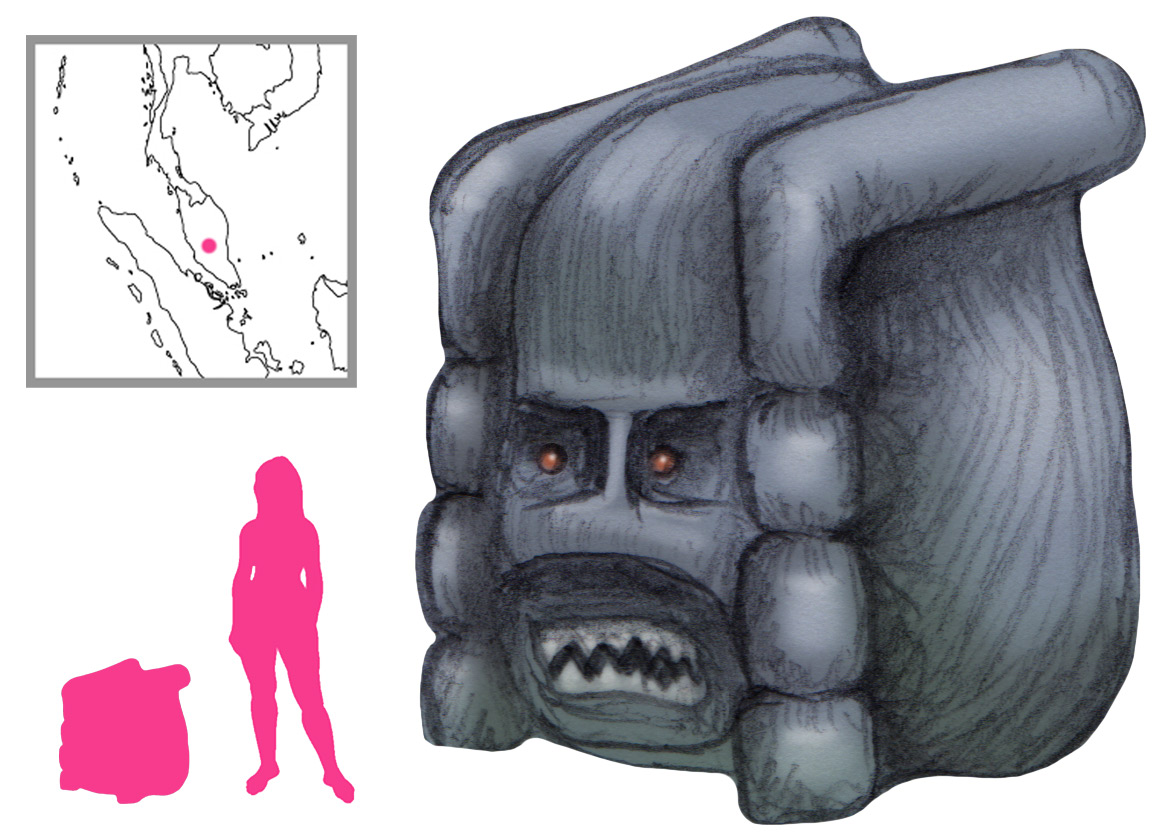
Bès Kotak, “box spirit”, is a bès or spirit from the folklore of the Jah Hut people of Malaysia. It is apparently box-like in appearance and is a river spirit that lives in the muddy hollows of rivers.

When a person dives into the river to catch fish, the box spirit presses or sits on that person, causing them to become heavy, sink into the mud, and drown. Two or three days later the body will float to the surface, proof of the fate that awaits any who invade Bès Kotak’s domain.

References

Werner, R. (1975) Jah-hět of Malaysia, Art and Culture. Penerbit Universiti Malaya, Kuala Lumpur.

Itqiirpak

Variations: Fireball

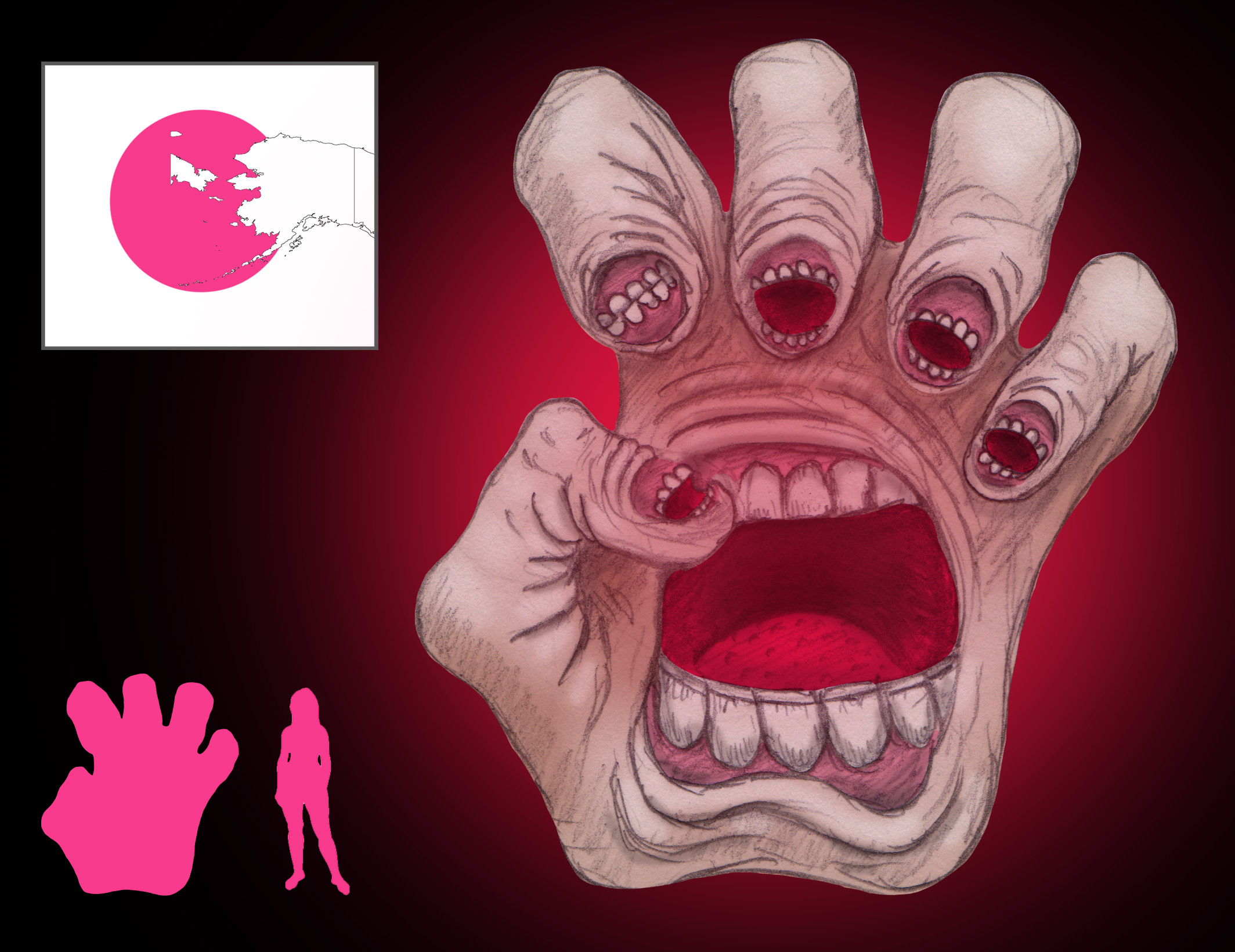
The Itqiirpak or Fireball is a creature from Alaskan Yupik folklore, notably from the Scammon Bay area. It appears as a crimson fireball flickering in the West over the sea, or, more alarmingly, as a big hand from the ocean with a mouth on each fingertip and a single large mouth in the palm of the hand.

An itqiirpak is a bad omen. It appears before terrible disasters, or it disposes of troublemakers directly.

A male itqiirpak was said to have burned through the entrance of a qasgiq (men’s house) and killed bad-mannered children there. It caught the children and dragged them out to eat them; all that could be heard was the crunching of their bones as the itqiirpak devoured them. When the men returned they saw the itqiirpak jumping up and down on the ice, looking like a fire. The monster was then slain by the men who left a swinging blade-trap for it. The female-hand remained at large and appeared whenever people were to die.

More modern itqiirpak stories tell of the fireball appearing before tragedies in the community, such as the drowning of two children in the Kun River in 2007. Simon saw the itqiirpak as a metaphor for tragedy and a cultural explanation for inexplicable tragedy.

References

Jacobson, S. A. ed. (2012) Yup’ik Eskimo Dictionary, v. I. Alaska Native Language Center, University of Alaska, Fairbanks.

Simon, K. A. The Meaning and Use of Narratives in a Central Yup’ik Community: The Scammon Bay ‘Fireball Story’. In Daveluy, M.; Lévesque, F.; and Ferguson, J. (eds.) (2011) Humanizing Security in the Arctic. CCI Press, Edmonton.

Ebigane

An Ebigane, in the folklore of the Fang of Cameroon, Gabon, and Equatorial Guinea, is an ambiguous monster that can be animal or human in form, or a mix of both. It commonly appears in legends and sagas sung by mvett players.

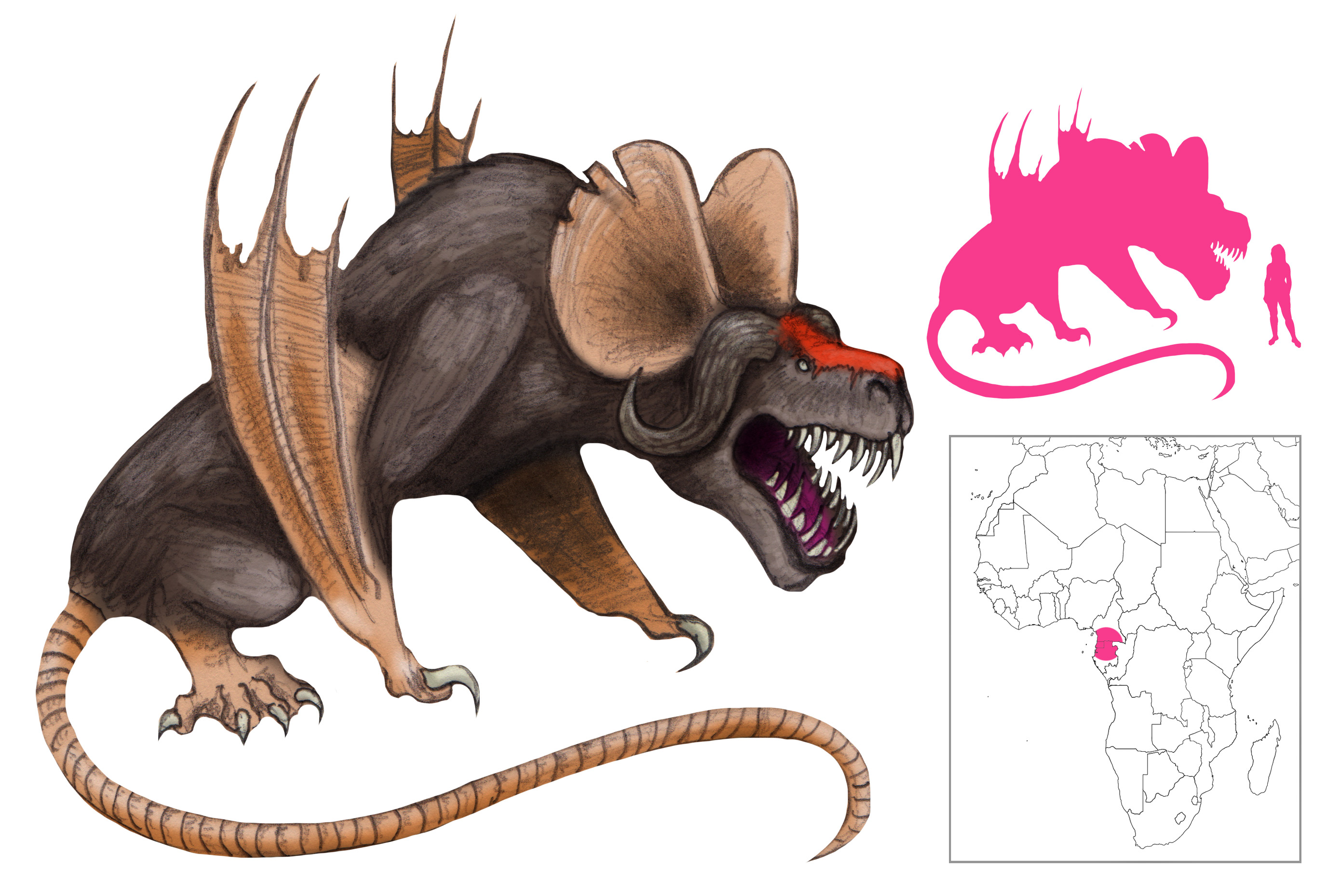
One such heroic tale, told by Tsira Ndong Ndoutoume, tells of the hero Mefoumou Mba Foumou. When faced with a bridge made of twisted, knotted pythons, he pulled a mouse out of his satchel and spat on its head. The mouse grew in size, its ears spread out like the petals of an enormous flower, its head sprouted horns, its legs lengthened and its claws sharpened, while its great tail stretched out behind it. Now armed with sharp fangs and claws and great bat-like wings, it had become an ebigane, something like a cross between a bat, a buffalo, and a vampire.

Mefoumou Mba took a red paste crayon and drew a red mark on the ebigane’s head from the base of its skull to the tip of its nose. Then he directed its attention to the pythons. “There is enough meat there to feed you for at least two years. To work!”

The ebigane flapped its ears loudly, whinnied, and took heavily to the air, circling around like a bird of prey before diving on the bridge. It seized one python in its claws and teeth and, after overcoming its prey’s resistance, carried it off to Mount Bèghlé to devour at its leisure.

References

Ndong Ndoutoume, T. (1993) Le Mvett: L’homme, la mort et l’immortalité. L’Harmattan, Paris.

Bjarndýrakóngur

Variations: King of the Bears, Einhyrningur (Unicorn)

The Bjarndýrakóngur, the “King of the Bears”, is the undisputed monarch of the polar bears of Iceland. It is born from a female polar bear and a walrus or a bull.

A bjarndýrakóngur has red cheeks and a single horn on its forehead. The horn, which is its scepter of authority, has a sharp end and is tipped with a platinum globe. It emits a bright light in all directions such that the bjarndýrakóngur can always see its way through the darkness.

The king of the bears is as wise and noble as it is powerful. It understands human speech and demands loyalty and obeisance from other polar bears. While easily capable of killing with its horn, it only does so in self-defense or in judgment on wayward subjects.

It is said that, on a Whitsun church service in the 18th century, a procession of 12 or 13 polar bears was seen ambling from the outer parts of Iceland. They were led by a stately and benevolent bjarndýrakóngur. The clergyman greeting them in full regalia, as did the congregation, and bowed to the king, who returned the bow. The bjarndýrakóngur continued to lead his subjects through southern Iceland. At Borgamór the last bear in the line killed and ate a sheep, whereupon the king ran the offending bear through with his horn. Eventually the royal cortège reached Grenivík where they disappeared into the sea.

The only animal that will dare challenge the king of the bears is a redcheek or redjowl. This is a highly aggressive polar bear with distinctive reddish pink coloration on one cheek. Redcheeks will attack any beast or man that it encounters – but against the king of bears they meet their match.

 References

Hlidberg, J. B. and Aegisson, S.; McQueen, F. J. M. and Kjartansson, R., trans. (2011) Meeting with Monsters. JPV utgafa, Reykjavik.

Hoga

Variations: Andura

Tenochtitlan, the great city of Mexico, is built on pilings on Lake Texcoco, much like Venice. In that lake is found numbers of the fish known as Hoga by the natives of the land and the Spaniards, and as Andura (vampire bat!) by natives further south.

A hoga has a head and ears very like those of a hog. It is the size of a seal or porpoise. There are five half-foot-long barbels around its mouth. When swimming it seems to change color from red to yellow to green like a chameleon. It gives birth to live young like a whale does.

Hogas are omnivorous. They live close to the shore where they feed on the leaves of the hoga tree. They are highly aggressive, as dangerous as the velachif, and will kill and eat animals larger than them, which is why they are hunted relentlessly. Their flesh is delicious and tastes like albacore.

The hoga skin in Thevet’s possession was destroyed by vermin, but fortunately he claims to have seen the creature alive in person.

Delaunay believed the lake not to be Lake Texcoco, but rather the nearby Lake Chalco. The Hoga could not be positively identified.

References

Paré, A. (1614) Les Oeuvres d’Ambroise Paré. Nicolas Buon, Paris.

Paré, A.; Pallister, J. L. trans. (1982) On Monsters and Marvels. University of Chicago Press, Chicago.

Thevet, A. (1575) La Cosmographie Universelle. Guillaume Chaudiere, Paris.

Mahwot

Variations: Mahwot’, Mawhot’

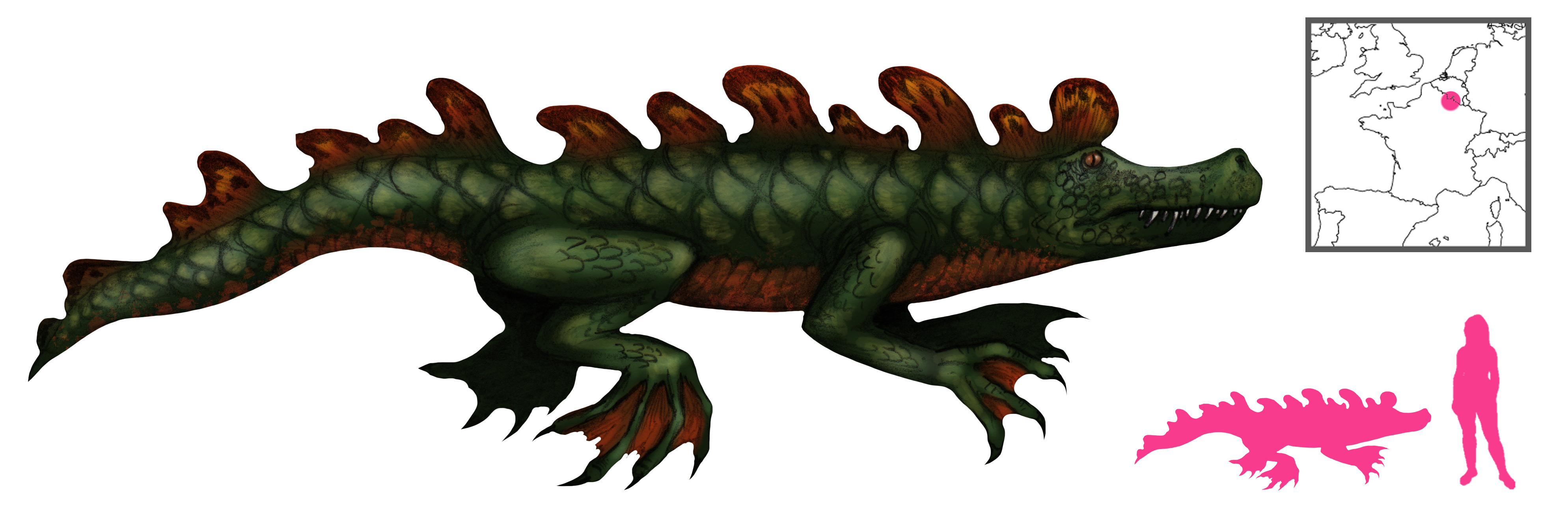
The Mahwot is a monstrous creature that makes its home in the Meuse River snaking through the Ardennes. A lizard-like amphibious monster the size of a calf, it runs back and forth on the bottom of the river from Revin to Liège and back. It has been sighted at Revin and Givet on a July night in 1870.

Its primary purpose lies in keeping children away from the water. As an aquatic bogey, it will not hesitate to pull in and devour any child foolish enough to play too near the Meuse.

The mahwot rarely leaves the water. Its appearance on land is believed to be a bad omen, presaging death, war, or pestilence. More importantly, it will haul itself onto land at the beck and call of angry mothers to eat naughty children. As the warning in the local dialect goes, “V’la le Mahwot, si tu n’ti tais nai, d’ji vas t’fouaire mandjie!” (“here’s the mahwot, if you don’t shut up right now, I’ll have you eaten!”). The phrase is effective.

References

Lambot, J. (1987) L’Ardenne. Pierre Mardaga, Brussels.

Meyrac, A. (1890) Traditions, coutumes, légendes et contes des Ardennes. Petit Ardennais, Charleville.

Dajna

Variations: Thunder Camel

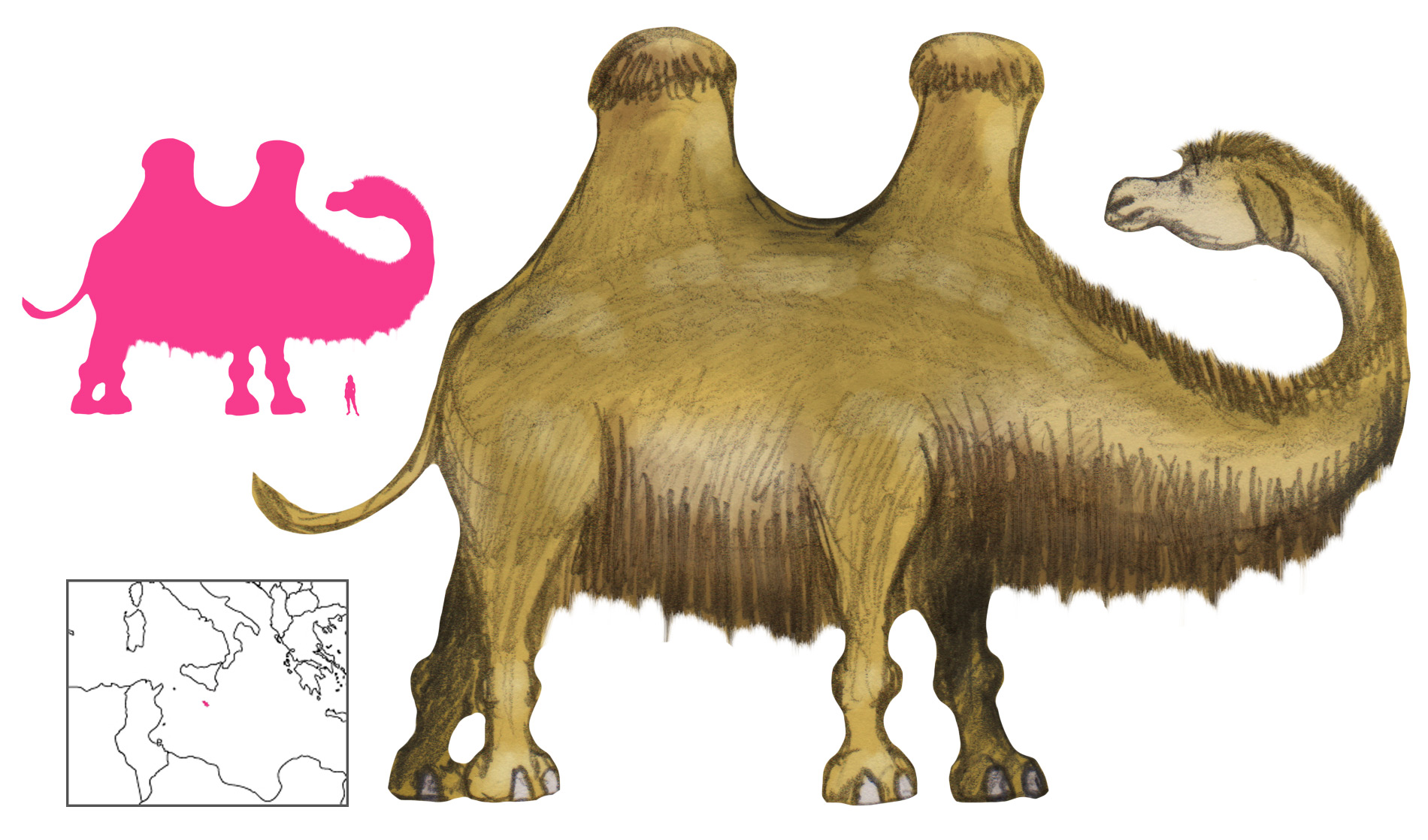
In Maltese, dajna refers to a fallow deer or an unkempt woman. It is also the name of a titanic primordial camel that lived on Malta before the Deluge.

A dajna or thunder camel had the head and neck of a camel but was ten times the size of an elephant. It could not fit into Noah’s Ark and went extinct as a result, but a population of these colossal camels survived in the netherworld.

Although a dajna is highly dangerous to human beings, the yellowish milk produced by the females is a remedy for baldness. Only heroes dare retrieve it.

References

Mifsud, S. D. (2017) The Maltese Bestiary. Merlin Publishers Ltd, Blata l-Bajda, Malta.

Lomie

Variations: Lomi, Lossie, Los, Moose, Elk

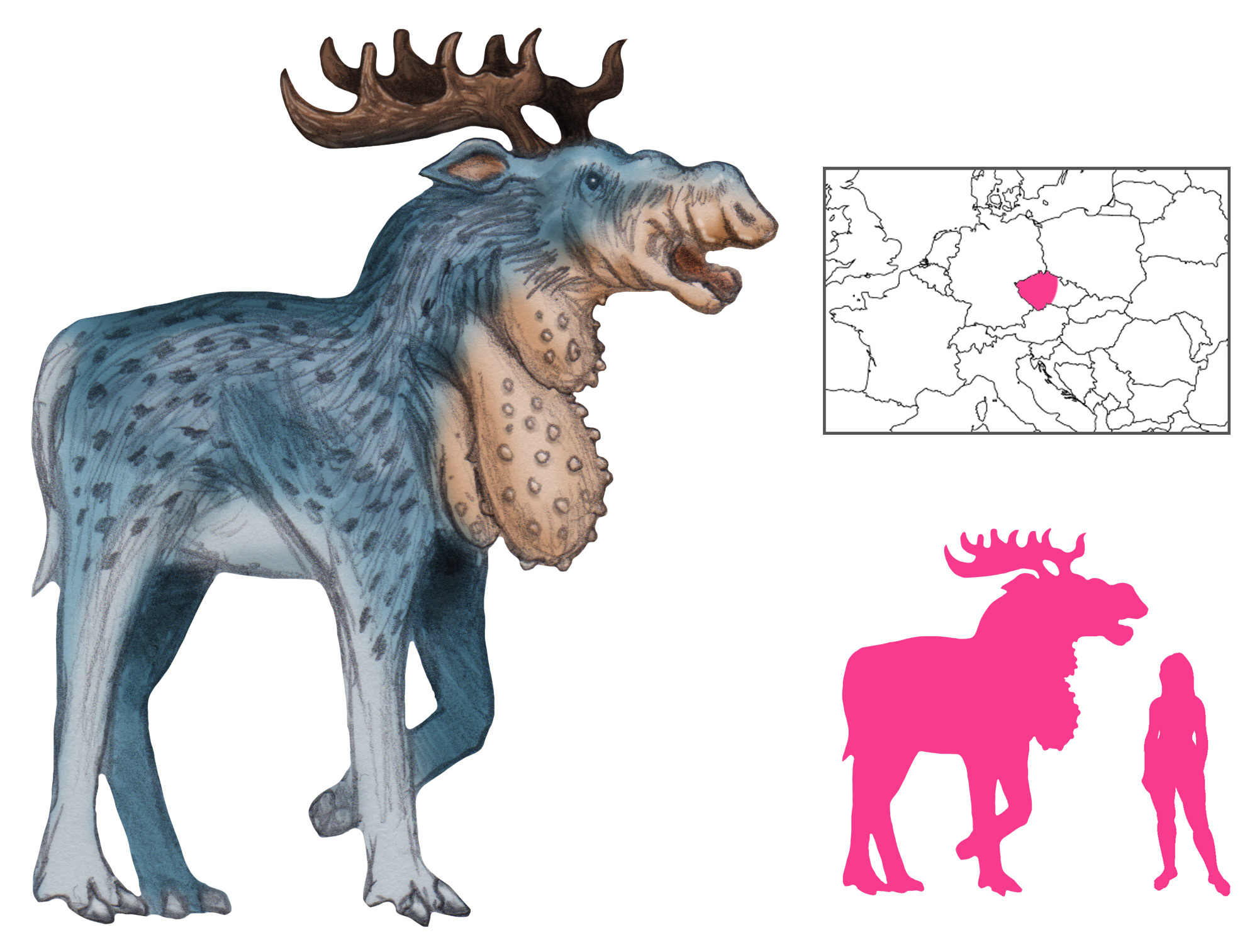
The Lomie is a beast found within the forests of Bohemia. It has a sac-like bladder under its neck. If pursued by hunters, it pauses at a nearby body of water to drink and fill up its neck-bladder. Then it runs, heating the water to boiling. When cornered by hunters and their dogs, it vomits the boiling water onto them, scalding them and making good its escape.

Heylyn merely refers to the water as boiling-hot. The Book of Marvels adds that the boiling water is incredibly toxic, causing incurable wounds and making skin and flesh slough off.

The name is derived from the Polish Lossie, the plural form of moose, while Los is singular. It is probably a typographical error on Heylyn’s part. Topsell lists Los and Lossie as synonyms for the elk or moose, and also ascribes the regurgitation of scalding water to the moose.

References

Heylyn, P. (1621) Microcosmus: A Little Description of the Great World. John Lichfield and James Short, Oxford.

Heylyn, P. (1636) Microcosmus: A Little Description of the Great World. William Turner, Oxford.

Heylyn, P. (1657) Cosmographie in Four Books. Henry Seile, London.

Topsell, E. (1658) The History of Four-footed Beasts. E. Cotes, London.

Various. (1996) Les Merveilles du Monde. Editions Anthese, Arcueil.