Heluo Zhi Yu

Variations: Heluo-fish, Never-Old Bird

Heluo

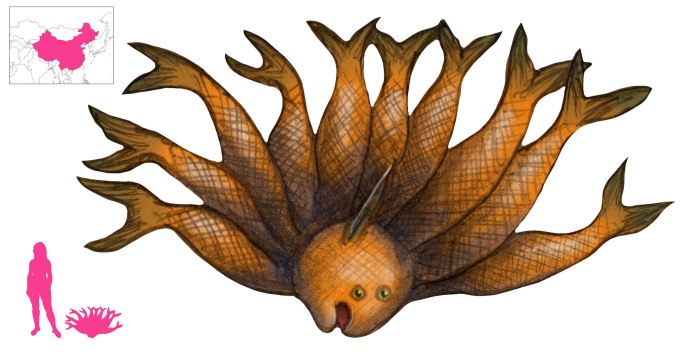
The Heluo Zhi Yu or Heluo-fish can be found in China’s Tower River. These unusual fishes have one head and ten bodies each, and bark like dogs. Eating them cures tumors.

According to Yang Shen’s encomium, a heluo-fish can transform itself into a Never-Old Bird, which steals rice grains from threshing pestles, falls into the mortar, and dies.

The single head and multiple tails may be a description of an octopus.

References

Mathieu, R. (1983) Étude sur la mythologie et l’ethnologie de la Chine ancienne. Collège de France, Paris.

Strassberg, R. E. (2002) A Chinese Bestiary: Strange Creatures from the Guideways Through Mountains and Seas. University of California Press.

Bregdi

Bregdi

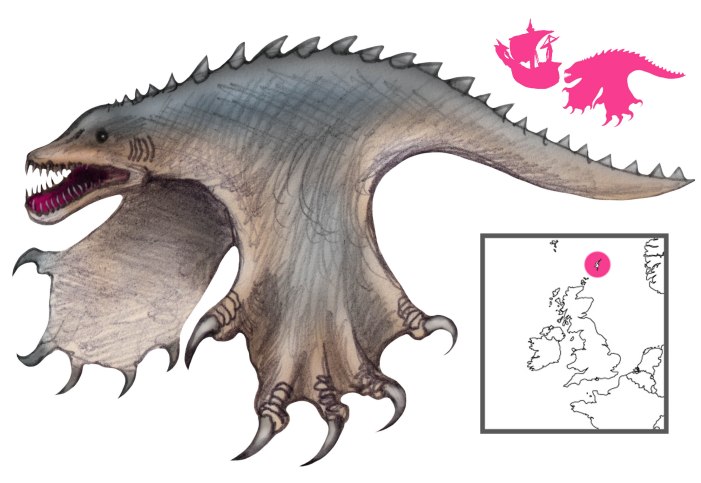
A malicious sea monster from Shetland waters, the Bregdi is feared for its habit of chasing boats. Once it has caught up with a boat, it wraps its long fins around it, putting them up over the gunwales, and dives with the boat in its deadly embrace.

Fortunately a bregdi’s attentions can be deterred in two ways. Like many other supernatural creatures, the bregdi hates the touch of cold steel. A simple skuni (knife) is more than enough to combat it. Slashing the fins as soon as they appear over the gunwales will make it let go and flee. It is also terrified of amber beads, and a single amber bead thrown at a bregdi is enough to scare it off.

References

Angus, J. S. (1914) A Glossary of the Shetland Dialect. Alexander Gardner, Paisley.

Fleming, M. (2002) Not of this World: Creatures of the Supernatural in Scotland. Mercat Press, Edinburgh.

Myrmecoleon

Variations: Myrmecoleo, Myrmekoleon, Mermecoleon, Mermecolion, Mirmicaleon, Mirmicoleon, Murmecoleon, Formicaleon, Ant-Lion, Antlion

Myrmecoleon

The Myrmecoleon, or Ant-lion, is a tale of two creatures and many translation errors. Druce distinguishes between the Eastern myrmecoleon, a hybrid of lion and ant, and the Western myrmecoleon, a carnivorous insect. These are one and the same, but the vagaries of translation led them down separate paths.

The Eastern myrmecoleon is found primarily in Greek, Arabian, Armenian, Ethiopian, and Syrian bestiaries. Its pedigree can be traced back to the giant gold-digging ants originally described by Herodotus. Further additions were added to the account as it evolved away from its origin. Nearchus claimed that the skins of the ants were as large as those of leopards. Pliny said that the horns of an Indian ant at the Erythraean temple of Hercules were remarkably large. Agatharchides, Aelian, and Strabo tell of Arabian and Babylonian lions called “ants” (myrmex) that have gleaming golden fur and reversed genitals (probably hyraxes, which have a distinctive dorsal gland).

The translators of the Septuagint were faced with the unfamiliar term lajisch or layish in Eliphaz’s phrase “the old lion perishes for lack of food” (Job 4:11). In the Vulgate it was rendered as tigris, and modern translations use “old lion”, but the Septuagint, drawing on obscure Classical species of lion, arbitrarily used the term myrmekoleon. Its name presupposes a hybrid of ant and lion; as the Bible is inerrant, this led led to the necessary existence of a creature whose father was a lion and whose mother was an ant. The fruit of this improbable union is a lion in front and an ant behind, and dies of starvation since the ant half cannot digest what the lion half eats, while the lion half cannot eat the plants the ant half requires. Thus “the myrmecoleon perishes for lack of food” became a logical statement, and was expounded upon in the Physiologus.

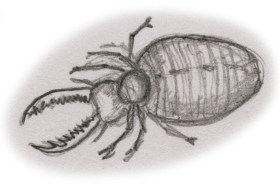
Myrmecoleon antlionThe Western myrmecoleon originally appeared in Latin sources and subsequently found its way into European bestiaries. This ant-lion is both ant and lion – an insect that preys on ants as lions prey on other animals, an ant to us, a lion to ants. It is an ant with a white head and a black body marked with white spots. It appears in bestiaries as something like a large ant or spider. This is a real animal – the antlion is a larva with huge jaws that constructs funnel-shaped traps in sand to catch ants. It eventually metamorphoses into a lacy-winged fly, but both larva and adult are completely harmless to humans.

As a denizen of bestiaries the ant-lion has its own religious connotations. The Eastern myrmecoleon is two-faced, double-minded, unstable, and deceitful. The Western myrmecoleon represents Satan lying in wait for sinners.

References

Beavis, I. C. (1988) Insects and other Invertebrates in Classical Antiquity. Alden Press, Osney Mead, Oxford.

Borges, J. L.; trans. di Giovanni, N. T. (1969) The Book of Imaginary Beings. Clarke, Irwin, & Co., Toronto.

Borges, J. L.; trans. Hurley, A. (2005) The Book of Imaginary Beings. Viking.

Druce, G. C. (1923) An account of the Μυρμηκολέων or Ant-lion. The Antiquaries Journal, 3(4), pp. 347-364.

Flaubert, G. (1885) La Tentation de Saint Antoine. Quantin, Paris.

Isidore of Seville, trans. Barney, S. A.; Lewis, W. J.; Beach, J. A.; and Berghof, O. (2006) The Etymologies of Isidore of Seville. Cambridge University Press, Cambridge.

Kitchell, K. F. (2014) Animals in the Ancient World from A to Z. Routledge, Milton Park, Abingdon, Oxon.

Newbold, D. (1924) The Ethiopian Ant-lion. Sudan Notes and Record, 7(1), pp. 133-135.

Robin, P. A. (1936) Animal Lore in English Literature. John Murray, London.

Aspidochelone

Variations: Aspido-chelone, Aspidochelon, Aspidocalon, Aspidoceleon, Aspidodeleon, Aspidodelone, Aspischelone, Aspido-tortoise, Asp-tortoise, Asp-turtle, Fastitocalon, Shield-tortoise, Sea-monster, Sea-tortoise, Sea-turtle, Sulhafat, Turtle
Aspidochelone

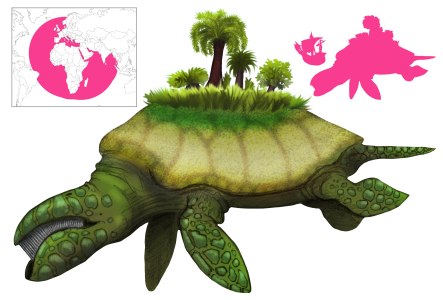
The motif of the island-turtle or island-whale is one of the most common and pervasive of maritime yarns. Whether it is a turtle, a whale, a fish, or a crab, the story is the same. A great sea creature raises its back out of the water. Sea-sand and vegetation gather in on its rough back, until it looks like a small island. Sailors anchor their ship to the deceptive “island”, disembark, and light a fire. The monster, feeling the fire on its back, immediately dives, taking the sailors and their ship down to a watery grave.

Prototypes of the gigantic fish are in the Indian Zend-Avesta, the supposed 3rd-Century letter of Aristotle to Alexander, and the Babylonian Talmud composed around CE 257-320.

The monster in al-Jahiz’s account is a crab (saratan) – surely confusion with the similarly shelled turtle? In al-Qazwini’s entry on the turtle (sulhafat), he distinguishes between the terrestrial tortoise and the sea turtle. The sea turtle is of great size, and sailors believe it to be an island in the middle of the sea, landing on it and lighting a fire until the turtle stirs, whereupon those aboard the ship call out “Come back, for it is a turtle that felt the heat of the fire, come back that you may not go down with it!” Sindbad the Sailor encountered this creature in his first Voyage, but managed to escape with his life.

The Account repeated in the Physiologus and bestiaries such as the Exeter Book, and the monster is identified with the whale that swallowed Jonah. The original Greek versions of the bestiary talk of the Aspidochelone – a name of uncertain etymology. Chelone refers to a turtle or tortoise, but aspido has been assumed to mean “shield” or “asp” (as in, the snake). The “shield” origin may stem from the turtle’s shell, but it seems like a redundant descriptor for a turtle. Another possibility is that the turtle was originally more of a serpent, or that this is a reference to the aspidochelone’s evil.

Whatever the meaning, the name aspidochelone became corrupted over time to become the “fastitocalon”, and the turtle supplanted with the more familiar whale (although the description of a rough back sounds more like a turtle’s shell).

The Physiologus or Bestiary adds further moralizing elements to the story. The aspidochelone will exhale a pleasant odor from its mouth, attracting fish that are then swallowed. Thus the aspidochelone is an allegory for Satan. Sinners who anchor themselves to the Devil are doomed to go to Hell, and sinful pleasures are enticing as perfume.

The aspidochelone entry is preceded by the panther entry. Both use fragrant breath to attract other animals, but the aspidochelone is evil while the panther is an allegory for Christ. The juxtaposition is probably intentional. The fragrant smell of the aspidochelone may also be derived from the odorous cetacean substance known as ambergris.

Aspidochelones are minor subjects in medieval woodcarvings, visible at Kidlington, Great Grandsden, Isleham, Swaffham Bulbeck, and Norwich Cathedral. They can be distinguished by the presence of ships and cooking-pots on their back, or with their mouths open to attract fish.

References

Barber, R. (1993) Bestiary. The Boydell Press, Woodbridge.

Borges, J. L.; trans. di Giovanni, N. T. (2002) The Book of Imaginary Beings. Vintage Classics, Random House, London.

Cook, A. S. (1821) The Old English Physiologus. Yale University Press, New Haven.

Cook, A. S. (1894) The Old English ‘Whale’. Modern Language Notes, 9(3), pp. 65-68.

Curley, M. J. (1979) Physiologus. University of Chicago Press, Chicago.

Druce, G. C. (1914) Animals in English Wood Carving. The Third Annual Volume of the Walpole Society, pp. 57-73.

Gordon, R. K. (1957) Anglo-Saxon Poetry. J. M. Dent & Sons Ltd, London.

Hippeau, C. (1852) Le Bestiaire Divin de Guillaume, Clerc de Normandie. A. Hardel, Caen.

Iannello, F. (2011) Il motive dell’aspidochelone nella tradizione letteraria del Physiologus. Considerazioni esegetiche e storico-religiose. Nova Tellus 29(2), pp. 151-200.

Al-Jahiz, A. (1966) Kitab al-Hayawan. Mustafa al-Babi al-Halabi wa Awladihi, Egypt.

Al-Qazwini, Z. (1849) Zakariya ben Muhammed ben Mahmud el-Cazwini’s Kosmographie. Erster Theil: Die Wunder der Schöpfung. Ed. F. Wüstenfeld. Dieterichsche Buchhandlung, Göttingen.

White, T. H. (1984) The Book of Beasts. Dover Publications, New York.

Wiener, L. (1921) Contributions toward a history of Arabico-Gothic culture, volume IV: Physiologus studies. Innes and Sons, Philadelphia.

Nartôq

nartoq

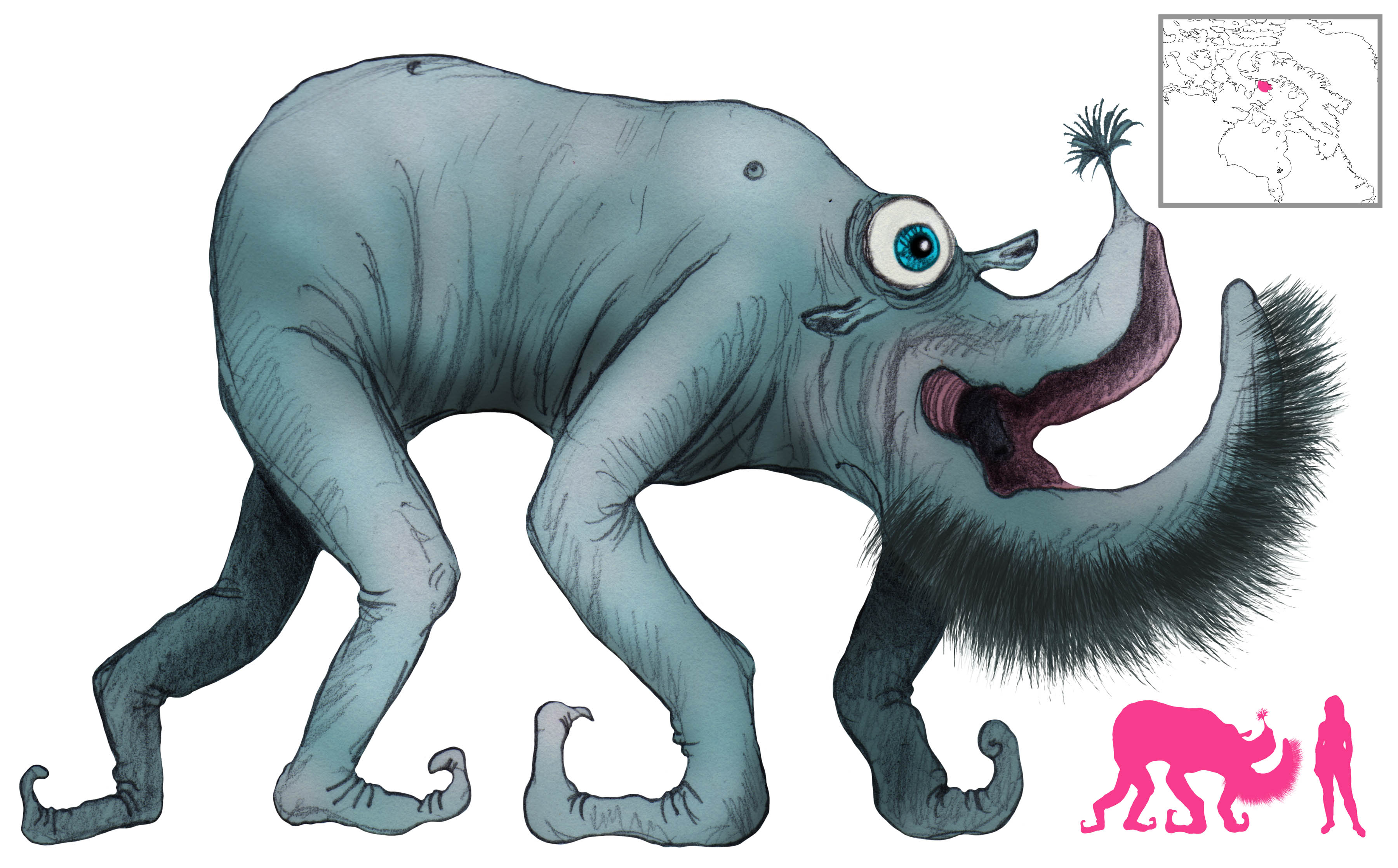
The helping spirit Nartôq is “the pregnant one” or “the big-bellied one”. Iglulik Inuit shaman Anarqâq first encountered this spirit while out hunting caribou. Nartôq is a horrifying sight – its nose is on its forehead, and its lower jaw runs down into its breast.

When they first met, Nartôq charged Anarqâq threateningly, disappearing just before it reached him. Later on Nartôq reappeared and introduced itself to Anarqâq. “I was hot-headed earlier because you yourself are too quick to anger”, it told the shaman. “You need never fear me as long as you abandon your short temper”. Since then Nartôq become one of the shaman’s best helping spirits.

References

Rasmussen, K. (1929) Intellectual Culture of the Iglulik Eskimos. Glydendalske Boghandel, Nordisk Forlag, Copenhagen.

Nuppeppō

Variations: Nuppefuhofu (Mizuki); Nikubito (probably); Hō (probably); Nopperabō (probably)

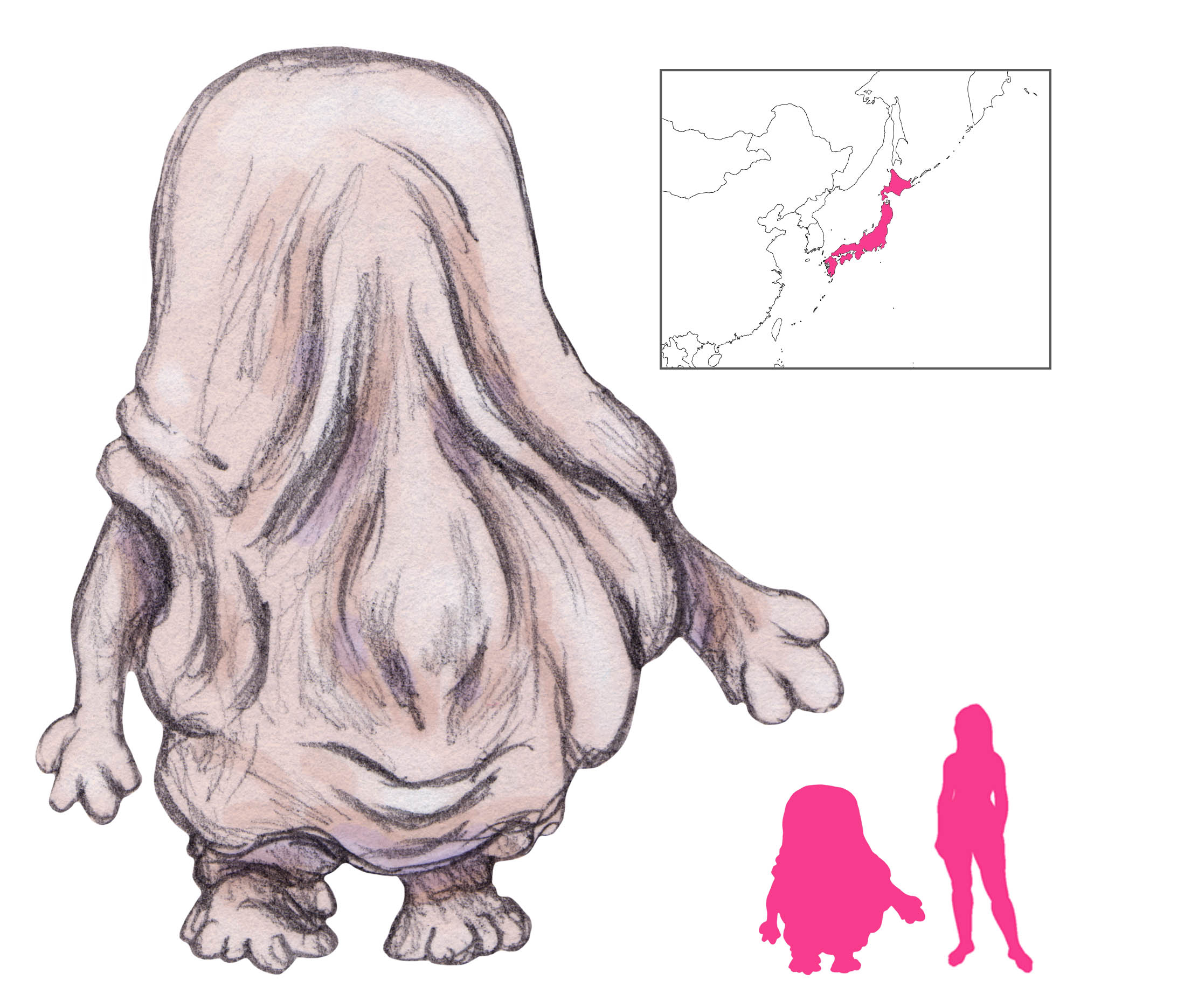
The word Nuppeppō is derived from nupperi or nopperi, meaning “flat-faced” and referring to a flat, dazed expression. This yokai first appears in texts from the Edo period, and resembles nothing more than a blob of flesh with arms and legs. Its folds of skin and fat give it the appearance of a face on its body. While repulsive, nuppeppōs are frequently comical and inoffensive.

Sekien’s rendition of the nuppeppō has a culinary theme, placing it under a bronze bell that calls monks to their meals. The nuppeppō itself may be edible; according to Maki Bokusen, a nuppeppō-like creature appeared in the gardens of Shogun Tokugawa Ieyasu. This nikubito (“meat-man”) was taken away to the mountains away from the shogun’s sight. Alas, he discovered too late that it may have been the legendary Hō described in the book of the Hakutaku. One bite of the Hō’s flesh would reinvigorate a person’s constitution.

Shigeru Mizuki added further embellishments to the nuppeppō based on Sekien’s image. His “nuppefuhofu” is a “spirit of flesh” found in deserted temples. Monks that choose to sleep in those temple are unpleasantly awakened by the fleshy sound of its aimless staggering.

The Nopperabō is a later yokai probably derived from the nuppeppō. It is human in appearance except for its face – completely featureless and smooth as an egg. Unlike its older counterpart, the nopperabō is only ever a thing of terror.

References

Foster, M. D. (2015) The Book of Yokai. University of California Press, Berkeley.

Sekien, T.; Alt, M. and Yoda, H. eds. (2017) Japandemonium Illustrated: The Yokai Encyclopedias of Toriyama Sekien. Dover Publications, New York.

Lukwata

Variations: Lokwata, Luquata; Balukwata (pl.)

Victoria Nyanza is home to the Lukwata. The deeds and misdeeds of this great sea-serpent are told on both sides of the lake, from Uganda to the Kavirondo (Winam) Gulf in Kenya. The lukwata is commonly lumped with the dingonek, but the lukwata’s pedigree is far older. Lukwata is also the name of a Baganda clay charm which, when hidden in the king’s house, presents theft in the village, but this seems unrelated.

The lukwata has been around from time immemorial and makes occasional appearances. It is a huge and terrifying lake demon, a serpent, a cetacean, or perhaps a giant fish. It is associated with whirlpools in the lake. Ja-Luo fishermen have tales of the lukwata attacking their canoes. The Baganda, Kavirondo, and Wasoga of the north shore of lake Nyanza used to sacrifice livestock to it. The lukwata’s disappearance coincided with the sleeping-sickness epidemic, and it was believed that the muzungu (foreigners) caused the disease by killing the lukwata, thus bringing its wrath upon the people.

W. Grant, Provincial Commissioner of Jinja, saw a lukwata swimming down the Napoleon Gulf; its head was out of the water but it was too far to make out its features. Clement Hill of the Foreign Office had a far closer encounter when a lukwata off Homa Mountain tried unsuccessfully to seize a man on the bow of Hill’s ship. He saw a lizard-like head, roundish and dark-colored, on a four-foot-long neck attached to a large, rounded mass that formed the body. Some sort of tail seemed to be trailing behind.

E. G. Wayland, head of the Geological Survey of Uganda, claimed to have heard the lukwata’s distant bellowing. He was shown pieces of lukwata bone, and was told that the lukwata fought epic battles with crocodiles. Pieces of skin lost in those struggles were used for potent amulets.

The most complete account of a lukwata’s appearance is recorded by H. Bell, who shot one on the western border of Uganda near the Semliki River and Lake Albert. The creature, which was identified as a small lukwata by a native boy, was deemed to resemble Hill’s serpent. It had a snakelike head, a neck several inches long, a tail a few inches long, and flippers like a sea turtle’s. Instead of a hard shell, the lukwata had a thick, soft, rubbery carapace. Bell believed that the lukwata – evidently an odd species of turtle – would, at the surface, give the impression of a bulky, long-necked animal.

Balukwata are not particularly smart. A Baganda folktale tells of the friendship between a lukwata and a monkey. It came to pass that the King of the balukwata took ill, and his wizard told him to eat the heart of a monkey as a cure. The King offered great rewards to any of the balukwata who would bring him the heart of a monkey. So the lukwata went to the home of his friend the monkey and hailed him. “How are you? You should come visit me, my wife and sons want to see you”. “But I cannot swim”, said the monkey. “I’ll carry you on my back”, said the lukwata, and they were off. Halfway across the lake, the lukwata, having a crisis of conscience, decided to tell the monkey the truth. “I’m really sorry, but our King is sick and needs your heart”. The monkey thought fast. “You silly thing”, he told the lukwata, “I don’t have my heart with me. I leave it behind so I can jump through the trees. Take me back and I’ll fetch my heart from the branch where I left it”. Of course, the unsuspecting lukwata swam back, and the monkey escaped to safety in the trees – but not before mocking his erstwhile friend’s intelligence.

References

Bell, H. (1948) Witches & Fishes. Edward Arnold & Co., London.

Bronson, E. B. (1910) In Closed Territory. A. C. McClurg & Co., Chicago.

Cunningham, J. F. (1905) Uganda and its peoples. Hutchinson & Co., London.

Hattersley, C. W. (1900) An English Boy’s Life and Adventures in Uganda. The Religious Tract Society, London.

Heuvelmans, B.; Garnett, R. trans. (1958) On the Track of Unknown Animals. Rupert Hart-Davis, London.

Hobley, C. W. (1913) On Some Unidentified Beasts. The Journal of the East Africa and Uganda Natural History Society, III(6), pp. 48-52.

Johnston, H. (1902) The Uganda Protectorate. Hutchinson & Co., London.

Pilkington, G. L. (1911) A Hand-book of Luganda. Richard Clay & Sons, Limited, London.

Bès Jě’la Kòy

Variations: Hantu Kepala Berduri (Malay), Spiky-head Spirit

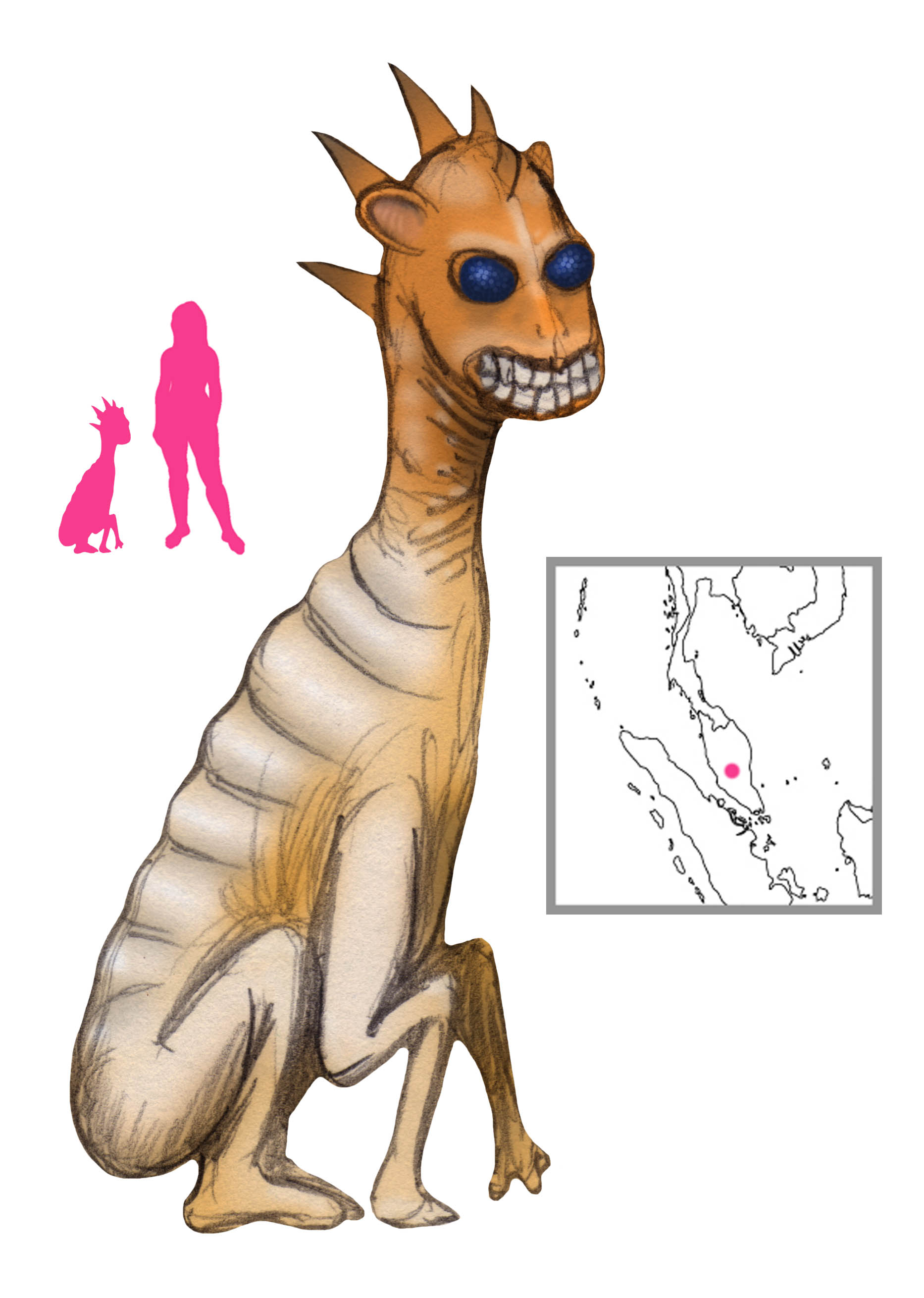
The Bès Jě’la Kòy, “spiky-head spirit”, is one of many bès or spirits from the folklore of the Jah Hut people of Malaysia. It lives on top of termite hills and knows how long every person will live. If it judges that a person’s lifespan is too short, it will take them into the termite hill to be friends with it forever.

A spiky-head spirit takes one person a year into its termite hill.

References

Werner, R. (1975) Jah-hět of Malaysia, Art and Culture. Penerbit Universiti Malaya, Kuala Lumpur.

Igtuk

Igtuk, the boomer, is the source of mysterious booming sounds heard in the Canadian mountains. His place of residence is unknown. Our knowledge of this creature was related by the Iglulik Inuit mystic Anarqâq. Igtuk was not specified to be one of Anarqâq’s helping spirits, and he is probably hostile to humans.

Igtuk resembles no other living thing. His arms and legs are on the back of his body, while his single large eye is level with his arms, and his ears are in line with his eye. His nose is inside his cavernous mouth, and there is a tuft of thick hair on his chin. The booming for which he is known is produced when Igtuk moves his jaws.

References

Rasmussen, K. (1929) Intellectual Culture of the Iglulik Eskimos. Glydendalske Boghandel, Nordisk Forlag, Copenhagen.

Agropelter

Variations: Anthrocephalus craniofractens (Cox), Brachiipotentes craniofractans (Tryon), Argopelter (erroneously), Widow-maker

Agropelters are violent and aggressive critters found in lumberwoods from Maine to Oregon. Injury and death blamed on freak falling branches are always the work of an agropelter, who hates lumberjacks for their invasion of its territory.

Our only description of an agropelter comes from Big Ole Kittleson, who survived an agropelter attack long enough to see the creature escape. An agropelter has the villainous face of an ape on a sinewy little body, with incredibly powerful arms like organic whips.

Agropelters use the prodigious strength of their arms to break off and fling branches. They always pelt with pinpoint accuracy, smashing or impaling their victims. Big Ole Kittleson was fortunate enough to be pelted with a rotten branch that crumbled upon impact.

Apart from their murderous activities, agropelters are highly agile climbers and brachiators, and make their home in trees by eating and hollowing out the center of a dead tree. Pups are born on February 29 and always in odd numbers. Agropelters subsist on a diet of owls and woodpeckers. As these birds are sadly being exterminated, the agropelters are getting scarce.

References

Brown, C. E. (1935) Paul Bunyan Natural History. Madison, Wisconsin.

Cox, W. T. (1910) Fearsome Creatures of the Lumberwoods with a Few Desert and Mountain Beasts. Judd and Detweiler, Washington D. C.

Tryon, H. H. (1939) Fearsome Critters. The Idlewild Press, Cornwall, NY.