Agropelters
are violent and aggressive critters found in lumberwoods from Maine to Oregon.
Injury and death blamed on freak falling branches are always the work of an
agropelter, who hates lumberjacks for their invasion of its territory.
Our only
description of an agropelter comes from Big Ole Kittleson, who survived an agropelter
attack long enough to see the creature escape. An agropelter has the villainous
face of an ape on a sinewy little body, with incredibly powerful arms like
organic whips.
Agropelters
use the prodigious strength of their arms to break off and fling branches. They
always pelt with pinpoint accuracy, smashing or impaling their victims. Big Ole
Kittleson was fortunate enough to be pelted with a rotten branch that crumbled
upon impact.
Apart from
their murderous activities, agropelters are highly agile climbers and
brachiators, and make their home in trees by eating and hollowing out the
center of a dead tree. Pups are born on February 29 and always in odd numbers.
Agropelters subsist on a diet of owls and woodpeckers. As these birds are sadly
being exterminated, the agropelters are getting scarce.
References
Brown, C.
E. (1935) Paul Bunyan Natural History. Madison, Wisconsin.
Cox, W. T.
(1910) Fearsome Creatures of the Lumberwoods with a Few Desert and
Mountain Beasts. Judd and Detweiler, Washington D. C.
Tryon, H.
H. (1939) Fearsome Critters. The Idlewild Press, Cornwall, NY.
The Loðsilungur, or “Shaggy Trout”, is one of
the most toxic fishes to inhabit Iceland. The earliest accounts date from the
mid-17th century, where it is obliquely referred to as the
“poisonous menace”. Illness and death follow the consumption of a loðsilungur.
The appearance of the Icelandic shaggy
trout varies, but a trout-like shape and the presence of hair are diagnostic.
Loðsilungurs tend to be ugly and strange. The one described in Nordri in 1855 had a beard of reddish
hair on its lower jaw and neck as well as hairy patches on its sides and hairy
fins. Another account distinguishes between trout with shaggy hair near the
front of their head, and trout with hairy manes on either side. The adipose fin
is either reduced or absent, and scales may not be present. The most detailed
description specifies that it is no bigger than an Arctic char, and is often
the size of a man’s finger. The tail is narrower and the front thicker than in
other trout. The small, deep-set eyes are set ahead of a bulbous skull. The
short snout has a distinctive overbite. The teeth are pitch black. Finally, the
loðsilungur is covered with fine, downy, cottony-white hair. This hair, the
namesake of the trout, resembles mold and is visible only when the fish is dead
and in the water; on dry land it lies flat against the scales and becomes
invisible. This makes it easier to confuse with edible trout – and makes it
that much more deadly.
Across Iceland the tale is told of a
tragic group poisoning. In 1692 the inhabitants of the farm called Gröf were
found dead around a table with a cooked loðsilungur. Two brothers in a hunting
lodge near Gunnarssonavatn Lake died with plates of trout on their knees. The
most notorious poisoning incident is that of the Kaldrani farm, where an entire
household were killed by a meal of loðsilungur. Only one young pauper girl had
no appetite at the time, and avoided a terrible death.
Dogs and
birds of prey, normally indiscriminate in their eating habits, will refuse to
eat a loðsilungur. The shaggy trout are also
tenacious and will cling stubbornly to life as long as possible. A group of
fishermen in Hoffellsvatn Lake found that out the hard way; they left a catch
of fish out overnight, only to find a live loðsilungur squirming on top of the
pile. The entire catch was discarded and the lake abandoned.
References
Davidsson,
O. (1900) The Folk-lore of Icelandic Fishes. The Scottish Review,
October, pp. 312-332.
Hlidberg,
J. B. and Aegisson, S.; McQueen, F. J. M. and Kjartansson, R., trans. (2011) Meeting
with Monsters. JPV utgafa, Reykjavik.
The Jarjacha is a nocturnal Peruvian beast, quadrupedal, with a long neck and glowing eyes. It lives on a diet of human flesh, but has very specific preferences: it feeds solely on incestuous men and women, or those who have committed carnal sins towards their spiritual compadres. It itself may be born from the soul of an incestuous person or taboo-breaker.
A jarjacha
manifests primarily in its call, a loud rattling cry that echoes through the
hills. “Jar-jar-jar-jar-jar”… It
repeats, over and over. The villagers shiver, cross themselves, and lock their
doors.
By morning
the atmosphere is tense. Everyone knows there is a sinner among them, some
incestuous wretch who has brought judgment down on themselves. The parish
priest decries the existence of the son of Satan in their midst, one who will
be punished by divine retribution. Eventually the shamed culprit is brought to
light, and given an auto-da-fé in the
public square.
Jarjacha is the
worst insult that can be leveled at someone.
References
Bustamante, M. E. (1943)
Apuntes para el folklore Peruano. La
Miniatura, Ayacucho.
Tales from
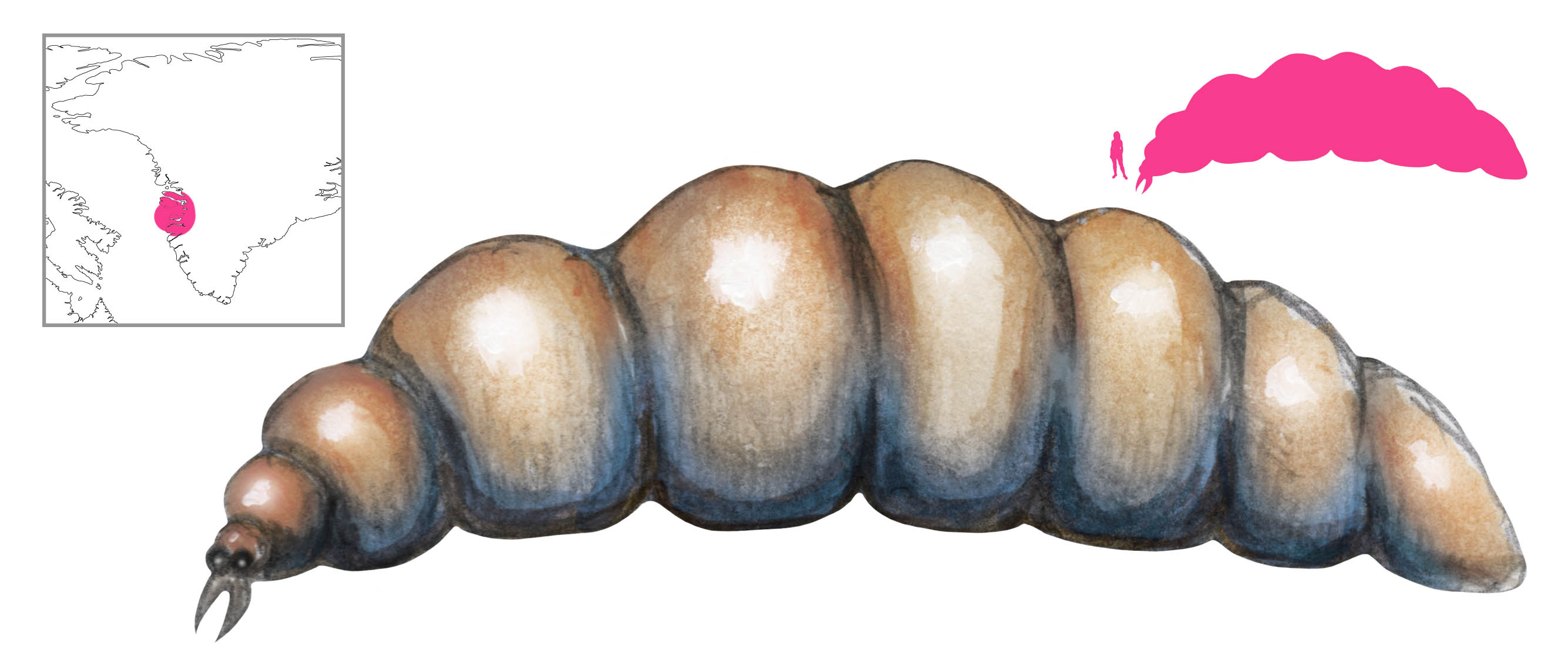
Greenland, notably Aasiaat, tell of a gigantic maggot called Quvdlugiarsuaq. It
is so big that the legend of Aqigsiaq tells of a dwelling place that survived
an entire winter on the blubber of one quvdlugiarsuaq.
The Auseq
is a similar creature described as a giant caterpillar. It is dangerous to
humans.
References
Birket-Smith,
K. (1924) Ethnography of the Egedesminde
District. Bianco Lunos Bogtrykkeri, Copenhagen.
Erumía is a
gigantic jellyfish associated with the Papuan village of Mawata. She lives on
the reef Tére-múba-mádja offshore of the Gésovamúba point. The édeéde, or normal jellyfish, are her
children, and they are abundant on that reef. She is also the patron of all the
fish. Her long, slimy, stringy tentacles can sting a man to death, and any
swimmer who sees them stretching in their direction knows to flee for their
lives. The tentacles can be seen floating around the mouth of the Bina River.
As the
patron ororárora or spirit of Mawata,
Erumía is associated with the people of the village, the “Erumía people”. She
appears in dreams as a good omen and grants “lucky things” for fishing.
References
Landtman,
G. (1917) The Folk-tales of the Kiwai
Papuans. Acta Societatis Scientiarium Fennicae, t. XLVII, Helsingfors.
Landtman,
G. (1927) The Kiwai Papuans of British
New Guinea. MacMillan and Co. Limited, London.
The story
of the Circhos is one fraught with misunderstandings, mistranslations, and
general confusion. It should serve as a morality tale on the importance of
accurate information transmission.
Aristotle
describes the habits of hermit crabs in detail. The carcinium (“small crab”) is soft-bodied after the thorax,
resembling a spider, with two red horns and forward-pointing eyes. The mouth
has hair-like appendages and two divided feet that it uses to catch prey. There
are two additional smaller pairs of feet beside them.
Of the
hermit crabs, the kind that lives in the nerita
or brita shell is unusual because its
right divided foot is small while the left one is large. It walks more on the
left foot than the right. The nerita
itself, Aristotle adds, has a large, smooth, rounded shell, and a red
hepatopancreas, as opposed to the ceryx
and its black hepatopancreas. During a storm the crabs hide under a rock, and
the gastropods attach themselves to the rock and close their opercula.
All of the
preceding information is stated consecutively. Michael Scot’s translation of
Aristotle gives the name of kiroket
to the nerita shell. Thomas de Cantimpré takes Scot’s kiroket
and his descriptions of the hermit crab and gastropod, but omits connecting
names and details to combine them into a single confused account. It is likely
that Scot’s jargon and neologisms threw Thomas off.
Thomas de Cantimpré’s
cricos (corrupted from kiroket) now has two fissures at the end of its
feet, giving it three fingers and three nails on each foot (Thomas’
“common-sense” addition). Its left foot is big and its right foot is small, and
it carries its weight on its left foot. The comparison of hepatopancreas colors
becomes the shell of the cricos, colored black and red. In good weather, the
cricos moves around; in bad weather, it attaches itself to rocks and doesn’t
move.
Albertus Magnus takes
up Thomas’ account, but drops the confusing details of the feet. The Ortus Sanitatis,
on the other hand, creates some additional features out of whole cloth. The
circhos or crichos has the head of a man and the body of a sea-dog (i.e. a
dogfish or shark); it is healthy in good weather, but weakens and turns ill in
bad weather.
Olaus Magnus borrows
the circhos of the Ortus Sanitatis to populate his Scandinavian sea. The
physical description of a human-headed fish is wisely redacted. Whether it was
meant to represent an actual Scandinavian animal, or is merely plagiarism,
remains unclear.
It is Olaus Magnus’
account that is best known today. Concept drift in modern retellings have led
to fabrications such as a limping gait that forces the circhos to move only in
fine weather and cling to rocks during storms, and even a “humanoid” appearance.
References
Aristotle, Cresswell, R.
trans. (1862) Aristotle’s History of
Animals. Henry G. Bohn, London.
Barber, R.
and Riches, A. (1971) A Dictionary of Fabulous Beasts. The Boydell
Press, Ipswich.
de Cantimpré, T. (1280)
Liber de natura rerum. Bibliothèque municipale de Valenciennes.
Cuba, J. (1539) Le iardin de santé. Philippe le Noir,
Paris.
Gauvin, B.;
Jacquemard, C.; and Lucas-Avenel, M. (2013) L’auctoritas
de Thomas de Cantimpré en matière
ichtyologique (Vincent de Beauvais, Albert le Grand, l’Hortus sanitatis).
Kentron, 29, pp. 69-108.
Magnus, A.
(1920) De Animalibus Libri XXVI.
Aschendorffschen Verlagbuchhandlung, Münster.
Magnus, O.
(1555) Historia de gentibus septentrionalibus. Giovanni M. Viotto, Rome.
Magnus, O.
(1561) Histoire des pays septentrionaus. Christophle Plantin, Antwerp.
Magnus, O.
(1658) A compendious history of the
Goths, Swedes, and Vandals, and other Northern nations. J. Streater,
London.
Rose, C. (2000) Giants, Monsters, and Dragons. W. W. Norton and Co., New York. Unknown. (1538) Ortus Sanitatis. Joannes de Cereto de Tridino.
The Ilomba
is one of several familiar spirits associated with sorcerers and witchcraft in
Zambia. Malomba appear as snakes with human heads and share the features and
emotions of their owners. As malomba are obtained through deliberate sorcery in
order to kill enemies or steal food, anyone suspected of having an ilomba is up
to no good. That said, powerful chiefs and hunters are said to have their own
malomba to protect them from witchcraft. Owners of malomba are usually male.
Evil
sorcerers can make malomba in a number of ways. Most commonly, a mixture of
certain medicines and water is made and placed on a piece of bark. Five duiker
horns are placed next to this. A plait of luwamba
or mbamba (spiky grass) is made to
about 15-18 inches long and 0.5-1 inch wide; the duiker horns are placed at one
end of this plait. Fingernail parings from the client are put in the horns, and
blood taken from the client’s forehead and chest are mixed with the medicine.
Some of the concoction is drunk by the client, while the rest is sprinkled onto
the plait with a second luwamba
plait. After the first sprinkling, the plait turns ash-white. The second
sprinkling turns it into a snake. The third gives it a head and shoulders that
resemble the client in miniature, including any jewelry present. The shoulders
soon fade away to leave only the head.
The ilomba
then addresses its master. “You know and recognize me, you see that our faces
are similar?” When the client answers both questions in the affirmative, then
they are given their ilomba.
Once
obtained, an ilomba will live wherever the owner desires it to, but usually
this is in riverside reeds. Soon it makes its first demand for the life of a
person. The owner can then designate the chosen target, and the ilomba kills
the victim. It kills by eating its victim’s life, by consuming their shadow, or
by simply feasting on their flesh or swallowing them whole. Then it returns and
crawls over its owner, licking them. People who keep mulomba become sleek and
fat and clean, are possessed of long life, and will not die until all their
relatives are dead. This comes at a steep price, however, as the ilomba will hunger
again, and continue eating lives. If it is not allowed to feed itself, its
owner will grow weak and ill until the ilomba feeds again.
Soon the
unnatural death toll will be noticed, and a sorcerer is called in to divine the
hiding place of the ilomba. To kill an ilomba, a sorcerer will sprinkle nsompu medicine around its suspected
lair. This causes the water level to rise and the ground to rumble. First fish,
then crabs, and finally the ilomba itself appear. The snake is promptly shot
with a poisoned arrow – and its owner feels its pain. They die at the same
time.
References
Melland, F.
H. (1923) In Witch-bound Africa. J.
B. Lippincott Company, Philadelphia.
Turner, V.
(1975) Revelation and Divination in
Ndembu Ritual. Cornell University Press, Ithaca.
White, C. M. N. (1948) Witchcraft, Divination and Magic among the
Balovale Tribes. Africa: Journal of the International African Institute,
18(2), pp. 81-104.
The slopes
of Exceedingly Lofty Mountain in China are home to the Chouyu. It is like a
rabbit but has a bird’s beak, owl’s eyes, and the tail of a snake. It falls
asleep (i.e. plays dead) when it sees people. If a chouyu is seen it is an omen
of a locust plague.
Mathieu
identifies this animal as the armadillo, but admits with impressive
understatement that China is a bit far from the neotropics…
References
Mathieu, R.
(1983) Étude sur la mythologie et l’ethnologie de la Chine ancienne.
Collège de France, Paris.
Strassberg, R. E. (2002)
A Chinese Bestiary: Strange Creatures from the Guideways Through Mountains
and Seas. University of California Press.
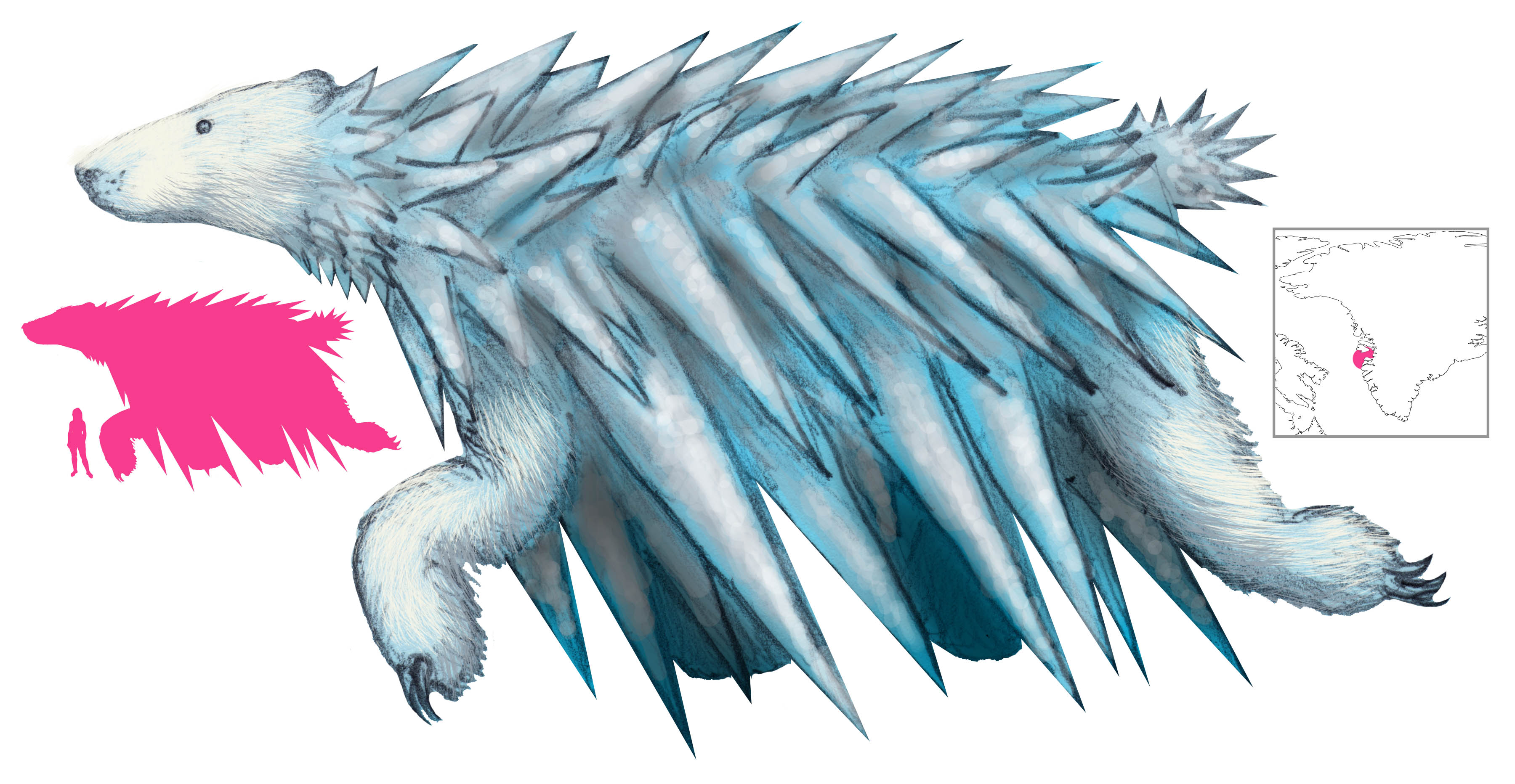
The Sermilik, “ice-clad”, is an enormous and highly dangerous polar bear found in the seas around Aasiaat in Greenland. Unlike the bears it resembles, it has very long fur completely covered with ice. Four lumps of ice at the surface are in fact the four paws of a sermilik lying in wait, and young hunters are warned never to paddle near those.
References
Birket-Smith,
K. (1924) Ethnography of the Egedesminde
District. Bianco Lunos Bogtrykkeri, Copenhagen.
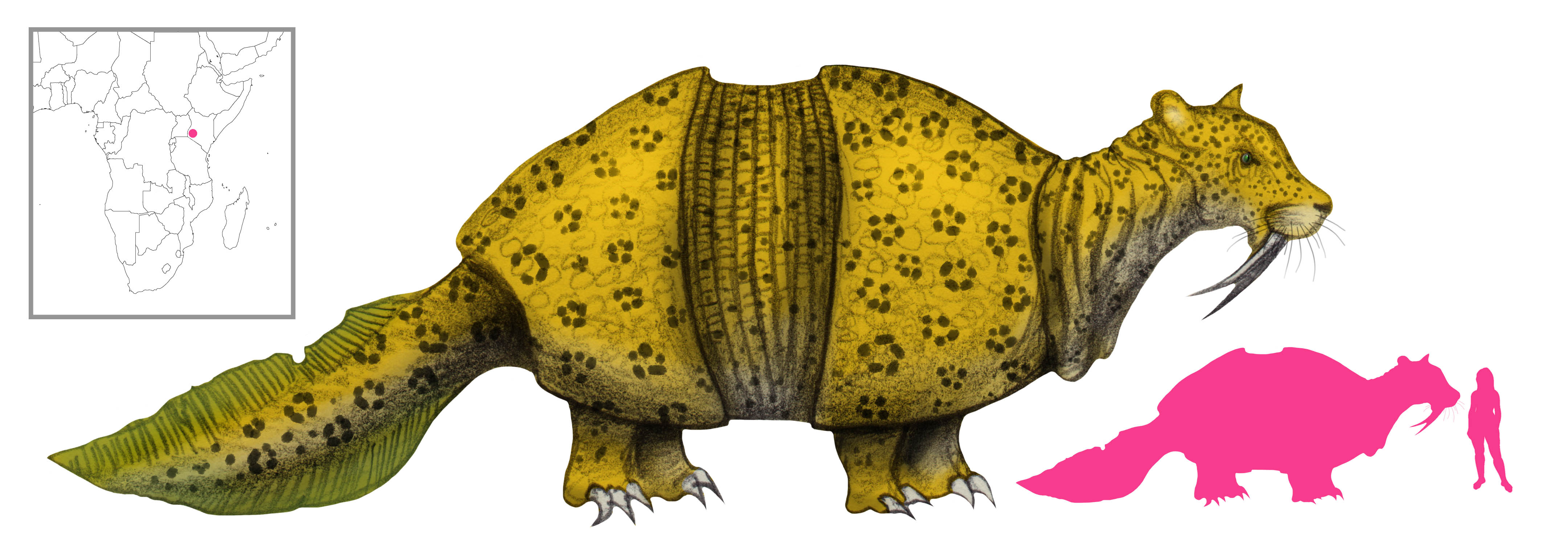
The Dingonek is a creature that lives in the Maggori River in Kenya, as well as in Lake Nyanza (Victoria). Our primary source for the dingonek comes from big-game hunter John Alfred Jordan, as recorded by Edgar Beecher Bronson. As a tale told by one big-game hunter to another, there is no reason to believe there was any embellishment or exaggeration involved.
Legends of aquatic monsters predate Jordan’s account, but they describe a generic large water python. Clement Hill claimed to have seen one in Lake Nyanza that attempted to seize a man on the prow of his boat. It had a dark, roundish head.
The dingonek as described by Jordan is a cross between a sea serpent, a leopard, and a whale. It is fourteen or fifteen feet long. Its head is similar in shape and markings to that of a leopard, but is the size of a lioness’ head. There are two long white fangs protruding downwards from the upper jaw. The back is broad like that of a hippo, patterned and colored like a leopard, and “scaled like an armadillo”. The tail, used for aquatic propulsion, is broad and finned. When ashore, the dingonek leaves behind prints as wide as a hippo’s but with reptilian claw-marks.
A .303 shot behind the ear had no effect on the dingonek. It reared straight up out of the water, and Jordan ran for his life. The dingonek was not seen again.
Hobley tells of another man who swears he saw a dingonek. When the Mara River was in flood, the eyewitness said he saw a creature floating down the river on a big log. It had its tail in the water, but its length was estimated to be sixteen feet. It had scales, spots like a leopard, and a head like an otter, but no long fangs. When shot at, it slipped into the water and disappeared. Apart from the (surely inaccurate) length given, this is a good account of a Nile monitor lizard.
Finally, rock art from a cave in Brakfontein Ridge, South Africa, has been claimed to depict a walrus-like dingonek, but the location is far from the dingonek’s habitat, and the association is arbitrary.
Heuvelmans initially believed the dingonek to be an odd species of prehistoric crocodile. Later he revised this to create an aquatic saber-toothed cat whose wet fur clumped and gave the appearance of scales.
As armadillos are New World animals, modern reconstructions have assumed the armadillo “scales” to be those of a pangolin instead. Other recent additions include a single horn and a stinger tail, neither of which have any basis.
Cryptozoologists have equated the dingonek with a number of other creatures, including the far better known Lukwata, the Ndamathia, and the Ol-umaina or Ol-maima of the Mara River. This is known to the Masai and has been described by Hobley as fifteen feet in length and scaly with a dog-like or otter-like head, leopard spots, small ears “marked somewhat after the fashion of a puff adder”, a short neck, short legs with claws. It may be seen sunning itself on logs and riverbanks, and dives into the water when threatened. Hobley’s ol-umaina account is copied by Heuvelmans, who expresses some confusion at the “ears” comment but otherwise affirms that the dingonek and the ol-umaina are one and the same. Shuker corrects the name to ol-maima.
All of this is moot. Ol-maima (or, more correctly ɔl-máɨ́má) is the Maa term for a cripple or a Nile monitor lizard (owing to its waddling movement on land). The descriptions are exaggerated but recognizable accounts of monitor lizards – as the dingonek itself almost certainly is.
References
Bronson, E. B. (1910) In Closed Territory. A. C. McClurg & Co., Chicago.
Bryant, A. T. (1948) The Zulu People. Shuter and Shooter, Pietermaritzburg.
Conway, J.; Kosemen, C. M.; and Naish, D. (2013) Cryptozoologicon Vol. I. Irregular Books.
Heuvelmans, B.; Garnett, R. trans. (1958) On the Track of Unknown Animals. Rupert Hart-Davis, London.
Hobley, C. W. (1913) On Some Unidentified Beasts. The Journal of the East Africa and Uganda Natural History Society, III(6), pp. 48-52.
Oswald, F. (1915) Alone in the Sleeping-Sickness Country. Kegan Paul, Trench, Trubner & Co., London.
Payne, D. L. and Ole-Kotikash, L. (2008) Maa Dictionary. University of Oregon, accessed online.
Shuker, K. P. N. (1995) In Search of Prehistoric Survivors. Blandford, London.
Stow, G. W. and Bleek, D. F. (1930) Rock-paintings in South Africa. Methuen & Co. Ltd., London.