Beathach Mòr Loch Odha

Variations: Big Beast of Loch Awe, Big Beast of Lochawe

big-beast

Like so many other lake monsters, the true nature and appearance of the Beathach Mòr Loch Odha, the “Big Beast of Loch Awe”, is shrouded in mystery. Some say it resembles a giant horse, while others describe a colossal eel. What is known for certain is that the Big Beast is a large and powerful creature with twelve legs. It can be heard in the dead of winter, breaking the ice on the frozen loch.

It has been a long time since the Big Beast was last seen. Its existence is all but forgotten on the shores of Loch Awe, and a resident of Ford interviewed by Fleming in 2001 had nothing to say on its subject.

References

Campbell, J. G. (1900) Superstitions of the Highlands and Islands of Scotland. James MacLehose and Sons, Glasgow.

Fleming, M. (2002) Not of this World: Creatures of the Supernatural in Scotland. Mercat Press, Edinburgh.

Lupeux

lupeux

“Ah, ah! Ah, ah!” The sound echoes through the still, moonlit ponds of Brenne. “Ah, ah, ah!” It’s a pleasant, gently teasing sort of laugh, in a soft human voice. You look around you, but the sound is hard to place. “Who’s there?” you might think of asking. “What’s going on?” Inhabitants of the Berry region in France know better than to respond. Your traveling companion chides you. “For the love of God, don’t answer a third time!”

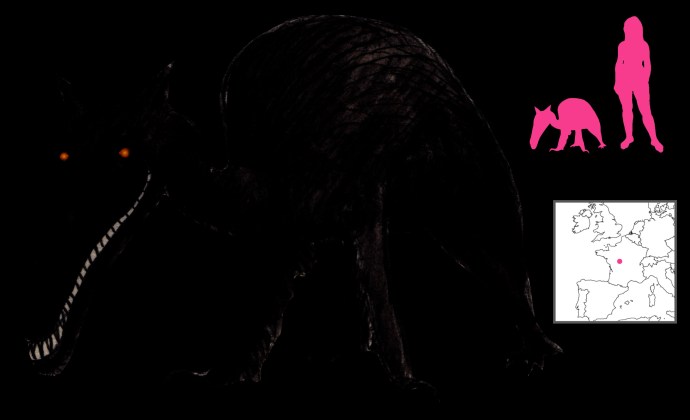
The laughter comes from the Lupeux, a mysterious, perverse creature with a cruel sense of humor. The lupeux is heard but not seen. Its appearance is uncertain and varies from area to area, but it usually has the head of a wolf, as hinted by its name.

“Ah, ah!” You don’t heed your friend’s warning and call out once more. “What’s funny?” That’s when the floodgates open. The lupeux’s laughter ceases, and it begins to talk to you. In its friendly, genial, engaging voice, it relates juicy rumors, scandalous gossip, inside secrets. If you’re single, it tantalizes you with its matchmaking, sets you up with the hottest dates; if you’re romantically involved, it taunts you with your partner’s infidelity and reveals all their secret lovers. There is seemingly nothing the lupeux doesn’t know – or pretend to know.

Once in the lupeux’s spell, you do not tire of listening to it. You follow its congenial voice as it travels through the skeletal branches of blasted willows, desperate for more. Then the voice stops moving, and you stop in front of a pool, crystal clear, reflecting you and all your hopes and fears, all the tales the lupeux has planted in your head. You come closer for a better look – and the lupeux pushes you in. As you sink into the bottomless pool, as the cold water pours into your lungs and you take your last breath, you see the lupeux perched on a nearby branch, watching you drown and laughing in its charming, friendly voice. “Ah, ah! Now that’s funny”.

References

Jaubert, H. (1864) Glossaire du Centre de la France. Imprimerie et Librairie Centrales de Napoleon Chaix et Cie, Paris.

Sand, G. (1858) Légendes Rustiques. Amorel et Cie Libraires-Editeurs, Paris.

Oókempán

ookempan

Oókempán is an ogre known to the Tehuelche of Argentina and Chile. He looks like a very large man, but has a shell on his back and moves around on all fours like a pig. Oókempán abducts children, enticing them with a bit of meat before slinging them into a box on his back and carrying them off. Any child playing on their own is at risk of being taken and presumably eaten. Attempts to stop Oókempán will fail, as his hard shell prevents any damage from reaching him; his weakness is in his heel, which is unprotected.

It was Oóuk’en, “truth”, the man incapable of lying, who put an end to Oókempán’s kidnappings. He interceded after a child escaped by grabbing hold of an overhead branch as Oókempán passed under it. Oóuk’en went to meet Oókempán at the top of a cliff. “What did you do with the children?” he asked the ogre. “I took them to increase my people”, replied Oókempán. “I only eat rhea, and I needed them to hunt for me”. After some more small talk, Oóuk’en pushed Oókempán off the cliff, shattering his shell and killing him.

The presence of fossil elephant bones in the region have been seen as evidence of Oókempán’s existence.

References

Borgatello, M.; Bórmida, M.; Casamiquela, R. M.; Baleta, M. E.; Escalada, F. A.; Harrington, T.; Hughes, W.; Lista, R.; Samitier, M. L.; and Siffredi, A.; Wilbert, J. and Simoneau, K. eds. (1984) Folk Literature of the Tehuelche Indians. UCLA Latin American Center Publications, University of California, Los Angeles.

Tçulo

Variations: Tculo, Thulo

tculo

Tçulo is the third child of Ana, Queen of the Keshalyi. As with his siblings before and after him, he is a vile demon of disease with no redeeming features, and originated from the machinations of the evil King of the Loçolico to impregnate his wife. Their stories are told in Roma folklore.

Eventually, the King realized that he could only make love to his wife while she was asleep, and Melalo was more than happy to oblige with soporific vapors. But Melalo himself was procreating with Lilyi, bringing more diseases and ailments into the world, and the King grew jealous of his son’s brood. On the other hand, Melalo found that he could not sire powerful demons, and hoped that his mother could produce a race of evil beings strong enough to destroy humanity. Following Melalo’s advice, the King ate a stag beetle and a crayfish before visiting Ana. Tçulo was the result.

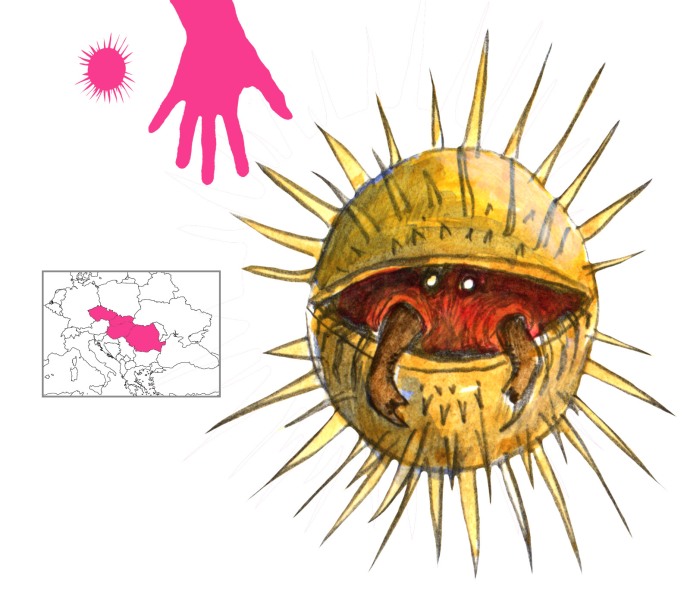
Tçulo, “Thick” or “Potbellied”, is little more than a small ball full of spikes. He enters human bodies and rolls around within the intestines, causing severe abdominal pains and colic. He particularly targets pregnant women, and even his big sister Lilyi was tormented by him. It was this behavior that led to the conception of Tçaridyi, Tçulo’s own sister-wife. Both of them caused pain but rarely death, and their offspring were all women’s diseases.

References

Clébert, J. P. (1976) Les Tziganes. Tchou, Paris.

Clébert, J. P.; Duff, C. trans. (1963) The Gypsies. Vista Books, London.

Meyers Brothers Druggist (1910) Demons of Disease. Meyers Brothers Druggist, v. 31, p. 141.

Pavelčík, N. and Pavelčík, J. (2001) Myths of the Czech Gypsies. Asian Folklore Studies, v. 60, pp. 21-30.

Muirdris

Variations: Muirgris (erroneously); Sínach, Sinech; Píast Uiscide (“Water Beast”); Úath (“Horror”)

muirdris

Fergus mac Léti, the King of Ulster, was an inveterate swimmer. Captured while sleeping by water-spirits, the lúchorpáin or “small bodies” (actually the first appearance of leprechauns), he was awoken by the cold water they tried to carry him into. This allowed him to turn the tables on his would-be captors, and he seized three of the lúchorpáin. Fergus demanded that the sprites grant him three wishes: the ability to breathe underwater in seas, pools, and lakes.

The sprites granted him his wish, in the form of enchanted earplugs and a tunic to wear around his head. But like all wishes granted by the Fair Folk, it came with a caveat. Fergus was not to use his gifts at Loch Rudraige (Dundrum Bay) in his own land of Ulster.

Of course, Fergus arrogantly disregards the rule and swims underwater at Loch Rudraige anyway. There he encounters the Muirdris, the “Sea Bramble” or “Sea Briar”, a huge, mysterious, undefined horror that inflates and deflates, expands and contracts like a bellows. It has features of a thorn-bush, with branches and stings, and its appearance alone is deadly.

Fergus does not take well to his encounter with the muirdris, and he is horribly disfigured after seeing it, with his mouth moving to the back of his head. His courtiers are dismayed, as a man with a blemish cannot be king, but they somehow keep this defacement a secret from Fergus for seven years. They prevent him from accessing mirrors, and surround him only with people who will protect the king’s deformity. He finds out only after Dorn, a highborn slave, taunts him about it after he strikes her with a whip. She is bisected for her troubles, and Fergus goes to face his nemesis alone.

The battle between Fergus and the muirdris lasts a day and a night, during which the water of the loch bubbles like a giant cauldron. Finally Fergus slays the monster with his bare hands, and emerges from the loch holding its head in triumph – only to collapse and die from the ordeal.

A thirteenth-century retelling of Fergus’ tribulations renames the monster sínach or sinech. In this version, it is the king’s wife who reveals his secret after an argument.

The muirdris is a monster, but is it rooted in fact? Surely the expansion and contraction, the comparison to a thornbush, and the disfiguring stings strongly suggest a large jellyfish, perhaps the lion’s mane jellyfish.

References

Borsje, J. (1996) From Chaos to Enemy: Encounters with Monsters in Early Irish Texts. Brepols Publishers, Turnhout.

MacKillop, J. (2005) Myths and Legends of the Celts. Penguin Books, London.

Ṣannāja

Variations: Ṣannājah, Ṣunnājah, Sannaja; Nubian Horse (erroneously)
Sannaja

The Ṣannāja, “Cymbalist” (!), is a gigantic, deadly, yet pathetic creature originally described by al-Qazwini. It can be found in the land of Tibet, making it an abominable snowman of sorts, although it has more in common with the Gorgons of Greek myth.

According to al-Qazwini, the ṣannāja is indescribably vast, such that no animal can compare to it in size. This largest of all beasts makes dens one league wide.

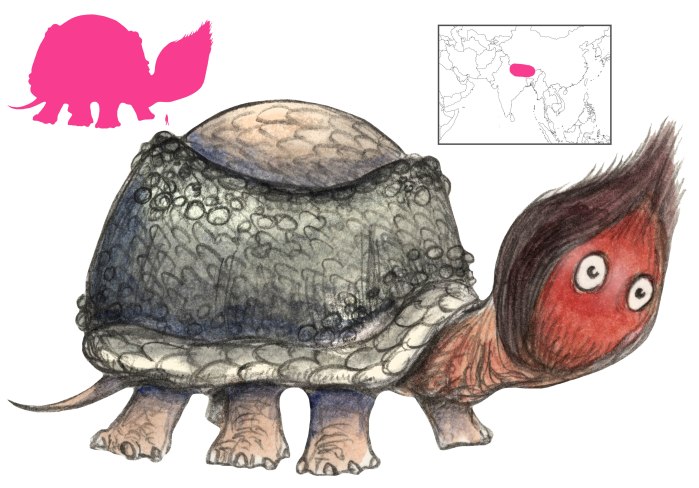
Neither al-Qazwini nor al-Damiri describe its appearance, so artistic depictions of ṣannājas vary. As it is described in the same section along with insects and reptiles, the Wasit manuscript shows it with six stubby legs and a segmented, shelled turtle-like body. Its red, vaguely spiderish head is blank except for hair and two large, staring eyes. The artist of the C.1300 manuscript gives the ṣannāja a tusked, leonine head with massive, spotted folds of skin all over its body. A third is more cautious, assigning it the looks of a dragon. Finally, one Egyptian account is a ṣannāja in name only, placing it in African rivers and giving it four duck feet, a horse’s mane, water-buffalo skin, and a huge mouth. Described as the “Nubian Horse” living in water and ruining crops on land, this is the only case where the name has been applied to the hippopotamus.

The most distinctive quality of the ṣannāja is its deadly gaze, which nonetheless has a peculiar quality. Any animal that sees the ṣannāja dies instantly, but if the ṣannāja sees the animal first, it is the one to expire. Thus animals of Tibet come up to ṣannājas with their eyes closed, such that the monster will see them and drop dead, guaranteeing them a feast for weeks to come.

Accounts of mammoth fossils from Central Asia may have inspired the enormous ṣannāja. Traditional Tibetan art and kirttimukha faces may also have had a hand in its genesis.

References

Berlekamp, P. (2011) Wonder, Image, and Cosmos in Medieval Islam. Yale University Press, New Haven.

al-Damiri, K. (1891) Hayat al-hayawan al-kubra. Al-Matba’ah al-Khayriyah, Cairo.

Jayakar, A. S. G. (1908) Ad-Damiri’s Hayat al-Hayawan (A Zoological Lexicon), vol. II, part I. Luzac and Co., London.

Komaroff, L. and Carboni, S. (eds.) (2002) The Legacy of Genghis Khan. Yale University Press, New Haven.

Rapoport, Y. and Savage-Smith, E. (eds.) (2014) An Eleventh-Century Egyptian Guide to the Universe. Brill, Leiden.

al-Qazwini, Z. (1849) Zakariya ben Muhammed ben Mahmud el-Cazwini’s Kosmographie. Erster Theil: Die Wunder der Schöpfung. Ed. F. Wüstenfeld. Dieterichsche Buchhandlung, Göttingen.

Swan Valley Monster

Swan Valley Monster

The Swan Valley Monster made its appearance on August 22, 1868, in the otherwise tranquil locale of Swan Valley, Idaho. Its presence was witnessed and reacted to by an unnamed old-timer crossing the river at Olds Ferry.

The first thing he saw of the monster was an elephant’s trunk rising from below the surface and spouting water. This was followed by a snake-like head the size of a washtub, with a single horn that kept moving up and down, and long black whiskers on both sides of the face. It had ten-inch-long fangs and a red forked tongue that spewed green poison. When it hauled its massive body onto the shore, the old-timer noted that it must have been twenty feet long, and it stank to high heaven. A pair of wing-like fins – or fin-like wings – came out of the sides of its neck. Its forward half was like a snake, the thickness of a calf, greenish-yellow with red and black spots; this in turn led into a fish-like section with hand-sized rainbow scales shining in the sun; finally, the tail was a drab, scaly gray like a crocodile or lizard tail. Shiny black barbed spines, like those of a porcupine, lined its back from head to tail. Finally, it had twelve stubby legs that were easily missed at first glance; the first pair under the fins had hoofs, followed by two pairs of legs with razor-sharp claws, then a pair of hoofed feet, a pair of clawed feet, and another pair of hoofed feet near the tail.

Of course, the old-timer’s first reaction to the abomination slithering up the bank was to fire a slug into its eye. The monster reared up, hissing, bellowing, and spurting poison over its surroundings, so it got shot a second time in its yellow belly, convulsed, and stopped moving. Everything its poison had touched, whether trees or grass or other living beings, withered and died.

As the monster was too large to be carried off by one man, the old-timer returned to town to fetch a wagon and six strapping lads to help him, as well as a tarp to protect them from the poison. They could smell the odoriferous creature a hundred yards away, and one of the men had to stay with the horses to keep them from bolting, while another got sick and refused to come any closer. But when they reached the bank where the monster had fallen, there was nothing but withered vegetation and a trail leading to the water.

Presumably the Swan Valley monster had crawled back into the river to die – or perhaps it didn’t die. Whatever its fate, the old-timer recommended keeping a close watch on the river, as “I’ve hunted an trapped an fished all over the state fer nigh ontuh seventy-five year… but I ain’t never seen nothin tuh compare with that speciment”.

References

Clough, B. C. (1947) The American Imagination at Work. Alfred A. Knopf, New York.

Fisher, V. ed. (1939) Idaho Lore. Federal Writers’ Project, The Caxton Printers, Caldwell.

Lewicki, J. and the editors of LIFE (1960) Folklore of America, part V. LIFE Magazine, Aug. 22, 1960.

Colôrobètch

Variations: Colô Rodje Bètch, Colô Rotje Bètch, Clô Rotje Bètch, Colôrobètche, Colaurobètch, Colaurobètche, Colau-rodje-bètch, Corobètch, Routge Bètch

Colorobetch

Bogeys represent a variety of childhood fears – darkness, retribution, the murky depths of deep ponds… In Wallonia children are menaced by the personification of the bise or icy wind, in the form of a bird with a red beak.

He can be found around Andenne, Bastogne, Dinant, Huy, and Neufchâteau, and Warsage; in On, Oignies, and Stavelot he is simply the “red beak”. The Somme-Leuze redbeak is a monstrous sparrow, the Condroz and Hesbaye variety is a pigeon, while the Namur redbeak is Colôrobètch or Colô Rodje Bètch, the “Red-Beaked Rooster”.

As his name indicates, Colôrobètch has a beak stained red with blood; beyond that, it is unclear whether he is a bird, a human, or a grotesque combination of both. He preys on children unwary enough to walk in the cold without adequate clothing, nipping at their exposed faces and hands until they turn red, dry, cracked, and bleeding. Colôrobètch comes out in the winter to pinch noses and spread frostbite.

In Andenne Colôrobètch becomes a nocturnal water bogey who drags children into the Meuse.

References

Pignolet, M. (1985) La Symbolique du Coq. Le Guetteur Wallon, 61 (3), pp. 81-104.

Tijskens, J. (1965) Les Noms du Croquemitaine en Wallonie. Enquêtes du Musée de la Vie Wallonne, nos. 117-120, tome X, pp. 257-391.

It

It

Shetland is home to a number of creatures, some malevolent and some benign, but the most disconcerting of all is the entity known only as It.

Nobody can agree on what It looks like, and It has never appeared in the same form twice. Whether It is a shapeshifter or uses magic to obscure Its true appearance is unknown. Descriptions include a lump of “slub” or jellyfish, a legless animal, a headless human, and a bag of white wool. It could be a large otter or seal, but to those who have seen It, there is no otter or seal that compares. It is legless, but runs faster than any dog; It is wingless, but flies faster than any eagle; It is silent, but people understand what It is saying without hearing a word.

One Shetland house was plagued every Christmas by It. A man living there was alerted to Its presence, Its movement sounding like a mass of dead flesh hitting the floor. The man ran outside armed with an axe and a Bible, and chased It up the cliffs, embedding his axe in Its body while uttering a holy word. It was immobilized before It could dive back into the sea.

When the man called his friends over, they could tell if It was alive or dead, and It looked different to each of them. It was buried in earth and a trench dug around it, but nobody dared check on It. A stranger was brave enough to observe the burial site, but a mist rose, and something emerged from the ground to roll into the ocean. It had escaped.

References

Saxby, J. M. E. (1932) Shetland Traditional Lore. Grant and Murray Limited, Edinburgh.

Romŝiwamnari’

Variations: Romŝiwamnare’

Romsiwamnari

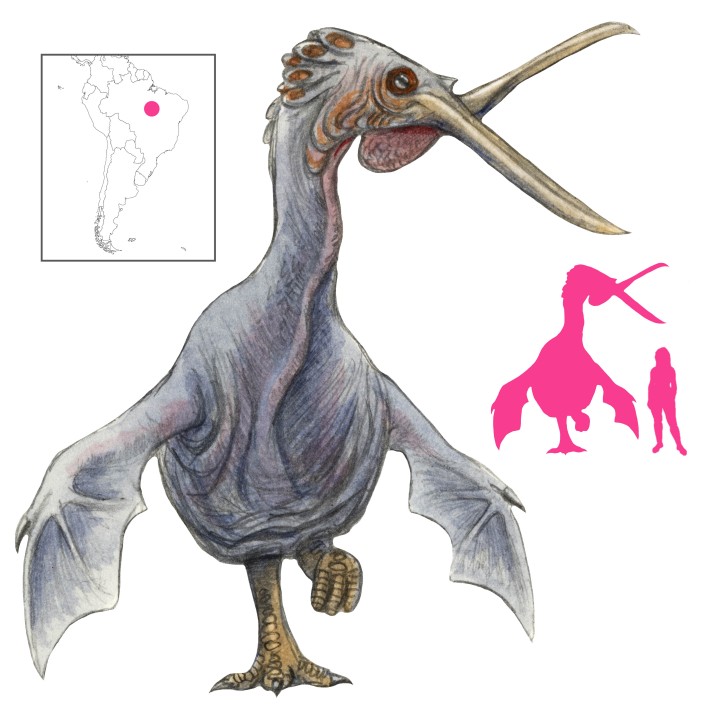
The Romŝiwamnari’ are forest and cave demons, known to the Šerente people of Tocantins, Brazil. They look like large birds with flabby, flightless bat’s wings, armed with beaks like scissors. Their call is an eerie whistle. Romŝiwamnari’ also appear as tapirs, or as stout humans with prominent teeth and a howler monkey’s tail. When in human guise, a romŝiwamnari’ resembles the Pope – a relic of missionary activity in Brazil.

Romŝiwamnari’ not only prey upon the living, but also ambush and consume the souls of the dead. A sufficiently powerful shaman can kill them while in the realm of death, but other souls are greedily devoured.

A man of the krara’ society and his pregnant wife once encoutered a pair of romŝiwamnari’ in a cave. The man held the monsters off as long as he could while his wife escaped, but he was outmatched and decapitated by the romŝiwamnari’. The woman brought the news to the rest of the village, and the other krara’ launched an assault on the romŝiwamnari’ cave. Three of the villagers were killed in the battle, but they slew the two romŝiwamnari’ – unaware that there were two more in hiding. However, the boy the woman gave birth to grew into a mighty hero in less than a year, and he avenged his father by burning the romŝiwamnari’ bones and killing the other two demons. The romŝiwamnari’ were not seen again in that area.

References

Crocker, W. H.; Giaccaria, B.; Heide, A.; Lea, V.; Melatti, J. C.; Nimuendajú, C.; Seeger, A.; Verswijver, G.; Vidal, L.; Wilbert, J. and Simoneau, K. (eds.) (1984) Folk Literature of the Gê Indians, v. 2. UCLA Latin American Center Publications, University of California, Los Angeles.

Nimuendajú, C.; Lowie, R. H. (trans.) (1942) The Šerente. The Southwest Museum, Los Angeles.