Puaka

Variations: Puwaka, Puaki

Puaka

The Puaka (“Pig”) is a Dusun demon that guards water in eddies, and resembles a pig with a razor-sharp tongue. Puakas like to feed from trees, and stand on each other’s backs until they reach the branches.

When you meet a Puaka, it will attack if you move, and come to a halt if you stop. If it catches up with you, it will lick your bones clean. To lose the Puaka it is recommended to cross a stream; the creature may follow you across the stream, but once on dry land it will pause to lick itself dry, licking the flesh off its bones in the process.

“Puaka” and similar terms have meant pig in a number of languages – puaka in Rarotongan, Mangarevan, Rotuma, and Malay, vuaka in Fiji, puwaka in Malay, pua’a in Samoan, puaa in Tahitian, Marquesan, and Hawaiian, buaka in Tongan, and poaka in Maori. While this has been alternately compared to the Sanskrit sukara, the Latin porcus, and the English porker, the word seems to have had its own unique Polynesian origin. In some areas puaka has come to denote the pig-like demon; sometimes it loses its meaning as “pig” altogether, possibly due to the influence of Islam.

References

Mackenzie, D. A. (1930) Myths from Melanesia and Indonesia. Gresham Publishing Company, Ltd., London.

Dijiang

Variations: Ti-chiang

Dijiang

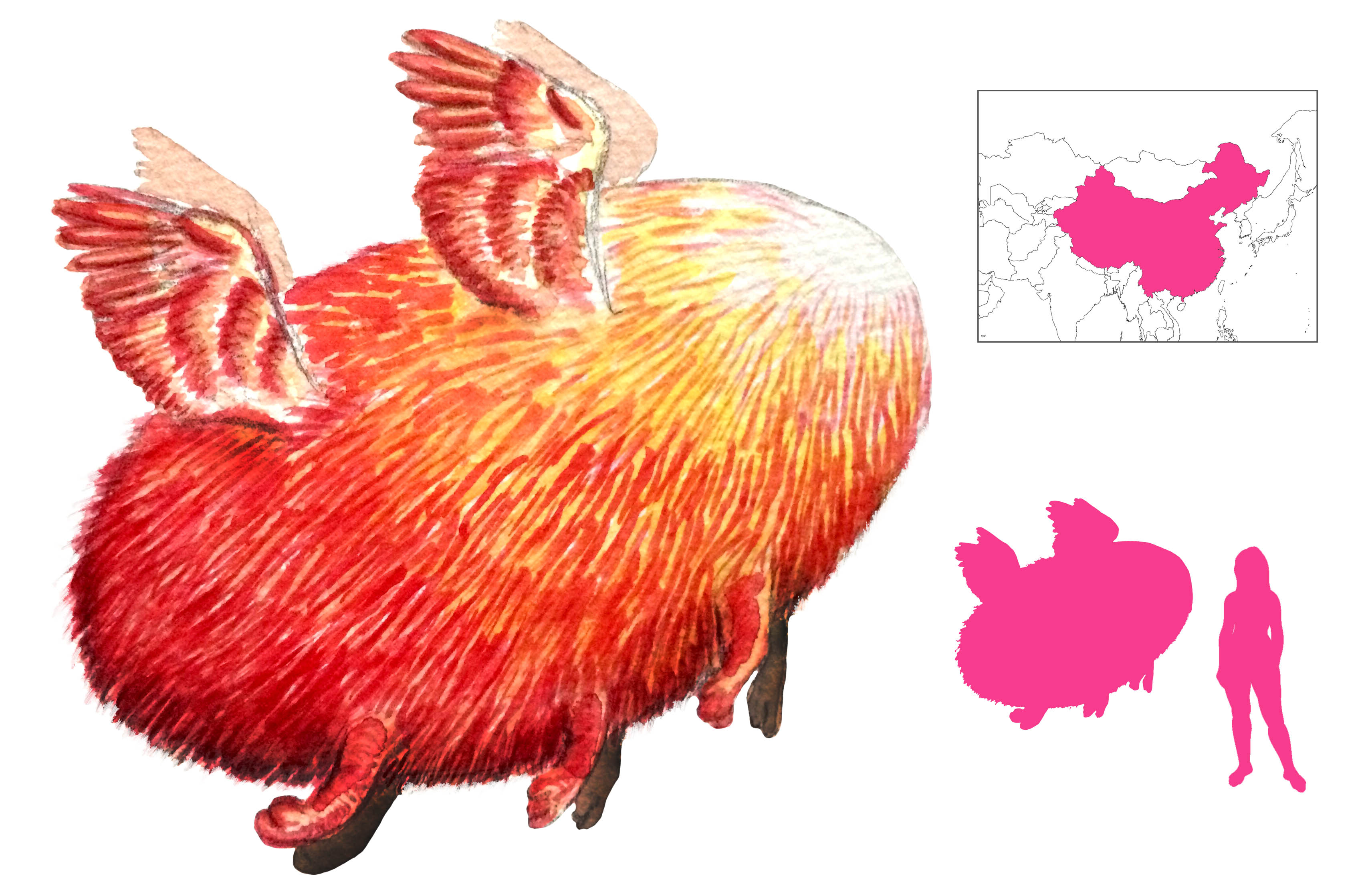
The divine bird known as Dijiang, the “Thearch Long River”, was like a yellow sack with an aura of cinnabar; Borges, calling it the Ti-chiang, described it as bright red. It had six legs and four wings, but no eyes or facial features of any kind, living in a perpetual state of confusion. It was also fond of singing and dancing.

This “state of confusion” led to the association of Dijiang with Hundun, a being of cosmic chaos. The undifferentiated Hundun had no eyes, ears, mouth, or orifices of any sort, and died when his guests tried to drill openings in his body.

Dijiang’s description can be found in the Guideways Through Mountains and Seas, where it is located in the Celestial Mountain along with large quantities of metal and jade. Borges attributes it to the T’ai Kuang Chi.

The four wings and six legs, as well as the lack of apparent head, suggest a magnified insect of some sort.

References

Borges, J. L.; trans. Hurley, A. (2005) The Book of Imaginary Beings. Viking.

Mathieu, R. (1983) Étude sur la mythologie et l’ethnologie de la Chine ancienne. Collège de France, Paris.

Strassberg, R. E. (2002) A Chinese Bestiary: Strange Creatures from the Guideways Through Mountains and Seas. University of California Press.

Dipsas

Variations: Dipsa, Dipsades (pl.), Ammobates (“sand crawler”), Arida (“arid”), Kausone (“burner”), Melanurus (“black-tail”), Prester (“inflater”, erroneously), Situla (“bucket”), Torrida (“torrid”)

Dipsas

The Dipsas – “thirsty” or “thirst-causer”, among its many names – was one of the deadly snakes encountered by Cato’s army in the African desert. It was feared for its venom, which induced unquenchable, desperate thirst in its victims. Aelian and Aldrovandi believed it to be the same as the prester, a conclusion which Topsell disputed.

Aelian points out that the dipsas is white with two black stripes on its tail; Topsell mentions its black tail and black-and-yellow spots on its anterior; Aldrovandi pictures it with longitudinal black and white stripes and prominent scales on its head. Dipsades may be found near sources of water, including springs and marshes, and they will also lie in wait in ostrich nests.

The small size of the dipsas makes it easy to overlook, and its bite is painless; its victims often are oblivious to the cause of their unnatural thirst. The venom seeps into the bones, sets fire to the organs, absorbs vital fluids, and parches the tongue and throat. Sometimes victims are driven to drink so much that their stomachs explode; if there is no water around, they eventually succumb to internal burning.

Lucan describes the effect of a dipsas bite on the Roman standard-bearer Aulus, bitten after he accidentally stepped on a dipsas. No amount of water could quench his thirst, and, after trying in vain to drink up a river, he tore his wrists open in a last-ditch effort to drink his own blood. His suicide was practically a mercy.

Aelian mentions a tale told where a donkey, charged by Zeus with bestowing immortality on mankind, stopped by a spring to drink. That spring was guarded by a dipsas, which refused to allow the donkey to drink until it had given it the secret of immortality – and since then, the snake sheds its skin and rejuvenates itself, while humans, much like the unfortunate Gilgamesh, lost their chance at eternal youth. This story was also told by Sophocles and a number of other authors. Dipsades also guard a spring in the Pharsalia, and Cato (correctly) points out that snake venom is harmless in water. In both of these cases, we have the dipsas causing thirst not by its bite, but by denying access to water.

The descriptions of dipsas venom may be close to the actual effects of some snake venoms, notably the burning sensation and the parched throat. Nowadays Dipsas refers to a genus of New World snakes that only pose a threat to snails and slugs.

References

Aelian, trans. Scholfield, A. F. (1959) On the Characteristics of Animals, vol. II. Harvard University Press, Cambridge, Massachusetts.

Aldrovandi, U. (1640) Serpentum, et Draconum Historiae. Antonij Bernie, Bologna.

Batinski, E. (1992) Cato and the Battle with the Serpents. Syllecta Classica, Vol. 3, pp. 71-80.

Eldred, K. O. (2000) Poetry in Motion: the Snakes of Lucan. Helios 27.1, p. 63.

Isidore of Seville, trans. Barney, S. A.; Lewis, W. J.; Beach, J. A.; and Berghof, O. (2006) The Etymologies of Isidore of Seville. Cambridge University Press, Cambridge.

Lucan, trans. Rowe, N. (1720) Pharsalia. T. Johnson, London.

Topsell, E. (1658) The History of Serpents. E. Cotes, London.

Sinad

Variations: Sinād, Sénad, Senad

Sinad 2

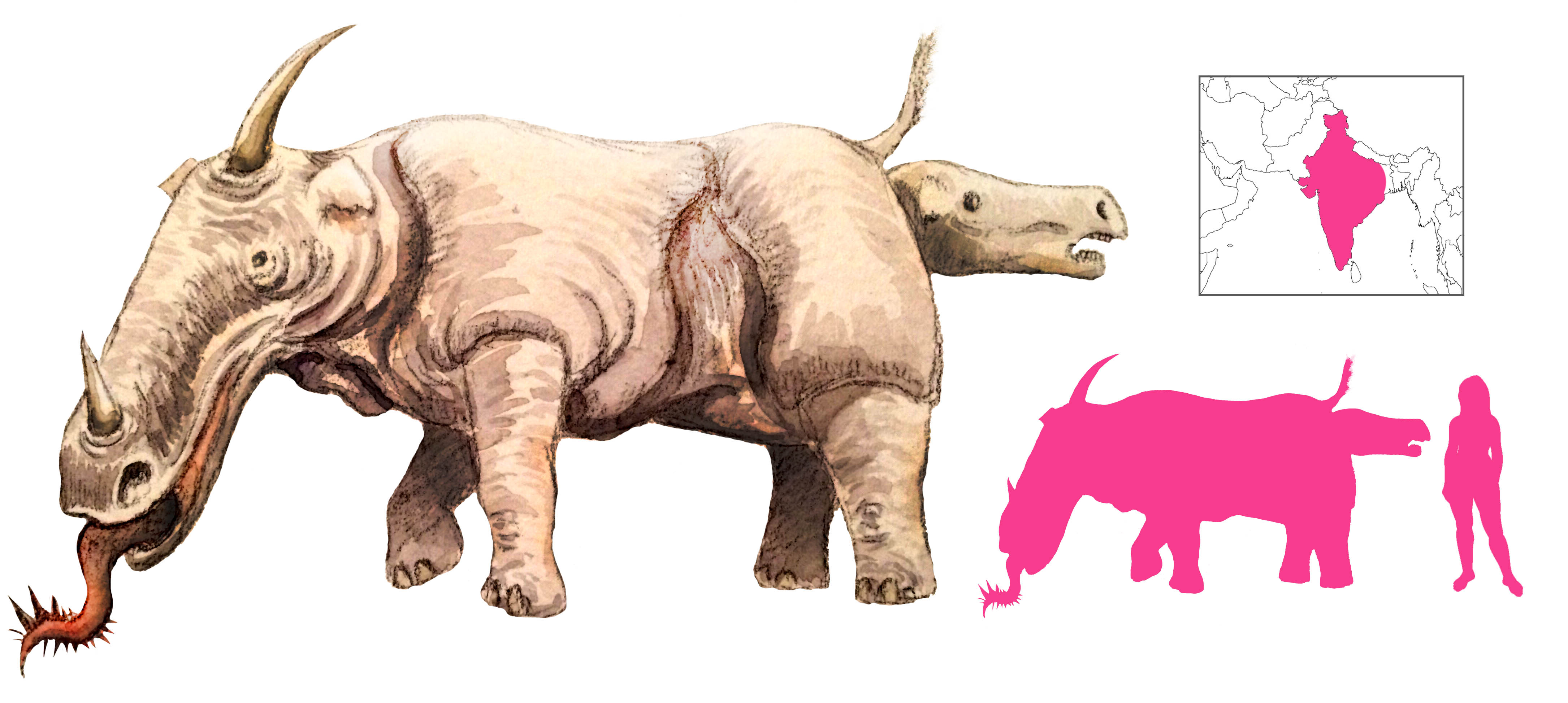
The Sinad is an Indian creature of uncertain appearance and dubious maternal instinct, described by Al-Jahiz, Al-Qazwini, and a number of other Muslim authors. Its primary characteristics – also attributed to the karkadann – were its sharp, thorny tongue and its unusual method of giving birth.

Al-Qazwini describes the sinad as similar to but smaller than an elephant, and larger than an ox. When the female is ready to give birth, the young sinad would stick its head out of its mother’s womb, feeding on grass and waiting until it was mature enough to run away. This was because the mother sinad, following her parental instincts, would attempt to lick her calf clean – in the process flaying the flesh off its bones. Once it was large enough, the calf would squirm out and gallop to safety.

This lethal tongue was also associated with the karkadann, and representations of them became blurred. Some images of the sinad are elephantine, while others came to follow the established iconography of the karkadann, giving it one or two horns. Al-Gharnati stated that the kings of China tortured people by having a karkadann lick them. Marco Polo, in his disillusioned report on the unicorn, said that its deadliest weapon was its tongue.

Flaubert, in his Temptation of Saint Anthony, makes an allusion to the Sénad as a three-headed bear that tears its cubs apart with its tongue. Here he conflates the sinad as described by Bochart with Pliny’s description of the bear licking its amorphous newborn cubs into shape. The three heads are a Flaubertian flourish.

References

Ettinghausen, R. (1950) The Unicorn. Studies in Muslim Iconography, Freer Gallery of Art Occasional Papers Vol. 1, No. 3, Washington.

Flaubert, G. (1885) La Tentation de Saint Antoine. Quantin, Paris.

Pliny; Holland, P. trans. (1847) Pliny’s Natural History. George Barclay, Castle Street, Leicester Square.

Polo, M. (1965) The Travels. Penguin Classics, London.

Al-Qazwini, Z. (1849) Zakariya ben Muhammed ben Mahmud el-Cazwini’s Kosmographie. Erster Theil: Die Wunder der Schöpfung. Ed. F. Wüstenfeld. Dieterichsche Buchhandlung, Göttingen.

Seznec, J. (1943) Saint Antoine et les Monstres: Essai sur les Sources et la Signification du Fantastique de Flaubert. PMLA, Vol. 58, No. 1, pp. 195-222.

Umutwa

Variations: Abatwa (pl., often used as singular), Chitowe, Katsumbakazi, Maithoachiana, Mkonyingo, Mumbonelekwapi, Wabilikimo
Umutwa

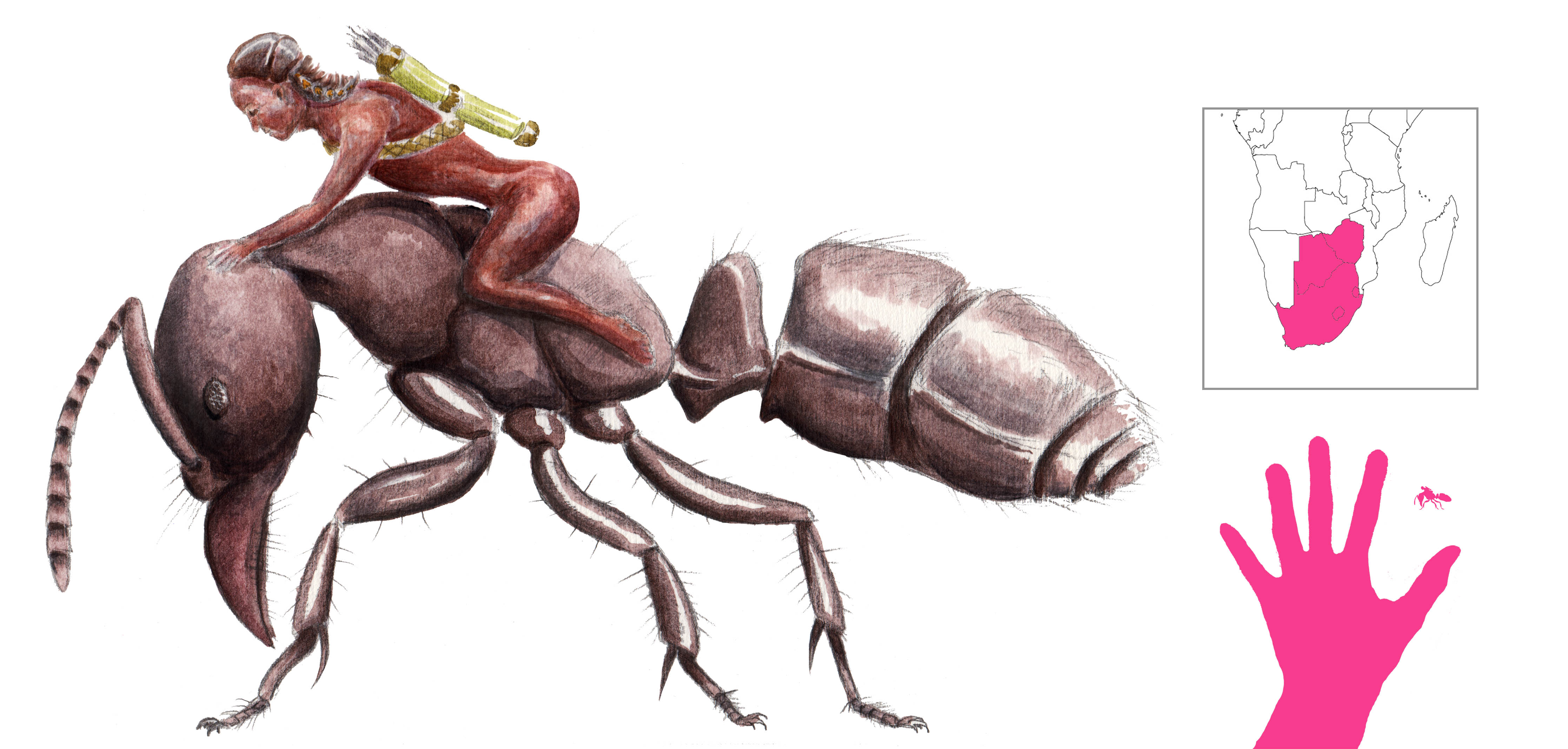
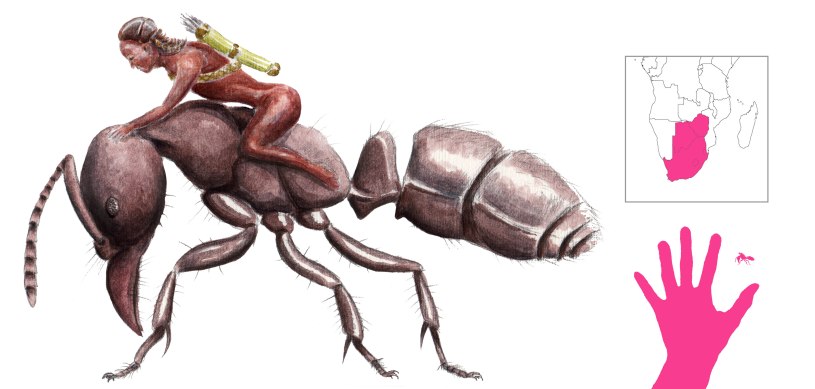
First contact between different people is never easy. Sometimes one group ends up exaggerated, romanticized, altered until they are virtually unrecognizable. It was this process that turned Saracens into malevolent mountain goblins, and which caused the San bushmen to shrink to near-microscopic size in Zulu folklore, resulting in the Abatwa. The term is still used in Zulu to refer to bushmen, and some identify as Abatwa, but the Abatwa of folklore are supernatural and unmistakeable.

The Abatwa, Umutwa in the singular, are the smallest of all fairies. They live in the rugged uplands, where they use blades of grass as shelters and sleep in anthills. Abatwa have no fixed village apart from their bivouacs in the anthills. The only times they are sedentary are when they kill game; even then they stay around the carcass only as long as it takes to fully consume it. Sometimes the Abatwa ride horses in search of game. In such cases, dozens of the tiny warriors sit atop one horse, in a line from head to tail. If their hunt is unsuccessful, they do the next best thing and eat the horse.

Despite their size, they are deadly hunters, armed with poisoned arrows that can kill even elephants. Being stalked and killed by Abatwa is a nightmare, as you face foes too small to see; they are like driver ants, or puff adders, virtually invisible, yet disproportionately deadly. However, they are also self-conscious about being tiny, to the point of being very touchy about it. This insecurity is outweighed by an enormous ego. Abatwa are vulnerable to flattery.

When one meets an Umutwa and hails him with the traditional Sa-ku-bona (“I have seen you”), the Umutwa is immediately suspicious. “Where did you see me?” If you answer “I haven’t seen you before”, “Just now”, or words to that effect, the Umutwa, furious about this slight on his size, will immediately draw his bow and shoot you dead.

Clearly a more diplomatic approach is in order. Creativity is vital here, as is exaggeration and, above all, sincere delivery. “I last saw you on my way here. See that mountain on the horizon? I was on top of it when I saw you, I couldn’t mistake you for anyone else”. Then the Umutwa smiles with pride, secure in the knowledge that despite being tiny, he is still a towering and respected figure.

The motif of tiny warriors with height insecurity is widespread in sub-Saharan Africa. All of these creatures, associated with different cultures, can be dealt with in the same way as the Abatwa, and respond negatively (and lethally) to going unnoticed.

If you flatter the Katsumbakazi of the Giryama, something lucky will happen to you.

The Maithoachiana of the Akikyu in Dagoreti are a cannibal race that are rich and skilled in metalworking.

The Wabilikimo of the Swahili live four days’ journey from Chaga, and are only twice the length from the middle finger to the elbow.

The Itowe (singular Chitowe) of the Machinga Yao rob gardens, rot pumpkins, turn fruits bitter, and leave footprints everywhere. Putting some of your crops at cross-roads will help placate them. They are like men but run on all fours. The related Mumbonelekwapi have long beards.

The Wakonyingo (singular Mkonyingo) of the Wachaga have enormous, misshapen heads and hide on Mount Kilimanjaro; none are bigger than a little boy. They have ladders that reach into the sky. They never lie down but lean against a wall, as getting up is hard with their top-heavy build. Wakonyingo take pity on people in trouble and will help them if they are lost. They leave bits of meat when sacrificing to their ancestors; the meat rolls down the mountain and turns into white-necked ravens. They are somewhat less touchy than the others mentioned, but can still exact terrible vengeance.

References

Ananikian, M. H. and Werner, A. (1964) The Mythology of All Races v. VII: Armenian and African. Cooper Square Publishers, New York.

Callaway, C. (1868) Nursery Tales, Traditions, and Histories of the Zulus. Trübner and Co., London.

Arragouset

Variations: Arragousset, Sarregouset, Sarragouset

Arragouset 2

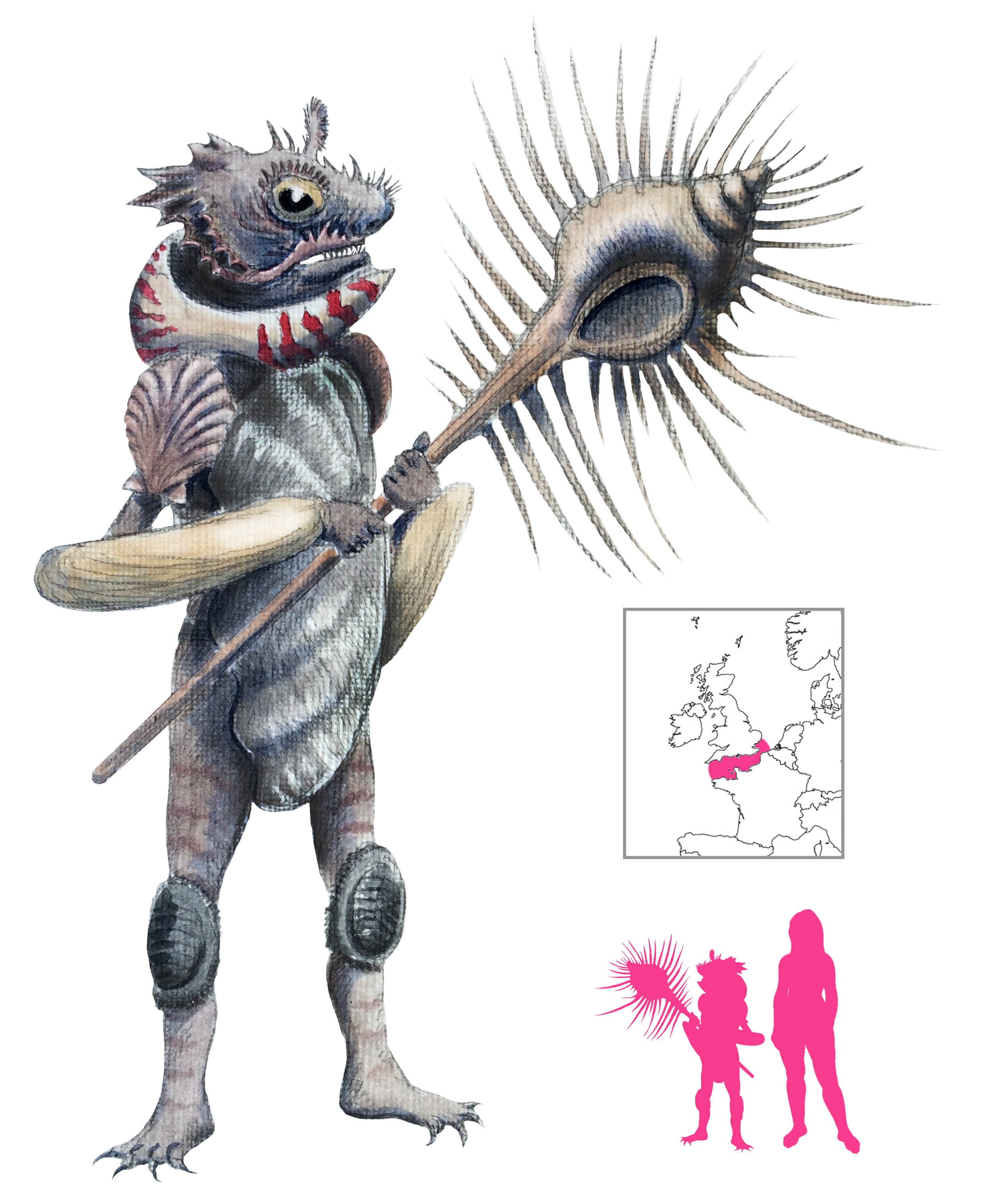
Jean Letocq, a shepherd on the west coast of Guernsey, woke up one morning to see hundreds of little people streaming out of the Creux des Fées (Fairies’ Hollow). They were armed to the teeth, carrying weapons made of sharpened shells. They told the man to bear their message: they wished to take human wives, and would be strongly displeased if women were not turned over to them. This ultimatum was refused, and so the fairies slaughtered every last man they encountered, dying the sea red with blood. The only survivors, a man and a boy of St. Andrew’s parish, hid in an abandoned oven for years.

They were the Arragousets, or Sarregousets as Hugo called them. We know that they were bellicose fairies of the sea, dwelling underwater and in seaside caves, ruling their own marine kingdom. One of their number once took a human woman for his wife, and her beauty and wit so enamored the other fairies that they had to follow suit.

With the men safely massacred, the Arragousets put down the sword and went native. They married the maidens and the newly-widowed, and lived peacefully on land. They made caring husbands and doting fathers, to the extent that the widows warmed to them, and the maidens were delighted with their fairy lovers.

Then, after years of peace, they disappeared as quickly as they had appeared. The circumstances remain mysterious. Sébillot suggests that they were recalled by their king, while MacCulloch states that their time on land was limited. Whatever the reason, all the Arragousets left the island and were never seen again.

Or rather, they went invisible, as their presence remained on Guernsey. They sired a new generation of boys and girls – intelligent, able sailors of small stature – and they returned regularly to watch over them. They did a hundred little favors in the hopes of finishing the work they had started. Arragousets are always ready to help their descendants, but they are pitiless in dealing with offenders.

Hugo said they can still be seen on stormy days, dancing in the clouds and longing to return to the land.

References

Dubois, P.; Sabatier, C.; and Sabatier, R. (1992) La Grande Encyclopédie des Lutins. Hoëbeke, Paris.

Hugo, V. (1866) Les Travailleurs de la Mer. Librairie Internationale, Paris.

MacCulloch, E. (1903) Guernsey Folk Lore. Elliot Stock, London.

Sébillot, P. (1905) Le Folk-lore de France, Tome Deuxième: La Mer et les Eaux Douces. Librairie Orientale et Américaine, Paris.

Munuanë

Variations: Munuane, Munuani

Munuane

Munuanë is either a single entity or an entire species of ogres native to the Guahibo people of Colombia and Venezuela. Many stories end with him being outsmarted and killed, which would be slightly inconvenient if he was one person.

Munuanë plies the waterways of the jungle on a makeshift raft. He is tall and powerful, with long grey hair, but his mouth is as toothless as a turtle’s. He loves eating human flesh, but his lack of teeth forces him to prepare his meals before eating them. Munuanë lacks eyes in his head, instead having them in his knees. Those eyes are his weak spot, as he is invulnerable everywhere but his knees. His wife is called Matasoropapénayo, or “Little-bone-of-the-crown”, and they live together in a hut in the deepest part of the jungle.

He is the “grandfather of fish”, and claims ownership over all the fish in the river. Fishermen are advised to bring in their catch as quickly as possible and not fish more than they need, as Munuanë hates greed, and mesmerizes overfishers into walking off ravines. Other times he shoots offenders with his arrow – Munuanë always carries around only one arrow, as he never misses his target. He is also an insatiable sexual predator, and his victims turn into termites.

It is said that a man once met Munuanë while out fishing, and did not manage to escape in time. Fortunately, Munuanë is not particularly bright, and accidentally shot the man’s reflection in the water instead of the man himself. By the time Munuanë had retrieved the arrow, his quarry had managed to swim away. Munuanë chased after the man and followed him to his village, where he ran rampant. But the man realized what Munuanë’s weakness was, shot him in the eye, and killed him instantly.

Such are the tales of Munuanë. Sometimes he is outsmarted by a powerful shaman. At other times a friendly spirit – Banajuli or Banaxuruni – is there to reveal his weak spot. Sometimes he is transformed into a rotten tree stump when he dies, with the arrow that killed him still embedded in the trunk. The entire forest cries out upon his death; he may be an ogre, but he also cares for the jungle and the fish of the river.

References

Kondo, R. L. W.; Kondo, V. F.; Maltoni, R.; Gómez, F. O.; Queixalós, F.; and Vargas, E.; Wilbert, J. and Simoneau, K. eds. (1992) Folk Literature of the Sikuani Indians. UCLA Latin American Center Publications, University of California, Los Angeles.

Stymphalian Bird

Variations: Stymphalide, Bird of Ares

Stymphalian bird 2

Pausanias theorized that the Stymphalian birds originated in Arabia, citing the presence of fierce desert birds known as the Stymphalides. He then admits that the population found at Stymphalos, in Arcadia, may have been the result of a few wayward birds making their way into Greece. Following this line of reasoning, Pausanias deduces that they earned the name of Stymphalides due to their fame in Greece, and the name then supplanted whatever name they originally had in Arabia!

The appearance of the Stymphalian birds is no less muddled. Their most feared weapon is the sharpened, pointed tips of their wing feathers, which they fling like darts to stab their prey. Sometimes their feathers and beaks are made of bronze or iron, the better for piercing armor. Pausanias described them as about crane-sized, but resembling the ibis in shape, but with a stronger bill; elsewhere he says they are like hawks or eagles. In Greek art they have been represented as ibises, swans, and other such waterfowl; at least one obol from Stymphalos shows a bird with a short crest and a stout, powerful bill. Finally, no doubt influenced by tales of harpies and sirens, the temple of Stymphalian Diana also has stone statues of virgins with birds’ feet.Stymphalian bird bw

It remains true that the Stymphalian birds were first and foremost associated with Lake Stymphalia. They terrorized the region, ravaging crops, killing people, and poisoning the ground with their dung. Fox suggests that the legend originated as a glamorization of a plague or pestilence rising from the marshes, which would explain their noxious qualities. While their feathered darts could pierce armor, they were powerless against a certain type of tree bark, which held them fast like quicklime. There was only so much bark to go around, though, and the birds seemed numberless.

It was this scourge that Heracles was sent to destroy. As his sixth labor, it was one of a list of impossible tasks, and indeed the vast numbers of birds seemed beyond the hero’s strength. Heracles got around this by exploiting a simple fact – despite their numbers and ferocity, Stymphalian birds were as easily spooked as sparrows. Fashioning a pair of bronze castanets, he made such a din that the flock took off in a panic; from there he shot a great number down with his arrows, while the remainder of the birds flew off and were never seen in Arcadia again.

That was not the end of the Stymphalian birds, as from Greece they made their way to the Black Sea and populated the Island of Ares, where they became sacred guardians to the god of war. It was this flock that Jason and his Argonauts encountered on their way to Colchis. While the birds of Ares managed to wound the Argonaut Oileus with a feather projectile, they were scared off once more by the noise of rattling bronze armor, but not before pelting the Argonauts with a hailstorm of feathers.

References

Aldington, R. and Ames, D. trans.; Guirand, F. (1972) New Larousse Encyclopedia of Mythology. Paul Hamlyn, London.

Ames, D. trans.; Guirand, F. (1963) Greek Mythology. From Mythologie Generale Larousse. Paul Hamlyn, London.

Apollonius, Coleridge, E.P. trans. (1889) The Argonautica. George Bell and Sons, London.

Fox, W. M. (1964) The Mythology of All Races v. I: Greek and Roman. Cooper Square Publishers, New York.

Pausanias, Levi, P. trans. (1979) Guide to Greece, volume 2: Southern Greece. Penguin Books, London.

Scarbo

Scarbo

Scarbo is a vampiric dwarf with specialized tastes. He enjoys nothing more than entering the rooms of poets, artists, and writers, and spending the night tormenting them. With his razor-sharp fangs, he bites into his host’s neck, then helpfully cauterizes the bloody wound with a metal finger heated red-hot.

He clambers around the victim’s room, scrabbling at the rafters, scratching at the bedposts. He whispers threats into their ears – and his creativity knows no bounds, as he describes in loving detail the burial shroud he has planned for his victim, the funeral that he will hold, and the sobbing children that will gather in his wake.

He spends the entire night in the room, growing larger as the moon rises, then, as dawn approaches, he flickers, turns blue and translucent, and winks out like a snuffed candle.

Scarbo’s primary contributions to the arts are the Gothic prose poem Gaspard de la Nuit, reportedly written by the Devil himself, and the piano piece of the same name by Ravel, which matches his fiendish activities with its fiendish difficulty.

References

Bertrand, L. (1904) Gaspard de la Nuit. Ambroise Vollard, Paris.

Isitwalangcengce

Isitwalangcengce

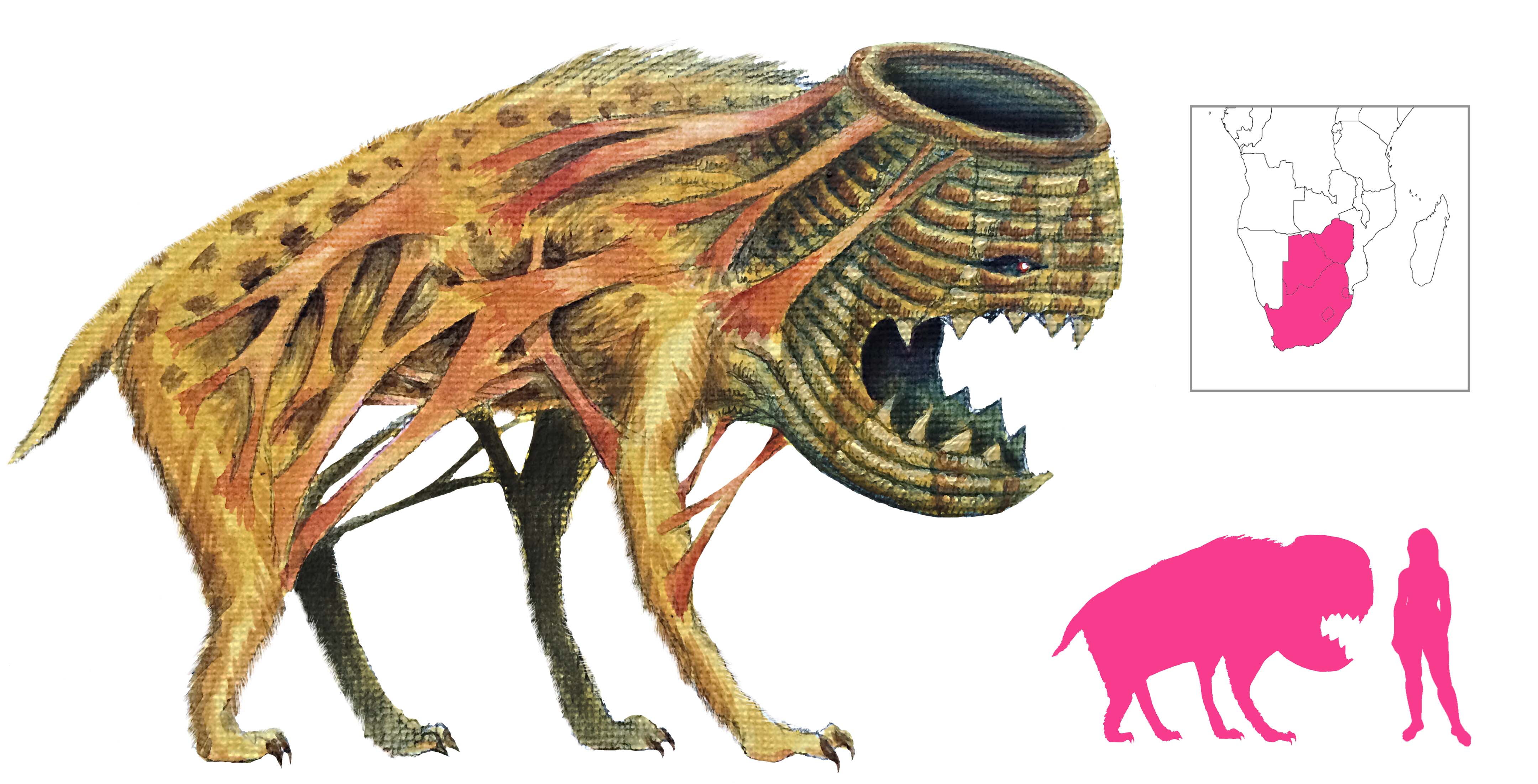
The Isitwalangcengce, or “Basket-bearer”, is hardly seen these days. Which is all the better, as this monster known to the Zulu people is a dedicated man-eater. Somewhat like a hyena in appearance, an Isitwalangcengce’s most notable feature is its basket-shaped head, complete with an opening in the top for carrying its prey.

Isitwalangcengces are powerful, and can easily overcome the bravest of men. They wait around villages during feast days, when children carrying freshly butchered meat go from house to house. They hide beside the doorway, and quickly stuff their victims into their head, carrying them off to eat. Isitwalangcengces do not actually eat all of their prey, but eat only the brain. An Isitwalangcengce will have a favorite rock to smash human heads on and lap up the contents.

If the Isitwalangcengce is strong, it is also dimwitted. This fact was exploited by one Zulu man who was being carried off in the basket. When the Isitwalangcengce passed through bushy terrain, the man reached out of the basket and pulled branches off, stuffing them into the cavity with him. Once he had filled the Isitwalangcengce’s head with sufficient branches, he grabbed onto a tree and hauled himself out. The Isitwalangcengce, meanwhile, noticed no difference in weight. By the time it reached the rocks and poured out a clump of branches and twigs, the man was long gone.

When the man returned to his village, he made sure to narrate his escapade in detail. News of that spread. Soon everyone knew to fill an Isitwalangcengce’s head with branches, and predation dropped drastically.

Now the Isitwalangcengce are mere nursery bogeys, good only for intimidating children. “If you aren’t good, the Isitwalangcengce will carry you off!” And the children smile to themselves, knowing that there’s always an easy way out.

References

Callaway, C. (1868) Nursery Tales, Traditions, and Histories of the Zulus. Trübner and Co., London.