Markupo

Variations: Macupo, Marcupo

Markupo

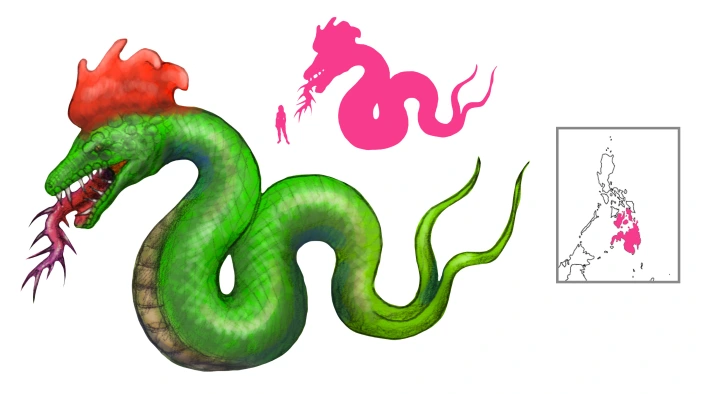
The Markupo is a serpent known to the Hiligaynon of the Philippines. It lives in the highest mountains of the historical province of Bulgas, between Marapara and Canlaon.

In appearance the markupo is a huge snake with a distinctive red crest. Its long tongue has thornlike hairs. It has sharp tusks and a forked tail.

The markupo sings sonorously on clear days. Its exhaled poison is instantly lethal to the touch. If sprinkled on plants, this poison withers the plant, kills any birds that land on it, and kills any beast touched by its shadow.

References

Ramos, M. D. (1971) Creatures of Philippine Lower Mythology. University of the Philippines Press, Quezon.

Ramos, M. D. (1973) Filipino Cultural Patterns and Values. Island Publishers, Quezon City.

Teakettler

Teakettler

This small Northwoods denizen makes a sound like the whistle of a boiling teakettle. It walks backwards by choice, and clouds of steam come out of its nostrils. Nothing else is known of its appearance as few have ever seen it.

References

Borges, J. L.; trans. Hurley, A. (2005) The Book of Imaginary Beings. Viking.

Brown, C. E. (1935) Paul Bunyan Natural History. Madison, Wisconsin.

Tompondrano

Variations: Tòmpondràno, Tompon-drano, Tompoudrano

Tompondrano final

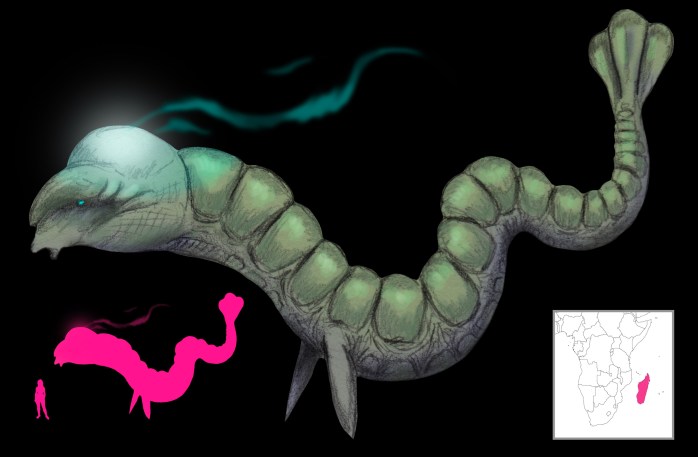
Tompondrano, “lord of the water” or “master of the water”, applies to multiple concepts within the folklore of Madagascar. For our purposes, it refers to at least two types of water snake – one which was commonly encountered in day-to-day life, and an undefined marine monster. Whales, sharks, and crocodiles are also known as tompondrano; the Sakalava proverb “the amby never leaves the master of the water” apparently refers to the pilotfish. The alternative spelling of tompoudrano is phonetically identical to tompondrano in French.

The tompondrano is a water-snake blessed by the Vazimba, a mythical ancient race that lived in the center of Madagascar. For this reason it is respected as a sacred animal. It should not be killed, and dead tompondranos are wrapped in red silk in the same way as human corpses. Tompondranos are good swimmers, often seen crossing ponds and rivers in the forest, but they are not notably large (the largest snake in Madagascar, the akoma or Madagascar ground boa, is some 2.7 meters long).

A very different tompondrano was seen by G. Petit in 1926, on the night a cyclone was announced. He describes seeing bright and fleeting lights produced intermittently every few seconds, something like a much weaker signal beacon of a ship. They were emitted by a large aquatic body rolling on its axis and leaving an indefinitely long phosphorescent trail behind it. Petit was later told by Vezo informants that he had seen a tompondrano a creature 20 to 25 meters long, large and flattened, with hard plates on its body and a tail like that of a shrimp. It is the tompondrano’s head that is luminous. Its mouth is ventrally located, and the creature turns itself upside down to attack targets on the surface. There is a retractable fleshy hood that protects the eyes. It is either legless or has appendages like those of whales. To ward off its unwelcome attentions, an axe and a silver ring are suspended at the bows of boats.

References

Birkeli, E. (1924) Folklore Sakalava. Bulletin de l’Academie Malgache, IV, pp. 185-417.

Jourdran, E. (1903) Les Ophidiens de Madagascar. A. Michalon, Paris.

Romanovsky, V.; Francis-Boeuf, C.; and Bourcart, J. (1953) La Mer. Larousse, Paris.

Sibree, J. (1896) Madagascar Before the Conquest. Macmillan, New York.

Muscaliet

Variations: Muscardin; Dormouse; Musquelibet, Musquelibus, Musquilibet (possibly)

Muscaliet

Nobody is quite sure what a Muscaliet is. Our only source for this unusual rodent is found in the bestiary of Pierre de Beauvais, and it appears to have been cobbled together from multiple unrelated accounts.

The muscaliet is found in India, in the land of the three talking trees that predicted the death of Alexander the Great. This by itself is suspect, as the accounts of Alexander in India only mention two trees, consecrated to the sun and moon. Then again, the sun-tree was said to have spoken twice and the moon-tree once, making for three tree speeches. The life of a copyist was a thankless one.

Beauvais gives the muscaliet a body like a hare, but smaller. Its legs, feet, and tail are like those of a squirrel, but the tail, while held in a squirrel-like manner, is larger. It uses the strength in its tail to jump from tree to tree. Its head is rounded, its ears small and weasel-like, and its nose long and pointed like a mole. There is a tooth sticking out of its mouth on either side, like a boar’s tusks, and it has bristles around its snout like the bristles on a boar’s back.

A muscaliet is a highly adept climber. No animal can catch it in the trees, and its claws are so sharp that it can cling to any surface. It eats fruits, leaves, and flowers and digs out its dens in the roots of trees. It is so “hot by nature” (calde de nature) that the tree it lives in eventually rots, withers, and dies as the muscaliet gnaws away at the roots.

This is a moral lesson. The tree represents a human; its leaves and flowers are good deeds, and its fruits are the soul. But the muscaliet is Pride, its sharp teeth are cutting words that Cruelty brings, and its feet show that cruelty is tenacious. Once Pride takes up residence within us, Beauvais warns, it rots us from the inside out.

The term “muscaliet” itself is an archaic French term for the common dormouse or muscardin (Muscardinus), that which Buffon described as “the least ugly of all the rats”. Its name is derived from its presumed musky odor; whether this attribution came before or after Beauvais’ usage is unclear. The –caliet part of the name superficially suggests heat, which would have inspired our bestiarist to describe it as “hot by nature”. Alternative, “muscaliet” may have been derived from the musquelibet, a creature like a roe deer in size, with an abscess-like growth that produces musk. This is the musk deer Moschus moschiferus, which does have tusks like a boar but little connection to the muscaliet otherwise – not even musk is mentioned.

Is this the fox-sized mouse described by Aristotle? It was a wonder of India found by Alexander, a mouse the size of a fox and with a noxious bite that harmed animals and humans. This sounds like a rat, and perhaps an early allusion to the diseases carried by those animals – rats were unknown to the ancient Greeks and Romans, with black rats appearing in late antiquity and brown rats showing up in the 16th century. Tales of rats with toxic bites combined with dormouse and musk-deer anecdotes are likely the basis for the tree-poisoning muscaliet, which exists as a moral warning and not a zoological account.

References

de Beauvais, P.; Baker, C. ed. (2010) Le Bestiaire. Honoré Champion, Paris.

Buffon, G. L. L. (1775) Oeuvres completes de M. le Cte. De Buffon, t. II. Imprimerie Royal, Paris.

Cahier, C. (1856) Bestiaires. Melanges d’Archeologie, 1856(IV), pp. 55-87.

de Cantimpré, T. (1280) Liber de natura rerum. Bibliothèque municipale de Valenciennes.

Cuba, J. (1539) Le iardin de santé. Philippe le Noir, Paris.

Godefroy, F. (1901) Lexique de l’Ancien Francais. H. Welter, Paris.

Kitchell, K. F. (2014) Animals in the Ancient World from A to Z. Routledge, Milton Park, Abingdon, Oxon.

Magnus, A. (1920) De Animalibus Libri XXVI. Aschendorffschen Verlagbuchhandlung, Münster.

Unknown. (1538) Ortus Sanitatis. Joannes de Cereto de Tridino.

de Xivrey, J. B. (1836) Traditions Tératologiques. L’Imprimerie Royale, Paris.

Origorúso

Variations: Oriogorúho, Orio-goruhu; Suguma; Poópoó

Origoruso

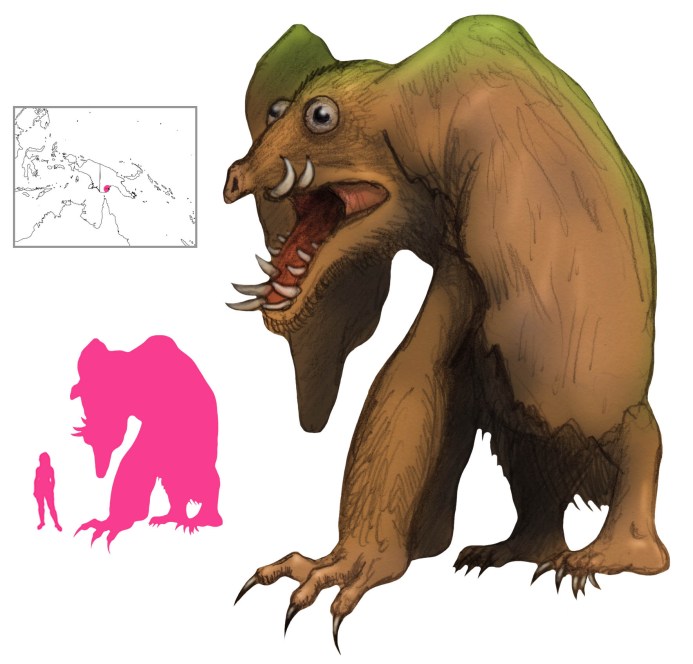
The Origorúso (Kiwai) or Oriogorúho (Mawata) is a man-beast, an ogre from the folklore of the Kiwai islanders of Papua New Guinea. Its name is derived from the fact that it eats (orúso) its food raw (orío).

An origorúso has very short legs, and supports itself on its hands while walking. It has huge eyes and enormous ears; its cavernous mouth has protruding tusks like those of a pig. The tusks are superfluous, as an origorúso swallows its prey whole and raw.Its fingers are armed with long claws. Male origorúso have two penises. An origorúso can make a sound like a loud grunt or roar, but it can also speak normally with people.

At night an origorúso lies on one of its oversized ears, and uses the other as a blanket. By day the ears are usually rolled up.

Origorúsos live underground or inside large trees. They raid villages to carry off and eat people. Sometimes an origorúso will enter a village and devour everyone in one house before leaving. An origorúso used to carry off a child in a village every day, until a cripple guarding a little boy tied a string around the child’s leg. When the cripple went to sleep, the origorúso pulled on the child, and by doing so pulled the string and alerted the man. Everyone in the village wisely fled, with the exception of a man, a woman and their child. They managed to appease the origorúso by throwing pigs at it until it fed and went to sleep. Then they left behind a coconut shell full of lice collected from their child; the lice answered the origorúso’s calls and detained it while they made good their escape.

Sometimes humans can become origorúsos under the right condition. A Kiwai woman in childbirth, upon being insulted by her husband, transformed into an origorúso who pursued the husband relentlessly. A man who lived a while with a friendly origorúso slept in the creature’s ears and ate raw meat; it was all fine until the man’s ears started to grow as big as the origorúso’s. “You got bed, I got bed; you got mat, I got mat”, the origorúso said cheerfully. But the man, terrified, ran back home and hid among his people. It was all in vain. The origorúso, angered, lay siege to the village, and with him came other origorúsos, the horrific útumos that are the ghosts of decapitated men, and other vile spirits. They did not leave until the escapee was given to them, torn apart, and consumed.

Fragments of origorúso bone make potent fighting medicine and are given to dogs.

The origorúso is only one of a number of creatures with enormous ears used to sleep in. The Bina people refer to their oriogorúho as female and nocturnal. The Suguma seems to be synonymous with the origorúso. The Poópoó also has huge ears, and has skin covered with po (knobs); it either has huge tusks or normal-sized teeth, and it otherwise looks like a normal man.

References

Beaver, W. N. (1920) Unexplored New Guinea. Seeley, Service & Co. Limited, London.

Kirtley, B. F. (1963) The Ear-Sleepers: Some Permutatios of a Traveler’s Tale. The Journal of American Folklore, 76(300), pp. 119-130.

Landtman, G. (1917) The Folk-tales of the Kiwai Papuans. Acta Societatis Scientiarium Fennicae, t. XLVII, Helsingfors.

Landtman, G. (1927) The Kiwai Papuans of British New Guinea. MacMillan and Co. Limited, London.

Cuero

Variations: Hide, Skin; Manta; Huecú, Chueiquehuecu, Chueiquehuecuvu, Trelque, Trelquehuecufe, Trelquehuecuvu, Trilkehuecufe; Ghyryvilu (erroneously?); El Cuero (erroneously)

Cuero

The tale of the living cow-hide is widespread throughout the lakes of Chile. Originally a type of huecuve, a Mapuche evil spirit responsible for all sorts of ills, it has since assimilated into local folklore and been attributed to animals such as the octopus and ray. Sometimes the creature is merely a physical manifestation of the huecuve, which can then go on to possess people or animals and inflict them with consumption.

The Mapuche term for this creature is Trelquehuecuve, “skin huecuve”. In Spanish-speaking contexts it is known as Cuero, “Hide” or “Skin”, or Manta, “Mantle” or “Cloak”. Molina describes it as a variant of the ghyryvilu or fox-snake, another aquatic terror.

A cuero is a creature that looks like a cowhide, sheepskin, or goatskin, stretched out flat and laid on the surface of the water. It is usually white with black or brown spots, or brilliant yellow and white. The edges of the cuero are armed with hooked claws. The cueros of Butaro laguna, Atacama, resemble living fabric with suckers; they are also the souls of the damned. In central Chile the cuero is an octopus that resembles a cowhide with numberless eyes and with four enormous eyes in its head. Laguna Copín, Aconcagua, is home to a furry, flat creature fond of human flesh.

Anything that enters the water is engulfed and squeezed in the cuero’s folds, and dragged under to have its blood sucked out. After feeding the cuero will release its drained prey and find itself a solitary beach on which to stretch out, bask, and digest peacefully. Unexplained drownings are the work of a cuero. In Ovalle and Coquimbo the goatskin cueros couple with cows and sire deformed offspring.

Cueros can be killed by tossing branches of quisco cactus (Cereus or Echinocactus) into the water. The creature will attempt to seize the cactus, injure itself, and bleed to death. The heroic youth Ñanco successfully confronted a cuero by holding quisco in his hands and tying quisco branches to his legs

The motif of the living hide extends to other beings and motifs. Another Chilean folktale tells of a magical cow that told its master Joaquin to kill and skin it. The resultant cowhide was alive in its own fashion and served Joaquin as a boat, and the cow’s eyes in his pocket granted him the power to see through anything. At the end of his adventures, the skin, bones, eyes, and other remains of the cow were collected for burning, but the moment the last hair of the cow touched the pile, the cow was brought back to life, plump and healthy, and walked off to the farm as though nothing had happened.

References

Aguirre, S. M. (2003) Mitos de Chile. Random House, Editorial Sudamericana Chilena.

Borges, J. L.; trans. di Giovanni, N. T. (2002) The Book of Imaginary Beings. Vintage Classics, Random House, London.

Cifuentes, J. V. (1947) Mitos y supersticiones (3rd Ed.). Editorial Nascimento, Santiago, Chile.

Guevara, T. (1908) Psicolojia del pueblo araucano. Imprenta Cervantes, Santiago de Chile.

Latcham, R. E. (1924) La organización social y la creencias religiosas de los antiguos araucanos. Imprenta Cervantes, Santiago de Chile.

Molina, M.; Jaramillo, R. trans. (1987) Ensayo sobre la Historia Natural de Chile. Ediciones Maule, Santiago de Chile.

Soustelle, G. and Soustelle, J. (1938) Folklore Chilien. Institut International de Coopération Intellectuelle, Paris.

Dard

Dard

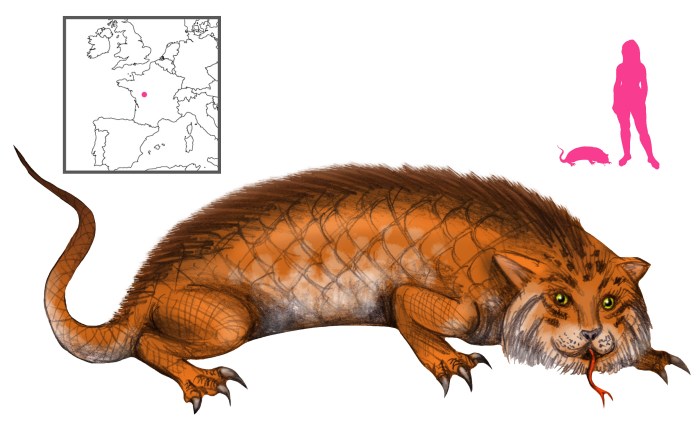
The Dard is peculiar to the department of Vienne in France, but its physiognomy recalls that of the alpine dragons – and, like them, it probably evolved from mustelid accounts. It is a serpent with four legs and a short viper’s tail. It has the head of a cat and a mane running down its dorsal spine.

Dards drink milk from cows and can produce a terrifying whistle. They are nonvenomous, but bite viciously when provoked.

Peasants in Vienne claimed to recognize the dard’s likeness in the carvings of certain churches.

References

Ellenberger, H. (1949) Le Monde Fantastique dans le Folklore de la Vienne. Nouvelle Revue des Traditions Populaires, 1(5), pp. 407-435.

Arassas

Arassas

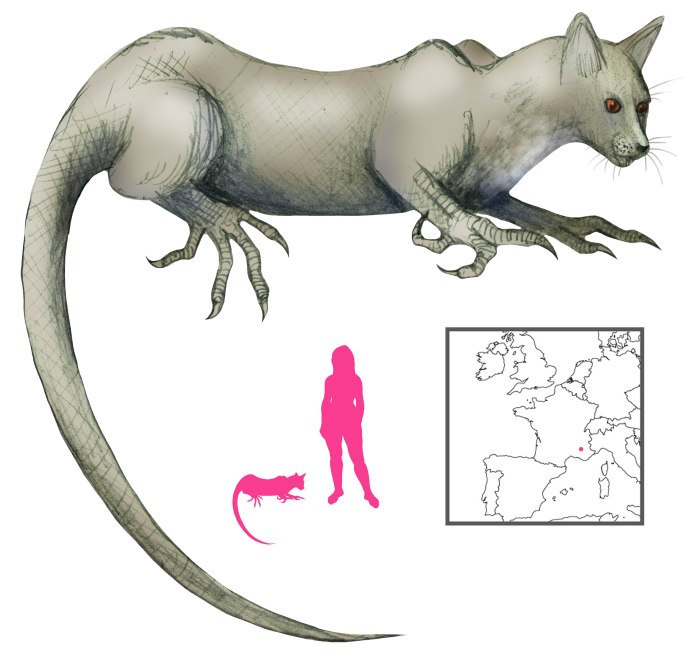
The Arassas hails from the folklore of Lagrand in the Hautes-Alpes region of France. It is a greyish-colored animal with the head of a cat and the body of a lizard. It lives in ruined houses and old crumbling walls. Its gaze kills immediately.

Like other European mountain dragons, it is likely derived from superstitions about otters and martens.

References

van Gennep, A. (1948) Le folklore des Hautes-Alpes, Tome II. J. P. Maisonneuve et Cie, Paris.

Cathach

Variations: Cáthach

Cathach

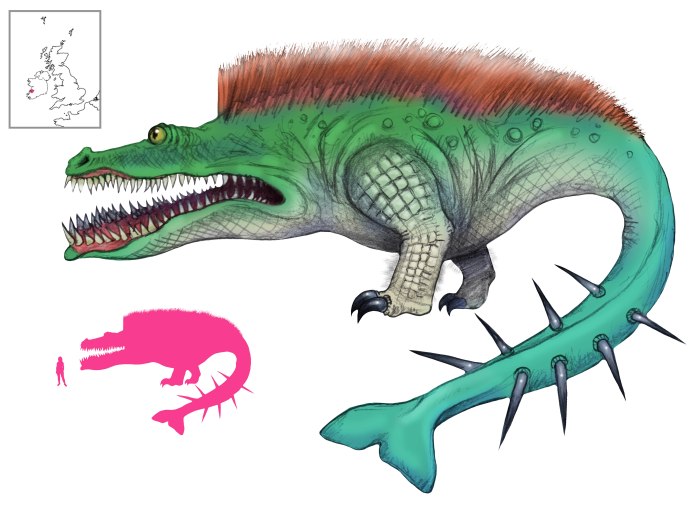
Ireland’s three dragon sisters Dabran, Farbagh, and Cathach were the offspring of the gatekeeper of Hell and the all-devouring sow; they were nursed by the red demon of West Ireland. Cathach, the youngest of the three, made her home on Inis Cathaig (now Scattery Island).

A horrible sight she was to see, a great dragon bigger a small isle, with a back like a round island covered with scales and shells. A rough bristly mane like a boar’s covered her foreparts. When she opened her cavernous mouth filled with a double row of sharp teeth, her entrails could be seen. A cruel eye gleamed in her head. Her body stood on two short, thick, hairy legs armed with iron nails that struck sparks on the rocks as she moved. Her belly was like a furnace. The tail of a whale she had, a tail with iron claws on it that ploughed furrows in the ground behind her. Cathach could move on land and swim with equal ease, and the sea boiled around her.

Farbagh was slain by Crohan, Sal, and Daltheen, the three sons of Toraliv M’Stairn, and Dabran was killed by Diarmuid O’Duibhne after the three brothers set her to protect their forts. When Cathach sensed the loss of her siblings, she went on a rampage, laying waste to the lands around the Shannon Estuary from Limerick to the sea, sinking ships and paralyzing commerce for a year. When the three brothers returned and saw the destruction wreaked by Cathach, they were so distraught that they flung themselves into the sea to their deaths.

Cathach herself was defeated by a far more humble and unassuming hero. When Saint Senan made landfall on Inis Cathaig, Cathach prepared to devour him whole. But the holy man made the sign of the cross in front of her face, and she was quieted. “In the name of the Father, the Son, and the Holy Ghost, leave this island, and hurt no one here or wherever you leave to”. And Cathach did as she was told. She disappeared into the estuary and went to Sliab Collain without harming anyone; and if she is still alive, she has remained obedient to Senan’s command.

The ruins of the church of Saint Senan can still be seen to this day on Scattery Island.

References

Hackett, W. (1852) Folk-lore – No. I. Porcine Legends. Transactions of the Kilkenny Archaeological Society, 2(1), pp.

O’Donovan, J. (1864) The Martyrology of Donegal. Alexander Thom, Dublin.

Stokes, W. S. (1890) Lives of Saints from the Book of Lismore. Clarendon Press, Oxford.

Stokes, W. (1905) The Martyrology of Oengus the Culdee. Harrison and Sons, London.

Watts, A. A. (1828) The Literary Souvenir. Longman, Rees, Orme, Brown, & Green, London.

Famocantratra

Variations: Famocantraton (Dapper)

Famocantratra

The Famocantratra (as Flacourt describes it) or Famocantraton (in Dapper and subsequent works) is a small lizardlike animal found in Madagascar. Its name means “leaper at the chest”.

The famocantratra’s back, chin, and top of its neck, legs, and tail are made of small paws or claws which allow it to adhere to trees like glue. It is almost impossible to see as it sticks to trunks. Its mouth is always open to capture insects and other small invertebrates.

It will leap onto the chest of anyone who passes by, and it holds on so fast that the skin has to be sliced off with a razor. For this reason it is feared and avoided by the natives of Madagascar.

References

Dapper, O. (1686) Description de l’Afrique. Wolfgang, Waesberge, Boom, & van Someren, Amsterdam.

de Flacourt, E. (1661) Histoire de la Grande Isle Madagascar. Francois Clouzier, Paris.