Khodumodumo

Variations: Kholomodumo, Modumo o Moholo, Khamapa, Kammapa, Khanyapa
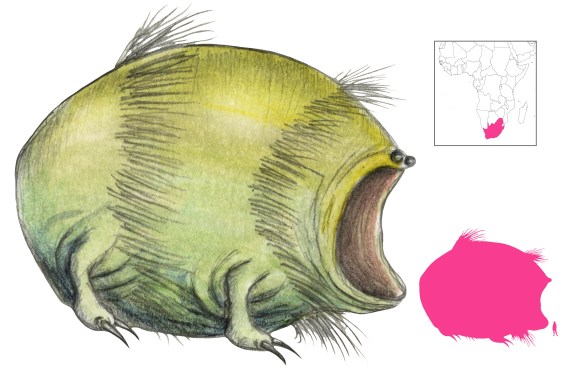
Khodumodumo

The swallowing monster of the Basuto people of South Africa and Lesotho is called Khodumodumo. The name of Khodumodumo is an archaic Sesotho term, most likely meaning “great noise”, although Hichens refers to the “gaping-mouthed bush monster”. Modern Sesotho often makes it into kholomodumo. Its synonym and possible ancestor is Kammapa, a giant river python. Khodumodumo’s amorphous appearance is undefined, and it is vast in size. It has multiple sharp tongues which it uses as weapons.

Once Khodumodumo went about swallowing every living thing in its path, man and beast alike, lumbering through towns and villages and engulfing their inhabitants. Only one pregnant woman survived, as she had been hiding on a manure heap, and the ashes masked her appearance and scent. Eventually the bloated Khodumodumo dragged itself off and wedged its massive body in a mountain pass.

Eventually the woman gave birth to a baby boy, and went off to fetch some manure powder to lie on, as tradition dictates. She returned to find her son fully grown, dressed in skins, with divining beads around his neck, and armed with assagais. “Where is my son?” she asked, marveling at the heroic figure in front of her. “I am your son, Senkatana”, he said. “Mother, where is the rest of the village?” “Alas, Khodumodumo ate them all”, she lamented. “And the cattle?” “The cattle too”. “And the dogs?” “The dogs too”. “And the poultry?” “The poultry too”.

Senkatana demanded that his mother show him where the beast had gone to. “See the big hill in the pass?” she said. “That is Khodumodumo”. Despite his mother’s warnings, Senkatana went to face Khodumodumo alone. When it saw him, it opened its mouth wide and tried to spear him with its tongues, but Senkatana chopped them off one by one. He circled around the beast, which was too fat to turn around and face him, and stabbed it with his assagais until it was dead.

He then started to cut open Khodumodumo, but had to avoid cutting the people imprisoned inside. His first cut accidentally injured a man, and then he had to avoid stabbing a cow, a goat, a dog, and a hen before he could finally release Khodumodumo’s victims. Senkatana then went on to become a great chief, but the man he had inadvertently stabbed continued to bear a grudge. The resentful man and others jealous of the hero attempted to assassinate him multiple times, until Senkatana, weary of the hatred of mankind, allowed himself to be killed.

References

Hichens, W. (1937) African Mystery Beasts. Discovery (Dec): 369-373.

Jacottet, E. (1888) Légendes et contes Bassoutos. Revue des Traditions Populaires, v. 3, Maisonneuve et Ch. Leclerc, Paris.

Werner, A. (1968) Myths and legends of the Bantu. Frank Cass and Co. Ltd., London.
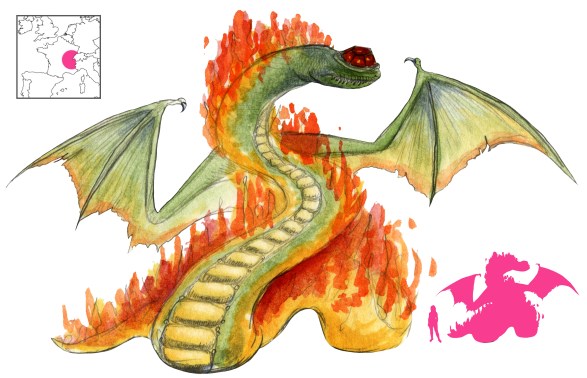
Vouivre

Variations: Vaivre, Givre, Guivre, Wivre

Vouivre

Vouivres, the great fiery serpents of France, have been reported primarily from remote, mountainous regions, where they haunt springs, wells, caves, deep ponds, and ruined castles. They are known from Bourgogne, Franche-Comté, Savoie, the Jura mountains, and neighboring areas, with possible relatives in the Aosta Valley and Switzerland.

The word “vouivre” is derived from the Latin vipera, or “viper”. Vouivres themselves are the spiritual descendants of Mélusine, stripped of her human features. They have been described as dragons, serpents, and fairies in the form of great reptiles; they are always the guardians of priceless treasures.

In its most simple definition, a Vouivre is a female dragon. Vouivres vary wildly in appearance, but are always female and associated with fire and water. The classic vouivre, as observed in Faverges, Fleury-la-Tour, Mont-Beuvray, Rosemont, Solutré, and Thouleurs, is an immense winged serpent covered with fire. Instead of eyes, a vouivre has a single large diamond or ruby in its head that guides it through the air. She removes it when bathing, leaving it blind and vulnerable to theft. Possession of a vouivre’s eye-stone would bring riches and happiness to anyone who stole it. The immense vouivre of Boëge guards treasure and wears a priceless golden necklace. In La Baume she is 4 meters long and covered in gems and pearls. She sometimes leaves gems behind where she lands. The Lucinges vouivre is a glowing red viper that whistles eerily in flight. The Gemeaux vouivre, which appeared between 2 and 3 in the afternoon, was hooded like a cobra.

In Brizon, she is equally likely to appear as a bird or a winged beech marten with a brilliant necklace as she is to have the form of a great serpent with wings and a diamond on its tail. Vouivres may not even look like animals. In Chevenoz she appears as a burning fireball streaking across the sky, in Saint-Jean-d’Aulps and Vallorcine she is a single-eyed tongue of fire, and in Le Biot she is a star whose appearance foretells war and strife. The Orgelet Castle vouivre looks like a red-hot iron bar in flight, and the vouivre of Sixt-Fer-À-Cheval is a plumed golden necklace that flies through the air.

One of the more effective ways of slaying a vouivre has been making a spiked barrel to hide in. At Condes, a man managed to steal a vouivre’s diamond and hide in a nail-studded washtub; the infuriated, blinded dragon killed herself trying to get to him. While another man at the Aosta Valley slew a vouivre in a similar manner, other prospective thieves have not been so lucky. The vouivre of Reyvroz had a necklace of great value, which was stolen by a man in a spiked barrel; she died and the thief died soon after. The vouivre of Samoëns had her pearl necklace stolen in the same manner, but she constricted the barrel anyway and made the thief return the necklace; she then disappeared and was never seen again. In Manigod, where grass would not grow for a couple of years after the vouivre’s passage, a man who stole her diamond was killed, his barrel smashed, and the gem retrieved.

Finally, as with all dragons, vouivres are vulnerable to the power of saints and other holy persons. The vouivre of Saint-Suliac was cast into a deep cave by Saint Suliac after she killed one of his monks. The location became known as the Trou de la Guivre, the Guivre’s Hole.

In Thollon-Les-Mémises, among other places, “vouivre” has become a byword for an unpleasant, nasty woman.

Modern versions of the vouivre, perhaps conflating her with Mélusine, have embellished with her the features of a seductive woman. Marcel Aymé makes her a wild girl of the forest with an entourage of vipers, and Dubois makes her a beautiful fairy who sheds her dragon skin when bathing.

References

Aymé, M. (1943) La Vouivre. Gallimard.

Dontenville, H. (1966) La France Mythologique. Tchou, Paris.

Dubois, P.; Sabatier, C.; and Sabatier, R. (1996) La Grande Encyclopédie des Fées. Hoëbeke, Paris.

Joisten, C. (2010) Êtres fantastiques de Savoie. Musée Dauphinois, Grenoble.

Monnier, D. (1819) Essai sur L’Origine de la Séquanie. Gauthier, Lons-Le-Saunier.

Sébillot, P. (1905) Le Folk-Lore de France, Tome Deuxième: La Mer et les Eaux Douces. Librairie Orientale et Américaine, Paris.

Isiququmadevu

Variations: Usiququmadevu (flattering); Isikqukqumadevu, Usikqukqumadevu; Unomabunge; O’gaul’-iminga; O-nsiba-zimakqembe

Isiququmadevu

When Untombinde, the king’s daughter, set out for the mythical Ilulange River, she took with her two hundred maidens to be her escorts. She was determined to bathe in one of its pools despite her parents’ warnings of dire consequences. Once there, she and her handmaidens undressed and played in the water, but when they came back out their clothes, their beautiful bracelets and jewels and finery were all gone. Isiququmadevu had taken them.

Isiququmadevu, “Smelly Whiskers”, is a mountainous “swallowing monster” from Bantu and Zulu folklore. She is bearded, bloated, hairless, and squatting, with an enormous mouth capable of engulfing entire villages. Other clues as to her appearance are given in her many epithets, which include Unomabunge (“Mother of Beetles”), O’gaul’-iminga (“Feller of Lofty Thorn-trees”), and O-nsiba-zimakqembe (“She Whose Feathers are Long and Broad”).

Naturally the royal cortège was mortified, and entreated the isiququmadevu to return their belongings. “Untombinde, the king’s daughter, brought us here, she is to blame”. One by one they recuperated their effects, until Untombinde was left. “Beseech Usiququmadevu”, they told her, using a more personal and flattering name for the monster. But Untombinde – perhaps miffed by her companions’ accusations – refused. “I am the king’s daughter”, she said haughtily, “and I will never entreat the isiququmadevu”. Whereupon the monster seized her and took her into the pool.

King Usikulumi despaired for his daughter, fearing she was lost forever, and ordered his troops to slay the isiququmadevu. But the monster hauled herself onto the bank, and swallowed the entire army in one gulp. She then followed their trail back to the village, and swallowed the men, the women, the children, the dogs, the cattle, every living thing she found there.

Among her victims were two adorable twin children whose father was the only villager who escaped the isiququmadevu’s attack. He resolved to kill the creature, arming himself with his assagai and following her back into the woods. First he met a herd of buffaloes. “Where has Usiququmadevu gone? She has taken my children”. Acknowledging his plight, the buffaloes told him he was on the right track with a “forward, forward!” Next he met some leopards and an elephant, who advised him to keep on going. Finally he found the isiququmadevu herself, replete and squatting. “I seek Usiququmadevu, who has taken my children!” he announced. “Forward, forward!” said the isiququmadevu, but the man was not as dimwitted as she had hoped, and he stabbed her with his spear until she died. Then all her victims climbed out, none the worse for wear, with Untombinde, defiant and proud, coming out last.

In another isiququmadevu story, it is Usitungusobenthle, a young woman who had been abducted by pigeons to be their queen, who brings about the creature’s demise. She returns to her village after escaping her captors only to find it empty, with the isiququmadevu sleeping nearby. She cut it open with a knife, and released all its victims.

Another princess, Uluthlazase, actually stood up to an isiququmadevu and tried to wrest her clothes from the monster. She held on so firmly that the isiququmadevu could not remove her, and the two fought each other to a stalemate. When it left to get assistance from other isiququmadevu, Uluthlazase collected her effects and wisely escaped.

References

Callaway, C. (1868) Nursery Tales, Traditions, and Histories of the Zulus. Trübner and Co., London.

Koopman, A. (2002) Zulu Names. University of Natal.

Werner, A. (1968) Myths and legends of the Bantu. Frank Cass and Co. Ltd., London.

Araǵanaqlta’a

Variations: AraGanaqlta’a, AraGanaGalta’a; AraGanaqlate’e, AraGanaGalate’e; Owner of the Snakes, Father of the Snakes

Araganaqltaa

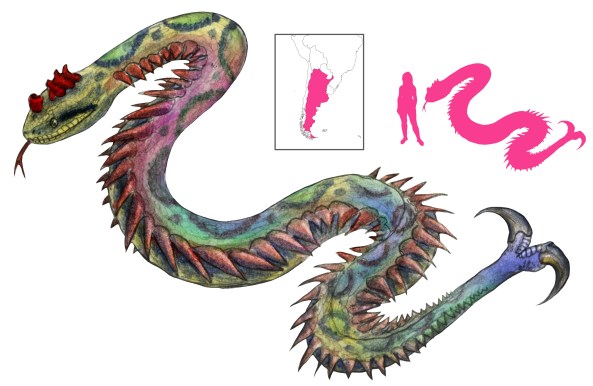
Araǵanaqlta’a is the father or owner of the snakes in Argentinian Toba folklore. It can be found in a range of habitats, but usually likes rivers and deep caves with access to water. In addition to snakes, which are all under its command, it is associated with water, rainbows, and storms.

The araǵanaqlta’a appears as a large, multicolored snake, 10 meters or more in length, resembling a bushmaster or fer-de-lance. It has a red crest, its “sign” (ndage), on top of its head, and a sawlike structure on either side of its body that allows it to move. An araǵanaqlta’a’s tail ends in two hooks which it uses to hold prey. The females are known as araganaqlate’e, the mother of the snakes.

Araǵanaqlta’a are shapeshifters, adjusting to fit their environment, and are also known in the form of four-legged snakes, as humans in elegant business attire, or as rheas with colorful necks. No matter what shape it takes, however, the araǵanaqlta’a always has its characteristic ndage, which identifies it as a powerful mythical creature.

Araǵanaqlta’a are intelligent and enjoy human conversation. These snakes will punish desecrators of nature and persecutors of snakes, but will reward those who they find worthy. After a hunter treated an araǵanaqlta’a with respect and obeisance, the snake promised him that he would have all he would ever need, and taught him how to heal the sick with his words.

References

Wilde, G. and Schamber, P. (2006) Simbolismo, Ritual, y Performance. Paradigma Indicial, Buenos Aires.

Wright, P. G. A semantic analysis of the symbolism of Toba mythical animals. In Willis, R. (Ed.) (1990) Signifying Animals: Human Meaning in the Natural World. Unwin Hyman, London.

Wright, P. G. (2008) Ser-en-el-sueño. Editorial Biblos, Buenos Aires.

Xuangui

Variations: Twisting-Turtle, Round-Turtle, Xuan-Turtle

Xuangui

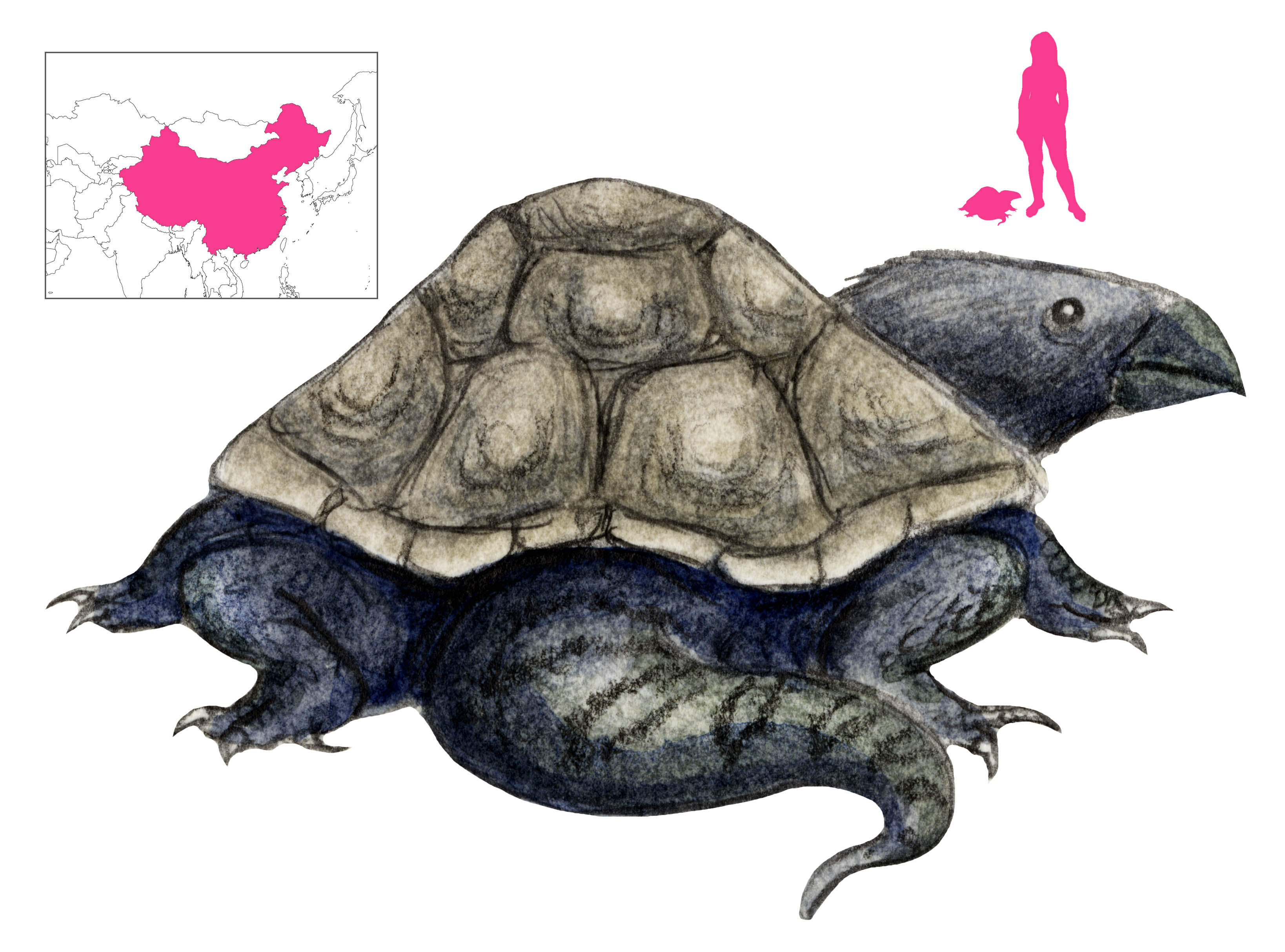
Xuangui, or Twisting-Turtles, are found in the Strange River, east of the Niu-Trees Mountain. They are black turtles with a bird’s head and a viper’s tail, and they make sounds like that of splitting wood. Wearing a piece of xuangui from the belt protects from deafness and calluses. Mathieu compares it to the Japanese water turtle Clemmys japonica.

It is unclear what, exactly, is strange about the river.

References

Mathieu, R. (1983) Étude sur la mythologie et l’ethnologie de la Chine ancienne. Collège de France, Paris.

Strassberg, R. E. (2002) A Chinese Bestiary: Strange Creatures from the Guideways Through Mountains and Seas. University of California Press.

Păl-raí-yûk

Pal-rai-yuk

Long ago, the Yukon and Kuskokwim rivers were far warmer than they are today, and the winters shorter, with the snow melting and the birds returning as early as February. This allowed for large stretches of creeks, lakes, and marshland, and the Păl-raí-yûk haunted the waterways between the two rivers. They were most common around the temperate Kuskokwim, and they fed on humans and animals alike.

Păl-raí-yûk was one of Raven’s many creations, one that would lie in wait, submerged, to attack anyone coming to the water’s edge. It would also attack boats that entered its territory. For this reason Raven warned First Man to be cautious about approaching lakes and rivers.

The păl-raí-yûk has been compared to the crocodile or alligator, which it resembles in both form and habit, but it is also very similar to the muskox. It is typically represented on umiaks, masks, and dishes as an elongated, stylized reptilian creature with a long, narrow head and six legs. “Cutaway views” above the legs show human remains, indicating the grisly nature of its meals. One păl-raí-yûk that was killed by the Sky People had six legs, the hind ones long, the fore ones short, and the small middle ones hanging from the abdomen. It had small eyes and fine, dense, very dark fur on its body, like that of a shrew, that was longest on its feet. A pair of horns, extending forward, out, and curving back, are present on the head.

Păl-raí-yûk are large and bulky, but can lie on grass without bending the stems. On the other hand, a dead păl-raí-yûk would become so heavy that its body would sink into the ground if not supported. Many hunters were usually required to kill one, usually by holding it down with logs while smashing its head with clubs.

The last known păl-raí-yûk was slain by a hunter after it killed and ate his wife who was fetching water from a lake.

References

Nelson, E. W. (1900) The Eskimo about Bering Strait. Extract from the Eighteenth Annual Report of the Bureau of American Ethnology, Government Printing Office, Washington.

Tsemaus

Variations: Tsemaus, Chemouse, Narhnarem-tsemaus, Snag, Supernatural Snag, Tsem’aus, Tcamaos, Tca’maos, Tidewalker, Ts’um’os, Tsamaos, Kanem Ktsem’aus; Weegyet, Wi’git

Tsemaus

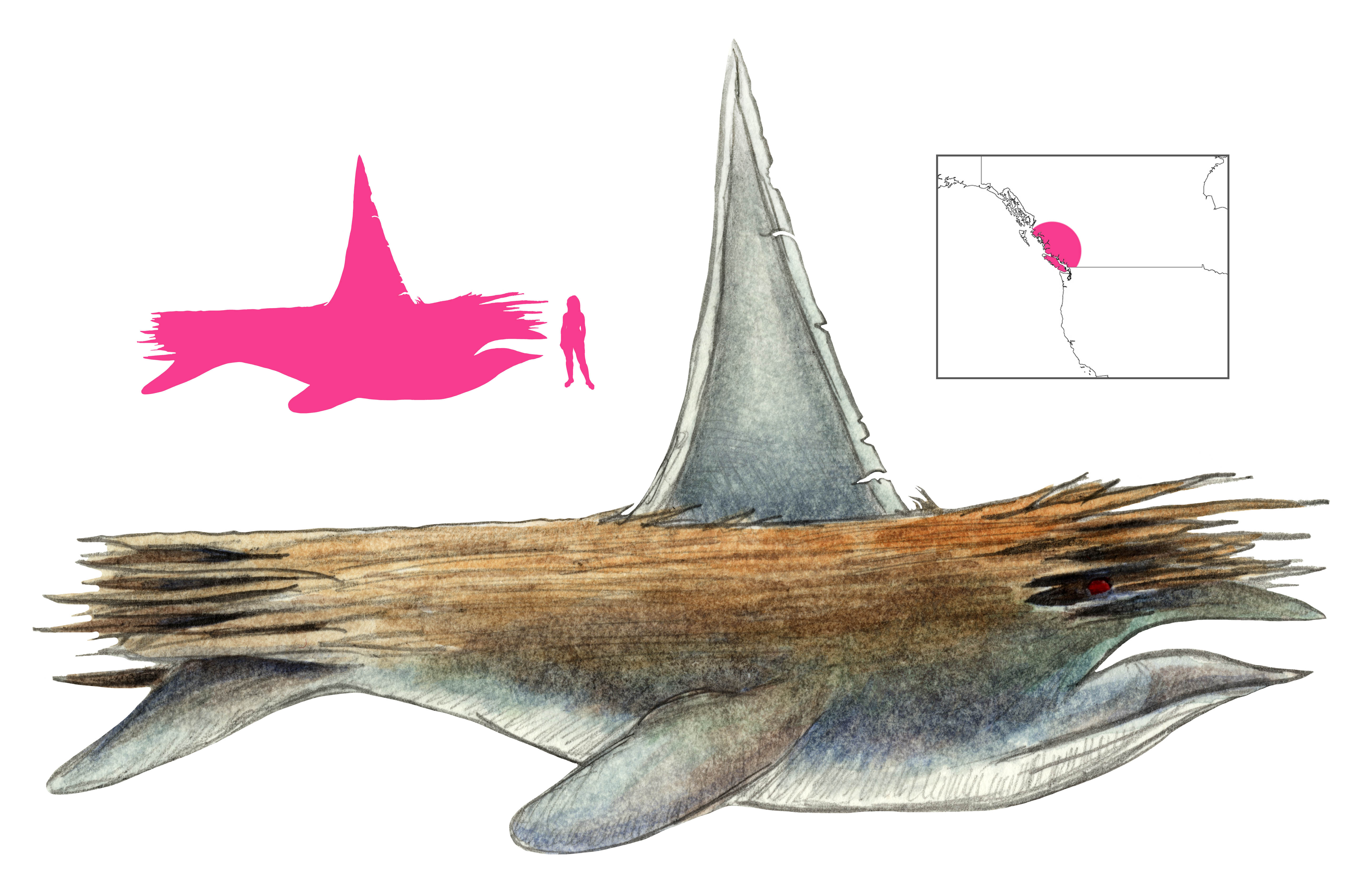
The Tsemaus (“Snag”) or Narhnarem-Tsemaus (“Supernatural Snag”) is the personification of river snags., floating logs, and other hazards of the water. It is found in the folklore and art of the Pacific Northwest, notably in Tsimshian and Haida culture around the mouth of the Skeena River.

One of its names, Wi’git or Weegyet, connects it to Raven the trickster, and it is one of his many forms. The creator and trickster Nanki’islas also assumed the form of a tsemaus after he was done.

A tsemaus can vary a lot in appearance, much like the driftwood it imitates, but it almost always has a snag for a dorsal fin – or is itself a snag. It can be as simple as a dead log with a tail that can swim against the current. It can be a huge sea lion with dorsal fins and blowholes, or an enormous grizzly bear with a downturned mouth like a dogfish and two sharp snags protruding from its back, with or without one or more sharp fins of a killer whale. It can be a hybrid of bear and killer whale, or raven and killer whale, with multiple bodies. It can be a large frog covered in seaweed with a snag sticking out of its back, and can even be a canoe or a schooner. Meurger states that it can cleave swimmers with its fin.

The tsemaus uses its fin to destroy boats. It has no problem swimming upstream and plowing through log jams. If angered it breaches and lands on canoes, smashing them to bits, or makes huge waves to capsize boats. It drowns people, who then become killer whales.

It is found as a crest on the totem poles of the coastal clans.

References

Barbeau, M. (1950) Totem poles. Bulletin No. 119, Anthropological Series No. 30, National Museum of Canada, Ottawa.

Barbeau, M. (1953) Haida Myths Illustrated in Argillite Carvings. Bulletin No. 127, Anthropological Series No. 32, National Museum of Canada, Ottawa.

Boas, F. (1951) Primitive Art. Capitol Publishing Company, New York.

Deans, J. (1893) Totem Posts at the World’s Fair. The American Antiquarian and Oriental Journal, Vol. XV, No. 4, pp. 281-286.

Meurger, M. (1988) Lake Monster Traditions: A Cross-Cultural Analysis. Fortean Tomes, London.

Swanton, J. R. (1909) Contributions of the Ethnology of the Haida. Memoirs of the American Museum of Natural History, Vol. VIII.

Butatsch Cun Ilgs

Variations: Butatsch-ah-ilgs (erroneously, apparently a typo in Rose’s encyclopedia)

Butatsch Cun Ilgs

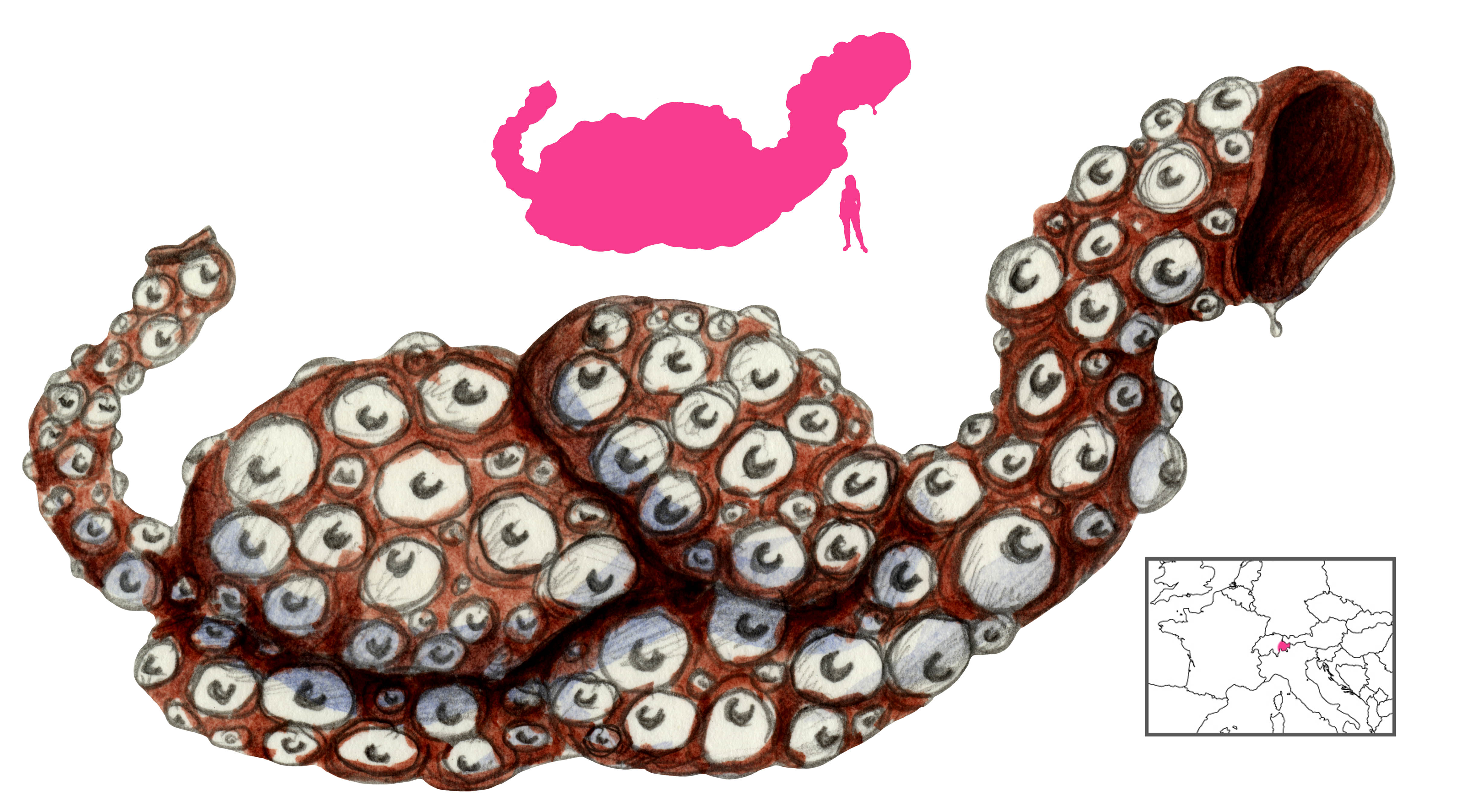
The Lüschersee, a small Swiss alpine lake nestled in the heather-covered hills of Graubünden, seems tranquil enough on the surface. Yet it is said that the lake’s waters reach down to the center of the Earth, where eternal fires rage. This is the home of the Butatsch Cun Ilgs, the “Cow’s Stomach”.

Long ago, during a more feudal time, the shepherds of Graubünden were in a constant struggle for freedom from the cruel barons and lords of the land. Their masters were prone to treating them unjustly, and even harming them for sport. A group of noblemen once returned from an ibex hunt to find herds of cattle and sheep grazing peacefully by the Lüschersee. Naturally they decided to kill them. With loud whoops and peals of laughter, they drove the animals before them, hacking at them with their swords and forcing them into the lake to drown. The peasants could only watch as the lords mocked them.

It was then that the water started to foam and bubble, and the Butatsch cun ilgs heaved itself onto the shore. It had the appearance of an enormous cow’s stomach, and was covered with thousands of eyes. The eyes had hypnotic powers, and if they focused on one point, bone-melting flames would erupt.

Mesmerized by the Butatsch cun ilgs, the lords stood dumbly as the enormous mass trampled and crushed them. Butatsch cun ilgs slipped back into the water after killing them all, leaving the shepherds terrified but unharmed.

Since then Butatsch cun ilgs has only reappeared twice, in 100-year intervals. The second time it came out of the Lüschersee, it gouged the rapids of the Nolla along its path. The third time was during a terrifying thunderstorm, when the monster of the Lüschersee slithered through a rivulet, tearing out the banks, causing massive landslides, and creating ravines.

After this last appearance – the starmentusa notg or “Night of Terror” – the Butatsch cun ilgs was not seen again. Yet sometimes a distant, unearthly bellowing can be heard over the still waters of the lake… “The Lüschersee roars”, say the shepherds, and bring the hay in.

References

Burde-Schneidewind, G. (1977) Historische Volkssagen Aus Dem 13. Bis 19. Jahrhundert. Akademie-Verlag, Berlin.

Derichsweiler, W. Das Safiental. In Schweizer Alpenclub (1919) Jahrbuch das Schweizer Alpenclub. Stämpfl & Co., Bern.

Jecklin, D. (1874) Volksthümliches aus Graubünden. Orell Füssli & Co., Zürich.

Rose, C. (2000) Giants, Monsters, and Dragons. W. W. Norton and Co., New York.

Mourioche

Variations: Guenne; Fausserole (possibly)

Mourioche

Nobody knows for sure where Mourioche came from. Some say that he (for lack of a better pronoun) was once a Breton man or a woman, versed in the dark arts, who sold their soul for a magical ointment. Other accounts make him a simple werewolf without control of his actions. Dubois whimsically claims he was once the court jester of an undersea kingdom, and was banished for bad behavior. There are even claims that he is the Devil himself.

It is more likely that Mourioche has always haunted Brittany, spreading his brand of cruel humor along the coastlines of Côtes-d’Armor and around Jugon-les-Lacs. He is a water-horse, and a shapeshifter; there is no end to the forms he has assumed, and he loves using his powers in creative ways. Mourioche is usually seen in the form of a yearling colt, pig, cow, or sheep, often with a pair of muscular arms.

Mourioche comes out at night, and preys on nocturnal travelers. Sometimes he is a horse standing by the side of the road, waiting for riders. His spine stretches as more and more people get on, then he gallops right into the lake, his laugh echoing in the darkness. At other times he wrestles passers-by, grappling with his brawny arms and throwing his victims into muddy ditches. He will jump onto men’s back and force them to carry him until they drop of exhaustion. He will follow people along the road, changing shape every time they turn to look at him, and making a sound like tearing canvas.

Drawn-out sadistic pranks are Mourioche’s favorite form of entertainment. A farmer of Saint-Cast once found Mourioche in the form of an abandoned ewe, and took him home to his barn. The next day, when he went to check on his new sheep, he found a cow; the day after, it had become a horse. On the fourth night, it was a sheep again, who laughed and said “Why do you check on me every morning? You’re weird!” It was then that the farmer saw that all his animals had been slaughtered. He reached for his shotgun, but Mourioche took off, destroying half the barn and abducting the farmer’s three children (who were never seen again). Mourioche is not without mercy, though, and he left behind a golden necklace.

Mourioche is not without his faults, however, and is baffled by anyone who doesn’t fear him. One man nonchalantly carried Mourioche all the way back home, and the shapeshifter fled when he called his wife. Another time Mourioche took a tailor on his back, who threatened to cut his ears off with his scissors. The tailor was returned to dry land very quickly.

In Matignon, parents would get their children to bed with a “hattaï, mon p’tit gars; Mourioche te prenrait!” (“hurry, my l’il lad, Mourioche will take you!). It is also said that of a frightened person that “il a eu peur comme s’il avait vu Mourioche” (“he’s scared as though he saw Mourioche”). To ward off Mourioche, one must curse him with “Mourioche, le diable t’écorche” (“Mourioche, the Devil flay you”).

The Fausserole of Saint-Cast is very similar, and may be another form of Mourioche. She likes to appear as a white beast, a dog or a calf, and has no qualms about tossing clergy around, as the rector of Saint-Cast found out.

References

Dubois, P.; Sabatier, C.; and Sabatier, R. (1992) La Grande Encyclopédie des Lutins. Hoëbeke, Paris.

Morvan, F. (1998) Vie et mœurs des lutins bretons. Actes Sud.

Sébillot, P. (1882) Traditions et superstitions de la Haute-Bretagne. Maisonneuve et Cie, Paris.

Sébillot, P. (1905) Le Folk-Lore de France, Tome Deuxième: La Mer et les Eaux Douces. Librairie Orientale et Américaine, Paris.

Sébillot, P. (1968) Le folklore de la Bretagne. Éditions G. P. Maisonneuve et Larose, Paris.

Auñ Pana

Variations: Pehiwetinome

Aun Pana

The Auñ Pana are evil man-eating fish from the folklore of the Yanomami of Brazil and Venezuela. They are large, have arms, and are covered with hair. Apparently they also have some degree of magical power. The auñ pana live in deep water and school with Pehiwetinome, which are equally large and anthropophagous.

A group of auñ pana and pehiwetinome once tore down a bridge that the Yanomami were crossing by biting through its wood. The bridge collapsed and became a raft, and the surviving Yanomami were turned into monkeys and pigs.

References

Albert, B.; Becher, H.; Borgman, D. M.; Cocco, L.; Colchester, M. E. M.; Finkers, J.; Knobloch, F.; Lizot, J.; and Wilbert, J.; Wilbert, J. and Simoneau, K. eds. (1990) Folk Literature of the Yanomami Indians. UCLA Latin American Center Publications, University of California, Los Angeles.