Odontotyrannus

Variations: Arine Hayant Le Tirant, Arine Qui Het Le Tirant, Armez Hayant Le Tirant, Dentem Tyrannum, Dentirant, Dentityrannus, Dent Tyrans, Odentetiranno,  Odontatyrannum,  Odontatyrannus, Odontetiranno

odontotyrannus

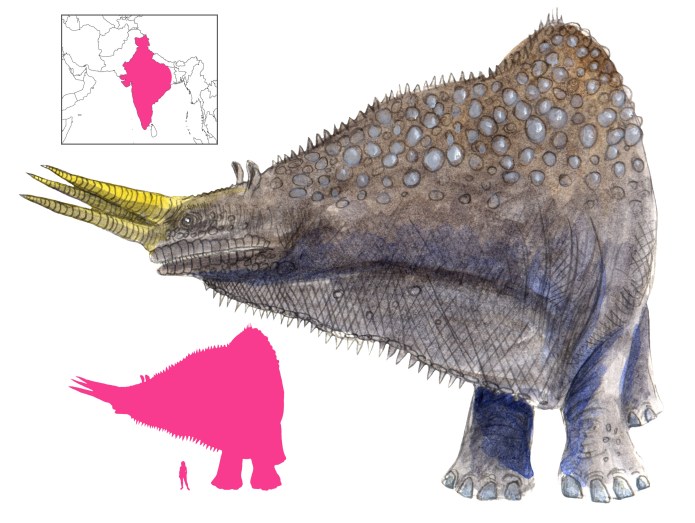
The Odontotyrannus is a massive beast found in the rivers of India, whose account has been told as one of Alexander the Great’s many exploits. Its name apparently means “tooth tyrant”, but medieval reading errors led to a variety of increasingly awkward alternate names and direct translations.

When Alexander and his men made camp by a river, they were found by an odontotyrannus coming to the water to drink. It was enormous, large enough to swallow an elephant whole, and black in color, or otherwise with a head black as pitch. It had three horns on its head. When it saw the Macedonians, it went on a rampage, killing 26 and injuring 52 of the soldiers before it was brought down by Emendus, Duke of Arcadia.

The rhinoceros is a certain candidate as the progenitor of the odontotyrannus, as is the crocodile. Confusion with Indus worms – Indian, armed with two terrible teeth, and capable of swallowing prey whole – may have led to the name, as nowhere in its description are teeth ever mentioned.

References

Wauquelin, J., Hériché, S. ed. (2000) Les Faicts et les Conquestes d’Alexandre le Grand. Librairie Droz, Geneva.

de Xivrey, J. B. (1836) Traditions Tératologiques. L’Imprimerie Royale, Paris.

Indus Worm

Variations: Odontotyrannus (allegedly)

indus-worm

Deep in the Indus River live worms that resemble those found in figs or rotten wood, only seven cubits (over 3 meters) in length on average, and thick enough that a ten-year-old boy could barely wrap his arms around one. They have two square teeth, one above and one below, each about 18 inches long. The skin is two fingers thick.

By day the worms remain underwater, wallowing in mud, but they emerge at night to prey on animals up to the size of a cow or camel. Victims are seized, dragged into the Indus, and devoured at leisure. The large teeth can crush their way through flesh, bone, and stone, and only the paunch is left uneaten. There have also been cases of hungry worms seizing drinking camels and oxen by the nose in broad daylight, and pulling them under.

Despite its predatory nature, it is prized by the Indians for its oil, which is highly flammable and capable of consuming wood and animals alike. Fires started by Indus worm oil can only be quenched by throwing large amounts of clay and rubbish on them. The oil is so rare that only the king of India may possess it. To obtain this oil, the worms are captured on hooks to which a lamb or kid has been chained, and slain with javelins, swords, and clubs. After landing and killing a worm, it is hung up for thirty days, with vessels underneath to catch the oil that drips from its carcass. 5 pints of oil are produced in this way. The worm is then disposed of, and the oil is sent to the king. Stored in clay vessels, it makes a formidable siege weapon.

The amphibious lifestyle, geographical location, and predatory habits of the Indus worm have led to comparisons with the Odontotyrannus, although the similarities end there.

References

Aelian, trans. Scholfield, A. F. (1959) On the Characteristics of Animals, vol. I. Harvard University Press, Cambridge, Massachusetts.

Ctesias, McCrindle, J. W. trans. (1882) Ancient India as described by Ktesias the Knidian. Thacker, Spink & Co., Calcutta; B. E. S. Press, Bombay; Trubner and Co., London.

de Xivrey, J. B. (1836) Traditions Tératologiques. L’Imprimerie Royale, Paris.

Selamóðir

Variations: Seal Mother

selamodir

The Selamóðir, or “Seal Mother”, is the protector of the harbor seals and grey seals of Iceland. It is called by seals when persecuted, or it may appear of its own accord to defend its charges. Unlike most seals, it can be found inland as well as at sea, in freshwater and saltwater.

Seal mother or not, a selamóðir is a monstrous sight. It is like a seal in general appearance, but of “unusual dimensions”, “terrifying size”, or simply the size of a large foreign dog with short legs. It is reddish-pink in color (perhaps with a red neck), with flashing eyes and a back like an island. There is a tuft of hair, like brushwood or heather, between its eyes.

Seal mothers may be found wherever seals gather, and ferociously attack anything that approaches their “children”. There is one report of a selamóðir charging out of the sea to scare off would-be seal hunters, and others of selamóðirs swimming upriver.

A selamóðir was also one of the three monsters inhabiting the Lagarfljót river. It slept under the waterfall, and was much feared until it was vanquished and transfixed to a rock.

References

Hlidberg, J. B. and Aegisson, S.; McQueen, F. J. M. and Kjartansson, R., trans. (2011) Meeting with Monsters. JPV utgafa, Reykjavik.

Each Uisge

Variations: Each-uisge, Water horse

each-uisge

While the kelpie plies the rivers and streams of Scotland, the lochs and seas are home to the far more dangerous Each Uisge, literally the “Water Horse”. Each uisges are carnivorous, and relish human flesh. While other water-horses are content with playing pranks, tossing riders into ponds and laughing at their lot, an each uisge’s actions are always predatory. In addition to hunting humans, they will also reproduce with farm animals, siring foals with flashing eyes, strong limbs, distended nostrils, and an indomitable spirit.

Like kelpies, each uisges are shapeshifters and can assume a wide variety of forms, from sea life to attractive human beings. Their most common guise, however, is that of a fine horse, standing by the waterside and waiting to be mounted. Such horses are always magnificent, sleek, and wild-looking, and their neighs can wake people up all around the mountains.

The each uisge in human form is attractive and charming, but always has some features that give it away – horse’s hooves, for instance, or hair full of sand and seaweed, or a tendency to whinny in pain. In such cases where an each uisge lover was found out, it is usually killed by the girl’s father or brothers before it can devour her. Regardless of the shape it has taken, an each uisge’s carcass will turn into formless jellyfish slime by the next day.

Sometimes the each uisge is a large bird, although this may be confusing it with the boobrie. More worrisome features have been observed, including viciously hooked, 17-inch long beaks, enormous claws, and footprints larger than an elephant’s. An each uisge observed at the Isle of Arran was light grey, with a parrot-like beak and a body longer than an elephant’s.

For all their carnivorous nature, each uisges can be easily tamed by slipping a cow’s cap or shackle onto it, turning it docile and harmless. If the cap or shackle ever falls off, the each uisge immediately gallops off for the safety of the loch, possibly dragging its would-be master with it. Each uisges can also be tamed by stealing their magic bridles. They use them to see fairies and demons, and are vulnerable without them. Finally, like many other evil creatures, each uisges avoid crosses and other religious symbols.

Every loch in Scotland has its own each uisge. Loch Treig was said to have the fiercest each uisges. Loch Eigheach means “Horse Loch” and is home to a much-feared each uisge, with a deadly charm and a silky grey hide. It would yell triumphantly as it bore its prey into the water.

Seven girls and a boy once found an each uisge on a Sunday afternoon near Aberfeldy. It was in the form of a pony, and it continued grazing as the first girl jumped onto its back. One by one, the other girls followed their friend onto the pony, but only the boy noticed that the pony’s back grew longer to accommodate its riders. Finally, the pony tried to get him on as well. “Get on my back!” it said, and the boy ran, hiding in the safety of the rocks. The terrified girls found that their hands stuck to the each uisge’s back, and they could only scream as it dove into the loch. The next day, seven livers floated to the surface.

The son of the Laird of Kincardine encountered an each-uisge near Loch Pityoulish. He and his friends found a black horse with a bridle, reins, and saddle all made of silver. They got onto it and immediately found themselves on a one-way trip to the loch, their hands glued to the reins. Fortunately for the heir of Kincardine, the youth had only touched the reins with one finger, and freed himself by cutting it off, but he could only watch as the water-horse took his friends with it.

While the water-horse legend may be pervasive and universal in northern Europe, some of the each uisge’s appearances may be more prosaic. The beak and large footprints of some each uisges suggest a leatherback turtle more than they do a horse.

References

Fleming, M. (2002) Not of this World: Creatures of the Supernatural in Scotland. Mercat Press, Edinburgh.

Gordon, S. (1923) Hebridean Memories. Cassell and Company Limited, London.

MacKinlay, J. M. (1893) Folklore of Scottish Lochs and Springs. William Hodge & Co., Glasgow.

Parsons, E. C. M. (2004) Sea monsters and mermaids in Scottish folklore: Can these tales give us information on the historic occurrence of marine animals in Scotland? Anthrozoös 17 (1), pp. 73-80.

Calopus

Variations: Aeternae, Analopos, Antalope, Antholops, Aptaleon, Aptolos, Pantolops; Jachamur, Jachmur, Jamur, Yamur (Bochart); Chatloup (erroneously)

Calopus

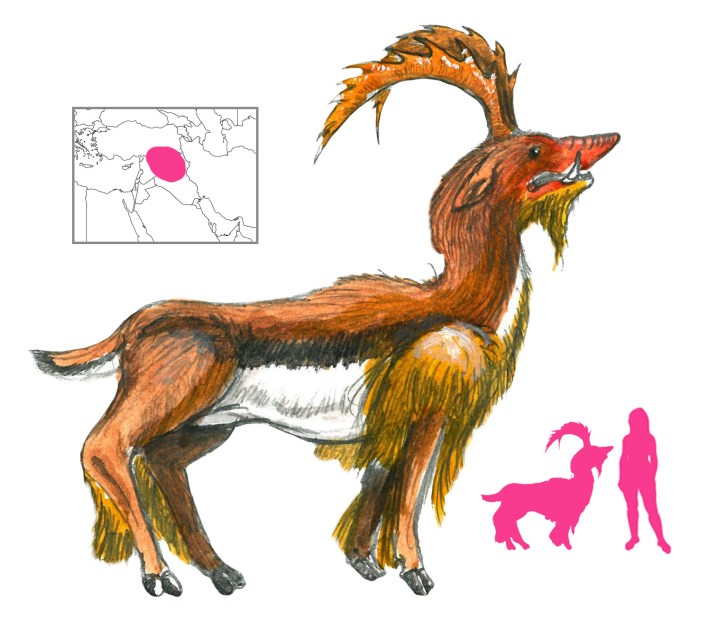
The antelope was known to the Greeks as Analopos (and variations thereof, derived from the Coptic Pantolops according to Bochart) and to the Romans as Calopus, “pretty foot” . These creatures were believed to inhabit India, Syria, and the Euphrates basin, and were fond of drinking the cool Euphrates water.

A calopus resembled a roe deer in appearance and size, with the exception of large saw-toothed horns growing out of their heads. These horns can be used to shred branches and human limbs alike, but are also easily entangled in thickets. A calopus trapped in this way will cry out, making it easily found and killed by hunters.

Alexander the Great encountered a number of these antelopes in India, where at least one obscure account refers to them as “aeternae”. The creatures pierced the Macedonian shields with their horns, but they were no match for Alexander’s soldiers, who slew anywhere from five thousand and four hundred to eight thousand five hundred and fifty of them. This, Topsell concludes, is the reason why we barely see any more of these animals.

Possible identities for the calopus include a number of antelopes, but also the moose, whose tree-shredding behavior may have inspired the calopus’ serrated weapons.

The “chatloup” (“catwolf”) name popularized by Barber and Rose appears to be a corruption of calopus.

References

Barber, R. and Riches, A. (1971) A Dictionary of Fabulous Beasts. The Boydell Press, Ipswich.

Bochart, S. (1675) Hierozoicon. Johannis Davidis Zunneri, Frankfurt.

Cuba, J. (1539) Le iardin de santé. Philippe le Noir, Paris.

Rose, C. (2000) Giants, Monsters, and Dragons. W. W. Norton and Co., New York.

Topsell, E. (1658) The History of Four-footed Beasts. E. Cotes, London.

de Xivrey, J. B. (1836) Traditions Tératologiques. L’Imprimerie Royale, Paris.

Swan Valley Monster

Swan Valley Monster

The Swan Valley Monster made its appearance on August 22, 1868, in the otherwise tranquil locale of Swan Valley, Idaho. Its presence was witnessed and reacted to by an unnamed old-timer crossing the river at Olds Ferry.

The first thing he saw of the monster was an elephant’s trunk rising from below the surface and spouting water. This was followed by a snake-like head the size of a washtub, with a single horn that kept moving up and down, and long black whiskers on both sides of the face. It had ten-inch-long fangs and a red forked tongue that spewed green poison. When it hauled its massive body onto the shore, the old-timer noted that it must have been twenty feet long, and it stank to high heaven. A pair of wing-like fins – or fin-like wings – came out of the sides of its neck. Its forward half was like a snake, the thickness of a calf, greenish-yellow with red and black spots; this in turn led into a fish-like section with hand-sized rainbow scales shining in the sun; finally, the tail was a drab, scaly gray like a crocodile or lizard tail. Shiny black barbed spines, like those of a porcupine, lined its back from head to tail. Finally, it had twelve stubby legs that were easily missed at first glance; the first pair under the fins had hoofs, followed by two pairs of legs with razor-sharp claws, then a pair of hoofed feet, a pair of clawed feet, and another pair of hoofed feet near the tail.

Of course, the old-timer’s first reaction to the abomination slithering up the bank was to fire a slug into its eye. The monster reared up, hissing, bellowing, and spurting poison over its surroundings, so it got shot a second time in its yellow belly, convulsed, and stopped moving. Everything its poison had touched, whether trees or grass or other living beings, withered and died.

As the monster was too large to be carried off by one man, the old-timer returned to town to fetch a wagon and six strapping lads to help him, as well as a tarp to protect them from the poison. They could smell the odoriferous creature a hundred yards away, and one of the men had to stay with the horses to keep them from bolting, while another got sick and refused to come any closer. But when they reached the bank where the monster had fallen, there was nothing but withered vegetation and a trail leading to the water.

Presumably the Swan Valley monster had crawled back into the river to die – or perhaps it didn’t die. Whatever its fate, the old-timer recommended keeping a close watch on the river, as “I’ve hunted an trapped an fished all over the state fer nigh ontuh seventy-five year… but I ain’t never seen nothin tuh compare with that speciment”.

References

Clough, B. C. (1947) The American Imagination at Work. Alfred A. Knopf, New York.

Fisher, V. ed. (1939) Idaho Lore. Federal Writers’ Project, The Caxton Printers, Caldwell.

Lewicki, J. and the editors of LIFE (1960) Folklore of America, part V. LIFE Magazine, Aug. 22, 1960.

Colôrobètch

Variations: Colô Rodje Bètch, Colô Rotje Bètch, Clô Rotje Bètch, Colôrobètche, Colaurobètch, Colaurobètche, Colau-rodje-bètch, Corobètch, Routge Bètch

Colorobetch

Bogeys represent a variety of childhood fears – darkness, retribution, the murky depths of deep ponds… In Wallonia children are menaced by the personification of the bise or icy wind, in the form of a bird with a red beak.

He can be found around Andenne, Bastogne, Dinant, Huy, and Neufchâteau, and Warsage; in On, Oignies, and Stavelot he is simply the “red beak”. The Somme-Leuze redbeak is a monstrous sparrow, the Condroz and Hesbaye variety is a pigeon, while the Namur redbeak is Colôrobètch or Colô Rodje Bètch, the “Red-Beaked Rooster”.

As his name indicates, Colôrobètch has a beak stained red with blood; beyond that, it is unclear whether he is a bird, a human, or a grotesque combination of both. He preys on children unwary enough to walk in the cold without adequate clothing, nipping at their exposed faces and hands until they turn red, dry, cracked, and bleeding. Colôrobètch comes out in the winter to pinch noses and spread frostbite.

In Andenne Colôrobètch becomes a nocturnal water bogey who drags children into the Meuse.

References

Pignolet, M. (1985) La Symbolique du Coq. Le Guetteur Wallon, 61 (3), pp. 81-104.

Tijskens, J. (1965) Les Noms du Croquemitaine en Wallonie. Enquêtes du Musée de la Vie Wallonne, nos. 117-120, tome X, pp. 257-391.

Traîcousse

Variations: Trécouche

Traicousse

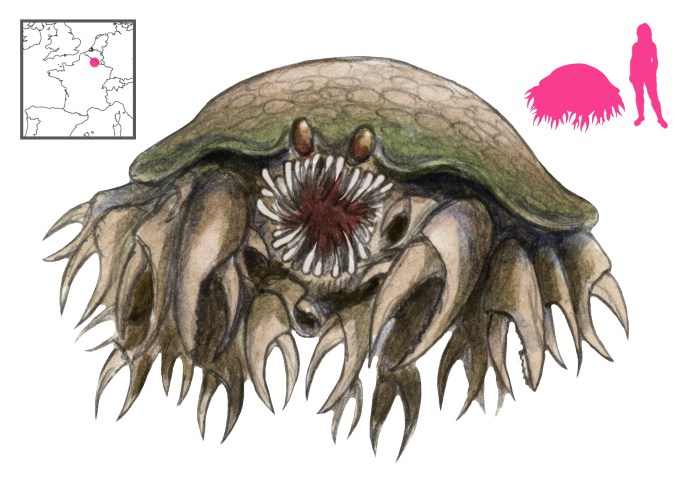
The Traîcousse, also known as Trécouche (pronounced tré-coutche) is a vile creature that can be found lurking in the ponds and waterways of the Southwestern Ardennes and the Semois, especially Hautes-Rivières in France and Bohan in Belgium. As a water bogey, it is invoked to discourage children from entering rivers.

In appearance the traîcousse is most like a large crab, a meter in diameter, with a flattened, rounded body covered with palm-sized brownish scales. Its bloodshot eyes are the size of a human fist. Its mouth is huge and bristles with sharp shark-like teeth, while countless pincer-tipped legs allow it to move and grasp its prey. In some areas the traîcousse has become an ugly river witch.

The deepest part of the river, where the current is fastest, is where the traîcousse lives. It digs itself into small cavities and rocky ledges as it waits for prey to come near. Anything that approaches is seized and dragged under, never to be seen again. Missing livestock, fishermen, and children are its doing.

Every now and then the traîcousse will vomit up the skin and bones of its prey, which rise to the surface in a macabre mix of foam and blood.

References

Lambot, J. (1987) L’Ardenne. Pierre Mardaga, Brussels.

Tijskens, J. (1965) Les Noms du Croquemitaine en Wallonie. Enquêtes du Musée de la Vie Wallonne, nos. 117-120, tome X, pp. 257-391.

Yuanat

Yuanat

The Yuanat is a type of serpent reported by Thevet from the island of Hispaniola, or Cuba. It lives in trees, on land, and in the water, making it fish, fowl, and land beast.

This greatly terrifying creature is about the size of a rabbit and is frightful to behold. It has the tail of a lizard, and four weak bird’s legs, with the forelegs longer than the hindlegs and long claws on each toe. Its teeth are sharp. It has a spine running down its back like the fin of a fish. Underneath its throat there is a colorful flap of skin reaching down to its belly, its varied hues making it hard to tell which color is dominant. It can swim well, and is completely mute.

Despite its horrifying appearance, the yuanat tastes excellent, and its flesh is more highly prized than that of rabbits. It is also so gentle and harmless that the natives would keep a yuanat on a leash for ten or twelve days before eating it, and it would never attempt to harm them. However, Thevet notes that yuanat meat is harmful to those who have had the pox, as it causes the disease to return in full force.

References

Thevet, A. (1575) La Cosmographie Universelle. Guillaume Chaudiere, Paris.

Vodyanoi

Variations: Vodianoi, Vodyanik, Vodnik, Vodeni Moz, Deduska Vodyanoy (Water-Grandfather), Vodianoi-chert (Water Devil), Vodianikha (female), Topielec (Drowner, Polish), Vodyany-ye (pl.); Bolotnyi (potentially)

Vodyanoi

The malevolent and murderous Vodyanoi, from voda or “water”, is the Slavic water spirit. It frequents lakes, ponds, rivers, and other bodies of water, but it especially prefers mill-ponds. Their homes range from the humble dwellings of sand and slimy logs of Olonets to underwater palaces of crystal, decorated with gold and silver taken from shipwrecks, and illuminated by a magic stone shining brighter than the sun. The palaces are primarily known from Kaluga, Orel, Riazan, and Tula. The female vodyanyoi is also known as the vodianikha, although a rusalka or a drowned woman will also be taken as a bride. Variants of the vodyanoi are known in Belarus, Poland, and Yugoslavia.

A vodyanoi varies wildly in appearance. It can be roughly human in appearance, with big paws, horns, tail, and eyes like burning coals; it can be a huge man covered with grass and moss, with shaggy white fur, or with scales; it can be black with huge red eyes and a long nose, or bluish and slimy, bloated and crowned with reeds. Sometimes it appears in the form of a human, as an old man with green hair and beard that turned white with the waning moon, as a white-bearded peasant in a red shirt, as a naked woman with enormous breasts combing her dripping hair while seated on a log, or in the form of guardsmen and children. It can be half fish and half human, or appear as a huge moss-covered fish, a swan, or even a bouquet of red flowers on the water. In Smolensk the vodyanoi is humpbacked and has the feet and tail of a cow, while in Vologda it is a log with little wings flying over the water. A vodyanoi out of the water and in human guise can be identified by the water oozing out of its coat.

The vodyany-ye are immortal, but grow younger or older with the moon. They are weak on land, but virtually invincible in the water, and they dislike going out of the water beyond the bank or mill-wheel; some vodyany-ye refuse to emerge from water beyond the waist. They like to ride livestock until they die of exhaustion. Their presence in the market is an omen; if a vodyanoi buys corn at high prices, the harvest will fail, but a vodyanoi buying cheaply foretells bountiful crops.

They rest in their palaces during the day, and come out in the evening splashing the water with their paws, making a noise that can be heard over great distances. Vodyany-ye hate humans and lurk in the water after sunset, dragging people in when the opportunity arises. Those they drown become their slaves, or if attractive enough their wives. They take offense to anyone attempting to retrieve the bodies of the drowned, seeing them as their rightful property. Recovered bodies with bruises and marks on them were seen as bearing the scars of battle with a vodyanoi. In some places the presence of a vodyanoi became a serious threat. One mill-pond in Olonets held a vodyanoi family that required a constant source of corpses to eat. The inhabitants of the area learned to avoid the pond, and the family was eventually forced to relocate.

A vodyanoi sees mill-dams as an insult, and will destroy them to keep the water flowing. Horses smeared with honey, hobbled, and drowned with millstones make good placatory offerings. Drunk passers-by can also be pushed into mill-ponds to earn the vodyanoi’s trust.

As with other evil spirits, a vodyanoi can be exorcised; in fact, in some areas such as Tula, the vodyanoi is indistinguishable from the devil. Shooting a vodyanoi with buttons has been known to kill them as well. But while a vodyanoi can bear grudges, it can just as soon show gratitude. One vodyanoi who was aided in fighting off a rival promised never to drown anyone.

A vodyanoi is not hostile to fishermen and millers due to their affinity with water. Millers would deposit bread, salt, vodka, black sows, and ram’s heads at the water’s edge as offerings to the vodyanoi, and offer black roosters when building a new mill. Some millers were on such good terms with their local vodyanoi that they dined with them every night. Fishermen, on the other hand, would toss butter or tobacco into the water, saying “here’s some tobacco for you, vodyanoi, give me a fish!” A pleased vodyanoi would drive fish into a fisherman’s net. Finally, beekeepers also kept up good relations with the vodyanoi by offering honey and wax, and in return the water-spirit prevented humidity from damaging the hives.

The bolotnyi, from boloto or “swamp”, is a possible variation of the vodyanoi found in swamps.

References

Aldington, R. and Ames, D. trans.; Guirand, F. (1972) New Larousse Encyclopedia of Mythology. Paul Hamlyn, London.

Dubois, P.; Sabatier, C.; and Sabatier, R. (1992) La Grande Encyclopédie des Lutins. Hoëbeke, Paris.

Ivanits, L. J. (1989) Russian Folk Belief. M. E. Sharpe, Inc., Armonk, New York.

MacCulloch, J. A. and Machal, J. (1918) The Mythology of All Races v. III: Celtic and Slavic. Marshall Jones Company, Boston.