Númhyalikyu

Variations: Númhyělekum

Numhyalikyu

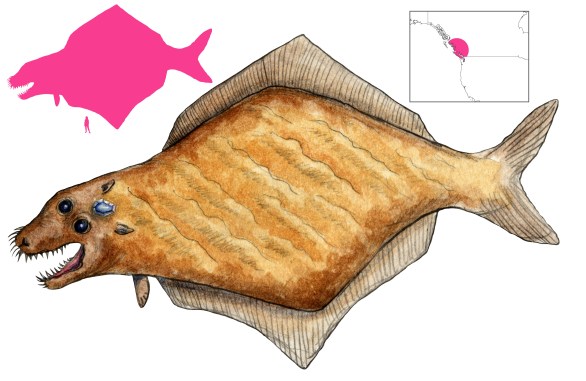
Númhyalikyu, “one chief one”, is an enormous, monstrous halibut of Pacific Northwest Kwakwaka’wakw folklore. Its back looks like a beach, complete with ripples left behind by the waves. It has the head of a seal, with a shining spot that gleams like fire.

If a númhyalikyu is killed, its head can be stabbed and its gleaming ornament extracted, revealing it to be a hard and shiny crystalline object. This is known as tlúgwi, and it is highly valuable. It is hard to pinpoint the location of a númhyalikyu, however, as it makes a deep humming sound that reverberates through water and air and rumbles through the trees, seeming to come from everywhere at once.

Númhyalikyu brings bad weather and storms. When it comes to the surface, it creates treacherous shallows that wreck canoes. Its rippled back, often just below the surface of the water, can be easily mistaken for a small island.

Númhyalikyu’s dance is númkahl, “personification of númhyalikyu”. The initiate playing the part of númhyalikyu wears a face mask, and is caught on the beach after metaphorically leaving the sea.

References

Curtis, E. S. (1915) The North American Indian, v. X. The Plimpton Press, Norwood.

Isiququmadevu

Variations: Usiququmadevu (flattering); Isikqukqumadevu, Usikqukqumadevu; Unomabunge; O’gaul’-iminga; O-nsiba-zimakqembe

Isiququmadevu

When Untombinde, the king’s daughter, set out for the mythical Ilulange River, she took with her two hundred maidens to be her escorts. She was determined to bathe in one of its pools despite her parents’ warnings of dire consequences. Once there, she and her handmaidens undressed and played in the water, but when they came back out their clothes, their beautiful bracelets and jewels and finery were all gone. Isiququmadevu had taken them.

Isiququmadevu, “Smelly Whiskers”, is a mountainous “swallowing monster” from Bantu and Zulu folklore. She is bearded, bloated, hairless, and squatting, with an enormous mouth capable of engulfing entire villages. Other clues as to her appearance are given in her many epithets, which include Unomabunge (“Mother of Beetles”), O’gaul’-iminga (“Feller of Lofty Thorn-trees”), and O-nsiba-zimakqembe (“She Whose Feathers are Long and Broad”).

Naturally the royal cortège was mortified, and entreated the isiququmadevu to return their belongings. “Untombinde, the king’s daughter, brought us here, she is to blame”. One by one they recuperated their effects, until Untombinde was left. “Beseech Usiququmadevu”, they told her, using a more personal and flattering name for the monster. But Untombinde – perhaps miffed by her companions’ accusations – refused. “I am the king’s daughter”, she said haughtily, “and I will never entreat the isiququmadevu”. Whereupon the monster seized her and took her into the pool.

King Usikulumi despaired for his daughter, fearing she was lost forever, and ordered his troops to slay the isiququmadevu. But the monster hauled herself onto the bank, and swallowed the entire army in one gulp. She then followed their trail back to the village, and swallowed the men, the women, the children, the dogs, the cattle, every living thing she found there.

Among her victims were two adorable twin children whose father was the only villager who escaped the isiququmadevu’s attack. He resolved to kill the creature, arming himself with his assagai and following her back into the woods. First he met a herd of buffaloes. “Where has Usiququmadevu gone? She has taken my children”. Acknowledging his plight, the buffaloes told him he was on the right track with a “forward, forward!” Next he met some leopards and an elephant, who advised him to keep on going. Finally he found the isiququmadevu herself, replete and squatting. “I seek Usiququmadevu, who has taken my children!” he announced. “Forward, forward!” said the isiququmadevu, but the man was not as dimwitted as she had hoped, and he stabbed her with his spear until she died. Then all her victims climbed out, none the worse for wear, with Untombinde, defiant and proud, coming out last.

In another isiququmadevu story, it is Usitungusobenthle, a young woman who had been abducted by pigeons to be their queen, who brings about the creature’s demise. She returns to her village after escaping her captors only to find it empty, with the isiququmadevu sleeping nearby. She cut it open with a knife, and released all its victims.

Another princess, Uluthlazase, actually stood up to an isiququmadevu and tried to wrest her clothes from the monster. She held on so firmly that the isiququmadevu could not remove her, and the two fought each other to a stalemate. When it left to get assistance from other isiququmadevu, Uluthlazase collected her effects and wisely escaped.

References

Callaway, C. (1868) Nursery Tales, Traditions, and Histories of the Zulus. Trübner and Co., London.

Koopman, A. (2002) Zulu Names. University of Natal.

Werner, A. (1968) Myths and legends of the Bantu. Frank Cass and Co. Ltd., London.

Orabou

Variations: Orobon (erroneously)

Orabou

Mount Marzouan, once known as Mount Orabou, was described by Thevet in his Cosmographie. It is home to a small population of Arabs, and the waters of the sea there house a fish known as Orabou, for which the mountain was once named.

Not much is known of the orabou’s appearance. Thevet only states that it is nine to ten feet long, and is plated with armor like a brigandine, although its scales are not as tough as a crocodile’s hide. The depiction of the orabou provided gives it a humpbacked, rather feline appearance.

Orabou flesh is particularly foul-tasting, and Thevet believed that old camel meat and Livonian mastiff were preferable to the execrable orabou. Eating it also results in kidney and bladder stones. Despite that, the inahabitants of Mount Marzouan eat it anyway, treating their stones with a diuretic concoction of orabou fat, two handfuls of false gold dust, and cyclamen.

Paré takes the orabou from Thevet, but misspells its name as the phonetically-similar “orobon” and its locality as “Mount Mazouan”. Ever the embellisher, he also adds that it is extremely ferocious towards other fish.

The orabou may have been inspired by crocodiles, although Thevet makes a distinction between the two. Another possibility is a monitor lizard, like a similar creature encountered by Sir Andrew de Toulongeon and Pierre de Vaudrei in the desert of Palestine. It was a three-foot-long green lizardlike animal covered with sturgeon-like scales, having feet like the hands of a child, a head like a hare’s, and a long lizard’s tail. It made sounds like a cat, and was feared by the Arabs accompanying the knights. Naturally this affront to the natural order was promptly slain.

References

Butazzoni, F. (1997) Los Ensayos del Orobon. Ariel, Montevideo.

Paré, A. (1614) Les Oeuvres d’Ambroise Paré. Nicolas Buon, Paris.

Thevet, A. (1575) La Cosmographie Universelle. Guillaume Chaudiere, Paris.

Wright, T. (1848) Early Travels in Palestine. Henry G. Bohn, London.

Araǵanaqlta’a

Variations: AraGanaqlta’a, AraGanaGalta’a; AraGanaqlate’e, AraGanaGalate’e; Owner of the Snakes, Father of the Snakes

Araganaqltaa

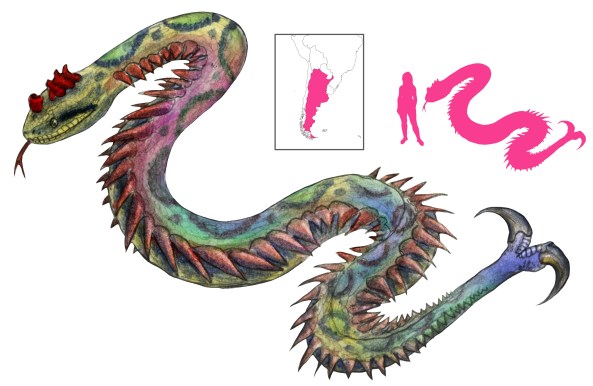
Araǵanaqlta’a is the father or owner of the snakes in Argentinian Toba folklore. It can be found in a range of habitats, but usually likes rivers and deep caves with access to water. In addition to snakes, which are all under its command, it is associated with water, rainbows, and storms.

The araǵanaqlta’a appears as a large, multicolored snake, 10 meters or more in length, resembling a bushmaster or fer-de-lance. It has a red crest, its “sign” (ndage), on top of its head, and a sawlike structure on either side of its body that allows it to move. An araǵanaqlta’a’s tail ends in two hooks which it uses to hold prey. The females are known as araganaqlate’e, the mother of the snakes.

Araǵanaqlta’a are shapeshifters, adjusting to fit their environment, and are also known in the form of four-legged snakes, as humans in elegant business attire, or as rheas with colorful necks. No matter what shape it takes, however, the araǵanaqlta’a always has its characteristic ndage, which identifies it as a powerful mythical creature.

Araǵanaqlta’a are intelligent and enjoy human conversation. These snakes will punish desecrators of nature and persecutors of snakes, but will reward those who they find worthy. After a hunter treated an araǵanaqlta’a with respect and obeisance, the snake promised him that he would have all he would ever need, and taught him how to heal the sick with his words.

References

Wilde, G. and Schamber, P. (2006) Simbolismo, Ritual, y Performance. Paradigma Indicial, Buenos Aires.

Wright, P. G. A semantic analysis of the symbolism of Toba mythical animals. In Willis, R. (Ed.) (1990) Signifying Animals: Human Meaning in the Natural World. Unwin Hyman, London.

Wright, P. G. (2008) Ser-en-el-sueño. Editorial Biblos, Buenos Aires.

Xuangui

Variations: Twisting-Turtle, Round-Turtle, Xuan-Turtle

Xuangui

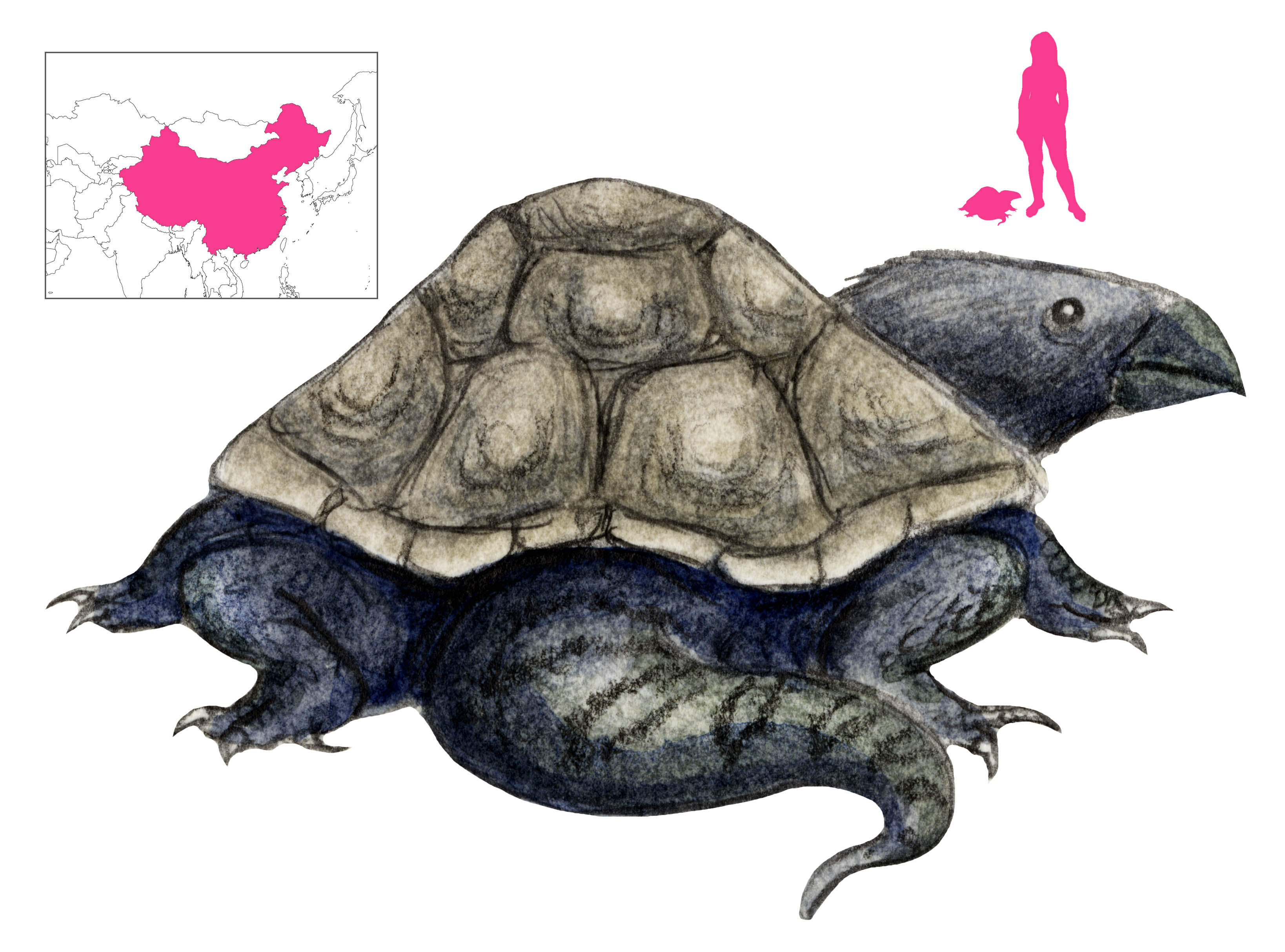
Xuangui, or Twisting-Turtles, are found in the Strange River, east of the Niu-Trees Mountain. They are black turtles with a bird’s head and a viper’s tail, and they make sounds like that of splitting wood. Wearing a piece of xuangui from the belt protects from deafness and calluses. Mathieu compares it to the Japanese water turtle Clemmys japonica.

It is unclear what, exactly, is strange about the river.

References

Mathieu, R. (1983) Étude sur la mythologie et l’ethnologie de la Chine ancienne. Collège de France, Paris.

Strassberg, R. E. (2002) A Chinese Bestiary: Strange Creatures from the Guideways Through Mountains and Seas. University of California Press.

Xi

Variations: Xi-Rhinoceros; Xiqu (potentially); Si, Si-Rhinoceros (potentially)

Xi

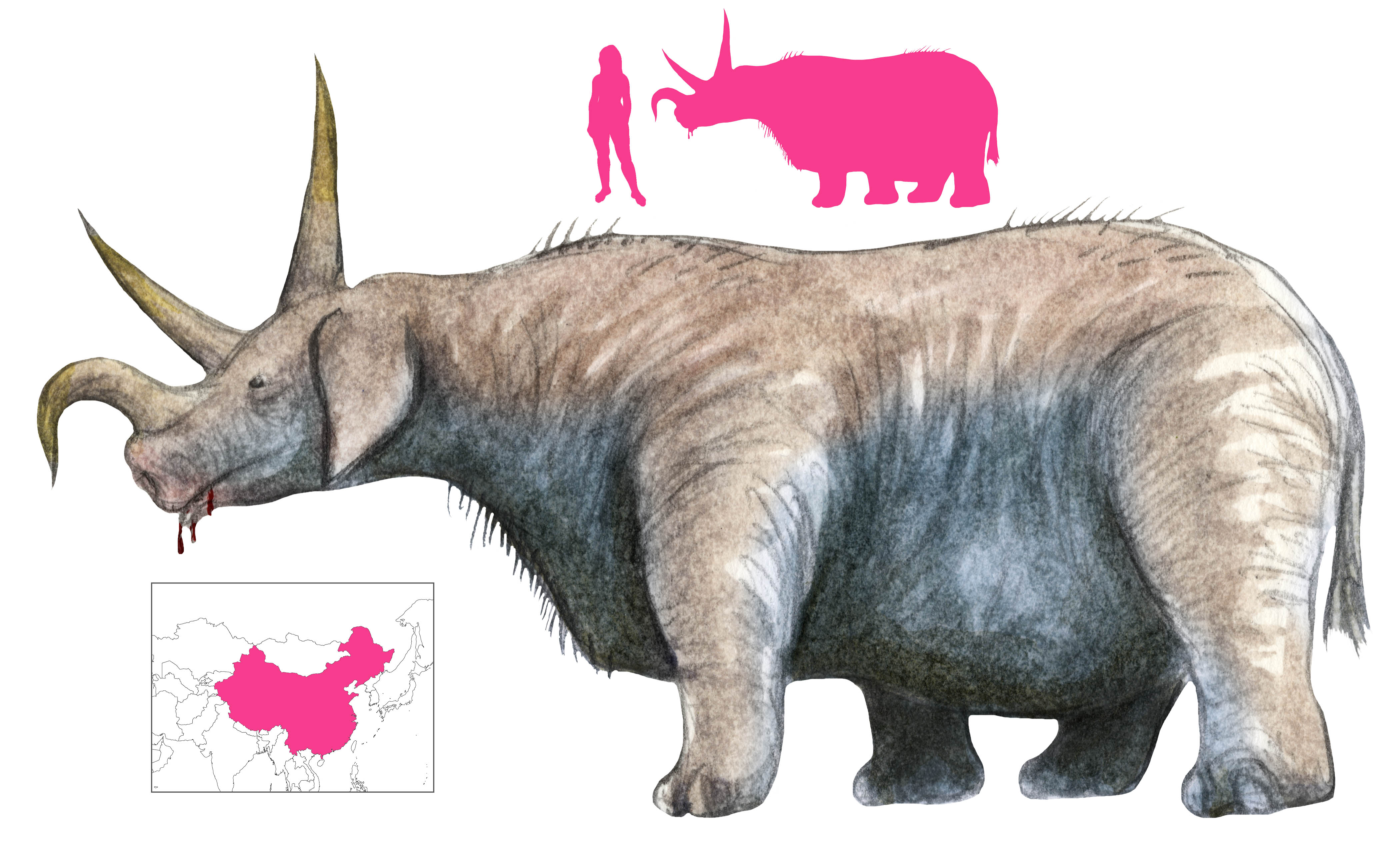
Among the wildlife to be found on Cauldron Mountain, Mount Min and Pray-and-Pass Mountain is the Xi. It is like a black water buffalo with a pig’s head, a large belly, and three-toed elephant’s feet on short legs. It has three horns, found on its nose, forehead, and crown. The nose horn does not fall off and helps it eat. Xi feed primarily on brambles, and therefore often drool blood. It may be the same animal as the Xiqu, which is a man-eating blue-black ox that makes sounds like a baby.

The Si is similar, but blue or green with a single horn weighing 1,333 pounds. Its thick skin could be used as armor.

Guo Pu mocked the Xi for its big nose, and the Si for its tough hide which ironically made it more desirable and vulnerable to human exploitation.

Both Xi and Si have been used interchangeably to refer to a number of large herbivores including oxen, yaks, and buffalo, but they are generally believed to be rhinos.

References

Strassberg, R. E. (2002) A Chinese Bestiary: Strange Creatures from the Guideways Through Mountains and Seas. University of California Press.

Taumafiskur

Variations: Taumhveli (Bridle-whale); Taumur, Taumi (Bridle, Striped One); Stóri-hnýfill (Big Shorthorn)

Taumafiskur

The Taumafiskur, or “bridle fish”, is one of the many illhveli – the “evil whales” of Iceland. It is the most dangerous and feared of the evil whales, as are the others. Its flesh is inedible, and speaking its name at sea will attract its unwelcome attention.

Its name is derived from the white or pink stripes extending from its eyes to its mouth, and from its mouth outwards. These contrast sharply with its raven-black color, and give the appearance of a bridle. In the East Fjords it is known as the “big shorthorn”, distinguishing it from the “little shorthorn” or minke whale which is smaller and shorter-finned. The taumafiskur is slightly larger than the stökkull in size.

Taumafiskurs are cruel, destructive, and spiteful; worse than that, they have an excellent memory and will hold grudges for as long as they live, tracking down anyone who has escaped them. They flip boats over, tear them up with their teeth, pummel them with their tails, and even get under them crosswise and fold them in half.

One minister from Fáskrúðsfjörður survived a taumafiskur’s attack by clinging to the wreckage of his boat. Since then, he was unable to go to sea without the whale zeroing in on him again, seeking to kill him once and for all.

Another time the crew of a Danish fishing boat sighted a taumafiskur around the Snæfellsnes glacier. They were saved by the quick thinking and skill in the dark arts of the captain, who dove overboard with a small bag in hand, and when he returned he assured them the taumafiskur would not bother them anymore. And sure enough, it was not seen again that day.

Exactly what the captain used to repel the taumafiskur is unknown. The substances known to be abhorrent to taumafiskurs (and most likely other illhveli) include chewed angelica, rotting baitfish, bilge-water, cod-liver oil, live fire in a bucket, juniper, cow or sheep manure, sulfur, chopped fox testicles, and yarrow. Setting fire to these substances before throwing them overboard was believed to make them more potent. Taumafiskurs can also be distracted by loud noises and barrels thrown into the water, and sailing into the sun can dazzle them into giving up the chase.

References

Davidsson, O. (1900) The Folk-lore of Icelandic Fishes. The Scottish Review, October, pp. 312-332.

Hlidberg, J. B. and Aegisson, S.; McQueen, F. J. M. and Kjartansson, R., trans. (2011) Meeting with Monsters. JPV utgafa, Reykjavik.

Abúhukü

Variations: Abúhuwa (pl.)

Abuhuwa

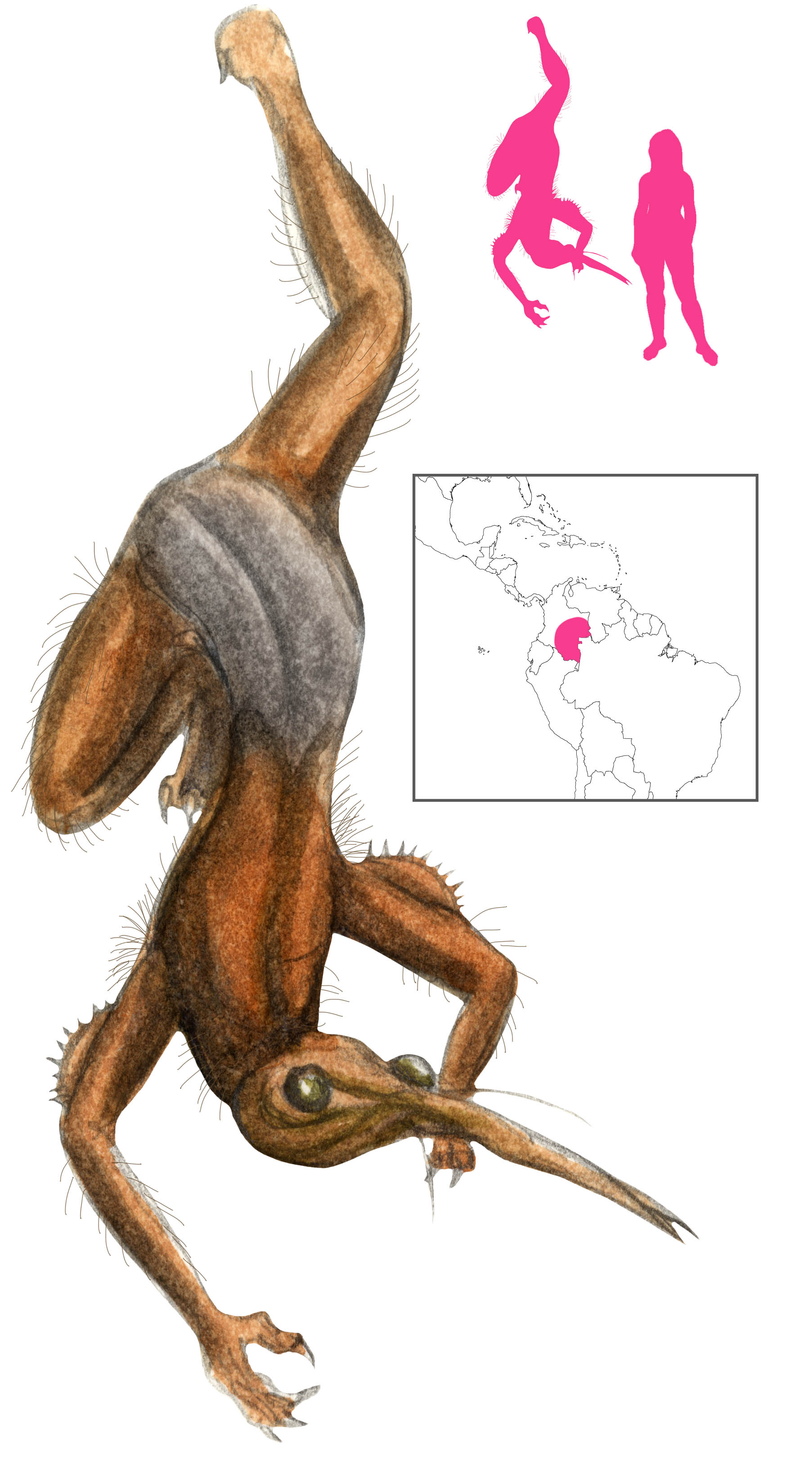
The victims of the Abúhuwa, the rainforest demons of the Cubeo people of the Colombian Amazon, are easily recognized. An abúhukü will cut a hole in the skull before sucking out the contents of the body. Sometimes prey is rolled in palm leaves and tenderized. Either way, they leave an empty skin hanging from a branch.

Abúhuwa are nocturnal creatures who embody disease, death, and all that is evil. They associate with the spirits of dead poisoners, murderers, and male adulterers, and are described as misty creatures from the realm of darkness. Their name is derived from “whiteness”, or the foaming of rapids. Like almost all other Amazonian ogres, the abúhuwa are hairy and foul-smelling, associating them with bestial sexuality and death respectively. In addition to that, they have an extra face in the back of their head, and sticky bodies that make escape from their embrace impossible. The females have long pendulous breasts and prefer to kill men, while the males attack women, often killing mothers and abducting their children to raise as their own. Such abúhuwa changelings become cannibals themselves.

The abúhuwa were once far more common, and were allied with a race of evil jaguars that worked with them to decimate human populations. Humanity got a respite after a series of floods and fires that reduced the numbers of both predators.

Abúhuwa are fortunately quite stupid, and can easily be outwitted by children. They are relegated to the status of nursery bogies, reflected in a sort of tag game where one child plays the part of the abúhukü. The grotesqueness of the abúhuwa makes them easier to confront and mock.

Armpit hair from an abúhukü makes a potent ingredient in poisons. To obtain it, an abúhukü must be caught during a lunar eclipse, and the hair from its left armpit must be cut with a corn husk, reduced to ash, mixed with water and turned into paste, and left to dry. It keeps well in a gourd sealed with beeswax.

Capsicum smoke is toxic to abúhuwa, and they can be easily driven away by burning peppers. When killed, they turn into sloths.

References

Goldman, I. (1979) The Cubeo Indians of the Northwest Amazon. University of Illinois Press, Urbana.

Goldman, I. (2004) Cubeo Hehénewa Religious Thought. Columbia University Press, New York.

Smith, N. J. H. (1996) The Enchanted Amazon Rain Forest. University Press of Florida, Gainesville.

Barcädžy Calh

Variations: Wheel of Balsæg/Barsæg/Barsag/Balsag/Marsug/Father Ojnon, Thinking Wheel, Cutting Wheel

Wheel of Balsaeg

When Soslan or Sosryko, greatest of the Nart heroes, was born, his mother had him dipped in magical fire. The process rendered him immortal and invulnerable, but alas, the smith’s tongs had held him by the knees, which became his only weak spot.

After many adventures, Soslan was finally defeated by the jealous Syrdon. Aware of the hero’s weakness, Syrdon incited the devils to fire their arrows from below ground into his horse’s hooves. Like its master, the horse had only one weak spot, in this case the underside of its hooves.

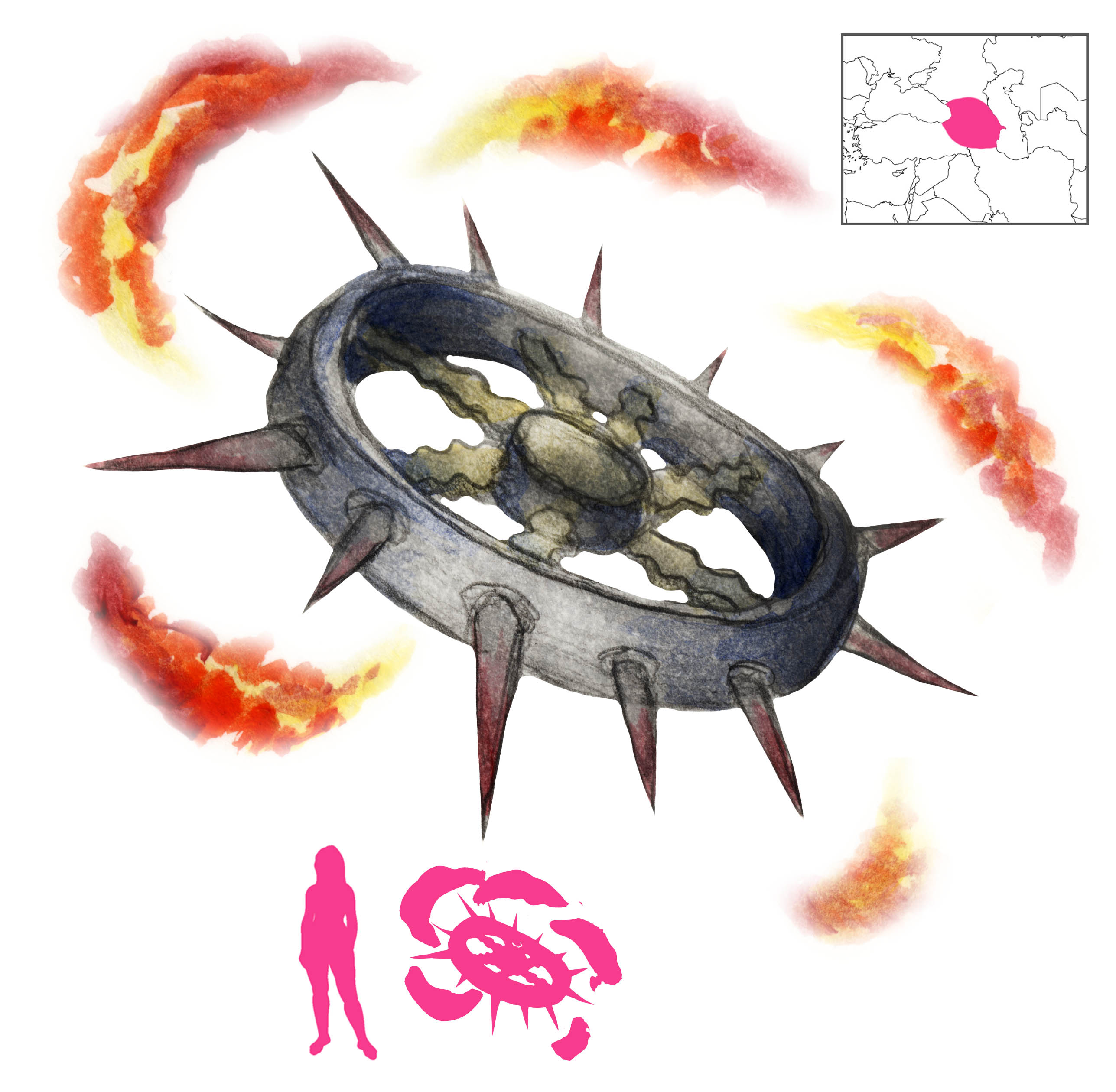
Once the horse fell, Syrdon called upon the enigmatic Barcädžy Calh, the Wheel of Balsæg or Cutting Wheel. The Wheel was a Thinking Machine, an intelligent and malevolent automaton that took the form of a razor-sharp metal wheel with steel teeth and flames bursting from it. It came rolling down from the heavens to the Earth, setting fire to plains and forests as it went on its headlong charge to the Black Sea. Only birch trees managed to avoid the flaming Wheel’s wrath. Soslan gave chase to it and captured it, but it escaped his grasp, flew at him, and sliced through his knees, leaving him for dead. The hero’s sons chased the Wheel back into the Black Sea, but it was already too late. The Narts buried him as he died; his last act from the grave was the impalement of Syrdon. Soslan’s nephew avenged him by breaking the Wheel in half.

Balsæg, also known as Barsæg, Marsug, and permutations thereof, remains unknown. Knowledge of his nature has been lost, save that he is the proprietor of the Wheel. In some accounts, the Daughter of the Sun sends the Wheel to kill Soslan; in others, it belongs to Father Ojnon – John the Baptist. It may have its origin as a solar symbol or accessory in solstice rituals. Finally, in some retellings the Wheel is reduced to a mere training discus, albeit a very sharp one. Soslan is tricked into bouncing it off his weak spot.

References

Cayla, F.; Quesnel, A.; Welply, M.; and Laverdet, M. (1997) Le guide illustré des mythes et légendes. Hachette, Paris.

Colarusso, J. (2002) Nart Sagas from the Caucasus. Princeton University Press.

Dumézil, G. (1978) Romans de Scythie et d’alentour. Bibliothèque Historique, Payot, Paris.

Littleton, C. S. (1979) The Holy Grail, the Cauldron of Annwn, and the Nartyamonga: A Further Note on the Sarmatian Connection. The Journal of American Folklore, vol. 92, no. 365, pp. 326-333.

Skoffín

Variations: Skoffin; Skuggabaldur, Finngalkn, Fingal; Urdarköttur, Naköttur; Modyrmi
Skoffin

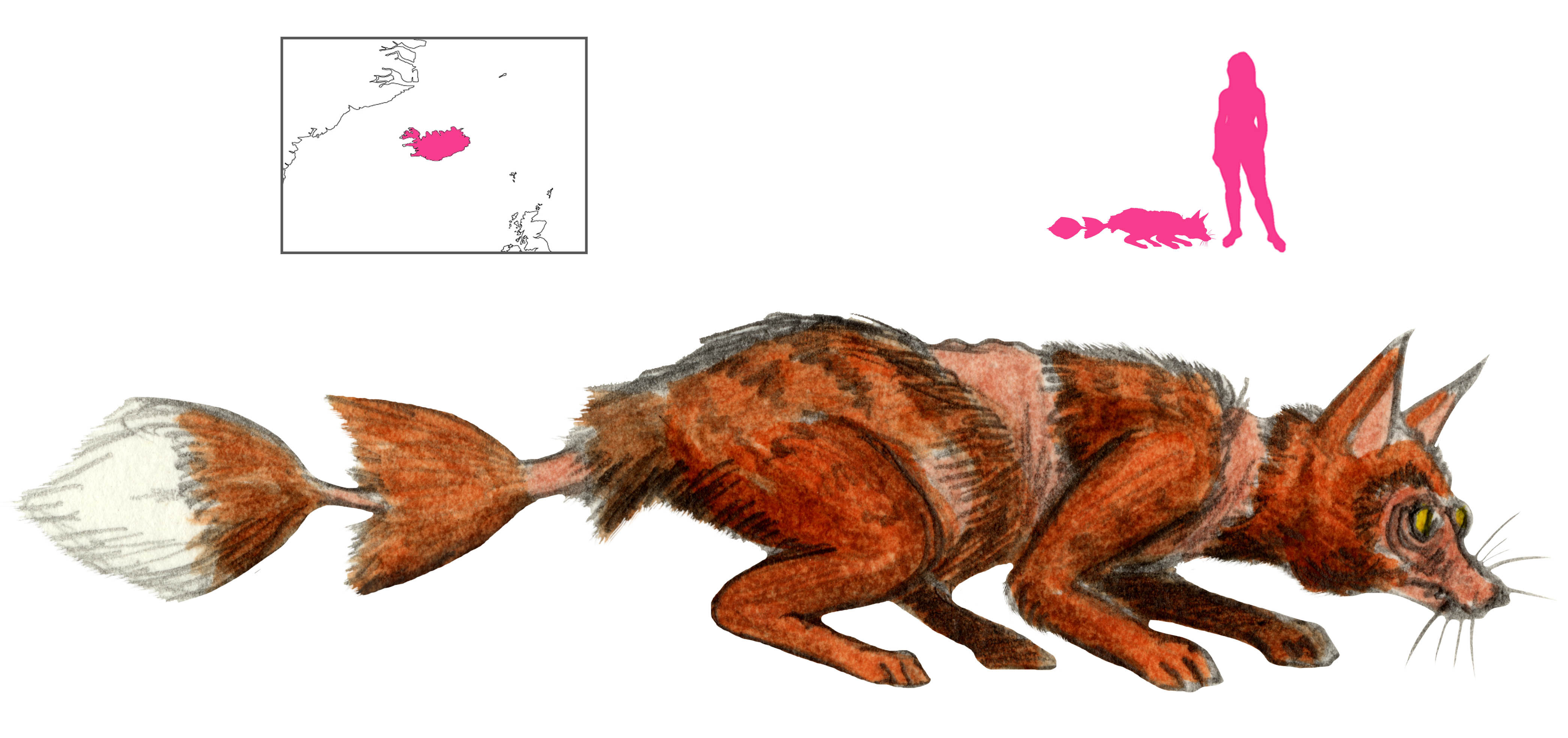
The Skoffín is one of a complex of Icelandic fox-cat hybrids with a lethal gaze, combining the cunning of the fox with the cruelty of the cat. This group also includes the Skuggabaldur, Urdarköttur, and Modyrmi, all of which are variations on the same theme; they are also linked to the “demon harriers”, foxes sent by sorcerers to maul livestock.

A skoffín is born from the union of a male Arctic fox and a female tabby cat, and resembles both of them. Its gaze is so deadly that everything it looks at dies immediately, without needing to see it. Its exact appearance varies; it may even change color with the seasons like the Arctic fox does. Reports suggest that skoffíns are short-haired, with bald patches of skin throughout.

Skoffín kittens are born with their eyes wide open. If not destroyed immediately, they sink into the ground and emerge after 3 years of maturation. It is therefore imperative to kill sighted kittens before they can disappear into the ground. When a litter of three sighted kittens was born at a farm in Súluholt, they were placed in a tub of urine to prevent their descent into the earth, and were drowned by placing turf on top of them. The entire tub was then tossed onto a pile of manure and hay and set on fire. The mother cat was also killed.

Skoffíns are irredeemably vile and malicious, and satisfy their appetite for destruction by killing humans and livestock alike. They are best shot from a safe distance, ideally with a silver bullet and after having made the sign of the cross in front of the barrel, or having a human knucklebone on the barrel. Hardened sheep dung makes equally effective bullets.

Thankfully, skoffíns are not immune to their own gaze. An encounter between two skoffíns will lead to the death of both of them. As with basilisks, mirrors are their bane. Once a skoffín stationed itself on the roof of a church, and the parishioners started dropping dead as they left the building. The deacon understood what was going on, and had the rest of the congregation wait inside while he tied a mirror to a long pole and extended it outside to the roof. After a few minutes he gave the all-clear, and they were able to leave the church safely, as the skoffín had perished immediately upon seeing its reflection.

Eventually, confusion with the basilisk of the mainland muddled the skoffín’s image, leading to some accounts claiming it was hatched from a rooster’s egg.

The skuggabaldur (“shadow baldur”) or finngalkn has the same parentage as the skoffín, but is born of a tomcat and a vixen. It has very dark fur shading to black, sometimes has a deadly gaze, and preys on livestock. It may be killed in the same way as the skoffín. One particularly destructive skuggabaldur in Húnavatnssýslur was tracked down and killed in a canyon; with its last breath, it exhorted its killers to inform the cat at Bollastadir of its death. When a man repeated that incident at a Bollastadir farm, a tomcat – no doubt the skuggabaldur’s father – jumped at him and sank its teeth and claws into his throat. It had to be decapitated to release its hold, but by then the man was dead.

The urdarköttur (“ghoul cat”) or naköttur (“corpse cat”) is of less certain parentage. It may be a hybrid, but other accounts state that any cat that goes feral in Iceland eventually becomes an urdarköttur, and all-white kittens born with their eyes open will sink into the ground and re-emerge after three years in this form. Shaggy, white or black furred, growing up to the size of an ox, these felines kill indiscriminately and dig up corpses in graveyards. It may be killed in the same way, and is attached to the same story as the Bollastadir cat. Gryla’s pet, the Yule Cat, is most likely an urdarköttur.

The modyrmi (“hay wormling”) is a canine variant, created when puppies born with their eyes open sink into the ground and reappear after three years as wretched, virulent monsters. The specifics are the same as with the skoffín.

References

Boucher, A. (1994) Elves and Stories of Trolls and Elemental Beings. Iceland Review, Reykjavik.

Hermansson, H. (1924) Jon Gudmundsson and his Natural History of Iceland. Islandica, Cornell University Library, Ithaca.

Hlidberg, J. B. and Aegisson, S.; McQueen, F. J. M. and Kjartansson, R., trans. (2011) Meeting with Monsters. JPV utgafa, Reykjavik.

Stefánsson, V. (1906) Icelandic Beast and Bird Lore. The Journal of American Folklore, vol. 19, no. 75, pp. 300-308.