As part of the Wednesday Interludes, I will also be including paeans to certain creatures I believe are woefully underrated. These will all be fairly modern, pop-culture creatures, and so will not be part of ABC, but I’ll be darned if I don’t give them a deserving moment in the limelight. There will be no particular rhyme or reason to them, but a fair few of them will be from BD (that’s Franco-Belgian comics to you, you uncultured swine), which are less well known in the English-speaking world.

What better way to start than with the nameless Giant Purple Slug? This monster is quite possibly my favorite pop-culture monster of all time, and was responsible for some of the most wonderful, pleasant dreams I had as a child. It is the primary “antagonist” of the 1972 Tif et Tondu book Sorti des Abimes (“Out of the Abyss”, more or less). A bit of background… Tif et Tondu is a Belgian BD by Will and Rosy that follows the adventures of private investigators Tif (the bald guy) and Tondu (the hairy guy, amusingly enough). Their tales fall mostly on the science-fiction side. Today the series is mostly remembered for introducing Monsieur Choc, the urbane, well-dressed, knight-helmeted international criminal mastermind.

But in Sorti des Abimes, it is not Monsieur Choc but a gigantic gastropod that causes consternation for our heroes. The adventure is set in the docks of London, where their friend the Countess Amélie “Kiki” d’Yeu is looking for her confiscated Great Dane. She finds him in a pound, along with something big, tentacley, and drooling green slime. (All art by Will, buy his books!).

sorti des abimes 1.jpg

The “thing” escapes its confines and slithers into the Thames, where it is sighted swimming through the canals and generally making the most delightful floppery ooshy sounds.

sorti des abimes 2

Of course, Our Heroes (O. H.) find out about this and won’t have any of it. I mean, the slug does eat its way through the Thames, chews through a few ship hulls, and drives a steamer aground, but what’s a few fish and ships between friends? Nonetheless, they find out that it’s an abyssal slug brought to the surface by a misguided biologist at the pound. Turns out that, having never seen the light of day, ultraviolet rays cause the slug to grow out of control. O. H. track it down to a dock, where – have I mentioned how much I love/am terrified of the dark outlines of huge things under the water?


sorti des abimes 4

The slug is making a water-based beeline for the sea, and crushing everything along its path. After O. H. try to kill it with a WWII-surviving Junkers Stuka (!), the slug decides it’s had enough and hauls its mass out of the water, looking for all the world like an adorable purple cross of Aplysia and Glaucus.

sorti des abimes 5

It’s not malicious or anything, it just decides to take a more direct route for the sea – a route that leads it to noted landmark Tower Bridge.

sorti des abimes 6


Fortunately for Tower Bridge (what would the Queen say?), O.H. realize that if ultraviolet rays make it grow, infrared rays must clearly have the opposite effect (ignore the spectroscopic and biological problems here, this was a 70s BD). They pelt the poor slug with IR radiation…

sorti des abimes 8

… whereupon it melts into black slime.

sorti des abimes 9

sorti des abimes 10

All it ever wanted was to return to the sea…

Gold-digging Ant

Variations: Formica maior, Formica aurum

Gold-digging ant

Herodotus originally placed the Gold-digging Ants in the sandy deserts in the land of the Dards, in India, within the Persian Empire. Some later sources, such as the Ortus Sanitatis, move them to Ethiopia. Their story is the same regardless of location.

Gold-digging ants are smaller than dogs, but larger than foxes. Pliny specifies that they are as large as an Ethiopian wolf, and the color of a cat. Skins of those ants brought before Alexander the Great were like panther skins. In the Ortus Sanitatis, the gold-digging ant is given a form unlike any ant – indeed, unlike any living animal, with a rounded, bird-like head and four legs with long talons. These ants are exceedingly fast, strong, and dangerous.

Most importantly, gold-digging ants excavate their nests in an area rich with gold dust. The sand they bring to the surface is full of the precious metal, making them an attractive target for treasure seekers, but they also fiercely defend their gold from anyone who would dare take it.

To steal the ants’ gold, camel caravans approach the nests on hot summer mornings, when the ants are safely underground. Gold sand can be quickly scooped up into bags, but the ants soon catch the scent of the intruders and hurry to the surface. Without a head start for the camels, the ants would easily catch up and dismember them.

Whatever the nature of the gold-digging ants, it is agreed that they definitely weren’t ants, and most likely were some sort of mammal. Suggestions include the hyena, whose Persian name resembled the Greek name for the ant; and the Siberian fox, whose digging and ferocity parallel those of the ant. The most compelling argument is elaborated by Peissel, who identifies the “ants” as Himalayan marmots whose tireless digging would have brought gold to the surface. Herodotus’ usage of murmex for ant may have muddled the distinction between ant and marmot.

References

Cuba, J. (1539) Le iardin de santé. Philippe le Noir, Paris.

Herodotus, Macaulay, G. C. trans. (1890) The History of Herodotus, translated into English. Macmillan and Company, London.

Peissel, M. (1984) The Ants’ Gold. Harvill Press, London.

Pliny; Bostock, J. and Riley, H. T. trans. (1857) The Natural History of Pliny, v. III. Henry G. Bohn, London.

de Xivrey, J. B. (1836) Traditions Tératologiques. L’Imprimerie Royale, Paris.

Cenchris

Variations: Cenchros, Cenchrines, Cenchridion, Cenchrites, Cenchria; Millet; Milliaris (from millet); Punter-schlang, Berg-schlang (German); Lyon (due to its color and ferocity); Famusus, Aracis, Falivisus (Topsell gives those last three as barbarous versions)

Cenchris

The Cenchris or Millet is one of the many venomous snakes spawned from the blood of Medusa that live in the Sahara desert. It was listed in the catalog of serpents assailing Cato and his men, but did not receive a separate account describing the effects of its deadly venom. Situated in Libya according to Lucan, Topsell stated it to hail from Lemnus and Samothracia.

The most obvious characteristic of a cenchris is that it always move in a straight line, and does not coil or flex its body. For this reason it can travel fast in a straight line, but cannot make sharp turns. In color it is a dusky yellow, looking like the color of millet seed, but Aldrovandi suggests it to be at least partly green. Regardless of the color, the cenchris is attractively spotted and speckled, bringing to mind millet or marbled columns. The pointed tail is turned upwards, like a lion’s. A cenchris grows to two cubits (about one meter) long.

The cenchris is most active and aggressive when millet is at the peak of its growth, and head to the mountains in the summer. Unlike other venomous snakes, it will use its entire body when attacking, wrapping around its victim and beating it; meanwhile, it fastens its fangs in its prey and sucks its blood out.

Cenchris venom rots and putrefies flesh, causing lethargy, stomachache, and death within two days if left untreated. Lettuce, flax-seed, savory, rue, betony, and daffodil in three cups of wine, followed by two drams of centaury, gentian, hartwort, nosewort, or sesame, makes a good antidote.

While not easy to narrow to a single species, the rectilinear locomotion suggests the cenchris to be inspired by large, heavy-bodied vipers such as the puff adder.

References

Aldrovandi, U. (1640) Serpentum, et Draconum Historiae. Antonij Bernie, Bologna.

Isidore of Seville, trans. Barney, S. A.; Lewis, W. J.; Beach, J. A.; and Berghof, O. (2006) The Etymologies of Isidore of Seville. Cambridge University Press, Cambridge.

Lucan, trans. Rowe, N. (1720) Pharsalia. T. Johnson, London.

Topsell, E. (1658) The History of Serpents. E. Cotes, London.

Margot la Fée

Variations: Margot-la-Fée, Margot, La Bonne Femme Margot (The Good Woman Margot), Ma Commère Margot (My Godmother Margot), Fée Morgant

Margot

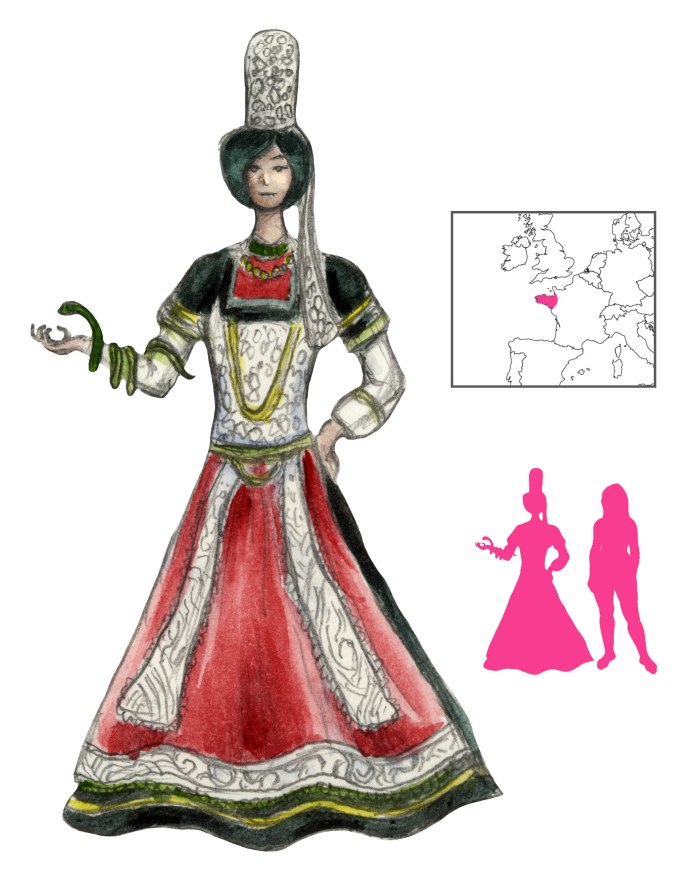
The Margot la Fée, “Margot the Fairy”, or more simply Margot, are fairies native to Brittany, particularly Collinée, Lamballe, Moncontour, and most of the Côtes-d’Armor. They are generally seen as benevolent and protective, but capable of deadly violence when provoked. The name of Margot – also used for magpies – is probably derived from Morgan or Morgana, as evidenced by the alternative name of Morgant; most local names are placatory terms of affection. Margot fairies are closely associated with megaliths, caves, treasures, and snakes, leaving the beaches to the Fées des Houles and the Groac’h.

Like most fairies, Margot fairies vary a lot in appearance, appearing as both young and old women as well as animals. They spend part of their time as snakes, both willingly and against their will, in which form they are most vulnerable. They possess considerable magical powers, dance in circles at night, haunt dolmens, swap babies with voracious changelings, and flee religious symbols.  Sometimes a Margot would take a fancy to a handsome young shepherd and choose to keep him in a cave for herself. In those cases time itself would seem to slow down, such were the pleasures that the fairy offered.

Margot fairies happily care for the livestock of their neighbors, even going so far as to feed them in the caverns while their owners were away. The Margot’s own livestock remained in the caves, emerging only to feed. On the other hand, hungry Margot fairies will tear a cow to pieces and devour it, only to restore it to life by the next morning, missing only any pieces that had been eaten by humans during the feast.

Margot fairies are often the guardians of fabulous riches. They will handsomely reward those who aid them, and punish any who take advantage of their generosity. If they tell you to take a certain amount of treasure and no more than that, you would be wise to follow their instructions to the letter. One man who took more gold from the Crokélien Hill fairies than he was instructed to had his son taken away from him, never to be seen again.

Other gifts of the Margot are more prosaic. They will offer piping hot loaves of bread to the hungry – loaves that never get smaller, no matter how many slices are cut from them. But if a piece is offered to someone else deemed unworthy by the fairies, the loaf will no longer regenerate.

Small acts of compassion are looked on with great favor. Two harvesters, resting after scything wheat, encountered a little grass snake eating the breadcrumbs they left behind. One tried to kill it, while the other stopped him, saying it would be wrong to kill a small, harmless animal. In the evening a Margot appeared to the second man and thanked him for protecting her daughter. She gave him two belts, one for him and one for his friend, telling him not to mix them up. His was of pure gold, while the other he tied to an oak tree, which wilted overnight.

Another man working near the hill of Crokélien encountered a Margot, who asked a favor of him. “Bring a large washtub with you”, she said, “and go to the Planchettes Bridge at sunrise. There you will find a grass snake. Put the washtub over it and sit on top. If anybody asks you why you’re there, tell them you’re waiting for the blacksmiths to fix the tub. At sundown, remove the tub, and you shall be richly rewarded for your help”. The man did as he was told, and sure enough, the snake was there at the bridge as the fairy had said. He covered it with the washtub and sat patiently there for the rest of the day, weathering the taunts and jeers of passers-by with aplomb. At sunset he removed the tub to find a beautiful maiden underneath. She was the Margot’s daughter, who transformed into a snake one day every year, and would have been killed had it not been for the man’s intervention. As promised, he never wanted for gold or silver for the rest of his life.

Human midwives will also be recruited by Margots to aid them in childbirth, gifting them with the power of second sight for the occasion. But woe to her if she let on that she could still see the fairies! A vindictive Margot would gouge her eye out, or spit in her face and blind her.

References

Dubois, P.; Sabatier, C.; and Sabatier, R. (1996) La Grande Encyclopédie des Fées. Hoëbeke, Paris.

Sébillot, P. (1887) Légendes Locales de la Haute-Bretagne: Les Margot la Fée. Maisonneuve et Ch. Leclerc, Paris.

Sébillot, P. (1904) Le Folk-Lore de France, Tome Premier: Le Ciel et la Terre. Librairie Orientale et Américaine, Paris.

Sébillot, P. (1905) Le Folk-Lore de France, Tome Deuxième: La Mer et les Eaux Douces. Librairie Orientale et Américaine, Paris.

Sébillot, P. (1906) Le Folk-lore de France, Tome Troisième: La Faune et la Flore. Librairie Orientale et Américaine, Paris.

Sébillot, P. (1968) Le folklore de la Bretagne. Éditions G. P. Maisonneuve et Larose, Paris.

Melalo

Variations: The Filthy One, The Dirty One, The Obscene One

Melalo

According to the Roma of Eastern Europe, notably Romania and Slovakia, all the diseases and ailments of the world can be traced back to a family of creatures born from an unholy union of fairy and demon. These unloved bastard children, hated by their parents, take their spite out on humans.

Long ago, the good fairies or Keshalyi lived in the high mountains, while the evil Loçolico, former humans warped and twisted by the Devil, lived underground. But when the King of the Loçolico took a fancy to Ana, Queen of the Keshalyi, their separate worlds were brought too close for comfort. After Ana turned down the ugly King of the Loçolico, the demons responded by hunting down and devouring the Keshalyi. Only Ana’s forced marriage to the King saved her people from utter annihilation.

Ana found her husband so disgusting that she refused to consummate the marriage. The King finally forced himself on her following the advice of a golden toad, who told him to feed her the brains of a magpie. Ana fell into a deep sleep, and soon after conceived Melalo, their first son.

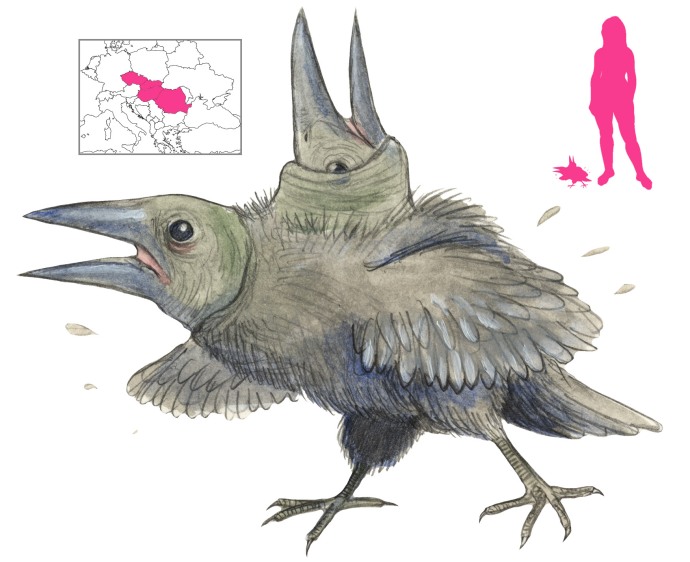
Melalo, literally “filthy”, “dirty”, or “obscene”, is the oldest and most feared of Ana’s children. He is a small, dirty grey (the English translation oddly gives the color as green), unkempt bird with two heads. He has sharp claws which he uses to tear out hearts and rip bodies to shreds; with his wings, he stuns victims and makes them lose their reason. Melalo foments anger, rage, cruelty, sadism, frenzy, rape, and insanity. Those he has affected can only chatter like a magpie.

Melalo would go on to influence the creation of the remainder of Ana’s brood. It was he who put his mother to sleep with his vapors, and convinced his father to sire Lilyi, his sister, wife, and eventual mother to countless women’s diseases. Melalo also guided the conception of his siblings.

To counter Melalo, one must tie an amulet with his image to the afflicted part of the body.

It is possible that the two-headed bird imagery that created Melalo started with the Hittites, who took it to Byzantium and eventually to Russia and Austria. Meanwhile, the expression yov hin jiamutr Melaskero (“he is Melalo’s son-in-law”) has persisted in reference to a violent, nasty person.

References

Clébert, J. P. (1976) Les Tziganes. Tchou, Paris.

Clébert, J. P.; Duff, C. trans. (1963) The Gypsies. Vista Books, London.

Meyers Brothers Druggist (1910) Demons of Disease. Meyers Brothers Druggist, v. 31, p. 141.

Pavelčík, N. and Pavelčík, J. (2001) Myths of the Czech Gypsies. Asian Folklore Studies, v. 60, pp. 21-30.

As promised, this is going to be the first in a hopefully long-running series of official Wednesday Interludes. Due to popular demand, these will be covering a number of behind-the-scenes topics, including research, bestiary reviews, and my favorite obscure pop-culture monsters.

The first Digression will be a simple one. I have often been asked* “where on Earth do you find these things?” My answer is, inevitably, I follow the breadcrumbs. As any academic will tell you, references are everything, and every claim should be taken with a grain of salt the size of Uluru**. An unreferenced book is practically useless, but as long as there’s one reference, I can follow the trail of literary references back to its estranged home. Often there’s only one ultimate origin from which all the others sprung.

Google Books and Hathitrust have been a godsend in this regard, as has access to a university library*** and fluency in three languages. I have also had a number of wonderful friends and acquaintances (you know who you are) who helped in translating different texts**** where I couldn’t. But, once again, it all involves following the breadcrumb trail to its source, even though some breadcrumbs end up taking on a life of their own.

One good example of this process was brought to me by notable monster hunter Fredrik H., who suggested:

And I wonder if you know something more about … that five-legged Celphie bovine.

Now there’s a start! A strange creature – the beginning of our breadcrumb trail. What is this Celphie*****?

Like the vast majority of creatures you can find online, the Celphie comes from Carol Rose’s Giants, Monsters, and Dragons. I will reserve my thoughts on it for the official review, but suffice to say that it’s the progenitor of most online information of this kind. And sure enough, page 71 informs us:

This is a monstrous hybrid creature in the traditions of medieval Europe. It was described as having a body resembling a cow but with five legs, each of which was human from the elbow down to the hands… said to inhabit the wastes of Ethiopia… (Rose, 2000)

That is definitely monstrous. Where is it from? Rose provides a single reference – Barber and Riches’ A Dictionary of Fabulous Beasts. Following that trail gives us:

Curious Ethiopian beast which had man’s hands for its five feet; its hind-legs from the ankle to the top of the calf were also human. The rest of its body was that of an animal similar to a cow. (Barber and Riches, 1971)

Curiouser and curiouser. There is no mention of medieval Europe – and sure enough, the solitary citation directs us to The Excellent and Pleasant Work of Julius Solinus Polyhistor, translated by A. Golding in 1587. That breadcrumb is as follows, just pretend I put a [sic] after every word:

Almost about the same time also were brought from thence monsters called Celphies, whose hinder feete from the ancle upp to the toppe of the calfe, where like a mans legge, and lyke-wyse hys forefeete resembled a mans hande: notwithstanding, these were never seene of the Romaines but once. (Golding, 1587)

So apparently the good folks of Rome****** got to see Celphies brought back from the wilds of Aethiopia. Note now that Celphies have legs like a man’s legs up to the knee, and arms like a man’s arms in the same way. There is no mention of five legs, a cow’s body, and human hands everywhere. Something must have been lost in the adaptation, the breadcrumb must have crumbled somewhere along the way. But the description is getting clearer. It couldn’t be…? But there’s one more ancient, dusty breadcrumb to tackle – the original Solinus book, De Mirabilibus Mundi. There we get our final hint (with apologies for bad Latin transcription):

…exhibita monstra sunt cephos appellant quor posteriores pedes crure & uestigio humanos artus metiut, priores hominum manus referut… (Solinus, 1473)

Another translation quirk? The original Latin refers to Cephos instead of Celphies, and now it all falls together*******. Human-like limbs, taken from Africa… Celphies are unspecified primates! As further verification, Topsell provides an additional, delicious breadcrumb:

The CEPUS, or Martine Munkey. The Martin called Cepus of the Greek word Kepos, which Aristotle writeth Kebos, and some translate Caebus, some Cephus or Cepphus  or more barbarously Celphus… such being alwayes the most ingenious imitators of men… The games of great Pompey first of all brought these Martines to the fight of the Romans, and afterward Rome saw no more; they are the same which are brought out of Aethiopia and the farthest Arabia; their feet and knees being like a mans, and their forefeet like hands, their inward parts like a mans, so that some of us have doubted what kind of creature this should be… it having a face like a Lion, and some part of the body like a Panther, being as big as a wilde Goat or Roe-buck, or as one of the Dogs of Erithrea, and a long tail… (Topsell, 1658)

And there you have it. The breadcrumbs got weirder and moldier the farthest we went from home, starting with a monkey and ending with a five-legged-cow-thing. Sometimes my research does the opposite, though, and the original ends up stranger than the modern conception!

Either way, it’s all done citationally, my dear Watson.

*By people I’ve hired to ask.
**My claims too! Go out there and do your own research! Correct my misteaks!
***Disclaimer: the author no longer has access to a university library.
****Disclaimer: the author no longer has access to those friends.
*****It’s not an awkward photo of yourself, leave me alone!
******Or a bunch of lettuces. You never know.
*******I hate asterisks too. 😦

References

Barber, R. and Riches, A. (1971) A Dictionary of Fabulous Beasts. The Boydell Press, Ipswich.

Rose, C. (2000) Giants, Monsters, and Dragons. W. W. Norton and Co., New York.

Solinus, G. J. (1473) De Mirabilibus Mundi. N. Jenson, Venice.

Solinus, G. J.; Golding, A. trans. (1587) The Excellent and Pleasant Worke of Caius Julius Solinus. Scholars’ Facsimiles and Reprints, Gainesville, Florida.

Topsell, E. (1658) The History of Four-footed Beasts. E. Cotes, London.

Qiongqi

Variations: Thoroughly-Odd, Divine Dog

Qiongqi

Two versions of the Qiongqi, or “Thoroughly-Odd”, are described in the Guideways. The first variant of this Chinese creature is from Mount Gui, and resembles an ox with the quills of a hedgehog, and it howls like a dog. The second lives in the Land of the Demon People, and is a winged tiger. A third variety, referred to as a “divine dog”, is human with a dog’s head.

Qiongqi are carnivorous, and devour their prey head or feet first. They feed on people who wear their hair long, making them a particular threat to shamans and demons. They are evil creatures who devour the loyal and feed the rebellious, but they also eat insect poison.

Qiongqi has also appeared as the son of the thearch Lesser-Brilliance in Zuo’s Narratives, as the offspring of the Northern Desert Wind in Master of Huainan, and one of twelve divinities invoked in the Grand Exorcism.

References

Mathieu, R. (1983) Étude sur la mythologie et l’ethnologie de la Chine ancienne. Collège de France, Paris.

Strassberg, R. E. (2002) A Chinese Bestiary: Strange Creatures from the Guideways Through Mountains and Seas. University of California Press.

Ṣannāja

Variations: Ṣannājah, Ṣunnājah, Sannaja; Nubian Horse (erroneously)

Sannaja

The Ṣannāja, “Cymbalist” (!), is a gigantic, deadly, yet pathetic creature originally described by al-Qazwini. It can be found in the land of Tibet, making it an abominable snowman of sorts, although it has more in common with the Gorgons of Greek myth.

According to al-Qazwini, the ṣannāja is indescribably vast, such that no animal can compare to it in size. This largest of all beasts makes dens one league wide.

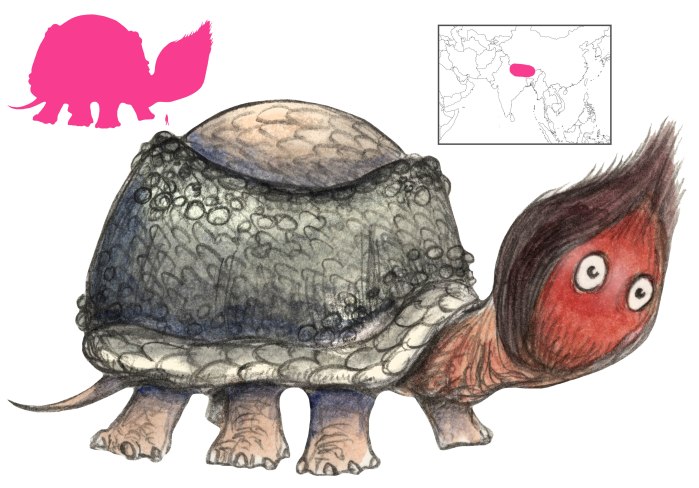
Neither al-Qazwini nor al-Damiri describe its appearance, so artistic depictions of ṣannājas vary. As it is described in the same section along with insects and reptiles, the Wasit manuscript shows it with six stubby legs and a segmented, shelled turtle-like body. Its red, vaguely spiderish head is blank except for hair and two large, staring eyes. The artist of the C.1300 manuscript gives the ṣannāja a tusked, leonine head with massive, spotted folds of skin all over its body. A third is more cautious, assigning it the looks of a dragon. Finally, one Egyptian account is a ṣannāja in name only, placing it in African rivers and giving it four duck feet, a horse’s mane, water-buffalo skin, and a huge mouth. Described as the “Nubian Horse” living in water and ruining crops on land, this is the only case where the name has been applied to the hippopotamus.

The most distinctive quality of the ṣannāja is its deadly gaze, which nonetheless has a peculiar quality. Any animal that sees the ṣannāja dies instantly, but if the ṣannāja sees the animal first, it is the one to expire. Thus animals of Tibet come up to ṣannājas with their eyes closed, such that the monster will see them and drop dead, guaranteeing them a feast for weeks to come.

Accounts of mammoth fossils from Central Asia may have inspired the enormous ṣannāja. Traditional Tibetan art and kirttimukha faces may also have had a hand in its genesis.

References

Berlekamp, P. (2011) Wonder, Image, and Cosmos in Medieval Islam. Yale University Press, New Haven.

al-Damiri, K. (1891) Hayat al-hayawan al-kubra. Al-Matba’ah al-Khayriyah, Cairo.

Jayakar, A. S. G. (1908) Ad-Damiri’s Hayat al-Hayawan (A Zoological Lexicon), vol. II, part I. Luzac and Co., London.

Komaroff, L. and Carboni, S. (eds.) (2002) The Legacy of Genghis Khan. Yale University Press, New Haven.

Rapoport, Y. and Savage-Smith, E. (eds.) (2014) An Eleventh-Century Egyptian Guide to the Universe. Brill, Leiden.

al-Qazwini, Z. (1849) Zakariya ben Muhammed ben Mahmud el-Cazwini’s Kosmographie. Erster Theil: Die Wunder der Schöpfung. Ed. F. Wüstenfeld. Dieterichsche Buchhandlung, Göttingen.

Kamaitachi

Variations: Kama-itachi, Kamakaze (“Sickle wind”)

Kamaitachi

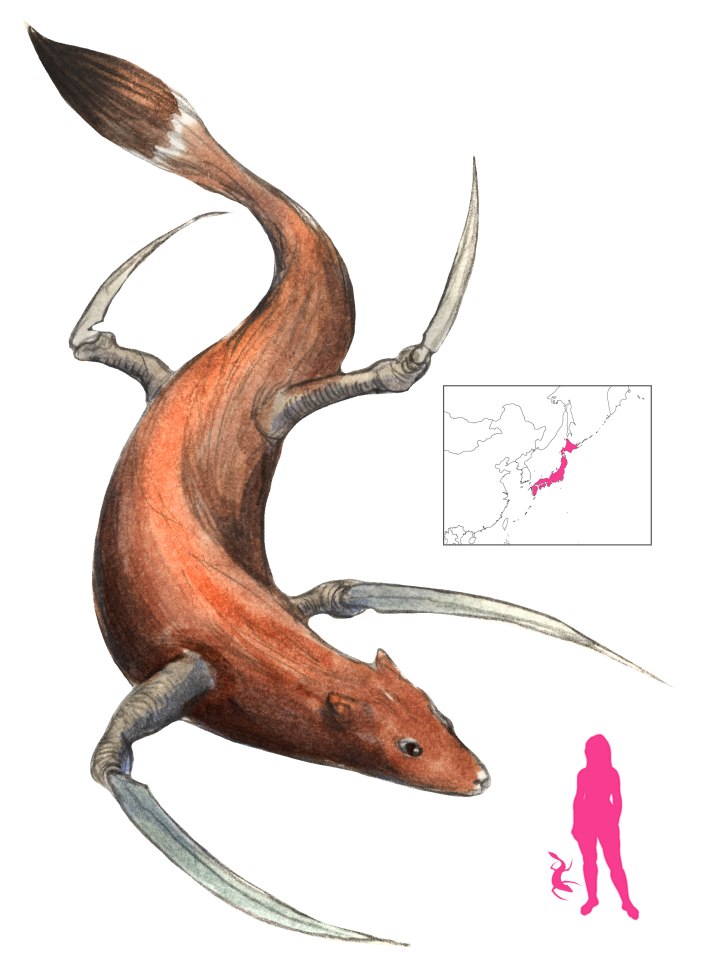
The Kamaitachi, or “sickle weasel”, is the Japanese yokai of unexplained cuts. It is most common in snowy Honshu. The name itself may be alternately derived from kamae-tachi, “poised sword”.

A kamaitachi looks something like a weasel with razor-sharp sickle claws. It travels in whirlwinds, but it is never seen. Instead, the presence of a kamaitachi is known by the cuts it leaves on its victims. It will also cause people to trip and fall, taking malign pleasure in causing injury.

Kamaitachi are useful scapegoats for inconvenient injuries. A woman in Niigata, after injuring herself during a nocturnal tryst, successfully deflected attention by blaming the kamaitachi for her wound.

The kamaitachi was rationalized in a number of ways, including pieces of sharp debris tossed around in whirlwinds. Y. Tanaka suggested that the “kamaitachi disease” was the result of temporary vacuums forming from stray air currents, slicing skin that came in contact with them. Such vacuums would be common in mountainous areas and thunderstorm conditions.

In Gifu the kamaitachi becomes three gods, the first pushing over the victim, with the second cutting with a knife and the third healing the injury.

References

Foster, M. D. (2015) The Book of Yokai. University of California Press, Berkeley.

Griffis, W. E. (1876) The Mikado’s Empire. Harper and Brothers, New York.

Y. Tanaka (1911) An Epitome of Current Medical Literature: Spontaneous Wounds. British Medical Journal, v. 2, p. 37.

Swan Valley Monster

Swan Valley Monster

The Swan Valley Monster made its appearance on August 22, 1868, in the otherwise tranquil locale of Swan Valley, Idaho. Its presence was witnessed and reacted to by an unnamed old-timer crossing the river at Olds Ferry.

The first thing he saw of the monster was an elephant’s trunk rising from below the surface and spouting water. This was followed by a snake-like head the size of a washtub, with a single horn that kept moving up and down, and long black whiskers on both sides of the face. It had ten-inch-long fangs and a red forked tongue that spewed green poison. When it hauled its massive body onto the shore, the old-timer noted that it must have been twenty feet long, and it stank to high heaven. A pair of wing-like fins – or fin-like wings – came out of the sides of its neck. Its forward half was like a snake, the thickness of a calf, greenish-yellow with red and black spots; this in turn led into a fish-like section with hand-sized rainbow scales shining in the sun; finally, the tail was a drab, scaly gray like a crocodile or lizard tail. Shiny black barbed spines, like those of a porcupine, lined its back from head to tail. Finally, it had twelve stubby legs that were easily missed at first glance; the first pair under the fins had hoofs, followed by two pairs of legs with razor-sharp claws, then a pair of hoofed feet, a pair of clawed feet, and another pair of hoofed feet near the tail.

Of course, the old-timer’s first reaction to the abomination slithering up the bank was to fire a slug into its eye. The monster reared up, hissing, bellowing, and spurting poison over its surroundings, so it got shot a second time in its yellow belly, convulsed, and stopped moving. Everything its poison had touched, whether trees or grass or other living beings, withered and died.

As the monster was too large to be carried off by one man, the old-timer returned to town to fetch a wagon and six strapping lads to help him, as well as a tarp to protect them from the poison. They could smell the odoriferous creature a hundred yards away, and one of the men had to stay with the horses to keep them from bolting, while another got sick and refused to come any closer. But when they reached the bank where the monster had fallen, there was nothing but withered vegetation and a trail leading to the water.

Presumably the Swan Valley monster had crawled back into the river to die – or perhaps it didn’t die. Whatever its fate, the old-timer recommended keeping a close watch on the river, as “I’ve hunted an trapped an fished all over the state fer nigh ontuh seventy-five year… but I ain’t never seen nothin tuh compare with that speciment”.

References

Clough, B. C. (1947) The American Imagination at Work. Alfred A. Knopf, New York.

Fisher, V. ed. (1939) Idaho Lore. Federal Writers’ Project, The Caxton Printers, Caldwell.

Lewicki, J. and the editors of LIFE (1960) Folklore of America, part V. LIFE Magazine, Aug. 22, 1960.