Kranokolaptes

Variations: Kephalokroustes, Sklerokephalon

kranokolaptes

Nicander classified the Kranokolaptes, the “Head Striker”, as a phalangion or spider. This is all the more puzzling because the description has nothing arachnoid about it. No doubt its deadly bites were seen as reason enough to list it after wolf spiders and malmignattes.

The kranokolaptes is an insect found in Egypt, and which develops in the persea tree (perhaps Mimusops). It has the appearance of a moth, with four downy felt-textured wings that leave an ashy dust behind. Philoumenos described it as green in color, but that is apparently a misreading of Nicander. The head of the kranokolaptes is hard, heavy, and nodding; its abdomen is thick and fat. It has a deadly stinger located below its head.

A kranokolaptes will use its stinger to attack the heads and necks of humans and cause instant death. Kranokolaptes stings are deadly unless victims are treated with its antidote – a kranokolaptes drowned in oil.

It has been suggested that hawkmoths (Sphingidae), with their impressive sizes, thick abdomens, and prominent probosces, are at the root of the kranokolaptes tale. The vampire moth Calyptra thalictri is even more compelling. Having evolved from fruit-piercing moths, vampire moths use the same methods to puncture skin and drink blood – and they rock their heads back and forth as they penetrate, explaining the “nodding” aspect. The similarities end here, however, as a bite from Calyptra merely causes swelling and irritation.

References

Beavis, I. C. (1988) Insects and other Invertebrates in Classical Antiquity. Alden Press, Osney Mead, Oxford.

Kitchell, K. F. (2014) Animals in the Ancient World from A to Z. Routledge, Milton Park, Abingdon, Oxon.

Lakúma

Variations: Lucooma

lakuma

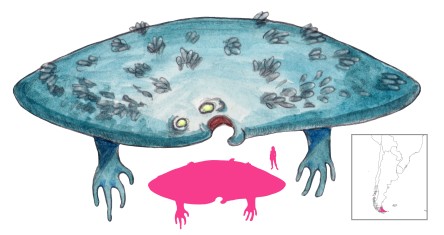
According to the Yamana, the Lakúma are the most dangerous sea creatures of Tierra del Fuego. These water spirits have been known to tip canoes over, pull their occupants out, and drag them under to consume, leaving their entrails to float to the surface. They can also create huge waves, summon whirlpools, and whip up storms to damage larger vessels.

Lakúma have been compared to whales, squids, and giant worms, making their exact appearance hard to pin down. What is known is that they like to flatten themselves out on the water’s surface, letting their back protrude like a small island. Their broad and flat backs are covered with encrustations of unusually large mussels.

Sometimes there are so many lakúma in one spot that they can be used as stepping-stones. A group of Yamana on a desert island saw countless wide, flat lakúma rise to the surface, forming a living bridge to a bountiful island. “If we run quickly, we’ll get to the other side!” said one man, running over the backs of the lakúma and reaching the other shore. But the others were too slow, and the lakúma dove, taking them to a watery grave. The one survivor recruited enough men to slay many lakúma in retaliation, and their bodies can still be seen today in the form of large, flat stones at the bottom of the sea.

Lakúma will also attack people breaking taboos. It is known that a menstruating girl or túrikipa should not eat berries, but one girl thought she could circumvent the rule by sucking out the juices and spitting the solid outer part. Alas, her canoe was attacked by a lakúma, and it refused the offerings tossed at it until it took the girl and devoured her. It then flattened itself out on the surface and rested. The túrikipa’s people went onto the lakúma’s back, took some of the mussels, and used their sharp shells to dismember the lakúma. But that was small comfort for the túrikipa, whose entrails served as a grisly reminder of her fate.

For all their malevolence, lakúma can be tamed by a powerful yékamuš or shaman, and can become obedient servants. One yékamuš was with his wife in their canoe while she scolded him. “I thought you were a powerful yékamuš, but you can’t even strand a whale, or fetch birds to eat!” In response the yékamuš slept and summoned two lakúma, who raised the canoe’s bow up in the air. “Wake up! Help me!” cried his wife, and the yékamuš stirred and spoke nonchalantly. “I thought you said I was powerless”, he taunted, before telling her to paint the lakúma with white paint. She did as she was told, and the lakúma did not resist. Then they dove and created a good breeze to send the canoe effortlessly to its destination. “I had always made fun of you”, admitted the wife, “but now I know you are truly a capable yékamuš!”

References

Gusinde, M.; Schütze, F. trans. (1961) The Yamana; the life and thought of the water nomads of Cape Horn. Human Relations Area Files, New Haven.

Gusinde, M.; Wilbert, J. ed. (1977) Folk Literature of the Yamana Indians. University of California Press, University of California, Los Angeles.

Rahara

Variations: The Beast

rahara

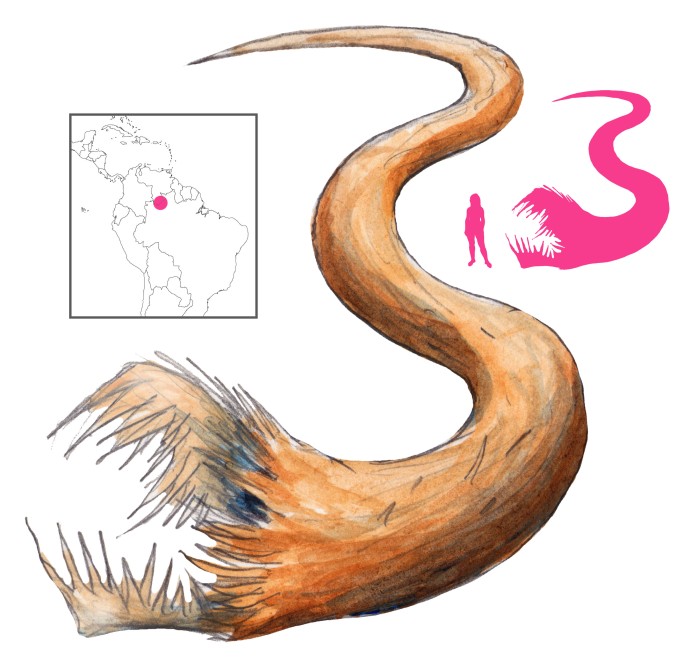
Deep, permanent lagoons in Brazil and Venezuela are home to the Rahara. According to the Yanomami, this aquatic monster once lived in a large lagoon called Akrawa. Since then the rahara has moved upstream in the Orinoco, finding suitable lagoons to inhabit, or enlarging small lagoons to better fit inside. A rahara lagoon never dries out and can be recognized by observing the shore – there are tracks leading in, but none leading out.

The rahara is the uncle of the anaconda, and grows to greater sizes. It may or may not have feet. Its serpentine body is like a rotten pawpaw tree or a manioc strainer. It is capable of drawing people towards it and swallowing them whole. A rahara will be attracted to fire as it is sure to find a meal there; it will also rush out of its submarine hole to swallow anyone foolish enough to say its name out loud, so it is usually referred to as “the beast”. When in a good mood, raharas make a snapping sound and alert others to their presence. Silence is dangerous.

Raharas have pets in the form of hoatzins and curassows, which roost above the waterholes to entice hunters.  Snakes are also associated with the raharas. One talking boa constrictor turned into a live baby rahara after being shot dead by a hunter. It was kept as a pet in a water-filled palm spathe until it grew big enough to devour its entire adopted village. Finally, the raharas are responsible for floods, tsunamis, and other water-based disasters.

It is advisable to avoid known rahara haunts, and refrain from drinking, bathing, or fishing in those waters. A messenger once ignored those warnings and bathed in such a pond, and was immediately swallowed by a rahara. He called out “Help! Over here!” from inside the creature’s belly, and men arrived from the village with bamboo lances. They began running the rahara – and its prey – through. “Stop! You’re hurting me!” he screamed from inside, but they ignored him until both he and the rahara were dead.

Presumably the man was not well-liked.

References

Albert, B.; Becher, H.; Borgman, D. M.; Cocco, L.; Colchester, M. E. M.; Finkers, J.; Knobloch, F.; Lizot, J.; and Wilbert, J.; Wilbert, J. and Simoneau, K. eds. (1990) Folk Literature of the Yanomami Indians. UCLA Latin American Center Publications, University of California, Los Angeles.

Lizot, J.; Simon, E. trans. (1985) Tales of the Yanomami. Cambridge University Press, Cambridge.

Dulhath

Variations: Dulhama (al-Damiri); Duhlak, Dulhak, Dulchaph (Bochart)

dulhath

The Dulhath has had a muddled history, with authors disagreeing with each other on the exact name, let alone the appearance. It is first mentioned by al-Qazwini, who refers to the dulhath, but al-Damiri describes it under the name of dulhama, and Bochart reports on the duhlak. Here al-Qazwini’s name has been given priority.

While the original description appears to be al-Qazwini’s, the dulhath’s pedigree probably goes back to jinn who appear as animals – in this case, an ostrich jinni. This in turn led to al-Qazwini’s dulhath as a demon found on certain desert islands, and which resembles a man riding an ostrich. It eats the flesh of humans who have been cast alive or dead into its territory. A dulhath will also invade ships to seek its prey, and when attacked by sailors it speaks loudly in a boastful voice, causing them to prostrate themselves before it. Bochart believed the “boastful voice” to have been some translation error derived from tales of sirens.

The best description of a dulhath is found in the tale of Aboulfaouaris the sailor. Sadly it is all but certifiable, as the creature in question remained unnamed, but its behavior is compellingly close to al-Qazwini’s broad outline. The dulhath that plagued Aboulfaouaris looked like a man of about 40. He had a monstrous shape, a big head, short bristly hair, and an excessively large mouth filled with sharp teeth. Eyes like those of a tiger glared above a flat nose with large nostrils. His arms were nervous, his hands large, and his fingers equipped with viciously hooked claws.

Aboulfaouaris and his crew encountered a dulhath near the island of Java. They saw a naked man clinging to a plank of wood in the sea, calling for help; accordingly the sailors rescued him and brought him aboard ship, where his appearance caused much consternation. When told that he had been narrowly rescued from drowning, the odd man smiled and said “I could have stayed for years in the sea without being bothered; what torments me most is hunger. I have not eaten in twelve hours. Please bring me something to eat, anything, I’m not particular”. An attempt was made to bring him clothing, but the dulhath explained that he always went naked. “Don’t worry, you’ll have lots of time to get used to it”, he added ominously, stamping his foot impatiently. Enough food was presented to him to feed six starving men. The dulhath polished it off and asked for more; the same amount was brought to him and disappeared in short order, and a third helping was called for. One of the slaves, shocked by the creature’s insolence, made to strike him, but the dulhath grabbed him both both shoulders and tore him in half.

All hell broke loose. Aboulfaouaris, sailors, slaves, all descended on the dulhath with sabers drawn, determined to kill the monster. But the dulhath’s skin was harder than diamond. Swords broke and arrows bounced uselessly off his hide. Then they tried to drag him off the ship, but the dulhath sank his claws into the deck, anchoring himself immovably. The sailors were utterly incapable of harming the dulhath. The dulhath, on the other hand, had no such problems as he took one of the sailors and ripped him to pieces with his claws. “My friends, you had better obey me. I’ve tamed worse people than you, and I will have no qualms about having you share the fate of your two shipmates”.

With that the reign of terror began. The dulhath was in full control of the ship, and ate his fourth course while the crew stared in terrified silence. Aboulfaouaris hoped that food and conversation might cause the monster to doze off, but the dulhath smugly reminded him that he had no need for sleep, and none of the soporific tales they told him would have any effect.

All hope seemed lost until deliverance came from the sky. The sailors looked up to see a rukh soaring overhead, and they scattered in fear. The dulhath, however, was unaware of the huge bird, and was standing confidently in the middle of the deck. An easy target! The rukh dove and carried the dulhath off before he could cling to the ship. But the intended prey wasn’t giving up without a fight, and he began tearing and biting into the rukh’s belly. The rukh responded by gouging out the dulhath’s eyes with its talons, and the demon retaliated by eating his way to the rukh’s heart. As it expired, the rukh caught the dulhath’s head in its beak and crushed it like an eggshell. Both monsters plummeted into the waves and vanished.

References

Bochart, S. (1675) Hierozoicon. Johannis Davidis Zunneri, Frankfurt.

al-Damiri, K. (1891) Hayat al-hayawan al-kubra. Al-Matba’ah al-Khayriyah, Cairo.

de Lacroix, P. (1840) Les Mille et Un Jours: Contes Persans. Auguste Desrez, Paris.

al-Qazwini, Z. (1849) Zakariya ben Muhammed ben Mahmud el-Cazwini’s Kosmographie. Erster Theil: Die Wunder der Schöpfung. Ed. F. Wüstenfeld. Dieterichsche Buchhandlung, Göttingen.

Smith, W. R. (1956) The Religion of the Semites: the Fundamental Institutions. Meridian Books, New York.

Tuyango

Variations: Tagänogók

tuyango

The Tuyango is a carnivorous swamp bird from Argentinian folklore. The Mocoví know it as Tagänogók, while “tuyango” is of Guaraní origin. These birds are currently believed to have been hunted to extinction.

A tuyango looks a lot like a rhea, but it has a distinctive yellow neck. It preys on humans, which it kills and drags back to its lair to devour.

The hawk had a particular vendetta against the tuyangos, and sought to avenge their cannibalism of humans. One tuyango returned to his home with two dead men only to find his four children clubbed to death. The tuyango cried, ejeeejee, before heading out with his mate to find the hawk. But the hawk asked for fire, and he flew in and out of the smoke until the tuyangos were exhausted and thoroughly confused; only then did he club and kill them. He returned to widespread joy; when his daughter told him “Daddy, a cannibal bird is coming”, he reassured her that he had already killed the tuyango, and all were happy.

References

Cipolletti, M. S.; Guevara, J.; Lehmann-Nitsche, R.; Terán, B. R. D.; and Tomasini, J. A.; Wilbert, J. and Simoneau, K. eds. (1988) Folk Literature of the Mocoví Indians. UCLA Latin American Center Publications, University of California, Los Angeles.

Camacrusa

Variations: Came-crude, Came cruse, Came-cruse, Jambe Crue, L’Òs-de-la-Mala-Cama; Sopatard, Sopa-tot-sèr, Soupe-toute-sé (potentially); Ramponneau (potentially)

camacrusa

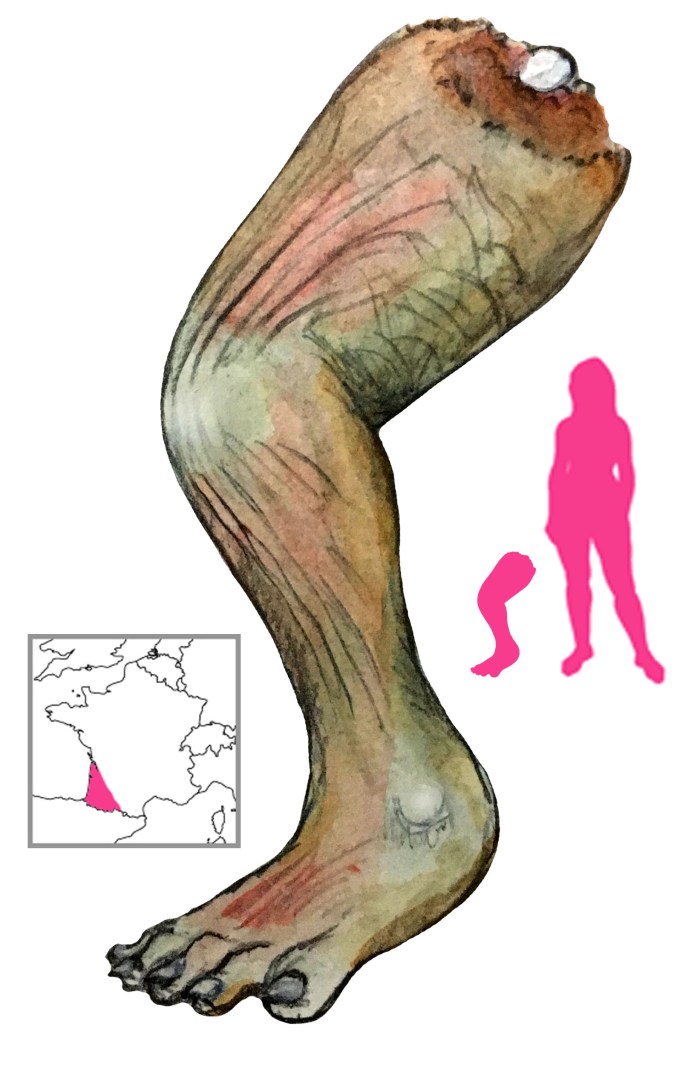
The Camacrusa, Came Cruse, Came Crude (“Raw Leg” in Gascon) or Òs-de-la-Mala-Cama (“Bone of the Bad Leg”) is a French nocturnal bogey that can be found in Gascony, notable around Aire-sur-L’Adour in the Landes. Its horrifying appearance is generally left to the imagination, but as its name implies it is usually a disembodied leg, possibly somewhat flayed.

Despite its appearance, a camacrusa is very rapid in movement, capable of hiding behind haybales, jumping over ditches and hedges, and easily running down its prey – children who remain outside after dark. How it eats them is unspecified.

Its role has largely been usurped by more traditional bogeys such as Ramponneau and the Sopatard (“Sups-late”) or Sopa-tot-sèr (“Sups-every-evening”). The latter in particular is closely associated with the camacrusa, for as the nursery rhyme goes: “La cama-cruda e lo sopa-tot-sèr, que hèn la nueit plenha de danger” (“The raw-leg and the sups-every-evening, make the night full of danger”).

References

Foix, V. (1904) Glossaire de la Sorcellerie Landaise. Revue de Gascogne, III, pp. 257-262.

Heiniger, P. Les Formes du Noir. In Loddo, D. and Pelen, J. (eds.) (2001) Êtres fantastiques des régions de France. L’Harmattan, Paris.

Nippgen, J. (1930) Les Traditions Populaires Landaises. Revue de Folklore Francais, IV, pp. 149-172.

Eloko

Variations: Biloko (plural)

eloko

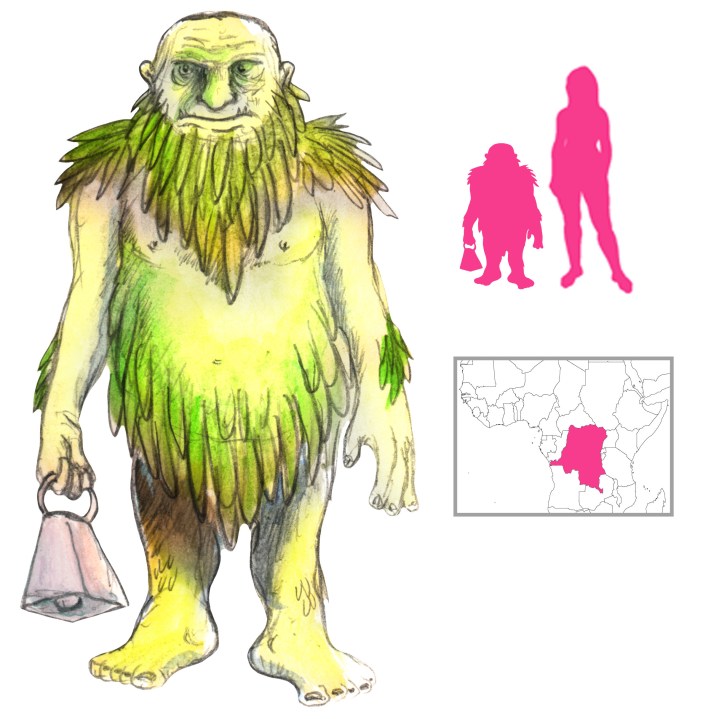
The Biloko of the Congo are vile, cannibalistic dwarfs or trolls of Nkundo folklore. They make their homes inside hollow trees, and they smell of the Congo’s rainforest. An Eloko has grass for a beard, clothes made of  leaves, and usually carries a bell, which is used to attract and bewitch unsuspecting humans. Despite their size, biloko are far stronger than the average human, and only heroes and sorcerers can defeat them.

Biloko represent the dangers of the forest, of going out alone, and of toying with danger. They are invoked to dissuade people from straying both physically and mentally, and warn husbands of the dangers of abandoning their wives. They may also represent various gangrenous diseases, as they slowly eat their victim away, eventually killing them by ending with the liver, where the spirit resides.

A Nkundo man once built a fenced-in hut in the forest to find game. Whenever the husband left for the village, he would warn his wife. “Remember, if you hear the sound of a little bell, don’t answer or you will die!” Yet as the monotonous hours went by, the wife found herself entranced by the ringing of a bell deep in the forest, coming closer and closer. Finally she ran outside calling to the eloko. “I’m here! Come to me!” she cried, and the eloko duly appeared. “Here I am, I have come to you”, he announced. The wife was overjoyed and prepared a meal for her guest, but the eloko refused the fried bananas and fish. “I only eat human meat, and I am so hungry…” he wheedled. “You are a delicious woman. Give me a piece of flesh”. The woman willingly proffered her arm, and the eloko took a portion of meat, which he roasted and devoured. Then he left, leaving the woman to bandage her wound in silence.

When her husband returned, he saw his wife bedridden and in pain. “I have sores”, she said. “Then take the bandage off, and have some medicine for it”. She refused, and would not explain further. But the next day the same gruesome episode repeated itself – the husband left, the wife entertained the eloko, and the eloko left the wife with another deep injury.

This time the husband did not believe his wife’s excuses, and decided to lie in wait instead of returning to the village. When the eloko returned that day, he pulled out a knife told the woman that this time he desired her liver. The husband immediately fired an arrow into the dwarf, then ran him through with his spear and decapitated him. But the eloko had already stabbed the wife in the liver, and she died. Those who love danger will die in it; or, those who play with fire will get burnt.

Other encounters with biloko treat them more as an enemy tribe than as forest bogeys. Likinda, Itonde, and Lianja, the grandsons of the spirit of Death Ilelangonda, went to war with the biloko, and tricked them into an ambush by scattering mbole-fruits on the path. They slaughtered all the biloko this way save for the wizard Inkankanga and his wife. Likinda caught up with them by turning himself into a baby, causing Inkankanga’s wife to pick him up and care for him. Then he climbed up a tree to throw fruits down to his adopted parents, but instead he transformed himself into a fruit and allowed Inkankanga to swallow him. The terrified eloko sorcerer killed his wife for being the cause of his impending doom, and then spent the rest of the day imploring Likinda not to kill him. Finally he fell into depressed acceptance, and the bored Likinda cut him up from the inside out. He returned to the village, where his story was celebrated with peals of laughter.

References

Knappert, J. (1971) Myths and Legends of the Congo. Heinemann Educational Books, London.

Knappert, J. (1977) Bantu myths and other tales. E. J. Brill, Leiden.

Bitoso

bitoso

Bitoso, “The Faster” or “Fasting One” (although some accounts mistakenly refer to “The Fastening One”) is one of the children of Ana, a Keshali fairy of Roma folklore who was coerced into bearing the offspring of the King of the Loçolico. As with his siblings, he is the cause of a number of diseases and ailments, although Bitoso has the dubious distinction of being the mildest and least harmful of the lot.

When Schilalyi moved on to molesting her own siblings, Melalo recommended that the King eat garlic on which he had urinated. After the King visited Ana, she give birth to Bitoso, who became Schilalyi’s husband.

Bitoso is a little worm with multiple heads (some accounts specifically refer to four heads) who causes headaches, stomachaches, and lack of appetite; his gnawing causes earache and toothache. He and Schilalyi’s children cause colic, cramps, tinnitus, and toothache. Bitoso himself is mercifully innocuous compared to his siblings.

Bitoso’s pedigree is one that goes back centuries. The folk knowledge that worms cause toothache dates back at least to the Babylonian civilization, in the tale of the worm’s creation. After Anu created the heavens, the heavens in turn created the Earth, the Earth created the rivers, the rivers created the canals, the canals created the marsh, and the marsh created the worm, the worm came before Shamash and Ea, demanding the food allotted to it. It refused figs and pomegranates, instead choosing to live between the teeth and the jawbone, destroying the blood vessels, seizing the roots, and ruining the strength of the teeth.

References

Clébert, J. P. (1976) Les Tziganes. Tchou, Paris.

Clébert, J. P.; Duff, C. trans. (1963) The Gypsies. Vista Books, London.

Kanner, L. (1931) Teeth of Gods, Saints, and Kings. Medical Life, 131, August 1931.

Meyers Brothers Druggist (1910) Demons of Disease. Meyers Brothers Druggist, v. 31, p. 141.

Pavelčík, N. and Pavelčík, J. (2001) Myths of the Czech Gypsies. Asian Folklore Studies, v. 60, pp. 21-30.

cover

I swear this is the last postapocalypic robot animals post I make in OMM, but I had to dedicate an entry to Metalzoic, an absurd and highly entertaining story told by Pat Mills and Kevin O’Neill, and published by DC Comics and 2000 AD. If tales of amoral robotic gorillas beating up tank-elephants are your bag, you can buy this stirring saga in stores, including here and here.

I will try not to give away too much plot, focusing only on the creatures, but if you were planning on reading this someday, spoilers are inevitable.
untitled-11

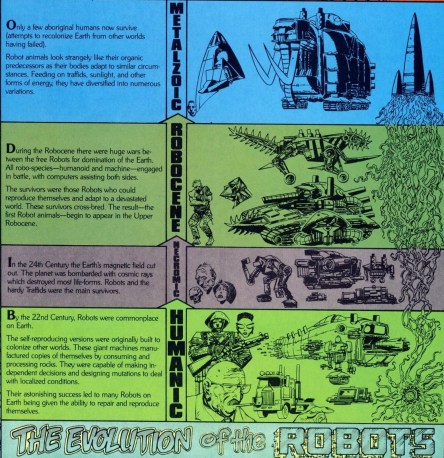
Metalzoic is set on Earth during the, well, Metalzoic period. The above timeline explains it far better than I ever could, but suffice to say the Earth belongs to metallic, naturally evolving robot and plants that evolved themselves from prior machinery. There are still pockets of humanity eking out a Mad Max-esque life, but it’s the robots that run this show.
untitled-9

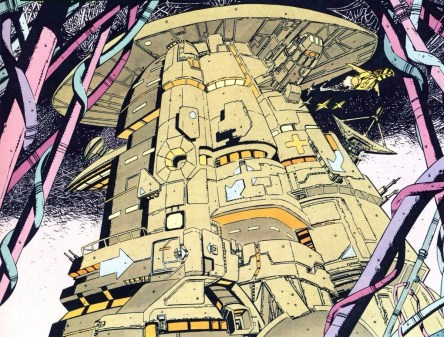
While the story focuses on Armageddon, Amok, and their respective tribes, it is arguably the Traffids that are the true dominant species. These are the mechanical equivalent of plants. Some grow to huge sizes and form dense forests through which other robots seek their food.

One interesting thing about Metalzoic is that it appears that all the robots are sapient and have names. Even the traffids. The specimen above, the equivalent of a pitcher plant, has successfully replicated a human building, down to the details of the interior, and uses this appearance to trick humans into coming in and dissolving in acid. Our heroes realize something is off when the pages of the books inside are blank.

untitled-5

The hero of the story is Armageddon, a robot gorilla and leader of the Mekaka*, a tribe of assorted robot primates. Armageddon, as the header image makes clear, operated on his own brain to remove such trivialities as emotion and compassion, making him ruthless, amoral, and highly respected by the other Mekaka. He even manages to pick up a squishy human and keep her alive somehow.

Armageddon’s special power, and a main plot point and deus ex machina, is to call on the power of Inti, the robot god, and start PUMPING IRON. It is as awesome as it sounds.
untitled-12

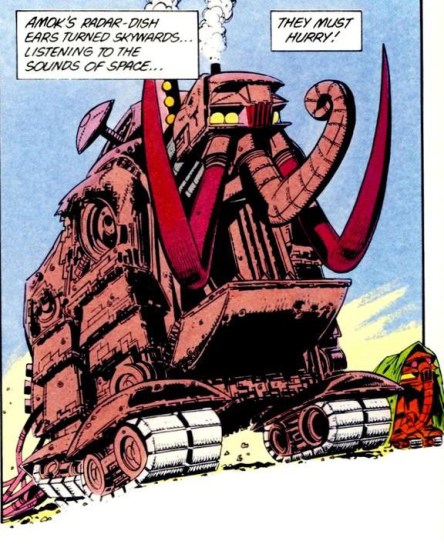
Opposing Armageddon is Amok the god-beast, the patriarch of a herd of wheeldebeasts – robo-elephants, the mightiest creatures of the Metalzoic. He’s pictured above with his calf, the little Buboc, next to him. The caterpillar treads and scoop mouth (just above them) strongly suggests ancestry in digging equipment.

Throughout the story Amok leads his herd of wheeldebeasts through various landscapes for a strange, unknown purpose. He is opposed in this by Attila, a younger male seeking to usurp him as leader of the wheeldebeast herd.

untitled-10

Amok is to the left here, Attila to the right. Why are they destroying the Mekaka village? Is this part of Amok’s mysterious goal? Read the book to find out!

untitled-1

Mekaka and wheeldebeasts are far from the only creatures shown, and a good deal of attention is granted to various predators that attack our heroes. Skimiteks are the lions of the Metalzoic, with saber teeth and chainsaw tongues, and they get around on skis, flying through the metal jungle at high speeds.

untitled-3

In this idyllic Metalzoic scene, a skimitek pride (bottom) is at an oilhole, with a girane and her calf (left) and  other assorted creatures of the open land.
untitled-2

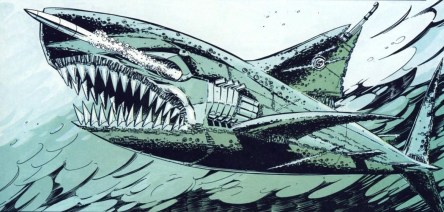
Polarisaurs are found underneath the frozen poles. Clearly the descendants of submarines, they use periscopes to sight prey on the ice before launching a torpedo at them. They then smash through the ice, grab their victim in their jagged teeth, and sink back into the depths. One of those claims the life of a wheeldebeast before Amok could intercede.

untitled-6

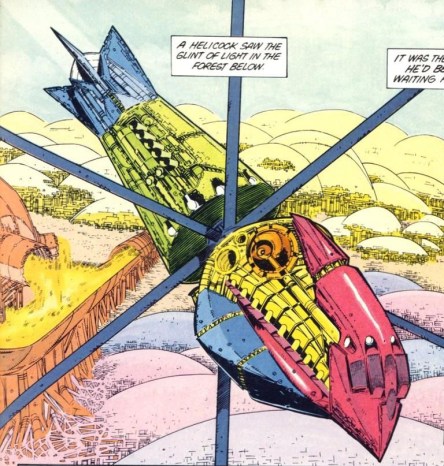
The mirrodillo above has an interesting hunting strategy. It works symbiotically with an airborne helicock, and they share the spoils. The mirrodillo attracts prey with its beautiful shining shell…
untitled-7

… prompting its helicock partner hovering above to fire a beam that reflects off the mirrodillo’s shell, causing indiscriminate damage to everything around it. The mirrodillo can then vacuum up its share while the helicock comes down to partake of the feast.

untitled-4

Mugger bugs are the descendants of car crushers, and have massive, crab-like bodies with powerful claws and huge mouths. The underbelly of a mugger bug is a powerful electromagnet that it uses to capture and disable prey before eating it and compressing it into a cube. Its back is covered with the remains of kills, effectively camouflaging it in plain sight. As you may have guessed, this is indeed something used in real life by assassin bugs, not to mention other insects as well. Technology imitates life. Or something.

untitled-8

Loco-constrictors, finally, are enormous snake-robots that evolved from trains, and still use the ruined rail system to get around. At least one of them, Nikku, was capable of generating paralyzing electrical shocks from the plates on her sides. She tries to eat Buboc, and gets chomped through by Amok for her trouble.

Metalzoic is © Pat Mills, Kevin O’Neill, DC Comics, 2000 AD, et al.

*Mekaka!

Schilalyi

Variations: Shilalyi, Shulalyi, Šilali

shilali

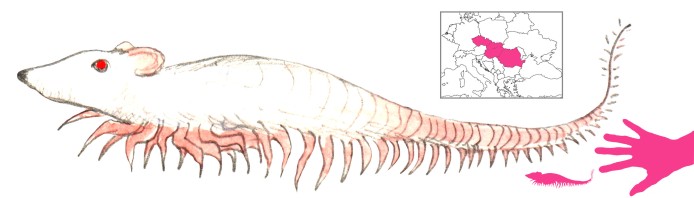
Schilalyi, “Cold” or “Cold One”, is the fifth of the children of Ana, and her third daughter. She and her siblings are the Roma demons of disease, and are the result of unnatural and undesired liaisons between the Keshali queen Ana and the King of the Loçolico.

After Ana’s fourth child, Melalo advised his father to serve her a cooked mouse which the King had spat on, along with soup. Ana fell ill, and as she drank water, Schilalyi crawled out of her mouth. This unnatural birth earned Schilalyi particular loathing from her mother. Schilalyi in turn tormented her brothers and sisters until her husband Bitoso was born.

Schilalyi’s form is that of a white mouse with many little legs and possibly multiple tails, and she is the cause of chills and cold fevers. To counter her symptoms, patients are treated with dried mouse lungs and stomachs, steeped in alcohol.

White mice are regarded as agents and offspring of Schilalyi, leading to one alleged incident where a pharmacist’s lab mice were drowned in a well to ward off certain disaster.

References

Clébert, J. P. (1976) Les Tziganes. Tchou, Paris.

Clébert, J. P.; Duff, C. trans. (1963) The Gypsies. Vista Books, London.

Meyers Brothers Druggist (1910) Demons of Disease. Meyers Brothers Druggist, v. 31, p. 141.

Pavelčík, N. and Pavelčík, J. (2001) Myths of the Czech Gypsies. Asian Folklore Studies, v. 60, pp. 21-30.