Bocarin

Variations: Manati

Bocarin

Thevet’s visit to the island of Hispaniola turned up a number of unusual and exotic creatures, one of which is a grass-eating fish known as the Bocarin or Manati.

Found in both rivers and the ocean, the bocarin looks primarily like a full wineskin tapering from the navel to the end of the tail. This corpulent monster is 20 feet long and 10 feet wide, and has grey skin with sparse hair. It has two legs at its shoulders, which it uses to swim with, and round, four-toed elephant’s feet with prominent nails. Its head is like that of an ox, except with a smaller face, much smaller eyes, and a much larger and fleshier chin. Females bocarins give birth to live young, and suckle them from teats much like whales do.

Thevet deemed it to be the most deformed and grotesque fish he had ever seen in that part of the world, but for all its ugliness it did have its uses. Its flesh tasted more like veal than like fish, and was fine to eat. Its skin was used to make shoes, its fat was used in leather-making and as ointment. Stones known as enar-onacpy in a bocarin’s head, ground into powder and taken with white wine, were remedies against kidney and bladder stones.

A Spaniard swore to Thevet that a bocarin had been kept for 20 or 30 years in a pond, and eventually became so tame that it would let people scratch its back and ride on it. But Thevet saw that as absurd, as who could imagine a fish being tamed in such a way, let alone a monstrously ugly one like the bocarin?

References

Lestringent, F. (1997) Le Brésil d’André Thevet. Éditions Chandeigne, Paris.

Thevet, A. (1558) Les Singularitez de la France Antarctique. Maurice de la Porte, Paris.

Thevet, A. (1575) La Cosmographie Universelle. Guillaume Chaudiere, Paris.

Shahmat al-Ard

Variations: Kharȃti

Shahmat-al-ard

Shahmat al-Ard, the “fat of the earth” or “grease of the earth”, is a worm that contracts into a bead if touched. Al-Qazwini, who called it the Kharȃti, said that it was long, red, and lived in damp areas. On the other hand, al-Zamakshari believed it to be small, white, speckled with red spots, and resembling both a white fish and the hand of a woman. Hurmus said that it smelled good, and was immune to fire, being capable of crawling through a bonfire unharmed.

Its primary value is in the variety of medicinal benefits it provides. Its fat, if painted onto one’s skin, will protect from fire. The entire worm, dried and eaten, cures jaundice and scrofula; dried and taken with water, causes immediate delivery in the case of a difficult birth. Roasted and eaten with bread, it dissolves bladder-stones. A shahmat al-ard reduced to ashes, mixed with oil, and applied to the head will cure alopecia and restore hair growth.

Nonetheless it is not generally eaten, since as a filthy worm it is unclean and unfit for human consumption.

References

al-Damiri, K. (1891) Hayat al-hayawan al-kubra. Al-Matba’ah al-Khayriyah, Cairo.

Jayakar, A. S. G. (1908) Ad-Damiri’s Hayat al-Hayawan (A Zoological Lexicon), vol. II, part I. Luzac and Co., London.

Aíǰe

Variations: Aíge, Spirit-Tadpole

Aige

The Aíǰe is associated with the Bororo of Brazil and Bolivia, and in particular the Páiwoe and Aróroe clans. It is a gigantic tadpole, somewhat like a hippopotamus.

Rubúgu of the Páiwoe first found the aíǰe while walking through a swamp. He liked the little animal and decided to keep it, taking it home in a vessel of water. Rubúgu had great plans for his little pet, and wanted it to become something great and amazing, so before covering its container with a fan he told it “Grow for me; thrive and become an extraordinary creature”.

And grow the aíǰe did. It became larger, and stronger, and it could sing a loud, buzzing song. Rubúgu had to keep switching it to increasingly large containers to support its bulk, and eventually he had nowhere left to put it. He tried doing a dance for the aíǰe, but the tadpole rejected Rubúgu’s mediocre talents. Instead, Chief Baitogógo of the Aróroe took the aíǰe, and honored it with a macaw-feather headdress and a marvelous dance, both of which pleased the tadpole greatly. Baitogógo told the aíǰe that it had to live in ponds, swamps, and lakes away from the Bororo, for it was so big and the magic of its song so powerful, it could pose a serious threat.

The aíǰe accepted, and before leaving it told Baitogógo that if the Bororo missed it, then they should fashion little tadpole sculptures in remembrance. Those figurines could be tied to a stick and swung in the air, making an amphibian buzzing much like aíǰe did. Thus the aíǰe went on to become one of the totems of the Bororo.

References

Albisetti, C.,; Colbacchini, A.; and Venturelli, A. J.; Wilbert, J. and Simoneau, K. eds. (1983) Folk Literature of the Bororo Indians. UCLA Latin American Center Publications, University of California, Los Angeles.

Tiddalik

Variations: Tiddalick, Karaknitt

Tiddalik

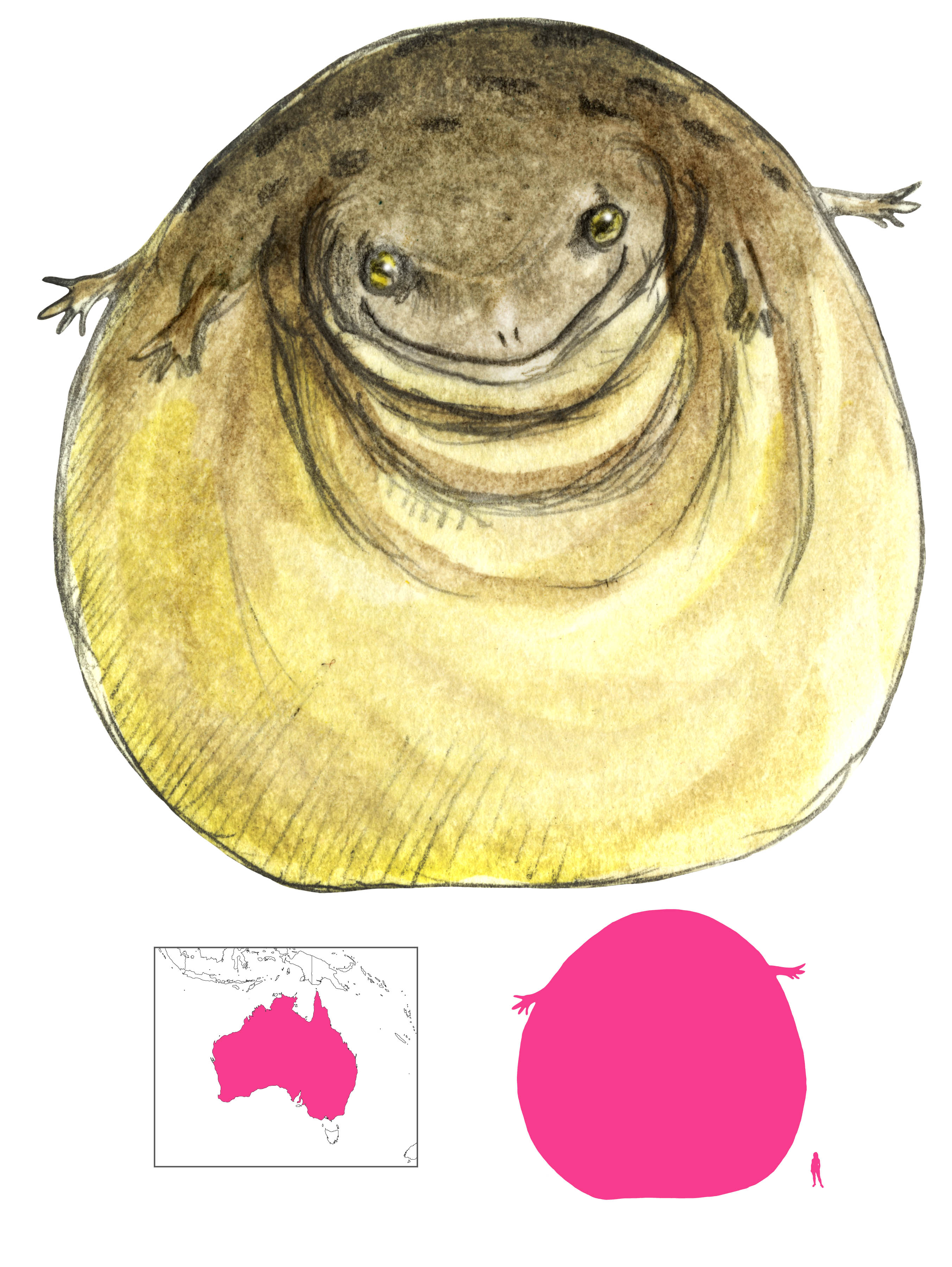
Tiddalik the frog was thirsty. He got up one day in the Australian bush and decided he needed more water. He began by drinking down all the water in his pond. After that, he crawled out of the hole left behind and drained the nearby waterholes. Then he swilled down the closest river, and followed its tributaries, drinking them down one by one. Billabongs and lakes were gobbled up, and Tiddalik grew bigger and bigger. Finally, once there was no water left in sight, Tiddalik stopped. He was now a bloated, mountainous creature filled with water and incapable of moving. He could only sit there and stare, content at last.

Soon, as the lack of water became painfully evident, the animals started to gather around Tiddalik. His size and thick skin made him impervious to anything they could do, and rain was nowhere in sight. It was Goorgourgahgah, the Kookaburra, who hit upon the solution. “We must make him laugh”, he said. “That way he’ll open his mouth and all the water will come out”.

As the champion laugher, Goorgourgahgah went first. He flew in front of Tiddalik’s face, laughing at the top of his lungs. He tumbled in the air, told jokes, and guffawed till he was hoarse. Tiddalik blinked impassively.

All the other animals tried their luck. Kangaroo turned somersaults. Koala made weird noises. Frilled Lizard ran around with his frill open. Wombat rolled around in the dirt. Brolga danced and squawked. But nothing they did seemed to get to Tiddalik, and the more they tried the thirstier they got. The monstrous frog merely continued to observe them with his globular eyes.

Then, as the other animals began to despair, Noyang the Eel stepped solemnly up. Everyone held their breath as Noyang straightened and balanced precariously on his tail. A ripple went through Tiddalik’s bloated body. Noyang began to twist and contort himself, forming hoops, spirals, springs, whirling around like a top… Tiddalik’s smile broadened, and he started to shake. Finally, Noyang tied himself in knots, and Tiddalik started to laugh hysterically – and all the water he held inside poured out, flooding the land before returning to its rightful place. Many died in the flood; Pelican took it upon himself to save as many as he could, but got aggressive when the human woman he wanted for a wife refused him. He painted his black feathers white to go to war, but was accidentally killed by another pelican who didn’t recognize him – pelicans today are both black and white in his honor.

When all had cleared, Tiddalik had shrunken back into a tiny frog once more. He had laughed so hard that he lost his voice, and could only croak hoarsely. Today, his descendants the water-holding frogs (Cyclorana platycephala) still practice every night in the hopes of regaining that voice, and still try to drink large quantities of water on a much smaller scale.

After losing all the water of the world, Tiddalik also came to resent anyone who tried to hoard water for themselves. When Echidna tried to keep a secret cache of water, it was Tiddalik who followed him and dove into the subterranean pond. “This water belongs to everyone!” he snapped. “You have no right to keep it to yourself!” The other animals punished Echidna by tossing him into a thornbush, and to this day he still has the thorns embedded in his back as a painful reminder of his greed.

References

Morton, J. (2006) Tiddalik’s Travels: The Making and Remaking of an Aboriginal Flood Myth. Advances in Ecological Research, vol. 39.

Ragache, C. C. and Laverdet, M. (1991) Les animaux fantastiques. Hachette.

Reed, A. W. (1965) Myths and Legends of Australia. A. H. and A. W. Reed, Sydney.

Reed, A. W. (1978) Aboriginal Legends: Animal Tales. A. H. and A. W. Reed, Sydney.

Tapirê-iauara

Variations: Tapir Nymph, Onça d’Água (Water Jaguar), Onça Pé de Boi (Cow-legged Jaguar), Paraná Pura Iuraretê (Turtle/Jaguar that Dwells in River Side Channels), Tai-açu-iara (potentially)

Tapire-iauara

The Tapirê-iauara, or Tapir Nymph, enjoys a wide distribution in the Amazon, from the Orinoco in Venezuela to the Rio Negro, the Madeira, the Tapajós, and the Amazon down to Pará. Sightings have been reported from around Codajás, Fonte Boa, Itacoatiara, Nova Olinda, Oriximiná, Santarém, and Urucurituba. It lives in slower-moving waters, near groves of aninga or palm trees, and avoids human settlements.

The name tapirê-iauara is etymologically complex. Tapiré is Tupi for “tapir”, while y is “water” and ara is “lady” in língua geral; it also draws from the Tupi uara (“dweller”) or yguara (“dweller in water”). Hence, “tapir water-lady” or “tapir nymph” is a rough translation. This same derivation gives us the Amazonian nymphs Yara and Oyoára, the sea monster Hipupiara, and Paraná Pura Iuraretê, which was apparently a giant turtle creature that later was subsumed into the tapirê-iauara (iuraretê meaning either “turtle” or “jaguar”).

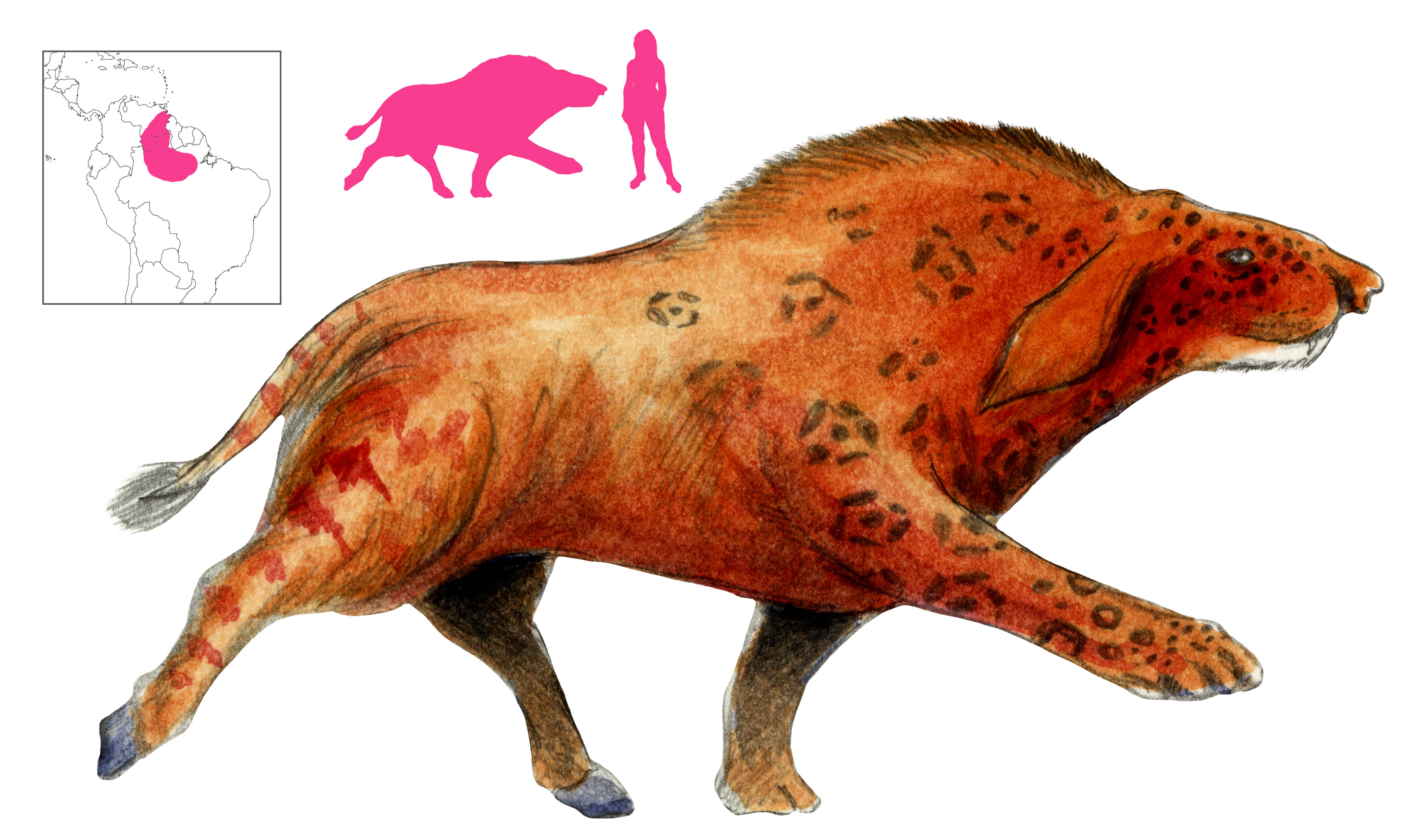
Reports of the tapirê-iauara appearance have varied somewhat. Most accounts agree that it resembles a cow-sized jaguar with a reddish waterproof coat, a thick mane, long droopy ears half a meter in length, and an overpowering stench (catinga). It may have jaguar legs, or the forelegs of a jaguar and hooved, donkey-like hindlegs. It may have horse legs with or without catlike paws, duck feet, or large otter paws. Variations in fur color include red, gold, and black with a cream patch in the chest. It notably does not look much like a tapir.

A tapirê-iauara is heard and smelled before it is seen. The large, finlike ears flap noisily against the water as it swims, while its putrid odor precedes it. From a safe distance, it’s merely nauseating; at close quarters the stench of a tapirê-iauara is enough to cause fainting and outright death. Tapirê-iauaras can also mesmerize prey into standing still before pouncing on them.

Tapirê-iauaras have a broad diet that includes large fish, capybaras, caimans, and humans. They are attracted to hauls of fish and the halitosis resulting from eating poorly-cooked fish. They often show up to inspect fishermens’ catches – or the fishermen themselves. When they do, they are fast, persistent, and resilient, relying on their odor to weaken prey before killing it with their sharp teeth and claws. One fisherman had to empty 12 slugs from a .22 rifle into a pursuing tapirê-iauara before the beast expired. Other fishermen have not been so lucky, having their catches stolen at best or being dragged into the river and devoured at worst.

Sometimes the stink of a tapirê-iauara is enough to cause a human’s shadow (and therefore soul) to depart. A person who has lost their shadow in this way is said to be assombrado. They can recover their soul by inhaling the fumes of a fire made with leaves, sticks, and the bones of undercooked piranhas.

Caraña resin (Protium heptaphyllum) is repulsive to tapirê-iauaras, and anyone concerned about tapirê-iauara attack should equip themselves with some before heading into the Amazon. Tapirê-iauaras also cannot climb, and so shelter should be sought in trees. As the tapirê-iauara’s odor will cause fainting and potentially falling out of the tree, secure branches must be found.

The Tai-açu-iara from around Parintins is similar and may be the same animal. It appears as a black piglike creature with jaguar paws.

References

Smith, N. J. H. (1981) Man, Fishes, and the Amazon. Columbia University Press, New York.

Smith, N. J. H. (1996) The Enchanted Amazon Rain Forest. University Press of Florida, Gainesville.

Hrökkáll

Variations: Hrökk-áll

Hrokkall

A malicious Icelandic wizard once revived a dead, half-rotted eel, giving rise to an evil and toxic creature. It was the first Hrökkáll, or “coil-eel”. The wizard may be long dead, but the eel’s descendants went on to infest polluted waters.

A hrökkáll is two feet long, and resembles an eel in appearance. It lives in still ponds and stagnant water, and occasionally in running rivers. It has flexible, iron-hard scales, and sharp saw-toothed fins. As with many Icelandic fishes, it secretes corrosive venom and its meat is poisonous. Captured hrökkálls have been known to melt their way through earth and rock to squirm back into the water.

Hrökkálls lie in wait until someone steps in the water. Then they coil around the person’s leg and constrict it, slicing into flesh and bone alike and amputating the limb. It is unknown whether hrökkálls use their acidic venom or their bladed fins (or both) to do this. They will dismember humans and horses in this way, but sheep are safe as their legs are too narrow for the hrökkáll to gain a hold.

Hrökkáll in common parlance has since evolved to mean electric eels.

References

Davidsson, O. (1900) The Folk-lore of Icelandic Fishes. The Scottish Review, October, pp. 312-332.

Zoëga, G. T. (1911) English-Icelandic Dictionary, Second Edition. Sigurdur Kristjansson, Reykjavik.

Mi-ni-wa-tu

Mi-ni-wa-tu

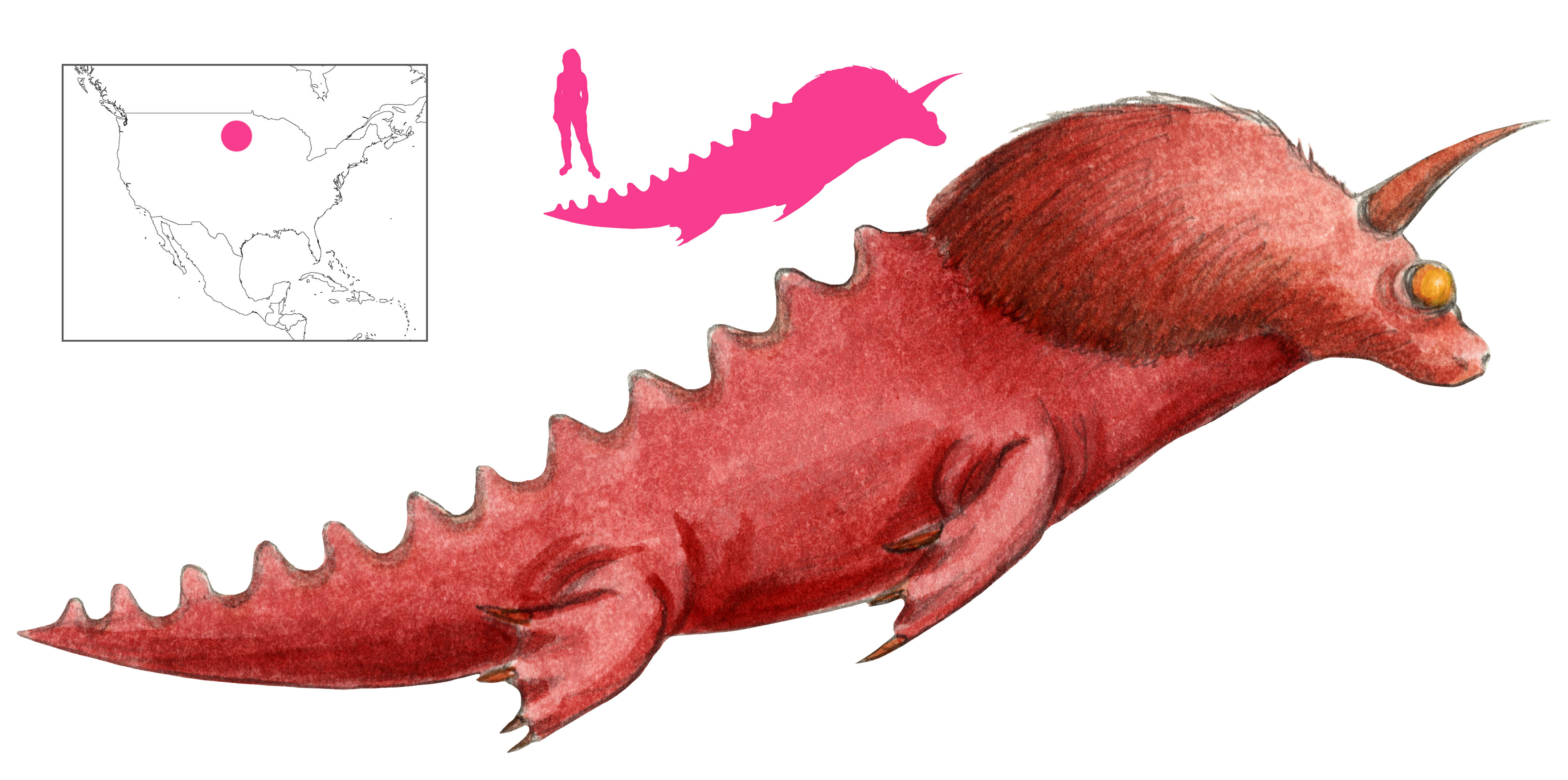
The Mi-ni-wa-tu, or “sea monster”, is known from the folklore of the Tetons, and may be found in the Missouri River.

A mi-ni-wa-tu is an amphibious creature with a body like that of a buffalo, and covered with red hair. It has a single horn in its forehead, and a single eye. Its back is notched like a saw or gear.

The mi-ni-wa-tu may be safely seen at night when it swims powerfully up the river, churning the water and glowing like fire; in the spring, it breaks up river ice. Seeing a mi-ni-wa-tu during the day causes confusion and loss of sight. Madness sets in; after a day of convulsions, the unfortunate victim dies.

References

Dorsey, J. O. (1889) Teton Folklore Notes. Journal of American Folklore, Vol. II, No. IV, pp. 133-139.

Codrille

Variations: Cocadrille, Cocodrille, Coquadrille, Cocatris

Codrille

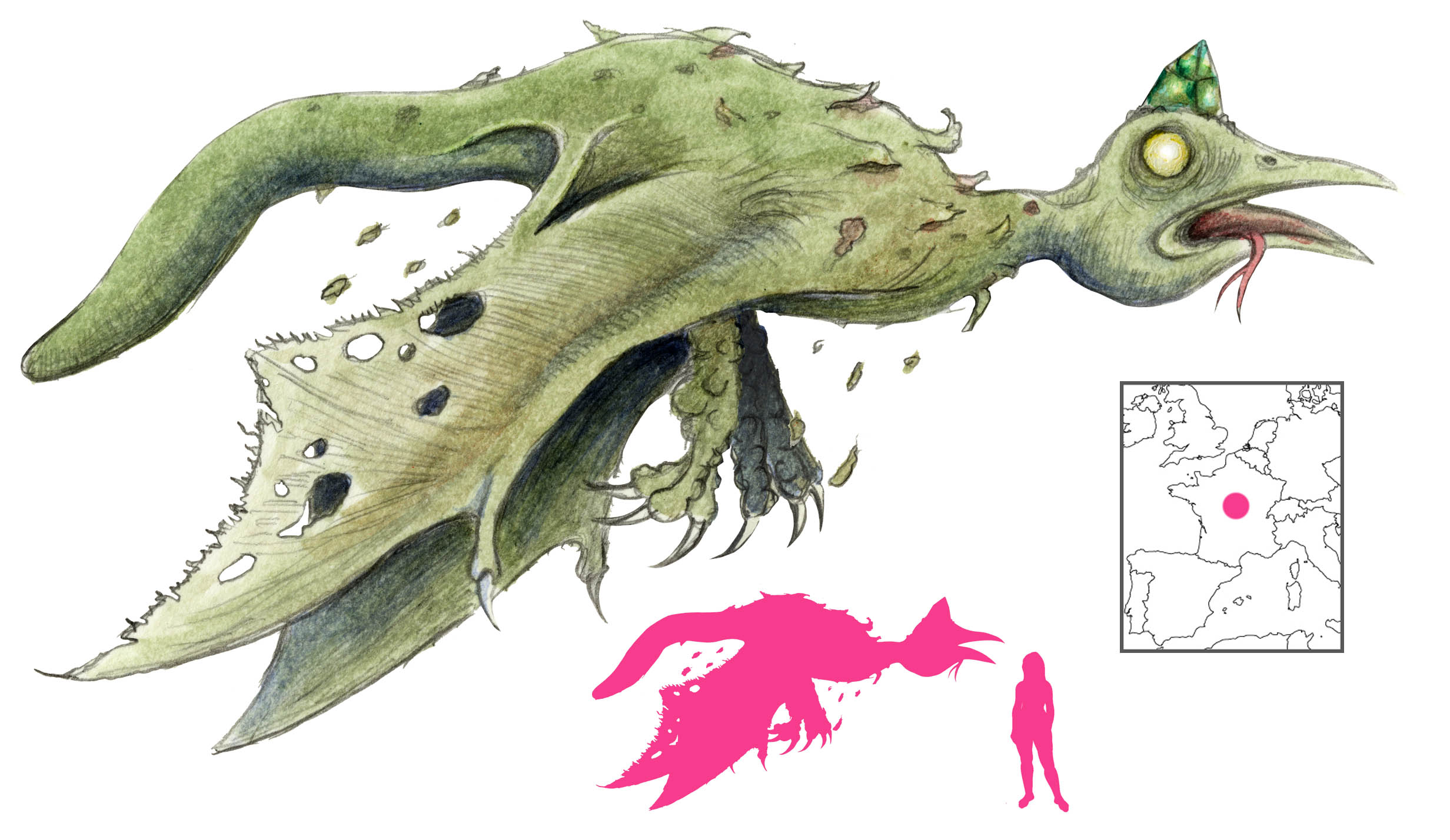
The Codrille, Cocadrille, or Codrille is a variety of basilisk or dragon native to central France, notably Berry, Maine, Poitou, Sologne, and Vendée. It combines features of basilisks and vouivres but without the redeeming aspects of either.

The name of the codrille was derived from the same etymological confusion that spawned the “cockatrice”. Starting with Crocodylus, the crocodile, practically a mythical creature in its own right, the name became progressively more garbled, becoming Cocodrillus, Cocodrille, Cocadrille, and Codrille. However, de la Salle derives it from coco and drille, meaning “rooster’s child”.

Unlike true basilisks, codrilles can grow to impressive size, becoming leathery-winged dragons at the last stage of their life cycle. The “crown” characteristic of basilisks manifests in the form of a brilliant gem on top of the codrille’s head. Codrilles can kill merely by looking at their victims, and emit an aura of disease and plague.

A codrille’s life is a complicated succession of metamorphoses. It hatches from a yolkless egg laid by a rooster, and incubated by the heat of the sun or of manure. To prevent those eggs from hatching, one must plant sprigs of ash in potential codrille breeding grounds. This should be done on the first day of May. Having other roosters around also helps, as they will devour the offspring of a codrille.

The codrille starts out its life as a very long, string-like snake. It is capable of killing right out of the egg – anyone who cracks a codrille egg and is seen by the newborn codrille dies instantly, but if they see the snake first, it dies instead. After a while, the juvenile codrille sprouts legs and becomes a salamander. During this stage of its life it will still die if seen first by humans, so it hides in deep wells, ruined tombs, and the masonry of houses, bringing bad luck to everyone living there and whistling ominously at night. It can debilitate a bull merely by crawling under it.

At the end of seven years the codrille reaches the adult stages. It grows spectacularly, sprouts wings, and metamorphoses into an enormous dragon. It spreads its wings and migrates towards the Tower of Babylon, breathing death and pestilence along its way. Its passage in the air dims the sun, and epidemics and plagues follow in its wake.

References

Sainéan, L. (1921) L’histoire naturelle et les branches connexes dans l’oeuvre de Rabelais. E. Champion, Paris.

de la Salle, L. (1875) Croyances et légendes du centre de la France, Tome Premier. Chaix et Cie., Paris.

Sébillot, P. (1906) Le Folk-lore de France, Tome Troisième: La Faune et la Flore. Librairie Orientale et Américaine, Paris.

Dodo

Variations: Kadindi, Kaddodi, Kadda, Swallower-of-Men

Dodo

The Dodo is a monstrous humanoid creature from the folklore of the Hausa people. He can be found lurking in the deep forests and swamps of sub-Saharan West Africa, with a range including Sudan, Ghana, Nigeria, and the Côte d’Ivoire. The dodo has nothing in common with the extinct flightless bird of the same name, and probably was derived from tales of giant snakes.

Not much is known about a dodo’s appearance. He – for the dodo is always male – is the King of Beasts, and can just as easily be the lion, the python, the elephant, or the rhinoceros. A dodo is humanoid in appearance and large in size, as he has to stoop to get through doors. He has long, shaggy black hair. He has a keen sense of smell, and can detect meat from far away. He has some degree of magic powers, but cannot cross running water (paradoxically, dodos also live in ponds and streams). Most importantly, the dodo has a vast mouth glowing red from the inside, a seemingly infinite stomach capacity, and a taste for human flesh. As one of the African “swallowing monsters”, a dodo can easily engulf an entire village.

A dodo is often a self-invited guest, eating more and more until there is nothing left. This is not always a bad thing. Once a miser and his son were preparing to butcher a freshly-slaughtered ox in the forest, far from prying eyes. They decided to cook it in a nearby fire – a fire which turned out to be a dodo’s glowing, cavernous mouth.

“Well well”, said the dodo. “Who has invited me?” The miser, hoping to placate him, said “I did!” and gave him a leg of beef, which the dodo put away in his bag. “Does a man invite a friend to a feast for such a small morsel?” said the dodo. In response, the miser gave him another leg. “Does a man invite a friend to a feast for such a small morsel?” The next two legs followed, then half the bull, then the remainder of the bull. “Does a man invite a friend to a feast for such a small morsel?” “But there is nothing left!” protested the man. “You are also meat”, came the response. Terrified, the miser shoved his son forward, and the dodo tossed him into his bag. Finally, he grabbed the miser himself. “What about you?” he said, throwing him into his bag as well. The dodo went to collect firewood, but in the meantime the father and son managed to cut their way out of the bag and made their escape. The dodo returned, shrugged, and got a meal of roast beef. The miser vowed he would never be greedy again, and devoted the rest of his life to sharing his food and wealth with others.

While dodos readily eat meat, they are also fond of taking human women as their wives, sometimes fathering repulsive half-dodo children with them. Dodos like to strike bargains with prospective spouses, promising to help them for the price of marriage; sometimes those “bargains” are more straightforward, consisting of “Would you like me to eat you or marry you?” Such unions are never happy, and the wife will always try to escape her captor.

One dodo story tells of a young woman, pregnant with her first child, drawing water from a stream. Another woman, jealous of her companion and looking to get her scolded, threw dirt in her pot before leaving. But as the pregnant woman tried to carry her water pot, a dodo came out of the water and helped her with her load. Before she could protest, he stated “If you give birth to a boy, he will be my friend. If your child is a girl, she will be my wife”. And with that, he disappeared back into the water.

The mother soon gave birth, and her jealous rival was prompt to report the news to the dodo. “She gave birth to a girl”, she announced, and the dodo was immensely pleased. He was content to wait over the years, until the girl had become a woman as beautiful as her mother. On the day of the girl’s wedding, the jealous woman once more reported the news to the dodo, and he decided to show up uninvited.

“Kadindi has arrived”, he boomed, as everyone stared at him. “I have come to collect the payment I am due”. The daughter was obviously unhappy about marrying the monster, so instead her father gave the dodo a horse, part of the bride’s dowry. “Here is the payment for your debt”, he said, and the dodo swallowed the horse. But that was not enough. Next he ate all of the cattle, all of the wedding feast, all of the guests, and finally the father and mother. There was only the daughter left, and in desperation she prayed to the heavens. “Dodo has come to demand payment”, she implored. In response to her prayer, a knife fell out of the sky, and it was promptly swallowed as well – killing the dodo, cutting open his belly, and causing all the livestock, food, guests, and parents to come out unharmed. The wedding went on as planned.

References

Tremearne, A. J. N. (1913) Hausa Superstitions and Customs. J. Bale and Sons and Danielsson, Ltd., London.

Zhubieyu

Variations: Pearl-turtle

Zhubieyu

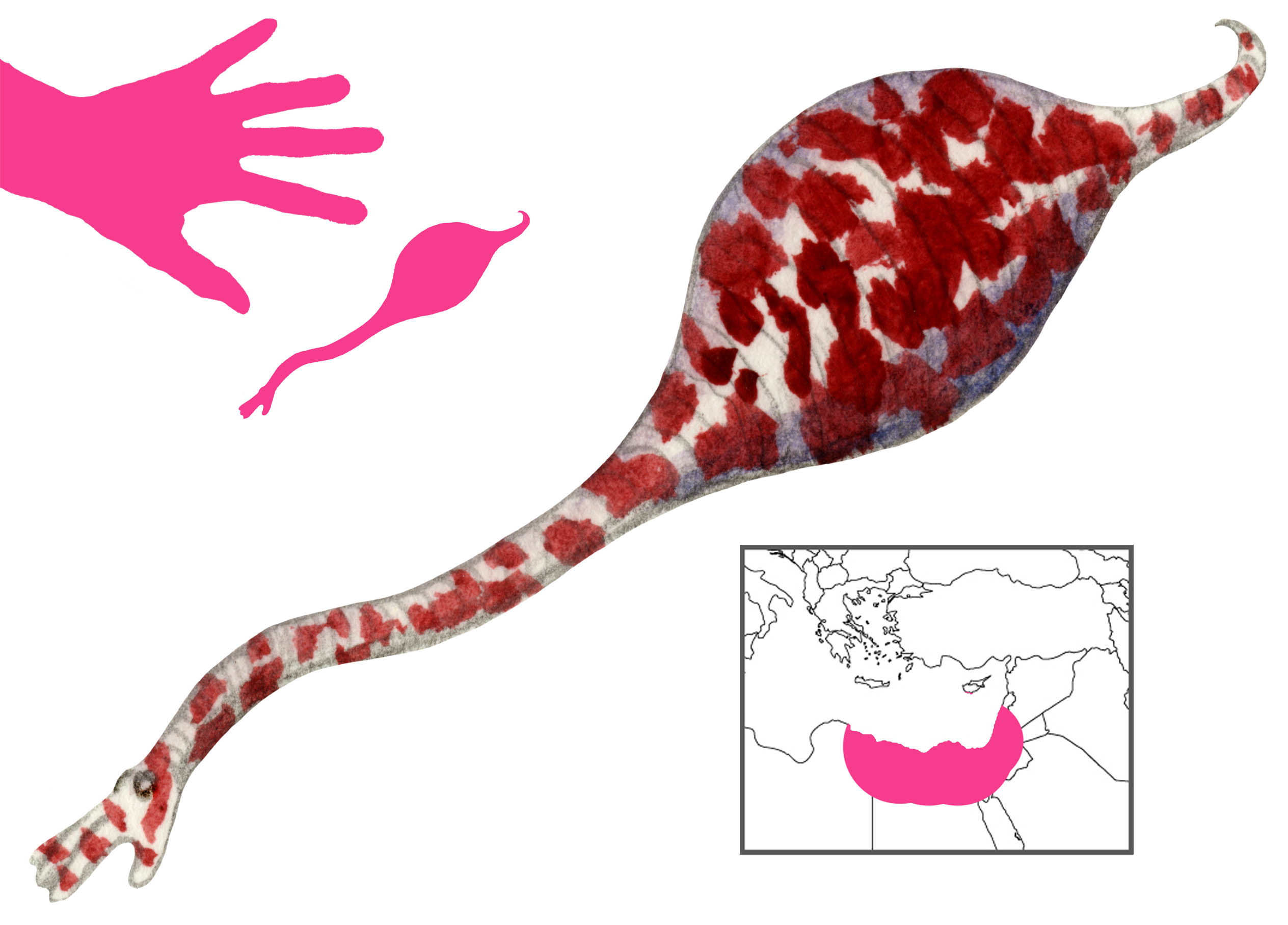
The Zhubieyu, or Pearl-turtle, can be found in the Li River and Yu Lake, near Vine Mountain. This unusual fish or reptile looked like a lung (or otherwise a piece of dried meat) with four eyes and six legs. It contains and spits out pearls, and its flesh tastes sweet and sour. Zhubieyus are considered a delicacy, and eating them protects from seasonal epidemics and furunculosis.

Guo Pu marveled at the lot of these “floating lungs… Embodying Heaven, Earth, and Man”, and found irony in the fact that their own usefulness doomed them.

They appear to be softshell turtles. Mathieu describes them as “red softshells” or “pearled softshells”.

References

Mathieu, R. (1983) Étude sur la mythologie et l’ethnologie de la Chine ancienne. Collège de France, Paris.

Strassberg, R. E. (2002) A Chinese Bestiary: Strange Creatures from the Guideways Through Mountains and Seas. University of California Press.