Lupeux

lupeux

“Ah, ah! Ah, ah!” The sound echoes through the still, moonlit ponds of Brenne. “Ah, ah, ah!” It’s a pleasant, gently teasing sort of laugh, in a soft human voice. You look around you, but the sound is hard to place. “Who’s there?” you might think of asking. “What’s going on?” Inhabitants of the Berry region in France know better than to respond. Your traveling companion chides you. “For the love of God, don’t answer a third time!”

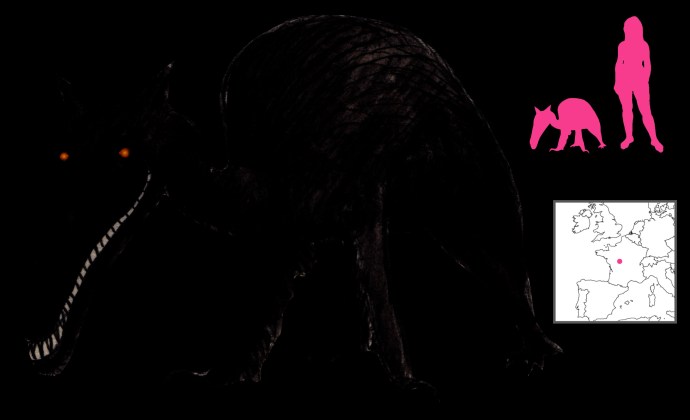
The laughter comes from the Lupeux, a mysterious, perverse creature with a cruel sense of humor. The lupeux is heard but not seen. Its appearance is uncertain and varies from area to area, but it usually has the head of a wolf, as hinted by its name.

“Ah, ah!” You don’t heed your friend’s warning and call out once more. “What’s funny?” That’s when the floodgates open. The lupeux’s laughter ceases, and it begins to talk to you. In its friendly, genial, engaging voice, it relates juicy rumors, scandalous gossip, inside secrets. If you’re single, it tantalizes you with its matchmaking, sets you up with the hottest dates; if you’re romantically involved, it taunts you with your partner’s infidelity and reveals all their secret lovers. There is seemingly nothing the lupeux doesn’t know – or pretend to know.

Once in the lupeux’s spell, you do not tire of listening to it. You follow its congenial voice as it travels through the skeletal branches of blasted willows, desperate for more. Then the voice stops moving, and you stop in front of a pool, crystal clear, reflecting you and all your hopes and fears, all the tales the lupeux has planted in your head. You come closer for a better look – and the lupeux pushes you in. As you sink into the bottomless pool, as the cold water pours into your lungs and you take your last breath, you see the lupeux perched on a nearby branch, watching you drown and laughing in its charming, friendly voice. “Ah, ah! Now that’s funny”.

References

Jaubert, H. (1864) Glossaire du Centre de la France. Imprimerie et Librairie Centrales de Napoleon Chaix et Cie, Paris.

Sand, G. (1858) Légendes Rustiques. Amorel et Cie Libraires-Editeurs, Paris.
Kăk-whăn’-û-ghăt Kǐg-û-lu’-nǐk

Variations: Akhlut (erroneously)

kakwanugat-kegurlunik

Around the coastlines of the Bering Strait, pack ice constantly breaks off and floats away. If there are wolf tracks on the ice, and a chunk of that breaks loose, then it looks as if the prints lead into the water’s edge, or as if a wolf came out of the sea. Yupik folklore holds that this is evidence of the Kăk-whăn’-û-ghăt Kǐg-û-lu’-nǐk.

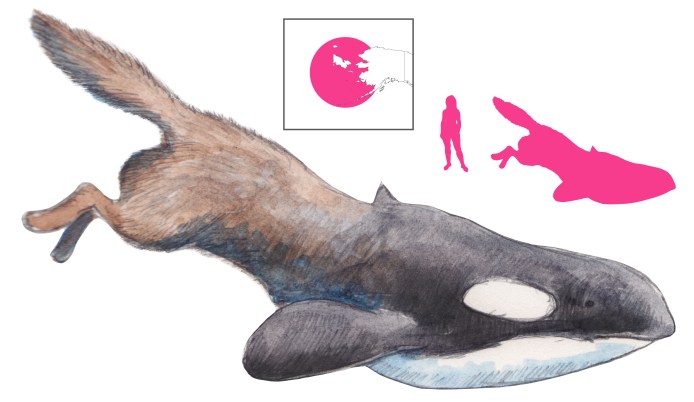
A kăk-whăn’-û-ghăt kǐg-û-lu’-nǐk is a killer whale (akh’-lut) that can shapeshift at will into a wolf (kǐg-û-lu’-nǐk) to hunt on land. The name of kăk-whăn’-û-ghăt kǐg-û-lu’-nǐk is applied to those creatures when in wolf form. They are aggressive and will kill humans if given the chance.

The kăk-whăn’-û-ghăt kǐg-û-lu’-nǐk is typically depicted as halfway through its transformation – whale at one end and wolf at the other. The beluga whale and caribou are a similarly symbiotic pair, becoming a whale in the sea and a reindeer on land.

References

Nelson, E. W. (1900) The Eskimo about Bering Strait. Extract from the Eighteenth Annual Report of the Bureau of American Ethnology, Government Printing Office, Washington.

Schilalyi

Variations: Shilalyi, Shulalyi, Šilali

shilali

Schilalyi, “Cold” or “Cold One”, is the fifth of the children of Ana, and her third daughter. She and her siblings are the Roma demons of disease, and are the result of unnatural and undesired liaisons between the Keshali queen Ana and the King of the Loçolico.

After Ana’s fourth child, Melalo advised his father to serve her a cooked mouse which the King had spat on, along with soup. Ana fell ill, and as she drank water, Schilalyi crawled out of her mouth. This unnatural birth earned Schilalyi particular loathing from her mother. Schilalyi in turn tormented her brothers and sisters until her husband Bitoso was born.

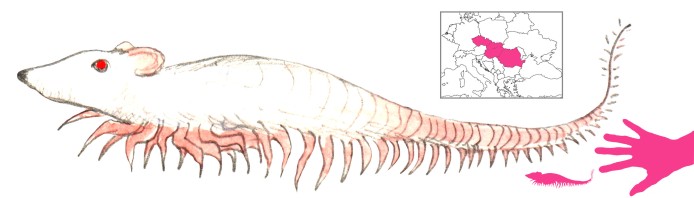
Schilalyi’s form is that of a white mouse with many little legs and possibly multiple tails, and she is the cause of chills and cold fevers. To counter her symptoms, patients are treated with dried mouse lungs and stomachs, steeped in alcohol.

White mice are regarded as agents and offspring of Schilalyi, leading to one alleged incident where a pharmacist’s lab mice were drowned in a well to ward off certain disaster.

References

Clébert, J. P. (1976) Les Tziganes. Tchou, Paris.

Clébert, J. P.; Duff, C. trans. (1963) The Gypsies. Vista Books, London.

Meyers Brothers Druggist (1910) Demons of Disease. Meyers Brothers Druggist, v. 31, p. 141.

Pavelčík, N. and Pavelčík, J. (2001) Myths of the Czech Gypsies. Asian Folklore Studies, v. 60, pp. 21-30.

Okpe

okpe

Okpe is a massive, quadrupedal ogre from Argentinian and Chilean Tehuelche folklore. He looks like a pig made of impregnable solid rock, without soft spots or weaknesses. Okpe preys on children, luring them with braised meat before carrying them off in a device on his back. Children captured by Okpe are taken into the jungle and devoured. Attempts to thwart his actions fail, as he is impervious to conventional weaponry.

Once Okpe abducted an older child, who had the presence of mind to hold onto an overhead branch and escape his captor. While Okpe sought his victim and screamed for him to return, the child ran back to his village. There a mare was butchered – as the Tehuelche do in emergencies – and its skin was stretched out on the ground. When Okpe trundled through in pursuit of the boy, he slipped on the stretched hide and fell so heavily that his stony armor rattled! Okpe started to cry in defeat, crying so hard that his tears caused a flood that went up as high as his teeth. He never bothered the Tehuelche again.

References

Borgatello, M.; Bórmida, M.; Casamiquela, R. M.; Baleta, M. E.; Escalada, F. A.; Harrington, T.; Hughes, W.; Lista, R.; Samitier, M. L.; and Siffredi, A.; Wilbert, J. and Simoneau, K. eds. (1984) Folk Literature of the Tehuelche Indians. UCLA Latin American Center Publications, University of California, Los Angeles.

Oókempán

ookempan

Oókempán is an ogre known to the Tehuelche of Argentina and Chile. He looks like a very large man, but has a shell on his back and moves around on all fours like a pig. Oókempán abducts children, enticing them with a bit of meat before slinging them into a box on his back and carrying them off. Any child playing on their own is at risk of being taken and presumably eaten. Attempts to stop Oókempán will fail, as his hard shell prevents any damage from reaching him; his weakness is in his heel, which is unprotected.

It was Oóuk’en, “truth”, the man incapable of lying, who put an end to Oókempán’s kidnappings. He interceded after a child escaped by grabbing hold of an overhead branch as Oókempán passed under it. Oóuk’en went to meet Oókempán at the top of a cliff. “What did you do with the children?” he asked the ogre. “I took them to increase my people”, replied Oókempán. “I only eat rhea, and I needed them to hunt for me”. After some more small talk, Oóuk’en pushed Oókempán off the cliff, shattering his shell and killing him.

The presence of fossil elephant bones in the region have been seen as evidence of Oókempán’s existence.

References

Borgatello, M.; Bórmida, M.; Casamiquela, R. M.; Baleta, M. E.; Escalada, F. A.; Harrington, T.; Hughes, W.; Lista, R.; Samitier, M. L.; and Siffredi, A.; Wilbert, J. and Simoneau, K. eds. (1984) Folk Literature of the Tehuelche Indians. UCLA Latin American Center Publications, University of California, Los Angeles.

Qasoǵonaǵa

Variations: Gasogonaga, Kasogonagá, Kasogongá, QasoGonaGa; Lightning; Owner of Storms/Lightning

qasogonaga

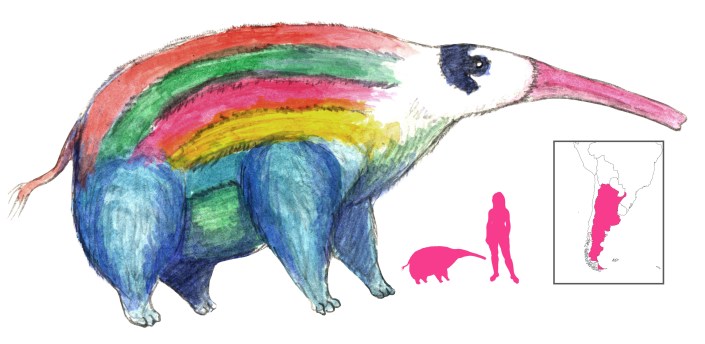
For the Toba of Argentina, lighning takes the form of a small, hairy creature called Qasoǵonaǵa, the Owner of Storms. It is an anteater, or perhaps an elephant, with a long snout, long rainbow-colored hair, and four tiny feet. Qasoǵonaǵa can also appear in human form, retaining a small head and shaggy body. As Qasoǵonaǵa has been referred to by both male and female pronouns, there are probably more than one of these beings.

Qasoǵonaǵa, as the Owner of Storms, lives in the skies and is responsible for storms and other meteorological conditions. Lightning comes out of its mouth, while its angry roars become thunder. It is responsible for rain, or lack thereof.

While Qasoǵonaǵa may be a mighty force of nature, it can be quite friendly and grateful for help granted it by the Toba. Often a Qasoǵonaǵa falls to the earth, and has to be returned there by human intervention, as it is too small to return there on its own. In such cases a bonfire must be built, and Qasoǵonaǵa placed on top before it is ignited. The rising smoke will carry Qasoǵonaǵa back into the sky, and the happy anteater will reward its benefactor with powerful shamanic powers. Qasoǵonaǵa will also cause or stop torrential rain if its helper requests it.

References

Cordeux, E. J.; Karsten, R.; Lehmann-Nitsche, R.; Mětraux, A.; Newbery, S. J.; Palavecino, E.; and Terán, B. R. D.; Wilbert, J. and Simoneau, K. eds. (1982) Folk Literature of the Toba Indians. UCLA Latin American Center Publications, University of California, Los Angeles.

Wright, P. G. A semantic analysis of the symbolism of Toba mythical animals. In Willis, R. (Ed.) (1990) Signifying Animals: Human Meaning in the Natural World. Unwin Hyman, London.

Wright, P. G. Dream, Shamanism, and Power among the Toba of Formosa Province. In Langdon, E. J. M. and Baer, G. (Eds.) (1992) Portals of Power. University of New Mexico Press.

Wright, P. G. (2008) Ser-en-el-sueño. Editorial Biblos, Buenos Aires.

Kori

kori

The Cuiva of Colombia and Venezuela tell of the Kori, a destructive aquatic monster. It has the appearance of a giant anteater, except far larger, and it lives underwater in the rivers. It uses its large claws to dig under riverbanks, causing their collapse, and that is why this is such a common occurrence in the rainforest. A kori can also cause strong gales to destroy constructions, and can turn soil into water to drown people.

A kori once collapsed a riverbank near a Cuiva village, killing most of the inhabitants. Only one man managed to escape by transforming himself into a howler monkey and climbing to the top of a tree, where he sat trembling and watching the kori. Even that wasn’t enough, as the kori eventually knocked down the tree and killed the monkey hiding there.

Word of the massacre reached the Cuiva, and after mourning the dead they set out to avenge them. The father of the howler-monkey man led the hunt, armed with a harpoon, while the others followed with poisoned arrows. Once found, the kori was riddled with harpoons and arrows while it was too weakened to fight back. It tried transmuting the ground to water, but it was only shallow water, and the warriors continued firing poisoned arrows until the enormous anteater died. The leader of the hunt chopped off the kori’s claws and made them into a necklace as payment for his son. The rest of the anteater’s body was left for the vultures.

References

Arcand, B.; Coppens, W.; Kerr, I.; and Gómez, F. O.; Wilbert, J. and Simoneau, K. eds. (1991) Folk Literature of the Cuiva Indians. UCLA Latin American Center Publications, University of California, Los Angeles.

Odontotyrannus

Variations: Arine Hayant Le Tirant, Arine Qui Het Le Tirant, Armez Hayant Le Tirant, Dentem Tyrannum, Dentirant, Dentityrannus, Dent Tyrans, Odentetiranno,  Odontatyrannum,  Odontatyrannus, Odontetiranno

odontotyrannus

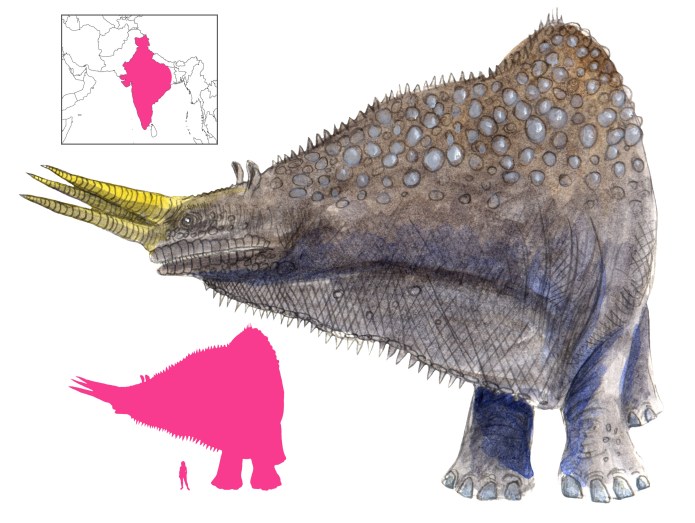
The Odontotyrannus is a massive beast found in the rivers of India, whose account has been told as one of Alexander the Great’s many exploits. Its name apparently means “tooth tyrant”, but medieval reading errors led to a variety of increasingly awkward alternate names and direct translations.

When Alexander and his men made camp by a river, they were found by an odontotyrannus coming to the water to drink. It was enormous, large enough to swallow an elephant whole, and black in color, or otherwise with a head black as pitch. It had three horns on its head. When it saw the Macedonians, it went on a rampage, killing 26 and injuring 52 of the soldiers before it was brought down by Emendus, Duke of Arcadia.

The rhinoceros is a certain candidate as the progenitor of the odontotyrannus, as is the crocodile. Confusion with Indus worms – Indian, armed with two terrible teeth, and capable of swallowing prey whole – may have led to the name, as nowhere in its description are teeth ever mentioned.

References

Wauquelin, J., Hériché, S. ed. (2000) Les Faicts et les Conquestes d’Alexandre le Grand. Librairie Droz, Geneva.

de Xivrey, J. B. (1836) Traditions Tératologiques. L’Imprimerie Royale, Paris.

Yin Shu

Variations: Tien-schu, Tin-schu, Tyn-schu, Yn-schu

yin-shu

In Siberia, mammoth fossils were seen as the remains of giant mole-like creatures that lived and moved underground. These subterannean monsters tore up riverbanks as they tunneled, but died in broad daylight.

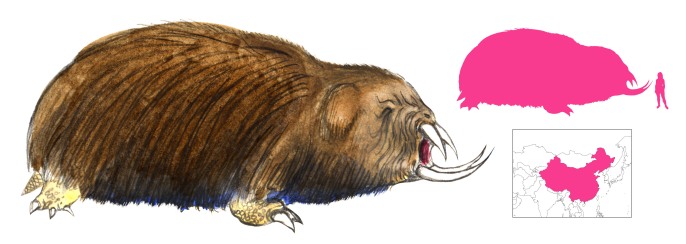
In China, numerous sources, including the treatise Ly-Ki, tell of the Yin Shu, the “Hidden Rodent” or “Hidden Mouse” that dwells in dark caves. The yin shu grows from the size of a buffalo to as big as an elephant in Manchurian manuscripts, but otherwise looks mouselike. It has a no tail (or a short tail), is dark in color, and has short legs, a short neck, and small eyes. Yin shu are dim-witted, slow, and extremely powerful, digging out caves in areas with the roots of the fu-kia plant. They have shown up when rivers flooded plains, and die instantly when exposed to sunlight.

Until recently, mammoth bones in drugstores were labeled as yin shu.

References

Buel, J. W. (1887) Sea and Land. Historical Publishing Company, Philadelphia.

Laufer, B. and Pelliot, P. (1913) Arabic and Chinese Trade in Walrus and Narwhal Ivory. T’Oung Pao, Second Series, v. 14, no. 3, pp. 315-370.

Pouchet, F. A. (1865) L’Univers. Librairie de L. Hachette et Cie, Paris.

Selamóðir

Variations: Seal Mother

selamodir

The Selamóðir, or “Seal Mother”, is the protector of the harbor seals and grey seals of Iceland. It is called by seals when persecuted, or it may appear of its own accord to defend its charges. Unlike most seals, it can be found inland as well as at sea, in freshwater and saltwater.

Seal mother or not, a selamóðir is a monstrous sight. It is like a seal in general appearance, but of “unusual dimensions”, “terrifying size”, or simply the size of a large foreign dog with short legs. It is reddish-pink in color (perhaps with a red neck), with flashing eyes and a back like an island. There is a tuft of hair, like brushwood or heather, between its eyes.

Seal mothers may be found wherever seals gather, and ferociously attack anything that approaches their “children”. There is one report of a selamóðir charging out of the sea to scare off would-be seal hunters, and others of selamóðirs swimming upriver.

A selamóðir was also one of the three monsters inhabiting the Lagarfljót river. It slept under the waterfall, and was much feared until it was vanquished and transfixed to a rock.

References

Hlidberg, J. B. and Aegisson, S.; McQueen, F. J. M. and Kjartansson, R., trans. (2011) Meeting with Monsters. JPV utgafa, Reykjavik.