Yedua

Variations: Jeduah, Jidoa, Feduah, Fedoui, Fadua, Adne Hasadeh, Adnei Ha-sadeh, Adne Sadeh, Abne Hasadeh, Avnei Ha-sadeh, Bar Nash D’tur, Jidra (erroneously)

yedua

The Talmudic equivalent of the Barometz, the Barnacle Goose, and other zoophytes is the Yedua. This name was used by Rabbi Meir, and these creatures are the yidoni of Leviticus 19:31, often translated to “wizards” in English. The exact pronunciation of the name is debatable, although one variation (“Jidra”) appears to be a misreading of Jidoa as used by Lewysohn. The yedua is also known as Adne Hasadeh (“lords of the field” or “men of the field”), Abne Hasadeh (“stones of the field”), or Bar Nash D’Tur (“man of the field”).

The size of the yedua is unspecified, but it has a human shape, having a face, body, arms, and feet.  However, Rabbi Jochanan, following Moses Chusensis of Ethiopia on the authority of Rabbi Simeon, believed the yedua to be a vegetable lamb, perhaps after confusion with the barometz. This wild man of the mountains lives through its navel, which connects it to the ground with a stem like that of a gourd or pumpkin. If this umbilicus is cut or uprooted the yedua dies. It will maul and kill any living thing within the radius of its stem, and will eat all vegetation within that circle. It is impure, and its body causes spiritual impurity in buildings.

It is valuable in witchcraft, as its bones placed in the mouth, along with certain incantations, allow one to see the future. Yedua hunters killed their quarry by shooting arrows into the navel-stem from a safe distance.

The account of the yedua can be read as an early observation of apes. Rabbi Lipschutz believed the yedua to be inspired by relict populations of chimpanzees or orangutans in the Lebanese cedar forests. The origin of the creature appears to have come about by a simple misspelling that turned tur (“field”) into tavur (“navel”).

References

Coogan, M. D.; Brettler, M. Z.; Newsom, C.; Perkins, P. (eds.) (2010) The New Oxford Annotated Bible. Oxford University Press, Oxford.

Laufer, B. (1915) The Story of the Pinna and the Syrian Lamb. The Journal of American Folk-lore, vol. XXVIII, no. CVIII, pp. 103-128.

Lee, H. (1887) The Vegetable Lamb of Tartary. Sampson Low, Marston, Searle, and Rivington, London.

Lewysohn, L. (1858) Die Zoologie des Talmuds. Joseph Baer, Frankfurt.

Ley, W. (1959) Exotic Zoology. The Viking Press, New York.

Slifkin, N. (2011) Sacred Monsters. Zoo Torah, Jerusalem.

Vodyanoi

Variations: Vodianoi, Vodyanik, Vodnik, Vodeni Moz, Deduska Vodyanoy (Water-Grandfather), Vodianoi-chert (Water Devil), Vodianikha (female), Topielec (Drowner, Polish), Vodyany-ye (pl.); Bolotnyi (potentially)

Vodyanoi

The malevolent and murderous Vodyanoi, from voda or “water”, is the Slavic water spirit. It frequents lakes, ponds, rivers, and other bodies of water, but it especially prefers mill-ponds. Their homes range from the humble dwellings of sand and slimy logs of Olonets to underwater palaces of crystal, decorated with gold and silver taken from shipwrecks, and illuminated by a magic stone shining brighter than the sun. The palaces are primarily known from Kaluga, Orel, Riazan, and Tula. The female vodyanyoi is also known as the vodianikha, although a rusalka or a drowned woman will also be taken as a bride. Variants of the vodyanoi are known in Belarus, Poland, and Yugoslavia.

A vodyanoi varies wildly in appearance. It can be roughly human in appearance, with big paws, horns, tail, and eyes like burning coals; it can be a huge man covered with grass and moss, with shaggy white fur, or with scales; it can be black with huge red eyes and a long nose, or bluish and slimy, bloated and crowned with reeds. Sometimes it appears in the form of a human, as an old man with green hair and beard that turned white with the waning moon, as a white-bearded peasant in a red shirt, as a naked woman with enormous breasts combing her dripping hair while seated on a log, or in the form of guardsmen and children. It can be half fish and half human, or appear as a huge moss-covered fish, a swan, or even a bouquet of red flowers on the water. In Smolensk the vodyanoi is humpbacked and has the feet and tail of a cow, while in Vologda it is a log with little wings flying over the water. A vodyanoi out of the water and in human guise can be identified by the water oozing out of its coat.

The vodyany-ye are immortal, but grow younger or older with the moon. They are weak on land, but virtually invincible in the water, and they dislike going out of the water beyond the bank or mill-wheel; some vodyany-ye refuse to emerge from water beyond the waist. They like to ride livestock until they die of exhaustion. Their presence in the market is an omen; if a vodyanoi buys corn at high prices, the harvest will fail, but a vodyanoi buying cheaply foretells bountiful crops.

They rest in their palaces during the day, and come out in the evening splashing the water with their paws, making a noise that can be heard over great distances. Vodyany-ye hate humans and lurk in the water after sunset, dragging people in when the opportunity arises. Those they drown become their slaves, or if attractive enough their wives. They take offense to anyone attempting to retrieve the bodies of the drowned, seeing them as their rightful property. Recovered bodies with bruises and marks on them were seen as bearing the scars of battle with a vodyanoi. In some places the presence of a vodyanoi became a serious threat. One mill-pond in Olonets held a vodyanoi family that required a constant source of corpses to eat. The inhabitants of the area learned to avoid the pond, and the family was eventually forced to relocate.

A vodyanoi sees mill-dams as an insult, and will destroy them to keep the water flowing. Horses smeared with honey, hobbled, and drowned with millstones make good placatory offerings. Drunk passers-by can also be pushed into mill-ponds to earn the vodyanoi’s trust.

As with other evil spirits, a vodyanoi can be exorcised; in fact, in some areas such as Tula, the vodyanoi is indistinguishable from the devil. Shooting a vodyanoi with buttons has been known to kill them as well. But while a vodyanoi can bear grudges, it can just as soon show gratitude. One vodyanoi who was aided in fighting off a rival promised never to drown anyone.

A vodyanoi is not hostile to fishermen and millers due to their affinity with water. Millers would deposit bread, salt, vodka, black sows, and ram’s heads at the water’s edge as offerings to the vodyanoi, and offer black roosters when building a new mill. Some millers were on such good terms with their local vodyanoi that they dined with them every night. Fishermen, on the other hand, would toss butter or tobacco into the water, saying “here’s some tobacco for you, vodyanoi, give me a fish!” A pleased vodyanoi would drive fish into a fisherman’s net. Finally, beekeepers also kept up good relations with the vodyanoi by offering honey and wax, and in return the water-spirit prevented humidity from damaging the hives.

The bolotnyi, from boloto or “swamp”, is a possible variation of the vodyanoi found in swamps.

References

Aldington, R. and Ames, D. trans.; Guirand, F. (1972) New Larousse Encyclopedia of Mythology. Paul Hamlyn, London.

Dubois, P.; Sabatier, C.; and Sabatier, R. (1992) La Grande Encyclopédie des Lutins. Hoëbeke, Paris.

Ivanits, L. J. (1989) Russian Folk Belief. M. E. Sharpe, Inc., Armonk, New York.

MacCulloch, J. A. and Machal, J. (1918) The Mythology of All Races v. III: Celtic and Slavic. Marshall Jones Company, Boston.

Isiququmadevu

Variations: Usiququmadevu (flattering); Isikqukqumadevu, Usikqukqumadevu; Unomabunge; O’gaul’-iminga; O-nsiba-zimakqembe

Isiququmadevu

When Untombinde, the king’s daughter, set out for the mythical Ilulange River, she took with her two hundred maidens to be her escorts. She was determined to bathe in one of its pools despite her parents’ warnings of dire consequences. Once there, she and her handmaidens undressed and played in the water, but when they came back out their clothes, their beautiful bracelets and jewels and finery were all gone. Isiququmadevu had taken them.

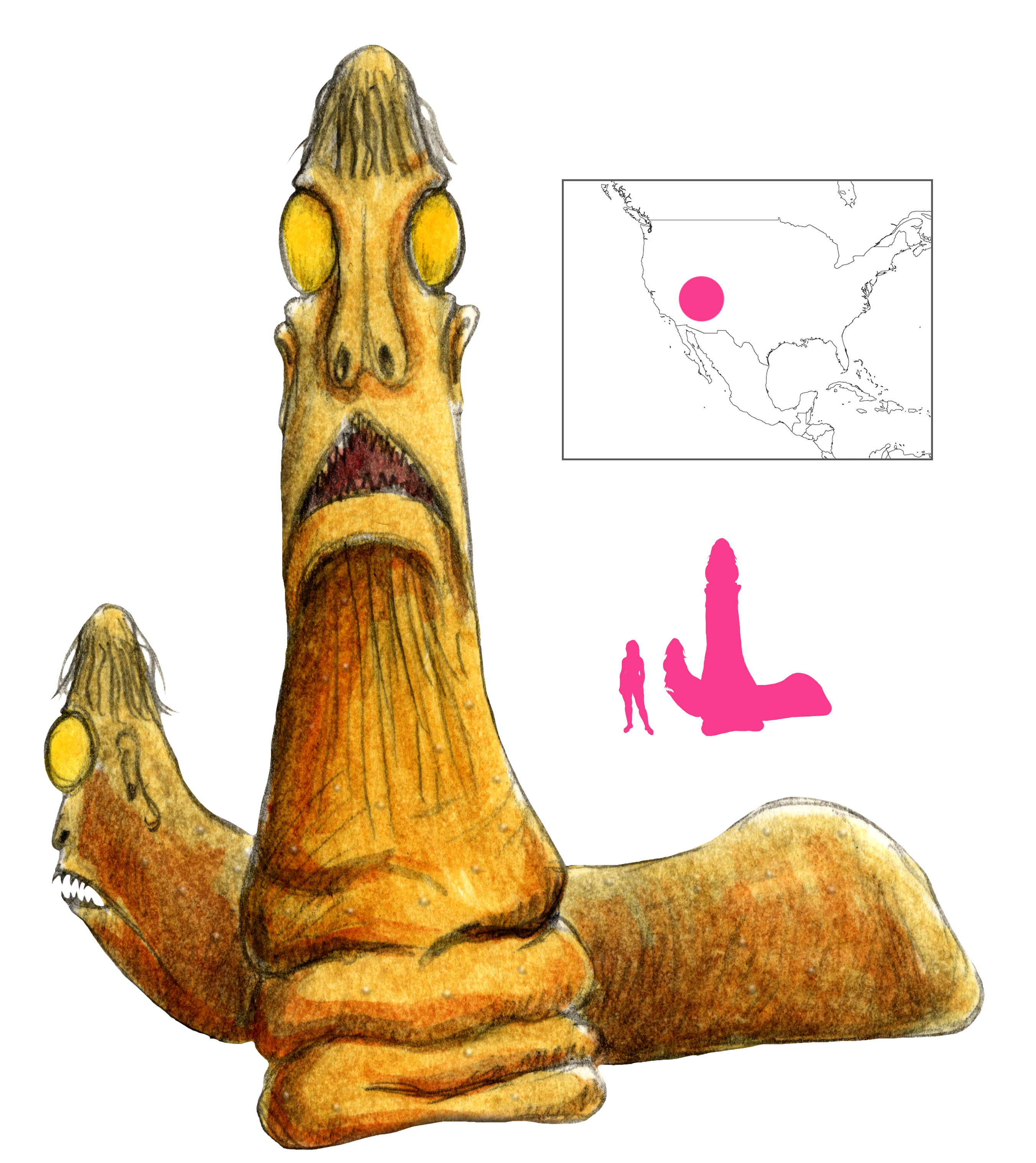
Isiququmadevu, “Smelly Whiskers”, is a mountainous “swallowing monster” from Bantu and Zulu folklore. She is bearded, bloated, hairless, and squatting, with an enormous mouth capable of engulfing entire villages. Other clues as to her appearance are given in her many epithets, which include Unomabunge (“Mother of Beetles”), O’gaul’-iminga (“Feller of Lofty Thorn-trees”), and O-nsiba-zimakqembe (“She Whose Feathers are Long and Broad”).

Naturally the royal cortège was mortified, and entreated the isiququmadevu to return their belongings. “Untombinde, the king’s daughter, brought us here, she is to blame”. One by one they recuperated their effects, until Untombinde was left. “Beseech Usiququmadevu”, they told her, using a more personal and flattering name for the monster. But Untombinde – perhaps miffed by her companions’ accusations – refused. “I am the king’s daughter”, she said haughtily, “and I will never entreat the isiququmadevu”. Whereupon the monster seized her and took her into the pool.

King Usikulumi despaired for his daughter, fearing she was lost forever, and ordered his troops to slay the isiququmadevu. But the monster hauled herself onto the bank, and swallowed the entire army in one gulp. She then followed their trail back to the village, and swallowed the men, the women, the children, the dogs, the cattle, every living thing she found there.

Among her victims were two adorable twin children whose father was the only villager who escaped the isiququmadevu’s attack. He resolved to kill the creature, arming himself with his assagai and following her back into the woods. First he met a herd of buffaloes. “Where has Usiququmadevu gone? She has taken my children”. Acknowledging his plight, the buffaloes told him he was on the right track with a “forward, forward!” Next he met some leopards and an elephant, who advised him to keep on going. Finally he found the isiququmadevu herself, replete and squatting. “I seek Usiququmadevu, who has taken my children!” he announced. “Forward, forward!” said the isiququmadevu, but the man was not as dimwitted as she had hoped, and he stabbed her with his spear until she died. Then all her victims climbed out, none the worse for wear, with Untombinde, defiant and proud, coming out last.

In another isiququmadevu story, it is Usitungusobenthle, a young woman who had been abducted by pigeons to be their queen, who brings about the creature’s demise. She returns to her village after escaping her captors only to find it empty, with the isiququmadevu sleeping nearby. She cut it open with a knife, and released all its victims.

Another princess, Uluthlazase, actually stood up to an isiququmadevu and tried to wrest her clothes from the monster. She held on so firmly that the isiququmadevu could not remove her, and the two fought each other to a stalemate. When it left to get assistance from other isiququmadevu, Uluthlazase collected her effects and wisely escaped.

References

Callaway, C. (1868) Nursery Tales, Traditions, and Histories of the Zulus. Trübner and Co., London.

Koopman, A. (2002) Zulu Names. University of Natal.

Werner, A. (1968) Myths and legends of the Bantu. Frank Cass and Co. Ltd., London.

Abúhukü

Variations: Abúhuwa (pl.)

Abuhuwa

The victims of the Abúhuwa, the rainforest demons of the Cubeo people of the Colombian Amazon, are easily recognized. An abúhukü will cut a hole in the skull before sucking out the contents of the body. Sometimes prey is rolled in palm leaves and tenderized. Either way, they leave an empty skin hanging from a branch.

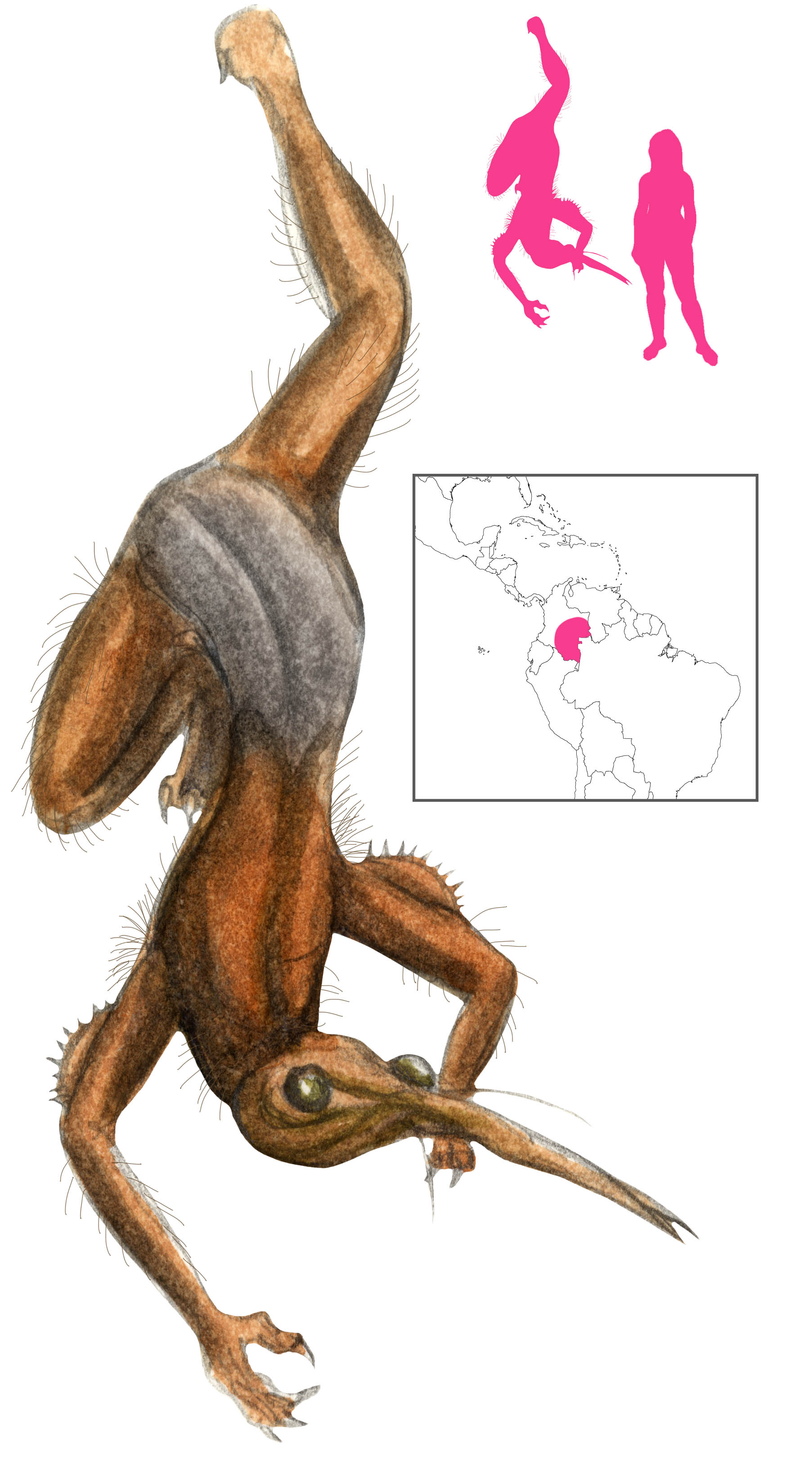
Abúhuwa are nocturnal creatures who embody disease, death, and all that is evil. They associate with the spirits of dead poisoners, murderers, and male adulterers, and are described as misty creatures from the realm of darkness. Their name is derived from “whiteness”, or the foaming of rapids. Like almost all other Amazonian ogres, the abúhuwa are hairy and foul-smelling, associating them with bestial sexuality and death respectively. In addition to that, they have an extra face in the back of their head, and sticky bodies that make escape from their embrace impossible. The females have long pendulous breasts and prefer to kill men, while the males attack women, often killing mothers and abducting their children to raise as their own. Such abúhuwa changelings become cannibals themselves.

The abúhuwa were once far more common, and were allied with a race of evil jaguars that worked with them to decimate human populations. Humanity got a respite after a series of floods and fires that reduced the numbers of both predators.

Abúhuwa are fortunately quite stupid, and can easily be outwitted by children. They are relegated to the status of nursery bogies, reflected in a sort of tag game where one child plays the part of the abúhukü. The grotesqueness of the abúhuwa makes them easier to confront and mock.

Armpit hair from an abúhukü makes a potent ingredient in poisons. To obtain it, an abúhukü must be caught during a lunar eclipse, and the hair from its left armpit must be cut with a corn husk, reduced to ash, mixed with water and turned into paste, and left to dry. It keeps well in a gourd sealed with beeswax.

Capsicum smoke is toxic to abúhuwa, and they can be easily driven away by burning peppers. When killed, they turn into sloths.

References

Goldman, I. (1979) The Cubeo Indians of the Northwest Amazon. University of Illinois Press, Urbana.

Goldman, I. (2004) Cubeo Hehénewa Religious Thought. Columbia University Press, New York.

Smith, N. J. H. (1996) The Enchanted Amazon Rain Forest. University Press of Florida, Gainesville.

Chonchón

Variations: Chonchon, Chonchoñ, Chon Chón, Chuncho, Chucho, Chuchu, Chaihue; Chonchones (pl.); Cocorote, Corocote (Venezuela); Cuscungo (Ecuador); Tecolote, Telocote (Mexico)

Chonchon

The Chonchón is a bird of ill omen from Chile and Argentina; it originally hails from Araucanian Mapuche folklore. Chonchón is also the name of a kind of kite.

In its simplest form it is a bird of the night, an owl (Strix rufipes) that flies on silent wings during the night to announce illness, death, or some other unwelcome event. When its croaking is heard it is advised to throw ash into the air and utter a few prayers in the hopes of turning away its evil.

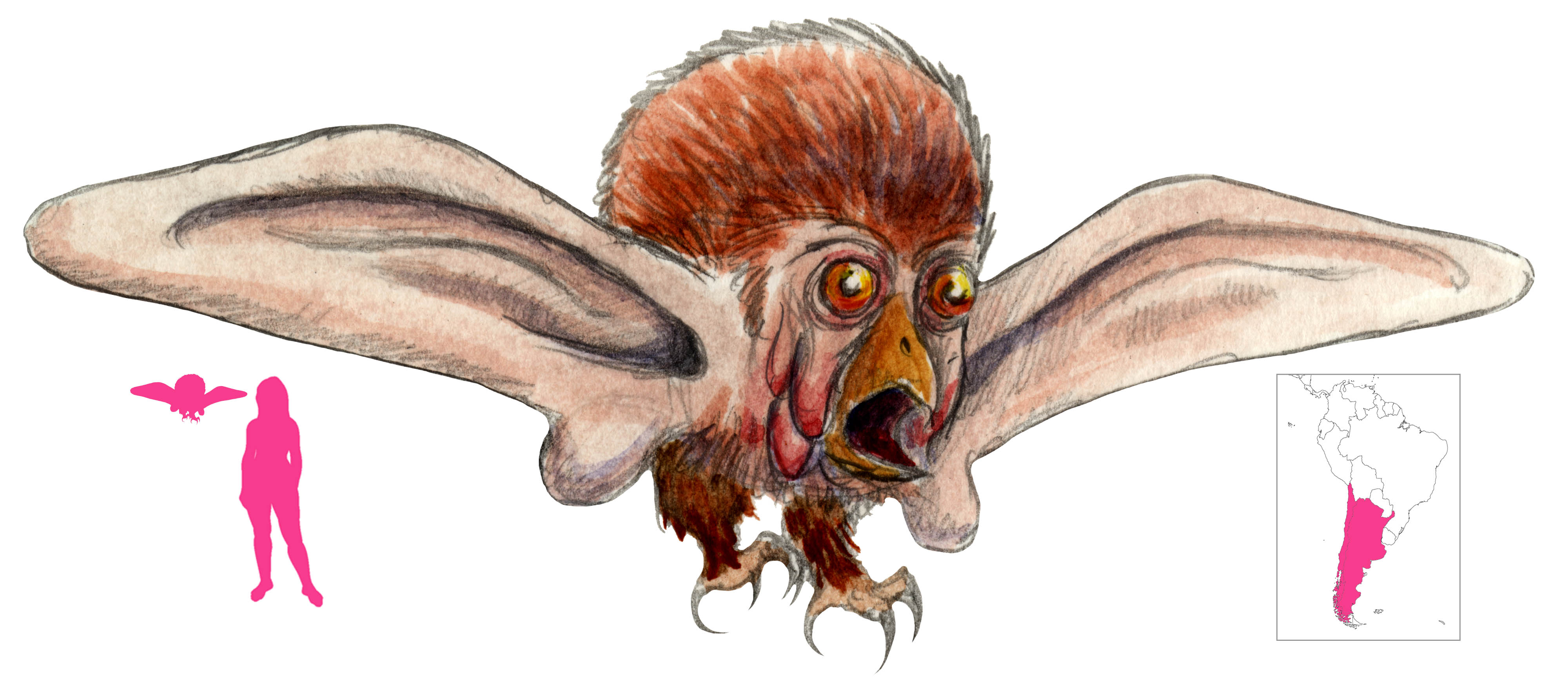
The chonchón is also said to be a calcu or evil sorcerer in disguise. It resemble a human head, with oversized wing-like ears that allow it to fly. During the night, these sorcerers’ heads detach themselves from their bodies and fly around to cause mischief, invisible to most, their ominous tué, tué, tué call announcing misfortune. They have the same powers as sorcerers do, and have been known to suck the blood of sleepers.

In order to repel chonchones, several methods are recommended. These include drawing a Solomon’s seal on the ground, laying out a waistcoat in a specified manner, or reciting certain phrases or hymns such as the Magnificat, the Doce Palabras Redobladas, “Saint Cyprian goes up, Saint Cyprian goes down, Saint Cyprian goes to the mountain, Saint Cyprian goes to the valley”, or “Jesus goes ahead, follow him behind”. Doing any of these actions forces the chonchón to leave, or even fall to the ground where it can be destroyed. If the headless body of a chonchón sorcerer is found, turning it onto its stomach prevents the chonchón from returning to it. Finally, a more humane means of dealing with a chonchón is to yell “Come back tomorrow for some salt!” The next day, the chonchón in its human guise will show up and sheepishly request the promised salt. Except perhaps for the last method, most interference with the ways of chonchones will eventually incur the revenge of the chonchón or its friends.

One chonchón was reportedly grounded in Limache when someone made a Solomon’s seal, causing a large bird with red wattles to fall out of the sky. It was decapitated and its head fed to a dog, whose belly swelled up as though it had eaten a human head. Later the local gravedigger told that unknown persons had come to bury a headless body.

Not all chonchones are irredeemably evil, however. A Mapuche man in Galvarino once woke up early in the morning to find his wife’s body without her head. He immediately realized that she was a chonchón, and turned the body onto its stomach to prevent the head from reattaching. As expected, a chonchón soon flew heavily into the house, flapping and staggering as though blind. It then turned into a dog and whined pleadingly to be reunited with its body. The man took pity on it and allowed it to do so, and it became his wife once more. “Every night I leave, without you knowing, and visit distant lands”, she explained. She begged him not to tell anyone, and swore she would never harm him, and both kept their word; the story became known only after the wife died of natural causes.

Some authorities separate the chonchón from the chuncho, with the former being the sorcerous flying head and the latter the owl. Their calls are also different, with the chuncho hooting chun, chun, chun. They have further owl equivalents in the Venezuelan cocorote, the Ecuadorian cuscungos, and the Mexican tecolote. It is also compared to the myth of the voladora, a witch who flies while cackling loudly.

All this is quite unfair to the owls themselves, which benefit the farmers by eating mice, rats, and other vermin.

References

Aguirre, S. M. (2003) Mitos de Chile. Random House, Editorial Sudamericana Chilena.

Borges, J. L.; trans. di Giovanni, N. T. (1969) The Book of Imaginary Beings. Clarke, Irwin, & Co., Toronto.

Cifuentes, J. V. (1947) Mitos y supersticiones (3rd Ed.). Editorial Nascimento, Santiago, Chile.

Coluccio, F. and Coluccio, S. (2006) Diccionario Folklórico Argentino. Corregidor, Buenos Aires.

Rodríguez, Z. (1875) Diccionario de Chilenismos. El Independiente, Santiago.

Soustelle, G. and Soustelle, J. (1938) Folklore Chilien. Institut International de Coopération Intellectuelle, Paris.

Tabib al-Bahr

Variations: Doctor of the Sea, Sea Doctor

Tabib-al-bahr

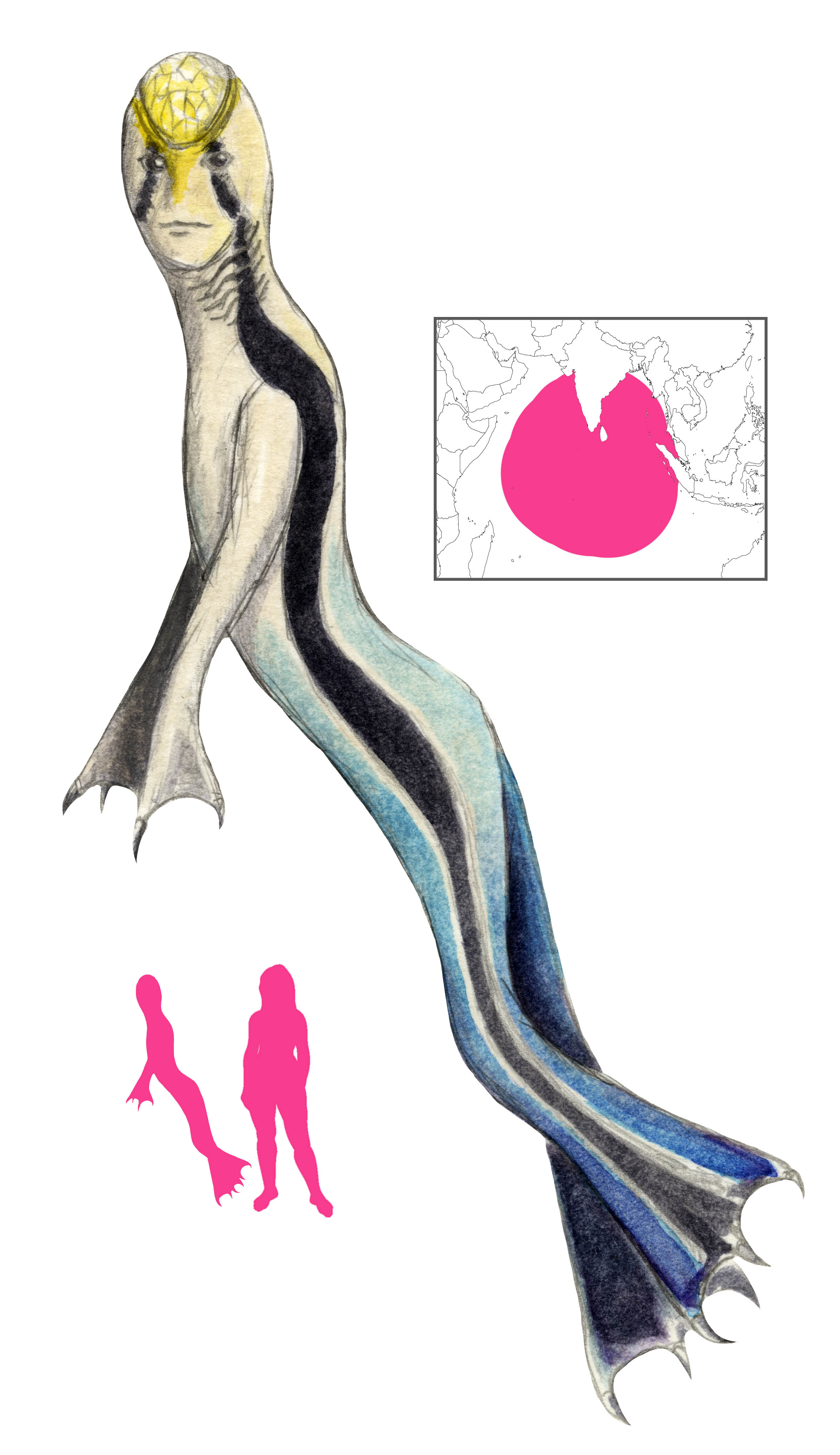
The mysterious Tabib al-Bahr, the “Doctor of the Sea”, is found in the writings of the alchemist Jabir ibn Hayyan. Its appearance is not very clear; we know that it is a fish with a yellow gemstone in its forehead, and that it is also human in shape. This marine animal, despite its considerable magical powers, is very caring and altruistic. It derives its name from the gemstone in its head, which can heal any ailment; it attends to other sea creatures by rubbing its head twice or thrice on their injuries, healing them instantly. Perhaps because of this self-sacrificing nature, the tabibs also do not resist capture by humans, instead waiting patiently for the right time to escape.

The gemstone of a tabib al-bahr is of great value to alchemy. If the creature is slaughtered and its stone taken out of its head, it can be used to create gold out of silver. It was that gemstone that drew Jabir ibn Hayyan into seeking out the tabib al-bahr.

After enlisting the aid of a number of skilled sailors, Jabir set sail into the Indian Ocean. He eventually found a group of tabib al-bahrs near the unknown island of Sindiyyāt. The net was cast, and one of the creatures was caught. It started striking its cheeks in a feminine act of desperation, and Jabir realized that the tabib they had caught was a young woman of great beauty. She was taken on board and imprisoned in a small cabin; she seemed incapable of speech beyond mumbling in an unknown language. Jabir was given the chance to test her powers by bringing in a sailor with torticollis. After the tabib rubbed her gemstone on his arms and legs, he was immediately cured.

This situation was not to last long. One of the sailors, a young man, fell in love with the strange creature, and Jabir allowed them to live together in the cabin. Eventually she became pregnant and gave birth to a boy, human in all aspects except for a marvelous, shining forehead. As the boy grew, the mother was eventually given free reign of the boat, as she seemed attached to the crew, keeping them company, tending to their injuries, and caring for her son. Unfortunately that was not the case, and after a long inspection of all possible escape routes, she finally climbed over the railing and dove into the water. Her husband was brokenhearted, but he swore to care for the son she left behind.

Eventually the ship sailed into a storm from which there seemed to be no escape. Throwing anchors into the water did nothing to hold the ship, and it was on the verge of capsizing. That was when they saw their tabib al-bahr sitting calmly on the surface and waving to them. All the sailors begged her to save them, and in response she transformed into a colossal fish, big enough to stretch from one end of the sea to the other. By swallowing huge quantities of seawater, she lowered the sea level enough for the storm to be quelled. While the sailors worried over whether or not she’d swallow them next, her son dove into the sea after her. The next day he returned to the ship, and his forehead now had a yellow gemstone in it.

Later on Jabir had the opportunity to catch two more tabib al-bahrs, one of which was sacrificed for its gemstone. Jabir marveled at it, a wondrous artifact the likes of which humans would never make.

This tale may not be meant literally, and it has generally been taken as some kind of alchemical allegory. His scribes agreed, noting that it is “very symbolic”, with elements representative of fire and water.

The alchemist-poet Ibn Arfa’ra’sahu dedicated several verses to the tabib al-bahr, saying that “the truest of scientists have vouched for it, Plato and his student Aristotle”.

References

Mahmud, Z. N. (1961) Jabir ibn Hayyan. Maktabat Misr.

Kraus, P. (1986) Jabir Ibn Hayyan : Contribution à l’historie des idées scientifiques dans l’Islam. Société d’Édition Les Belles Lettres, Paris.

Zitiron

Variations: Zityron, Zytyron; Albiron; Barchora; Miles; Soldier, Soldier of the Sea, Man-at-arms of the Sea; Soldat de Mer, Gendarme de Mer; Sea Turtle

Zitiron

The Zitiron (perhaps a corruption of Ketos or whale), or Soldier of the Sea, is a heavily armored marine fish. It has a rough and hard skin over its head like a helmet, and a long and wide shield hanging from its neck, attached by thick veins and nerves stretching from neck to shoulders. Its thick arms are two-fingered. It is long and wide, more or less triangular in shape, with a fish’s tail at its end. A zitiron is impervious to arrows, and can only be killed by bludgeoning it with hammers; it defends itself with its armor and with swipes of its strong arms.

Illustrators took the description of armor rather literally, turning the zitiron into a sort of merman encumbered with full plate armor, helmet, shield, and sword.

It is not hard to see a turtle in the zitiron’s description. Turtle shells have also been used as shields by various cultures, making the resemblance even more appropriate. Albertus Magnus asserted that Flemish and German fisherman give the name of “soldier” to turtles, because they have a helmet and a shield. The desire to see analogues of terrestrial entities in the sea completed the zitiron.

References

de Cantimpré, T. (1280) Liber de natura rerum. Bibliothèque municipale de Valenciennes.

Paré, A. (1614) Les Oeuvres d’Ambroise Paré. Nicolas Buon, Paris.

Magnus, A.; Kitchell, K. F. and Resnick, I. M. trans. (1999) On Animals: A Medieval Summa Zoologica, v. II. The Johns Hopkins University Press, Baltimore.

Unknown. (1538) Ortus Sanitatis. Joannes de Cereto de Tridino.

Vallot, M. (1834) Mémoire sur le Limacon de la Mer Sarmatique. Mémoires de L’Académie des Sciences, Arts, et Belles-Lettres de Dijon, Partie des Sciences, Frantin, Dijon.

Binaye Ahani

Variations: Bina’ye Ayani, Nayie A’anyie, Bina’yeagha’ni, Eye Killers, Evil Eyes

Binaye Ahani

The Binaye Ahani, or “Eye Killers”, were among the many Anaye that were slain by Nayenezgani. As with the other original Anaye or “Alien Gods”, they were born from human women who had resorted to unnatural practices. Their “father” was a sour cactus.

The Binaye Ahani were twins born at Tse’ahalizi’ni, or “Rock With Black Hole”. They were round with a tapering end, no limbs, and depressions that looked like eyes. Their horrified mother abandoned them on the spot, but they survived to grow into monsters; as they were limbless, they remained where they were born. Instead of hunting prey actively, they could fire lightning from their eye sockets and fry anyone who approached them. In time eyes developed in the depressions on their head, and they could kill with their eyes as long as they kept them open. Magpie was their spy, and they had many children who took after them in the worst way.

Nayenezgani prepared for his fight with the Binaye Ahani by taking a bag of salt with him, and found the old twins in a hogan with their offspring. The monsters immediately stared at him, lightning shooting from their bulging eyes, but Nayenezgani’s armor deflected the beams. He responded by throwing salt into the fire, which spluttered and sparked into their eyes, blinding them. With the Binaye Ahani in disarray, Nayenezgani waded in and killed all but the two youngest. He took the eyes of the first Binaye Ahani as trophies.

“If you grew up here, you would only become things of evil”, he told the survivors, “but I shall make you useful to my people in years to come”. To the older one, he said “You will warn men of future events, and tell them of imminent danger”, and it became a screech owl. To the younger he said “You will make things beautiful, and the earth happy”, and it became a whippoorwill.

In other versions the surviving children become a screech owl and an elf owl, while the parents are turned into cacti.

References

Locke, R. F. (1990) Sweet Salt: Navajo folktales and mythology. Roundtable Publishing Company, Santa Monica.

Matthews, W. (1897) Navaho legends. Houghton Mifflin and Company, New York.

O’Bryan, A. (1956) The Diné: Origin Myths of the Navaho Indians. Bulletin 163 of the Smithsonian Institution, Washington, D. C.

Reichard, G. A. (1950) Navaho Religion: A Study of Symbolism. Bollingen Foundation Inc., New York.

Fayette

Fayette

The Fayettes (“little fairies”) live in the Forez region in France, today around the Loire basin. They are believed to be the descendants of the Greek nymphs, having escaped the advance of Christianity in the Mediterranean.

In France they are much tinier versions of their former selves, but their magical powers are undiminished. They guard the caves and forests, and can be seen dancing in the woods of Couroux, in the Beaujolais. Like any self-respecting fairy, they like to abduct children and leave insatiable changelings behind. Those fairy children are best brought to the mouth of a cave and threatened with violence, causing the fayette to return the stolen child. Te, vequio le tio, rends me le mio (“There, here’s yours, return mine”).

During the night, the fayettes do their laundry under the moon. Travellers in the woods are advised to sing at the top of their lungs to make sure they’re not mistaken for threats. At daybreak the fairies dissipate like fog, sometimes leaving behind solid gold washboards that would make anyone’s fortune.

During the day the fayettes take the form of moles, and take pleasure in ravaging gardens. This is why moles have pretty little pink hands.

References

Proth, M. (1868) Au Pays de l’Astrée. Librairie Internationale, Paris.

Sébillot, P. (1904) Le Folk-Lore de France, Tome Premier: Le Ciel et la Terre. Librairie Orientale et Américaine, Paris.