Lilyi

Variations: Lilye, Lili

lilyi

Lilyi is the second child of Ana, Queen of the Keshalyi. Like her siblings, she is responsible for an array of ailments that plague humanity, and she had her genesis in the abusive relationship between Ana and her repulsive husband, the King of the Loçolico.

After the birth of Melalo, Ana understandably refused to have another child. But this time it was Melalo himself, desirous of a wife, who told his father to cook a fish in donkey’s milk, and administer a few drops of the liquid in Ana before taking her by force. The product of this vile union was Lilyi.

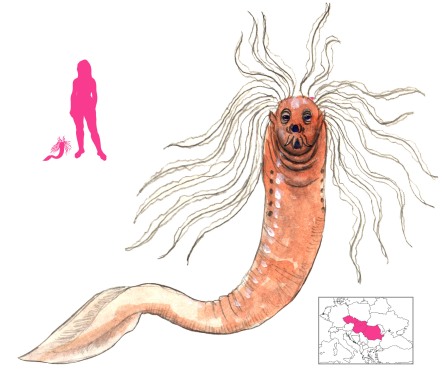
Lilyi, “Viscous” or “Slimy”, is mermaid-like, part fish (some sources specify hagfish) with a human head. Nine sticky threads or barbs flow from either side of her head, and they can penetrate a human body, causing buildup of mucus. She is responsible for catarrh, coughing, dysentery, influenza, vomiting, and other diseases involving mucus and discharges.

Her union with her brother Melalo produced further demons of disease, but she was herself persecuted by her younger brother Tçulo – at least until Tçulo got a sister-wife of his own.

References

Clébert, J. P. (1976) Les Tziganes. Tchou, Paris.

Clébert, J. P.; Duff, C. trans. (1963) The Gypsies. Vista Books, London.

Meyers Brothers Druggist (1910) Demons of Disease. Meyers Brothers Druggist, v. 31, p. 141.

Pavelčík, N. and Pavelčík, J. (2001) Myths of the Czech Gypsies. Asian Folklore Studies, v. 60, pp. 21-30.

Bruch

Variations: Bruchus, Brucha (pl.)

bruch

If the Hortus Sanitatis is to be believed, a young locust is far more dangerous than its adult counterparts. Referred to as a bruchus, it is an immature stage lasting until the animal can fly, and is distinguished by absent or undeveloped wings and a yellow color. As bruchi cannot fly, they remain in one place and gnaw fruiting plants down to the roots.

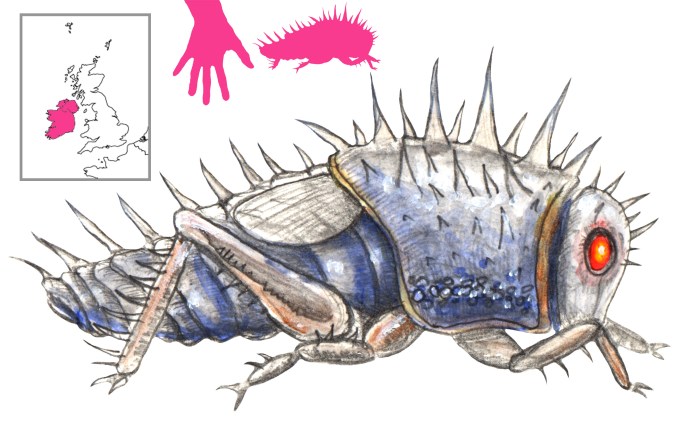
The Epistil Ísu, the Irish version of the pseudo-epigraphic Sunday Letter, describes the Bruch (pluralized as Brucha) differently. Here as before, the bruch is separated from its adult, and both are used to punish people who disrespect Sundays. A bruch has iron bristles and fiery eyes. Swarms of brucha go into the vineyards of sinners and cut the branches, roll about in the fallen grapes to impale them on their spikes, and carry the fruit off into their lairs – much like Pliny’s hedgehogs, which doubtlessly inspired this account.

Brucha apparently mature into locusts, which have iron wings that scythe wheat and make the ears fall. They too are avengers of Sunday.

References

Borsje, J. (1994) The Bruch in the Irish Version of the Sunday Letter. Ériu, v. XLV, pp. 83-98.

Borsje, J. (1996) From Chaos to Enemy: Encounters with Monsters in Early Irish Texts. Brepols Publishers, Turnhout.

Cuba, J. (1539) Le iardin de santé. Philippe le Noir, Paris.

Margot la Fée

Variations: Margot-la-Fée, Margot, La Bonne Femme Margot (The Good Woman Margot), Ma Commère Margot (My Godmother Margot), Fée Morgant

Margot

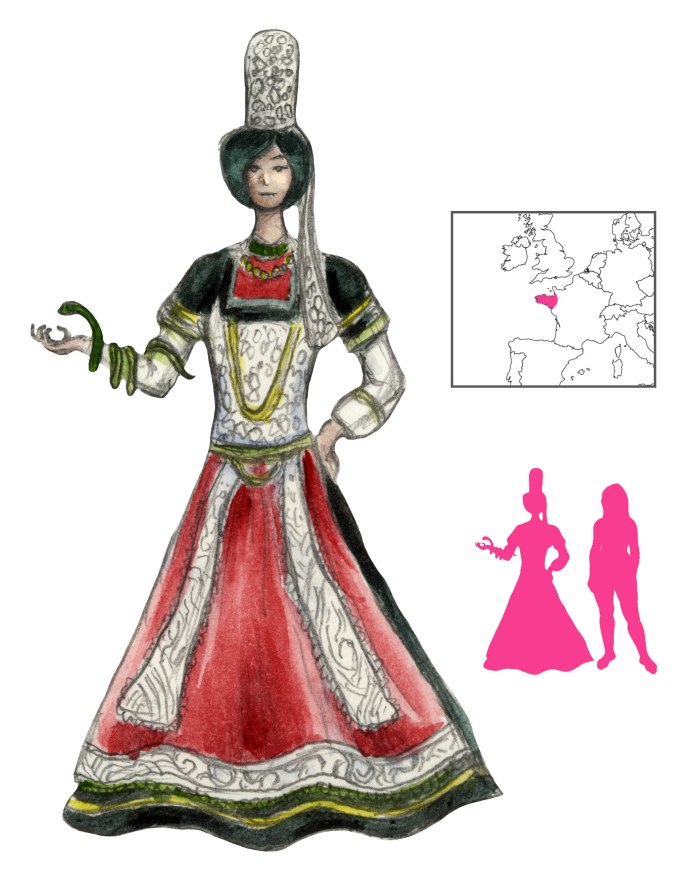
The Margot la Fée, “Margot the Fairy”, or more simply Margot, are fairies native to Brittany, particularly Collinée, Lamballe, Moncontour, and most of the Côtes-d’Armor. They are generally seen as benevolent and protective, but capable of deadly violence when provoked. The name of Margot – also used for magpies – is probably derived from Morgan or Morgana, as evidenced by the alternative name of Morgant; most local names are placatory terms of affection. Margot fairies are closely associated with megaliths, caves, treasures, and snakes, leaving the beaches to the Fées des Houles and the Groac’h.

Like most fairies, Margot fairies vary a lot in appearance, appearing as both young and old women as well as animals. They spend part of their time as snakes, both willingly and against their will, in which form they are most vulnerable. They possess considerable magical powers, dance in circles at night, haunt dolmens, swap babies with voracious changelings, and flee religious symbols.  Sometimes a Margot would take a fancy to a handsome young shepherd and choose to keep him in a cave for herself. In those cases time itself would seem to slow down, such were the pleasures that the fairy offered.

Margot fairies happily care for the livestock of their neighbors, even going so far as to feed them in the caverns while their owners were away. The Margot’s own livestock remained in the caves, emerging only to feed. On the other hand, hungry Margot fairies will tear a cow to pieces and devour it, only to restore it to life by the next morning, missing only any pieces that had been eaten by humans during the feast.

Margot fairies are often the guardians of fabulous riches. They will handsomely reward those who aid them, and punish any who take advantage of their generosity. If they tell you to take a certain amount of treasure and no more than that, you would be wise to follow their instructions to the letter. One man who took more gold from the Crokélien Hill fairies than he was instructed to had his son taken away from him, never to be seen again.

Other gifts of the Margot are more prosaic. They will offer piping hot loaves of bread to the hungry – loaves that never get smaller, no matter how many slices are cut from them. But if a piece is offered to someone else deemed unworthy by the fairies, the loaf will no longer regenerate.

Small acts of compassion are looked on with great favor. Two harvesters, resting after scything wheat, encountered a little grass snake eating the breadcrumbs they left behind. One tried to kill it, while the other stopped him, saying it would be wrong to kill a small, harmless animal. In the evening a Margot appeared to the second man and thanked him for protecting her daughter. She gave him two belts, one for him and one for his friend, telling him not to mix them up. His was of pure gold, while the other he tied to an oak tree, which wilted overnight.

Another man working near the hill of Crokélien encountered a Margot, who asked a favor of him. “Bring a large washtub with you”, she said, “and go to the Planchettes Bridge at sunrise. There you will find a grass snake. Put the washtub over it and sit on top. If anybody asks you why you’re there, tell them you’re waiting for the blacksmiths to fix the tub. At sundown, remove the tub, and you shall be richly rewarded for your help”. The man did as he was told, and sure enough, the snake was there at the bridge as the fairy had said. He covered it with the washtub and sat patiently there for the rest of the day, weathering the taunts and jeers of passers-by with aplomb. At sunset he removed the tub to find a beautiful maiden underneath. She was the Margot’s daughter, who transformed into a snake one day every year, and would have been killed had it not been for the man’s intervention. As promised, he never wanted for gold or silver for the rest of his life.

Human midwives will also be recruited by Margots to aid them in childbirth, gifting them with the power of second sight for the occasion. But woe to her if she let on that she could still see the fairies! A vindictive Margot would gouge her eye out, or spit in her face and blind her.

References

Dubois, P.; Sabatier, C.; and Sabatier, R. (1996) La Grande Encyclopédie des Fées. Hoëbeke, Paris.

Sébillot, P. (1887) Légendes Locales de la Haute-Bretagne: Les Margot la Fée. Maisonneuve et Ch. Leclerc, Paris.

Sébillot, P. (1904) Le Folk-Lore de France, Tome Premier: Le Ciel et la Terre. Librairie Orientale et Américaine, Paris.

Sébillot, P. (1905) Le Folk-Lore de France, Tome Deuxième: La Mer et les Eaux Douces. Librairie Orientale et Américaine, Paris.

Sébillot, P. (1906) Le Folk-lore de France, Tome Troisième: La Faune et la Flore. Librairie Orientale et Américaine, Paris.

Sébillot, P. (1968) Le folklore de la Bretagne. Éditions G. P. Maisonneuve et Larose, Paris.

Melalo

Variations: The Filthy One, The Dirty One, The Obscene One

Melalo

According to the Roma of Eastern Europe, notably Romania and Slovakia, all the diseases and ailments of the world can be traced back to a family of creatures born from an unholy union of fairy and demon. These unloved bastard children, hated by their parents, take their spite out on humans.

Long ago, the good fairies or Keshalyi lived in the high mountains, while the evil Loçolico, former humans warped and twisted by the Devil, lived underground. But when the King of the Loçolico took a fancy to Ana, Queen of the Keshalyi, their separate worlds were brought too close for comfort. After Ana turned down the ugly King of the Loçolico, the demons responded by hunting down and devouring the Keshalyi. Only Ana’s forced marriage to the King saved her people from utter annihilation.

Ana found her husband so disgusting that she refused to consummate the marriage. The King finally forced himself on her following the advice of a golden toad, who told him to feed her the brains of a magpie. Ana fell into a deep sleep, and soon after conceived Melalo, their first son.

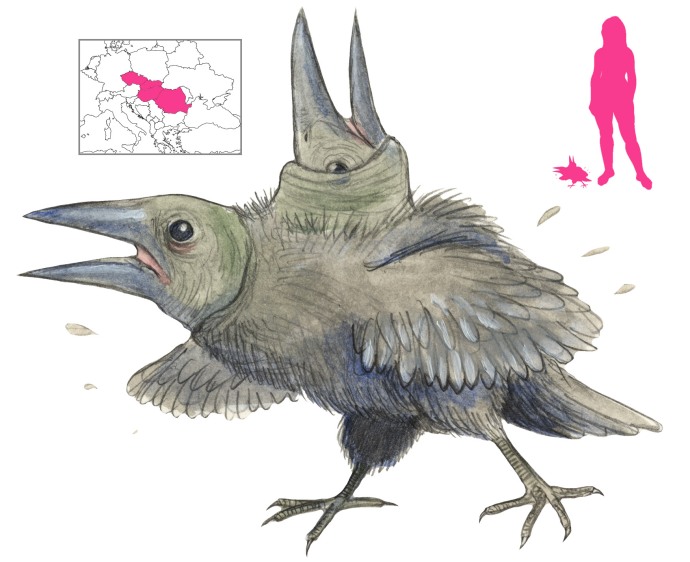
Melalo, literally “filthy”, “dirty”, or “obscene”, is the oldest and most feared of Ana’s children. He is a small, dirty grey (the English translation oddly gives the color as green), unkempt bird with two heads. He has sharp claws which he uses to tear out hearts and rip bodies to shreds; with his wings, he stuns victims and makes them lose their reason. Melalo foments anger, rage, cruelty, sadism, frenzy, rape, and insanity. Those he has affected can only chatter like a magpie.

Melalo would go on to influence the creation of the remainder of Ana’s brood. It was he who put his mother to sleep with his vapors, and convinced his father to sire Lilyi, his sister, wife, and eventual mother to countless women’s diseases. Melalo also guided the conception of his siblings.

To counter Melalo, one must tie an amulet with his image to the afflicted part of the body.

It is possible that the two-headed bird imagery that created Melalo started with the Hittites, who took it to Byzantium and eventually to Russia and Austria. Meanwhile, the expression yov hin jiamutr Melaskero (“he is Melalo’s son-in-law”) has persisted in reference to a violent, nasty person.

References

Clébert, J. P. (1976) Les Tziganes. Tchou, Paris.

Clébert, J. P.; Duff, C. trans. (1963) The Gypsies. Vista Books, London.

Meyers Brothers Druggist (1910) Demons of Disease. Meyers Brothers Druggist, v. 31, p. 141.

Pavelčík, N. and Pavelčík, J. (2001) Myths of the Czech Gypsies. Asian Folklore Studies, v. 60, pp. 21-30.

Kamaitachi

Variations: Kama-itachi, Kamakaze (“Sickle wind”)

Kamaitachi

The Kamaitachi, or “sickle weasel”, is the Japanese yokai of unexplained cuts. It is most common in snowy Honshu. The name itself may be alternately derived from kamae-tachi, “poised sword”.

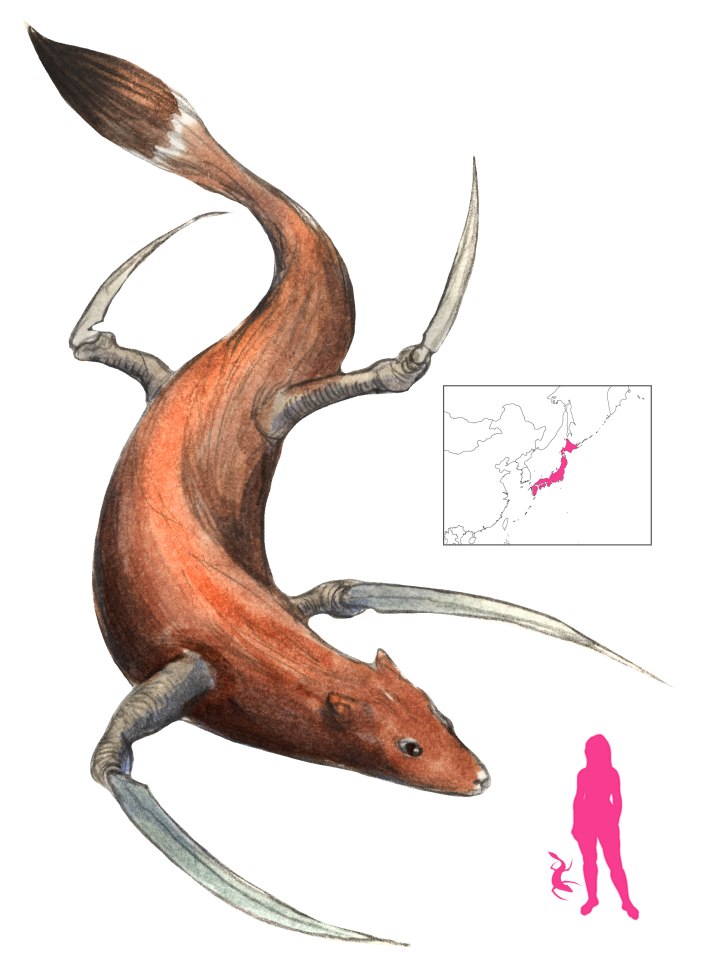
A kamaitachi looks something like a weasel with razor-sharp sickle claws. It travels in whirlwinds, but it is never seen. Instead, the presence of a kamaitachi is known by the cuts it leaves on its victims. It will also cause people to trip and fall, taking malign pleasure in causing injury.

Kamaitachi are useful scapegoats for inconvenient injuries. A woman in Niigata, after injuring herself during a nocturnal tryst, successfully deflected attention by blaming the kamaitachi for her wound.

The kamaitachi was rationalized in a number of ways, including pieces of sharp debris tossed around in whirlwinds. Y. Tanaka suggested that the “kamaitachi disease” was the result of temporary vacuums forming from stray air currents, slicing skin that came in contact with them. Such vacuums would be common in mountainous areas and thunderstorm conditions.

In Gifu the kamaitachi becomes three gods, the first pushing over the victim, with the second cutting with a knife and the third healing the injury.

References

Foster, M. D. (2015) The Book of Yokai. University of California Press, Berkeley.

Griffis, W. E. (1876) The Mikado’s Empire. Harper and Brothers, New York.

Y. Tanaka (1911) An Epitome of Current Medical Literature: Spontaneous Wounds. British Medical Journal, v. 2, p. 37.

Agrippa

Variations: Égremont, Vif

Agrippa

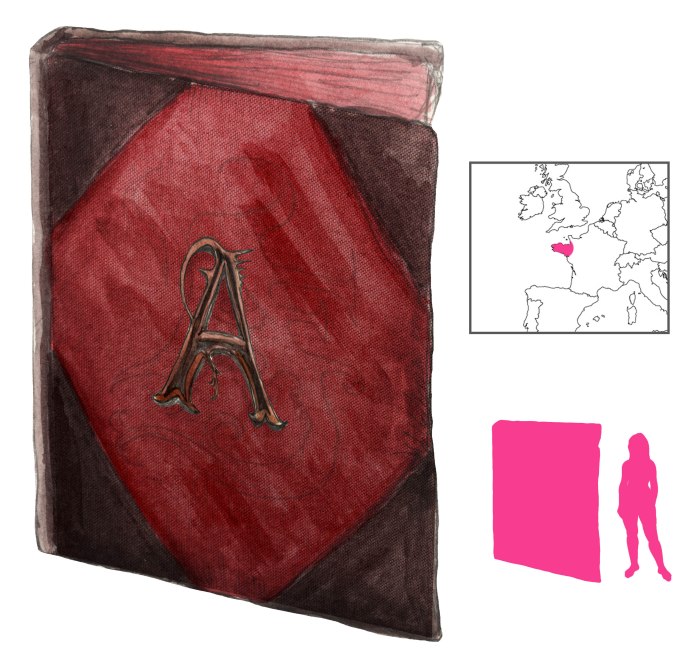
In Brittany, the Agrippa is one of the most feared and malevolent grimoires, a living book with a mind of its own. Its name in Tréguer is derived from that of Heinrich Cornelius Agrippa, but it is also known as Égremont in Châteaulin and Vif (“Alive”) around Quimper.

An agrippa is enormous, standing fully as tall as a man. Its pages are red, while its letters are black – although some variants exist with black pages and red text. It contains the names of all the devils, and how to summon them.

Agrippas are living, malicious creatures, and resent being read. An untamed agrippa will display only blank pages. To get the letters to appear, the agrippa must be battled, thrashed, and beaten like a stubborn mule. A fight with an agrippa can last hours, and victors come out of it exhausted and drenched in sweat. When not in use, an agrippa must be chained to a strong, bent beam.

Only priests can be trusted to keep agrippas, as they have the training and the force of will required to master it. They use it to deduce the fate of the dead by calling upon all the demons in order; if none will admit to having taken the deceased’s soul, then they were saved. Long ago all priests had agrippas, and a newly-ordained priest would inexplicably find one on his table. However, agrippas have since found their way into the hands of laymen, and the temptation to use them can be very strong. A priest will not be able to sleep well as long as one of his parishioners has an agrippa.

Uninitiated readers of the agrippa will always smell of sulfur and brimstone, and walk awkwardly to avoid treading on stray souls. A man with an agrippa will find himself incapable of destroying it – a task that will become increasingly desperate, as possession of an agrippa will prevent entry into Paradise. Loizo-goz, a man from Penvénan, tried to rid himself of his agrippa by dragging it away to Plouguiel on the end of a chain, but came back home to find it had returned to its usual place. He then tried burning it, but the flames recoiled from the book. Finally he dumped the agrippa into the sea with rocks tied to it, only to see it climb out of the water, shake its shackles off, and make a beeline for its suspended perch. Its pages were perfectly dry. Loizo-goz resigned himself to his fate.

Eventually a priest will arrive to save the owner of an agrippa. He will wait until the unfortunate is at death’s door, whereupon he will come to his deathbed. “You have a very heavy burden to carry beyond the grave, if you do not destroy it in this world”, he tells him. The agrippa is untied and brought down, and while it tries to escape, the priest exorcises it, and sets fire to it himself. He then collects the ashes, places them in a sachet, and puts them around the dying man’s neck, telling him “May this weigh lightly upon you!”

Other times a priest will have to save a man whose reading of the agrippa took him too far. A Finistère parson found his sacristan missing, and his agrippa open wide on the table. Understanding that the sacristan had summoned the devils and been unable to dismiss them, he started calling upon them one by one until they released him. The sacristan was blackened with soot and his hair was scorched, and he never told a soul of what had transpired.

References

Le Braz, A. (1893) La Légende de la Mort en Basse-Bretagne. Honoré Champion, Paris.

Luzel, F. M. (1881) Légendes Chrétiennes de la Basse-Bretagne, v. II. Maisonneuve et Cie, Paris.

Seignolle, C. (1964) Les Évangiles du Diable. Maisonneuve et Larose, Paris.

Gremlin

<strong>Variations:</strong> ?

<img class=”alignnone size-full wp-image” src=”https://abookofcreatures.com/wp-content/uploads/2016/04/gremlin.jpg&#8221; width=”451″ height=”612″ />

<img class=”alignnone size-full wp-image” src=”https://abookofcreatures.com/wp-content/uploads/2016/04/gremlin-2.jpg&#8221; width=”451″ height=”612″ />

Gremlin 3

Every unexplained mechanical error, every mysteriously malfunctioning engine, defective wheel, gas leak, fuselage weakness, cockpit damage, and avionics glitch can be blamed on gremlins. These little machine fairies are the modern equivalent of the ancient dwarfs, but they destroy instead of build.

Etymologies for “gremlin” disagree, and are probably all apocryphal. One suggestion holds that it originates from the antiquated Old English gremian, “to vex”. This is related to the Irish Gaelic gruaimin, “grumpy little fellow”, which comes from gruaim, “gloom” or “ill-humor”. Another suggestion is a shortening of grinning goblin. The French grelon or “hailstone” indicates some meteorological confusion. Edwards adds the German gram or “worry” to the mix, from which the diminutive gramlein can be derived. Finally, Fremlins beer may have had a hand in inspiring gremlins.

Similarly there is no consensus on gremlin appearance, but it is generally assumed that they are small, six inches to a foot in height, and humanoid in appearance. They are skinny and nimble enough to move about through complex machinery. Known colors include green and blue-grey. Some have horns, others have pointed ears; webbed feet and suction cups have been suggested for yet others. Clothing is optional, including nudity, pilot gear, breeches and jackets, and even spats and top-hats. They eat treacle and honey, and drink fuel, sucking tanks dry.

Gremlins were first identified by R.A.F. pilots, especially on Maltese airfields in World War I, although there is evidence to suggest that they have been around longer than that. From there tales of the gremlins and their deeds spread throughout the piloting world, until they became a byword for any unexplained mechanical issues.

Gremlin activities range from juvenile pranks to outright destructive cruelty. They view all airplanes as an affront, and do whatever they can to ground them. Some gremlin subspecies specialized in specific forms of mischief. Mole-like Cavity gremlins dug holes in runways, Incisors teethed on wires, Jockeys guided birds into airplane windscreens, and Optics glowed over bomb sights.

While gremlins have faded from the aerial popularity they enjoyed during the war, the preponderance of technology in our modern world has only given them further targets to mess wgsgnslfgnsogdkfjgluiw4v8r93428RQVNWAELIVJWBKkjdhzseuwy5ycjdft3534bsrg5566fgdfgcbvgbc

<strong>References</strong>

Dubois, P.; Sabatier, C.; and Sabatier, R. (1992) La Grande Encyclopédie des Lutins. Hoëbeke, Paris.

Edwards, G. (1974) Hobgoblin and Sweet Puck. John Sherratt and Son, Altrincham.

Sāmm-abraṣ

Variations: Sāmma-abraṣ, Abraṣan (dual); Sawāmm-abraṣ, Sawāmm, Biraṣa, Abariṣ, Abariṣa (plural); Borṣ-sāmm, Abu Braiṣ, Abu Breiṣ, Borṣ, Wazaghah, Gecko

[image pending]

The gecko has long been unfairly associated with leprosy in the Middle East, probably due to its greyish, leprous appearance, translucent, shedding skin, and detachable tail. Its common names of sāmm-abraṣ (“leper poison”) and abu braiṣ (“father of leprosy” or more simply “leper”) reflect the belief that it somehow transmits a deadly poison that causes leprosy.

Al-Qazwini and Al-Damiri describe the sāmm-abraṣ as being a large species of gecko, small-headed, long-tailed, with a leprous, sickly appearance. A sāmm-abraṣ is highly toxic and spreads leprosy by contact, often rolling in salt to transmit the disease. Its unwanted presence can be averted by the smell of saffron.

It is unlawful to eat or sell a sāmm-abraṣ, as one poet reflects “By God, even if I were His entirely, I would not be a slave eating abariṣ”. However, its blood cures alopecia, its liver alleviates toothache, its flesh heals scorpion stings, and its skin destroys hernias.

A sāmm-abraṣ in a dream is believed to represent poverty, anxiety, and toxic slander.

In India it is told that a gecko crawling over a sleeper’s body forebodes their imminent death, and a gecko falling on someone’s face makes them an albino. Ganges water and “gold water” in which gold has been placed counter the gecko’s poison, but it still ruins any food it touches.

The unwarranted evil reputation of the gecko, while deep-rooted, has not always been the case. Geckos feature in ancient Egyptian art in an apotropaic function, protecting the deceased from scavenging insects.

References

al-Damiri, K. (1891) Hayat al-hayawan al-kubra. Al-Matba’ah al-Khayriyah, Cairo.

Fremgen, J. (1996) The Folklore of Geckos: Ethnographic Data from South and West Asia. Asian Folklore Studies, vol. 55, pp. 135-143.

Guilhou, N. (2009) Lézards et geckos dans l’Égypte ancienne. IVe Rencontres archéozoologiques de Lattes, UMR 5140 – CNRS, Université Paul-Valéry
Montpellier 3.

Jayakar, A. S. G. (1908) Ad-Damiri’s Hayat al-Hayawan (A Zoological Lexicon), vol. II, part I. Luzac and Co., London.

Orr, J. (1915) The New Standard Bible Encyclopedia, volume III. The Howard-Severance Company, Chicago.

al-Qazwini, Z. (1849) Zakariya ben Muhammed ben Mahmud el-Cazwini’s Kosmographie. Erster Theil: Die Wunder der Schöpfung. Ed. F. Wüstenfeld. Dieterichsche Buchhandlung, Göttingen.

Vodyanoi

Variations: Vodianoi, Vodyanik, Vodnik, Vodeni Moz, Deduska Vodyanoy (Water-Grandfather), Vodianoi-chert (Water Devil), Vodianikha (female), Topielec (Drowner, Polish), Vodyany-ye (pl.); Bolotnyi (potentially)

Vodyanoi

The malevolent and murderous Vodyanoi, from voda or “water”, is the Slavic water spirit. It frequents lakes, ponds, rivers, and other bodies of water, but it especially prefers mill-ponds. Their homes range from the humble dwellings of sand and slimy logs of Olonets to underwater palaces of crystal, decorated with gold and silver taken from shipwrecks, and illuminated by a magic stone shining brighter than the sun. The palaces are primarily known from Kaluga, Orel, Riazan, and Tula. The female vodyanyoi is also known as the vodianikha, although a rusalka or a drowned woman will also be taken as a bride. Variants of the vodyanoi are known in Belarus, Poland, and Yugoslavia.

A vodyanoi varies wildly in appearance. It can be roughly human in appearance, with big paws, horns, tail, and eyes like burning coals; it can be a huge man covered with grass and moss, with shaggy white fur, or with scales; it can be black with huge red eyes and a long nose, or bluish and slimy, bloated and crowned with reeds. Sometimes it appears in the form of a human, as an old man with green hair and beard that turned white with the waning moon, as a white-bearded peasant in a red shirt, as a naked woman with enormous breasts combing her dripping hair while seated on a log, or in the form of guardsmen and children. It can be half fish and half human, or appear as a huge moss-covered fish, a swan, or even a bouquet of red flowers on the water. In Smolensk the vodyanoi is humpbacked and has the feet and tail of a cow, while in Vologda it is a log with little wings flying over the water. A vodyanoi out of the water and in human guise can be identified by the water oozing out of its coat.

The vodyany-ye are immortal, but grow younger or older with the moon. They are weak on land, but virtually invincible in the water, and they dislike going out of the water beyond the bank or mill-wheel; some vodyany-ye refuse to emerge from water beyond the waist. They like to ride livestock until they die of exhaustion. Their presence in the market is an omen; if a vodyanoi buys corn at high prices, the harvest will fail, but a vodyanoi buying cheaply foretells bountiful crops.

They rest in their palaces during the day, and come out in the evening splashing the water with their paws, making a noise that can be heard over great distances. Vodyany-ye hate humans and lurk in the water after sunset, dragging people in when the opportunity arises. Those they drown become their slaves, or if attractive enough their wives. They take offense to anyone attempting to retrieve the bodies of the drowned, seeing them as their rightful property. Recovered bodies with bruises and marks on them were seen as bearing the scars of battle with a vodyanoi. In some places the presence of a vodyanoi became a serious threat. One mill-pond in Olonets held a vodyanoi family that required a constant source of corpses to eat. The inhabitants of the area learned to avoid the pond, and the family was eventually forced to relocate.

A vodyanoi sees mill-dams as an insult, and will destroy them to keep the water flowing. Horses smeared with honey, hobbled, and drowned with millstones make good placatory offerings. Drunk passers-by can also be pushed into mill-ponds to earn the vodyanoi’s trust.

As with other evil spirits, a vodyanoi can be exorcised; in fact, in some areas such as Tula, the vodyanoi is indistinguishable from the devil. Shooting a vodyanoi with buttons has been known to kill them as well. But while a vodyanoi can bear grudges, it can just as soon show gratitude. One vodyanoi who was aided in fighting off a rival promised never to drown anyone.

A vodyanoi is not hostile to fishermen and millers due to their affinity with water. Millers would deposit bread, salt, vodka, black sows, and ram’s heads at the water’s edge as offerings to the vodyanoi, and offer black roosters when building a new mill. Some millers were on such good terms with their local vodyanoi that they dined with them every night. Fishermen, on the other hand, would toss butter or tobacco into the water, saying “here’s some tobacco for you, vodyanoi, give me a fish!” A pleased vodyanoi would drive fish into a fisherman’s net. Finally, beekeepers also kept up good relations with the vodyanoi by offering honey and wax, and in return the water-spirit prevented humidity from damaging the hives.

The bolotnyi, from boloto or “swamp”, is a possible variation of the vodyanoi found in swamps.

References

Aldington, R. and Ames, D. trans.; Guirand, F. (1972) New Larousse Encyclopedia of Mythology. Paul Hamlyn, London.

Dubois, P.; Sabatier, C.; and Sabatier, R. (1992) La Grande Encyclopédie des Lutins. Hoëbeke, Paris.

Ivanits, L. J. (1989) Russian Folk Belief. M. E. Sharpe, Inc., Armonk, New York.

MacCulloch, J. A. and Machal, J. (1918) The Mythology of All Races v. III: Celtic and Slavic. Marshall Jones Company, Boston.
Skoffín

Variations: Skoffin; Skuggabaldur, Finngalkn, Fingal; Urdarköttur, Naköttur; Modyrmi

Skoffin

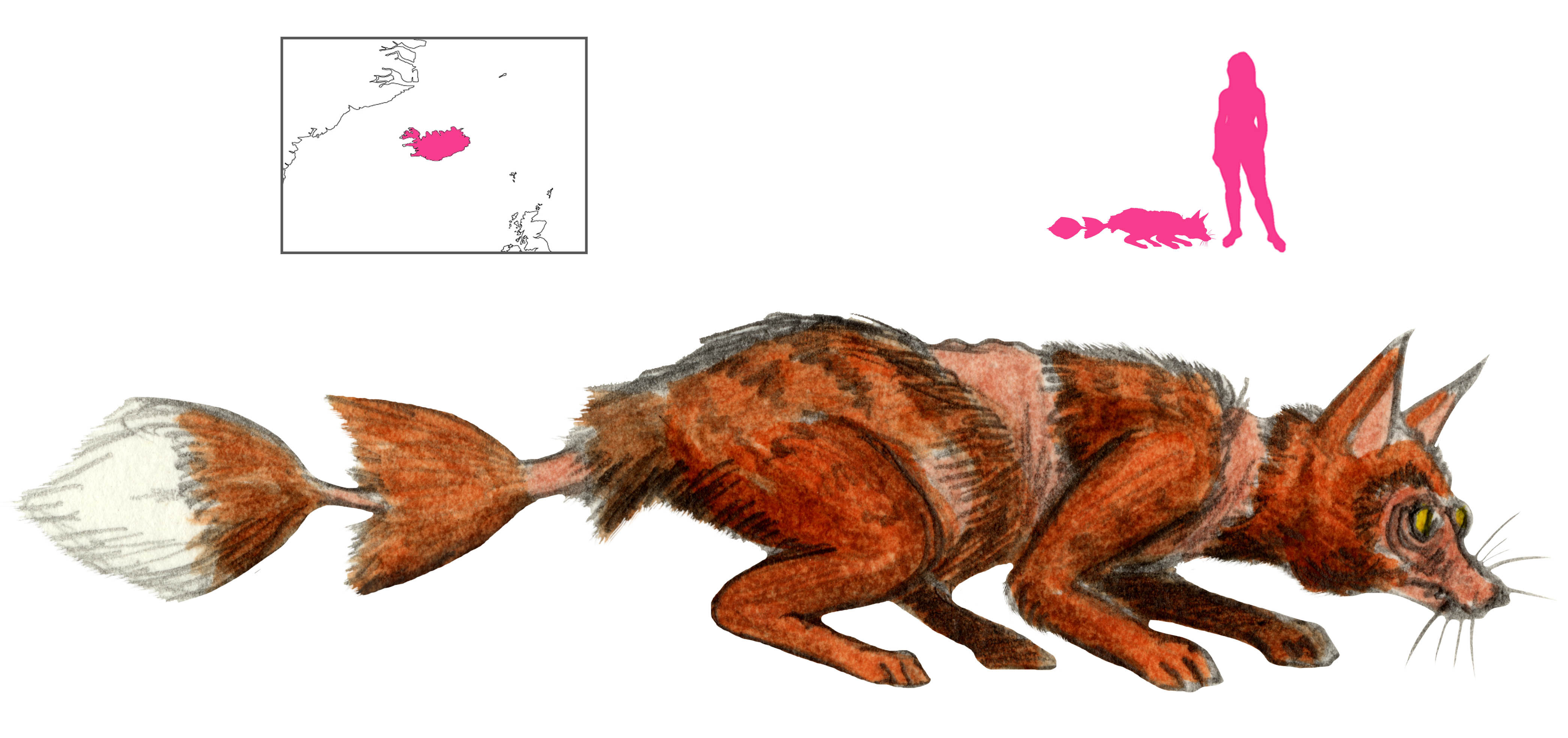
The Skoffín is one of a complex of Icelandic fox-cat hybrids with a lethal gaze, combining the cunning of the fox with the cruelty of the cat. This group also includes the Skuggabaldur, Urdarköttur, and Modyrmi, all of which are variations on the same theme; they are also linked to the “demon harriers”, foxes sent by sorcerers to maul livestock.

A skoffín is born from the union of a male Arctic fox and a female tabby cat, and resembles both of them. Its gaze is so deadly that everything it looks at dies immediately, without needing to see it. Its exact appearance varies; it may even change color with the seasons like the Arctic fox does. Reports suggest that skoffíns are short-haired, with bald patches of skin throughout.

Skoffín kittens are born with their eyes wide open. If not destroyed immediately, they sink into the ground and emerge after 3 years of maturation. It is therefore imperative to kill sighted kittens before they can disappear into the ground. When a litter of three sighted kittens was born at a farm in Súluholt, they were placed in a tub of urine to prevent their descent into the earth, and were drowned by placing turf on top of them. The entire tub was then tossed onto a pile of manure and hay and set on fire. The mother cat was also killed.

Skoffíns are irredeemably vile and malicious, and satisfy their appetite for destruction by killing humans and livestock alike. They are best shot from a safe distance, ideally with a silver bullet and after having made the sign of the cross in front of the barrel, or having a human knucklebone on the barrel. Hardened sheep dung makes equally effective bullets.

Thankfully, skoffíns are not immune to their own gaze. An encounter between two skoffíns will lead to the death of both of them. As with basilisks, mirrors are their bane. Once a skoffín stationed itself on the roof of a church, and the parishioners started dropping dead as they left the building. The deacon understood what was going on, and had the rest of the congregation wait inside while he tied a mirror to a long pole and extended it outside to the roof. After a few minutes he gave the all-clear, and they were able to leave the church safely, as the skoffín had perished immediately upon seeing its reflection.

Eventually, confusion with the basilisk of the mainland muddled the skoffín’s image, leading to some accounts claiming it was hatched from a rooster’s egg.

The skuggabaldur (“shadow baldur”) or finngalkn has the same parentage as the skoffín, but is born of a tomcat and a vixen. It has very dark fur shading to black, sometimes has a deadly gaze, and preys on livestock. It may be killed in the same way as the skoffín. One particularly destructive skuggabaldur in Húnavatnssýslur was tracked down and killed in a canyon; with its last breath, it exhorted its killers to inform the cat at Bollastadir of its death. When a man repeated that incident at a Bollastadir farm, a tomcat – no doubt the skuggabaldur’s father – jumped at him and sank its teeth and claws into his throat. It had to be decapitated to release its hold, but by then the man was dead.

The urdarköttur (“ghoul cat”) or naköttur (“corpse cat”) is of less certain parentage. It may be a hybrid, but other accounts state that any cat that goes feral in Iceland eventually becomes an urdarköttur, and all-white kittens born with their eyes open will sink into the ground and re-emerge after three years in this form. Shaggy, white or black furred, growing up to the size of an ox, these felines kill indiscriminately and dig up corpses in graveyards. It may be killed in the same way, and is attached to the same story as the Bollastadir cat. Gryla’s pet, the Yule Cat, is most likely an urdarköttur.

The modyrmi (“hay wormling”) is a canine variant, created when puppies born with their eyes open sink into the ground and reappear after three years as wretched, virulent monsters. The specifics are the same as with the skoffín.

References

Boucher, A. (1994) Elves and Stories of Trolls and Elemental Beings. Iceland Review, Reykjavik.

Hermansson, H. (1924) Jon Gudmundsson and his Natural History of Iceland. Islandica, Cornell University Library, Ithaca.

Hlidberg, J. B. and Aegisson, S.; McQueen, F. J. M. and Kjartansson, R., trans. (2011) Meeting with Monsters. JPV utgafa, Reykjavik.

Stefánsson, V. (1906) Icelandic Beast and Bird Lore. The Journal of American Folklore, vol. 19, no. 75, pp. 300-308.