Corocotta

Variations: Korokottas, Krokottas, Krokottos, Krokouttas (Greek); Corocottas, Crocotta, Crocote, Crocuta (Latin); Cynolycus, Kunolykos, Kynolykos (Greek, “Dog-wolf”); Leoncerote; Chaus; Cameleopard (Strabo); Cyrocrothes, Leucrocotham (Albertus Magnus); Cirotrochea (Ortus Sanitatis); Hyena, Iena, Yena, Yenna

The hyena was known to the ancients under several names. The term hyaina (Greek) and hyaena (Latin) almost certainly refer to the smaller and more familiar striped hyena. The more exotic Corocotta is probably the spotted hyena, especially considering its vocal qualities and prowess at hunting. Then there are other terms that may refer to hyenas such as the glanos, the chaus, and the thōs, the last of which is probably a jackal, civet, or hunting dog.

Much of what is said about the corocotta is shared with the hyena, and even Greek and Roman authors seem uncertain as to whether or not it is seprate from the hyena. Translators of classical texts have also chosen to retain “corocotta” as a unique word, or simply replace it with hyena. Further muddying the waters is the emergence of the derivative leucrocotta, which gained features of the hyena/corocotta through this confusion and passed on its own features (such as a lion-hyena ancestry and single bones for teeth) to the corocotta.

What is known is that the corocotta is unfamiliar, hailing from far-flung lands – either Ethiopia or India, depending on the author (the regions were used interchangeably). If it is indeed African, the word corocotta may be a Libyan or Ethiopian word for the hyena. Lassen (cited by McCrindle) saw in Ctesias an Indian origin to the corocotta, and derives its name from the Sanskrit kroshtuka, “jackal”. The name has since then been applied to the spotted hyena Crocuta crocuta.

Ctesias says that the corocotta is also known as the cynolycus (“dog-wolf”). It is found in Ethiopia and is incredibly strong. It can mimic human voices, calling people out by name at night and killing them when they come out in response. It is as brave as a lion, as fast as a horse, as strong as a bull, and cannot be fought with steel weapons.

Agatharchides says it is a fierce and powerful creature that lives in Ethiopia. It can crush bones with its jaws. The corocotta can also mimic human speech, and it uses this ability to lure humans out at night so it can kill them. Agatharchides rejects this.

Pliny says that the corocotta is the offspring of a dog and a wolf. It can crush anything with its teeth, and anything it eats is immediately digested and passed through its body. It is Ethiopian. Elsewhere further powers are attributed to the hyena or crocuta: it changes sex every other year, its neck is an extension of its spine, it can imitate human speech and vomiting sounds, it digs up graves, its shadow strikes dogs dumb, it paralyzes other living things by circling around them three times, and it has a thousand variations in eye color.

Aelian separates the hyena and the corocotta. The hyena roams around cattle pens by night and imitates the sound of vomiting, attracting dogs which are promptly killed and eaten. But the corocotta is even craftier. Aelian says that it listens to woodcutters calling each other by name and the words they say, then it imitates their voices, calling out to its victim and withdrawing before calling again. It continues this game of cat-and-mouse until its prey has been tempted far away from their friends, whereupon the corocotta pounces and kills them. Aelian admits that “the story may be fabulous”.

Dio Cassius reports that Severius had a corocotta imported from India to be slain in the games in AD 202. It had never been seen in Rome before.

By the time the crocotta and leucrocotta had reached medieval Europe, the similarity of their descriptions, combined with the leucrocotta’s more memorable physical features, caused them to combine. The MS Bodley 764 bestiary adds a mention of the crocote at the end of the hyena entry, describing it as a hybrid of lion and hyena with a single bone replacing its teeth (both features of the leucrocotta). It imitates human voices and is always found in the same place. The leucrota, on the other hand, is given a complete entry of its own which is fairly faithful to its original account.

Albertus Magnus refers to the “cyrocrothes”, which is the corocotta with the single tooth-bone of the leucrocotta, and the “leucrocotham”. It is further corrupted in the Ortus Sanitatis, which includes both the “cirotrochea” and the “leucrocuta”.

Topsell divides his Hyena entry to cover the varieties of hyena. In addition to the hyena proper, he provides additional hyenas including the papio (baboon), the mantichora, and the crocuta. The crocuta has become the same as the leucrocuta; it is an Ethiopian cross between a lioness and a hyena, with its teeth replaced by a single bone in each jaw. It imitates men’s voices and can break and digest anything.

Ludolphus is clear that the hyena or crocuta (by now they are one and the same, and refer to what we would now call the spotted hyena) is the most voracious of all Ethiopian beasts, preying upon men in the day as well as at night, and digging down the walls of houses and stables. It is speckled with black and white spots.

It may be that the hyena of the ancients was the striped hyena, while the corocotta was the spotted hyena, or vice versa. The imitation of human speech seems a clear allusion to the spotted or laughing hyena’s vocalizations. Despite that, the Palestrina Nile Mosaic identifies a striped creature as a corocotta; spotted animals are labeled as examples of the mysterious thōs.

Finally, a notable Spanish bandit was known as Corocotta. This may be a complete coincidence.

References

Aelian, trans. Scholfield, A. F. (1959) On the Characteristics of Animals, vol. II. Harvard University Press, Cambridge, Massachusetts.

Ball, V. (1885) On the Identification of the Animals and Plants of India. Proceedings of the Royal Irish Academy, II(6), pp 302-346

Barber, R. (1993) Bestiary. The Boydell Press, Woodbridge.

Borges, J. L.; trans. di Giovanni, N. T. (2002) The Book of Imaginary Beings. Vintage Classics, Random House, London.

Borges, J. L.; trans. Hurley, A. (2005) The Book of Imaginary Beings. Viking.

Brottman, M. (2012) Hyena. Reaktion Books, London.

Ctesias, McCrindle, J. W. trans. (1882) Ancient India as described by Ktesias the Knidian. Thacker, Spink & Co., Calcutta; B. E. S. Press, Bombay; Trubner and Co., London.

Cuba, J. (1539) Le iardin de santé. Philippe le Noir, Paris.

Kitchell, K. F. (2014) Animals in the Ancient World from A to Z. Routledge, Milton Park, Abingdon, Oxon.

Ludolphus, J. (1684) A New History of Ethiopia. Samuel Smith, London.

Magnus, A. (1920) De Animalibus Libri XXVI. Aschendorffschen Verlagbuchhandlung, Münster.

Pliny; Holland, P. trans. (1847) Pliny’s Natural History. George Barclay, Castle Street, Leicester Square.Robin, P. A. (1936) Animal Lore in English Literature. John Murray, London.

Topsell, E. (1658) The History of Four-footed Beasts. E. Cotes, London.

Unknown. (1538) Ortus Sanitatis. Joannes de Cereto de Tridino.
Yam Bhaya Akhoot

Variations: Abang Aku (Malay, corruption), A Bao a Qu (corruption)

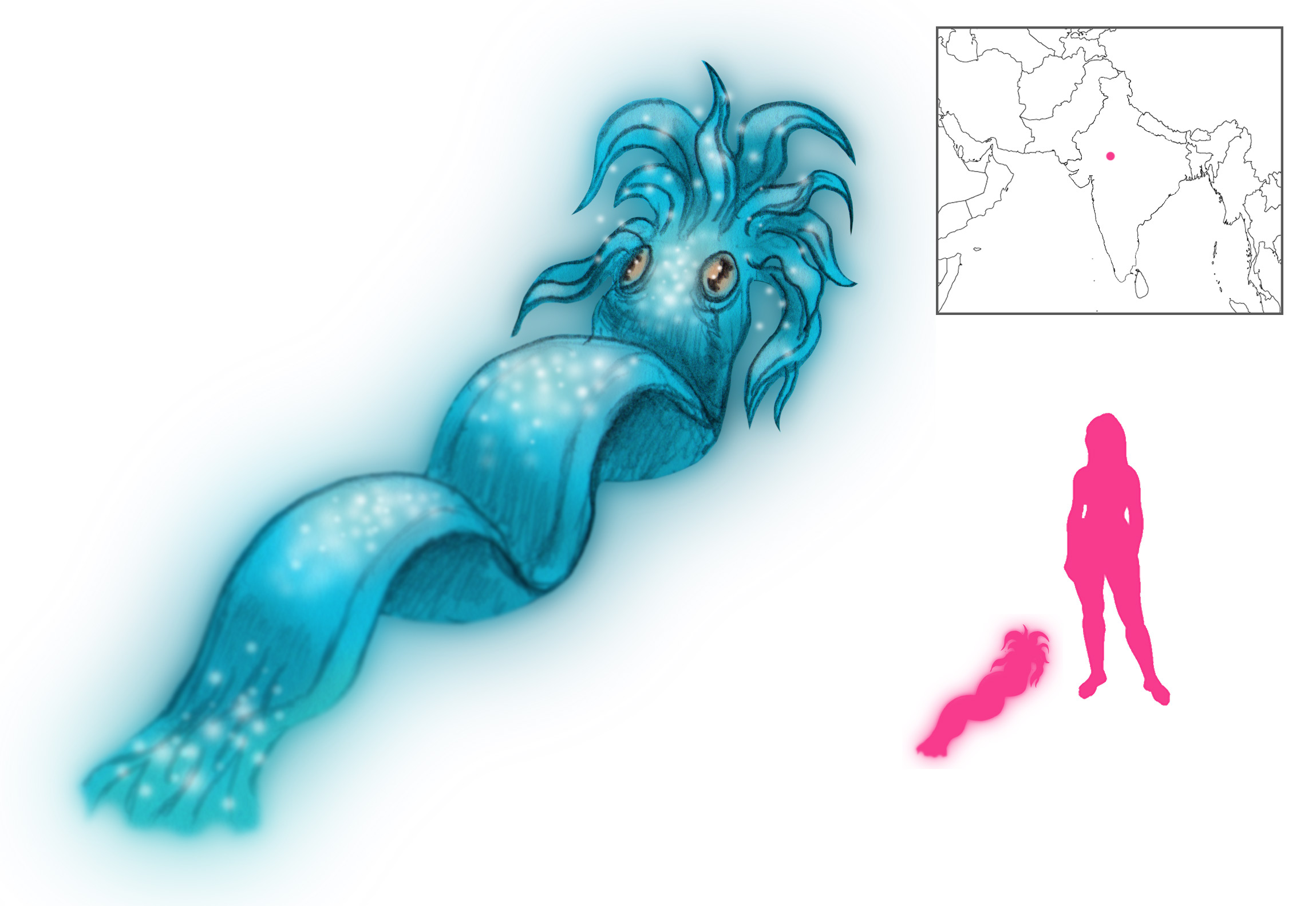
The Yam Bhaya Akhoot is a mysterious, amorphous being that lives at the bottom of the stairway of the Vijay Stambha, the Tower of Victory, in Chittorgarh, India. By night it haunts the Bhimlat Kund water tank.

Normally the Yam Bhaya Akhoot is in a dormant state, and is invisible. But when visitors start climbing the tower, it follows them up the stairs, remaining on the well-worn outside the steps. It can see through its whole body. Blue light starts to glow through its skin, which is translucent and feels like the skin of a peach. With each step covered its shape becomes clearer and its blue glow stronger. Tentacular appendages appear at the halfway point of the staircase.

It will only follow a fully self-realized person to the top of the stairs. If the Yam Bhaya Akhoot realizes that the person it’s following is unworthy, it lets out a sigh like the rustling of silk and tumbles down the stairs all the way back to the first step, where it awaits the next visitor. But if the person it follows is fully self-realized and blameless, then it will reach the top with them, become their aura, and guide them to Nirvana. This event has happened only once, and sadly is probably impossible today since the top of the tower was covered by a dome in more recent times.

Ethereal and benign, the Yam Bhaya Akhoot’s origin may be more sinister. One suggestion is that it is the ghost of the leader of the Nakshatra Meenu, the giant brittle stars that invaded the Konkan Coast. It had been captured and presented generations later to the ruler of Mewar.

In Malaysia the Yam Bhaya Akhoot is known as Abang Aku, probably a corruption of its name and which can be read as “elder brother”. This is turn was further corrupted to “A Bao A Qu”, a term which was used and popularized by J. L. Borges. Furthermore, Borges also confusingly attributes it to either C. C. Iturvuru’s On Malay Witchcraft or Richard Francis Burton’s The Thousand and One Nights depending on the version of his book.

References

Bhairav, J. F. and Khanna, R. (2020) Ghosts, Monsters, and Demons of India. Blaft Publications, Chennai.

Borges, J. L.; trans. di Giovanni, N. T. (1969) The Book of Imaginary Beings. Clarke, Irwin, & Co., Toronto.

Borges, J. L.; trans. di Giovanni, N. T. (2002) The Book of Imaginary Beings. Vintage Classics, Random House, London.

Borges, J. L. (1978) El Libro de los Seres Imaginarios. Emece Editores, Buenos Aires.

Borges, J. L.; trans. Hurley, A. (2005) The Book of Imaginary Beings. Viking.

Borges, J. L. (2009) Manual de Zoologia Fantastica. Fondo de Cultura Economica, Mexico.

Kurrea

The Kurrea is an enormous reptilian creature from the Boobera Lagoon, the Barwon River, and the Narran River in New South Wales, Australia. It may be considered the local variant of the rainbow serpent, although the lumping of such entities may be overzealous. The term kurrea, a Euahlayi word, has also been translated as “crocodile” in the one Narran River account, but a “serpent” interpretation is probably more correct. A 39-foot carving of the kurrea is clearly snake-shaped.

The deepest part of the Boobera Lagoon is bottomless and that is where the kurrea lives. An enormous serpentine creature, it is incapable of moving on dry land. When a kurrea wants to travel, it tears up the ground on the banks of the lagoon, excavating channels along which it can swim. The many shallow channels around the lagoon are evidence of the kurrea’s movements.

Anyone who dared fish, swim, or paddle in the Boobera Lagoon would immediately be attacked and devoured by the kurrea. This hostile behavior could cause serious shortages, as the lagoon had large flocks of waterfowl and schools of fish.

Once a man called Toolalla, of the Barwon River, decided to rid his people of the kurrea. He was a skilled hunter and, armed with his sharpest and strongest weapons, he stood on the bank of the lagoon. Before long the kurrea had noticed him and swam towards him. But despite all his preparations, Toolalla discovered that even his best weapons could not even injure the kurrea.

Toolalla made the wise decision to flee for his life. The kurrea followed him, gouging out a channel at high speed and rapidly gaining on his prey. Toolalla managed to climb up a tall bumble tree where the snake could not reach him. The bumble tree is also the kurrea’s mother-in-law, and the only thing it fears. Eventually, frustrated and disappointed, the kurrea returned to the Boobera Lagoon, where it continued to be a threat to all who trespassed on its domain.

Today the kurrea is harder to see. Its descendants are the gowarke, the giant, black-feathered, red-legged emus of the Baiame swamps.

References

Buchler, I. R. and Maddock, K. (eds.) (1978) The Rainbow Serpent: A Chromatic Piece. Mouton Publishers, The Hague.

Mathews, R. H. (1907) Notes on the Aborigines of New South Wales. William Appleworth Gullick, Sydney.

Reed, A. W. (1982) Aboriginal Myths, Legends, and Fables. Reed, Wellington.

Ajaju

The Ajaju was the terror of the Garo people of Achik Asong and Dura Hill in the Garo Hills of India. Nowadays members of this carnivorous species are a lot harder to find.

An ajaju looks like a chameleon with long kneeless legs. Its head may be like a human head or a chameleon’s head in appearance. It has twelve long, sharp, forked tongues that are very flexible and which it uses to lick up its prey’s flesh and blood.

The kneeless legs of an ajaju are like bamboo stalks without nodes. In the trees an ajaju can swing from branch to branch with ease, but movement on land is a lot harder. Chasing someone downhill is virtually impossible for an ajaju, but anyone running uphill would be immediately caught by the creature’s long sickle-like tongues, swallowed, and stripped of flesh and blood by the tongues. Then there would be nothing left save a few bones for the ajaju to spit out with distaste.

To attract prey an ajaju will call out in a shrill voice, “wa-o, wa-o, wa-o”. If someone responds, the ajaju will continue calling, coming nearer and nearer each time. That is why, if venturing into ajaju territory, one must call out in a high-pitched voice. If the ajaju responds, then one must remain silent and focus on putting as much distance as possible between them and the creature.

Ajaju parts are of great medicinal value, including as a substitute for missing bones when resurrecting someone. One narrator claimed to be in possession of ajaju parts from Rongkugiri, taken when a couple of ajajus were killed decades ago.

References

Rongmuthu, D. S. (1960) The Folk-tales of the Garos. University of Gauhati Department of Publication, Guwahati.

Siéhnam

Siéhnam the deer was once the terror of the Chorote of Argentina. He would attack at night, seeking out villages after midnight, and kill people by stabbing them with his large antlers. If he found someone sleeping on their back, he would bite their throat. He killed four people every night.

The day came when the Chorote, tired of the losses incurred, asked the shaman for help. “What is it that comes at night?” they asked him.

The shaman woke up just before midnight and heard Siéhnam approaching. “Now I have caught you!” the shaman said. “I thought it was someone else, but it was you. You and I will fight!”

And fight they did, until the shaman threw Siéhnam down and the deer did not come back. The next day the shaman brought the good news to the village. “Now we can sleep peacefully! I believe the one bothering us will not return again”.

References

Cordeu, E. J.; Mashnshnek, C. O.; von Nordenskiöld, E.; Siffredi, A.; and Verna, M. A.; Wilbert, J. and Simoneau, K. eds. (1985) Folk Literature of the Chorote Indians. UCLA Latin American Center Publications, University of California, Los Angeles.

Bès Rap

Variations: Hantu Babi (Malay), Pig Spirit

Bès Rap, “pig spirit”, is a bès or spirit from the folklore of the Jah Hut people of Malaysia. It lives in the deep jungle, at the roots of the pokok ara tree. It is particularly present during the tree’s fruiting period.

Anyone who comes to collect fruit from the pokok ara is targeted by the pig spirit. It blows its saliva at them, causing them to get sick, foaming at the mouth. Only a poyang’s blessing can save them.

The droppings of the pig spirit are equally noxious. The heat of its toxic stool penetrates the body of anyone who steps on them, seeping in through the toes and causing them to fall ill with bubbling, frothing saliva.

References

Werner, R. (1975) Jah-hět of Malaysia, Art and Culture. Penerbit Universiti Malaya, Kuala Lumpur.

Akhekh

Variations: Ākhekh

As an incarnation or ally of the god Set, the Akhekh is associated with darkness and water (both elements of chaos). Pierret gives it an eagle’s head on a winged lion’s body; Budge specifies that it is an antelope with two wings on its back, and the head of a bird crowned with three uraei – the cobras on Pharaonic headdresses.

The akhekh is a symbol of terror, but the uraei also connect it to the power of the Pharaoh. Ramesses II was described as being an akhekh to his Hittite enemies. The Metternich stele shows a king in a chariot drawn by an akhekh galloping over two crocodiles.

References

Budge, E. A. W. (2015) The Gods of the Egyptians, vol. II. Dover Publications Inc., New York.

Pierret, P. (1875) Dictionnaire d’archéologie égyptienne. Imprimerie Nationale, Paris.

Pairío

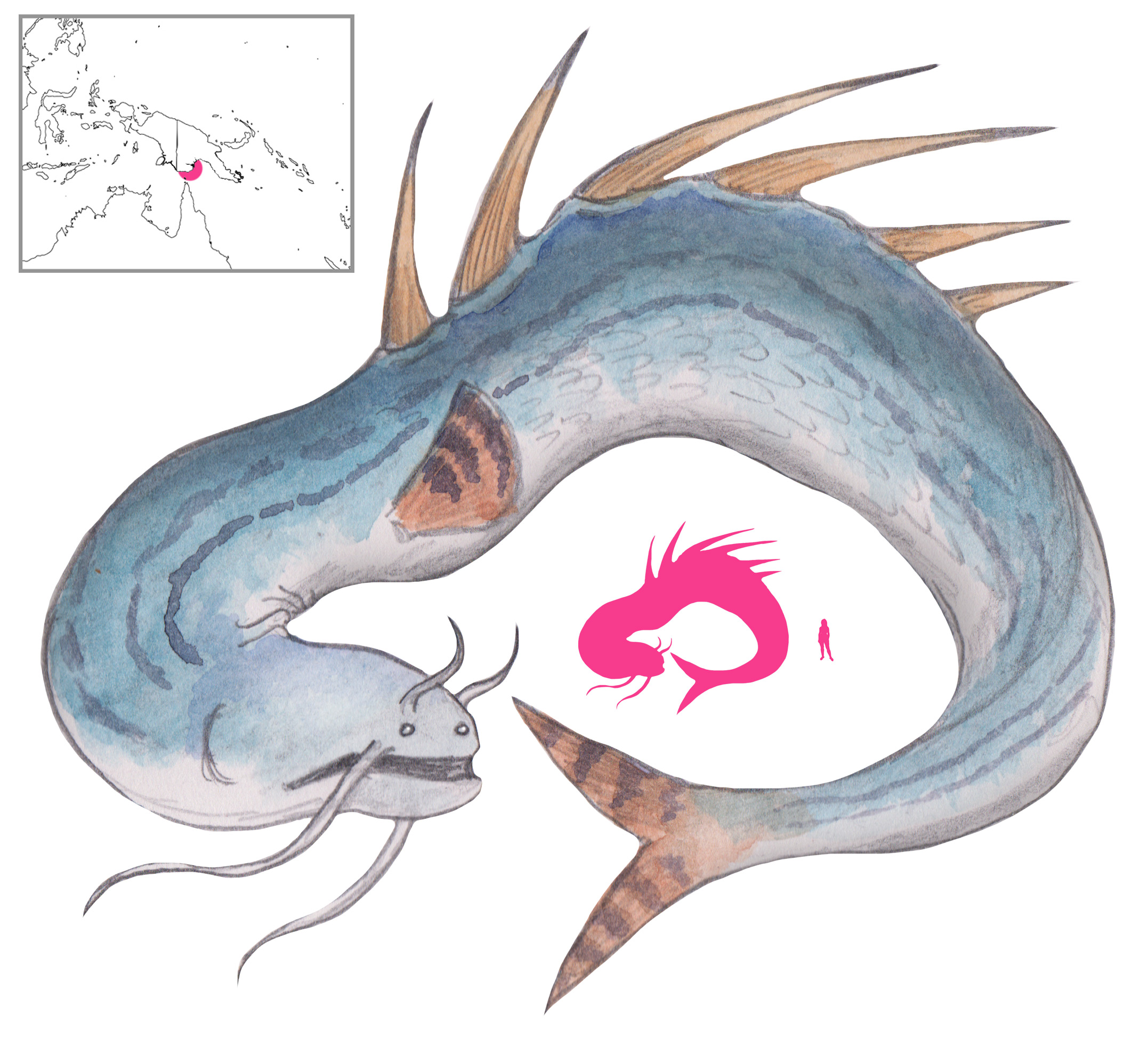
The Kúbání-kikáva reef in Papua New Guinea is home to Pairío, an enormous catfish. She attacks anyone who dares approach the reef by raising up her back, which is armed with spines that can rip a canoe in half. If people see a spine sticking out of the water, they know to change course as fast as possible. Sometimes Pairío will chase after those canoes, one of her spines pointing at the vessel, and the crew have to paddle for their lives.

Pairío herself was not always a catfish. She was once a malignant female spirit known to the islanders as a dógai-órobo, something like the híwai-abére of mainland Papua New Guinea. Her home was on Márukára Island. One day she was attacked by a cloud of butterflies which she could not shoo away; they settled on her thickly until she was completely covered. In desperation she threw herself into the water, where she transformed into a catfish. The butterflies clinging to her soaked through, their wings became hard and spiny, and they turned into stonefishes and catfishes as brightly colored as any butterfly.

References

Landtman, G. (1917) The Folk-tales of the Kiwai Papuans. Acta Societatis Scientiarium Fennicae, t. XLVII, Helsingfors.

Landtman, G. (1927) The Kiwai Papuans of British New Guinea. MacMillan and Co. Limited, London.

Paoxiao

Variations: Baoxiao

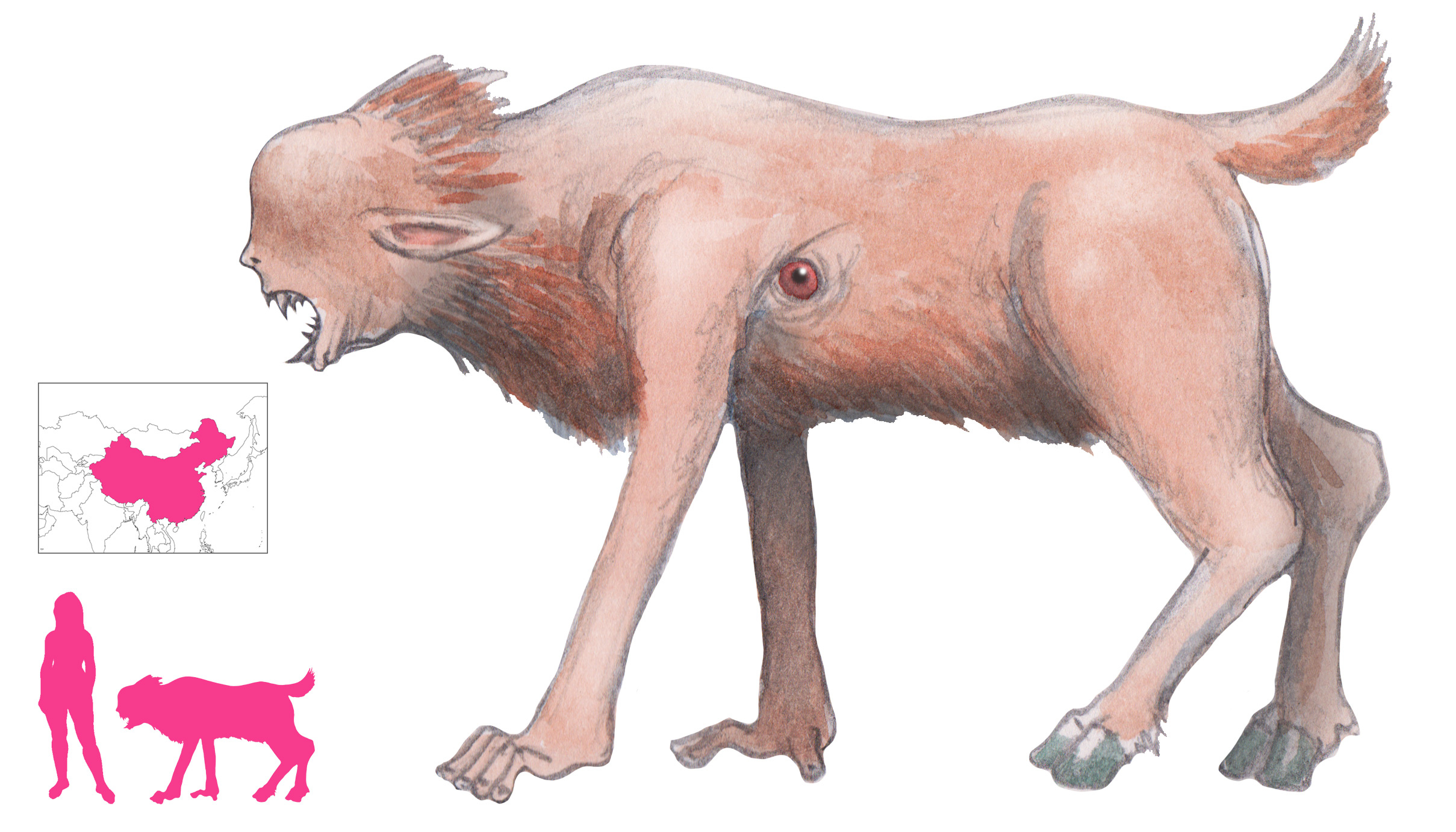
Mount Gouwu in China has much jade at its peak and much copper at its base. It is the dwelling-place of a beast called the Paoxiao. A Paoxiao looks like a goat with a human face armed with tiger’s teeth. Its eyes are behind its armpits (Wenxuan instead states that its mouth is under one armpit), and it has human hands. It is a man-eater that makes sounds like a baby.

Guo Pu described the paoxiao as exceedingly savage and gluttonous, liable to start biting itself before finishing its human prey. He also equated it with the ornamental taotie, a symbol of gluttony, but this connection is dubious at best.

Mathieu compares the unusual appearance of the Paoxiao with that of an animal delousing itself.

References

Mathieu, R. (1983) Étude sur la mythologie et l’ethnologie de la Chine ancienne. Collège de France, Paris.

Strassberg, R. E. (2002) A Chinese Bestiary: Strange Creatures from the Guideways Through Mountains and Seas. University of California Press.

Beast of the Charred Forests

Variations: The Beast, Dhu Guisch (“Of the Black Firs”)

Tradition holds that the dense, impenetrable forests of Scotland once covered most of the Highlands and Outer Hebrides, but fell to the Norsemen. The Scandinavians burned down the forests to dominate the trade in timber, and to prevent potential ambushes from forested areas.

In Sutherland the destruction of the forests is attributed to a dragon, the Beast of the Charred Forests. This terrifying, powerful monster was born from a fire that burned for seven years and lived in fire. It once stalked over northern Scotland, breathing fire and incinerating trees. There was no escaping its wrath, and people would abandon their villages to the dragon whenever they heard it was near. Only a man who saw it before it saw him could slay it.

But the Beast itself met its match in Saint Gilbert. When it came upon St. Gilbert’s Church in Dornoch, it roared “Pity on you, Dornoch!” Saint Gilbert, who had previously dug a hole and hid in it to see the dragon before it appeared, emerged from his church armed with a bow and arrows, and repeated the Beast’s boastful statement to its face. “Pity on you, Dornoch!” The beast prepared to breathe fire on Dornoch, but the Saint’s first arrow pierced and killed it immediately. It was buried on the moor between Dornoch and Skibo, and a stone – the Beast’s Stone – was placed over it.

The presence of charred pine stumps in the peat moss of Ross, Sutherland, and the Reay is evidence of the Beast’s ravages.

References

Dempster, M. (1888) The Folk-lore of Sutherlandshire. Folk-Lore Journal v. VI p. 3, pp. 149-189.

MacGregor, A. A. (1937) The Peat-Fire Flame: Folk-tales and Traditions of the Highlands and Islands. The Moray Press, Edinburgh.