Trollgädda

I am indebted to Fredrik “Tektalox” Hansing for introducing me to and translating material related to this enormous esocid!

Variations: Trollgäddor (pl.); Jättegädda (Giant Pike); Krongädda (Crown Pike); Skällgädda (Bell Pike); Sjörå
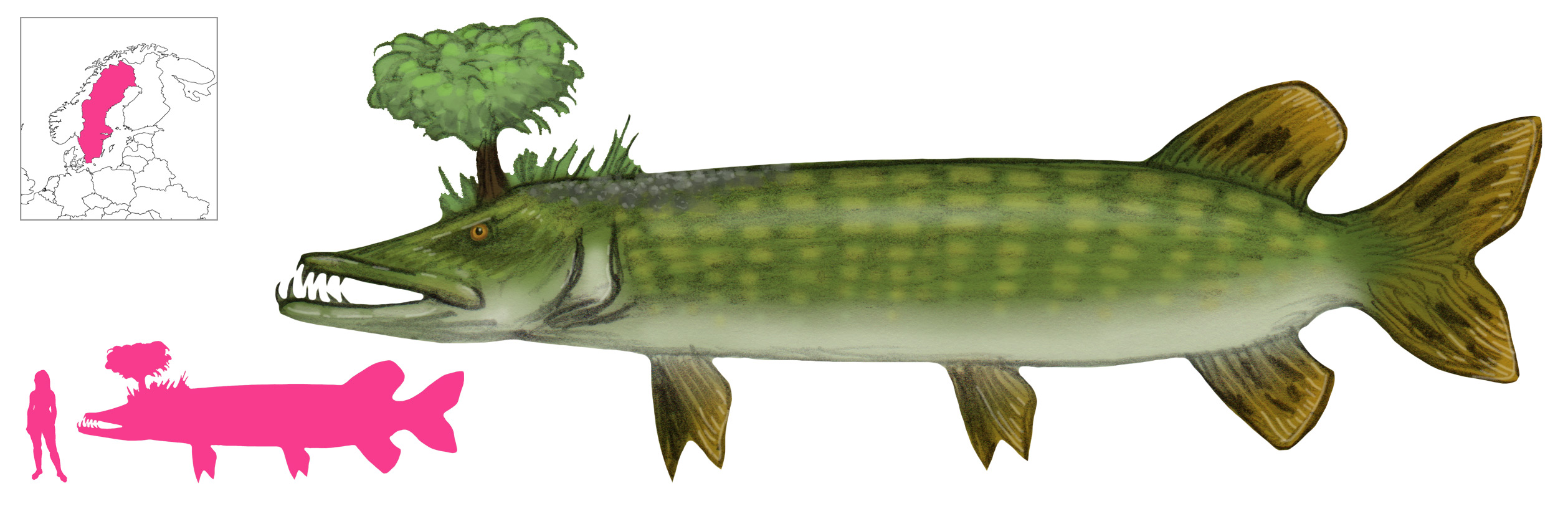
The lakes and waterways of Sweden are home to Trollgäddor, “troll pike”. These variable supernatural creatures take the form of a large pike, and cause problems ranging from being nuisances to attacking people.

Sometimes the pikes are associated with the Sjörå, the Mistress of the Lake; some may even be Sjörå themselves. More frequently they are the pets of the Sjörå. The water-spirit dresses them up with bells like cows, and the fish are called skällgäddor or “bell pikes”. Anglers who return those pikes upon capture are rewarded with success at fishing; those who kill them incur the Mistress’ wrath and find their livestock dying off.

The krongädda or “crown pike” is another of the Sjörå’s pets. It is a pike with a crown, and is regarded to be the Sjörå’s prized possession. The exact nature of the “crown” is unclear. It has been suggested that the crown is actually the remains of a bird’s talons embedded in the fish’s skull, left behind by an unfortunate osprey drowned by its “catch”.

Other times the trollgädda’s appears as a normal pike with no distinguishing characteristics. A pike captured in Lake Odensjön was large enough, but as the angler returned home it grew heavier and heavier. By the time he entered the house he had to drop it, and it started thrashing about as it grew big enough to destroy the house. Fortunately the angler had the presence of mind to let it out; the fish squirmed and flopped its way back into the water and disappeared.

Trollgädda tales vary by locale. The Kvittinge pike kills a human every year. In Lake Mjörn there is a huge, hairy, and bearded pike tied up with an iron chain. In Skåne there are pikes as big as wooden beams. The Dalsland pike has eyes as big as saucers and scales as big as roof tiles. It barely fits in the coves, and seeing it is a clear sign that fishing will be futile.

The pike of Lake Bolmen is as long as the lake is wide, and can barely move. It is so big that its back looks like a rocky island, and so old that a willow shrub grows on its head and neck. An enterprising angler tried to catch the pike using a rope for a fishing line and a dead foal for bait. When the trollgädda bit, the angler fastened the rope to a lakeside barn and went to get help. They returned to find the barn dragged out into the lake.

References

Gustavsson, P. (2008) Laskiga vidunder och sallsamma djur. Alfabeta, Stockholm.

Hansing, F. (pers. comm.)

Svanberg, I. (2000) Havsrattor, kuttluckor och rabboxar. Bokforlaget Arena, Falth & Hassler, Smedjebacken.

Olgoi-khorkhoi

Variations: Olgoi khorkhoi, Olgoj chorchoj, Allergorhai-horhai, Allergorhai horhai, Allghoi khorkhoi, Temen-Sul-Khorkhoi, Temeen Suul (Mongolian name of Tartar sand boa), Intestine Worm, Mongolian Death Worm, Tartar Sand Boa, Eryx tataricus

It has forever been in human nature to exaggerate the lethality of animals, regardless of whether or not the animal is actually deadly or even poisonous. Salamanders become fiery creatures whose breath slays, water shrews are accused of poisoning and killing cattle, geckos are so virulent they cause leprosy, viper venom causes the human body to melt… the list is endless.

One of the victims of this demonization is the creature known in Mongolia as the Olgoi-khorkhoi or “intestine worm”, also known in English by the even more sensationalistic name of “Mongolian death worm”.

Mongolian folklore is ambivalent on snakes. They are associated with dragons and the water world, and thus are worthy of respect and should not be killed; on the other hand, they are symbols of malice, antagonists to the forces of good, and hostile beings that should be destroyed. Saying the word mogoi (“snake”) is not recommended, with euphemisms like urt khorkhoi (“long worm”) or khairkhan (“holy” or “merciful”) used instead.

The olgoi-khorkhoi is a serpent that looks like a sausage, two feet (0.6 meters) long, and lacks a head and legs. Its color is a white brocade. It is so poisonous that looking at it is dangerous and anyone who touches it dies instantly. It lives in the sandiest, driest areas of the Western Gobi desert. If it shows up in a yurt, the inhabitants move out. It comes out after the rains when the ground has become damp.

Paleontologist Roy Chapman Andrews was informed of the olgoi-khorkhoi’s existence by the Mongolian Premier, and went on to hear much about it. Usually people had not seen one themselves, but knew others who had, and every time they went to a play where the olgoi-khorkhoi was said to be abundant, the inhabitants told them the creature could be found a few miles away. The scientist was optimistic about his chances of capturing one thanks to the neutralizing powers of dark glasses and steel forceps. No specimen was ever seen or captured, however.

The existence of the olgoi-khorkhoi was popularized by Andrews and fellow paleontologist and science-fiction author I. A. Efremov, and much has been posited since about its appearance, habits, and true nature.

However, the real identity of the olgoi-khorkhoi is far more prosaic: it is the Tartar sand boa, a desert-dwelling, nonvenomous snake. This was confirmed by Gorelov, who showed a specimen of the boa to people in the Gobi. They asserted that it was indeed an olgoi-khorkhoi and that they were afraid of it. Gorelov also reported an individual olgoi-khorkhoi preserved in a jar and exhibited in Dalaanzadgad Town during a holiday.

References

Andrews, R. C. (1926) On the Trail of Ancient Man. G. P. Putnam’s Sons, New York.

Andrews, R. C. (1932) The New Conquest of Central Asia. The American Museum of Natural History, New York.

Kuzmin, S. L.; Dunayev, E. A.; Munkhbayar, K.; Munkhbataar, M.; Oyuunchimeg, J.; and Terbish, K. (2017) The Amphibians of Mongolia. KMK Scientific Press, Moscow.

Shuker, K. P. N. (2003) The Beasts that Hide From Man. Paraview Press, London.

Lidérc

Variations: Ludvérc, Mit-mitke, Ignis Fatuus

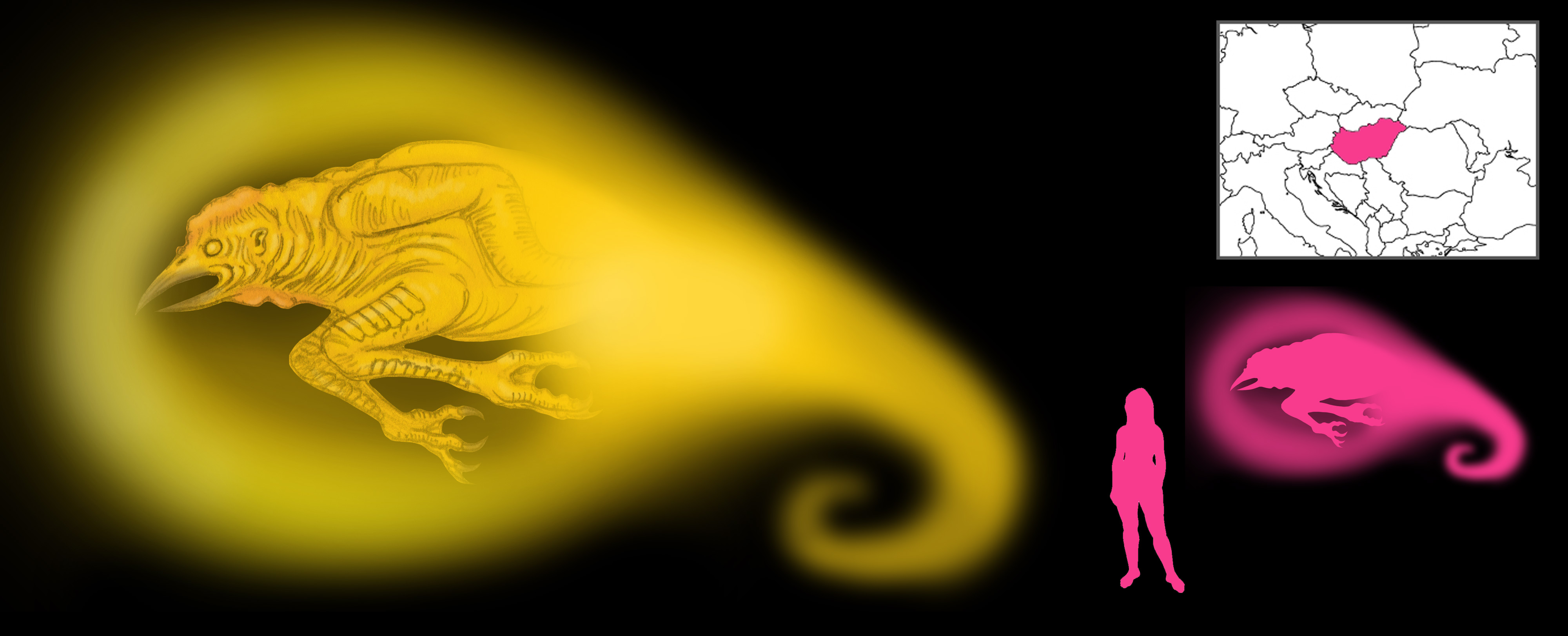
The Lidérc or Ludvérc is a polymorphic and polyvalent entity from Hungary. In its various guises, it appears as a will-o’-the-wisp, an astral phenomenon, a sexual vampire, a sleep nightmare, a sorcerer’s familiar, and a household spirit.

The origin of the term lidérc is unknown. It may or may not be of Slavic origin. In current Hungarian it usually refers to a flickering light or a marsh flame. It is also part of the compound words lidércfény, “will-o’-the-wisp”, and lidércnyomás, literally “lidérc pressure”, referring to nightmares and mental depression.

In its most spectacular form the lidérc is a shooting star or flame that travels through the air. In Zala County it appears as a fiery rod that excretes fire. A lidérc in Zselicség appeared as a staddle that caused outbreaks of fire and burned down pig-pens. Elsewhere a lidérc might be a marsh flame, a star, or a fiery person. It can breathe fire and make flames break out wherever it wishes.

A lidérc picks unhappy lovers as victims – widows, widowers, wives or those betrothed to soldiers, all are fair game to the lidérc. It flies into their house and takes the form of their loved one, whether male or female. It seduces them, giving them their heart’s desire while slowly draining them of their life and vitality. The victims waste away until they are literally loved to death, whereupon the lidérc becomes a star again and sets off in search of new prey.

While accomplished and silver-tongued mimics, a lidérc cannot change at least one of its legs, which is a bony, scaly leg of a goose or chicken, or even the iron shod foot of a horse. Scattering ashes at the doorstep will reveal that one foot wears a boot, while the other is that of a goose, and expose the lidérc. A lidérc can also be prevented from entering a house in the usual ways – garlic, trouser-cord, and other repellents will keep a lidérc at bay.

One such lidérc was reported from Gajcsána, as told by Jószef Jankó of Baranya County and collected by Mária Vámos in 1961. The village bell-ringer’s daughter wished to sleep in the barn, and her father set a bed for her there according to her wishes. She slept there throughout the summer. She seemed happy enough with the arrangement, but the bell-ringer and his wife couldn’t help but notice that she was losing weight and seemed constantly dizzy.

One night, the bell-ringer chanced to see a shooting star coming to Earth above his barn. Determined to understand what was going on, he confronted his daughter, asking if she had been seeing anyone recently, and she finally confessed to being in love with a handsome young man who visited her every evening. Sure enough, that night the watchful father saw the star land outside the barn, transform into a handsome lad, and walk in.

The next day, the bell-ringer decided to switch places with his daughter, despite her protests. He had her stay in the house, while he wore her clothes and ducked under the blankets in the barn. It wasn’t long before the lidérc arrived and lay in bed next to him. The father carefully ran his hand down the suitor’s leg – it was the scaly leg of a goose. Now aware of what he was up against, the bell-ringer ran out of the barn with the lidérc on his tail, and managed to enter the house and lock the door in time.

After that incident, the daughter remained safely at home, and the bed in the barn became host to a straw dummy smeared with excrement and waste. The lidérc was furious, spitting fire and throwing sparks all over the barn, but to no avail. After several more nights, the lidérc gave up and was never seen again.

The term lidérc also refers to a household spirit, one which is hatched from the first-laid egg of a black pullet that has been incubated under the armpit. The lidérc-chicken that hatches is featherless and latches onto the man who cared for it. It is intelligent and can talk. It will fetch treasure and do its master’s bidding, and subsist on butter, but in reality it is the master that has to fear the lidérc. The lidérc will constantly need new tasks to accomplish, and if its master does not provide it with such distractions, it will pester him from dawn to dusk. Eventually it will kill such an uncooperative master.

To rid oneself of a domestic lidérc, one must give it a task that is patently impossible, so impossible that the creature will be forced to quit or die of frustration. Traditional examples include fetching sand in a sieve, or squeezing themselves through a tiny hole in a tree-trunk, while one modern example is to making a telephone out of sand. Such tasks should be beyond even the most creative lidérc.

References

Dégh, L. (trans. Halász, J.) (1965) Folktales of Hungary. The University of Chicago Press.

Dömötor, T. (1982) Hungarian Folk Beliefs. Indiana University Press, Bloomington.

Karnabo

Variations: Carnabot

The Karnabo is found on the Rocroi plateau, near Regniowez in France. It is an Ardennes bogey, comparable to the Mahwot but with a more restricted distribution. Belief in it may trace back to some forgotten historical event. It lives in an abandoned, sealed-off slate quarry.

In appearance the Karnabo is hideous to behold. It is almost human in shape, but it has basilisk eyes and a long, trunk-like nose. It is believed to have come from Rièzes, and to be the offspring of an itinerant sorcerer and a 67-year-old female ghoul. Its evil deeds are numberless.

The horrible nasal whistling of the Karnabo is enough to paralyze or asphyxiate anyone foolish enough to wander within range of the quarry. Livestock are killed outright. While the Karnabo may have inherited its father’s diabolical powers, it also learned from him how to cure paronychia by chanting magical phrases. It works its curative powers on Good Fridays.

Once a young girl dared to play in the vicinity of the slate quarry. As soon as she came near the entrance of the tunnel, the Karnabo pounced on her and dragged her underground. Since then neither her nor the Karnabo have been seen, and the entrance has been sealed off. On stormy nights the sobbing of the girl and the nasal roars of the Karnabo can still be heard.

References

Lambot, J. (1987) L’Ardenne. Pierre Mardaga, Brussels.

Meyrac, A. (1890) Traditions, coutumes, légendes et contes des Ardennes. Petit Ardennais, Charleville.

Minokawa

Variations: Arimaonga (Maranao); Bannog, Banog, Ban-og (Iloko, Tinguian); Baua, Bawa (Pampangan, Tagalog)

The Minokawa is a Bagobo eclipse creature, comparable to other voracious dragons such as the bakunawa and the markupo. Its equivalents in other Filipino cultures include the Arimaonga of the Maranao, the Ban-og or Bannog of the Iloko and Tinguian, and the Baua of the Hiligaynon, Pampangan and Tagalog.

The minokawa appears as a bird as big as the islands of Negros and Bohol (it is unclear with this refers to combined or separate island masses). It has a beak and talons of steel, sharp swords for feathers, and mirror eyes.

It lives on the eastern horizon, above the clouds and outside the sky. There it lies in wait for the moon every night, and tries to devour her every time she appears. The moon has eight holes in the horizon to enter the sky, and another eight holes to leave the sky; thus she confuses her would-be predator, and manages to avoid being eaten – most of the time, at least. When the minokawa manages to start eating the moon, it causes a lunar eclipse.

The ultimate goal of the minokawa is to swallow the moon, then the sun, and then descend upon Earth to devour all its inhabitants. Fortunately, it can be startled in the same way as normal animals. During an eclipse one must scream and make noise to cause the bird to release its catch. The minokawa stops out of surprise, curiosity, or even appreciation of the music.

Its counterpart, the baua of the Hiligaynon, relents after the promise of ample food. It lives in a cave called calulundan, above the sky and guarded by blue smoke.

The ban-og of the Iloko and Tinguian is big enough to darken the sky in flight, and strong enough to carry off both a hunter and his porcine quarry. It builds its nests on the tops of trees on a distant mountain, and brings even the biggest animals as food for its chicks. However, it can be easily outwitted and tricked into its own demise.

References

Ramos, M. D. (1971) Creatures of Philippine Lower Mythology. University of the Philippines Press, Quezon.

Ramos, M. D. (1973) Filipino Cultural Patterns and Values. Island Publishers, Quezon City.

Ramos, M. D. (1990) Tales of Long Ago in the Philippines. Phoenix Publishing House, Quezon City.

Makalala

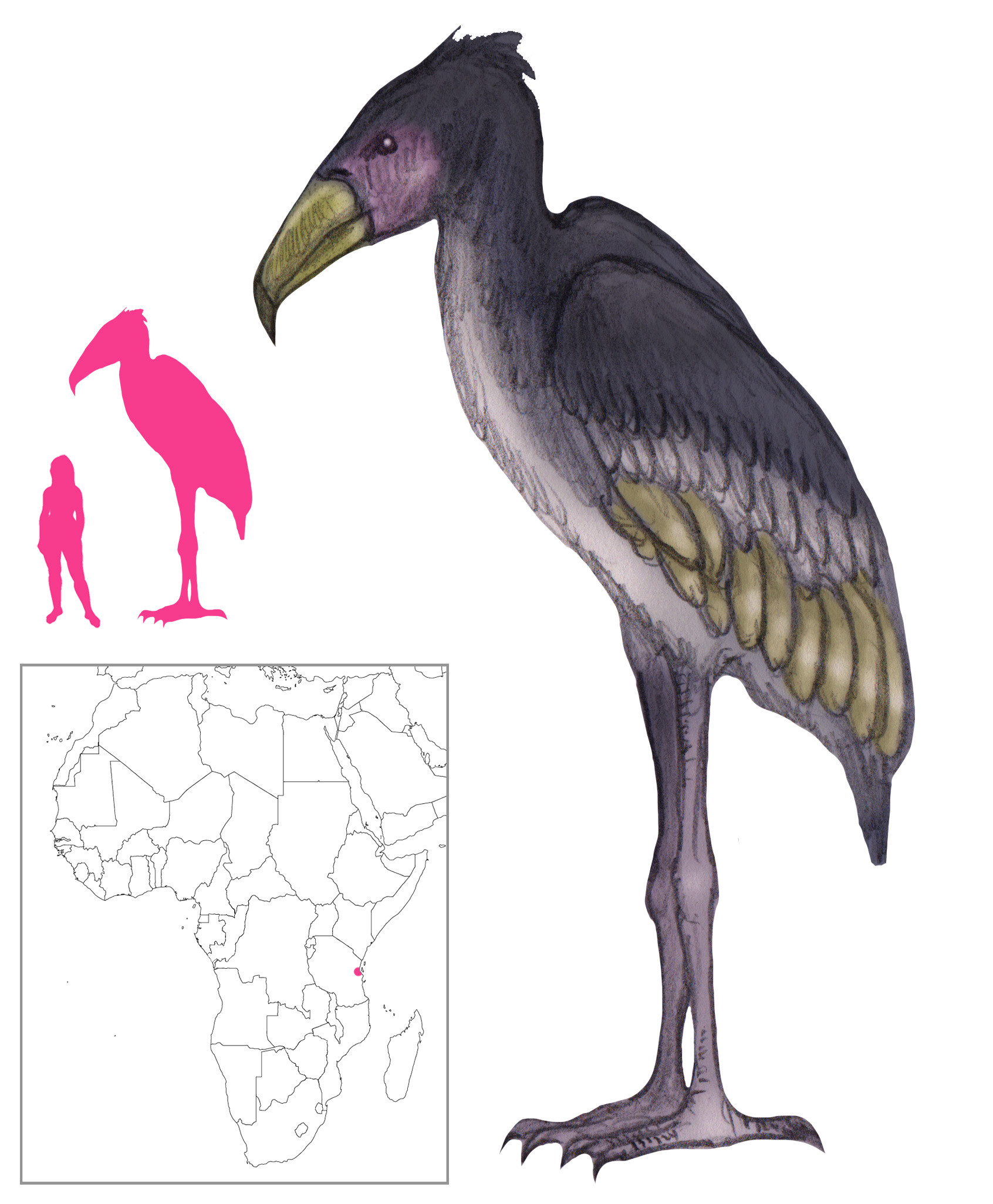
The single reference to the Makalala comes from an account written by Fischer, who attributes it to the Wasegua or Wasequa of Tanzania. These people live some 8-9 days’ journey inland from Zanzibar, with Fischer hearing of the makalala during a stay in Bagamojo and a visit to the Nguru Mountains. Fischer’s observations were summarized and repeated by Marschall under the title “Problematic bird”.

A makalala is an enormous bird, standing taller than an ostrich, with very long legs. Its head and beak are those of a bird of prey. Its wings end in plates of a compact, horny substance, which make a lot of noise when struck against each other – hence its name, which means “noisemaker”. It is a powerful flyer and feeds on carrion.

For all its size, a makalala is a very skittish, shy bird. The only way to come close enough to kill it is to feign death, and when the makalala approaches, the hunter can spring to life and knock it down.

Chiefs of the Wasegua wear makalala skulls as helmets. Fischer also saw in Zanzibar a baleen-like object tapering from 20 cm to 1.5 cm, and with a thickness of 0.5 cm, but did not believe at the time that it came from a bird.

References

Fischer, G. A. (1878) Briefliche Reiseberichte aus Ost-Afrika, III. Journal für Ornithologie, XXVI(6), pp. 268-297.

Marschall, C. (1879) Comptes-rendus zoologiques. Bulletin de la Société Philomathique de Paris, 7(3), pp. 169-181.

Shuyu

Variations: Shu-fishShuyu

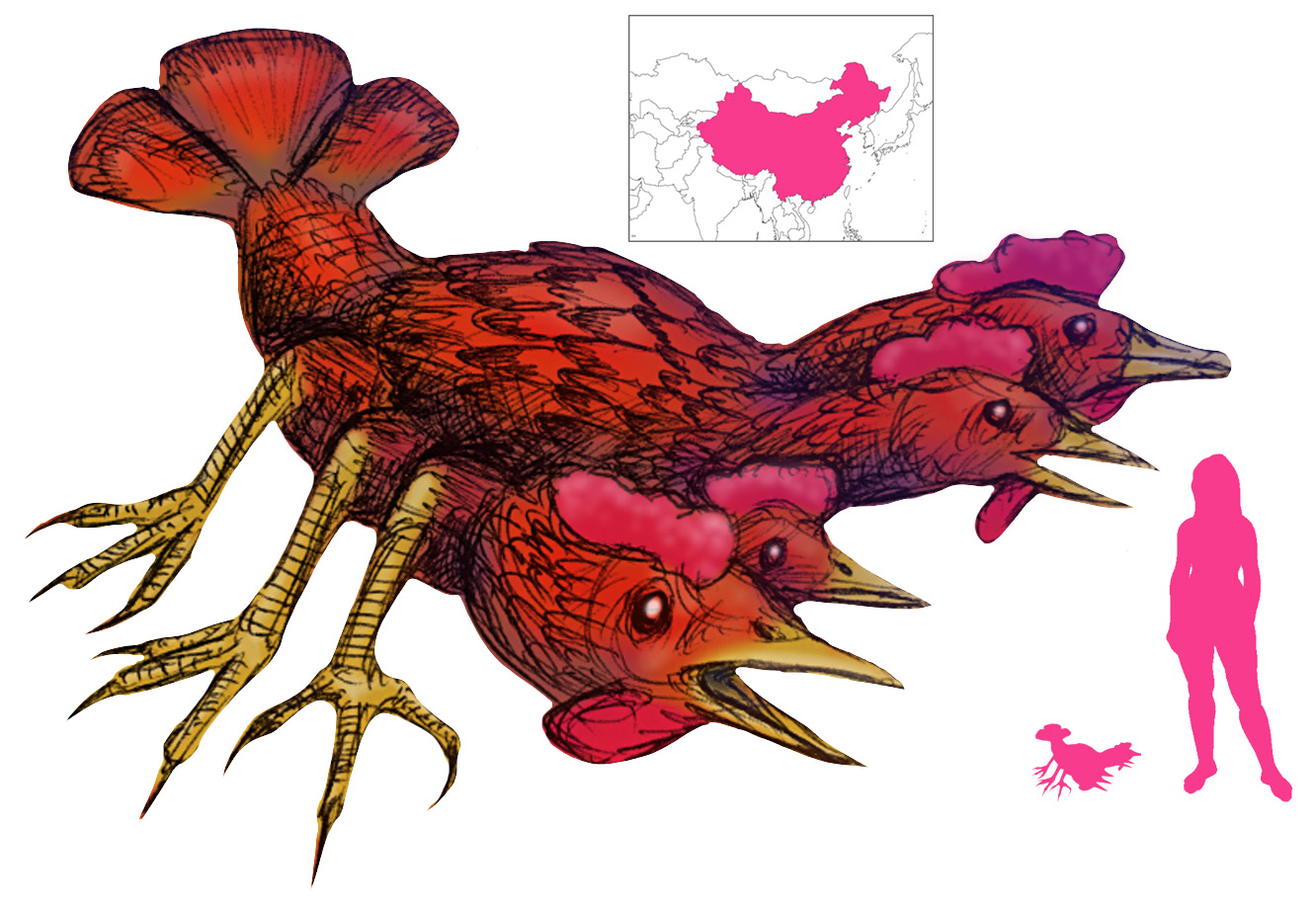
The Shuyu or Shu-fish can be found in abundance in China’s Peng River. It looks like a chicken with red feathers, and has four heads (or four eyes), six feet, and three tails. It caws like a magpie. Eating it cures melancholy.

The red color, multiplicity of appendages, and the triple (three-lobed?) tail combine to suggest a crayfish or lobster.

References

Mathieu, R. (1983) Étude sur la mythologie et l’ethnologie de la Chine ancienne. Collège de France, Paris.

Strassberg, R. E. (2002) A Chinese Bestiary: Strange Creatures from the Guideways Through Mountains and Seas. University of California Press.

Kusa Kap

The tale of Kusa Kap is told on the islands of Dauan and Mabuiag in the Torres Strait. The primary difference is the setting of the events and the name of the fisherman – Maiwasa in Mabuiag, Kaudab in Dauan. Of the two, the Dauan account is more detailed and is the primary source here.

Kaudab was a successful and handsome young dugong hunter from Dauan. He was recently married to Bakar, a woman so beautiful she was expected to never leave the house. But he had also attracted the attention of Giz. Giz was a dogai, a cunning female spirit with long ears and the ability to shapeshift. Giz would spend long hours desiring the beautiful red-headed man for herself, and she was so jealous that she wouldn’t leave him out of her sight. Giz could not tolerate Bakar’s existence.

One day, as Bakar was looking for octopus, Giz dove into a rockpool and turned herself into an octopus. Bakar had never seen an octopus before, and she leaned over the pool to try to grab it, only for Giz to grab her in her tentacles and pull her underwater. Bakar knew immediately that this was no ordinary octopus, but a dogai in disguise, and screamed to Kaudab for help – but alas, he was too far away to hear her.

This was only the beginning of Giz’s revenge. She pulled Bakar through Apangabia-taian, the tunnel beneath the sea, and took her to the island of Kusar, near New Guinea. There she abandoned the young bride before returning to Kaudab’s home and transforming into Bakar herself. When Kaudab came home, Giz tried to prepare food for him, but she did not know how to do so, burning her fingers on the coals, cackling wildly, and breaking wind crudely with every movement. Thus Kaudab knew his wife had been replaced by a dogai.

Bakar, meanwhile, was alone on a deserted island. There was nothing to eat beside kusa seeds (kapul). She became pregnant as a result, and eventually laid an egg like that of a sea-eagle’s. It hatched into a baby eagle that she cared for with as much love as if it had been a human child. She named the bird Kusa Kap after the kusa seeds that had conceived him.

With Bakar’s care Kusa Kap grew quickly. His first attempts to fly were clumsy, but soon his wings were strong enough to carry him to the tops of trees. In time he was strong enough to fly to Daudai and bring back coal, string, bark, and a bamboo knife, which Bakar used to get a fire going so she could start cooking food.

The next day Kusa Kap saw a dugong for the first time. He seized it in his talons and carried it off for Bakar to cook. In time he was capturing many dugong, sending the surplus to Pösipas.

Finally Bakar told her son to go to Dauan, and gave him directions to find Kaudab’s house. He informed him of Bakar’s plight by responding to his questions with nods, and directed Kaudab to Bakar’s island by alighting on the mast of his canoe and guiding him. Before long Bakar and Kaudab were joyfully reunited again.

The only thing left was Giz, and Kusa Kap swooped onto her and carried her off in his talons. After torturing her at length by dropping and recapturing her, he let go of her far away from Dauan. She plunged into the sea and turned to stone, becoming Dogail Malu, the dogai sea.

There is a final twist to the tale of Kusa Kap. In the account of New Guinea given by d’Albertis, he is informed by his traveling companions of a gigantic bird, some 16 to 22 feet in wingspan, whose wings make a noise like a steam engine. It lives around the Mai Kusa river. He adds that the natives have seen it carry dugongs into the air. He rejects the claims and later shoots a red-necked hornbill, which is a large bird that makes a strange noise in flight; he succeeded in convincing two or three of his companions that this was, in fact, the bird in question.

Either way, despite Kusa Kap being described as an eagle, Haddon identifies the red-necked hornbill as the origin of the Kusa Kap legend on the basis of its dugong-snatching activities.

References

d’Albertis, L. M. (1881) New Guinea: What I Did and What I Saw, v. I. Houghton, Mifflin, and Company, Boston.

d’Albertis, L. M. (1881) New Guinea: What I Did and What I Saw, v. II. Houghton, Mifflin, and Company, Boston.

Haddon, A. C. (1904) Reports of the Cambridge Anthropological Expedition to Torres Straits, v. V: Sociology, Magic, and Religion of the Western Islanders. Cambridge University Press, Cambridge.

Lawrie, M. (1970) Myths and Legends of Torres Strait. University of Queensland Press, St. Lucia.

Man-Eating Boulder

There was once a widow working in the fields of the Khasi Hills in Meghalaya, India. She gave her two sons bananas to eat and let them run off and play by themselves while she plowed the fields. The two boys were climbing over some rocks when the younger son found that his foot was stuck. His older brother tried to pull him out, but instead found that his brother was sinking deeper and deeper into the rock.

He called to his mother for help. “Come quickly, my brother’s feet have been swallowed by a boulder!” But his mother didn’t believe him. Thinking that he and his brother were playing a game, she ignored his cries and continued plowing. By the time she checked on her children, the younger brother had been completely swallowed up by the man-eating boulder, and only the outstretched hand of the older brother – still clutching a banana – was visible sticking out of the rock.

All the men of the village brought their hammers and tried to free the children, but every time they struck the boulder, it grew bigger. Finally, fearing that they too would be swallowed up, they abandoned the children to their fate.

References

Bhairav, J. F. and Khanna, R. (2020) Ghosts, Monsters, and Demons of India. Blaft Publications, Chennai.

Leucrocotta

Variations: Leucocrota, Leucocrote, Leucrocota, Leucrocuta, Leucrota, Leocrocota, Leoncerote; Corocotta, Korokottas, Krokottas, Krokottos, Krokouttas (Greek); Corocottas, Crocotta, Crocuta (Latin); Leoncerote

The Leucrocotta, unlike its close relative the corocotta, was not treated with any degree of seriousness by the ancients. There is only one primary textually corrupt record of it in Classical writing, it was never brought to Rome to the wonderment of all, and there are no contemporary depictions of it in art. And yet, the unique description it was given ensured not only that it would thrive in medieval writing, but also that it and the corocotta would eventually be hopelessly confused.

The only source for the leucrocotta is Pliny, who locates it in Ethiopia. It is as big as a wild donkey and has the cloven-hooved legs of stag, which enable it to run swiftly. It has the neck, tail, and breast of a lion, the head of a badger with a mouth slit all the way to the ears, and a single block of bone for teeth. Like the corocotta, it imitates the human voice.

Elsewhere Pliny says that the leucrocotta is the offspring of a lioness and a hyena (or corocotta). It has very sharp eyesight, a single continuous tooth in each jaw, and no gums. The single teeth are kept sharp by constantly rubbing against each other, and are enclosed in a sort of sheath.

The name of the leucrocotta itself is probably an error. Holland indicates that the best manuscripts of Pliny use the term leucocrota, which was then corrupted to leucrocota and its variants. The original may have been some kind of antelope, but the modified name gave it its origin from a lion and a corocotta (leo and crocotta).

Pliny’s copyist Solinus places the leucrocotta in India. It is as big as a donkey, haunched like a stag, with the breast and legs of a lion, the head of a camel, cloven hooves, a mouth that extends all the way back to the ears, and a single round bone instead of teeth. Its voice is like that of a man. It is the swiftest of all beasts.

Perhaps due to its clearly defined and unusual iconography, the leucrocotta found new popularity in medieval bestiaries, to the extent that it eclipsed the corocotta. The MS Bodley 764 bestiary says the leucrota is Indian, and is donkey-sized with the head of a horse, a lion’s chest and legs, a stag’s hindquarters, and cloven hooves. Its mouth is from ear to ear, it has a single bone in each jaw instead of teeth, and it imitates human speech.

Albertus Magnus makes reference to both the “cyrocrothes” and the “leucrocotham”. The Ortus Sanitatis brings further single-toothed creatures in the form of the “cirotrochea” and the “leucrocuta”.

Topsell’s crocuta is the same as the leucrocotta; it is an Ethiopian cross between a lioness and a hyena, with its teeth replaced by a single bone in each jaw. It imitates men’s voices and can break and digest anything.

Assuming the leucrocotta is a real animal, and stripping it of its confusion with the corocotta, its description evokes a large maned antelope. Ball suggests the nilgai as the origin of this chimera.

References

Ball, V. (1885) On the Identification of the Animals and Plants of India. Proceedings of the Royal Irish Academy, II(6), pp 302-346

Barber, R. (1993) Bestiary. The Boydell Press, Woodbridge.

Borges, J. L.; trans. di Giovanni, N. T. (2002) The Book of Imaginary Beings. Vintage Classics, Random House, London.

Borges, J. L.; trans. Hurley, A. (2005) The Book of Imaginary Beings. Viking.

Brottman, M. (2012) Hyena. Reaktion Books, London.

Cuba, J. (1539) Le iardin de santé. Philippe le Noir, Paris.

Kitchell, K. F. (2014) Animals in the Ancient World from A to Z. Routledge, Milton Park, Abingdon, Oxon.

Magnus, A. (1920) De Animalibus Libri XXVI. Aschendorffschen Verlagbuchhandlung, Münster.

Pliny; Holland, P. trans. (1847) Pliny’s Natural History. George Barclay, Castle Street, Leicester Square.

Solinus, G. J. (1473) De Mirabilibus Mundi. N. Jenson, Venice.

Solinus, G. J.; Golding, A. trans. (1587) The Excellent and Pleasant Worke of Caius Julius Solinus. Scholars’ Facsimiles and Reprints, Gainesville, Florida.

Topsell, E. (1658) The History of Four-footed Beasts. E. Cotes, London.

Unknown. (1538) Ortus Sanitatis. Joannes de Cereto de Tridino.