Cu Sith

Variations: Fairy Dog

Cu Sith

The Cu Sith (pronounced coo-shee), “fairy dog”, is a great beast associated with the fairies of the Highlands and Islands of Scotland. Fairy dogs are almost always malevolent and implacable with no love for humans. There are some stories of fairy dogs treating humans with kindness, but these are best regarded with suspicion.

A fairy dog is hideous in appearance. It appears as an enormous dog the size of a two-year-old stirk, with paw-prints as broad as a man’s outspread hand. The fur is dark green, lightening downwards to the paws. The ears are a deeper green in color. The tail may be flat and plaited, or long and coiled over the dog’s back.

During the day the fairies keep their dogs tied up to keep watch, and even untethered fairy dogs will hide in caves by day. Night-time is when they roam free and are at their most dangerous. They run in straight lines, silently; sometimes they make a sound like a galloping horse. They are deadly to humans and beasts, although at least one tale has them driven off by ordinary, mortal dogs.

Most dreaded of all is the cu sith’s bark. A fairy dog will bark three times, with an interval between each bark. The first and second barks are warnings; after the third bark the dogs appear and tear their victims to pieces. On the island of Tiree, those who hear the first baying of a cu sith know to immediately go indoors to safety.

Finding a cu sith tooth, on the other hand, is a sign of very good luck. The tooth itself can be placed in drinking water to cure the illnesses of cows, or in milk to cleanse it of a witch’s influence. The teeth tend to be found in odd places and are abandoned after the animal feeds. MacGregor tells of a farmer in Lewis whose potatoes were being stolen on a nightly basis. Yet stakeouts accomplished nothing – he could never catch the thief in the act. Then one day he found a fairy dog’s tooth sticking out of one of the potatoes. The tooth was passed down in the family for generations.

Cu sith can be avoided. A man traveling near Kennavara Hill, Tiree, saw a large dog (Campbell describes it as black in color) resting on a sand-dune. He gave it a wide berth and made for home. The next day he revisited the dune and found prints as large as his spread palm. These prints made a trackway leading to and disappearing on the plain. The dog had ignored him.

A shepherd from Lorn, Argyll, came upon two cu sith puppies curled up in their lair behind some rocks. They had green backs and sides and – most worryingly – were larger than his own hulking sheepdogs. The shepherd and his dogs wisely left before the parents showed up.

References

Briggs, K. M. (1976) An Encyclopedia of Fairies. Pantheon Books, New York.

Campbell, J. G. (1900) Superstitions of the Highlands and Islands of Scotland. James MacLehose and Sons, Glasgow.

Fleming, M. (2002) Not of this World: Creatures of the Supernatural in Scotland. Mercat Press, Edinburgh.

MacGregor, A. A. (1937) The Peat-Fire Flame: Folk-tales and Traditions of the Highlands and Islands. The Moray Press, Edinburgh.

Mokele-mbembe

Variations: Mokéle-mbêmbe, Mokele Mbembe, Monstrous Animal; Nsanga; Emela-ntouka, Emia-ntouka, Aseka-moke, Ngamba-namae, Killer of Elephants, Water Elephant; Nguma-monene, Badigui, Ngakoula Ngou, Diba, Songo; Mbielu-mbielu-mbielu
Mokele-mbembe

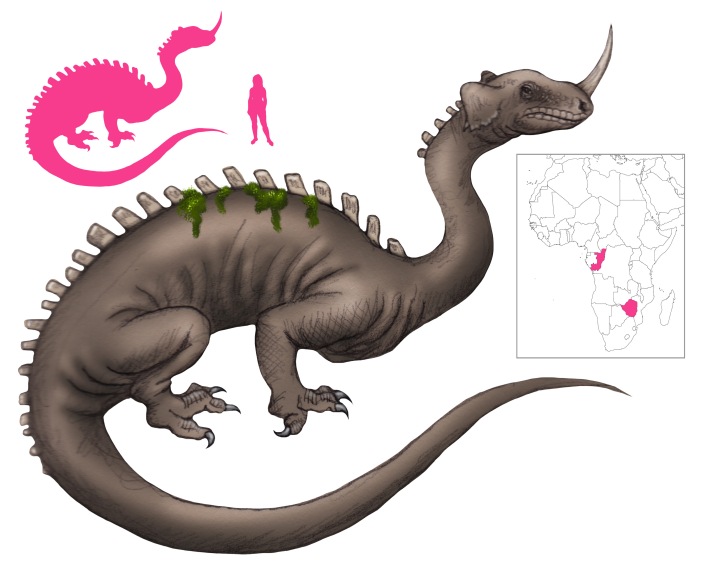
Tales of the Mokele-mbembe, “One Who Stops the Flow of Rivers” (or, more simply, “River-Shutter”), come from the Congo River Basin, around the Ikelemba, Sanga, and Ubangi rivers and Lake Tele. It is the most discussed and well-known of the “African mystery beasts” primarily due to the cryptozoological interpretation that defines it as a surviving sauropod dinosaur. It – or its unnamed predecessor, at any rate – was initially described as hailing from Rhodesia (Zimbabwe).

There is nothing unique about the mokele-mbembe. It is at least four notable mythic creatures: the river-shutter, the pachyderm slayer, the unicorn, and the giant reptile. River-shutters are sub-Saharan creatures with an aptitude for withholding or releasing a river’s water; in communities dependent on life-giving water, this can mean the difference between life and death. The pachyderm slayer – a creature so mighty and dangerous that it routinely kills the biggest and scariest animals known – is a far broader category that has been famously applied to the dragon and the unicorn. The presence of a single horn is a recurring feature of monsters, most notably the unicorn. Finally, giant reptiles (often irresponsibly called “dragons”) are a worldwide theme.

The first to suggest the existence of a large dinosaurian creature was big-game hunter and zoo supplier Carl Hagenbeck. Hagenbeck reports a huge animal, half elephant and half dragon, from deep within Rhodesia (not the Congo, where the mokele-mbembe eventually took up residence). He said that there are drawings of it on Central African caves but provides no further detail on that angle. All in all it is “seemingly akin to the brontosaurus [sic]”. Hans Schomburgk, one of Hagenbeck’s sources, stated that the lack of hippos on Lake Bangweulu was due to a large animal that killed hippos. An expedition sent by Hagenbeck to investigate the creature’s existence found nothing. Tantalizing as it may be, the entire episode with the nameless saurian is no more than an aside in Hagenbeck’s book, an attempt to attract potential investors by capitalizing on the contemporary “dinomania” sweeping the globe.

The first decade of the twentieth century saw a vast increase in public interest in dinosaurs. In 1905 the mounted skeleton of Apatosaurus was unveiled at the American Museum of Natural History and London’s Natural History Museum inaugurated its Diplodocus. Soon museums across the world were receiving their own gigantic sauropod skeletons courtesy of Andrew Carnegie, industrialist and patron of the sciences. In 1907 the skeletons of enormous sauropods emerged in German East Africa; these eventually formed a hall of titans in Berlin’s Natural History Museum. Hagenbeck’s account of a living sauropod was not written in a vacuum, but was – consciously or not – drawing on contemporary massive interest in massive reptiles.

E. C. Chubb of the Rhodesia Museum dismissed Hagenbeck’s claim. To him, this creature was no more than another example of the “land edition of the Great Sea Serpent”. He received further accounts of the Rhodesian creature, a large beast with flippers, rhinoceros horns, a crocodile’s head, a python’s neck, a hippo’s body, and a crocodile’s tail; a three-horned creature from Lake Bangweulu, Zambia, that killed hippos.

The next step came with Lieutenant Paul Graetz in 1911. He wrote about the Nsanga of Lake Bangweulu, a “degenerate saurian” like a crocodile but without scales and armed with claws on its feet. Graetz supposedly came by strips of nsanga skin but saw nothing more tangible.

The account that concretized the mokele-mbembe and gave it its name was that of German officer Ludwig Freiherr von Stein zu Lausnitz. His report places the mystery beast firmly in the Congo, around the Likouala rivers. The mokele-mbembe has smooth, brownish-grey skin. It is approximately the size of an elephant, or a hippopotamus at the smallest. Its neck is long and flexible. It has only one tooth, but that tooth is very long; “some say it is a horn” adds Stein (this feature is usually ignored, as it does not conform to the sauropod narrative). It has a long, muscular tail like a crocodile’s. It attacks canoes and kills its occupants without eating them. The mokele-mbembe is vegetarian and it feeds on a type of liana, leaving the water to do so. It lives in caves dug out by the sharp bends in the river. Stein was shown a supposed mokele-mbembe trackway but could not make it out among the elephant and hippo tracks.

Stein’s account is the basis for the modern mokele-mbembe legend. The report was never officially published, but was publicized by Willy Ley (who inexplicably linked the mokele-mbembe to the dragon of the Ishtar Gate).

This in turn led to successive expeditions to the Congo by James H. Powell Jr. and Roy Mackal. Mackal determined the mokele-mbembe to be 5 to 10 meters long, most of which is neck and tail. It has smooth brown-grey skin and a very long neck with a snakelike head on the end. Sometimes there is a frill, like a rooster’s comb, on the back of the head. The legs are short and stout, with three claws on the hind legs, and leave 30-centimeter-wide prints. The malombo plant is the staple of the creature’s diet. While herbivorous, the mokele-mbembe is very aggressive and will destroy any canoes that approach it. It does so by tipping the vessels, then biting and lashing out with its tail.

In addition to the mokele-mbembe, Mackal is responsible for bringing to light a whole menagerie of prehistoric survivors and some unusually-sized modern reptiles as well. The Emela-ntouka, for instance, is larger than an elephant. Its skin is smooth, hairless, and wrinkly, brown to grey in color. Its legs are thick and columnar to support its weight. The tail is heavy and similar to a crocodile’s. There is a single horn on the front of the head. These creatures are herbivorous and kill buffaloes and elephants by goring them with their single horns. If all this sounds familiar, it’s because none of it is distinguishable from what has been said about the mokele-mbembe (including the horn, no longer an inconvenient detail). Mackal optimistically proposes that the emela-ntouka is a late-surviving ceratopsian dinosaur.

Nguma-monene, “large python” (from nguma, “python”, and monene, “large”) is reported from the Dongou-Mataba river area. It is a large, serpentine reptile, some 40 to 60 meters long, with a saw-toothed ridge down its back. The head is snake-like with a forked tongue that flicks in and out. It is greyish-brown like just about every other large reptilian cryptid. It is indistinguishable from the badigui, ngakoula ngou, diba, or songo of the Ubangi-Shari. All of these are giant snakes which kill hippos and browse on tree branches without leaving the water. They leave tracks behind like those of a lorry. All of them are indistinguishable from the mokele-mbembe. Mackal describes them as enormous monitor lizards.

The Mbielu-mbielu-mbielu, or “animal with planks growing out of its back”, is restricted to the Likouala-aux-Herbes in the Congo. It is known solely as a large animal that has large “planks” on its back with algae growing between them. The rest of its appearance is unknown. Only one informant reported the mbielu-mbielu-mbielu. Mackal makes a surviving stegosaur out of it.

Finally there is the Ndendecki (a giant turtle), the Mahamba (a giant crocodile), and the Ngoima (a giant eagle). None of these are any more believable than the mokele-mbembe and its host of synonyms.

It would be tedious to list all subsequent expeditions (all unsuccessful) or the anthropological procedures used (all unprofessional). It should however be noted that the hunt for the mokele-mbembe has been coopted by the creationist movement. For some reason these people have decided that the discovery of the mokele-mbembe will be enough to destroy the entire theory of evolution (it won’t) because a surviving dinosaur would be a lethal paradox to science (it isn’t).

There is nothing unique about the mokele-mbembe, but as a vaguely defined reptilian river-shutter it is a sort of Rorschach test that viewers can project their preconceptions onto. Far from a detailed local legend, the myth of the mokele-mbembe evolved to suit the needs of the visitors who sought it, whether zoo suppliers, colonialists, cryptozoologists, or creationists. Any underlying folklore about river-shutting reptiles has long been abandoned and discarded, relegated to an etymological footnote. It does not fit the narrative.

References

Hagenbeck, C., Elliot, S. R. and Thacker, A. G. trans. (1911) Beasts and Men. Longmans, Green, And Co., London.

Ley, W. (1959) Exotic Zoology. The Viking Press, New York.

Loxton, D. and Prothero, D. R. (2013) Abominable Science! Origins of the Yeti, Nessie, and other Famous Cryptids. Columbia University Press, New York.

Mackal, R. (1987) A living dinosaur? E. J. Brill, New York.

Naish, D. (2016) Hunting Monsters: Cryptozoology and the Reality Behind the Myths. Arcturus, London.

Weishampel, D. B.; Dodson, P.; and Osmolska, H. (2004) The Dinosauria, 2nd Edition. University of California Press, Berkeley.

Markupo

Variations: Macupo, Marcupo

Markupo

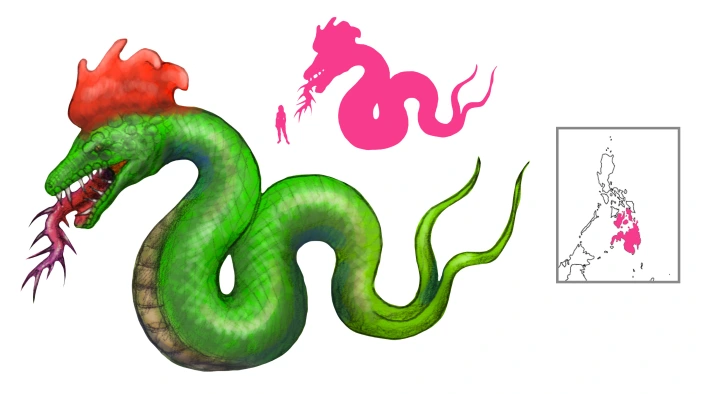
The Markupo is a serpent known to the Hiligaynon of the Philippines. It lives in the highest mountains of the historical province of Bulgas, between Marapara and Canlaon.

In appearance the markupo is a huge snake with a distinctive red crest. Its long tongue has thornlike hairs. It has sharp tusks and a forked tail.

The markupo sings sonorously on clear days. Its exhaled poison is instantly lethal to the touch. If sprinkled on plants, this poison withers the plant, kills any birds that land on it, and kills any beast touched by its shadow.

References

Ramos, M. D. (1971) Creatures of Philippine Lower Mythology. University of the Philippines Press, Quezon.

Ramos, M. D. (1973) Filipino Cultural Patterns and Values. Island Publishers, Quezon City.

Teakettler

Teakettler

This small Northwoods denizen makes a sound like the whistle of a boiling teakettle. It walks backwards by choice, and clouds of steam come out of its nostrils. Nothing else is known of its appearance as few have ever seen it.

References

Borges, J. L.; trans. Hurley, A. (2005) The Book of Imaginary Beings. Viking.

Brown, C. E. (1935) Paul Bunyan Natural History. Madison, Wisconsin.

Tompondrano

Variations: Tòmpondràno, Tompon-drano, Tompoudrano

Tompondrano final

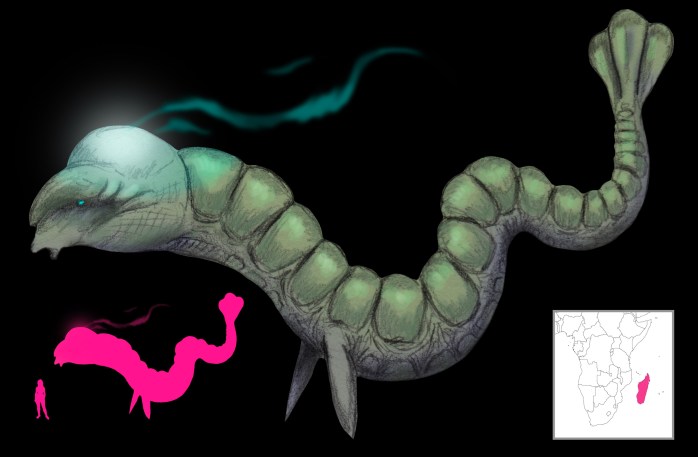
Tompondrano, “lord of the water” or “master of the water”, applies to multiple concepts within the folklore of Madagascar. For our purposes, it refers to at least two types of water snake – one which was commonly encountered in day-to-day life, and an undefined marine monster. Whales, sharks, and crocodiles are also known as tompondrano; the Sakalava proverb “the amby never leaves the master of the water” apparently refers to the pilotfish. The alternative spelling of tompoudrano is phonetically identical to tompondrano in French.

The tompondrano is a water-snake blessed by the Vazimba, a mythical ancient race that lived in the center of Madagascar. For this reason it is respected as a sacred animal. It should not be killed, and dead tompondranos are wrapped in red silk in the same way as human corpses. Tompondranos are good swimmers, often seen crossing ponds and rivers in the forest, but they are not notably large (the largest snake in Madagascar, the akoma or Madagascar ground boa, is some 2.7 meters long).

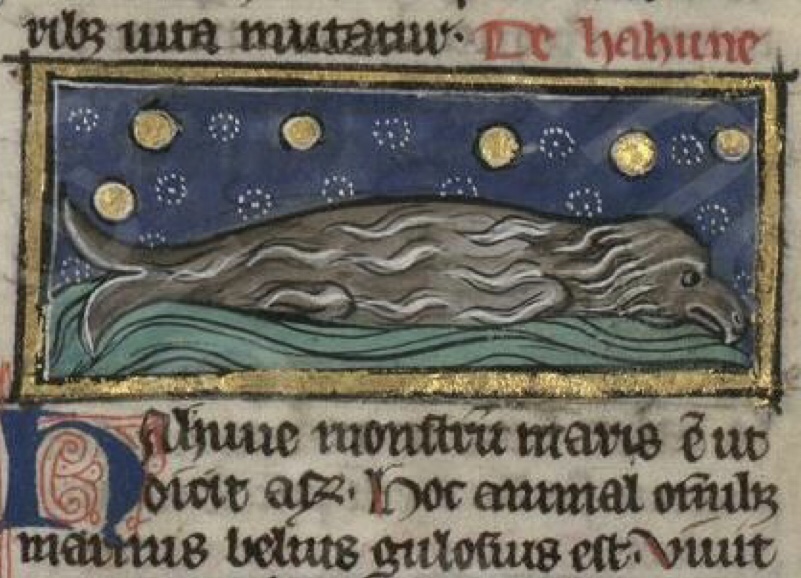
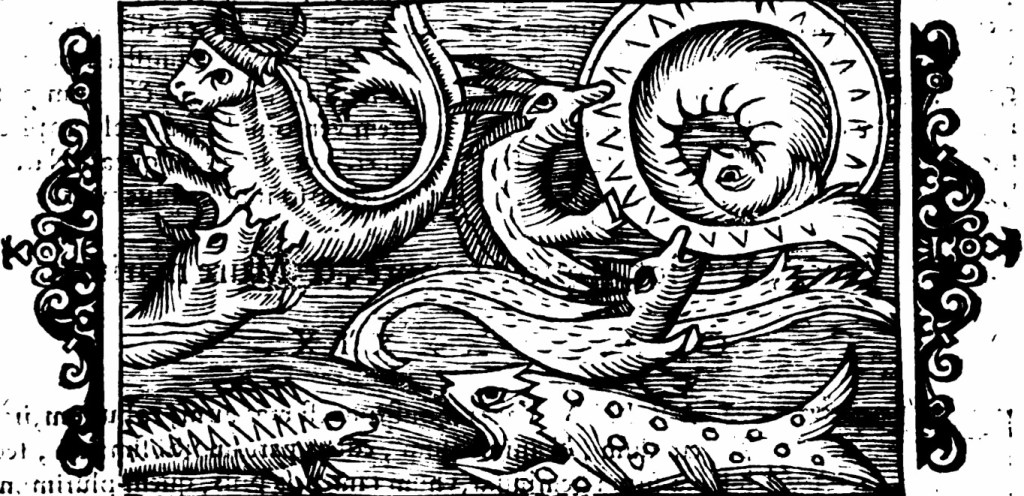
A very different tompondrano was seen by G. Petit in 1926, on the night a cyclone was announced. He describes seeing bright and fleeting lights produced intermittently every few seconds, something like a much weaker signal beacon of a ship. They were emitted by a large aquatic body rolling on its axis and leaving an indefinitely long phosphorescent trail behind it. Petit was later told by Vezo informants that he had seen a tompondrano a creature 20 to 25 meters long, large and flattened, with hard plates on its body and a tail like that of a shrimp. It is the tompondrano’s head that is luminous. Its mouth is ventrally located, and the creature turns itself upside down to attack targets on the surface. There is a retractable fleshy hood that protects the eyes. It is either legless or has appendages like those of whales. To ward off its unwelcome attentions, an axe and a silver ring are suspended at the bows of boats.

References

Birkeli, E. (1924) Folklore Sakalava. Bulletin de l’Academie Malgache, IV, pp. 185-417.

Jourdran, E. (1903) Les Ophidiens de Madagascar. A. Michalon, Paris.

Romanovsky, V.; Francis-Boeuf, C.; and Bourcart, J. (1953) La Mer. Larousse, Paris.

Sibree, J. (1896) Madagascar Before the Conquest. Macmillan, New York.

Muscaliet

Variations: Muscardin; Dormouse; Musquelibet, Musquelibus, Musquilibet (possibly)

Muscaliet

Nobody is quite sure what a Muscaliet is. Our only source for this unusual rodent is found in the bestiary of Pierre de Beauvais, and it appears to have been cobbled together from multiple unrelated accounts.

The muscaliet is found in India, in the land of the three talking trees that predicted the death of Alexander the Great. This by itself is suspect, as the accounts of Alexander in India only mention two trees, consecrated to the sun and moon. Then again, the sun-tree was said to have spoken twice and the moon-tree once, making for three tree speeches. The life of a copyist was a thankless one.

Beauvais gives the muscaliet a body like a hare, but smaller. Its legs, feet, and tail are like those of a squirrel, but the tail, while held in a squirrel-like manner, is larger. It uses the strength in its tail to jump from tree to tree. Its head is rounded, its ears small and weasel-like, and its nose long and pointed like a mole. There is a tooth sticking out of its mouth on either side, like a boar’s tusks, and it has bristles around its snout like the bristles on a boar’s back.

A muscaliet is a highly adept climber. No animal can catch it in the trees, and its claws are so sharp that it can cling to any surface. It eats fruits, leaves, and flowers and digs out its dens in the roots of trees. It is so “hot by nature” (calde de nature) that the tree it lives in eventually rots, withers, and dies as the muscaliet gnaws away at the roots.

This is a moral lesson. The tree represents a human; its leaves and flowers are good deeds, and its fruits are the soul. But the muscaliet is Pride, its sharp teeth are cutting words that Cruelty brings, and its feet show that cruelty is tenacious. Once Pride takes up residence within us, Beauvais warns, it rots us from the inside out.

The term “muscaliet” itself is an archaic French term for the common dormouse or muscardin (Muscardinus), that which Buffon described as “the least ugly of all the rats”. Its name is derived from its presumed musky odor; whether this attribution came before or after Beauvais’ usage is unclear. The –caliet part of the name superficially suggests heat, which would have inspired our bestiarist to describe it as “hot by nature”. Alternative, “muscaliet” may have been derived from the musquelibet, a creature like a roe deer in size, with an abscess-like growth that produces musk. This is the musk deer Moschus moschiferus, which does have tusks like a boar but little connection to the muscaliet otherwise – not even musk is mentioned.

Is this the fox-sized mouse described by Aristotle? It was a wonder of India found by Alexander, a mouse the size of a fox and with a noxious bite that harmed animals and humans. This sounds like a rat, and perhaps an early allusion to the diseases carried by those animals – rats were unknown to the ancient Greeks and Romans, with black rats appearing in late antiquity and brown rats showing up in the 16th century. Tales of rats with toxic bites combined with dormouse and musk-deer anecdotes are likely the basis for the tree-poisoning muscaliet, which exists as a moral warning and not a zoological account.

References

de Beauvais, P.; Baker, C. ed. (2010) Le Bestiaire. Honoré Champion, Paris.

Buffon, G. L. L. (1775) Oeuvres completes de M. le Cte. De Buffon, t. II. Imprimerie Royal, Paris.

Cahier, C. (1856) Bestiaires. Melanges d’Archeologie, 1856(IV), pp. 55-87.

de Cantimpré, T. (1280) Liber de natura rerum. Bibliothèque municipale de Valenciennes.

Cuba, J. (1539) Le iardin de santé. Philippe le Noir, Paris.

Godefroy, F. (1901) Lexique de l’Ancien Francais. H. Welter, Paris.

Kitchell, K. F. (2014) Animals in the Ancient World from A to Z. Routledge, Milton Park, Abingdon, Oxon.

Magnus, A. (1920) De Animalibus Libri XXVI. Aschendorffschen Verlagbuchhandlung, Münster.

Unknown. (1538) Ortus Sanitatis. Joannes de Cereto de Tridino.

de Xivrey, J. B. (1836) Traditions Tératologiques. L’Imprimerie Royale, Paris.

Origorúso

Variations: Oriogorúho, Orio-goruhu; Suguma; Poópoó

Origoruso

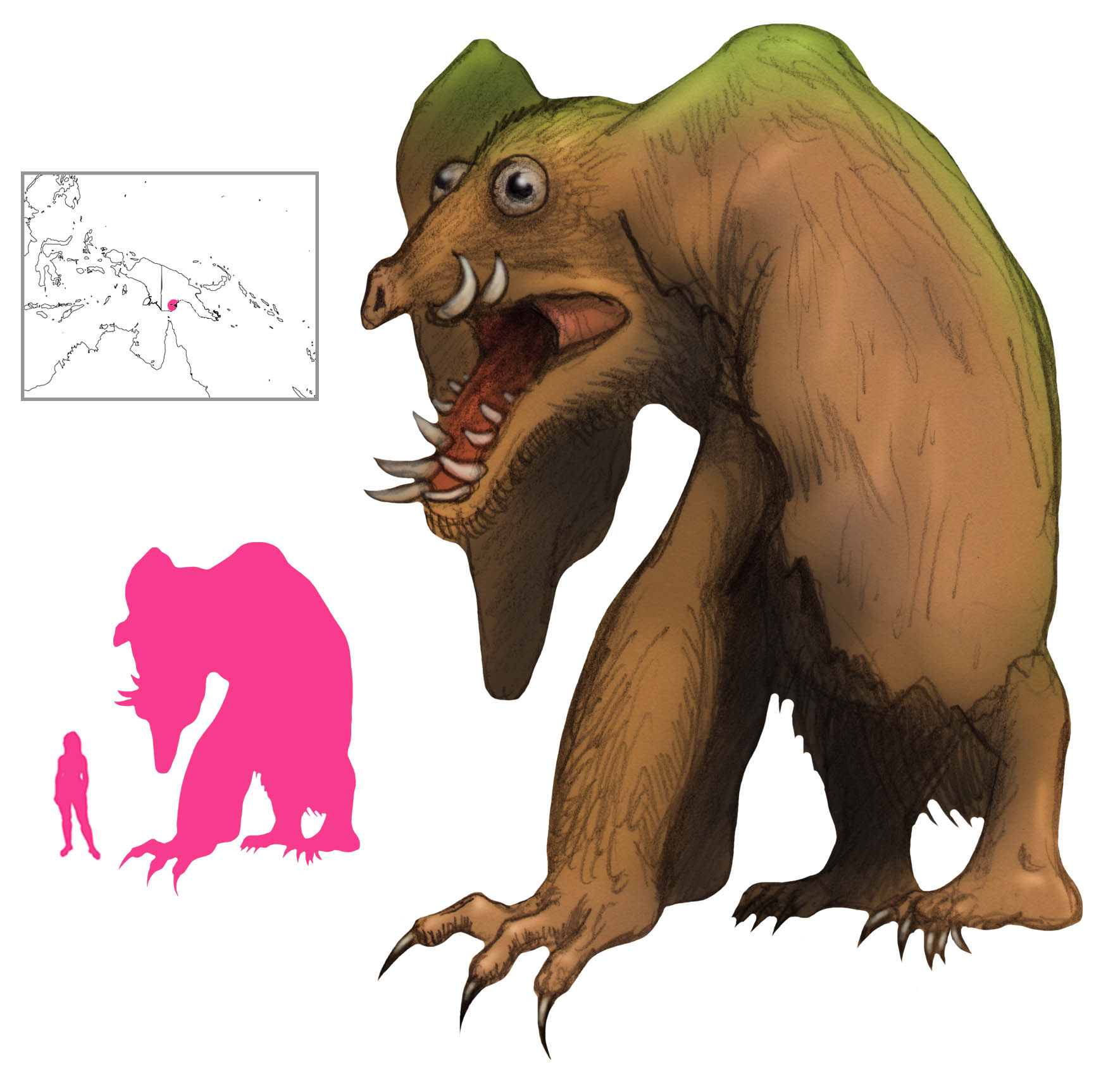
The Origorúso (Kiwai) or Oriogorúho (Mawata) is a man-beast, an ogre from the folklore of the Kiwai islanders of Papua New Guinea. Its name is derived from the fact that it eats (orúso) its food raw (orío).

An origorúso has very short legs, and supports itself on its hands while walking. It has huge eyes and enormous ears; its cavernous mouth has protruding tusks like those of a pig. The tusks are superfluous, as an origorúso swallows its prey whole and raw.Its fingers are armed with long claws. Male origorúso have two penises. An origorúso can make a sound like a loud grunt or roar, but it can also speak normally with people.

At night an origorúso lies on one of its oversized ears, and uses the other as a blanket. By day the ears are usually rolled up.

Origorúsos live underground or inside large trees. They raid villages to carry off and eat people. Sometimes an origorúso will enter a village and devour everyone in one house before leaving. An origorúso used to carry off a child in a village every day, until a cripple guarding a little boy tied a string around the child’s leg. When the cripple went to sleep, the origorúso pulled on the child, and by doing so pulled the string and alerted the man. Everyone in the village wisely fled, with the exception of a man, a woman and their child. They managed to appease the origorúso by throwing pigs at it until it fed and went to sleep. Then they left behind a coconut shell full of lice collected from their child; the lice answered the origorúso’s calls and detained it while they made good their escape.

Sometimes humans can become origorúsos under the right condition. A Kiwai woman in childbirth, upon being insulted by her husband, transformed into an origorúso who pursued the husband relentlessly. A man who lived a while with a friendly origorúso slept in the creature’s ears and ate raw meat; it was all fine until the man’s ears started to grow as big as the origorúso’s. “You got bed, I got bed; you got mat, I got mat”, the origorúso said cheerfully. But the man, terrified, ran back home and hid among his people. It was all in vain. The origorúso, angered, lay siege to the village, and with him came other origorúsos, the horrific útumos that are the ghosts of decapitated men, and other vile spirits. They did not leave until the escapee was given to them, torn apart, and consumed.

Fragments of origorúso bone make potent fighting medicine and are given to dogs.

The origorúso is only one of a number of creatures with enormous ears used to sleep in. The Bina people refer to their oriogorúho as female and nocturnal. The Suguma seems to be synonymous with the origorúso. The Poópoó also has huge ears, and has skin covered with po (knobs); it either has huge tusks or normal-sized teeth, and it otherwise looks like a normal man.

References

Beaver, W. N. (1920) Unexplored New Guinea. Seeley, Service & Co. Limited, London.

Kirtley, B. F. (1963) The Ear-Sleepers: Some Permutatios of a Traveler’s Tale. The Journal of American Folklore, 76(300), pp. 119-130.

Landtman, G. (1917) The Folk-tales of the Kiwai Papuans. Acta Societatis Scientiarium Fennicae, t. XLVII, Helsingfors.

Landtman, G. (1927) The Kiwai Papuans of British New Guinea. MacMillan and Co. Limited, London.

Cuero

Variations: Hide, Skin; Manta; Huecú, Chueiquehuecu, Chueiquehuecuvu, Trelque, Trelquehuecufe, Trelquehuecuvu, Trilkehuecufe; Ghyryvilu (erroneously?); El Cuero (erroneously)

Cuero

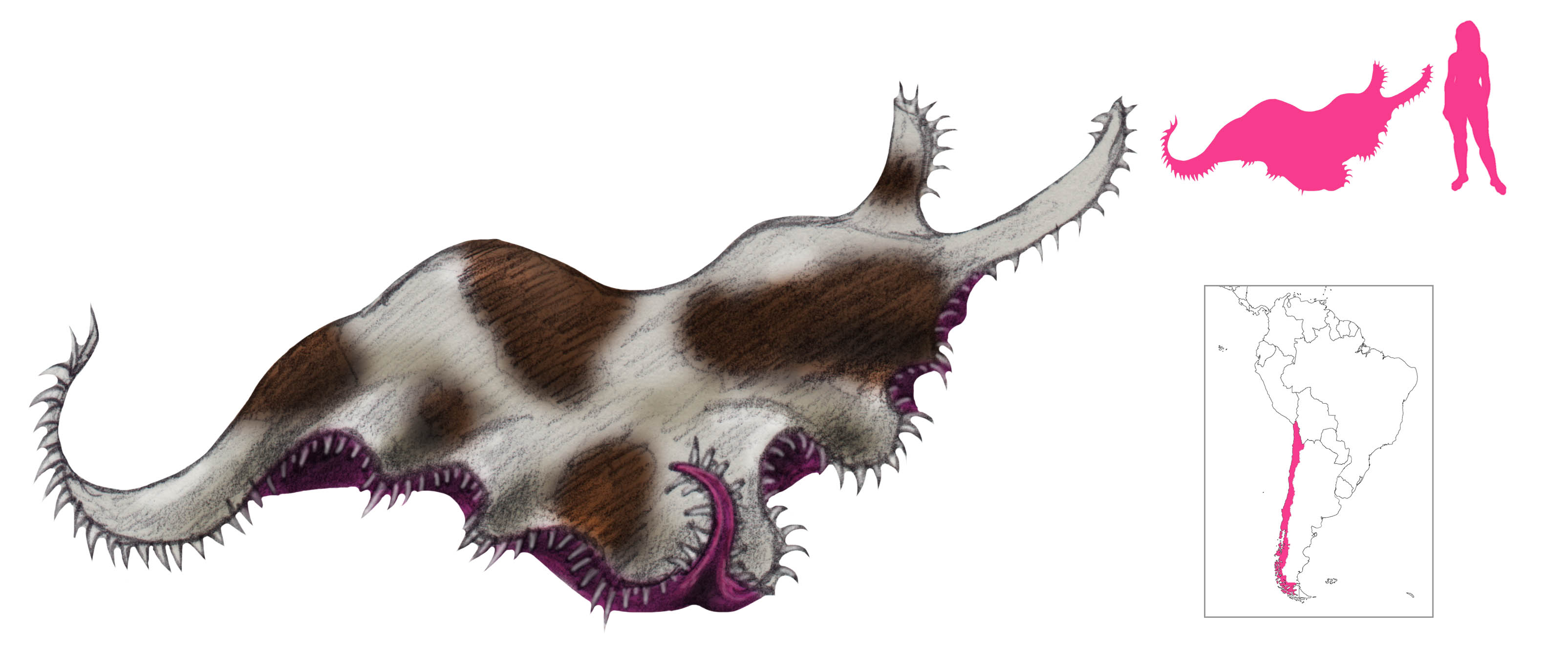
The tale of the living cow-hide is widespread throughout the lakes of Chile. Originally a type of huecuve, a Mapuche evil spirit responsible for all sorts of ills, it has since assimilated into local folklore and been attributed to animals such as the octopus and ray. Sometimes the creature is merely a physical manifestation of the huecuve, which can then go on to possess people or animals and inflict them with consumption.

The Mapuche term for this creature is Trelquehuecuve, “skin huecuve”. In Spanish-speaking contexts it is known as Cuero, “Hide” or “Skin”, or Manta, “Mantle” or “Cloak”. Molina describes it as a variant of the ghyryvilu or fox-snake, another aquatic terror.

A cuero is a creature that looks like a cowhide, sheepskin, or goatskin, stretched out flat and laid on the surface of the water. It is usually white with black or brown spots, or brilliant yellow and white. The edges of the cuero are armed with hooked claws. The cueros of Butaro laguna, Atacama, resemble living fabric with suckers; they are also the souls of the damned. In central Chile the cuero is an octopus that resembles a cowhide with numberless eyes and with four enormous eyes in its head. Laguna Copín, Aconcagua, is home to a furry, flat creature fond of human flesh.

Anything that enters the water is engulfed and squeezed in the cuero’s folds, and dragged under to have its blood sucked out. After feeding the cuero will release its drained prey and find itself a solitary beach on which to stretch out, bask, and digest peacefully. Unexplained drownings are the work of a cuero. In Ovalle and Coquimbo the goatskin cueros couple with cows and sire deformed offspring.

Cueros can be killed by tossing branches of quisco cactus (Cereus or Echinocactus) into the water. The creature will attempt to seize the cactus, injure itself, and bleed to death. The heroic youth Ñanco successfully confronted a cuero by holding quisco in his hands and tying quisco branches to his legs

The motif of the living hide extends to other beings and motifs. Another Chilean folktale tells of a magical cow that told its master Joaquin to kill and skin it. The resultant cowhide was alive in its own fashion and served Joaquin as a boat, and the cow’s eyes in his pocket granted him the power to see through anything. At the end of his adventures, the skin, bones, eyes, and other remains of the cow were collected for burning, but the moment the last hair of the cow touched the pile, the cow was brought back to life, plump and healthy, and walked off to the farm as though nothing had happened.

References

Aguirre, S. M. (2003) Mitos de Chile. Random House, Editorial Sudamericana Chilena.

Borges, J. L.; trans. di Giovanni, N. T. (2002) The Book of Imaginary Beings. Vintage Classics, Random House, London.

Cifuentes, J. V. (1947) Mitos y supersticiones (3rd Ed.). Editorial Nascimento, Santiago, Chile.

Guevara, T. (1908) Psicolojia del pueblo araucano. Imprenta Cervantes, Santiago de Chile.

Latcham, R. E. (1924) La organización social y la creencias religiosas de los antiguos araucanos. Imprenta Cervantes, Santiago de Chile.

Molina, M.; Jaramillo, R. trans. (1987) Ensayo sobre la Historia Natural de Chile. Ediciones Maule, Santiago de Chile.

Soustelle, G. and Soustelle, J. (1938) Folklore Chilien. Institut International de Coopération Intellectuelle, Paris.

Dard

Dard

The Dard is peculiar to the department of Vienne in France, but its physiognomy recalls that of the alpine dragons – and, like them, it probably evolved from mustelid accounts. It is a serpent with four legs and a short viper’s tail. It has the head of a cat and a mane running down its dorsal spine.

Dards drink milk from cows and can produce a terrifying whistle. They are nonvenomous, but bite viciously when provoked.

Peasants in Vienne claimed to recognize the dard’s likeness in the carvings of certain churches.

References

Ellenberger, H. (1949) Le Monde Fantastique dans le Folklore de la Vienne. Nouvelle Revue des Traditions Populaires, 1(5), pp. 407-435.