Whowie

Variations: Whowhie

Whowie

The Whowie was the terror of the Murray River in the Riverina district of Australia. He was like an enormous goanna, about twenty feet long, with six goanna legs and a huge frog-like head; he was perhaps somewhat like the huge monitor lizards that once roamed southern Australia. While very slow in his movement, he had no reason to be fast, as everyone fleed in terror from him. At night, the whowie would crawl into grounds where people were sleeping, and proceed to devour anyone who couldn’t get away. Thirty to sixty people could disappear down his cavernous mouth during one of those raids. During the day he would sleep in his cave on the Murray River, or bask along the riverbank; his movements created the sandhills of Riverina.

With the passage of time, the depredations of the whowie were starting to take their toll on the inhabitants. The water-rat tribe was first to convene, as they had suffered most from the whowie’s attention. The chief solemnly announced that they had no choice but to flee to a safer land or face certain annihilation. “I shall let you decide what we shall do”, he told his people. It was an elder who stood up and implored his people to stay. “We have lived here all our lives; we have always had plenty to eat, and much to do along the river. Now we dare not go there because of the whowie. Let us think of some other way by which we may be rid of this menace”.

A strict night guard was instated, and the aid of several other tribes was called for. The water-rats searched for the whowie, and found footprints leading into the cave’s one opening. As the whowie’s cave was many miles long, they knew it would take a week for him to return to the outside, and so they had all the time they needed.

Soon help had arrived from all over, from the kangaroo, platypus, eagle, magpie, cockatoo, lizard, snake, opossum and crow tribes, and many more besides. After holding a corroboree and spending a night in celebration, dancing, and storytelling, all of them busied themselves gathering sticks. The sticks were gathered into bundles and piled up halfway in the cave and at the entrance. Then, when they believed the whowie was soon to appear, they set the wood on fire.

Smoke and flames filled the cave, and the whowie roared and coughed angrily – but what good were his teeth and claws against smoke and fire? He struggled upwards through the cave for six days and appeared on the seventh burned, blinded, and gasping for breath. That was when the tribes descended upon him with spears, axes, and nulla-nullas, inflicting mortal wounds on their enemy. The giant lizard could only drag himself back into his cave, and was never seen again.

Now the whowie can still be heard sighing from deep inside the cave on the Murray River. He is dying, or perhaps his spirit has survived underground in some form. But either way he is harmless, and has become nothing more than a bogey with whom parents can threaten their children into good behavior.

References

Molnar, R. E. (2004) Dragons in the Dust. Indiana University Press, Bloomington.

Reed, A. W. (1965) Myths and Legends of Australia. A. H. and A. W. Reed, Sydney.

Smith, W. R. (2003) Myths and Legends of the Australian Aborigines. Dover Publications, Mineola.

Nauthveli

Variations: Nauthvalur, Nautshval (Ox-whale); Nautfiskur (Ox-fish); Kýrhvalur (Cow-whale); Fjósi (Byre-whale); Baulhveli (Bellow-whale); Búrhvalur, Sperm Whale

Nauthveli

The Nauthveli or Nauthvalur (“Ox-whale”) is one of the many illhveli or “evil whales” of Iceland. It is the second biggest of the evil whales, and like the others, it is inedible and will show up if its name is said out loud.

A nauthveli is a toothed whale, bicolored much like a cow. The large head is similar to that of a bull and has two nodules on top. The trunk tapers off, wormlike, and lacks fins.

However, the nauthveli is named not for its appearance, but rather for the terrifying bull-like bellow it makes when hungry, a sound like that of roaring, maddened bulls. The call of a nauthveli is made in the open sea or near the shore, and can be heard reverberating over long distances. The vibrations cause the ground to shake and knock oars out of sailors’ hands. Going out to sea is forbidden if nauthveli bellowing can be heard.

As will all evil whales, the nauthveli delights in killing men and scuttling smaller boats, but it has a particular fondness for beef. The bellow of a nauthveli is hypnotic to cattle, compelling them to run off cliffs and headlong into the sea. There the nauthveli plays with them like a cat does with a mouse before biting them in half and eating them. The whales are attracted to cattle on board ship; one nauthveli off Grimsey harassed a vessel until they released the one cow on board, who promptly dove into the sea. Cattle have to be locked up for days until the nauthveli’s spell wears off, and indeed cow-herding was strongly discouraged in areas where nauthvelis had been heard. Sacrificing one bull or cow usually satisfies the nauthveli, making it safe to go out to sea again.

Gudmundsson listed the nauthveli as synonymous with the búrhvalur or sperm whale.

References

Davidsson, O. (1900) The Folk-lore of Icelandic Fishes. The Scottish Review, October, pp. 312-332.

Hermansson, H. (1924) Jon Gudmundsson and his Natural History of Iceland. Islandica, Cornell University Library, Ithaca.

Hlidberg, J. B. and Aegisson, S.; McQueen, F. J. M. and Kjartansson, R., trans. (2011) Meeting with Monsters. JPV utgafa, Reykjavik.

Devouring Gourd

Variations: Devouring Pumpkin; Sala Fruit (possibly)
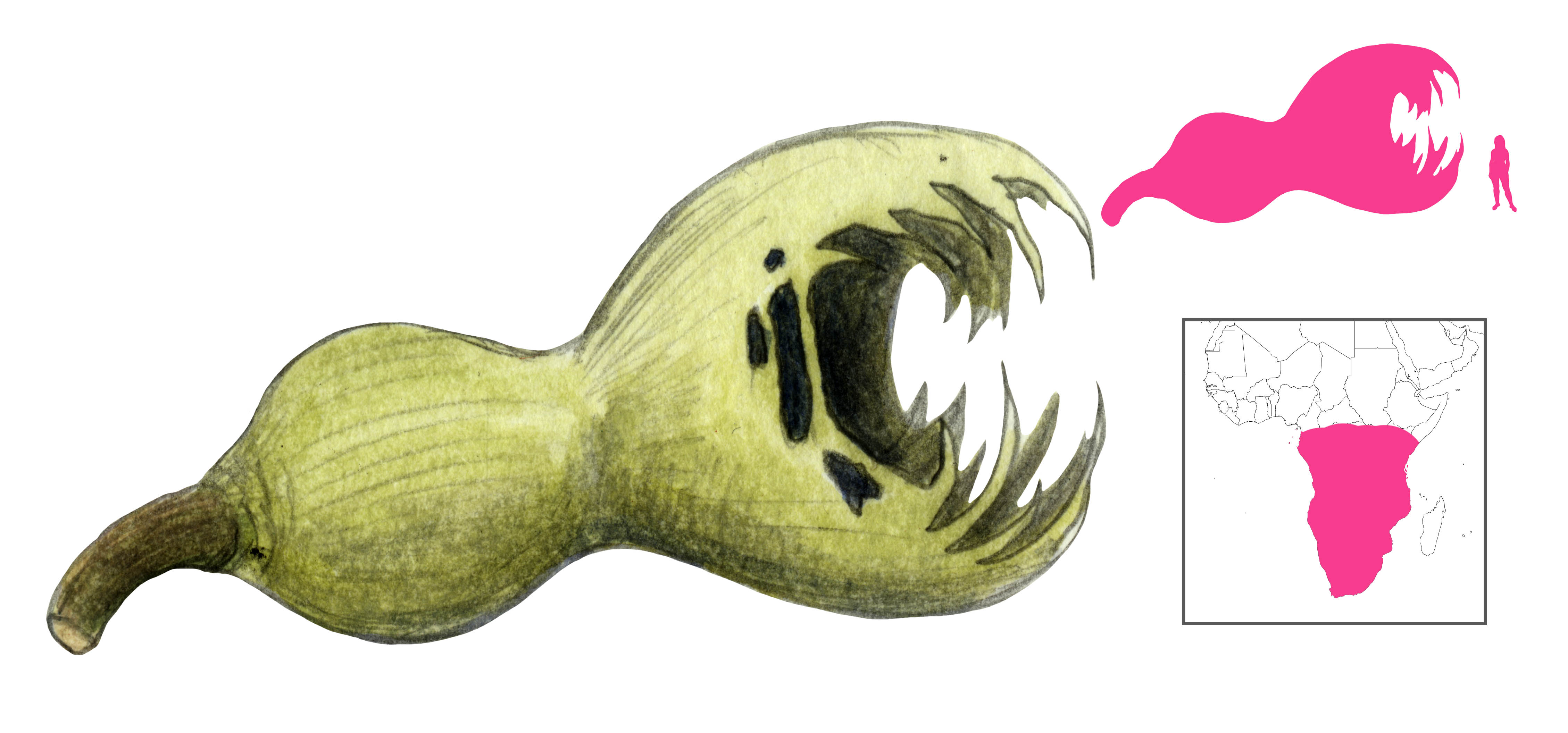
Swallowing Gourd final

Not all swallowing monsters are animals. In Bantu folklore, gourds and pumpkins have the potential to grow into vast, devouring creatures. Such plants usually grow where evil sorcerers or ogres were slain.

The devouring gourd of Usambara was discovered by a group of little boys at play. “Look at how big that gourd is getting!” said one of the boys. To their surprise, the gourd responded. “If you pluck me, I’ll pluck you!” it said. The boys ran home and told their mother, who refused to believe them. But their sisters insisted on seeing the large gourd, and when they were taken to it, they said as their brothers had, “Look at how big that gourd is getting!” This time the gourd did not respond, and the girls went home to complain about their brothers being liars.

As the gourd was not plucked, it continued to grow. Eventually it became the size of a house, uprooted itself, and went about swallowing everyone in the village. After consuming everyone within reach, it rolled into a lake.

Only one woman had survived the gourd’s rampage, and she was pregnant. When her son was born, they lived together in the ruins of the village. When the son got around to asking where his father was, his mother told him “He was swallowed by a gourd, which is now in the lake”. The son decided to avenge his father, and went out to the lake where he could see the gourd’s ears sticking out of the water, and he proceeded to taunt the vegetable. “Gourd, come out!” he yelled. “Gourd, come out!” Annoyed and enraged, the gourd hauled itself out of the lake, but the boy was ready for it, and fired a volley of arrows into it. The tenth arrow killed it, and it died with a roar that could be heard all the way to Vuga. The boy cut it open with a knife, released the villagers unharmed, and went on to become a great leader of his people.

Gourds are not the only plants that devour and kill people. Another carnivorous plant, a pumpkin, grew over the burial location of an evil shapeshifting porcupine. It repeated everything that was said to it, and when an axe was brought to destroy it, it proceeded to swallow everyone. The poisonous Sala fruits of the Ronga have arms and legs, and wield spears ands shields.

References

Knappert, J. (1977) Bantu myths and other tales. E. J. Brill, Leiden.

Werner, A. (1968) Myths and legends of the Bantu. Frank Cass and Co. Ltd., London.
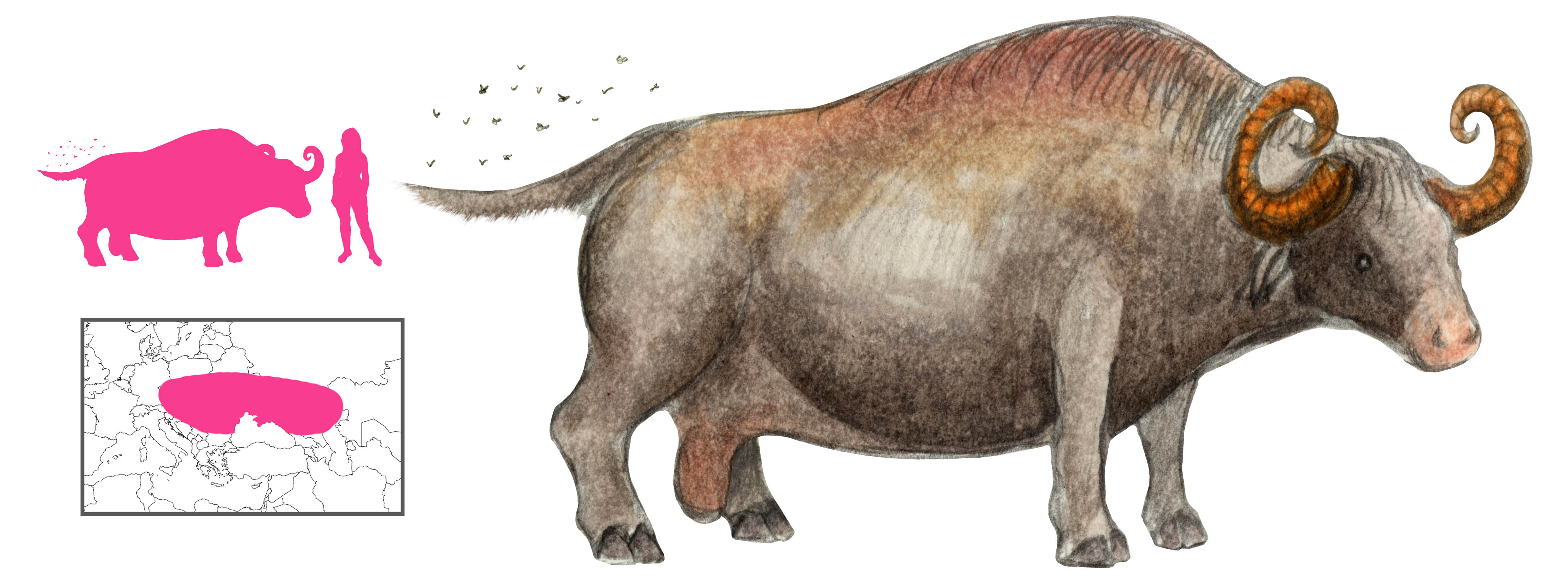
Bonnacon

Variations: Bonasus, Bonasos, Monassos, Monops; Bison, Maned Bison, European Bison, Aurochs, Urus, Urus Bonasus

Bonnacon

The Bonnacon’s range extends from Scythia in the east to Bulgaria, Macedonia, and Germany in the West. It would be a fine prize for hunters were it not for its remarkable flatulent defenses.

A bonnacon looks like a bull, but is squatter, with reddish fur shading to black, a short tail, and the shaggy mane of a horse. Its horns curl inwardly towards the head, making them of no use in self-defense.

When attacked, the bonnacon voids the contents of its intestines over an area of 3 acres (Aristotle gives a more conservative estimate of 4 fathoms). The noxious, acrid dung ignites and burns anything it touches, leaving a trail of flame in its wake.

The European bison (Bison bonasus) is generally believed to be the basis of the bonnacon.

References

Aelian, trans. Scholfield, A. F. (1959) On the Characteristics of Animals, vol. II. Harvard University Press, Cambridge, Massachusetts.

Cuba, J. (1539) Le iardin de santé. Philippe le Noir, Paris.

Pliny; Holland, P. trans. (1847) Pliny’s Natural History. George Barclay, Castle Street, Leicester Square.

Sainéan, L. (1921) L’histoire naturelle et les branches connexes dans l’oeuvre de Rabelais. E. Champion, Paris.

Unknown. (1538) Ortus Sanitatis. Joannes de Cereto de Tridino.

White, T. H. (1984) The Book of Beasts. Dover Publications, New York.

Az’-i-wû-gûm Ki-mukh’-ti

Variations: Walrus Dog

Aziwugum

Az’-i-wû-gûm Ki-mukh’-ti, the “Walrus Dog”, can be found roaming the rugged coastlines of Alaska. While not walrus-like, it lives with herds of walrus and acts as a protector of sorts. It is one of Raven’s many creations.

An az’-i-wû-gûm ki-mukh’-ti is rather like a large dog in general appearance, smaller than a walrus, elongate and slender, with a long, powerful rounded tail. Its body is covered with tough black scales which make it impervious to all but the best spears.

Walrus hunters in the Bering strait fear the az’-i-wû-gûm ki-mukh’-ti. Its muscular tail can easily kill a man, and at least one case is known of a walrus dog attacking an umiak and killing all aboard.

References

Nelson, E. W. (1900) The Eskimo about Bering Strait. Extract from the Eighteenth Annual Report of the Bureau of American Ethnology, Government Printing Office, Washington.

Butatsch Cun Ilgs

Variations: Butatsch-ah-ilgs (erroneously, apparently a typo in Rose’s encyclopedia)

Butatsch Cun Ilgs

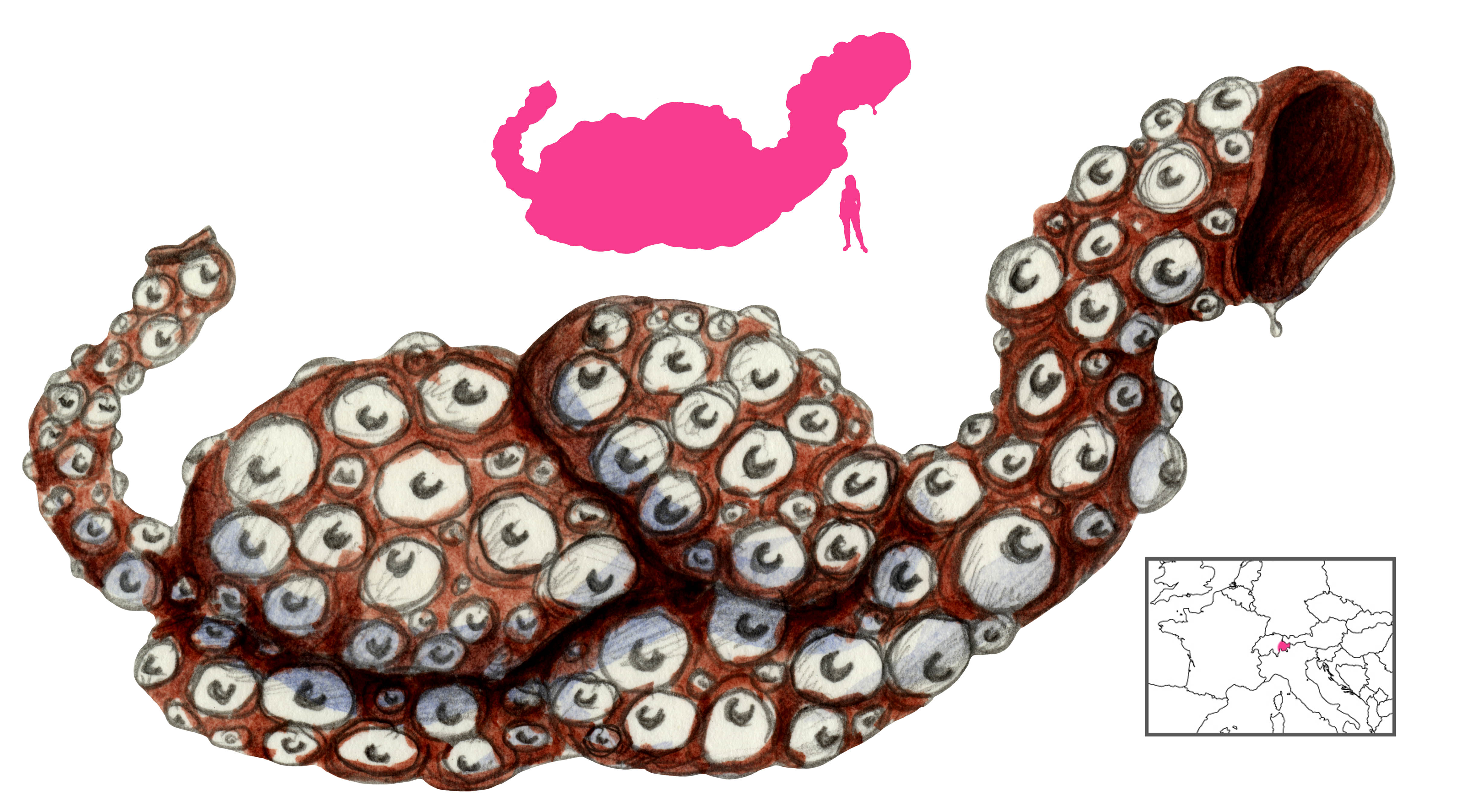
The Lüschersee, a small Swiss alpine lake nestled in the heather-covered hills of Graubünden, seems tranquil enough on the surface. Yet it is said that the lake’s waters reach down to the center of the Earth, where eternal fires rage. This is the home of the Butatsch Cun Ilgs, the “Cow’s Stomach”.

Long ago, during a more feudal time, the shepherds of Graubünden were in a constant struggle for freedom from the cruel barons and lords of the land. Their masters were prone to treating them unjustly, and even harming them for sport. A group of noblemen once returned from an ibex hunt to find herds of cattle and sheep grazing peacefully by the Lüschersee. Naturally they decided to kill them. With loud whoops and peals of laughter, they drove the animals before them, hacking at them with their swords and forcing them into the lake to drown. The peasants could only watch as the lords mocked them.

It was then that the water started to foam and bubble, and the Butatsch cun ilgs heaved itself onto the shore. It had the appearance of an enormous cow’s stomach, and was covered with thousands of eyes. The eyes had hypnotic powers, and if they focused on one point, bone-melting flames would erupt.

Mesmerized by the Butatsch cun ilgs, the lords stood dumbly as the enormous mass trampled and crushed them. Butatsch cun ilgs slipped back into the water after killing them all, leaving the shepherds terrified but unharmed.

Since then Butatsch cun ilgs has only reappeared twice, in 100-year intervals. The second time it came out of the Lüschersee, it gouged the rapids of the Nolla along its path. The third time was during a terrifying thunderstorm, when the monster of the Lüschersee slithered through a rivulet, tearing out the banks, causing massive landslides, and creating ravines.

After this last appearance – the starmentusa notg or “Night of Terror” – the Butatsch cun ilgs was not seen again. Yet sometimes a distant, unearthly bellowing can be heard over the still waters of the lake… “The Lüschersee roars”, say the shepherds, and bring the hay in.

References

Burde-Schneidewind, G. (1977) Historische Volkssagen Aus Dem 13. Bis 19. Jahrhundert. Akademie-Verlag, Berlin.

Derichsweiler, W. Das Safiental. In Schweizer Alpenclub (1919) Jahrbuch das Schweizer Alpenclub. Stämpfl & Co., Bern.

Jecklin, D. (1874) Volksthümliches aus Graubünden. Orell Füssli & Co., Zürich.

Rose, C. (2000) Giants, Monsters, and Dragons. W. W. Norton and Co., New York.

Danghu

Variations: Danghu-bird

Danghu

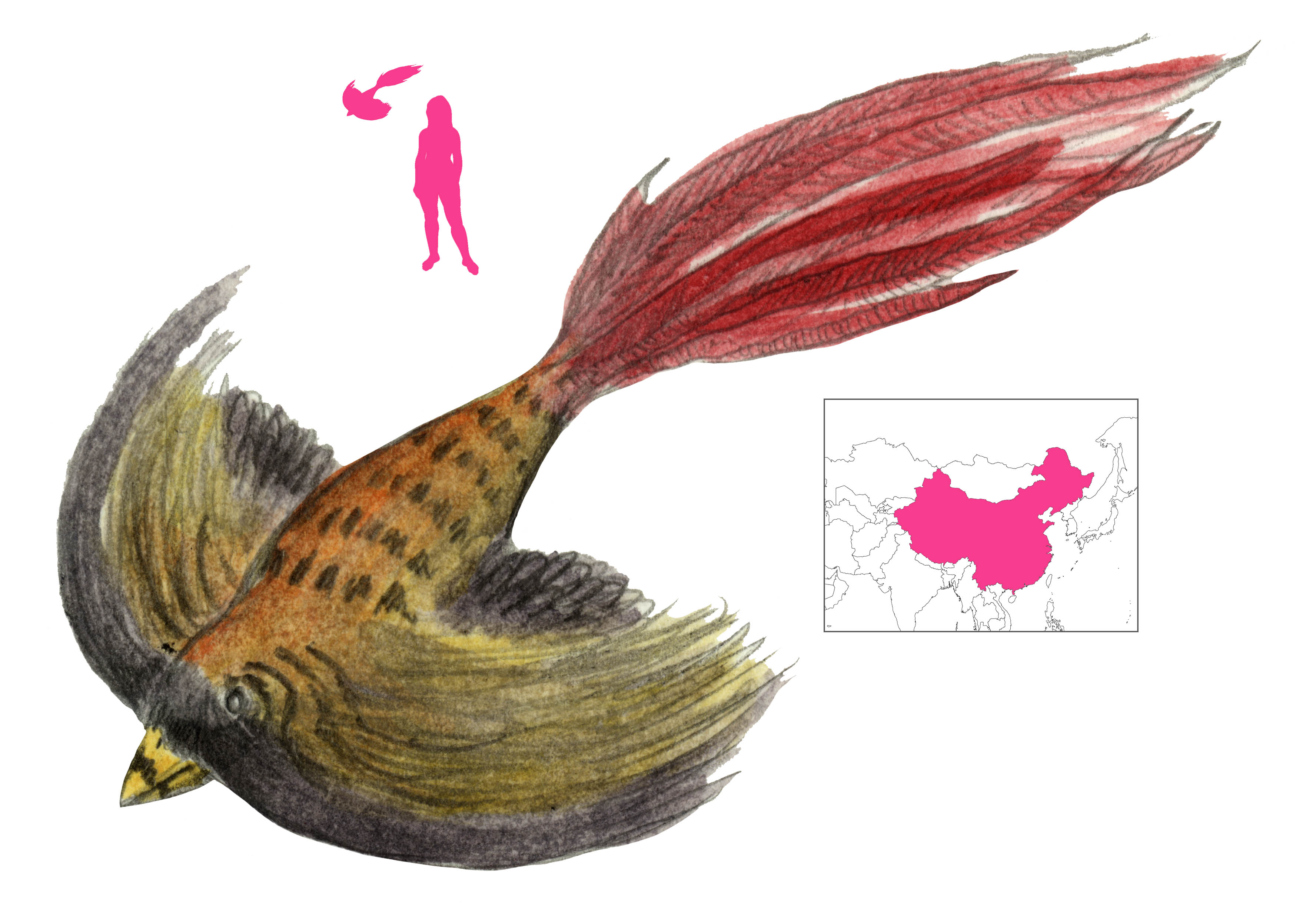
Upper-Shen Mountain or Shangshen is a rugged, rocky peak with no vegetation on it, but there are hazelnut groves at its base. There, Danghu birds can be seen flying from branch to branch. A danghu looks like a pheasant, but it flies using its hypertrophied whiskers and throat feathers. Consuming a danghu protects from and cures myopia. Guo Pu extolled the virtues of the danghu, using it as a metaphor for the economical mindset of Daoism as it makes do with what it has.

Mathieu suggests that this bird is the masked Japanese grosbeak (Eophona personata), which is nonetheless unwhiskered and unpheasantlike.

References

Mathieu, R. (1983) Étude sur la mythologie et l’ethnologie de la Chine ancienne. Collège de France, Paris.

Strassberg, R. E. (2002) A Chinese Bestiary: Strange Creatures from the Guideways Through Mountains and Seas. University of California Press.

Tabib al-Bahr

Variations: Doctor of the Sea, Sea Doctor

Tabib-al-bahr

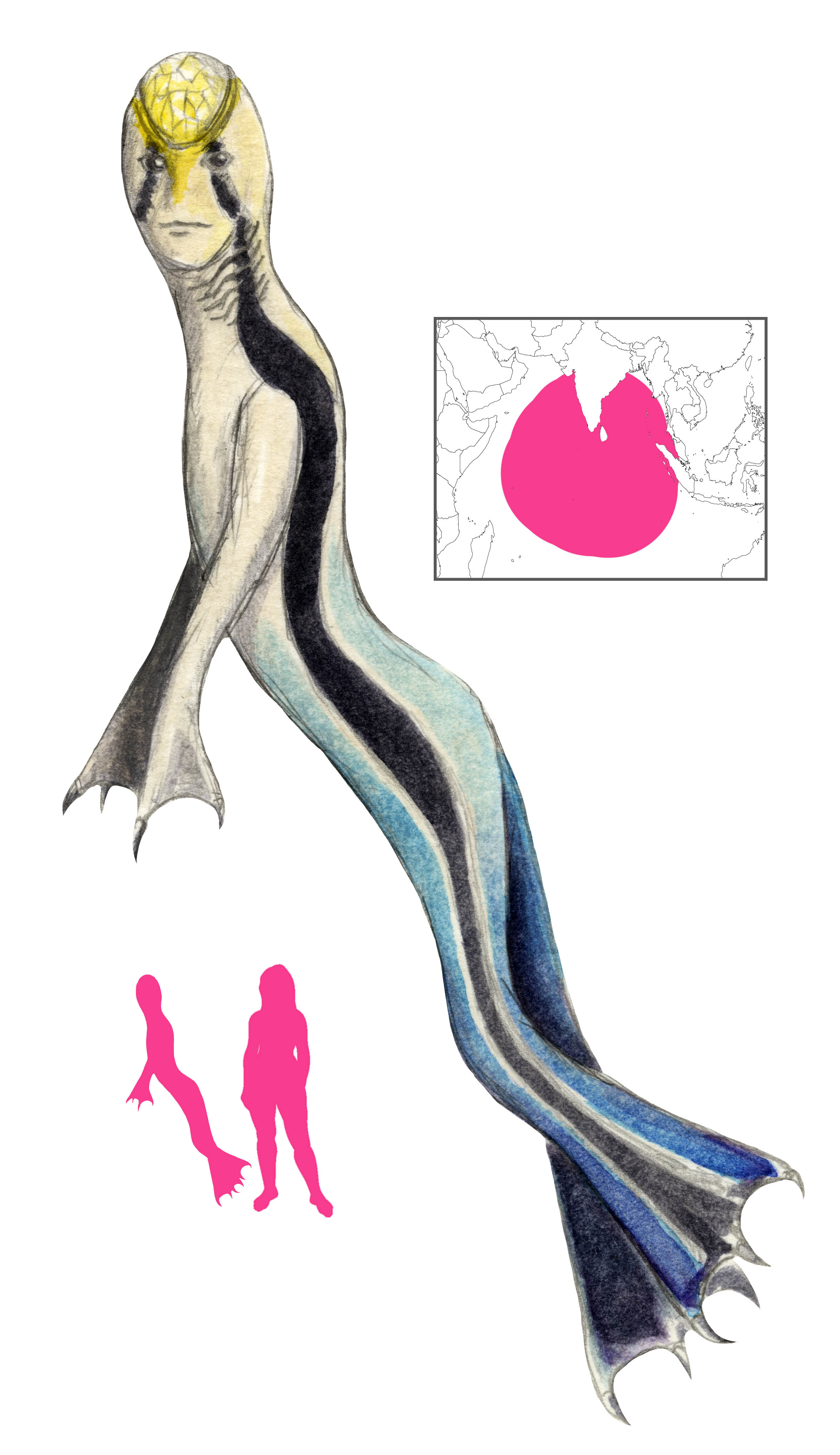
The mysterious Tabib al-Bahr, the “Doctor of the Sea”, is found in the writings of the alchemist Jabir ibn Hayyan. Its appearance is not very clear; we know that it is a fish with a yellow gemstone in its forehead, and that it is also human in shape. This marine animal, despite its considerable magical powers, is very caring and altruistic. It derives its name from the gemstone in its head, which can heal any ailment; it attends to other sea creatures by rubbing its head twice or thrice on their injuries, healing them instantly. Perhaps because of this self-sacrificing nature, the tabibs also do not resist capture by humans, instead waiting patiently for the right time to escape.

The gemstone of a tabib al-bahr is of great value to alchemy. If the creature is slaughtered and its stone taken out of its head, it can be used to create gold out of silver. It was that gemstone that drew Jabir ibn Hayyan into seeking out the tabib al-bahr.

After enlisting the aid of a number of skilled sailors, Jabir set sail into the Indian Ocean. He eventually found a group of tabib al-bahrs near the unknown island of Sindiyyāt. The net was cast, and one of the creatures was caught. It started striking its cheeks in a feminine act of desperation, and Jabir realized that the tabib they had caught was a young woman of great beauty. She was taken on board and imprisoned in a small cabin; she seemed incapable of speech beyond mumbling in an unknown language. Jabir was given the chance to test her powers by bringing in a sailor with torticollis. After the tabib rubbed her gemstone on his arms and legs, he was immediately cured.

This situation was not to last long. One of the sailors, a young man, fell in love with the strange creature, and Jabir allowed them to live together in the cabin. Eventually she became pregnant and gave birth to a boy, human in all aspects except for a marvelous, shining forehead. As the boy grew, the mother was eventually given free reign of the boat, as she seemed attached to the crew, keeping them company, tending to their injuries, and caring for her son. Unfortunately that was not the case, and after a long inspection of all possible escape routes, she finally climbed over the railing and dove into the water. Her husband was brokenhearted, but he swore to care for the son she left behind.

Eventually the ship sailed into a storm from which there seemed to be no escape. Throwing anchors into the water did nothing to hold the ship, and it was on the verge of capsizing. That was when they saw their tabib al-bahr sitting calmly on the surface and waving to them. All the sailors begged her to save them, and in response she transformed into a colossal fish, big enough to stretch from one end of the sea to the other. By swallowing huge quantities of seawater, she lowered the sea level enough for the storm to be quelled. While the sailors worried over whether or not she’d swallow them next, her son dove into the sea after her. The next day he returned to the ship, and his forehead now had a yellow gemstone in it.

Later on Jabir had the opportunity to catch two more tabib al-bahrs, one of which was sacrificed for its gemstone. Jabir marveled at it, a wondrous artifact the likes of which humans would never make.

This tale may not be meant literally, and it has generally been taken as some kind of alchemical allegory. His scribes agreed, noting that it is “very symbolic”, with elements representative of fire and water.

The alchemist-poet Ibn Arfa’ra’sahu dedicated several verses to the tabib al-bahr, saying that “the truest of scientists have vouched for it, Plato and his student Aristotle”.

References

Mahmud, Z. N. (1961) Jabir ibn Hayyan. Maktabat Misr.

Kraus, P. (1986) Jabir Ibn Hayyan : Contribution à l’historie des idées scientifiques dans l’Islam. Société d’Édition Les Belles Lettres, Paris.

Mourioche

Variations: Guenne; Fausserole (possibly)

Mourioche

Nobody knows for sure where Mourioche came from. Some say that he (for lack of a better pronoun) was once a Breton man or a woman, versed in the dark arts, who sold their soul for a magical ointment. Other accounts make him a simple werewolf without control of his actions. Dubois whimsically claims he was once the court jester of an undersea kingdom, and was banished for bad behavior. There are even claims that he is the Devil himself.

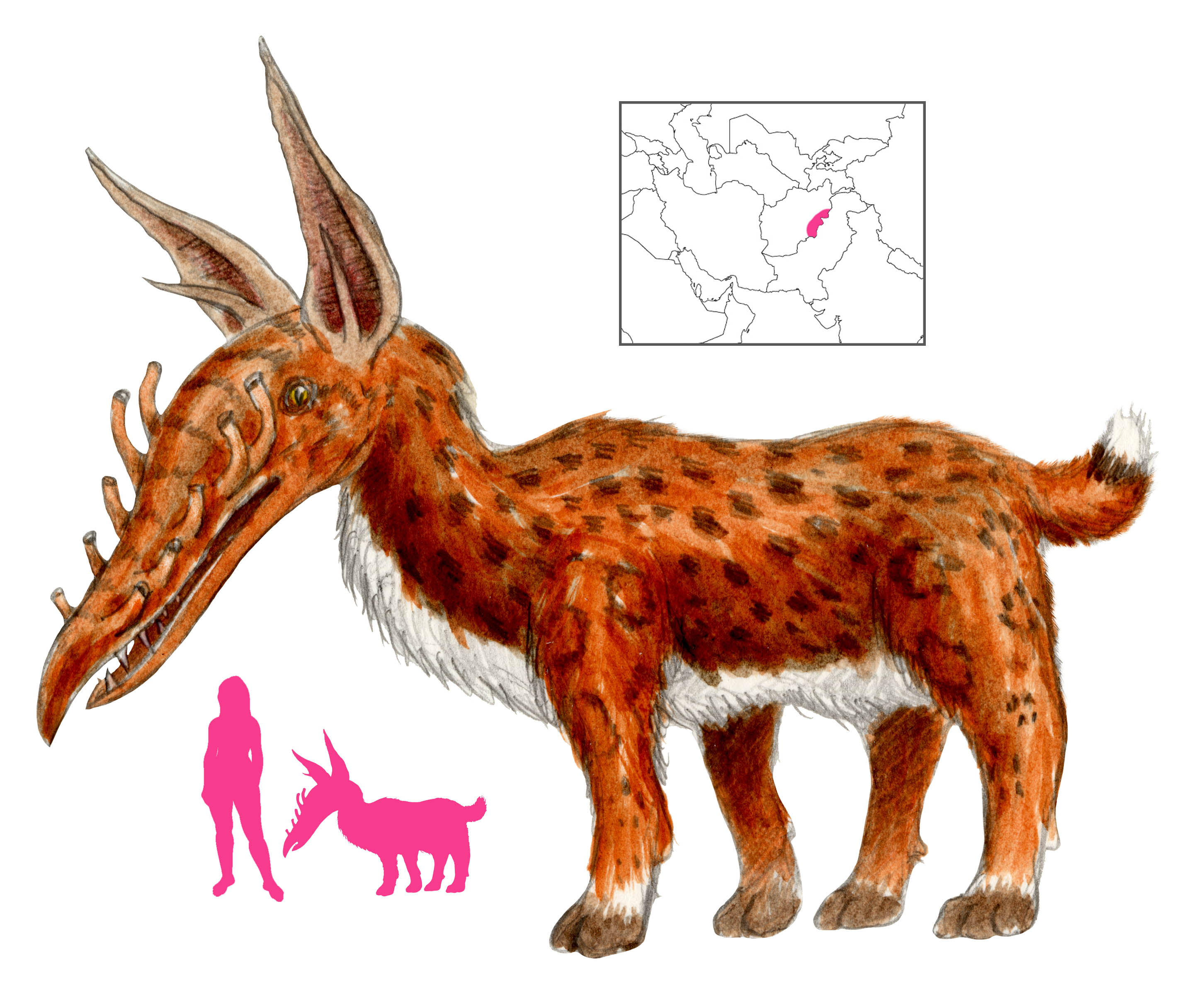
It is more likely that Mourioche has always haunted Brittany, spreading his brand of cruel humor along the coastlines of Côtes-d’Armor and around Jugon-les-Lacs. He is a water-horse, and a shapeshifter; there is no end to the forms he has assumed, and he loves using his powers in creative ways. Mourioche is usually seen in the form of a yearling colt, pig, cow, or sheep, often with a pair of muscular arms.

Mourioche comes out at night, and preys on nocturnal travelers. Sometimes he is a horse standing by the side of the road, waiting for riders. His spine stretches as more and more people get on, then he gallops right into the lake, his laugh echoing in the darkness. At other times he wrestles passers-by, grappling with his brawny arms and throwing his victims into muddy ditches. He will jump onto men’s back and force them to carry him until they drop of exhaustion. He will follow people along the road, changing shape every time they turn to look at him, and making a sound like tearing canvas.

Drawn-out sadistic pranks are Mourioche’s favorite form of entertainment. A farmer of Saint-Cast once found Mourioche in the form of an abandoned ewe, and took him home to his barn. The next day, when he went to check on his new sheep, he found a cow; the day after, it had become a horse. On the fourth night, it was a sheep again, who laughed and said “Why do you check on me every morning? You’re weird!” It was then that the farmer saw that all his animals had been slaughtered. He reached for his shotgun, but Mourioche took off, destroying half the barn and abducting the farmer’s three children (who were never seen again). Mourioche is not without mercy, though, and he left behind a golden necklace.

Mourioche is not without his faults, however, and is baffled by anyone who doesn’t fear him. One man nonchalantly carried Mourioche all the way back home, and the shapeshifter fled when he called his wife. Another time Mourioche took a tailor on his back, who threatened to cut his ears off with his scissors. The tailor was returned to dry land very quickly.

In Matignon, parents would get their children to bed with a “hattaï, mon p’tit gars; Mourioche te prenrait!” (“hurry, my l’il lad, Mourioche will take you!). It is also said that of a frightened person that “il a eu peur comme s’il avait vu Mourioche” (“he’s scared as though he saw Mourioche”). To ward off Mourioche, one must curse him with “Mourioche, le diable t’écorche” (“Mourioche, the Devil flay you”).

The Fausserole of Saint-Cast is very similar, and may be another form of Mourioche. She likes to appear as a white beast, a dog or a calf, and has no qualms about tossing clergy around, as the rector of Saint-Cast found out.

References

Dubois, P.; Sabatier, C.; and Sabatier, R. (1992) La Grande Encyclopédie des Lutins. Hoëbeke, Paris.

Morvan, F. (1998) Vie et mœurs des lutins bretons. Actes Sud.

Sébillot, P. (1882) Traditions et superstitions de la Haute-Bretagne. Maisonneuve et Cie, Paris.

Sébillot, P. (1905) Le Folk-Lore de France, Tome Deuxième: La Mer et les Eaux Douces. Librairie Orientale et Américaine, Paris.

Sébillot, P. (1968) Le folklore de la Bretagne. Éditions G. P. Maisonneuve et Larose, Paris.

Zitiron

Variations: Zityron, Zytyron; Albiron; Barchora; Miles; Soldier, Soldier of the Sea, Man-at-arms of the Sea; Soldat de Mer, Gendarme de Mer; Sea Turtle

Zitiron

The Zitiron (perhaps a corruption of Ketos or whale), or Soldier of the Sea, is a heavily armored marine fish. It has a rough and hard skin over its head like a helmet, and a long and wide shield hanging from its neck, attached by thick veins and nerves stretching from neck to shoulders. Its thick arms are two-fingered. It is long and wide, more or less triangular in shape, with a fish’s tail at its end. A zitiron is impervious to arrows, and can only be killed by bludgeoning it with hammers; it defends itself with its armor and with swipes of its strong arms.

Illustrators took the description of armor rather literally, turning the zitiron into a sort of merman encumbered with full plate armor, helmet, shield, and sword.

It is not hard to see a turtle in the zitiron’s description. Turtle shells have also been used as shields by various cultures, making the resemblance even more appropriate. Albertus Magnus asserted that Flemish and German fisherman give the name of “soldier” to turtles, because they have a helmet and a shield. The desire to see analogues of terrestrial entities in the sea completed the zitiron.

References

de Cantimpré, T. (1280) Liber de natura rerum. Bibliothèque municipale de Valenciennes.

Paré, A. (1614) Les Oeuvres d’Ambroise Paré. Nicolas Buon, Paris.

Magnus, A.; Kitchell, K. F. and Resnick, I. M. trans. (1999) On Animals: A Medieval Summa Zoologica, v. II. The Johns Hopkins University Press, Baltimore.

Unknown. (1538) Ortus Sanitatis. Joannes de Cereto de Tridino.

Vallot, M. (1834) Mémoire sur le Limacon de la Mer Sarmatique. Mémoires de L’Académie des Sciences, Arts, et Belles-Lettres de Dijon, Partie des Sciences, Frantin, Dijon.