Butatsch Cun Ilgs

Variations: Butatsch-ah-ilgs (erroneously, apparently a typo in Rose’s encyclopedia)
Butatsch Cun Ilgs

The Lüschersee, a small Swiss alpine lake nestled in the heather-covered hills of Graubünden, seems tranquil enough on the surface. Yet it is said that the lake’s waters reach down to the center of the Earth, where eternal fires rage. This is the home of the Butatsch Cun Ilgs, the “Cow’s Stomach”.

Long ago, during a more feudal time, the shepherds of Graubünden were in a constant struggle for freedom from the cruel barons and lords of the land. Their masters were prone to treating them unjustly, and even harming them for sport. A group of noblemen once returned from an ibex hunt to find herds of cattle and sheep grazing peacefully by the Lüschersee. Naturally they decided to kill them. With loud whoops and peals of laughter, they drove the animals before them, hacking at them with their swords and forcing them into the lake to drown. The peasants could only watch as the lords mocked them.

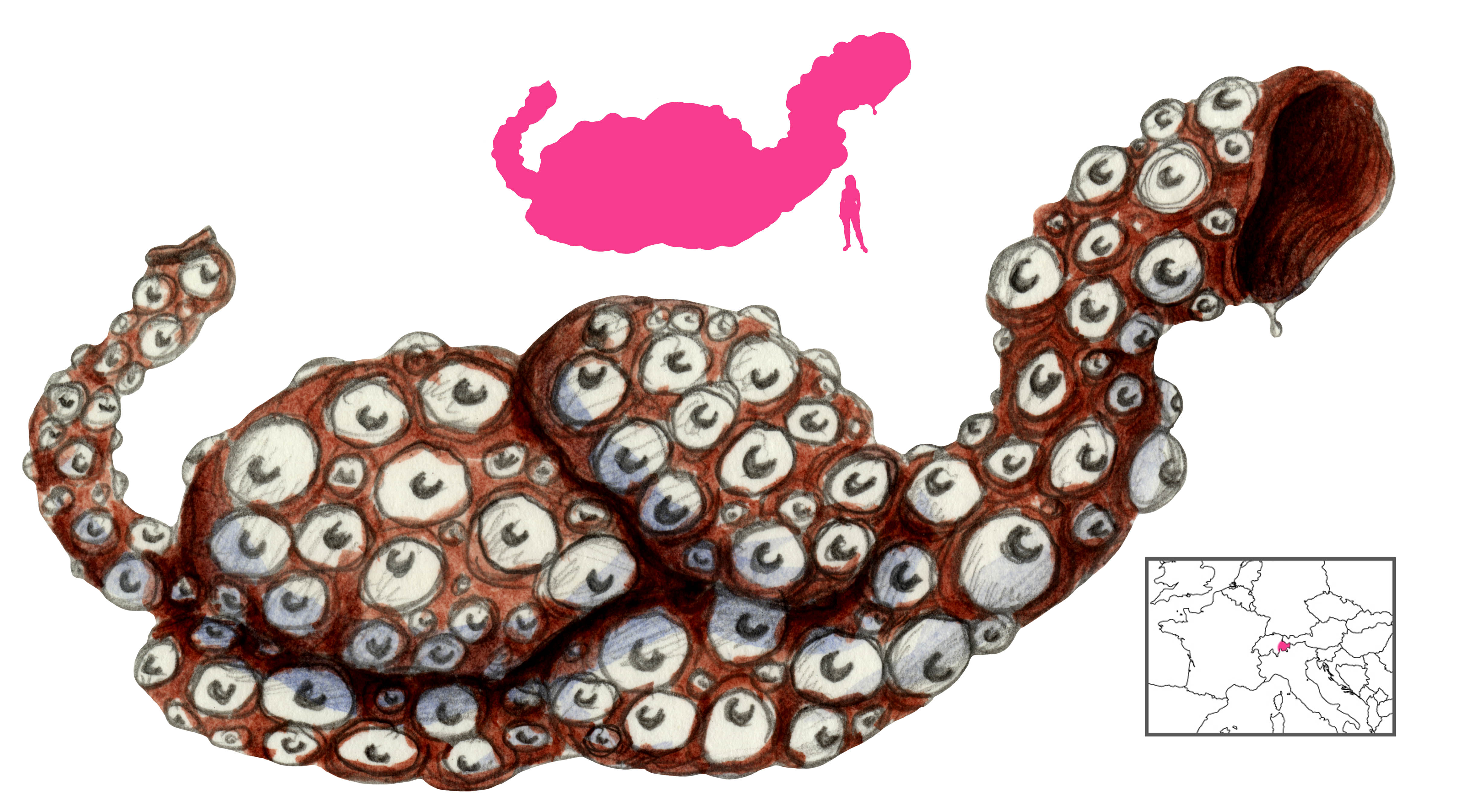
It was then that the water started to foam and bubble, and the Butatsch cun ilgs heaved itself onto the shore. It had the appearance of an enormous cow’s stomach, and was covered with thousands of eyes. The eyes had hypnotic powers, and if they focused on one point, bone-melting flames would erupt.

Mesmerized by the Butatsch cun ilgs, the lords stood dumbly as the enormous mass trampled and crushed them. Butatsch cun ilgs slipped back into the water after killing them all, leaving the shepherds terrified but unharmed.

Since then Butatsch cun ilgs has only reappeared twice, in 100-year intervals. The second time it came out of the Lüschersee, it gouged the rapids of the Nolla along its path. The third time was during a terrifying thunderstorm, when the monster of the Lüschersee slithered through a rivulet, tearing out the banks, causing massive landslides, and creating ravines.

After this last appearance – the starmentusa notg or “Night of Terror” – the Butatsch cun ilgs was not seen again. Yet sometimes a distant, unearthly bellowing can be heard over the still waters of the lake… “The Lüschersee roars”, say the shepherds, and bring the hay in.

References

Burde-Schneidewind, G. (1977) Historische Volkssagen Aus Dem 13. Bis 19. Jahrhundert. Akademie-Verlag, Berlin.

Derichsweiler, W. Das Safiental. In Schweizer Alpenclub (1919) Jahrbuch das Schweizer Alpenclub. Stämpfl & Co., Bern.

Jecklin, D. (1874) Volksthümliches aus Graubünden. Orell Füssli & Co., Zürich.

Rose, C. (2000) Giants, Monsters, and Dragons. W. W. Norton and Co., New York.
Danghu

Variations: Danghu-bird

Danghu

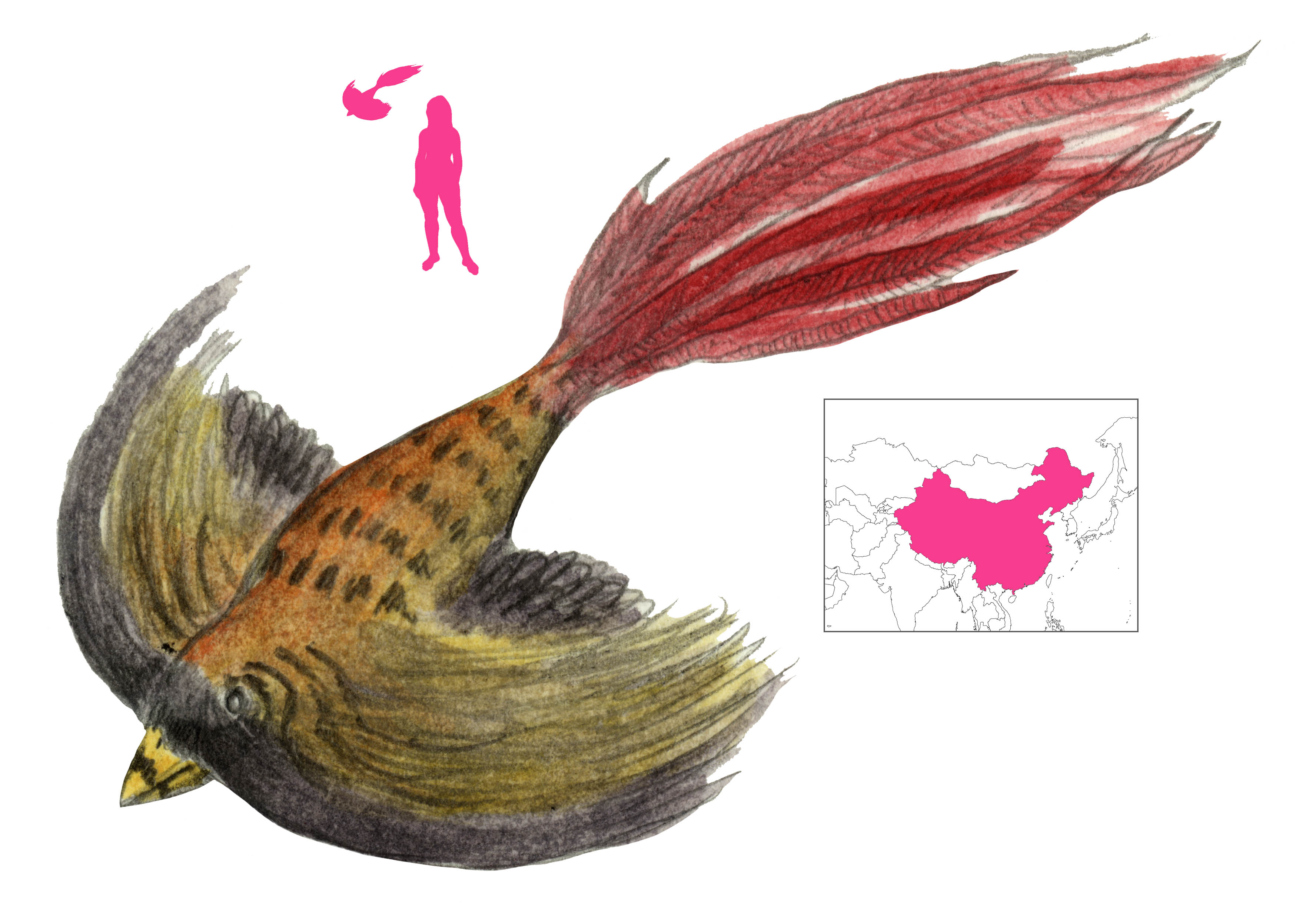
Upper-Shen Mountain or Shangshen is a rugged, rocky peak with no vegetation on it, but there are hazelnut groves at its base. There, Danghu birds can be seen flying from branch to branch. A danghu looks like a pheasant, but it flies using its hypertrophied whiskers and throat feathers. Consuming a danghu protects from and cures myopia. Guo Pu extolled the virtues of the danghu, using it as a metaphor for the economical mindset of Daoism as it makes do with what it has.

Mathieu suggests that this bird is the masked Japanese grosbeak (Eophona personata), which is nonetheless unwhiskered and unpheasantlike.

References

Mathieu, R. (1983) Étude sur la mythologie et l’ethnologie de la Chine ancienne. Collège de France, Paris.

Strassberg, R. E. (2002) A Chinese Bestiary: Strange Creatures from the Guideways Through Mountains and Seas. University of California Press.

Tabib al-Bahr

Variations: Doctor of the Sea, Sea Doctor

Tabib-al-bahr

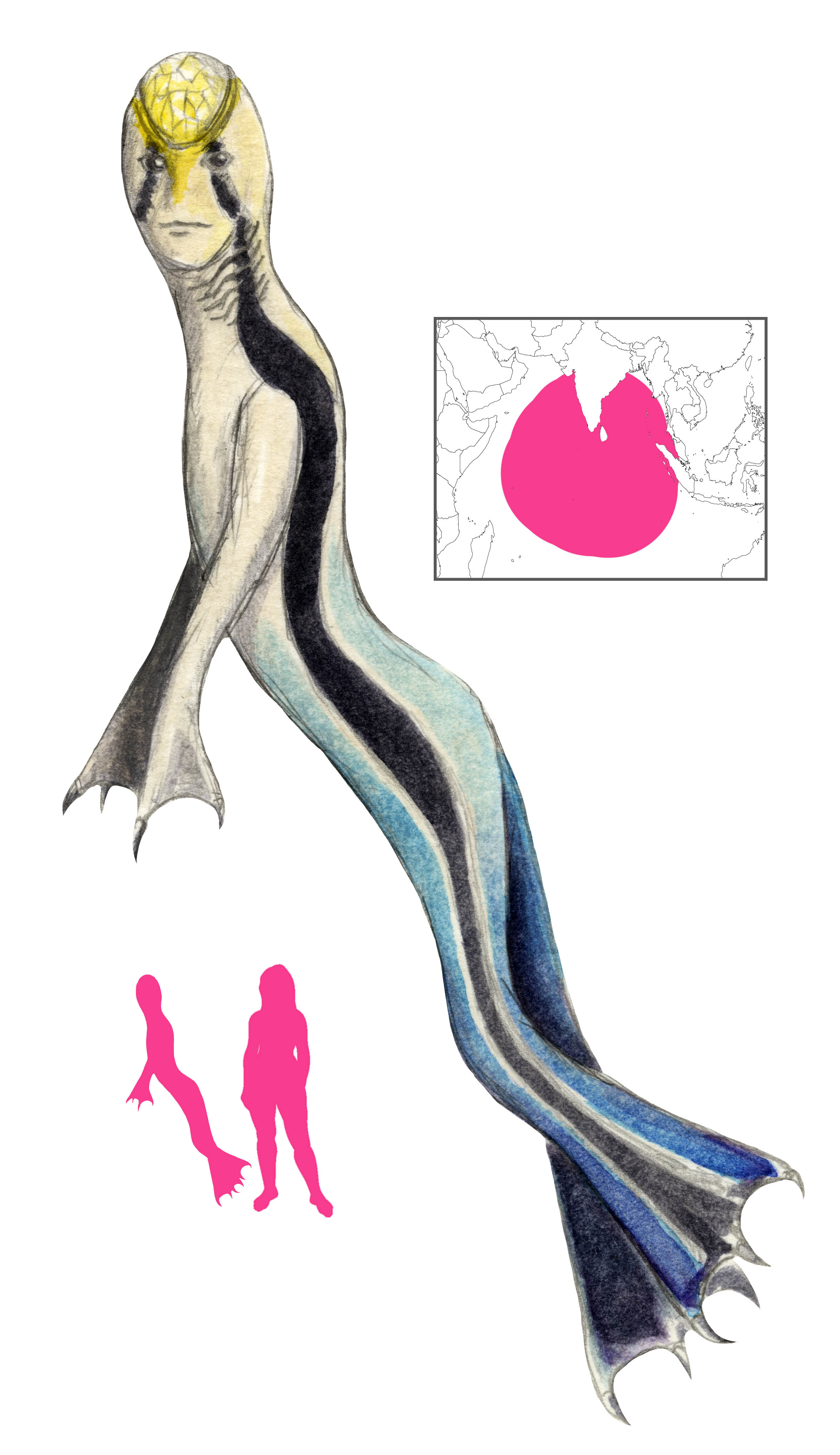
The mysterious Tabib al-Bahr, the “Doctor of the Sea”, is found in the writings of the alchemist Jabir ibn Hayyan. Its appearance is not very clear; we know that it is a fish with a yellow gemstone in its forehead, and that it is also human in shape. This marine animal, despite its considerable magical powers, is very caring and altruistic. It derives its name from the gemstone in its head, which can heal any ailment; it attends to other sea creatures by rubbing its head twice or thrice on their injuries, healing them instantly. Perhaps because of this self-sacrificing nature, the tabibs also do not resist capture by humans, instead waiting patiently for the right time to escape.

The gemstone of a tabib al-bahr is of great value to alchemy. If the creature is slaughtered and its stone taken out of its head, it can be used to create gold out of silver. It was that gemstone that drew Jabir ibn Hayyan into seeking out the tabib al-bahr.

After enlisting the aid of a number of skilled sailors, Jabir set sail into the Indian Ocean. He eventually found a group of tabib al-bahrs near the unknown island of Sindiyyāt. The net was cast, and one of the creatures was caught. It started striking its cheeks in a feminine act of desperation, and Jabir realized that the tabib they had caught was a young woman of great beauty. She was taken on board and imprisoned in a small cabin; she seemed incapable of speech beyond mumbling in an unknown language. Jabir was given the chance to test her powers by bringing in a sailor with torticollis. After the tabib rubbed her gemstone on his arms and legs, he was immediately cured.

This situation was not to last long. One of the sailors, a young man, fell in love with the strange creature, and Jabir allowed them to live together in the cabin. Eventually she became pregnant and gave birth to a boy, human in all aspects except for a marvelous, shining forehead. As the boy grew, the mother was eventually given free reign of the boat, as she seemed attached to the crew, keeping them company, tending to their injuries, and caring for her son. Unfortunately that was not the case, and after a long inspection of all possible escape routes, she finally climbed over the railing and dove into the water. Her husband was brokenhearted, but he swore to care for the son she left behind.

Eventually the ship sailed into a storm from which there seemed to be no escape. Throwing anchors into the water did nothing to hold the ship, and it was on the verge of capsizing. That was when they saw their tabib al-bahr sitting calmly on the surface and waving to them. All the sailors begged her to save them, and in response she transformed into a colossal fish, big enough to stretch from one end of the sea to the other. By swallowing huge quantities of seawater, she lowered the sea level enough for the storm to be quelled. While the sailors worried over whether or not she’d swallow them next, her son dove into the sea after her. The next day he returned to the ship, and his forehead now had a yellow gemstone in it.

Later on Jabir had the opportunity to catch two more tabib al-bahrs, one of which was sacrificed for its gemstone. Jabir marveled at it, a wondrous artifact the likes of which humans would never make.

This tale may not be meant literally, and it has generally been taken as some kind of alchemical allegory. His scribes agreed, noting that it is “very symbolic”, with elements representative of fire and water.

The alchemist-poet Ibn Arfa’ra’sahu dedicated several verses to the tabib al-bahr, saying that “the truest of scientists have vouched for it, Plato and his student Aristotle”.

References

Mahmud, Z. N. (1961) Jabir ibn Hayyan. Maktabat Misr.

Kraus, P. (1986) Jabir Ibn Hayyan : Contribution à l’historie des idées scientifiques dans l’Islam. Société d’Édition Les Belles Lettres, Paris.

Mourioche

Variations: Guenne; Fausserole (possibly)

Mourioche

Nobody knows for sure where Mourioche came from. Some say that he (for lack of a better pronoun) was once a Breton man or a woman, versed in the dark arts, who sold their soul for a magical ointment. Other accounts make him a simple werewolf without control of his actions. Dubois whimsically claims he was once the court jester of an undersea kingdom, and was banished for bad behavior. There are even claims that he is the Devil himself.

It is more likely that Mourioche has always haunted Brittany, spreading his brand of cruel humor along the coastlines of Côtes-d’Armor and around Jugon-les-Lacs. He is a water-horse, and a shapeshifter; there is no end to the forms he has assumed, and he loves using his powers in creative ways. Mourioche is usually seen in the form of a yearling colt, pig, cow, or sheep, often with a pair of muscular arms.

Mourioche comes out at night, and preys on nocturnal travelers. Sometimes he is a horse standing by the side of the road, waiting for riders. His spine stretches as more and more people get on, then he gallops right into the lake, his laugh echoing in the darkness. At other times he wrestles passers-by, grappling with his brawny arms and throwing his victims into muddy ditches. He will jump onto men’s back and force them to carry him until they drop of exhaustion. He will follow people along the road, changing shape every time they turn to look at him, and making a sound like tearing canvas.

Drawn-out sadistic pranks are Mourioche’s favorite form of entertainment. A farmer of Saint-Cast once found Mourioche in the form of an abandoned ewe, and took him home to his barn. The next day, when he went to check on his new sheep, he found a cow; the day after, it had become a horse. On the fourth night, it was a sheep again, who laughed and said “Why do you check on me every morning? You’re weird!” It was then that the farmer saw that all his animals had been slaughtered. He reached for his shotgun, but Mourioche took off, destroying half the barn and abducting the farmer’s three children (who were never seen again). Mourioche is not without mercy, though, and he left behind a golden necklace.

Mourioche is not without his faults, however, and is baffled by anyone who doesn’t fear him. One man nonchalantly carried Mourioche all the way back home, and the shapeshifter fled when he called his wife. Another time Mourioche took a tailor on his back, who threatened to cut his ears off with his scissors. The tailor was returned to dry land very quickly.

In Matignon, parents would get their children to bed with a “hattaï, mon p’tit gars; Mourioche te prenrait!” (“hurry, my l’il lad, Mourioche will take you!). It is also said that of a frightened person that “il a eu peur comme s’il avait vu Mourioche” (“he’s scared as though he saw Mourioche”). To ward off Mourioche, one must curse him with “Mourioche, le diable t’écorche” (“Mourioche, the Devil flay you”).

The Fausserole of Saint-Cast is very similar, and may be another form of Mourioche. She likes to appear as a white beast, a dog or a calf, and has no qualms about tossing clergy around, as the rector of Saint-Cast found out.

References

Dubois, P.; Sabatier, C.; and Sabatier, R. (1992) La Grande Encyclopédie des Lutins. Hoëbeke, Paris.

Morvan, F. (1998) Vie et mœurs des lutins bretons. Actes Sud.

Sébillot, P. (1882) Traditions et superstitions de la Haute-Bretagne. Maisonneuve et Cie, Paris.

Sébillot, P. (1905) Le Folk-Lore de France, Tome Deuxième: La Mer et les Eaux Douces. Librairie Orientale et Américaine, Paris.

Sébillot, P. (1968) Le folklore de la Bretagne. Éditions G. P. Maisonneuve et Larose, Paris.

Zitiron

Variations: Zityron, Zytyron; Albiron; Barchora; Miles; Soldier, Soldier of the Sea, Man-at-arms of the Sea; Soldat de Mer, Gendarme de Mer; Sea Turtle

Zitiron

The Zitiron (perhaps a corruption of Ketos or whale), or Soldier of the Sea, is a heavily armored marine fish. It has a rough and hard skin over its head like a helmet, and a long and wide shield hanging from its neck, attached by thick veins and nerves stretching from neck to shoulders. Its thick arms are two-fingered. It is long and wide, more or less triangular in shape, with a fish’s tail at its end. A zitiron is impervious to arrows, and can only be killed by bludgeoning it with hammers; it defends itself with its armor and with swipes of its strong arms.

Illustrators took the description of armor rather literally, turning the zitiron into a sort of merman encumbered with full plate armor, helmet, shield, and sword.

It is not hard to see a turtle in the zitiron’s description. Turtle shells have also been used as shields by various cultures, making the resemblance even more appropriate. Albertus Magnus asserted that Flemish and German fisherman give the name of “soldier” to turtles, because they have a helmet and a shield. The desire to see analogues of terrestrial entities in the sea completed the zitiron.

References

de Cantimpré, T. (1280) Liber de natura rerum. Bibliothèque municipale de Valenciennes.

Paré, A. (1614) Les Oeuvres d’Ambroise Paré. Nicolas Buon, Paris.

Magnus, A.; Kitchell, K. F. and Resnick, I. M. trans. (1999) On Animals: A Medieval Summa Zoologica, v. II. The Johns Hopkins University Press, Baltimore.

Unknown. (1538) Ortus Sanitatis. Joannes de Cereto de Tridino.

Vallot, M. (1834) Mémoire sur le Limacon de la Mer Sarmatique. Mémoires de L’Académie des Sciences, Arts, et Belles-Lettres de Dijon, Partie des Sciences, Frantin, Dijon.

Auñ Pana

Variations: Pehiwetinome

Aun Pana

The Auñ Pana are evil man-eating fish from the folklore of the Yanomami of Brazil and Venezuela. They are large, have arms, and are covered with hair. Apparently they also have some degree of magical power. The auñ pana live in deep water and school with Pehiwetinome, which are equally large and anthropophagous.

A group of auñ pana and pehiwetinome once tore down a bridge that the Yanomami were crossing by biting through its wood. The bridge collapsed and became a raft, and the surviving Yanomami were turned into monkeys and pigs.

References

Albert, B.; Becher, H.; Borgman, D. M.; Cocco, L.; Colchester, M. E. M.; Finkers, J.; Knobloch, F.; Lizot, J.; and Wilbert, J.; Wilbert, J. and Simoneau, K. eds. (1990) Folk Literature of the Yanomami Indians. UCLA Latin American Center Publications, University of California, Los Angeles.

Sirānis

Variations: Sirānas, Suryānās, Sirinā, Siwānis

Siranis

According to al-Qazwini, the Sirānis can be found in the undergrowth of Kabul and Zabulistan. Its name is derived from the Greek siren, from which the sirānis evolved beyond recognition.

Originally the sirānis was believed to be a marine animal with seven openings in its mouth, and which used its seven toes to play its snout like a musical instrument. This description, in turn, came to be that of the Qaqnus or Arghun, which was known by the same name as well. Sirinā was also the name of a system of walls with holes in them that replicated the call of the sirānis, and which was used by the Byzantines to attract and capture that animal.

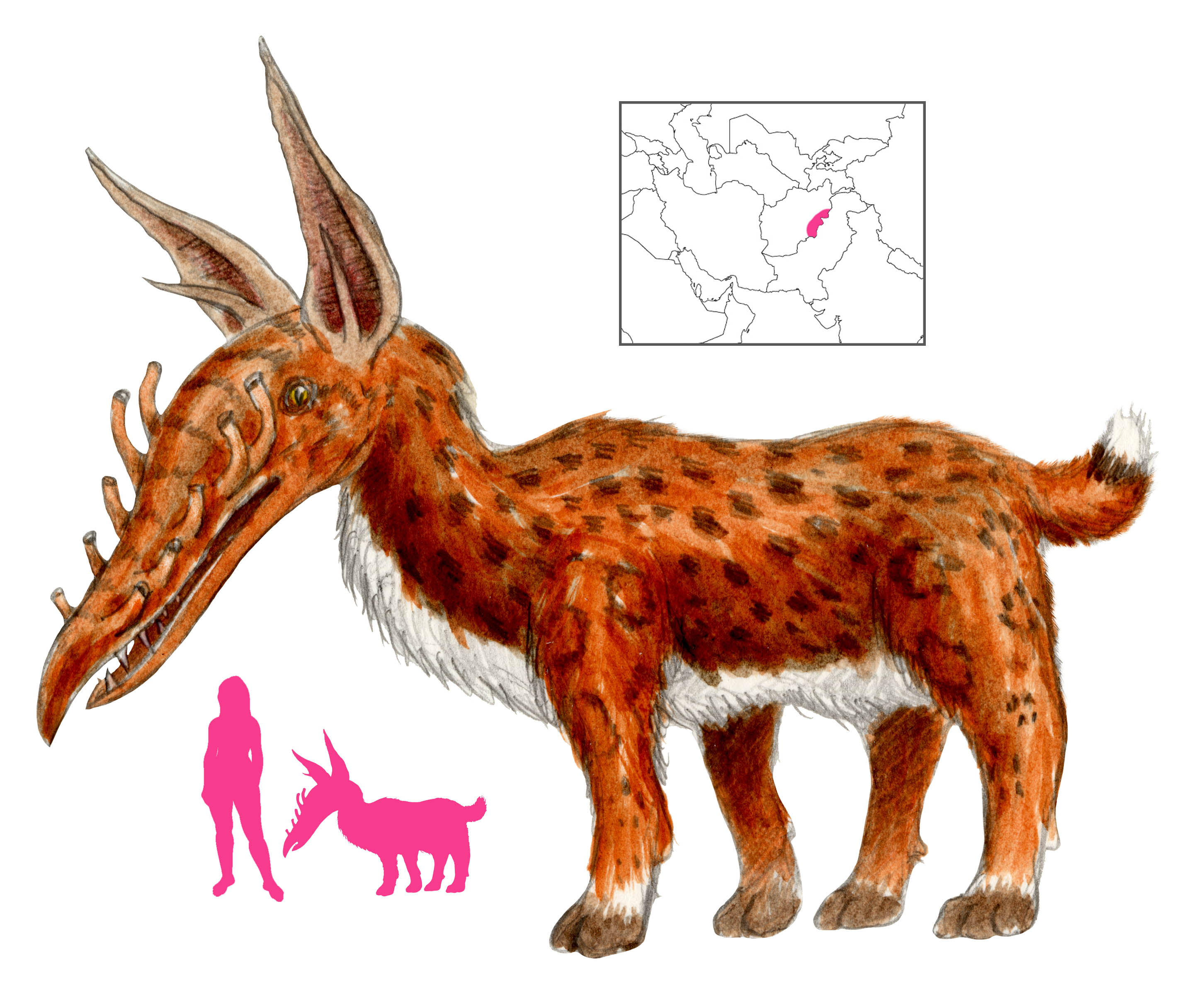
Al-Qazwini, however, places the sirānis firmly on land as a carnivorous mammal with 12 openings in its snout. When it breathes, those orifices produce a pleasant sound like that of the mizmar or flute; indeed, it is said that it was the inspiration for the musical instruments.

A sirānis uses its musical prowess to capture prey. It produces a melody so entrancing that animals gather around it and swoon in wonder, giving the sirānis an open buffet to choose from. If none of the animals present are satisfactory, it lets out an earsplitting screech that scares its audience away.

In time, the proximity of the sirānis to the shādawār in al-Qazwini’s text led later authors to combine them, granting the more iconographically defined shādawār the predatory nature of the sirānis.

References

Contadini, A. Musical Beasts: The Swan-Phoenix in the Ibn Bakhtishu’ Bestiaries. In O, Kane, B. (2005) The Iconography of Islamic Art. Edinburgh University Press.

Contadini, A. (2012) A World of Beasts: A Thirteenth-Century Illustrated Arabic Book on Animals (the Kitab Na’t al-Hayawan) in the Ibn Bakhtishu’ Tradition. Brill, Leiden.

Ettinghausen, R. (1950) The Unicorn. Studies in Muslim Iconography, Freer Gallery of Art Occasional Papers Vol. 1, No. 3, Washington.

al-Qazwini, Z. (1849) Zakariya ben Muhammed ben Mahmud el-Cazwini’s Kosmographie. Erster Theil: Die Wunder der Schöpfung. Ed. F. Wüstenfeld. Dieterichsche Buchhandlung, Göttingen.

Bocarin

Variations: Manati

Bocarin

Thevet’s visit to the island of Hispaniola turned up a number of unusual and exotic creatures, one of which is a grass-eating fish known as the Bocarin or Manati.

Found in both rivers and the ocean, the bocarin looks primarily like a full wineskin tapering from the navel to the end of the tail. This corpulent monster is 20 feet long and 10 feet wide, and has grey skin with sparse hair. It has two legs at its shoulders, which it uses to swim with, and round, four-toed elephant’s feet with prominent nails. Its head is like that of an ox, except with a smaller face, much smaller eyes, and a much larger and fleshier chin. Females bocarins give birth to live young, and suckle them from teats much like whales do.

Thevet deemed it to be the most deformed and grotesque fish he had ever seen in that part of the world, but for all its ugliness it did have its uses. Its flesh tasted more like veal than like fish, and was fine to eat. Its skin was used to make shoes, its fat was used in leather-making and as ointment. Stones known as enar-onacpy in a bocarin’s head, ground into powder and taken with white wine, were remedies against kidney and bladder stones.

A Spaniard swore to Thevet that a bocarin had been kept for 20 or 30 years in a pond, and eventually became so tame that it would let people scratch its back and ride on it. But Thevet saw that as absurd, as who could imagine a fish being tamed in such a way, let alone a monstrously ugly one like the bocarin?

References

Lestringent, F. (1997) Le Brésil d’André Thevet. Éditions Chandeigne, Paris.

Thevet, A. (1558) Les Singularitez de la France Antarctique. Maurice de la Porte, Paris.

Thevet, A. (1575) La Cosmographie Universelle. Guillaume Chaudiere, Paris.

Hrosshvalur

Variations: Hrosshvalr, Hrosshualar, Hrosshveli, Rosshvalur, Equinus Cetus, Horse-whale; Saehestur (Sea Horse); Stökkull (Jumper, probably erroneously); Stori Svinhvalur (Large Pig-whale); Pollur (Tenacious One); Monoculus

Hrosshvalur

The Hrosshvalur, or “Horse-whale”, is among the most cruel and dreaded of the Icelandic illhveli, or “Evil Whales”. Only the Stökkull and Raudkembingur rival it in malice. It is irredeemably evil and is unfit for eating, its flesh vanishing from the pot if cooked, and its consumption was banned by law.

The hrosshvalur is easily confused with its fellow illhveli; notably, it has a red crest similar to the raudkembingur, and tends to jump onto ships like the stökkull. It is distinguished from those two by its enormous eyes, which have earned it the nickname of Monoculus (“One-Eyed”). It earned its name from a somewhat equine head, a flowing red mane covering more or less of its neck, a horse’s tail, and a call like a horse neighing. It also smells bad, is covered with fine fur, and its insides are like those of a horse. Jon Gudmundsson, who confused it with the stökkull, depicted it with a dappled back. These whales grow 30 to 80 cubits (15 to 40 meters) long.

As with other illhveli, the hrosshvalur delights in destroying ships. A hrosshvalur will charge over the waves at high speed, holding its head just above the water with its mane trailing behind. These whales sink ships by jumping onto them, or pressing their weight on them until they capsize. Horse-whales are also portents of bad weather, and can create huge waves by whipping their tails. A number of euphemistic names are used to refer to horse-whales, to avoid attracting their attention. While not as easily distractable as raudkembingurs and stökkulls, their large eyes are a notable weakness.

In the 13th century, a hrosshvalur that surfaced alongside a ship was bombarded with every heavy implement available, which caused it to sink back below the waves. Another hrosshvalur attacked the heroes Hjalmper and Olvir; it was defeated with the help of a Skeljungur (“shell whale”), vagnhvalur (“chariot whale”, or killer whale), and two vultures. A cutlass thrown into one of its large eyes weakened it significantly, and it was torn apart by the whales.

Hrosshvalurs are also associated with the dark arts. The size and ferocity of the horse-whale made it an excellent accomplice for sorcerers and witches bent on destruction, and a perfect form to assume when causing chaos. In the Kormaks saga, the witch Dorveig transforms herself into a hrosshvalur to attack the brothers Kormakr and Dorgils. They recognize her from her eyes, and drive her off by throwing a javelin into her back.

It is generally believed that the hrosshvalur was derived from the walrus, and ultimately gave it its name by converting hval-hross to walrus. However, it was clear early on that it and the walrus were very different animals, as Gudmundsson separately describes both the hrosshvalur and the walrus (rostungur) in detail.

References

Davidsson, O. (1900) The Folk-lore of Icelandic Fishes. The Scottish Review, October, pp. 312-332.

Dillmann, F. Les Yeux de Dorveig: À propos de la métamorphose en hrosshvalr d’une sorcière de la Kormaks saga. In Heizmann, W. and van Nahl, A. (2003) Runica – Germanica – Medievalia. Walter de Gruyter, Berlin.

Fraser, F. C. An Early 17th Century Record of the Californian Grey Whale in Icelandic Waters. In Pilleri, G. (1970) Investigations on Cetacea, vol. II. Benteli AG, Bern.

Hermansson, H. (1924) Jon Gudmundsson and his Natural History of Iceland. Islandica, Cornell University Library, Ithaca.

Hlidberg, J. B. and Aegisson, S.; McQueen, F. J. M. and Kjartansson, R., trans. (2011) Meeting with Monsters. JPV utgafa, Reykjavik.

Larson, L. M. (1917) The King’s Mirror. Twayne Publishers Inc., New York.

Nunda

Variations: Nundá, Eater of People

Nunda

The cat of Sultan Majnún was unusually fierce. One day it killed a calf, but the Sultan dismissed the event, stating that “the cat is mine, and the calf is also mine”. Then the cat proceeded to kill and eat a goat, then a cow, a donkey, a horse, and a camel, with the good Sultan shrugging each time. “I will not kill it, let it even eat a man”. Sure enough, the cat killed a human child next, and followed up with a man.

By this time the creature had grown large and monstrous on its diet of flesh, and it left the town on its own. It hid in the undergrowth outside city, and feasted on anyone who passed by, human or animal. At night, it would sneak into the dark roads and abduct hapless wanderers. Sultan Majnún still refused to see the danger. “You all want me to kill this cat. It’s my cat and everything it eats is mine”. He refused to address any more complaints, and the population of the town slowly dwindled. Anyone and anything not locked up indoors was at risk.

Eventually, it would come to pass that Sultan Majnún went out to look at the countryside with six of his sons, whereupon the cat pounced on them and killed three of the sons. It was then that Sultan Majnún finally came to his senses. “That is no longer my cat”, he said firmly. “That is a Nunda, and it will eat even me if I give it the chance”. He sent his soldiers to kill the nunda, but it killed some of them and scattered the rest.

Sultan Majnún’s seventh son, having heard of the carnage, swore a solemn oath that he would slay the nunda. “I shall find the nunda who killed my brothers”, he told his mother as he set out alone with a spear and a knife.

The young prince was nothing if not zealous. The first vaguely intimidating creature he ran into was a large dog, which he promptly killed and dragged home. “Mamá, wee, niulága nundá mla wátu“, he sang triumphantly. “O mother, I have killed the nunda, eater of people”. But his mother shook her head sadly and said “My son, this is not he, the nunda, eater of people. The nunda is much larger”.

So the son set out again, and successively killed a civet, a larger civet, a zebra, a giraffe, a rhinoceros, and an elephant, bringing each one back in turn only to be corrected by his mother. In time, he gathered a small group of followers, and managed to piece together a description of the nunda: it was elephant-sized or larger, had small ears, was broad and not long, had two blotches like a civet, and had a thick tail.

Finally, the youth’s efforts paid off, and the nunda was found asleep in the shade of a grove of trees. That was clearly the nunda, as it fit his mother’s description of it perfectly, and did not resemble anything else he had killed so far. He and his slaves fired their guns into the nunda at close range, but did not hang around for fear that it was still alive. Instead they slept through the night, and checked on it in the morning. The huge cat was undeniably dead.

The beast was dragged back to the city in triumph, and the prince sang of his victory, to which his mother chanted back “Mwanangu, ndiyeye nundá mla watu. My son, this is he, the nunda, eater of people”. The nunda’s carcass was buried, a house was built on top of it, and a guard was placed at the house.

This is but one tale of the insatiable nunda. It is another “swallowing monster”, and sometimes it swallows up the entire populace except for one hero. The hero kills the nunda and cuts it open, releasing the victims unharmed.

References

Steere, E. (1870) Swahili Tales. Bell & Daldy, London.