Rukh

Variations: Rokh, Rukhkh, Roc, Ruc; Griffon, Griffin, Gryphon

Rukh

The lineage of the Rukh (or, less correctly, Roc) is an ancient and venerable one, with tales of enormous birds stretching back into ancient Egypt. Generally believed to live in Madagascar (or possibly at the top of Mount Qaf), it is another iteration of the Arabian ‘Anqa, the Persian Simurgh, and the Indian Garuda and Cyena. The name rukh itself may have come about by a corruption of simurgh, which in turn came from cyena.

There is little defining the appearance of the rukh; it is a gigantic bird of prey, but what exactly that entails has varied from artist to artist. The only indisputable feature is that it is enormous. A rukh is as big as the storyteller needs it to be, leading to accounts of a hatchling rukh with wings a thousand fathoms (over 1800 meters) in length!

Rukhs are uncontested predators capable of feeding on the largest and most dangerous land animals. They have a particular fondness for giant serpents, elephants, and karkadanns or rhinoceroses. Sindbad observed that when a karkadann spears an elephant on its horn, the elephant’s fat runs into the rhino’s eyes and blinds it; a rukh will then swoop down and carry both combatants off to feed its chicks. Rukhs also appear to have some degree of intelligence, using boulders to smash prey.

The best-known interactions with rukhs were those of Sindbad the Sailor, who encountered them on his second and fifth voyages. The first time around, Sindbad found himself alone on a deserted island – not an uncommon occurrence in his life – and discovered a strange white dome, some fifty paces in circumference. As he pondered what the structure might be, the sky darkened as a huge rukh appeared. The dome was none other than its egg. Fortunately for Sindbad, it showed no interest in him as it sat on the egg and dozed off, and Sindbad tied himself to its leg with his turban, figuring that it might fly him to more civilized lands. In time the rukh awoke, screeched, and took off on the most terrifying ride of Sindbad’s life. When it finally landed he untied himself as fast as he could and ran for cover, while the rukh busied itself seizing a giant serpent in its talons and flying off with its prey.

Sindbad’s fifth voyage was even more catastrophic. This time, Sindbad’s crew went ashore without him and found the white dome of a rukh’s egg. Despite Sindbad’s warnings, they broke the egg and killed the chick inside. As they butchered the chick, the two parent rukhs appeared, their angry calls louder than thunder. When the sailors tried to flee in their ship, the birds returned with enormous boulders in their talons. The male’s rock narrowly missed the ship, but the female scored a direct hit, sinking the vessel. All sailors on board died with the exception of Sindbad, who drifted off towards further adventures.

In the tale of Aladdin, the evil necromancer attempts to convince Aladdin to demand a rukh egg to hang from the ceiling, a request which infuriates the genie. “You want me to hang our Liege Lady for your pleasure?” he roared, before informing them that such a wicked request could only have come from their enemy. In this case the author combined the rukh with the ineffably pure and holy simurgh.

Abd al-Rahman the Maghrebi, who had travelled far and wide across the world, obtained a rukh chick’s feather quill capable of holding a goatskin’s worth of water. He and his companions obtained it from a rukh chick that they cut out of an egg a hundred cubits long. The parent rukh flew after them and dropped a rock on their ship, but unlike Sindbad’s crew they successfully avoided it and went on their way. All those who had eaten the baby rukh’s flesh remained youthful and never grew old.

Ibn Battuta saw a rukh soaring over the China Seas. It was sufficiently far away to be mistaken for a flying mountain, and he and his companions were thankful that it did not notice them.

Marco Polo had the opportunity to observe rukhs on Madagascar; he believed them to be griffons, and specified that they were not half lion and half bird as he was led to believe, but simply enormous eagles. They had wings 30 paces long with feathers 12 paces long, and would pick up elephants and carry them into the air, dropping them onto the ground from great heights and feeding on the pulverized remains. A rukh feather was brought as a gift to the Great Khan, who was greatly pleased with it.

The rukh is not to be confused with al-Marwazi’s camel-like urine-spouting animal of the same name, described as zabraq by al-Mas’udi and as phalmant by Bochart. This grounded rukh may also be related to the rook chess piece, but both are far removed from the giant raptor.

The giant elephant bird Aepyornis of Madagascar, or its remains, was feasibly the origin of the rukh. It was, however, flightless, harmless, and non-elephantivorous. The rukh feathers that circulated as curiosities during the Middle Ages were fronds from the Madagascan Raphia vinifera palms.

References

Adler, M. N. (1907) The Itinerary of Benjamin of Tudela. Oxford University Press, London.

Bianconi, G. G. (1862) Degli scritti di Marco Polo e dell’uccello ruc da lui menzionato. Tipi Gamberini e Parmeggiani, Bologna.

Burton, R. F. (1885) The Book of the Thousand Nights and a Night, vol. V. Burton Club, London.

Burton, R. F. (1887) Supplemental Nights to the Book of the Thousand Nights and a Night, vol. III. Kamashastra Society, London.

Casartelli, L. C. (1891) Cyena-Simurgh-Roc: Un Chapitre d’Evolution Mythologique et Philologique. Compte Rendu du Congres Scientifique International des Catholiques, Alphonse Picard, Paris.

al-Damiri, K. (1891) Hayat al-hayawan al-kubra. Al-Matba’ah al-Khayriyah, Cairo.

Golénischeff, W. (1906) Le Papyrus No. 1115 de l’Ermitage Impérial. Recueil de Travaux Relatifs a la Philologie et a l’Archéologie Egyptiennes et Assyriennes, v. 12, pp. 73-112.

Kruk, R. (2001) Of Rukhs and Rooks, Camels and Castles. Oriens, vol. 36, pp. 288-298.

Payne, J. (1901) The Book of the Thousand Nights and One Night, vol. V. Herat, London.

Yule, C. B. (1875) The Book of Ser Marco Polo. John Murray, London.
Chonchón

Variations: Chonchon, Chonchoñ, Chon Chón, Chuncho, Chucho, Chuchu, Chaihue; Chonchones (pl.); Cocorote, Corocote (Venezuela); Cuscungo (Ecuador); Tecolote, Telocote (Mexico)

Chonchon

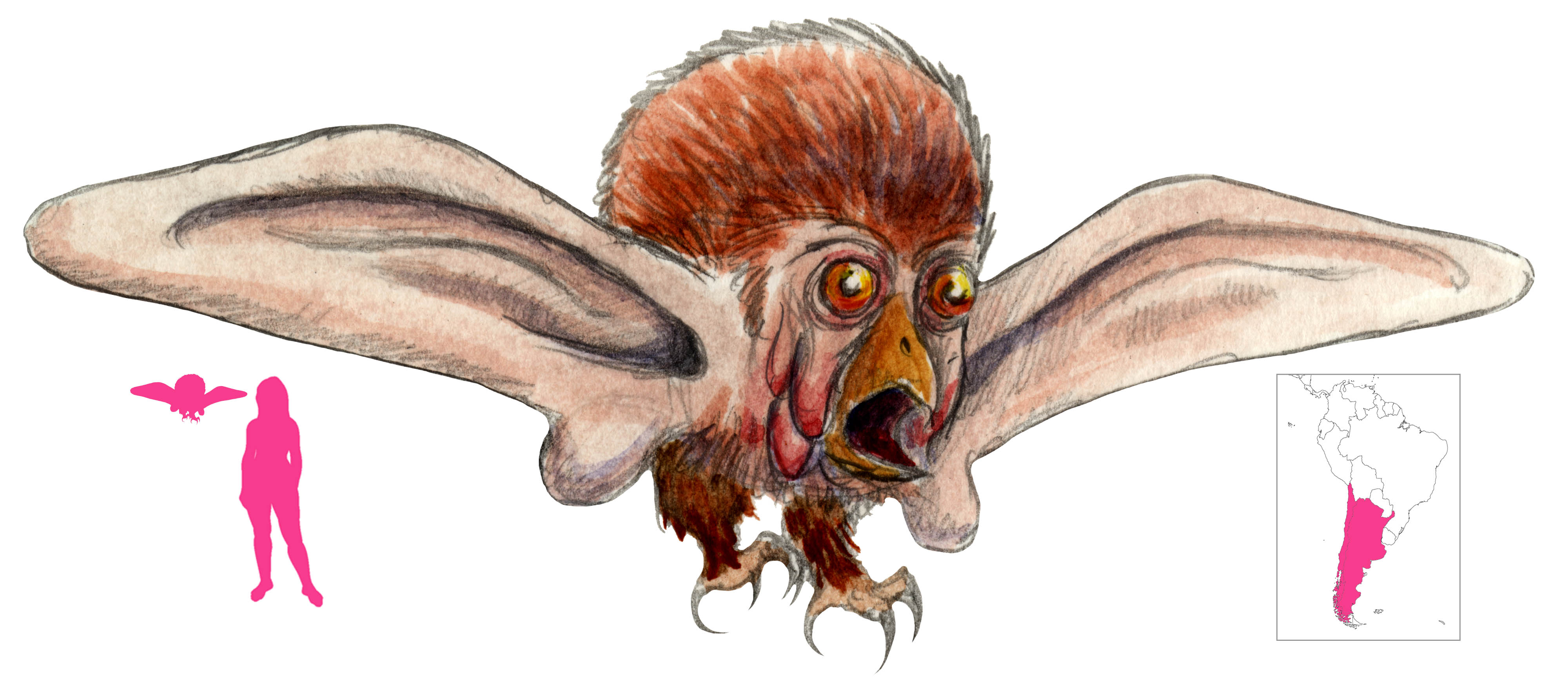
The Chonchón is a bird of ill omen from Chile and Argentina; it originally hails from Araucanian Mapuche folklore. Chonchón is also the name of a kind of kite.

In its simplest form it is a bird of the night, an owl (Strix rufipes) that flies on silent wings during the night to announce illness, death, or some other unwelcome event. When its croaking is heard it is advised to throw ash into the air and utter a few prayers in the hopes of turning away its evil.

The chonchón is also said to be a calcu or evil sorcerer in disguise. It resemble a human head, with oversized wing-like ears that allow it to fly. During the night, these sorcerers’ heads detach themselves from their bodies and fly around to cause mischief, invisible to most, their ominous tué, tué, tué call announcing misfortune. They have the same powers as sorcerers do, and have been known to suck the blood of sleepers.

In order to repel chonchones, several methods are recommended. These include drawing a Solomon’s seal on the ground, laying out a waistcoat in a specified manner, or reciting certain phrases or hymns such as the Magnificat, the Doce Palabras Redobladas, “Saint Cyprian goes up, Saint Cyprian goes down, Saint Cyprian goes to the mountain, Saint Cyprian goes to the valley”, or “Jesus goes ahead, follow him behind”. Doing any of these actions forces the chonchón to leave, or even fall to the ground where it can be destroyed. If the headless body of a chonchón sorcerer is found, turning it onto its stomach prevents the chonchón from returning to it. Finally, a more humane means of dealing with a chonchón is to yell “Come back tomorrow for some salt!” The next day, the chonchón in its human guise will show up and sheepishly request the promised salt. Except perhaps for the last method, most interference with the ways of chonchones will eventually incur the revenge of the chonchón or its friends.

One chonchón was reportedly grounded in Limache when someone made a Solomon’s seal, causing a large bird with red wattles to fall out of the sky. It was decapitated and its head fed to a dog, whose belly swelled up as though it had eaten a human head. Later the local gravedigger told that unknown persons had come to bury a headless body.

Not all chonchones are irredeemably evil, however. A Mapuche man in Galvarino once woke up early in the morning to find his wife’s body without her head. He immediately realized that she was a chonchón, and turned the body onto its stomach to prevent the head from reattaching. As expected, a chonchón soon flew heavily into the house, flapping and staggering as though blind. It then turned into a dog and whined pleadingly to be reunited with its body. The man took pity on it and allowed it to do so, and it became his wife once more. “Every night I leave, without you knowing, and visit distant lands”, she explained. She begged him not to tell anyone, and swore she would never harm him, and both kept their word; the story became known only after the wife died of natural causes.

Some authorities separate the chonchón from the chuncho, with the former being the sorcerous flying head and the latter the owl. Their calls are also different, with the chuncho hooting chun, chun, chun. They have further owl equivalents in the Venezuelan cocorote, the Ecuadorian cuscungos, and the Mexican tecolote. It is also compared to the myth of the voladora, a witch who flies while cackling loudly.

All this is quite unfair to the owls themselves, which benefit the farmers by eating mice, rats, and other vermin.

References

Aguirre, S. M. (2003) Mitos de Chile. Random House, Editorial Sudamericana Chilena.

Borges, J. L.; trans. di Giovanni, N. T. (1969) The Book of Imaginary Beings. Clarke, Irwin, & Co., Toronto.

Cifuentes, J. V. (1947) Mitos y supersticiones (3rd Ed.). Editorial Nascimento, Santiago, Chile.

Coluccio, F. and Coluccio, S. (2006) Diccionario Folklórico Argentino. Corregidor, Buenos Aires.

Rodríguez, Z. (1875) Diccionario de Chilenismos. El Independiente, Santiago.

Soustelle, G. and Soustelle, J. (1938) Folklore Chilien. Institut International de Coopération Intellectuelle, Paris.

Tsemaus

Variations: Tsemaus, Chemouse, Narhnarem-tsemaus, Snag, Supernatural Snag, Tsem’aus, Tcamaos, Tca’maos, Tidewalker, Ts’um’os, Tsamaos, Kanem Ktsem’aus; Weegyet, Wi’git

Tsemaus

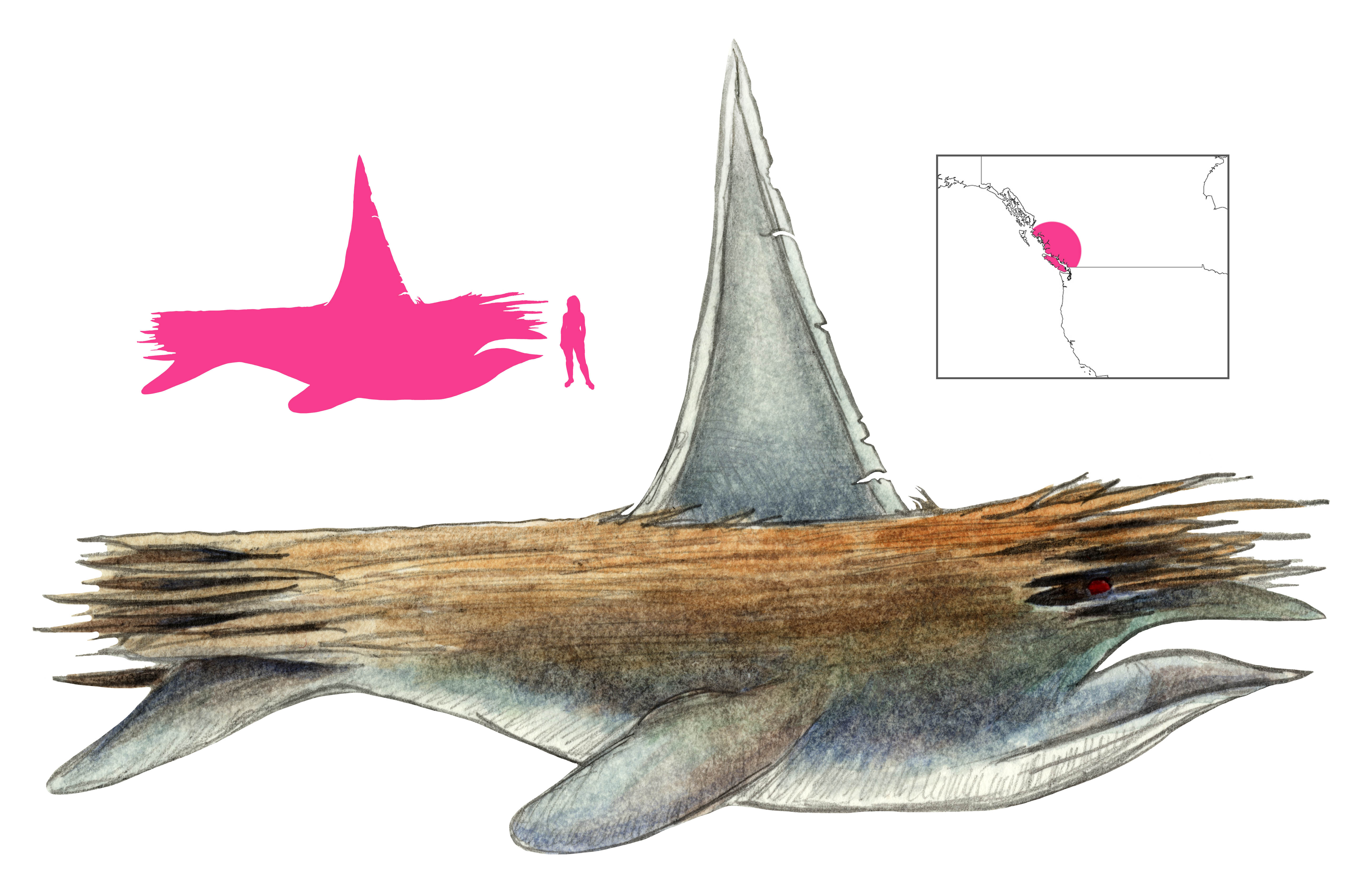
The Tsemaus (“Snag”) or Narhnarem-Tsemaus (“Supernatural Snag”) is the personification of river snags., floating logs, and other hazards of the water. It is found in the folklore and art of the Pacific Northwest, notably in Tsimshian and Haida culture around the mouth of the Skeena River.

One of its names, Wi’git or Weegyet, connects it to Raven the trickster, and it is one of his many forms. The creator and trickster Nanki’islas also assumed the form of a tsemaus after he was done.

A tsemaus can vary a lot in appearance, much like the driftwood it imitates, but it almost always has a snag for a dorsal fin – or is itself a snag. It can be as simple as a dead log with a tail that can swim against the current. It can be a huge sea lion with dorsal fins and blowholes, or an enormous grizzly bear with a downturned mouth like a dogfish and two sharp snags protruding from its back, with or without one or more sharp fins of a killer whale. It can be a hybrid of bear and killer whale, or raven and killer whale, with multiple bodies. It can be a large frog covered in seaweed with a snag sticking out of its back, and can even be a canoe or a schooner. Meurger states that it can cleave swimmers with its fin.

The tsemaus uses its fin to destroy boats. It has no problem swimming upstream and plowing through log jams. If angered it breaches and lands on canoes, smashing them to bits, or makes huge waves to capsize boats. It drowns people, who then become killer whales.

It is found as a crest on the totem poles of the coastal clans.

References

Barbeau, M. (1950) Totem poles. Bulletin No. 119, Anthropological Series No. 30, National Museum of Canada, Ottawa.

Barbeau, M. (1953) Haida Myths Illustrated in Argillite Carvings. Bulletin No. 127, Anthropological Series No. 32, National Museum of Canada, Ottawa.

Boas, F. (1951) Primitive Art. Capitol Publishing Company, New York.

Deans, J. (1893) Totem Posts at the World’s Fair. The American Antiquarian and Oriental Journal, Vol. XV, No. 4, pp. 281-286.

Meurger, M. (1988) Lake Monster Traditions: A Cross-Cultural Analysis. Fortean Tomes, London.

Swanton, J. R. (1909) Contributions of the Ethnology of the Haida. Memoirs of the American Museum of Natural History, Vol. VIII.

Qiqirn

Variations: Quiquern

Qiqirn

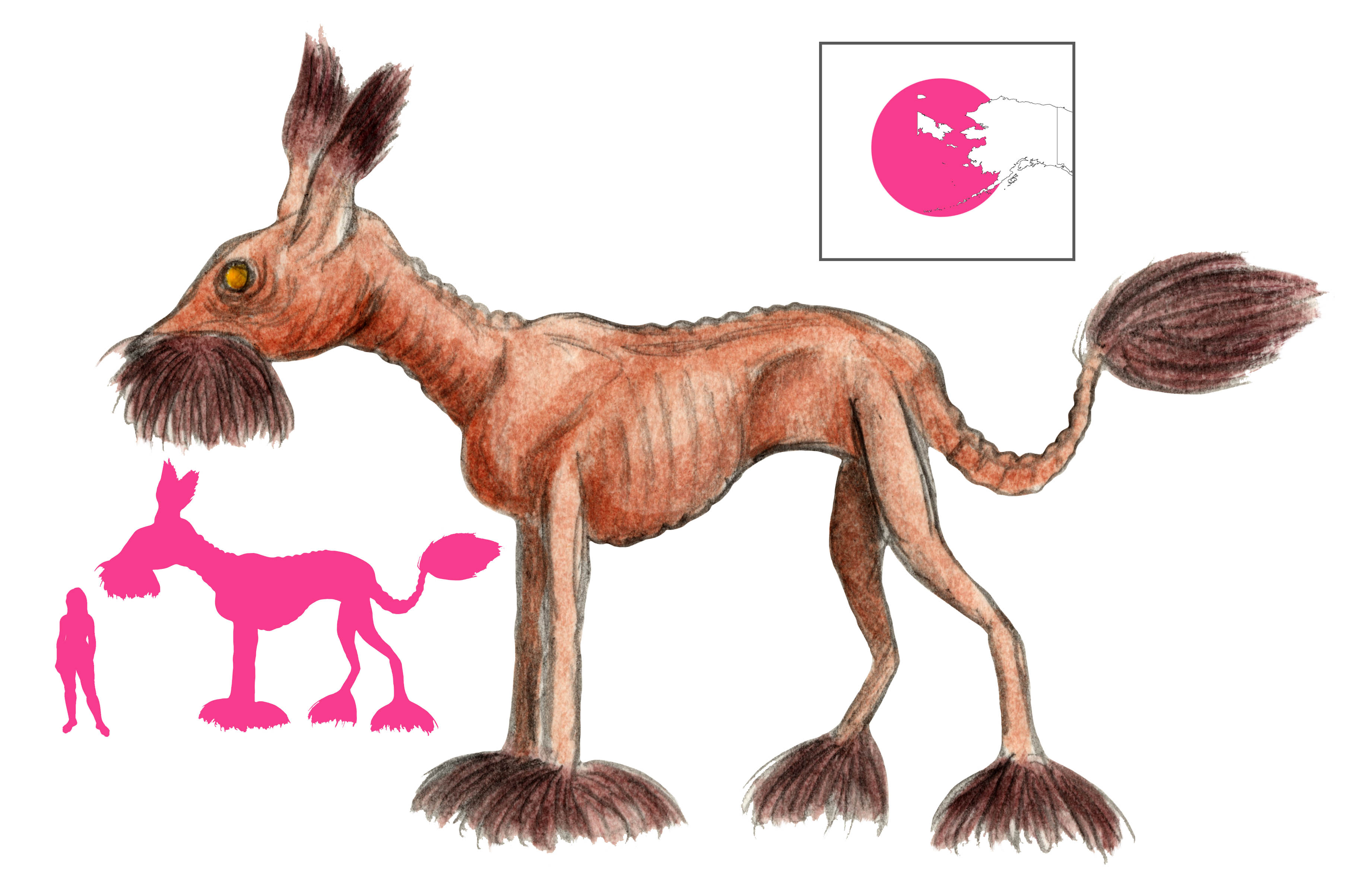
The Qiqirn is a huge dog of Inuit folklore. It is hairless except for its mouth, feet, and ear and tail tips. The mere presence of a qiqirn around men or dogs causes them to suffer fits, a state which ends only when the qiqirn leaves. However, the qiqirn is also extremely scared of humans, and will run away if an angakoq sees it.

Merkur suggests that the “fits” induced by the qiqirn’s presence may be a symbolic reference to shamanic initiation. It shares this feature with the initiatory bear spirit of Baffin Island.

In the Second Jungle Book, the qiqirn – as Quiquern – appears in a snowstorm as an enormous, toothless, and hairless dog, with two heads and eight pairs of legs. He leads two Inuit hunters towards more fruitful lands, and proves to be two sled dogs tied together.

References

Boas, F. The Central Eskimo. In Powell, J. W. (1888) Sixth Annual Report of the Bureau of Ethnology. Government Printing Office, Washington.

Kipling, R. (1921) The Second Jungle Book. Doubleday, Page & Company, Garden City.

Merkur, D. (1991) Powers Which We Do Not Know. University of Idaho Press, Moscow.

Whowie

Variations: Whowhie

Whowie

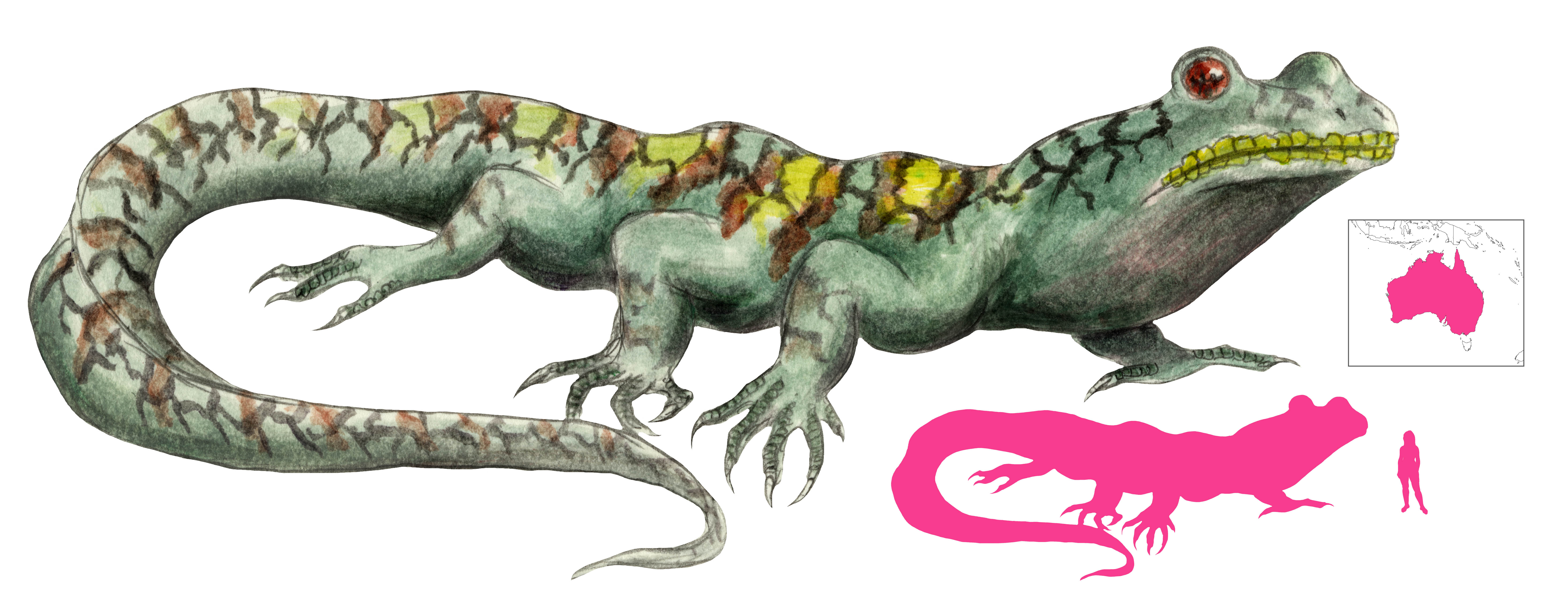
The Whowie was the terror of the Murray River in the Riverina district of Australia. He was like an enormous goanna, about twenty feet long, with six goanna legs and a huge frog-like head; he was perhaps somewhat like the huge monitor lizards that once roamed southern Australia. While very slow in his movement, he had no reason to be fast, as everyone fleed in terror from him. At night, the whowie would crawl into grounds where people were sleeping, and proceed to devour anyone who couldn’t get away. Thirty to sixty people could disappear down his cavernous mouth during one of those raids. During the day he would sleep in his cave on the Murray River, or bask along the riverbank; his movements created the sandhills of Riverina.

With the passage of time, the depredations of the whowie were starting to take their toll on the inhabitants. The water-rat tribe was first to convene, as they had suffered most from the whowie’s attention. The chief solemnly announced that they had no choice but to flee to a safer land or face certain annihilation. “I shall let you decide what we shall do”, he told his people. It was an elder who stood up and implored his people to stay. “We have lived here all our lives; we have always had plenty to eat, and much to do along the river. Now we dare not go there because of the whowie. Let us think of some other way by which we may be rid of this menace”.

A strict night guard was instated, and the aid of several other tribes was called for. The water-rats searched for the whowie, and found footprints leading into the cave’s one opening. As the whowie’s cave was many miles long, they knew it would take a week for him to return to the outside, and so they had all the time they needed.

Soon help had arrived from all over, from the kangaroo, platypus, eagle, magpie, cockatoo, lizard, snake, opossum and crow tribes, and many more besides. After holding a corroboree and spending a night in celebration, dancing, and storytelling, all of them busied themselves gathering sticks. The sticks were gathered into bundles and piled up halfway in the cave and at the entrance. Then, when they believed the whowie was soon to appear, they set the wood on fire.

Smoke and flames filled the cave, and the whowie roared and coughed angrily – but what good were his teeth and claws against smoke and fire? He struggled upwards through the cave for six days and appeared on the seventh burned, blinded, and gasping for breath. That was when the tribes descended upon him with spears, axes, and nulla-nullas, inflicting mortal wounds on their enemy. The giant lizard could only drag himself back into his cave, and was never seen again.

Now the whowie can still be heard sighing from deep inside the cave on the Murray River. He is dying, or perhaps his spirit has survived underground in some form. But either way he is harmless, and has become nothing more than a bogey with whom parents can threaten their children into good behavior.

References

Molnar, R. E. (2004) Dragons in the Dust. Indiana University Press, Bloomington.

Reed, A. W. (1965) Myths and Legends of Australia. A. H. and A. W. Reed, Sydney.

Smith, W. R. (2003) Myths and Legends of the Australian Aborigines. Dover Publications, Mineola.

Nauthveli

Variations: Nauthvalur, Nautshval (Ox-whale); Nautfiskur (Ox-fish); Kýrhvalur (Cow-whale); Fjósi (Byre-whale); Baulhveli (Bellow-whale); Búrhvalur, Sperm Whale

Nauthveli

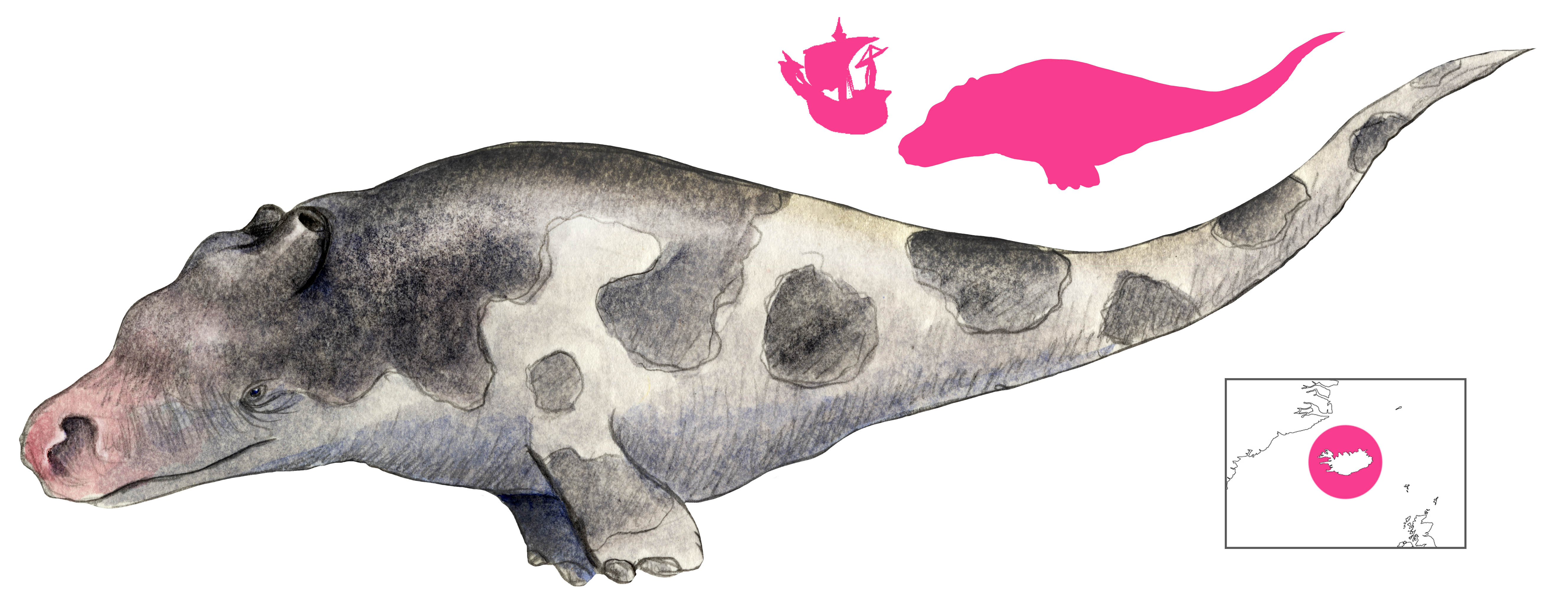
The Nauthveli or Nauthvalur (“Ox-whale”) is one of the many illhveli or “evil whales” of Iceland. It is the second biggest of the evil whales, and like the others, it is inedible and will show up if its name is said out loud.

A nauthveli is a toothed whale, bicolored much like a cow. The large head is similar to that of a bull and has two nodules on top. The trunk tapers off, wormlike, and lacks fins.

However, the nauthveli is named not for its appearance, but rather for the terrifying bull-like bellow it makes when hungry, a sound like that of roaring, maddened bulls. The call of a nauthveli is made in the open sea or near the shore, and can be heard reverberating over long distances. The vibrations cause the ground to shake and knock oars out of sailors’ hands. Going out to sea is forbidden if nauthveli bellowing can be heard.

As will all evil whales, the nauthveli delights in killing men and scuttling smaller boats, but it has a particular fondness for beef. The bellow of a nauthveli is hypnotic to cattle, compelling them to run off cliffs and headlong into the sea. There the nauthveli plays with them like a cat does with a mouse before biting them in half and eating them. The whales are attracted to cattle on board ship; one nauthveli off Grimsey harassed a vessel until they released the one cow on board, who promptly dove into the sea. Cattle have to be locked up for days until the nauthveli’s spell wears off, and indeed cow-herding was strongly discouraged in areas where nauthvelis had been heard. Sacrificing one bull or cow usually satisfies the nauthveli, making it safe to go out to sea again.

Gudmundsson listed the nauthveli as synonymous with the búrhvalur or sperm whale.

References

Davidsson, O. (1900) The Folk-lore of Icelandic Fishes. The Scottish Review, October, pp. 312-332.

Hermansson, H. (1924) Jon Gudmundsson and his Natural History of Iceland. Islandica, Cornell University Library, Ithaca.

Hlidberg, J. B. and Aegisson, S.; McQueen, F. J. M. and Kjartansson, R., trans. (2011) Meeting with Monsters. JPV utgafa, Reykjavik.

Devouring Gourd

Variations: Devouring Pumpkin; Sala Fruit (possibly)

Swallowing Gourd final

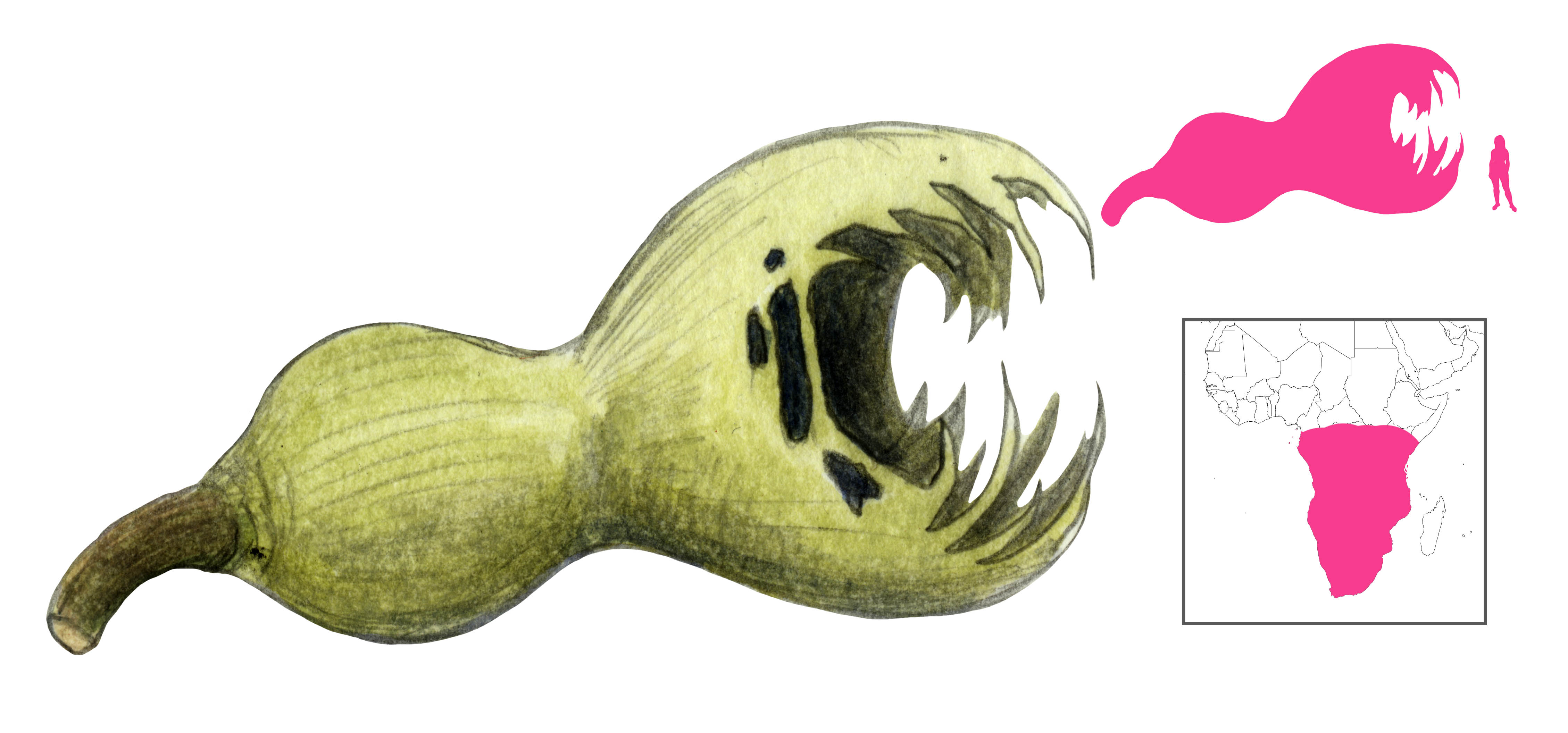
Not all swallowing monsters are animals. In Bantu folklore, gourds and pumpkins have the potential to grow into vast, devouring creatures. Such plants usually grow where evil sorcerers or ogres were slain.

The devouring gourd of Usambara was discovered by a group of little boys at play. “Look at how big that gourd is getting!” said one of the boys. To their surprise, the gourd responded. “If you pluck me, I’ll pluck you!” it said. The boys ran home and told their mother, who refused to believe them. But their sisters insisted on seeing the large gourd, and when they were taken to it, they said as their brothers had, “Look at how big that gourd is getting!” This time the gourd did not respond, and the girls went home to complain about their brothers being liars.

As the gourd was not plucked, it continued to grow. Eventually it became the size of a house, uprooted itself, and went about swallowing everyone in the village. After consuming everyone within reach, it rolled into a lake.

Only one woman had survived the gourd’s rampage, and she was pregnant. When her son was born, they lived together in the ruins of the village. When the son got around to asking where his father was, his mother told him “He was swallowed by a gourd, which is now in the lake”. The son decided to avenge his father, and went out to the lake where he could see the gourd’s ears sticking out of the water, and he proceeded to taunt the vegetable. “Gourd, come out!” he yelled. “Gourd, come out!” Annoyed and enraged, the gourd hauled itself out of the lake, but the boy was ready for it, and fired a volley of arrows into it. The tenth arrow killed it, and it died with a roar that could be heard all the way to Vuga. The boy cut it open with a knife, released the villagers unharmed, and went on to become a great leader of his people.

Gourds are not the only plants that devour and kill people. Another carnivorous plant, a pumpkin, grew over the burial location of an evil shapeshifting porcupine. It repeated everything that was said to it, and when an axe was brought to destroy it, it proceeded to swallow everyone. The poisonous Sala fruits of the Ronga have arms and legs, and wield spears ands shields.

References

Knappert, J. (1977) Bantu myths and other tales. E. J. Brill, Leiden.

Werner, A. (1968) Myths and legends of the Bantu. Frank Cass and Co. Ltd., London.

Bonnacon

Variations: Bonasus, Bonasos, Monassos, Monops; Bison, Maned Bison, European Bison, Aurochs, Urus, Urus Bonasus

Bonnacon

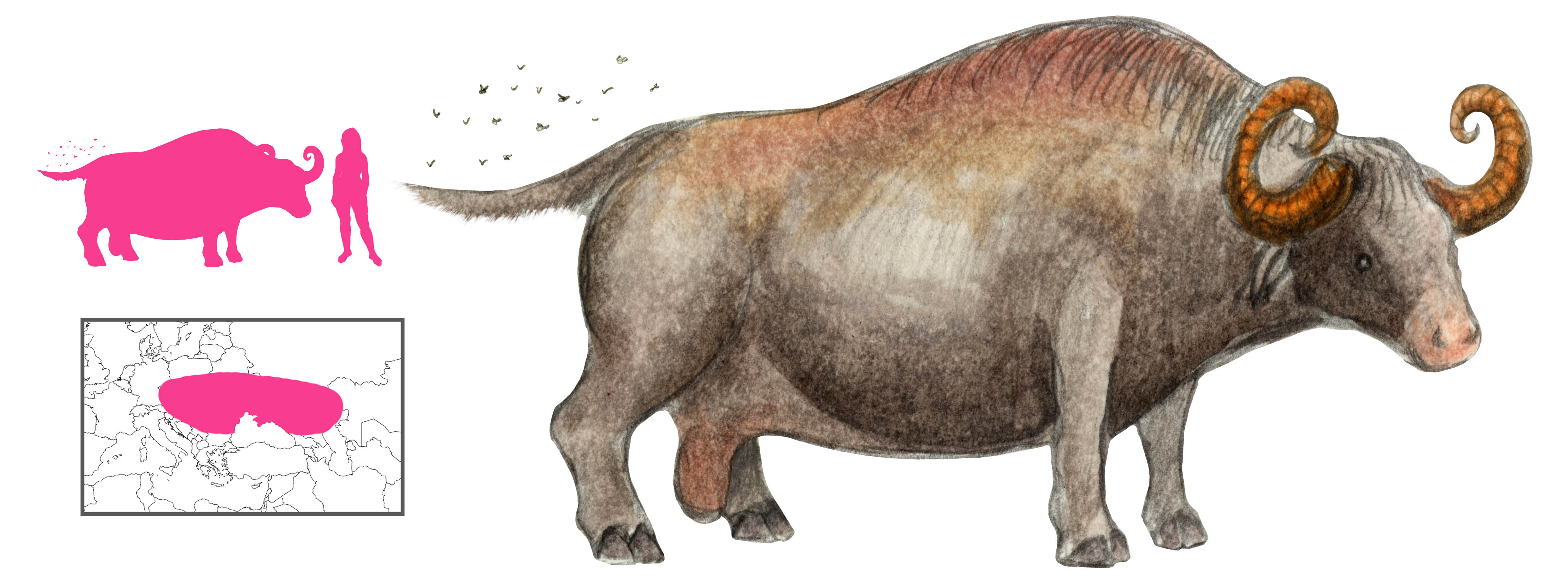
The Bonnacon’s range extends from Scythia in the east to Bulgaria, Macedonia, and Germany in the West. It would be a fine prize for hunters were it not for its remarkable flatulent defenses.

A bonnacon looks like a bull, but is squatter, with reddish fur shading to black, a short tail, and the shaggy mane of a horse. Its horns curl inwardly towards the head, making them of no use in self-defense.

When attacked, the bonnacon voids the contents of its intestines over an area of 3 acres (Aristotle gives a more conservative estimate of 4 fathoms). The noxious, acrid dung ignites and burns anything it touches, leaving a trail of flame in its wake.

The European bison (Bison bonasus) is generally believed to be the basis of the bonnacon.

References

Aelian, trans. Scholfield, A. F. (1959) On the Characteristics of Animals, vol. II. Harvard University Press, Cambridge, Massachusetts.

Cuba, J. (1539) Le iardin de santé. Philippe le Noir, Paris.

Pliny; Holland, P. trans. (1847) Pliny’s Natural History. George Barclay, Castle Street, Leicester Square.

Sainéan, L. (1921) L’histoire naturelle et les branches connexes dans l’oeuvre de Rabelais. E. Champion, Paris.

Unknown. (1538) Ortus Sanitatis. Joannes de Cereto de Tridino.

White, T. H. (1984) The Book of Beasts. Dover Publications, New York.

Az’-i-wû-gûm Ki-mukh’-ti

Variations: Walrus Dog

Aziwugum

Az’-i-wû-gûm Ki-mukh’-ti, the “Walrus Dog”, can be found roaming the rugged coastlines of Alaska. While not walrus-like, it lives with herds of walrus and acts as a protector of sorts. It is one of Raven’s many creations.

An az’-i-wû-gûm ki-mukh’-ti is rather like a large dog in general appearance, smaller than a walrus, elongate and slender, with a long, powerful rounded tail. Its body is covered with tough black scales which make it impervious to all but the best spears.

Walrus hunters in the Bering strait fear the az’-i-wû-gûm ki-mukh’-ti. Its muscular tail can easily kill a man, and at least one case is known of a walrus dog attacking an umiak and killing all aboard.

References

Nelson, E. W. (1900) The Eskimo about Bering Strait. Extract from the Eighteenth Annual Report of the Bureau of American Ethnology, Government Printing Office, Washington.