Yuanat

Yuanat

The Yuanat is a type of serpent reported by Thevet from the island of Hispaniola, or Cuba. It lives in trees, on land, and in the water, making it fish, fowl, and land beast.

This greatly terrifying creature is about the size of a rabbit and is frightful to behold. It has the tail of a lizard, and four weak bird’s legs, with the forelegs longer than the hindlegs and long claws on each toe. Its teeth are sharp. It has a spine running down its back like the fin of a fish. Underneath its throat there is a colorful flap of skin reaching down to its belly, its varied hues making it hard to tell which color is dominant. It can swim well, and is completely mute.

Despite its horrifying appearance, the yuanat tastes excellent, and its flesh is more highly prized than that of rabbits. It is also so gentle and harmless that the natives would keep a yuanat on a leash for ten or twelve days before eating it, and it would never attempt to harm them. However, Thevet notes that yuanat meat is harmful to those who have had the pox, as it causes the disease to return in full force.

References

Thevet, A. (1575) La Cosmographie Universelle. Guillaume Chaudiere, Paris.

Stray Sod

Variations: Ar Iotan, Egaire, Fairy Grass, Faud Shaughran, Fair-Gortha (potentially), Herb of Distraction, Herbe à Adirer, Herbe d’Egarement, Herbe d’Engaire, Herbe de Fourvoiement, Herbe Maudite, Herbe d’Oubli, Herbe à la Recule, Herbe Royale, Herbe des Tournes, Lezeuen Eur, Lezuenn er Seudann, Tourmentine

Tourmentine

“Stray sod” is a general term used here to refer to any plant that, if trodden upon, causes travelers to lose their way. Stray sods have been reported primarily from France and Ireland, and come about in a number of ways. Usually they are specific herbs with magical properties that grow along footpaths. At other times they form over the graves of unbaptised children, or are patches of grass enchanted by fairies. They themselves may be fairies or inhabited by fairies.

No matter the origin, the result is always the same. A solitary traveler at night will inadvertently step on a stray sod, and no matter how good their sense of direction, they immediately lose their path. All landmarks seem to vanish, all roads are dead ends. The unfortunate victim is compelled to wander aimlessly through the night, trudging through hedges and thorns, crossing rivers, slogging through marshes, and feeling their way through thickets. The spell is broken at daybreak, when they find themselves with their clothes torn and stained, their hands and feet bleeding, and miles away from home.

When this happens it is advised to turn one’s coat inside out to counteract the spell. Other remedies include the usage of metal as abhorrent to fairies, or finding certain plants or benevolent spirits to regain one’s bearings.

The stray sod is known as the herbe à adirer (“herb of misplacement”) in Anjou, the herbe à la recule (“herb of turning back”) in Besançon, the herbe d’oubli (“herb of forgetfulness”) in Brittany and Lorraine, the egaire in Normandy, and the herbe maudite (“damned herb”) or herbe des tournes (“herb of turning”) in Saintonge. The ar iotan (“golden herb”) of Brittany is inhabited by a spirit that shines like a glowworm; touching a piece of wood or metal breaks its spell, as does changing horseshoes on one side. The lezeuen eur (“golden herb”) and the lezuenn er seudann (“herb of dizziness”) of the Morbihan cause their victims to walk in circles until daybreak. The herbe royale (“royal herb”) of Saint-Mayeux causes even horses to lose their way. The herbe d’engaire of the Berry grows in vast plains, and causes those who step on it to lose sight of the path entirely. The tourmentine (Potentilla erecta, formerly Potentilla tormentilla) of Forez, which causes disorientation for 12 hours, can be countered by the parisette (Paris quadrifolia), a plant whose fallen seeds guide travelers by pointing in the right direction.

The faud shaughran of Ireland induces a sensation of flying, of being incapable of stopping until one is over twenty or thirty miles from home. There is a herb that counteracts its effects, but it is known only to the initiated. The similar fair-gortha causes unnatural hunger and craving for food if stepped on. One man in County Leitrim turned his coat and hat inside out but was unable to find his way home, ending up miles away from his destination.

References

Barton, B. H. and Castle, T. (1845) The British Flora Medica. Henry G. Bohn, London.

Dubois, P.; Sabatier, C.; and Sabatier, R. (1992) La Grande Encyclopédie des Lutins. Hoëbeke, Paris.

Duncan, L. L. (1893) Folk-Lore Gleanings from County Leitrim. Folklore, vol. 4, no. 2, pp. 176-194.

Rolland, E. (1904) Flore populaire, Tome V. Librairie Rolland, Paris.

Sébillot, P. (1894) Les travaux publics et les mines dans les traditions et les superstitions de tous les pays. J. Rothschild, Paris.

Sébillot, P. (1898) Les Forêts. Revue des Traditions Populaires, t. XIII, no. 12, pp. 641-661.

Sébillot, P. (1904) Le Folk-Lore de France, Tome Premier: Le Ciel et la Terre. Librairie Orientale et Américaine, Paris.

Sébillot, P. (1906) Le Folk-lore de France, Tome Troisième: La Faune et la Flore. Librairie Orientale et Américaine, Paris.

Wilde, F. S. (1887) Ancient Legends, Mystic Charms, and Superstitions of Ireland, v. II. Ward and Downey, London.

Part of my job in curating ABC involves responding to email. While this can mostly be done from the safety of my email application, every now and then I get correspondence that requires a broader answer for the public good.

Dear ABC,

How many illhveli species are there? I am planning a pleasure trip to Iceland – should I reconsider?

Sincerely,

Alex S.

illhveli scaleDear Alex S.,

The illhveli, or “evil whales” are a very specific grouping of Icelandic whales, which mostly share a few key features. There are 10 species of illhveli. As is evident from the image, they come in a dizzying variety of shapes and sizes, and are not necessarily biologically related. Due to the dangers involved in studying them, the scale given (with a human diver in the bottom left corner) is approximate.

An evil whale is known to be:

  1. Inedible. In fact, it is a crime to eat them, and attempts to do so will result in their flesh disappearing from the cooking pot. The only exception to this is the skeljúngur, which is safe to eat.
  2. Evil. By and large illhveli are dedicated to the destruction of humans and other, benign whales, and take sadistic pleasure in death and destruction. Once again, the skeljúngur is an occasional exception, as it has been known to help worthy humans.

If you have the misfortune to run into an evil whale, try making full speed towards the sun, whose blinding rays will dazzle the whale. If the whale is a raudkembingur, outracing it will cause it to die in frustration. Try making loud noises, or tossing items overboard to distract the whale. Any number of foul substances have been known to deter taumafiskurs, and will probably work on other illhveli as well.

The steypireyður, or blue whale, is the mightiest of the “good” whales and is a valuable ally. It will intercept and fight any illhveli nearby. For that reason, do not harm or impede blue whales; in fact, killing one of those gentle giants may place a terrible curse on you.

Not all evil whales are illhveli; the trolual and the ziphius, for instance, are not illhveli, although they share the Scandinavian waters with the evil whales and are no less bloodthirsty. They are also found alongside the hafgufa or kraken, which is bigger and more terrifying than any of them.

In conclusion, I would say that your chances of getting shipwrecked are quite high, but I wouldn’t let that scupper your travel plans. I would steer clear of the sea if I were you, unless your boat was particularly fast or your captain was an Icelandic sorcerer. Avoid any suspicious-looking islands, but look out for blue whales.

ABC will resume encyclopedic coverage on Friday. Thank you for your patience!

hrossgrr

References

Davidsson, O. (1900) The Folk-lore of Icelandic Fishes. The Scottish Review, October, pp. 312-332.

Hermansson, H. (1924) Jon Gudmundsson and his Natural History of Iceland. Islandica, Cornell University Library, Ithaca.

Hlidberg, J. B. and Aegisson, S.; McQueen, F. J. M. and Kjartansson, R., trans. (2011) Meeting with Monsters. JPV utgafa, Reykjavik.

Larson, L. M. (1917) The King’s Mirror. Twayne Publishers Inc., New York.

Vodyanoi

Variations: Vodianoi, Vodyanik, Vodnik, Vodeni Moz, Deduska Vodyanoy (Water-Grandfather), Vodianoi-chert (Water Devil), Vodianikha (female), Topielec (Drowner, Polish), Vodyany-ye (pl.); Bolotnyi (potentially)

Vodyanoi

The malevolent and murderous Vodyanoi, from voda or “water”, is the Slavic water spirit. It frequents lakes, ponds, rivers, and other bodies of water, but it especially prefers mill-ponds. Their homes range from the humble dwellings of sand and slimy logs of Olonets to underwater palaces of crystal, decorated with gold and silver taken from shipwrecks, and illuminated by a magic stone shining brighter than the sun. The palaces are primarily known from Kaluga, Orel, Riazan, and Tula. The female vodyanyoi is also known as the vodianikha, although a rusalka or a drowned woman will also be taken as a bride. Variants of the vodyanoi are known in Belarus, Poland, and Yugoslavia.

A vodyanoi varies wildly in appearance. It can be roughly human in appearance, with big paws, horns, tail, and eyes like burning coals; it can be a huge man covered with grass and moss, with shaggy white fur, or with scales; it can be black with huge red eyes and a long nose, or bluish and slimy, bloated and crowned with reeds. Sometimes it appears in the form of a human, as an old man with green hair and beard that turned white with the waning moon, as a white-bearded peasant in a red shirt, as a naked woman with enormous breasts combing her dripping hair while seated on a log, or in the form of guardsmen and children. It can be half fish and half human, or appear as a huge moss-covered fish, a swan, or even a bouquet of red flowers on the water. In Smolensk the vodyanoi is humpbacked and has the feet and tail of a cow, while in Vologda it is a log with little wings flying over the water. A vodyanoi out of the water and in human guise can be identified by the water oozing out of its coat.

The vodyany-ye are immortal, but grow younger or older with the moon. They are weak on land, but virtually invincible in the water, and they dislike going out of the water beyond the bank or mill-wheel; some vodyany-ye refuse to emerge from water beyond the waist. They like to ride livestock until they die of exhaustion. Their presence in the market is an omen; if a vodyanoi buys corn at high prices, the harvest will fail, but a vodyanoi buying cheaply foretells bountiful crops.

They rest in their palaces during the day, and come out in the evening splashing the water with their paws, making a noise that can be heard over great distances. Vodyany-ye hate humans and lurk in the water after sunset, dragging people in when the opportunity arises. Those they drown become their slaves, or if attractive enough their wives. They take offense to anyone attempting to retrieve the bodies of the drowned, seeing them as their rightful property. Recovered bodies with bruises and marks on them were seen as bearing the scars of battle with a vodyanoi. In some places the presence of a vodyanoi became a serious threat. One mill-pond in Olonets held a vodyanoi family that required a constant source of corpses to eat. The inhabitants of the area learned to avoid the pond, and the family was eventually forced to relocate.

A vodyanoi sees mill-dams as an insult, and will destroy them to keep the water flowing. Horses smeared with honey, hobbled, and drowned with millstones make good placatory offerings. Drunk passers-by can also be pushed into mill-ponds to earn the vodyanoi’s trust.

As with other evil spirits, a vodyanoi can be exorcised; in fact, in some areas such as Tula, the vodyanoi is indistinguishable from the devil. Shooting a vodyanoi with buttons has been known to kill them as well. But while a vodyanoi can bear grudges, it can just as soon show gratitude. One vodyanoi who was aided in fighting off a rival promised never to drown anyone.

A vodyanoi is not hostile to fishermen and millers due to their affinity with water. Millers would deposit bread, salt, vodka, black sows, and ram’s heads at the water’s edge as offerings to the vodyanoi, and offer black roosters when building a new mill. Some millers were on such good terms with their local vodyanoi that they dined with them every night. Fishermen, on the other hand, would toss butter or tobacco into the water, saying “here’s some tobacco for you, vodyanoi, give me a fish!” A pleased vodyanoi would drive fish into a fisherman’s net. Finally, beekeepers also kept up good relations with the vodyanoi by offering honey and wax, and in return the water-spirit prevented humidity from damaging the hives.

The bolotnyi, from boloto or “swamp”, is a possible variation of the vodyanoi found in swamps.

References

Aldington, R. and Ames, D. trans.; Guirand, F. (1972) New Larousse Encyclopedia of Mythology. Paul Hamlyn, London.

Dubois, P.; Sabatier, C.; and Sabatier, R. (1992) La Grande Encyclopédie des Lutins. Hoëbeke, Paris.

Ivanits, L. J. (1989) Russian Folk Belief. M. E. Sharpe, Inc., Armonk, New York.

MacCulloch, J. A. and Machal, J. (1918) The Mythology of All Races v. III: Celtic and Slavic. Marshall Jones Company, Boston.

Khodumodumo

Variations: Kholomodumo, Modumo o Moholo, Khamapa, Kammapa, Khanyapa

Khodumodumo

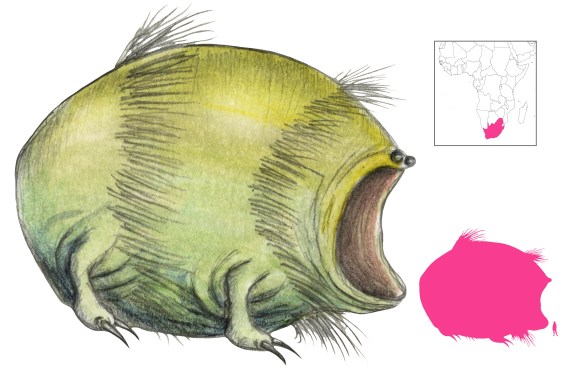
The swallowing monster of the Basuto people of South Africa and Lesotho is called Khodumodumo. The name of Khodumodumo is an archaic Sesotho term, most likely meaning “great noise”, although Hichens refers to the “gaping-mouthed bush monster”. Modern Sesotho often makes it into kholomodumo. Its synonym and possible ancestor is Kammapa, a giant river python. Khodumodumo’s amorphous appearance is undefined, and it is vast in size. It has multiple sharp tongues which it uses as weapons.

Once Khodumodumo went about swallowing every living thing in its path, man and beast alike, lumbering through towns and villages and engulfing their inhabitants. Only one pregnant woman survived, as she had been hiding on a manure heap, and the ashes masked her appearance and scent. Eventually the bloated Khodumodumo dragged itself off and wedged its massive body in a mountain pass.

Eventually the woman gave birth to a baby boy, and went off to fetch some manure powder to lie on, as tradition dictates. She returned to find her son fully grown, dressed in skins, with divining beads around his neck, and armed with assagais. “Where is my son?” she asked, marveling at the heroic figure in front of her. “I am your son, Senkatana”, he said. “Mother, where is the rest of the village?” “Alas, Khodumodumo ate them all”, she lamented. “And the cattle?” “The cattle too”. “And the dogs?” “The dogs too”. “And the poultry?” “The poultry too”.

Senkatana demanded that his mother show him where the beast had gone to. “See the big hill in the pass?” she said. “That is Khodumodumo”. Despite his mother’s warnings, Senkatana went to face Khodumodumo alone. When it saw him, it opened its mouth wide and tried to spear him with its tongues, but Senkatana chopped them off one by one. He circled around the beast, which was too fat to turn around and face him, and stabbed it with his assagais until it was dead.

He then started to cut open Khodumodumo, but had to avoid cutting the people imprisoned inside. His first cut accidentally injured a man, and then he had to avoid stabbing a cow, a goat, a dog, and a hen before he could finally release Khodumodumo’s victims. Senkatana then went on to become a great chief, but the man he had inadvertently stabbed continued to bear a grudge. The resentful man and others jealous of the hero attempted to assassinate him multiple times, until Senkatana, weary of the hatred of mankind, allowed himself to be killed.

References

Hichens, W. (1937) African Mystery Beasts. Discovery (Dec): 369-373.

Jacottet, E. (1888) Légendes et contes Bassoutos. Revue des Traditions Populaires, v. 3, Maisonneuve et Ch. Leclerc, Paris.

Werner, A. (1968) Myths and legends of the Bantu. Frank Cass and Co. Ltd., London.

Skeljúngur

Variations: Skieliungur; Svarfhvalur, Suarfhualur (Iron Whale); Skútuhvalur (Schooner Whale); Tigrishvalur (Tiger Whale); Hnúfubakur, Humpback Whale

Skeljungur

The Skeljúngur, or “shell whale” is one of the many illhveli, or “evil whales” of Iceland. Unlike its brethren, the skeljúngur is edible and safe to eat, making it the most dangerous of the edible whales. It has even helped humans on occasion; one young skeljúngur aided Hjalmper and Olvir in battle against a vicious hrosshvalur.

It is described as ranging from 20 to 45 meters long. It is very fat and short-flippered, lacks dorsal fins, and its entire body is covered with shells that rattle as it swims. The shells tend to make it itchy, and it will rub its head against rocks in deep coastal waters. Despite its portly appearance, it is a fast swimmer, earning it the nickname of “tiger whale”. It dives vertically, and sleeps vertically with its head sticking out of the sea. Whether it has teeth or baleen is unclear.

A shell-whale will position itself in the path of an oncoming ship, and will continue to obstruct the vessel’s course if the captain tries to avoid it. Skilled sailors should change their course fast enough to evade it, as sailing right onto it causes the whale to throw the ship and kill all on board. When destroying boats, it likes to strike them with its fins and tails. Skeljúngur armor makes them impervious to most attacks and quite fearless, and the whales will play dead to entice prey within range. The whaling ship Minerva off Grimsey thought they had killed a skeljúngur, but the seemingly dead whale immediately recovered and destroyed the boat sent to finish it off.

Skeljúngurs hate the sound of iron being ground and filed. If one of these whales hears that loathed sound, it will go frantic and beach itself to get away from it. The alternate name of svarfhvalur (“iron whale”) is derived from this aversion.

Skeljúngur is also another name of the humpback whale or hnúfubakur.

References

Davidsson, O. (1900) The Folk-lore of Icelandic Fishes. The Scottish Review, October, pp. 312-332.

Hermansson, H. (1924) Jon Gudmundsson and his Natural History of Iceland. Islandica, Cornell University Library, Ithaca.

Hlidberg, J. B. and Aegisson, S.; McQueen, F. J. M. and Kjartansson, R., trans. (2011) Meeting with Monsters. JPV utgafa, Reykjavik.

Larson, L. M. (1917) The King’s Mirror. Twayne Publishers Inc., New York.

Vouivre

Variations: Vaivre, Givre, Guivre, Wivre

Vouivre

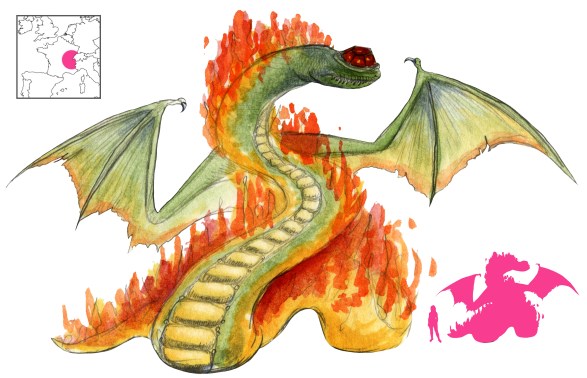
Vouivres, the great fiery serpents of France, have been reported primarily from remote, mountainous regions, where they haunt springs, wells, caves, deep ponds, and ruined castles. They are known from Bourgogne, Franche-Comté, Savoie, the Jura mountains, and neighboring areas, with possible relatives in the Aosta Valley and Switzerland.

The word “vouivre” is derived from the Latin vipera, or “viper”. Vouivres themselves are the spiritual descendants of Mélusine, stripped of her human features. They have been described as dragons, serpents, and fairies in the form of great reptiles; they are always the guardians of priceless treasures.

In its most simple definition, a Vouivre is a female dragon. Vouivres vary wildly in appearance, but are always female and associated with fire and water. The classic vouivre, as observed in Faverges, Fleury-la-Tour, Mont-Beuvray, Rosemont, Solutré, and Thouleurs, is an immense winged serpent covered with fire. Instead of eyes, a vouivre has a single large diamond or ruby in its head that guides it through the air. She removes it when bathing, leaving it blind and vulnerable to theft. Possession of a vouivre’s eye-stone would bring riches and happiness to anyone who stole it. The immense vouivre of Boëge guards treasure and wears a priceless golden necklace. In La Baume she is 4 meters long and covered in gems and pearls. She sometimes leaves gems behind where she lands. The Lucinges vouivre is a glowing red viper that whistles eerily in flight. The Gemeaux vouivre, which appeared between 2 and 3 in the afternoon, was hooded like a cobra.

In Brizon, she is equally likely to appear as a bird or a winged beech marten with a brilliant necklace as she is to have the form of a great serpent with wings and a diamond on its tail. Vouivres may not even look like animals. In Chevenoz she appears as a burning fireball streaking across the sky, in Saint-Jean-d’Aulps and Vallorcine she is a single-eyed tongue of fire, and in Le Biot she is a star whose appearance foretells war and strife. The Orgelet Castle vouivre looks like a red-hot iron bar in flight, and the vouivre of Sixt-Fer-À-Cheval is a plumed golden necklace that flies through the air.

One of the more effective ways of slaying a vouivre has been making a spiked barrel to hide in. At Condes, a man managed to steal a vouivre’s diamond and hide in a nail-studded washtub; the infuriated, blinded dragon killed herself trying to get to him. While another man at the Aosta Valley slew a vouivre in a similar manner, other prospective thieves have not been so lucky. The vouivre of Reyvroz had a necklace of great value, which was stolen by a man in a spiked barrel; she died and the thief died soon after. The vouivre of Samoëns had her pearl necklace stolen in the same manner, but she constricted the barrel anyway and made the thief return the necklace; she then disappeared and was never seen again. In Manigod, where grass would not grow for a couple of years after the vouivre’s passage, a man who stole her diamond was killed, his barrel smashed, and the gem retrieved.

Finally, as with all dragons, vouivres are vulnerable to the power of saints and other holy persons. The vouivre of Saint-Suliac was cast into a deep cave by Saint Suliac after she killed one of his monks. The location became known as the Trou de la Guivre, the Guivre’s Hole.

In Thollon-Les-Mémises, among other places, “vouivre” has become a byword for an unpleasant, nasty woman.

Modern versions of the vouivre, perhaps conflating her with Mélusine, have embellished with her the features of a seductive woman. Marcel Aymé makes her a wild girl of the forest with an entourage of vipers, and Dubois makes her a beautiful fairy who sheds her dragon skin when bathing.

References

Aymé, M. (1943) La Vouivre. Gallimard.

Dontenville, H. (1966) La France Mythologique. Tchou, Paris.

Dubois, P.; Sabatier, C.; and Sabatier, R. (1996) La Grande Encyclopédie des Fées. Hoëbeke, Paris.

Joisten, C. (2010) Êtres fantastiques de Savoie. Musée Dauphinois, Grenoble.

Monnier, D. (1819) Essai sur L’Origine de la Séquanie. Gauthier, Lons-Le-Saunier.

Sébillot, P. (1905) Le Folk-Lore de France, Tome Deuxième: La Mer et les Eaux Douces. Librairie Orientale et Américaine, Paris.

Númhyalikyu

Variations: Númhyělekum

Numhyalikyu

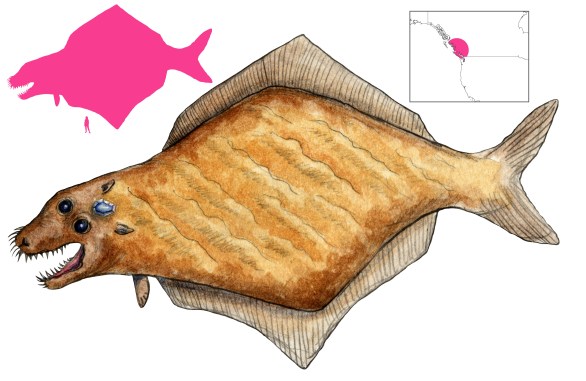
Númhyalikyu, “one chief one”, is an enormous, monstrous halibut of Pacific Northwest Kwakwaka’wakw folklore. Its back looks like a beach, complete with ripples left behind by the waves. It has the head of a seal, with a shining spot that gleams like fire.

If a númhyalikyu is killed, its head can be stabbed and its gleaming ornament extracted, revealing it to be a hard and shiny crystalline object. This is known as tlúgwi, and it is highly valuable. It is hard to pinpoint the location of a númhyalikyu, however, as it makes a deep humming sound that reverberates through water and air and rumbles through the trees, seeming to come from everywhere at once.

Númhyalikyu brings bad weather and storms. When it comes to the surface, it creates treacherous shallows that wreck canoes. Its rippled back, often just below the surface of the water, can be easily mistaken for a small island.

Númhyalikyu’s dance is númkahl, “personification of númhyalikyu”. The initiate playing the part of númhyalikyu wears a face mask, and is caught on the beach after metaphorically leaving the sea.

References

Curtis, E. S. (1915) The North American Indian, v. X. The Plimpton Press, Norwood.

Isiququmadevu

Variations: Usiququmadevu (flattering); Isikqukqumadevu, Usikqukqumadevu; Unomabunge; O’gaul’-iminga; O-nsiba-zimakqembe

Isiququmadevu

When Untombinde, the king’s daughter, set out for the mythical Ilulange River, she took with her two hundred maidens to be her escorts. She was determined to bathe in one of its pools despite her parents’ warnings of dire consequences. Once there, she and her handmaidens undressed and played in the water, but when they came back out their clothes, their beautiful bracelets and jewels and finery were all gone. Isiququmadevu had taken them.

Isiququmadevu, “Smelly Whiskers”, is a mountainous “swallowing monster” from Bantu and Zulu folklore. She is bearded, bloated, hairless, and squatting, with an enormous mouth capable of engulfing entire villages. Other clues as to her appearance are given in her many epithets, which include Unomabunge (“Mother of Beetles”), O’gaul’-iminga (“Feller of Lofty Thorn-trees”), and O-nsiba-zimakqembe (“She Whose Feathers are Long and Broad”).

Naturally the royal cortège was mortified, and entreated the isiququmadevu to return their belongings. “Untombinde, the king’s daughter, brought us here, she is to blame”. One by one they recuperated their effects, until Untombinde was left. “Beseech Usiququmadevu”, they told her, using a more personal and flattering name for the monster. But Untombinde – perhaps miffed by her companions’ accusations – refused. “I am the king’s daughter”, she said haughtily, “and I will never entreat the isiququmadevu”. Whereupon the monster seized her and took her into the pool.

King Usikulumi despaired for his daughter, fearing she was lost forever, and ordered his troops to slay the isiququmadevu. But the monster hauled herself onto the bank, and swallowed the entire army in one gulp. She then followed their trail back to the village, and swallowed the men, the women, the children, the dogs, the cattle, every living thing she found there.

Among her victims were two adorable twin children whose father was the only villager who escaped the isiququmadevu’s attack. He resolved to kill the creature, arming himself with his assagai and following her back into the woods. First he met a herd of buffaloes. “Where has Usiququmadevu gone? She has taken my children”. Acknowledging his plight, the buffaloes told him he was on the right track with a “forward, forward!” Next he met some leopards and an elephant, who advised him to keep on going. Finally he found the isiququmadevu herself, replete and squatting. “I seek Usiququmadevu, who has taken my children!” he announced. “Forward, forward!” said the isiququmadevu, but the man was not as dimwitted as she had hoped, and he stabbed her with his spear until she died. Then all her victims climbed out, none the worse for wear, with Untombinde, defiant and proud, coming out last.

In another isiququmadevu story, it is Usitungusobenthle, a young woman who had been abducted by pigeons to be their queen, who brings about the creature’s demise. She returns to her village after escaping her captors only to find it empty, with the isiququmadevu sleeping nearby. She cut it open with a knife, and released all its victims.

Another princess, Uluthlazase, actually stood up to an isiququmadevu and tried to wrest her clothes from the monster. She held on so firmly that the isiququmadevu could not remove her, and the two fought each other to a stalemate. When it left to get assistance from other isiququmadevu, Uluthlazase collected her effects and wisely escaped.

References

Callaway, C. (1868) Nursery Tales, Traditions, and Histories of the Zulus. Trübner and Co., London.

Koopman, A. (2002) Zulu Names. University of Natal.

Werner, A. (1968) Myths and legends of the Bantu. Frank Cass and Co. Ltd., London.

Orabou

Variations: Orobon (erroneously)

Orabou

Mount Marzouan, once known as Mount Orabou, was described by Thevet in his Cosmographie. It is home to a small population of Arabs, and the waters of the sea there house a fish known as Orabou, for which the mountain was once named.

Not much is known of the orabou’s appearance. Thevet only states that it is nine to ten feet long, and is plated with armor like a brigandine, although its scales are not as tough as a crocodile’s hide. The depiction of the orabou provided gives it a humpbacked, rather feline appearance.

Orabou flesh is particularly foul-tasting, and Thevet believed that old camel meat and Livonian mastiff were preferable to the execrable orabou. Eating it also results in kidney and bladder stones. Despite that, the inahabitants of Mount Marzouan eat it anyway, treating their stones with a diuretic concoction of orabou fat, two handfuls of false gold dust, and cyclamen.

Paré takes the orabou from Thevet, but misspells its name as the phonetically-similar “orobon” and its locality as “Mount Mazouan”. Ever the embellisher, he also adds that it is extremely ferocious towards other fish.

The orabou may have been inspired by crocodiles, although Thevet makes a distinction between the two. Another possibility is a monitor lizard, like a similar creature encountered by Sir Andrew de Toulongeon and Pierre de Vaudrei in the desert of Palestine. It was a three-foot-long green lizardlike animal covered with sturgeon-like scales, having feet like the hands of a child, a head like a hare’s, and a long lizard’s tail. It made sounds like a cat, and was feared by the Arabs accompanying the knights. Naturally this affront to the natural order was promptly slain.

References

Butazzoni, F. (1997) Los Ensayos del Orobon. Ariel, Montevideo.

Paré, A. (1614) Les Oeuvres d’Ambroise Paré. Nicolas Buon, Paris.

Thevet, A. (1575) La Cosmographie Universelle. Guillaume Chaudiere, Paris.

Wright, T. (1848) Early Travels in Palestine. Henry G. Bohn, London.