Each Uisge

Variations: Each-uisge, Water horse

each-uisge

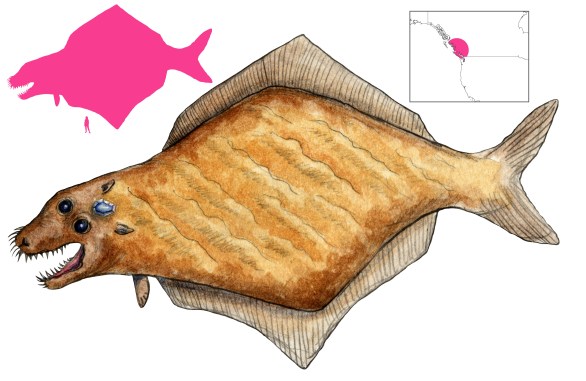
While the kelpie plies the rivers and streams of Scotland, the lochs and seas are home to the far more dangerous Each Uisge, literally the “Water Horse”. Each uisges are carnivorous, and relish human flesh. While other water-horses are content with playing pranks, tossing riders into ponds and laughing at their lot, an each uisge’s actions are always predatory. In addition to hunting humans, they will also reproduce with farm animals, siring foals with flashing eyes, strong limbs, distended nostrils, and an indomitable spirit.

Like kelpies, each uisges are shapeshifters and can assume a wide variety of forms, from sea life to attractive human beings. Their most common guise, however, is that of a fine horse, standing by the waterside and waiting to be mounted. Such horses are always magnificent, sleek, and wild-looking, and their neighs can wake people up all around the mountains.

The each uisge in human form is attractive and charming, but always has some features that give it away – horse’s hooves, for instance, or hair full of sand and seaweed, or a tendency to whinny in pain. In such cases where an each uisge lover was found out, it is usually killed by the girl’s father or brothers before it can devour her. Regardless of the shape it has taken, an each uisge’s carcass will turn into formless jellyfish slime by the next day.

Sometimes the each uisge is a large bird, although this may be confusing it with the boobrie. More worrisome features have been observed, including viciously hooked, 17-inch long beaks, enormous claws, and footprints larger than an elephant’s. An each uisge observed at the Isle of Arran was light grey, with a parrot-like beak and a body longer than an elephant’s.

For all their carnivorous nature, each uisges can be easily tamed by slipping a cow’s cap or shackle onto it, turning it docile and harmless. If the cap or shackle ever falls off, the each uisge immediately gallops off for the safety of the loch, possibly dragging its would-be master with it. Each uisges can also be tamed by stealing their magic bridles. They use them to see fairies and demons, and are vulnerable without them. Finally, like many other evil creatures, each uisges avoid crosses and other religious symbols.

Every loch in Scotland has its own each uisge. Loch Treig was said to have the fiercest each uisges. Loch Eigheach means “Horse Loch” and is home to a much-feared each uisge, with a deadly charm and a silky grey hide. It would yell triumphantly as it bore its prey into the water.

Seven girls and a boy once found an each uisge on a Sunday afternoon near Aberfeldy. It was in the form of a pony, and it continued grazing as the first girl jumped onto its back. One by one, the other girls followed their friend onto the pony, but only the boy noticed that the pony’s back grew longer to accommodate its riders. Finally, the pony tried to get him on as well. “Get on my back!” it said, and the boy ran, hiding in the safety of the rocks. The terrified girls found that their hands stuck to the each uisge’s back, and they could only scream as it dove into the loch. The next day, seven livers floated to the surface.

The son of the Laird of Kincardine encountered an each-uisge near Loch Pityoulish. He and his friends found a black horse with a bridle, reins, and saddle all made of silver. They got onto it and immediately found themselves on a one-way trip to the loch, their hands glued to the reins. Fortunately for the heir of Kincardine, the youth had only touched the reins with one finger, and freed himself by cutting it off, but he could only watch as the water-horse took his friends with it.

While the water-horse legend may be pervasive and universal in northern Europe, some of the each uisge’s appearances may be more prosaic. The beak and large footprints of some each uisges suggest a leatherback turtle more than they do a horse.

References

Fleming, M. (2002) Not of this World: Creatures of the Supernatural in Scotland. Mercat Press, Edinburgh.

Gordon, S. (1923) Hebridean Memories. Cassell and Company Limited, London.

MacKinlay, J. M. (1893) Folklore of Scottish Lochs and Springs. William Hodge & Co., Glasgow.

Parsons, E. C. M. (2004) Sea monsters and mermaids in Scottish folklore: Can these tales give us information on the historic occurrence of marine animals in Scotland? Anthrozoös 17 (1), pp. 73-80.
Calopus

Variations: Aeternae, Analopos, Antalope, Antholops, Aptaleon, Aptolos, Pantolops; Jachamur, Jachmur, Jamur, Yamur (Bochart); Chatloup (erroneously)

Calopus

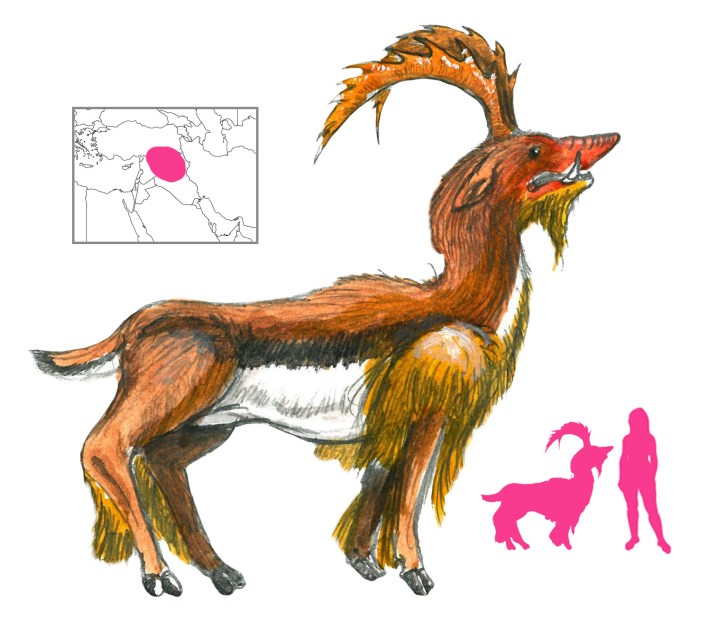
The antelope was known to the Greeks as Analopos (and variations thereof, derived from the Coptic Pantolops according to Bochart) and to the Romans as Calopus, “pretty foot” . These creatures were believed to inhabit India, Syria, and the Euphrates basin, and were fond of drinking the cool Euphrates water.

A calopus resembled a roe deer in appearance and size, with the exception of large saw-toothed horns growing out of their heads. These horns can be used to shred branches and human limbs alike, but are also easily entangled in thickets. A calopus trapped in this way will cry out, making it easily found and killed by hunters.

Alexander the Great encountered a number of these antelopes in India, where at least one obscure account refers to them as “aeternae”. The creatures pierced the Macedonian shields with their horns, but they were no match for Alexander’s soldiers, who slew anywhere from five thousand and four hundred to eight thousand five hundred and fifty of them. This, Topsell concludes, is the reason why we barely see any more of these animals.

Possible identities for the calopus include a number of antelopes, but also the moose, whose tree-shredding behavior may have inspired the calopus’ serrated weapons.

The “chatloup” (“catwolf”) name popularized by Barber and Rose appears to be a corruption of calopus.

References

Barber, R. and Riches, A. (1971) A Dictionary of Fabulous Beasts. The Boydell Press, Ipswich.

Bochart, S. (1675) Hierozoicon. Johannis Davidis Zunneri, Frankfurt.

Cuba, J. (1539) Le iardin de santé. Philippe le Noir, Paris.

Rose, C. (2000) Giants, Monsters, and Dragons. W. W. Norton and Co., New York.

Topsell, E. (1658) The History of Four-footed Beasts. E. Cotes, London.

de Xivrey, J. B. (1836) Traditions Tératologiques. L’Imprimerie Royale, Paris.

Behemoth

Variations: Shor Ha-bar (“Wild Ox”), Bahamut, Bahamoot

behemoth

Behemoth is the plural form of the Hebrew behemah, or “animal”; appropriately, the word is used to describe a creature of vast size and bulk.

The best-known reference to Behemoth is offered in the Biblical book of Job (40:15-24), where it is mentioned in God’s whirlwind tour of humbling natural wonders. The Behemoth eats grass like an ox, and its strength is in its muscular loins and tight-knit thigh sinews. Its tail stiffens like a cedar, its bones are like bronze, and its legs like iron bars. Despite its power, it is apparently passive and indolent, lying in marshes under lotus plants, and feeding in the mountains alongside the wild animals. Behemoth does not fear the river when it rushes into its mouth, and cannot be taken with hooks; only God can approach it.

Psalms 50:10 makes reference to “the behemoth on a thousand hills”, nowadays translated to “the cattle on a thousand hills”. The Midrash elaborates on that, making the Behemoth large enough to sit on the thousand mountains it feeds on, and making it drink six to twelve months’ worth of the Jordan River in one gulp.

The Talmud gives the Behemoth further cosmic significance. The behemoth were created male and female, but to prevent them destroying the Earth, God castrated the male and preserved the female in the World-to-Come for the righteous. This vision of the Behemoth has been interpreted as metaphoric, with the Behemoth representing materialism and the physical world.

If Behemoth is an animal known to us today, the primary candidates are the wild ox, the elephant, and the hippopotamus. The wild ox seems dubious, otherwise the Behemoth would not eat grass “like” an ox. The elephant’s trunk may have been the basis for the “tail”, but the description refers to stiffening, something which the hippo’s tail does. Another possibility is that the “tail” is in a fact a euphemism, and the description refers to the virility and vigor of the bull hippopotamus. Further details – living in water, feeding on land, a mouth big enough for the Jordan to rush into, terrifying power – all but prove that the hippopotamus is the subject of Job’s verses. Bochart agreed, heading his discussion of Behemoth with “non esse elephantum, ut volunt, sed hippopotamum“.

The Arabian Bahamut is a further magnification of the already-large Behemoth, turning it into a vast cosmic fish, one of the foundations on which the Earth stands. It is so big that all the seas and oceans of the Earth placed in its nostril would be like a mustard seed in a desert.

Behemoth is now a synonym for any large animal. Buel gives us behemoth as a possible originator of the word “mammoth”, alongside the Latin mamma and the Arabic mehemot.

The suggestion that Behemoth is a late-surviving dinosaur is best left unaddressed.

References

Bochart, S. (1675) Hierozoicon. Johannis Davidis Zunneri, Frankfurt.

Borges, J. L.; trans. Hurley, A. (2005) The Book of Imaginary Beings. Viking.

Buel, J. W. (1887) Sea and Land. Historical Publishing Company, Philadelphia.

Coogan, M. D.; Brettler, M. Z.; Newsom, C.; Perkins, P. (eds.) (2010) The New Oxford Annotated Bible. Oxford University Press, Oxford.

Slifkin, N. (2011) Sacred Monsters. Zoo Torah, Jerusalem.

Qiongqi

Variations: Thoroughly-Odd, Divine Dog

Qiongqi

Two versions of the Qiongqi, or “Thoroughly-Odd”, are described in the Guideways. The first variant of this Chinese creature is from Mount Gui, and resembles an ox with the quills of a hedgehog, and it howls like a dog. The second lives in the Land of the Demon People, and is a winged tiger. A third variety, referred to as a “divine dog”, is human with a dog’s head.

Qiongqi are carnivorous, and devour their prey head or feet first. They feed on people who wear their hair long, making them a particular threat to shamans and demons. They are evil creatures who devour the loyal and feed the rebellious, but they also eat insect poison.

Qiongqi has also appeared as the son of the thearch Lesser-Brilliance in Zuo’s Narratives, as the offspring of the Northern Desert Wind in Master of Huainan, and one of twelve divinities invoked in the Grand Exorcism.

References

Mathieu, R. (1983) Étude sur la mythologie et l’ethnologie de la Chine ancienne. Collège de France, Paris.

Strassberg, R. E. (2002) A Chinese Bestiary: Strange Creatures from the Guideways Through Mountains and Seas. University of California Press.

Kamaitachi

Variations: Kama-itachi, Kamakaze (“Sickle wind”)

Kamaitachi

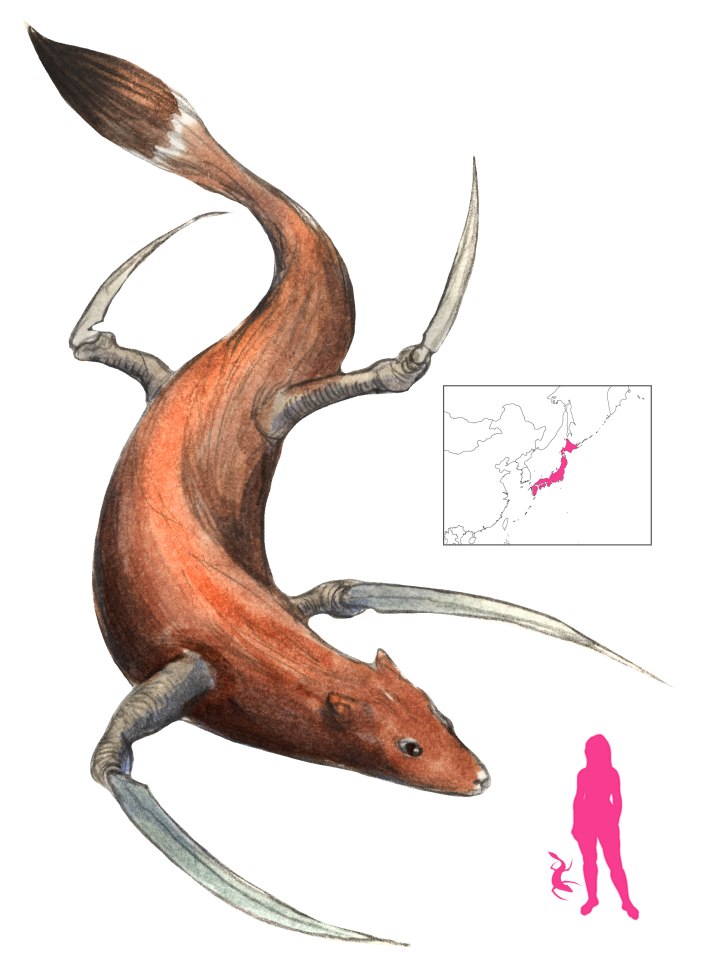
The Kamaitachi, or “sickle weasel”, is the Japanese yokai of unexplained cuts. It is most common in snowy Honshu. The name itself may be alternately derived from kamae-tachi, “poised sword”.

A kamaitachi looks something like a weasel with razor-sharp sickle claws. It travels in whirlwinds, but it is never seen. Instead, the presence of a kamaitachi is known by the cuts it leaves on its victims. It will also cause people to trip and fall, taking malign pleasure in causing injury.

Kamaitachi are useful scapegoats for inconvenient injuries. A woman in Niigata, after injuring herself during a nocturnal tryst, successfully deflected attention by blaming the kamaitachi for her wound.

The kamaitachi was rationalized in a number of ways, including pieces of sharp debris tossed around in whirlwinds. Y. Tanaka suggested that the “kamaitachi disease” was the result of temporary vacuums forming from stray air currents, slicing skin that came in contact with them. Such vacuums would be common in mountainous areas and thunderstorm conditions.

In Gifu the kamaitachi becomes three gods, the first pushing over the victim, with the second cutting with a knife and the third healing the injury.

References

Foster, M. D. (2015) The Book of Yokai. University of California Press, Berkeley.

Griffis, W. E. (1876) The Mikado’s Empire. Harper and Brothers, New York.

Y. Tanaka (1911) An Epitome of Current Medical Literature: Spontaneous Wounds. British Medical Journal, v. 2, p. 37.

Mantabungal

Mantabungal

The Mantabungal is known to the Tagbanua of Palawan, in the Philippines. It is found primarily in the forests of Mount Victoria in Baraki, and is the most feared of the mountain demons.

A mantabungal is like a cow in body and voice, but lacks horns. It has a long coat of shaggy hair that reaches the ground. Its monstrous mouth has two pairs of huge incisors – two above and two below – that it uses to tear its victims to shreds.

One man reported hearing bovine moos while gathering gum in the mountains. Spooked and disoriented in the darkness, he ran aimlessly into the forest as far as he could and spent the night shivering miserably under a tree. When he returned to camp, he found that the mantabungal had destroyed everything he had touched. His hut, gear, and even the firewood had been dismantled and chewed to bits.

References

Fox, R. B. (1982) Religion and Society among the Tagbanuwa of Palawan Island, Philippines. Monograph No. 9, National Museum, Manila.

Ramos, M. D. (1971) Creatures of Philippine Lower Mythology. University of the Philippines Press, Quezon.

Yamabiko

Variations: Yama-biko

Yamabiko

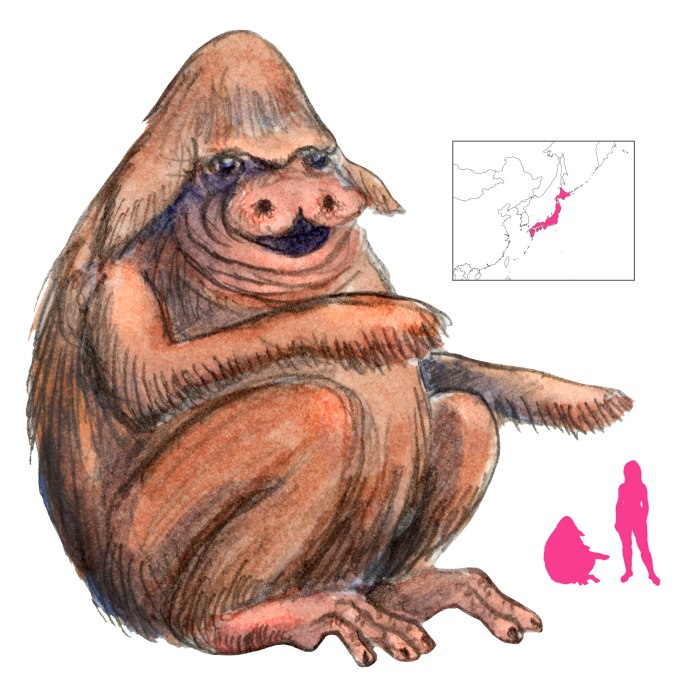
The Yamabiko, “mountain echo” or simply “echo” is heard rather than seen. It is found in the high mountains of Japan, and answers anyone shouting in the mountains with a mocking echo of their voice. While there is no definite version of its appearance, it was depicted by Toriyama Sekien as a rather simian creature.

Its name can also be interpreted as “spirit of valley reverberation”. It is not known if the yamabiko yokai was named for the echo, or if the echo was named for the yokai. The Yamabiko Shinkansen train, on the other hand, is named for the echo and not the yokai.

References

Foster, M. D. (2015) The Book of Yokai. University of California Press, Berkeley.

Romŝiwamnari’

Variations: Romŝiwamnare’

Romsiwamnari

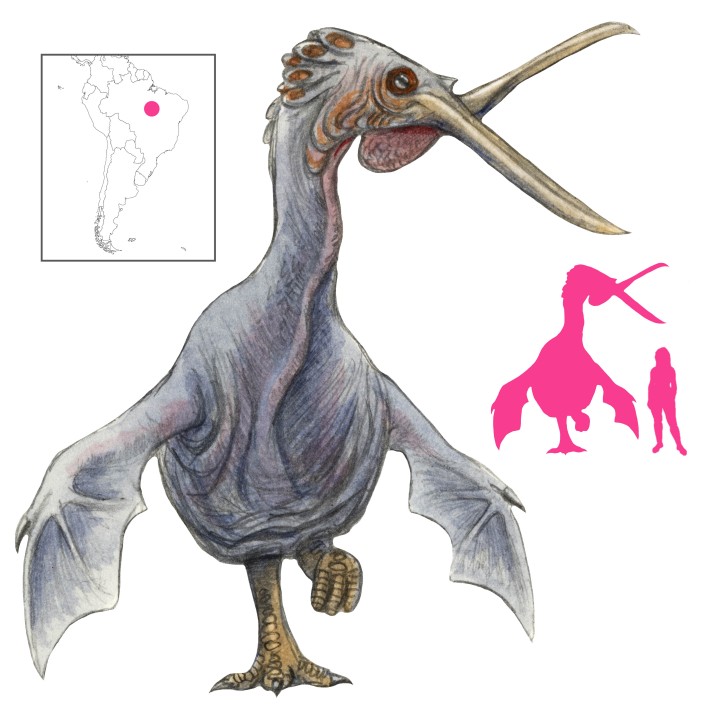
The Romŝiwamnari’ are forest and cave demons, known to the Šerente people of Tocantins, Brazil. They look like large birds with flabby, flightless bat’s wings, armed with beaks like scissors. Their call is an eerie whistle. Romŝiwamnari’ also appear as tapirs, or as stout humans with prominent teeth and a howler monkey’s tail. When in human guise, a romŝiwamnari’ resembles the Pope – a relic of missionary activity in Brazil.

Romŝiwamnari’ not only prey upon the living, but also ambush and consume the souls of the dead. A sufficiently powerful shaman can kill them while in the realm of death, but other souls are greedily devoured.

A man of the krara’ society and his pregnant wife once encoutered a pair of romŝiwamnari’ in a cave. The man held the monsters off as long as he could while his wife escaped, but he was outmatched and decapitated by the romŝiwamnari’. The woman brought the news to the rest of the village, and the other krara’ launched an assault on the romŝiwamnari’ cave. Three of the villagers were killed in the battle, but they slew the two romŝiwamnari’ – unaware that there were two more in hiding. However, the boy the woman gave birth to grew into a mighty hero in less than a year, and he avenged his father by burning the romŝiwamnari’ bones and killing the other two demons. The romŝiwamnari’ were not seen again in that area.

References

Crocker, W. H.; Giaccaria, B.; Heide, A.; Lea, V.; Melatti, J. C.; Nimuendajú, C.; Seeger, A.; Verswijver, G.; Vidal, L.; Wilbert, J. and Simoneau, K. (eds.) (1984) Folk Literature of the Gê Indians, v. 2. UCLA Latin American Center Publications, University of California, Los Angeles.

Nimuendajú, C.; Lowie, R. H. (trans.) (1942) The Šerente. The Southwest Museum, Los Angeles.

Brethmechin

Variations: Arabian Breth-mechin, Whale Panther

Brethmechin

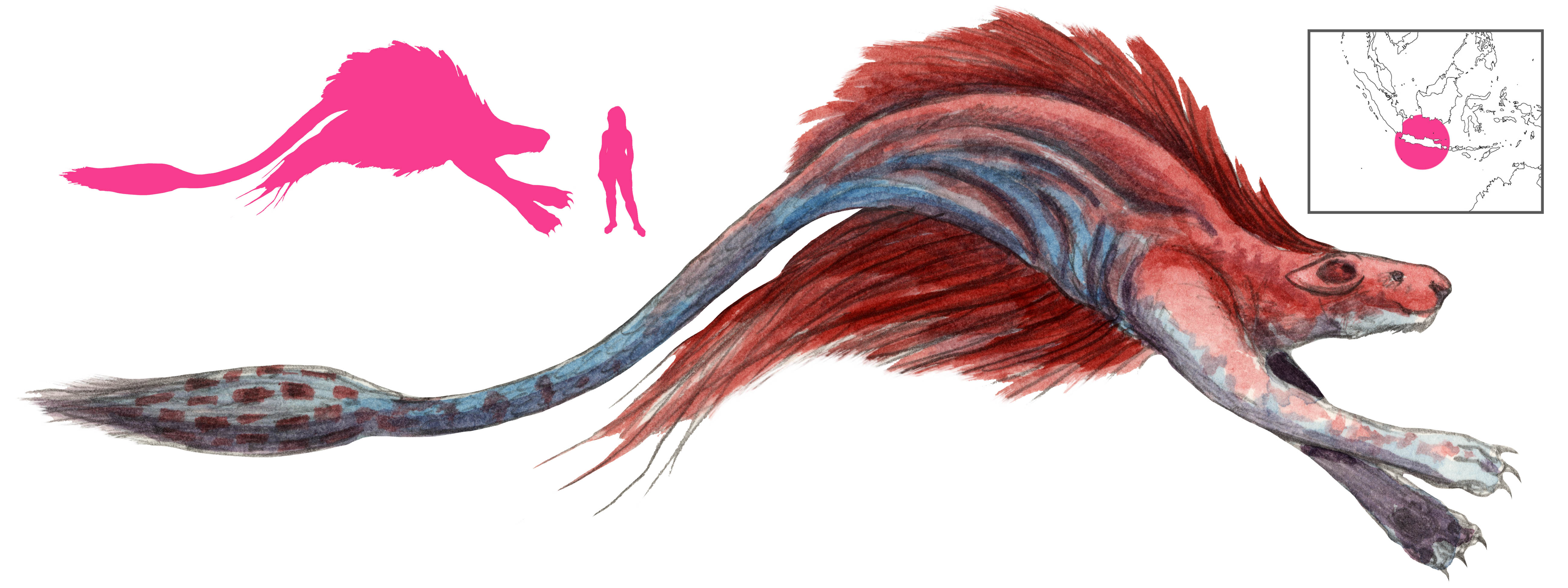
Gessner describes the Brethmechin as an amphibious beast found near the island of Java. He gives the name as being of Arabic etymology, although it is hard to tell what words it derives from. Gessner’s contact was Theodorus Beza, who reported a brethmechin washed up on the Javan shore on April 14, 1551.

A brethmechin is 10 cubits (about 4.5 meters) long and 2 cubits (about 1 meter) high. It has two legs, which allow it to move around on land to some extent. It has a panther’s head and a lion’s claws, with a horse-like tuft of hair on the tip of its pantherine tail. Brethmechins are red in color with blue markings, and have a lighter cerulean tail with red spots. They are well furnished with red dorsal and ventral bristles, with the ventral bristles being particularly long towards the tail.

The brethmechin has seen minor use in heraldry.

References

Gessner, C. (1560) Nomenclator aquatilium animantium. Christoph Froschoverus.

Holme, R. (1668) The academy of armory, or, A storehouse of armory and blazon containing the several variety of created beings, and how born in coats of arms, both foreign and domestick. Printed by the author at Chester.

Skeljúngur

Variations: Skieliungur; Svarfhvalur, Suarfhualur (Iron Whale); Skútuhvalur (Schooner Whale); Tigrishvalur (Tiger Whale); Hnúfubakur, Humpback Whale

Skeljungur

The Skeljúngur, or “shell whale” is one of the many illhveli, or “evil whales” of Iceland. Unlike its brethren, the skeljúngur is edible and safe to eat, making it the most dangerous of the edible whales. It has even helped humans on occasion; one young skeljúngur aided Hjalmper and Olvir in battle against a vicious hrosshvalur.

It is described as ranging from 20 to 45 meters long. It is very fat and short-flippered, lacks dorsal fins, and its entire body is covered with shells that rattle as it swims. The shells tend to make it itchy, and it will rub its head against rocks in deep coastal waters. Despite its portly appearance, it is a fast swimmer, earning it the nickname of “tiger whale”. It dives vertically, and sleeps vertically with its head sticking out of the sea. Whether it has teeth or baleen is unclear.

A shell-whale will position itself in the path of an oncoming ship, and will continue to obstruct the vessel’s course if the captain tries to avoid it. Skilled sailors should change their course fast enough to evade it, as sailing right onto it causes the whale to throw the ship and kill all on board. When destroying boats, it likes to strike them with its fins and tails. Skeljúngur armor makes them impervious to most attacks and quite fearless, and the whales will play dead to entice prey within range. The whaling ship Minerva off Grimsey thought they had killed a skeljúngur, but the seemingly dead whale immediately recovered and destroyed the boat sent to finish it off.

Skeljúngurs hate the sound of iron being ground and filed. If one of these whales hears that loathed sound, it will go frantic and beach itself to get away from it. The alternate name of svarfhvalur (“iron whale”) is derived from this aversion.

Skeljúngur is also another name of the humpback whale or hnúfubakur.

References

Davidsson, O. (1900) The Folk-lore of Icelandic Fishes. The Scottish Review, October, pp. 312-332.

Hermansson, H. (1924) Jon Gudmundsson and his Natural History of Iceland. Islandica, Cornell University Library, Ithaca.

Hlidberg, J. B. and Aegisson, S.; McQueen, F. J. M. and Kjartansson, R., trans. (2011) Meeting with Monsters. JPV utgafa, Reykjavik.

Larson, L. M. (1917) The King’s Mirror. Twayne Publishers Inc., New York.