Cherruve

Variations: Cheruvoe, Cheurvoe, Cheurvue, Cherufe

Cherruve

The Cherruve is the Chilean spirit of comets and asteroids. Originally no more than the Araucanian meteorite, the cherruve’s role has since expanded to include lava, volcanoes, fiery exhalations, will-o-the-wisps, whirlwinds, and animate stone axes.

Cherruve appearance varies from area to area, but it is usually described as a comet, or a great serpentine creature with a human head and lava dribbling from its mouth. Its appearance has been anthropomorphized to various degrees and conflated with aspects of European mythology; in the Andes it becomes a huge seven-headed dragon; elsewhere it is confused with dragons, devils, and giants, or bipedal goats with flaming eyes.

Cherruves live underground and in volcanoes, and streak across the sky by night. The appearance of a cherruve in the sky heralds the spread of an epidemic, the death of a great leader, or other misfortunes, while the cherruve’s vomit is lava and its movements underground cause earthquakes. They make thunder by tossing human heads. The more dragon-like cherruves may demand the sacrifice of Mapuche maidens, and will withhold the flow of rivers if their demands are not met.

Comets, asteroids, and meteors are all cherruves, as are meteorites and oddly-shaped volcanic rocks. Cherruve rocks are collected by sorcerers, who use them to carry out their evil purposes by sending them at their enemies. They are ordered to suck blood and inflict death and disease, and can operate on their own, returning diligently to their masters after performing their duties.

Cherruves are also capable of feeling more human emotions. One cherruve married a Cloud, and their beautiful daughter, ethereal and pale, was Snow. Despite the cherruve’s jealous attempts to keep his wife under lock and key, she was abducted by his mortal enemy Wind. Every now and then Wind would blow Cloud over the volcano, and her tears became rain, while the cherruve’s own despair turned into destructive eruptions. The cherruve redoubled his efforts to protect Snow, and kept her from leaving the mountain during the daylight hours. Snow’s curiosity about the world outside continued to grow, and one day she finally managed to escape her father and climb out into the light. She marveled at the sun, the songs of birds, the colors, all infinitely beautiful and unknown to her. The longer she stayed outside, the happier she was, and yet the weaker she felt. Her mother tried to protect her, but the spiteful Wind carried the Cloud away. When Snow sat down, exhausted, the love-stricken Sun came down to give her a kiss. When the cherruve finally caught up with his daughter, he found nothing but a puddle of crystalline water.

References

Faron, L. C. (1964) Hawks of the Sun. University of Pittsburgh Press, Pittsburgh.

Guevara, T. (1908) Psicolojia del pueblo araucano. Imprenta Cervantes, Santiago de Chile.

Latcham, R. E. (1924) La organización social y la creencias religiosas de los antiguos araucanos. Imprenta Cervantes, Santiago de Chile.

Lenz, R. (1897) Estudios Araucanos. Imprenta Cervantes, Santiago de Chile.

Pino-Saavedra, Y.; Gray, R. (trans.) (1967) Folktales of Chile. The University of Chicago Press, Chicago.

Soustelle, G. and Soustelle, J. (1938) Folklore Chilien. Institut International de Coopération Intellectuelle, Paris.

Yedua

Variations: Jeduah, Jidoa, Feduah, Fedoui, Fadua, Adne Hasadeh, Adnei Ha-sadeh, Adne Sadeh, Abne Hasadeh, Avnei Ha-sadeh, Bar Nash D’tur, Jidra (erroneously)

yedua

The Talmudic equivalent of the Barometz, the Barnacle Goose, and other zoophytes is the Yedua. This name was used by Rabbi Meir, and these creatures are the yidoni of Leviticus 19:31, often translated to “wizards” in English. The exact pronunciation of the name is debatable, although one variation (“Jidra”) appears to be a misreading of Jidoa as used by Lewysohn. The yedua is also known as Adne Hasadeh (“lords of the field” or “men of the field”), Abne Hasadeh (“stones of the field”), or Bar Nash D’Tur (“man of the field”).

The size of the yedua is unspecified, but it has a human shape, having a face, body, arms, and feet.  However, Rabbi Jochanan, following Moses Chusensis of Ethiopia on the authority of Rabbi Simeon, believed the yedua to be a vegetable lamb, perhaps after confusion with the barometz. This wild man of the mountains lives through its navel, which connects it to the ground with a stem like that of a gourd or pumpkin. If this umbilicus is cut or uprooted the yedua dies. It will maul and kill any living thing within the radius of its stem, and will eat all vegetation within that circle. It is impure, and its body causes spiritual impurity in buildings.

It is valuable in witchcraft, as its bones placed in the mouth, along with certain incantations, allow one to see the future. Yedua hunters killed their quarry by shooting arrows into the navel-stem from a safe distance.

The account of the yedua can be read as an early observation of apes. Rabbi Lipschutz believed the yedua to be inspired by relict populations of chimpanzees or orangutans in the Lebanese cedar forests. The origin of the creature appears to have come about by a simple misspelling that turned tur (“field”) into tavur (“navel”).

References

Coogan, M. D.; Brettler, M. Z.; Newsom, C.; Perkins, P. (eds.) (2010) The New Oxford Annotated Bible. Oxford University Press, Oxford.

Laufer, B. (1915) The Story of the Pinna and the Syrian Lamb. The Journal of American Folk-lore, vol. XXVIII, no. CVIII, pp. 103-128.

Lee, H. (1887) The Vegetable Lamb of Tartary. Sampson Low, Marston, Searle, and Rivington, London.

Lewysohn, L. (1858) Die Zoologie des Talmuds. Joseph Baer, Frankfurt.

Ley, W. (1959) Exotic Zoology. The Viking Press, New York.

Slifkin, N. (2011) Sacred Monsters. Zoo Torah, Jerusalem.

Stray Sod

Variations: Ar Iotan, Egaire, Fairy Grass, Faud Shaughran, Fair-Gortha (potentially), Herb of Distraction, Herbe à Adirer, Herbe d’Egarement, Herbe d’Engaire, Herbe de Fourvoiement, Herbe Maudite, Herbe d’Oubli, Herbe à la Recule, Herbe Royale, Herbe des Tournes, Lezeuen Eur, Lezuenn er Seudann, Tourmentine

Tourmentine

“Stray sod” is a general term used here to refer to any plant that, if trodden upon, causes travelers to lose their way. Stray sods have been reported primarily from France and Ireland, and come about in a number of ways. Usually they are specific herbs with magical properties that grow along footpaths. At other times they form over the graves of unbaptised children, or are patches of grass enchanted by fairies. They themselves may be fairies or inhabited by fairies.

No matter the origin, the result is always the same. A solitary traveler at night will inadvertently step on a stray sod, and no matter how good their sense of direction, they immediately lose their path. All landmarks seem to vanish, all roads are dead ends. The unfortunate victim is compelled to wander aimlessly through the night, trudging through hedges and thorns, crossing rivers, slogging through marshes, and feeling their way through thickets. The spell is broken at daybreak, when they find themselves with their clothes torn and stained, their hands and feet bleeding, and miles away from home.

When this happens it is advised to turn one’s coat inside out to counteract the spell. Other remedies include the usage of metal as abhorrent to fairies, or finding certain plants or benevolent spirits to regain one’s bearings.

The stray sod is known as the herbe à adirer (“herb of misplacement”) in Anjou, the herbe à la recule (“herb of turning back”) in Besançon, the herbe d’oubli (“herb of forgetfulness”) in Brittany and Lorraine, the egaire in Normandy, and the herbe maudite (“damned herb”) or herbe des tournes (“herb of turning”) in Saintonge. The ar iotan (“golden herb”) of Brittany is inhabited by a spirit that shines like a glowworm; touching a piece of wood or metal breaks its spell, as does changing horseshoes on one side. The lezeuen eur (“golden herb”) and the lezuenn er seudann (“herb of dizziness”) of the Morbihan cause their victims to walk in circles until daybreak. The herbe royale (“royal herb”) of Saint-Mayeux causes even horses to lose their way. The herbe d’engaire of the Berry grows in vast plains, and causes those who step on it to lose sight of the path entirely. The tourmentine (Potentilla erecta, formerly Potentilla tormentilla) of Forez, which causes disorientation for 12 hours, can be countered by the parisette (Paris quadrifolia), a plant whose fallen seeds guide travelers by pointing in the right direction.

The faud shaughran of Ireland induces a sensation of flying, of being incapable of stopping until one is over twenty or thirty miles from home. There is a herb that counteracts its effects, but it is known only to the initiated. The similar fair-gortha causes unnatural hunger and craving for food if stepped on. One man in County Leitrim turned his coat and hat inside out but was unable to find his way home, ending up miles away from his destination.

References

Barton, B. H. and Castle, T. (1845) The British Flora Medica. Henry G. Bohn, London.

Dubois, P.; Sabatier, C.; and Sabatier, R. (1992) La Grande Encyclopédie des Lutins. Hoëbeke, Paris.

Duncan, L. L. (1893) Folk-Lore Gleanings from County Leitrim. Folklore, vol. 4, no. 2, pp. 176-194.

Rolland, E. (1904) Flore populaire, Tome V. Librairie Rolland, Paris.

Sébillot, P. (1894) Les travaux publics et les mines dans les traditions et les superstitions de tous les pays. J. Rothschild, Paris.

Sébillot, P. (1898) Les Forêts. Revue des Traditions Populaires, t. XIII, no. 12, pp. 641-661.

Sébillot, P. (1904) Le Folk-Lore de France, Tome Premier: Le Ciel et la Terre. Librairie Orientale et Américaine, Paris.

Sébillot, P. (1906) Le Folk-lore de France, Tome Troisième: La Faune et la Flore. Librairie Orientale et Américaine, Paris.

Wilde, F. S. (1887) Ancient Legends, Mystic Charms, and Superstitions of Ireland, v. II. Ward and Downey, London.
Khodumodumo

Variations: Kholomodumo, Modumo o Moholo, Khamapa, Kammapa, Khanyapa

Khodumodumo

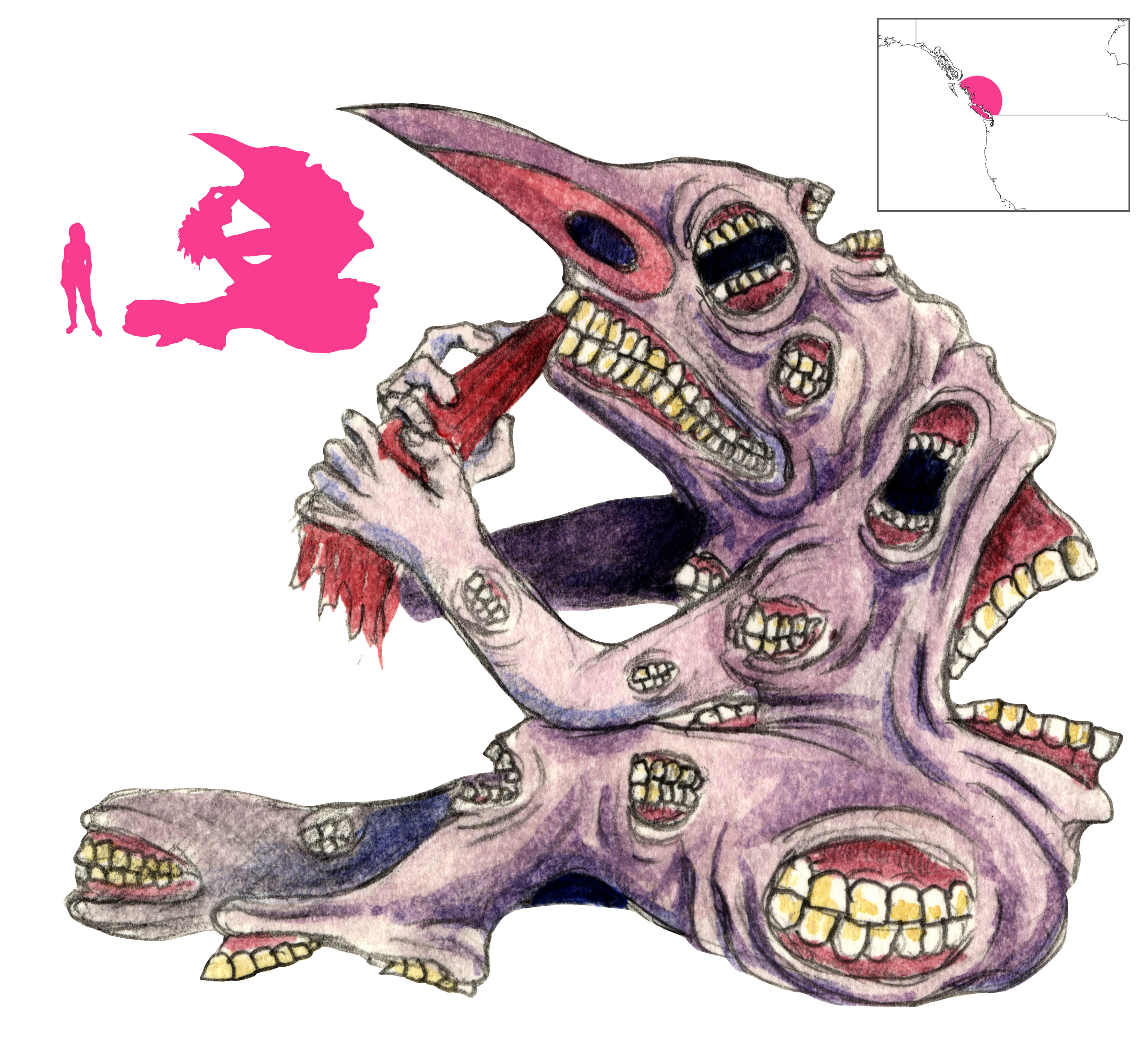
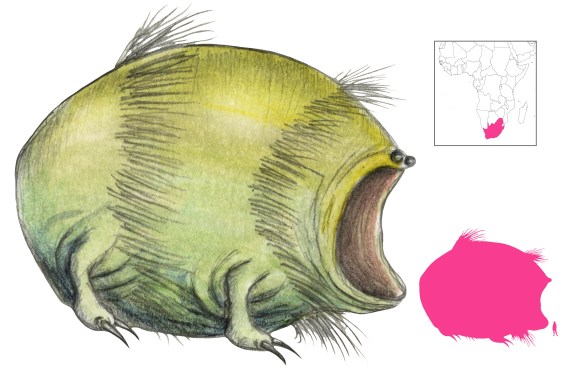
The swallowing monster of the Basuto people of South Africa and Lesotho is called Khodumodumo. The name of Khodumodumo is an archaic Sesotho term, most likely meaning “great noise”, although Hichens refers to the “gaping-mouthed bush monster”. Modern Sesotho often makes it into kholomodumo. Its synonym and possible ancestor is Kammapa, a giant river python. Khodumodumo’s amorphous appearance is undefined, and it is vast in size. It has multiple sharp tongues which it uses as weapons.

Once Khodumodumo went about swallowing every living thing in its path, man and beast alike, lumbering through towns and villages and engulfing their inhabitants. Only one pregnant woman survived, as she had been hiding on a manure heap, and the ashes masked her appearance and scent. Eventually the bloated Khodumodumo dragged itself off and wedged its massive body in a mountain pass.

Eventually the woman gave birth to a baby boy, and went off to fetch some manure powder to lie on, as tradition dictates. She returned to find her son fully grown, dressed in skins, with divining beads around his neck, and armed with assagais. “Where is my son?” she asked, marveling at the heroic figure in front of her. “I am your son, Senkatana”, he said. “Mother, where is the rest of the village?” “Alas, Khodumodumo ate them all”, she lamented. “And the cattle?” “The cattle too”. “And the dogs?” “The dogs too”. “And the poultry?” “The poultry too”.

Senkatana demanded that his mother show him where the beast had gone to. “See the big hill in the pass?” she said. “That is Khodumodumo”. Despite his mother’s warnings, Senkatana went to face Khodumodumo alone. When it saw him, it opened its mouth wide and tried to spear him with its tongues, but Senkatana chopped them off one by one. He circled around the beast, which was too fat to turn around and face him, and stabbed it with his assagais until it was dead.

He then started to cut open Khodumodumo, but had to avoid cutting the people imprisoned inside. His first cut accidentally injured a man, and then he had to avoid stabbing a cow, a goat, a dog, and a hen before he could finally release Khodumodumo’s victims. Senkatana then went on to become a great chief, but the man he had inadvertently stabbed continued to bear a grudge. The resentful man and others jealous of the hero attempted to assassinate him multiple times, until Senkatana, weary of the hatred of mankind, allowed himself to be killed.

References

Hichens, W. (1937) African Mystery Beasts. Discovery (Dec): 369-373.

Jacottet, E. (1888) Légendes et contes Bassoutos. Revue des Traditions Populaires, v. 3, Maisonneuve et Ch. Leclerc, Paris.

Werner, A. (1968) Myths and legends of the Bantu. Frank Cass and Co. Ltd., London.

Xi

Variations: Xi-Rhinoceros; Xiqu (potentially); Si, Si-Rhinoceros (potentially)

Xi

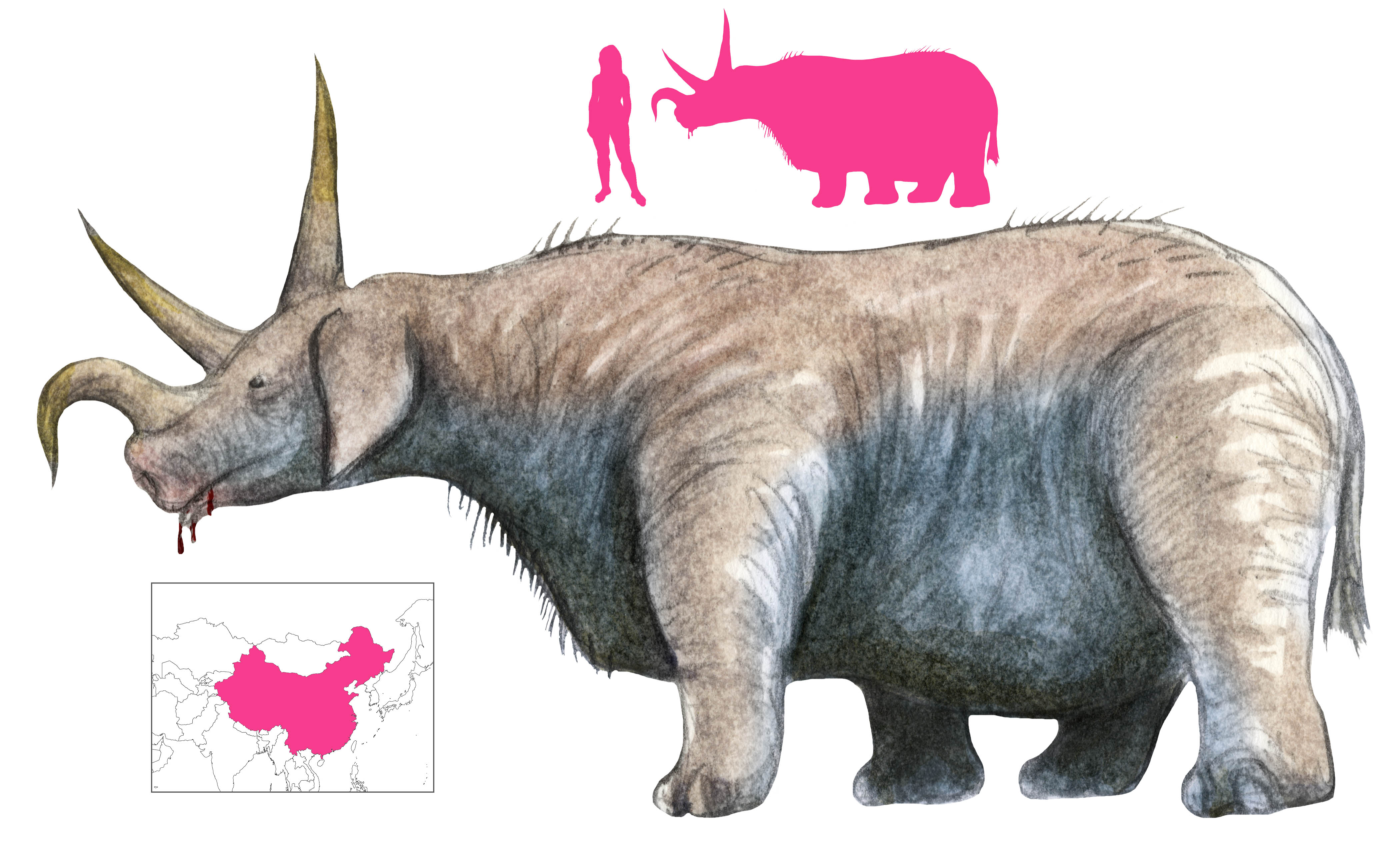
Among the wildlife to be found on Cauldron Mountain, Mount Min and Pray-and-Pass Mountain is the Xi. It is like a black water buffalo with a pig’s head, a large belly, and three-toed elephant’s feet on short legs. It has three horns, found on its nose, forehead, and crown. The nose horn does not fall off and helps it eat. Xi feed primarily on brambles, and therefore often drool blood. It may be the same animal as the Xiqu, which is a man-eating blue-black ox that makes sounds like a baby.

The Si is similar, but blue or green with a single horn weighing 1,333 pounds. Its thick skin could be used as armor.

Guo Pu mocked the Xi for its big nose, and the Si for its tough hide which ironically made it more desirable and vulnerable to human exploitation.

Both Xi and Si have been used interchangeably to refer to a number of large herbivores including oxen, yaks, and buffalo, but they are generally believed to be rhinos.

References

Strassberg, R. E. (2002) A Chinese Bestiary: Strange Creatures from the Guideways Through Mountains and Seas. University of California Press.

Skoffín

Variations: Skoffin; Skuggabaldur, Finngalkn, Fingal; Urdarköttur, Naköttur; Modyrmi

Skoffin

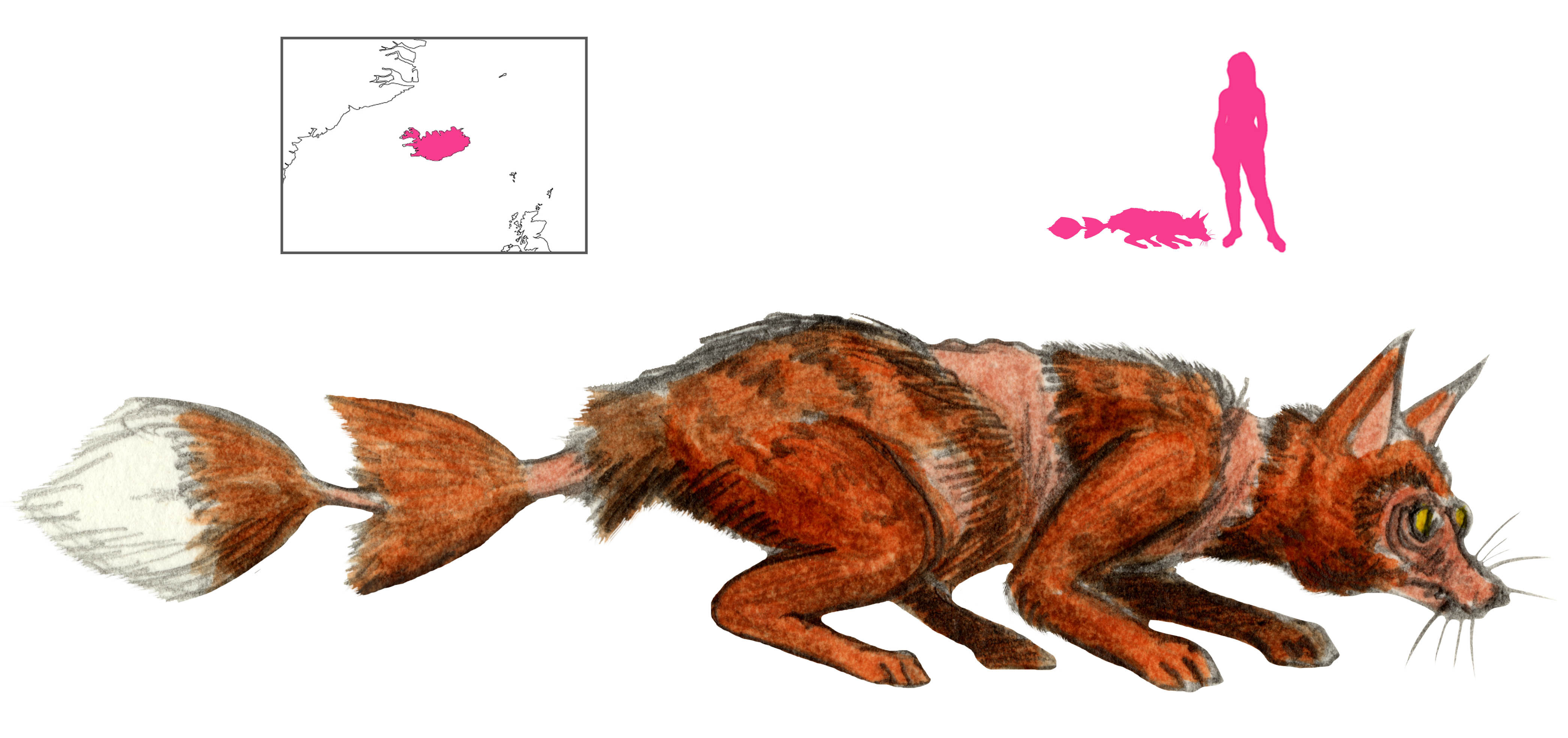
The Skoffín is one of a complex of Icelandic fox-cat hybrids with a lethal gaze, combining the cunning of the fox with the cruelty of the cat. This group also includes the Skuggabaldur, Urdarköttur, and Modyrmi, all of which are variations on the same theme; they are also linked to the “demon harriers”, foxes sent by sorcerers to maul livestock.

A skoffín is born from the union of a male Arctic fox and a female tabby cat, and resembles both of them. Its gaze is so deadly that everything it looks at dies immediately, without needing to see it. Its exact appearance varies; it may even change color with the seasons like the Arctic fox does. Reports suggest that skoffíns are short-haired, with bald patches of skin throughout.

Skoffín kittens are born with their eyes wide open. If not destroyed immediately, they sink into the ground and emerge after 3 years of maturation. It is therefore imperative to kill sighted kittens before they can disappear into the ground. When a litter of three sighted kittens was born at a farm in Súluholt, they were placed in a tub of urine to prevent their descent into the earth, and were drowned by placing turf on top of them. The entire tub was then tossed onto a pile of manure and hay and set on fire. The mother cat was also killed.

Skoffíns are irredeemably vile and malicious, and satisfy their appetite for destruction by killing humans and livestock alike. They are best shot from a safe distance, ideally with a silver bullet and after having made the sign of the cross in front of the barrel, or having a human knucklebone on the barrel. Hardened sheep dung makes equally effective bullets.

Thankfully, skoffíns are not immune to their own gaze. An encounter between two skoffíns will lead to the death of both of them. As with basilisks, mirrors are their bane. Once a skoffín stationed itself on the roof of a church, and the parishioners started dropping dead as they left the building. The deacon understood what was going on, and had the rest of the congregation wait inside while he tied a mirror to a long pole and extended it outside to the roof. After a few minutes he gave the all-clear, and they were able to leave the church safely, as the skoffín had perished immediately upon seeing its reflection.

Eventually, confusion with the basilisk of the mainland muddled the skoffín’s image, leading to some accounts claiming it was hatched from a rooster’s egg.

The skuggabaldur (“shadow baldur”) or finngalkn has the same parentage as the skoffín, but is born of a tomcat and a vixen. It has very dark fur shading to black, sometimes has a deadly gaze, and preys on livestock. It may be killed in the same way as the skoffín. One particularly destructive skuggabaldur in Húnavatnssýslur was tracked down and killed in a canyon; with its last breath, it exhorted its killers to inform the cat at Bollastadir of its death. When a man repeated that incident at a Bollastadir farm, a tomcat – no doubt the skuggabaldur’s father – jumped at him and sank its teeth and claws into his throat. It had to be decapitated to release its hold, but by then the man was dead.

The urdarköttur (“ghoul cat”) or naköttur (“corpse cat”) is of less certain parentage. It may be a hybrid, but other accounts state that any cat that goes feral in Iceland eventually becomes an urdarköttur, and all-white kittens born with their eyes open will sink into the ground and re-emerge after three years in this form. Shaggy, white or black furred, growing up to the size of an ox, these felines kill indiscriminately and dig up corpses in graveyards. It may be killed in the same way, and is attached to the same story as the Bollastadir cat. Gryla’s pet, the Yule Cat, is most likely an urdarköttur.

The modyrmi (“hay wormling”) is a canine variant, created when puppies born with their eyes open sink into the ground and reappear after three years as wretched, virulent monsters. The specifics are the same as with the skoffín.

References

Boucher, A. (1994) Elves and Stories of Trolls and Elemental Beings. Iceland Review, Reykjavik.

Hermansson, H. (1924) Jon Gudmundsson and his Natural History of Iceland. Islandica, Cornell University Library, Ithaca.

Hlidberg, J. B. and Aegisson, S.; McQueen, F. J. M. and Kjartansson, R., trans. (2011) Meeting with Monsters. JPV utgafa, Reykjavik.

Stefánsson, V. (1906) Icelandic Beast and Bird Lore. The Journal of American Folklore, vol. 19, no. 75, pp. 300-308.

Butatsch Cun Ilgs

Variations: Butatsch-ah-ilgs (erroneously, apparently a typo in Rose’s encyclopedia)

Butatsch Cun Ilgs

The Lüschersee, a small Swiss alpine lake nestled in the heather-covered hills of Graubünden, seems tranquil enough on the surface. Yet it is said that the lake’s waters reach down to the center of the Earth, where eternal fires rage. This is the home of the Butatsch Cun Ilgs, the “Cow’s Stomach”.

Long ago, during a more feudal time, the shepherds of Graubünden were in a constant struggle for freedom from the cruel barons and lords of the land. Their masters were prone to treating them unjustly, and even harming them for sport. A group of noblemen once returned from an ibex hunt to find herds of cattle and sheep grazing peacefully by the Lüschersee. Naturally they decided to kill them. With loud whoops and peals of laughter, they drove the animals before them, hacking at them with their swords and forcing them into the lake to drown. The peasants could only watch as the lords mocked them.

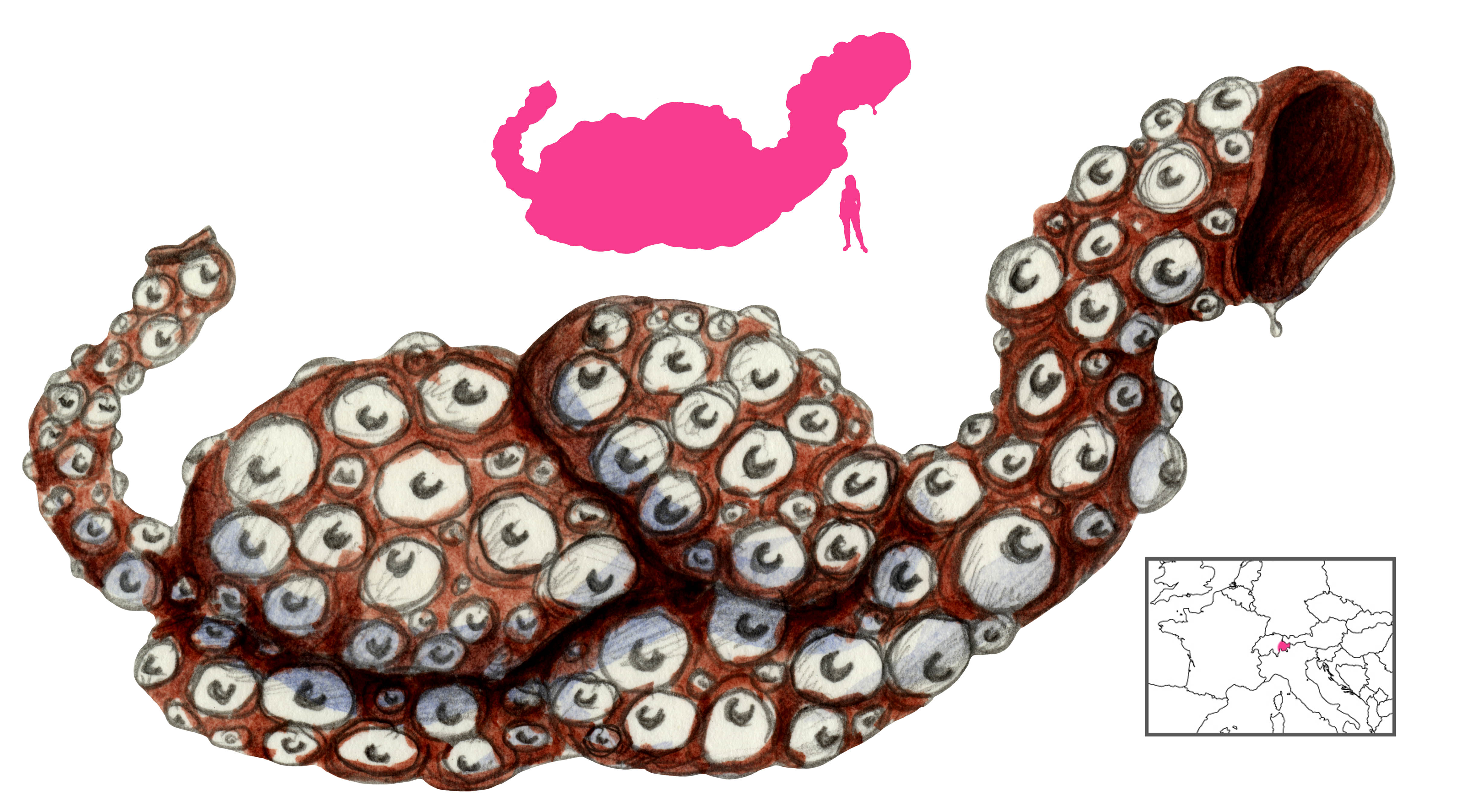
It was then that the water started to foam and bubble, and the Butatsch cun ilgs heaved itself onto the shore. It had the appearance of an enormous cow’s stomach, and was covered with thousands of eyes. The eyes had hypnotic powers, and if they focused on one point, bone-melting flames would erupt.

Mesmerized by the Butatsch cun ilgs, the lords stood dumbly as the enormous mass trampled and crushed them. Butatsch cun ilgs slipped back into the water after killing them all, leaving the shepherds terrified but unharmed.

Since then Butatsch cun ilgs has only reappeared twice, in 100-year intervals. The second time it came out of the Lüschersee, it gouged the rapids of the Nolla along its path. The third time was during a terrifying thunderstorm, when the monster of the Lüschersee slithered through a rivulet, tearing out the banks, causing massive landslides, and creating ravines.

After this last appearance – the starmentusa notg or “Night of Terror” – the Butatsch cun ilgs was not seen again. Yet sometimes a distant, unearthly bellowing can be heard over the still waters of the lake… “The Lüschersee roars”, say the shepherds, and bring the hay in.

References

Burde-Schneidewind, G. (1977) Historische Volkssagen Aus Dem 13. Bis 19. Jahrhundert. Akademie-Verlag, Berlin.

Derichsweiler, W. Das Safiental. In Schweizer Alpenclub (1919) Jahrbuch das Schweizer Alpenclub. Stämpfl & Co., Bern.

Jecklin, D. (1874) Volksthümliches aus Graubünden. Orell Füssli & Co., Zürich.

Rose, C. (2000) Giants, Monsters, and Dragons. W. W. Norton and Co., New York.

Sirānis

Variations: Sirānas, Suryānās, Sirinā, Siwānis

Siranis

According to al-Qazwini, the Sirānis can be found in the undergrowth of Kabul and Zabulistan. Its name is derived from the Greek siren, from which the sirānis evolved beyond recognition.

Originally the sirānis was believed to be a marine animal with seven openings in its mouth, and which used its seven toes to play its snout like a musical instrument. This description, in turn, came to be that of the Qaqnus or Arghun, which was known by the same name as well. Sirinā was also the name of a system of walls with holes in them that replicated the call of the sirānis, and which was used by the Byzantines to attract and capture that animal.

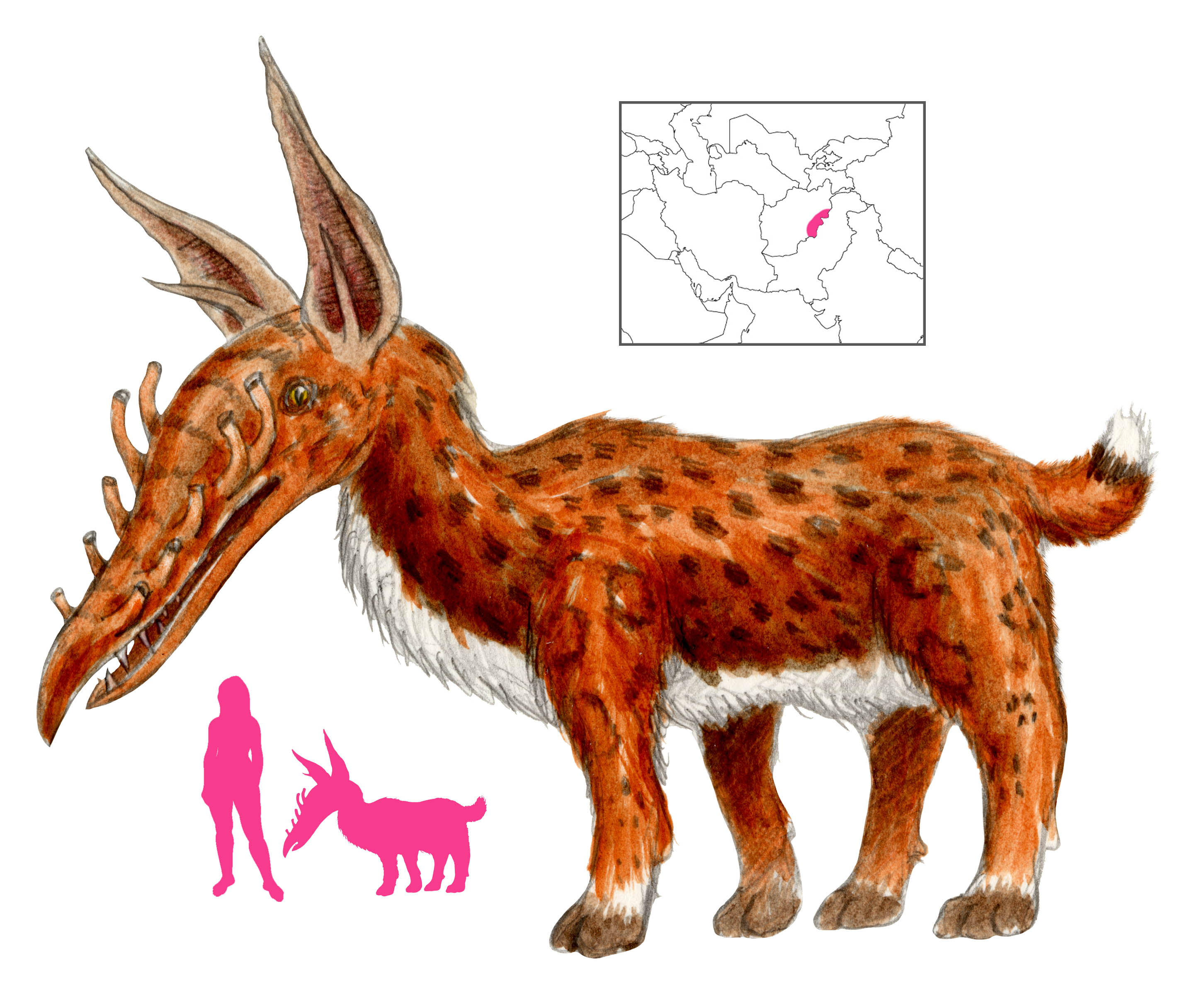
Al-Qazwini, however, places the sirānis firmly on land as a carnivorous mammal with 12 openings in its snout. When it breathes, those orifices produce a pleasant sound like that of the mizmar or flute; indeed, it is said that it was the inspiration for the musical instruments.

A sirānis uses its musical prowess to capture prey. It produces a melody so entrancing that animals gather around it and swoon in wonder, giving the sirānis an open buffet to choose from. If none of the animals present are satisfactory, it lets out an earsplitting screech that scares its audience away.

In time, the proximity of the sirānis to the shādawār in al-Qazwini’s text led later authors to combine them, granting the more iconographically defined shādawār the predatory nature of the sirānis.

References

Contadini, A. Musical Beasts: The Swan-Phoenix in the Ibn Bakhtishu’ Bestiaries. In O, Kane, B. (2005) The Iconography of Islamic Art. Edinburgh University Press.

Contadini, A. (2012) A World of Beasts: A Thirteenth-Century Illustrated Arabic Book on Animals (the Kitab Na’t al-Hayawan) in the Ibn Bakhtishu’ Tradition. Brill, Leiden.

Ettinghausen, R. (1950) The Unicorn. Studies in Muslim Iconography, Freer Gallery of Art Occasional Papers Vol. 1, No. 3, Washington.

al-Qazwini, Z. (1849) Zakariya ben Muhammed ben Mahmud el-Cazwini’s Kosmographie. Erster Theil: Die Wunder der Schöpfung. Ed. F. Wüstenfeld. Dieterichsche Buchhandlung, Göttingen.

Fayette

Fayette

The Fayettes (“little fairies”) live in the Forez region in France, today around the Loire basin. They are believed to be the descendants of the Greek nymphs, having escaped the advance of Christianity in the Mediterranean.

In France they are much tinier versions of their former selves, but their magical powers are undiminished. They guard the caves and forests, and can be seen dancing in the woods of Couroux, in the Beaujolais. Like any self-respecting fairy, they like to abduct children and leave insatiable changelings behind. Those fairy children are best brought to the mouth of a cave and threatened with violence, causing the fayette to return the stolen child. Te, vequio le tio, rends me le mio (“There, here’s yours, return mine”).

During the night, the fayettes do their laundry under the moon. Travellers in the woods are advised to sing at the top of their lungs to make sure they’re not mistaken for threats. At daybreak the fairies dissipate like fog, sometimes leaving behind solid gold washboards that would make anyone’s fortune.

During the day the fayettes take the form of moles, and take pleasure in ravaging gardens. This is why moles have pretty little pink hands.

References

Proth, M. (1868) Au Pays de l’Astrée. Librairie Internationale, Paris.

Sébillot, P. (1904) Le Folk-Lore de France, Tome Premier: Le Ciel et la Terre. Librairie Orientale et Américaine, Paris.

Malebête

Variations: Malbête, Malebàete, Malebeste (archaic), Bête d’Angles (Beast of Angles), Troussepoil

Malebete

Visitors to the French town of Angles, in the Vendée, are drawn to the beautiful church of Notre-Dame-des-Anges (Our Lady of the Angels). There, at the top of the bell tower, stands a monstrous stone bear glaring down on the city. Those visitors would be well advised to steer clear of its line of sight.

Long ago, it is said that a terrible beast ravaged the countryside of Angles. It was in the form of a great black bear, with shaggy, matted fur, and it became known as the Malebête – the “Evilbeast” or “Illbeast”. This monster had a predilection for young maidens, glutting itself almost exclusively on women. After feeding it would then wash itself in the nearby river, causing its hair to clump and stick out and granting the river the name of Troussepoil (“Hair-Raiser”, more or less).

The depredations of this demonic creature led to increasing concern. The river was running red with blood, and the female population was dwindling. None dared approach it, as its strength was greater than any knight’s. As it was an incarnation of the Devil himself, it became clear that only a sufficiently holy man would be capable of defeating it. The abbots of Fontaines and Talmont both went to face the beast, only to scurry away in terror when it charged them. The Pope’s envoy fasted for two days before confronting the Malebête, but barely escaped with his life and swore never to return.

Was there any man holy enough to destroy the Malebête? The answer came in the form of Father Martin, an old monk from the Angles cloister who spent most of his time isolated in contemplation of God. Perhaps out of desperation, he was begged to do something about this.

Leaning on a walking stick, dressed only in his ecclesiastical robes, Father Martin walked out to where the Malebête awaited him. To everyone’s amazement, the beast lowered its gaze in front of the hermit. “Follow me”, he said simply, and the Malebête did – as did the entire population of Angles. They followed Father Martin all the way back to the church, where he told the Malebête to climb the bell tower. Once at the top, it froze in place, and turned to stone.

Despite the rejoicing over the Malebête’s defeat, there were still a few voices of dissent in the form of a few girls who taunted Father Martin. “Since when are you the Devil’s shepherd?” they sneered. Father Martin merely smiled and looked up at the Malebête. “Henceforth, you shall feed only on the beauty of the girls of Angles”, he stated. And instantly all the women present became ugly and ran home in shame.

Since then, the resourceful women of Angles have found ways of avoiding the Malebête’s hungry gaze, and sneak safely into the church via a back door. Today the Malebête’s primary sustenance comes through the tourist industry.

This tale was first told by Benjamin Fillon, a dubious character who seems to have created the story out of whole cloth, making it a neo-myth of sorts. For one thing, the statue of the Malebête is of pre-Christian origin, predating its own legend; it was originally in a seated position, and was mutilated into its current shape. The Malebête’s story is also a familiar one, echoing many others told of anthropophagous monsters slain by righteous men.

References

Chaigne, L. (1942) La Vendée. F. Lanore, Paris.

Dillange, M. (1983) Eglises et Abbayes Romanes En Vendée. Jeanne Laffitte, Marseille.

Dubourg-Noves, P. (1996) Notre-Dame d’Angles. in Vendée. Congrès Archéologique de France, 151e Session. Musée des Monuments Francais, Paris.

Le Quellec, J. (1988) Le légendaire du Sud-Vendée: organisation spatio-mythique. Etuderies 3-4.

Trébucq, S. (1912) La chanson populaire et la vie rurale des Pyrénées à la Vendée. Feret et fils, Bordeaux.