Great-hand

Great-hand

The Old Town of Edinburgh is honeycombed with cellars, passages, and tunnels. These subterranean labyrinths are home to ancient horrors long forgotten by the residents. Great-hand is one of these.

Great-hand lives in the tunnel beneath the Royal Mile, stretching from the Castle to the Palace of Holyrood. Once used by soldiers for surprise attacks, it eventually fell into disuse. Then Great-hand moved in and the passage was abandoned completely. Nobody ever left the tunnel alive.

The only thing that has ever been seen of Great-hand is a hand – an enormous grisly hand, with fingernails like the claws of an eagle. If that hand is attached to a body, none have seen it.

After a while of avoiding the tunnel, a piper declared he would cross the tunnel, playing his pipes the whole way to verify his progress. Taking his dog along with him, he entered through the cave near the Castle, and the sound of his pipes could be heard traveling underground as he went down the hill. Then, at the Heart of Midlothian, the music stopped. The attending crowd went back to the entrance of the cave to see the dog running out in abject terror, completely hairless. The passage was blocked up from both ends.

Similar stories are told across Scotland involving haunted caves, foolhardy pipers, and dogs shedding their hair with fright. They are cautionary tales warning of the perils of the underground.

References

Fleming, M. (2002) Not of this World: Creatures of the Supernatural in Scotland. Mercat Press, Edinburgh.
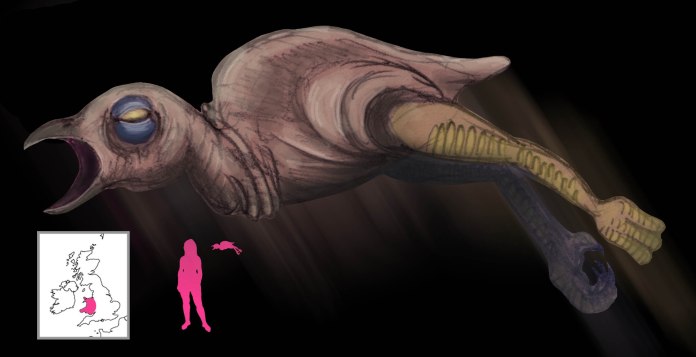
Aderyn y Corph

Variations: Aderyn y Corff, Aderyn y Cyrff, Corpse-bird

Aderyn y Corph

The Aderyn y Corph or corpse-bird chirps at the door of a dying person in Wales. Its call is dewch, dewch (“come, come”). It has no feathers or wings and can soar easily without them. When not presaging death it lives in the land of illusion and fantasy.

It is a variant of the screech owl whose call portends death. Aderyn y corph is also Welsh for the screech owl or brown owl.

References

Evan, D. S. (1858) An English and Welsh Dictionary. Thomas Gee, Denbigh.

Sikes, W. (1880) British Goblins. Sampson Low, Marston, Searle, & Rivington, London.

Chemosit

Chemosit

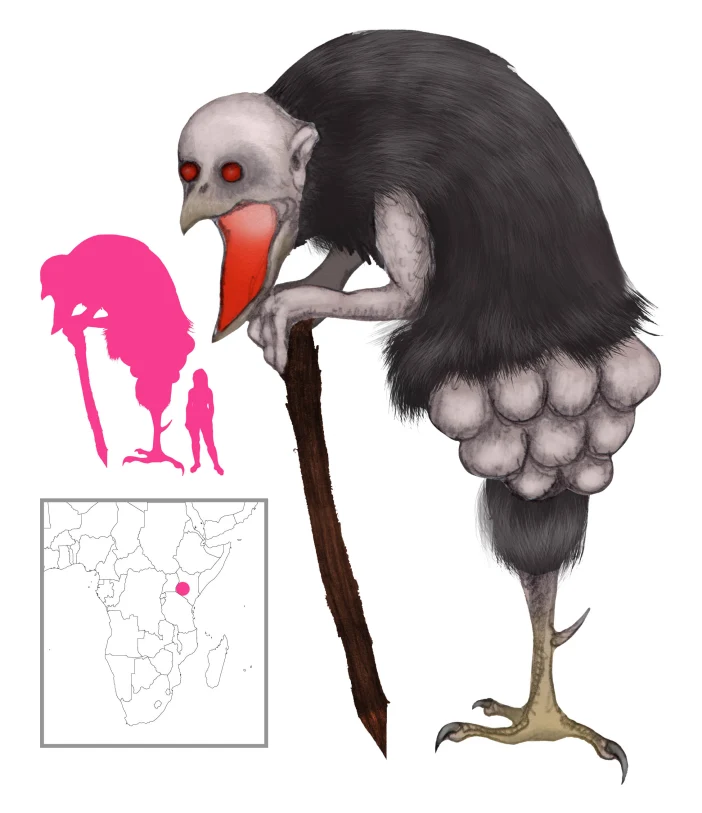
Chemosit is a demonic bogey that prowls the lands of the Nandi in Kenya. Half man, half bird, Chemosit stands on a single leg and has nine buttocks. Its mouth is red and shines brightly at night like a lamp. A spear-like stick serves as a means of propulsion and as a crutch.

People are Chemosit’s food, but it loves the flesh of children above all else. At night it sings a song near places where children live, its mouth glowing in the darkness. Unwary children seeing the light and hearing the song believe it to be a dance. They head out into the night to find the party and are never seen again.

References

Hollis, A. C. (1909) The Nandi, their Language and Folk-lore. Clarendon Press, Oxford.

Wingoc

Variations: Wing (obsolete), Wingocak (pl.), Wingwak (pl.)

Wingoc

The Wingwak are the Algonquian spirits of sleep. A wingoc appears as a somniferous fly or butterfly, with greater numbers appearing to bedevil people into sleep (they typically show up five per person). The term wingoc is also used for sleep; compare ingwac, to be sleepy, and ingwam, to sleep.

A man playing in the sky once fell through a hole to land on Earth. There he found people sleeping, and one man sleeping more than the others. The heavenly visitor fashioned himself a small bow and arrows and started shooting at the clouds of flies above the sleeper. With some of the wingwak killed and others set to flight, the sleeper awoke. The celestial man then imparted his wisdom to the Algonquians, warning them of the arrival of the bearded men who would be the end of their race.

Expressions include ni nisigok wingwak (“the wingwak kill me”, i.e. “I am overwhelmed with sleepiness”) and wingwak ondjita manek (“there are so many wingwak”, i.e. “everyone’s asleep”).

References

Chamberlain, A. F. (1900) Some Items of Algonkian Folk-Lore. The Journal of American Folklore, 13(51), pp. 271-277.

Cuoq, J. A. (1886) Lexique de la Langue Algonquine. J. Chapleau et Fils, Montreal.

Lemoine, G. (1909) Dictionnaire Francais-Algonquin. G. Delisle, Chicoutimi.

Rolling-calf

Variations: Rolling Calf

Rolling Calf

A duppy is a type of ghost or spirit native to Jamaica. While described as the souls of dead people, duppies have much in common with Old World shapeshifters and roadside tricksters. They may be found in bamboo thickets and cottonwood groves, and feed on bamboo, “duppy pumpkin”, and strangler figs. Duppies appear from seven in the evening till five in the morning, and sometimes at noon. Duppy activities range from simple mischief to arson, beating, burning, poisoning, and stoning, but they are powerless against twins and those born with a caul. A left-handed crack with a tarred whip and the burning of certain herbs keep them away.

Some of the more dangerous duppies include Three-foot Horse, whose breath is poison and which can outrun anything, but which cannot attack those in the shadow of trees. Then there is Whooping-Boy who rides Three-foot Horse while whooping loudly. Long-bubby Susan has pendulous breasts that reach the ground, and which she throws over her shoulders. Old Hige, the witch, is fond of abducting children, but can be confounded by rice thrown on the doorstep – the duppy cannot count above three, but is compelled to count the grains anyway.

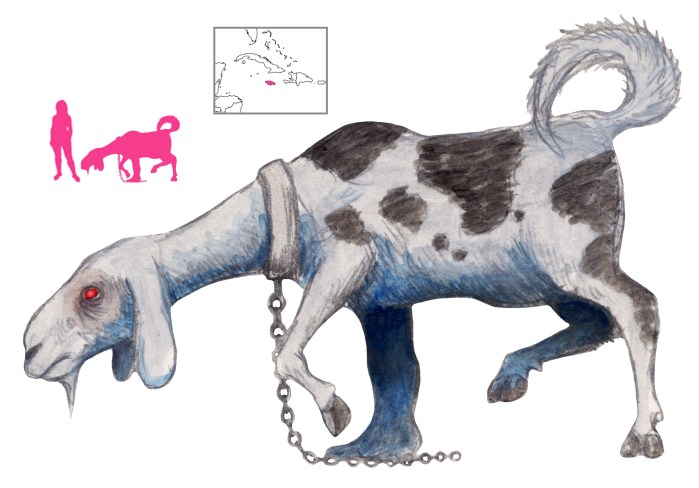
Then there is Rolling-calf, one of the worst and most feared duppies. “Rolling” in this context means “roaming”, as in “rolling through town”. It is a shapeshifter that can appear in a number of guises. The best known is that of a hornless goat, black or white or spotted, with a corresponding caprine stench. One of its front legs is human, the other is that of a horse, and the two hind legs are those of a goat. Its tail curls over its back. Its eyes are red and glow like blazing fires. Flames come from its nostrils. There is a collar on its neck, with a chain that drags on the ground and rattles ominously. The rolling-calf can also appear as a cat, dog, pig, goat, bull, or horse, with the brindled-cat form being particularly dangerous. It can be as small as a cat, or as big as a bull.

A rolling-calf is the soul of a particularly wicked person. Butchers and murderers return as rolling-calves, as do Obeah men; the latter can also set rolling-calves on people. Rolling-calves are found in bamboo and cottonwood as well as caves and abandoned houses, coming out on moonless nights in search of sugar (they are fond of molasses) and breaking into cattle pens.

Rolling-calves can wreak all sorts of evil and blow “bad breath” on their victims, but they can be warded off in a number of ways. Flogging them with a tarred whip always helps, as does sticking an open knife into the ground. Even more useful is the fact that rolling-calves are terrified of the moon to a comical extent.

But whatever method is used to escape a rolling-calf’s clutches, you would be well-advised to leave the premises at once. The rolling-calf will return with a vengeance.

References

Beckwith, M. W. (1924) Jamaica Anansi Stories. G. E. Stechert and Co., New York.

Beckwith, M. W. (1929) Black Roadways: A Study of Jamaican Folk Life. The University of North Carolina Press, Chapel Hill.

Apshait

Variations: Apsai, Apshai

Apshait

The XXXVIth chapter of the Egyptian Book of the Dead refers to the corpse-gnawing beetle Apshait. In typical apotropaic gestures, the soul of the deceased threatens the apshait with a knife, and runs it through with a spear.

The apshait may have originated in carrion beetles found in the bandages and bodies of poorly-prepared mummies. Later texts confuse the apshait with the tortoise, which dies as Ra lives.

References

Budge, E. A. W. (2015) The Gods of the Egyptians, vol. II. Dover Publications Inc., New York.

Budge, E. A. W. (2016) The Egyptian Book of the Dead. Dover Publications Inc., New York.

Yohualtepoztli

Variations: Yooaltepuztli, Youaltepoztli, Hacha Nocturna, Night Axe, Night Hatchet; Tooaltepuztli (Sahagun, typo)

Youaltepoztli

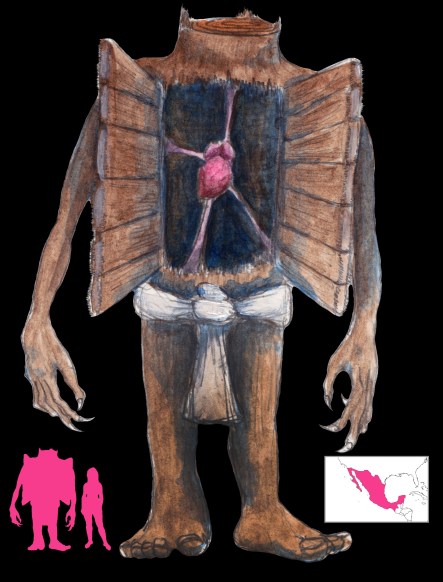
Thud. Thud. Thud. The Yohualtepoztli reveals its presence in the mountains of Mexico with a loud, intermittent sound, much like that of an axe being driven into wood. This is what earns it its name, from yohualli, “night”, and tepoztli, “axe” or “hatchet”. It is a spirit or phantasm associated with Tezcatlipoca, and it exists to torment nocturnal travelers.

Thud. Thud. Thud. The dull blows continue, and the traveler breaks out into a cold sweat. Fleeing seems like a good idea, but paradoxically they would be best advised to follow the noise to the yohualtepoztli itself. It manifests as a humanoid creature resembling a headless man. Instead of a head, the yohualtepoztli has a stump, like that of a felled tree. The chest cavity is open and hollow, the heart visible inside, and framed on both sides by what look like small hinged doors. The doors flap loosely as the yohualtepoztli moves, and their impact against each other causes the dull thuds.

Priests, warriors, and other fearless people should immediately grab the yohualtepoztli’s heart and hold it tight, threatening to tear it out. Then the creature can be asked for fame, glory, riches, strength, and other gifts. It will offer an agave thorn in return for its freedom, but it should not be released until three or four thorns have been gifted. In turn, those agave thorns guarantee the capture of as many prisoners of war – and therefore, of as much fame, glory, riches, and strength.

Holding onto a yohualtepoztli’s heart is a harrowing experience. Less brave people may immediately pull out the heart without bargaining and run home. If this happens, the heart should be wrapped up in cloth and left overnight. By morning, if the heart has transformed into agave thorns, bird down, or cotton, then it is a good omen. If coal or rags are left instead, then bad luck is sure to follow.

But for those cowards who fear the yohualtepoztli and dare not approach it, there are no rewards. They will flee in terror at the sound of the night hatchet, and misfortune will befall them.

References

Nuttall, Z. (1895) A Note on Ancient Mexican Folk-lore. The Journal of American Folklore, v. 8, no. 29, pp. 117-129.

Robelo, C. A. (1908) Diccionario de Mitologia Nahoa. Anales del Museo Nacional de México, t. V, Mexico.

Sahagun, B. (1829) Historia General de las Cosas de Nueva España, v. II. Alejandro Valdés, Calle de Santo Domingo, Esquina de Tacuba, Mexico.

Kamikiri

Variations: Kami-kiri, Kami Kiri, Kamikiri-ma, Kamikiri-mushi, Kami Kiri Mushi; Amikiri (probably)

Kamikiri

Hair has been of historical importance in Japan. During the Edo period, the chonmage or topknot in men was a status symbol. In women, long hair indicated beauty and wealth, with differing hairstyles communicating age, rank, and availability. Cutting one’s hair was a solemn and drastic step associated with religious vows.

Cutting someone’s hair without their consent, therefore, was a spiteful and criminal act, even more so if it seemed to happen without reason. Inexplicable and sudden hair-cutting was known as Kamikiri, “hair cutter”. Most kamikiri incidents happened at twilight, and the victims were usually young women. Matsuzaka City was especially plagued by kamikiri. Often the hair was snipped off while the victim was walking, with the crime noticed only upon returning home.

Who was to blame for kamikiri? Demonic winds could have been the culprit, and they were countered with prayers written on papers and placed in hairpins. Kitsune were also blamed; after three women fell victim in one area, a fox was cut open and long hair found inside.

The phenomenon has also been attributed to a yokai, the kamikiri, kamikiri-ma (“hair-cutting demon”), or kamikiri-mushi (“hair-cutting insect”). It may have been a large longhorn beetle (Cerambycidae), but Edo scrolls elaborate that into a small humanoid creature with pincer hands and a birdlike face. The insect features may be due to kamikiri’s similarity with kamakiri, “praying mantis”.

Toriyama Sekien’s yokai compendia do not include the kamikiri, but rather the scorpion-like amikiri or “net-cutter”. This may be an error, or Sekien’s own spin on the scissors-handed yokai.

References

Foster, M. D. (2015) The Book of Yokai. University of California Press, Berkeley.

Hepburn, J. C. (1872) A Japanese-English and English-Japanese Dictionary. American Presbyterian Mission Press, Shanghai.

Thunberg, C. P. (1796) Travels in Europe, Africa, and Asia, v. III. F. and C. Rivington, London.

Animalito

Animalito

During his time in Spain, Prosper Mérimée was introduced to a number of current superstitions by his traveling companion Vicente. This worthy Valencian informed him of certain animalitos, “little animals”, available for purchase in France from unscrupulous sorcerers.

Nobody knows what they look like save that they are tiny animals that live in reeds. The notorious embellisher Dubois gives them dog mouths and lizard heads. The reed an animalito lives in is sold with a knot in one end and a sturdy cork in the other.

Animalitos are magical beings, capable of granting their owners any wish, any request they desire. Napoleon had one of these imps with him, which prevented him from being killed while in Spain. Only silver bullets can harm those protected by an animalito.

In return for their services, the animalitos request a steep price. They have to be fed every 24 hours. They crave the flesh of unbaptized children, and if that is not available (as is often the case), their master has to cut a piece of flesh from his or her own body. Vicente recounts the tale of an old friend, Romero the footman, who cured his lung disease with the help of animalitos. Now he can run from Valencia to Murcia without breaking a sweat, but his bones show through his skin, his eyes are sunken…

The animalitos are eating him alive.

References

Dubois, P.; Sabatier, C.; and Sabatier, R. (1992) La Grande Encyclopédie des Lutins. Hoëbeke, Paris.

Mérimée, P. Les Sorcières Espagnoles. In Mérimée, P. (1873) Dernières Nouvelles de Prosper Mérimée. Michel Lévy Frères, Paris.

Poreskoro

Poreskoro

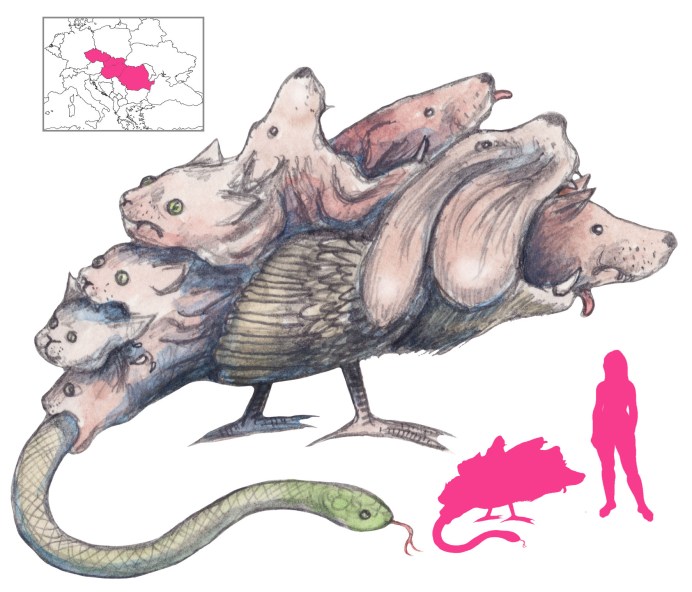
Poreskoro, “Tailed” or “Caudate”, is the ninth and final child of Ana, the ultimate Romani demon of disease produced from an unhappy and abusive relationship between Queen Ana of the Keshalyi and the King of the Loçolico.

After the failed attempt at sterilization that produced Minceskro, the distraught Keshalyi fed their Queen a mixture of cat hair, powdered snake, and hair from the hound of hell. This time the result was Poreskoro. A bird with four dog heads, four cat heads, and a snake tail with a forked tongue, Poreskoro is a hermaphrodite who does not require a mate to produce offspring. Its children are bubonic plague, cholera, smallpox, and all the pestilences, epidemics, and pandemics known to humanity. Poreskoro dwells deep underground with its offspring; its appearance on the surface heralds widespread destruction and disease.

It is small comfort, then, that even the King of the Loçolico had a shock upon seeing this monstrous child, and realized that his marriage was going nowhere. He and Ana divorced under two conditions – first, that the Loçolico would leave the Keshalyi alone as long as Ana was alive; second, that every Keshalyi nymph having reached the age of 999 would be given away to the Loçolico.

So it came to pass that Ana lived in blessed seclusion in an isolated mountain castle, rarely leaving, and sustained by the Keshalyi. Every morning three of the nymphs visit her and give her a single drop of blood from their left hand to keep her alive. She sometimes appears in the form of a golden toad, but more often she is only heard saying the word ana, meaning “bring” or “pass”. If you hear that, then you must pick up a frog, beetle, or other small animal and toss it into a bush, otherwise Ana will crush you under a rock.

As for her demonic children, they live on, and the diseases they spawn are endless.

References

Clébert, J. P. (1976) Les Tziganes. Tchou, Paris.

Clébert, J. P.; Duff, C. trans. (1963) The Gypsies. Vista Books, London.

Meyers Brothers Druggist (1910) Demons of Disease. Meyers Brothers Druggist, v. 31, p. 141.

Pavelčík, N. and Pavelčík, J. (2001) Myths of the Czech Gypsies. Asian Folklore Studies, v. 60, pp. 21-30.