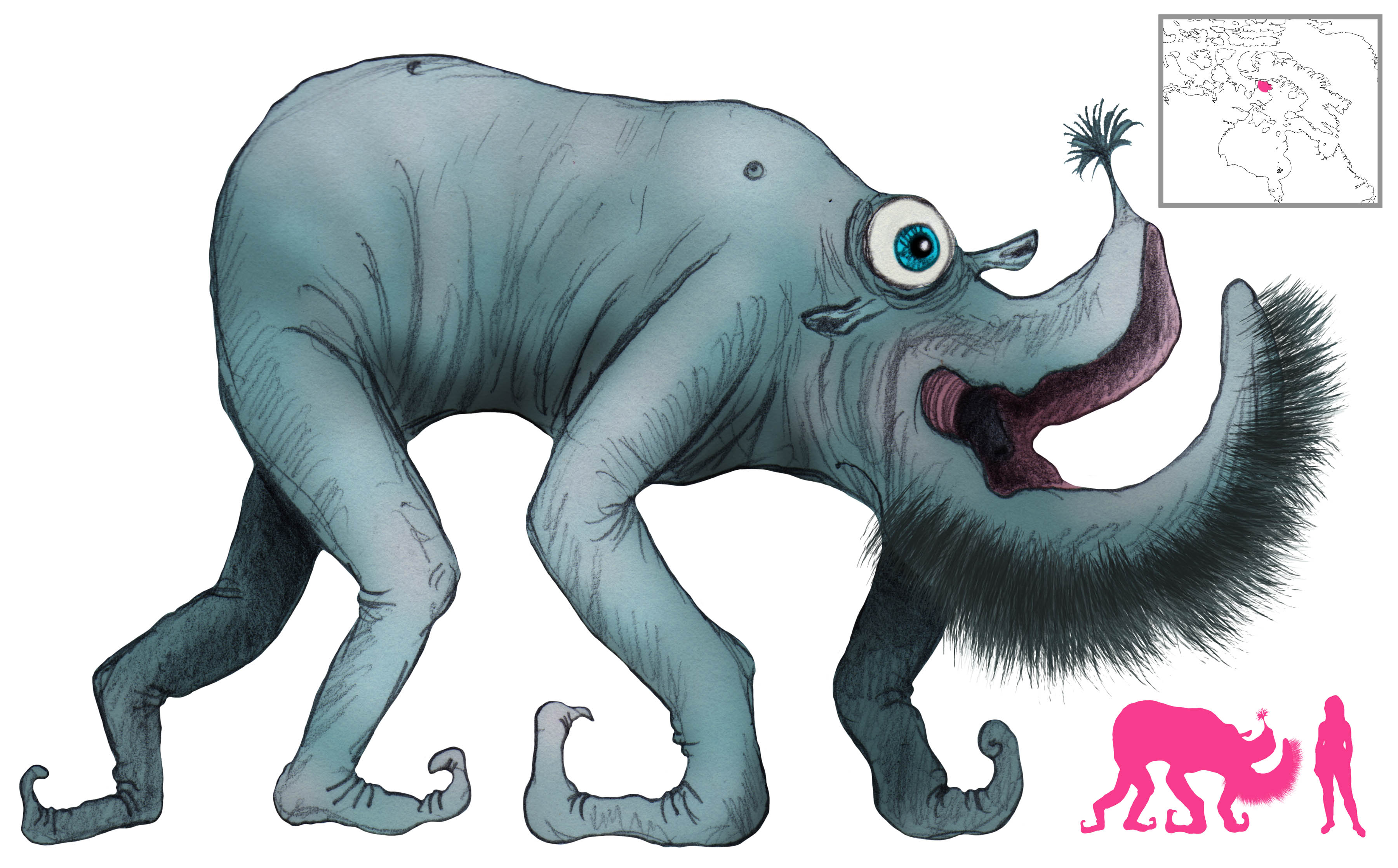
The helping spirit Nartôq is “the pregnant one” or “the big-bellied one”. Iglulik Inuit shaman Anarqâq first encountered this spirit while out hunting caribou. Nartôq is a horrifying sight – its nose is on its forehead, and its lower jaw runs down into its breast.
When they first met, Nartôq charged Anarqâq threateningly, disappearing just before it reached him. Later on Nartôq reappeared and introduced itself to Anarqâq. “I was hot-headed earlier because you yourself are too quick to anger”, it told the shaman. “You need never fear me as long as you abandon your short temper”. Since then Nartôq become one of the shaman’s best helping spirits.
References
Rasmussen, K. (1929) Intellectual Culture of the Iglulik Eskimos. Glydendalske Boghandel, Nordisk Forlag, Copenhagen.
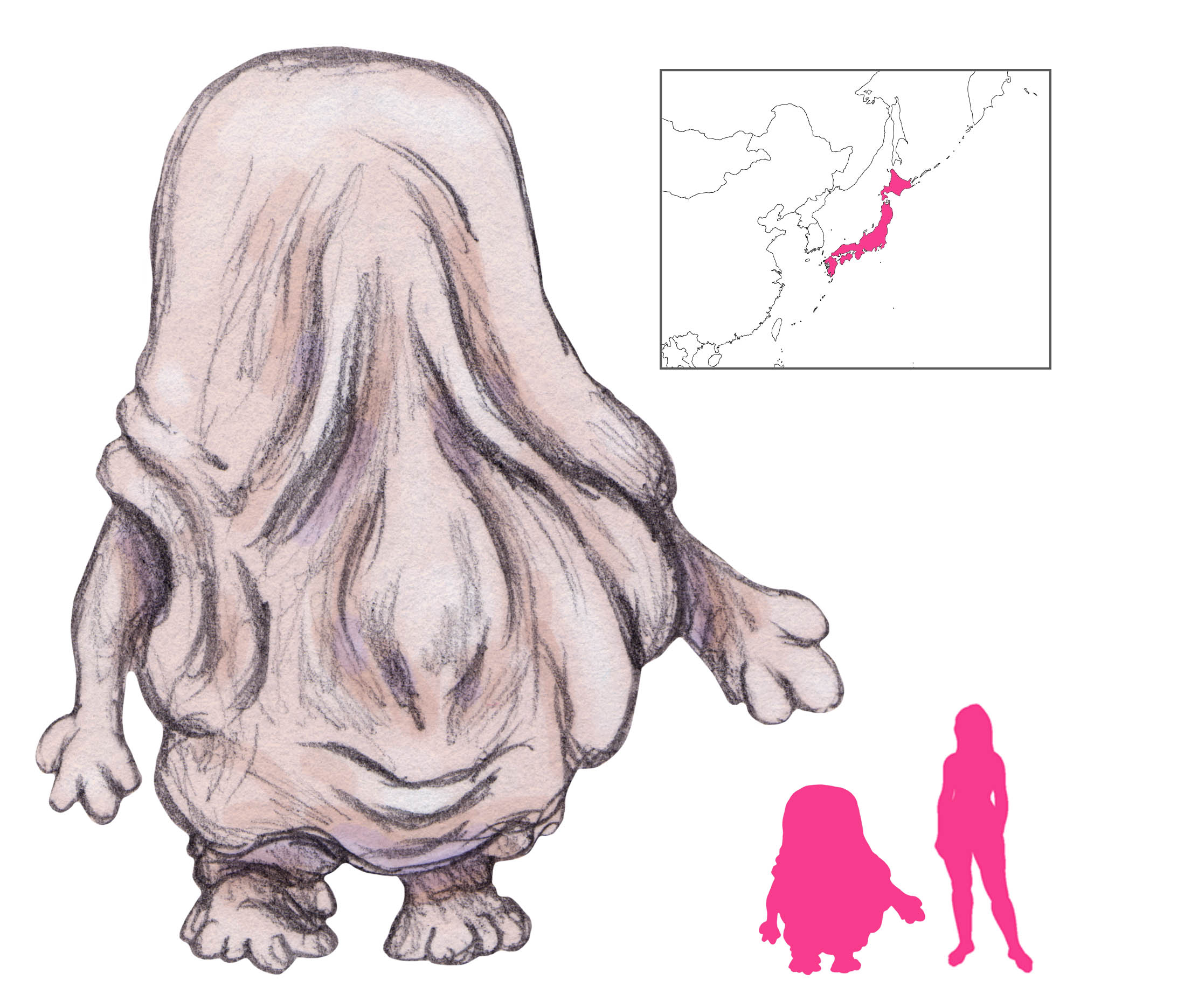
The word Nuppeppō is
derived from nupperi or nopperi, meaning “flat-faced” and
referring to a flat, dazed expression. This yokai first appears in texts from
the Edo period, and resembles nothing more than a blob of flesh with arms and
legs. Its folds of skin and fat give it the appearance of a face on its body.
While repulsive, nuppeppōs are frequently comical and
inoffensive.
Sekien’s rendition of the nuppeppō has a culinary theme, placing it under a bronze bell that calls monks to their meals. The nuppeppō itself may be edible; according to Maki Bokusen, a nuppeppō-like creature appeared in the gardens of Shogun Tokugawa Ieyasu. This nikubito (“meat-man”) was taken away to the mountains away from the shogun’s sight. Alas, he discovered too late that it may have been the legendary Hō described in the book of the Hakutaku. One bite of the Hō’s flesh would reinvigorate a person’s constitution.
Shigeru Mizuki added further embellishments to the nuppeppō based on Sekien’s image. His “nuppefuhofu” is a “spirit of flesh” found in deserted temples. Monks that choose to sleep in those temple are unpleasantly awakened by the fleshy sound of its aimless staggering.
The Nopperabō is a later yokai probably derived from
the nuppeppō.
It is human in appearance except for its face – completely featureless and
smooth as an egg. Unlike its older counterpart, the nopperabō is only ever a thing of terror.
References
Foster, M. D. (2015) The Book of Yokai. University of California Press,
Berkeley.
Sekien, T.; Alt, M. and Yoda, H. eds. (2017) Japandemonium Illustrated: The Yokai Encyclopedias of Toriyama Sekien. Dover Publications, New York.
Victoria
Nyanza is home to the Lukwata. The deeds and misdeeds of this great sea-serpent
are told on both sides of the lake, from Uganda to the Kavirondo (Winam) Gulf
in Kenya. The lukwata is commonly lumped with the dingonek, but the lukwata’s
pedigree is far older. Lukwata is also the name of a Baganda clay charm which,
when hidden in the king’s house, presents theft in the village, but this seems
unrelated.
The lukwata
has been around from time immemorial and makes occasional appearances. It is a
huge and terrifying lake demon, a serpent, a cetacean, or perhaps a giant fish.
It is associated with whirlpools in the lake. Ja-Luo fishermen have tales of
the lukwata attacking their canoes. The Baganda, Kavirondo, and Wasoga of the
north shore of lake Nyanza used to sacrifice livestock to it. The lukwata’s
disappearance coincided with the sleeping-sickness epidemic, and it was
believed that the muzungu
(foreigners) caused the disease by killing the lukwata, thus bringing its wrath
upon the people.
W. Grant,
Provincial Commissioner of Jinja, saw a lukwata swimming down the Napoleon
Gulf; its head was out of the water but it was too far to make out its
features. Clement Hill of the Foreign Office had a far closer encounter when a
lukwata off Homa Mountain tried unsuccessfully to seize a man on the bow of
Hill’s ship. He saw a lizard-like head, roundish and dark-colored, on a
four-foot-long neck attached to a large, rounded mass that formed the body.
Some sort of tail seemed to be trailing behind.
E. G.
Wayland, head of the Geological Survey of Uganda, claimed to have heard the
lukwata’s distant bellowing. He was shown pieces of lukwata bone, and was told
that the lukwata fought epic battles with crocodiles. Pieces of skin lost in
those struggles were used for potent amulets.
The most
complete account of a lukwata’s appearance is recorded by H. Bell, who shot one
on the western border of Uganda near the Semliki River and Lake Albert. The
creature, which was identified as a small lukwata by a native boy, was deemed
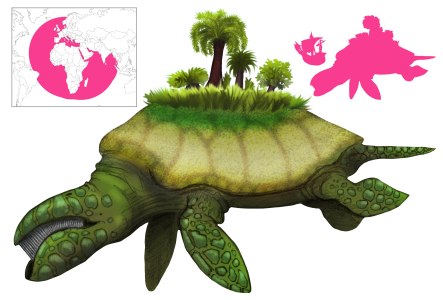
to resemble Hill’s serpent. It had a snakelike head, a neck several inches
long, a tail a few inches long, and flippers like a sea turtle’s. Instead of a
hard shell, the lukwata had a thick, soft, rubbery carapace. Bell believed that
the lukwata – evidently an odd species of turtle – would, at the surface, give
the impression of a bulky, long-necked animal.
Balukwata
are not particularly smart. A Baganda folktale tells of the friendship between
a lukwata and a monkey. It came to pass that the King of the balukwata took
ill, and his wizard told him to eat the heart of a monkey as a cure. The King
offered great rewards to any of the balukwata who would bring him the heart of
a monkey. So the lukwata went to the home of his friend the monkey and hailed
him. “How are you? You should come visit me, my wife and sons want to see you”.
“But I cannot swim”, said the monkey. “I’ll carry you on my back”, said the
lukwata, and they were off. Halfway across the lake, the lukwata, having a
crisis of conscience, decided to tell the monkey the truth. “I’m really sorry,
but our King is sick and needs your heart”. The monkey thought fast. “You silly
thing”, he told the lukwata, “I don’t have my heart with me. I leave it behind
so I can jump through the trees. Take me back and I’ll fetch my heart from the
branch where I left it”. Of course, the unsuspecting lukwata swam back, and the
monkey escaped to safety in the trees – but not before mocking his erstwhile friend’s
intelligence.
References
Bell, H.
(1948) Witches & Fishes. Edward
Arnold & Co., London.
Bronson, E.
B. (1910) In Closed Territory. A. C.
McClurg & Co., Chicago.
Cunningham, J. F. (1905)
Uganda and its peoples. Hutchinson
& Co., London.
Hattersley, C. W. (1900)
An English Boy’s Life and Adventures in
Uganda. The Religious Tract Society, London.
Heuvelmans,
B.; Garnett, R. trans. (1958) On the Track of Unknown Animals. Rupert
Hart-Davis, London.
Hobley, C.
W. (1913) On Some Unidentified Beasts.
The Journal of the East Africa and Uganda Natural History Society, III(6), pp.
48-52.
Johnston,
H. (1902) The Uganda Protectorate.
Hutchinson & Co., London.
Pilkington,
G. L. (1911) A Hand-book of Luganda.
Richard Clay & Sons, Limited, London.
Variations: Hantu Kepala Berduri (Malay), Spiky-head Spirit
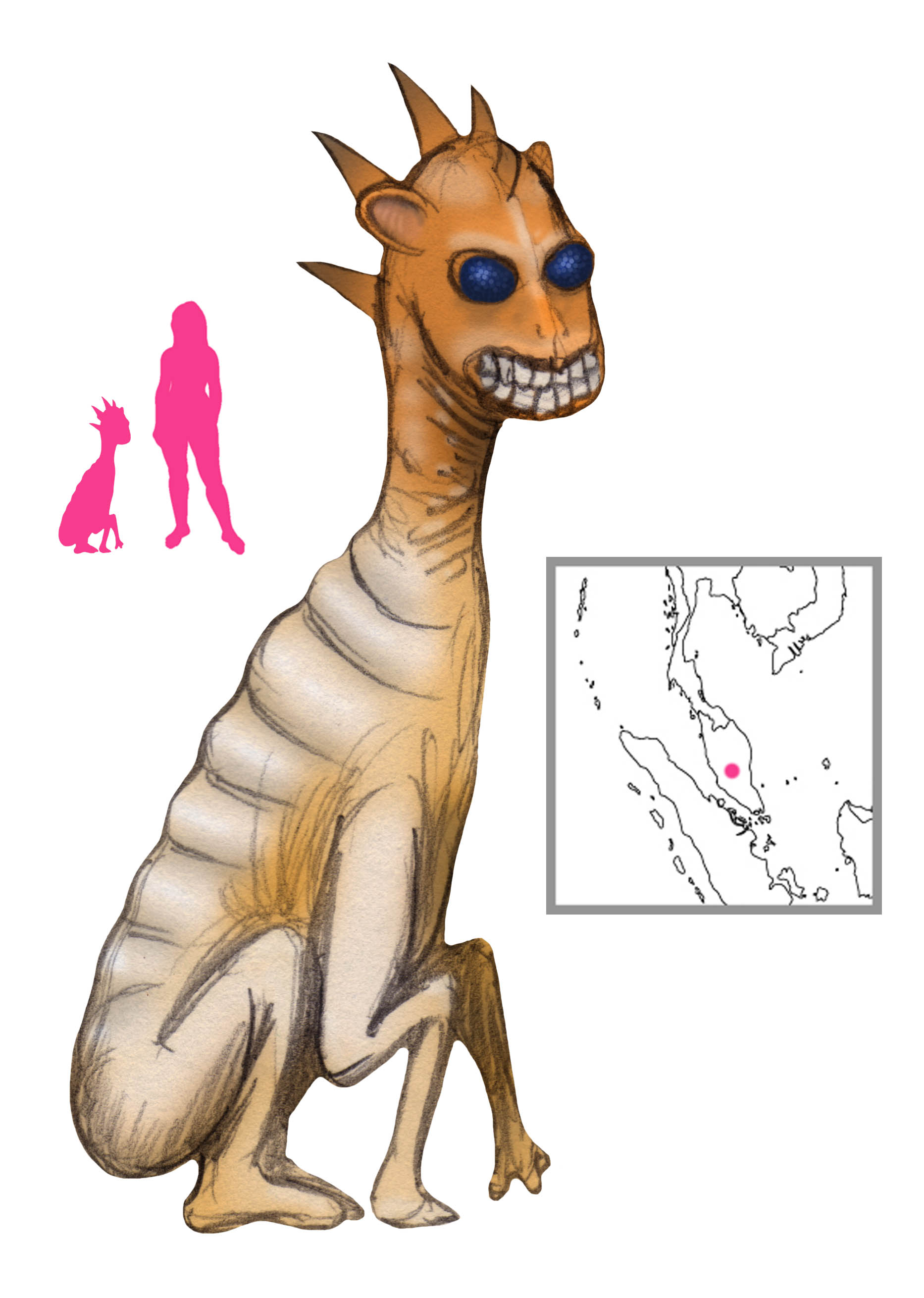
The Bès Jě’la Kòy, “spiky-head spirit”, is one of many bès or spirits from the folklore of the Jah Hut people of Malaysia. It lives on top of termite hills and knows how long every person will live. If it judges that a person’s lifespan is too short, it will take them into the termite hill to be friends with it forever.
A spiky-head spirit takes one person a year into
its termite hill.
References
Werner, R. (1975) Jah-hět of Malaysia, Art and Culture. Penerbit Universiti Malaya, Kuala Lumpur.
Igtuk, the
boomer, is the source of mysterious booming sounds heard in the Canadian
mountains. His place of residence is unknown. Our knowledge of this creature
was related by the Iglulik Inuit mystic Anarqâq. Igtuk was not specified to be
one of Anarqâq’s helping spirits, and he is probably hostile to humans.
Igtuk
resembles no other living thing. His arms and legs are on the back of his body,
while his single large eye is level with his arms, and his ears are in line
with his eye. His nose is inside his cavernous mouth, and there is a tuft of
thick hair on his chin. The booming for which he is known is produced when
Igtuk moves his jaws.
References
Rasmussen, K. (1929) Intellectual Culture of the Iglulik Eskimos. Glydendalske Boghandel, Nordisk Forlag, Copenhagen.
Agropelters
are violent and aggressive critters found in lumberwoods from Maine to Oregon.
Injury and death blamed on freak falling branches are always the work of an
agropelter, who hates lumberjacks for their invasion of its territory.
Our only
description of an agropelter comes from Big Ole Kittleson, who survived an agropelter
attack long enough to see the creature escape. An agropelter has the villainous
face of an ape on a sinewy little body, with incredibly powerful arms like
organic whips.
Agropelters
use the prodigious strength of their arms to break off and fling branches. They
always pelt with pinpoint accuracy, smashing or impaling their victims. Big Ole
Kittleson was fortunate enough to be pelted with a rotten branch that crumbled
upon impact.
Apart from
their murderous activities, agropelters are highly agile climbers and
brachiators, and make their home in trees by eating and hollowing out the
center of a dead tree. Pups are born on February 29 and always in odd numbers.
Agropelters subsist on a diet of owls and woodpeckers. As these birds are sadly
being exterminated, the agropelters are getting scarce.
References
Brown, C.
E. (1935) Paul Bunyan Natural History. Madison, Wisconsin.
Cox, W. T.
(1910) Fearsome Creatures of the Lumberwoods with a Few Desert and
Mountain Beasts. Judd and Detweiler, Washington D. C.
Tryon, H.
H. (1939) Fearsome Critters. The Idlewild Press, Cornwall, NY.
The Loðsilungur, or “Shaggy Trout”, is one of
the most toxic fishes to inhabit Iceland. The earliest accounts date from the
mid-17th century, where it is obliquely referred to as the
“poisonous menace”. Illness and death follow the consumption of a loðsilungur.
The appearance of the Icelandic shaggy
trout varies, but a trout-like shape and the presence of hair are diagnostic.
Loðsilungurs tend to be ugly and strange. The one described in Nordri in 1855 had a beard of reddish
hair on its lower jaw and neck as well as hairy patches on its sides and hairy
fins. Another account distinguishes between trout with shaggy hair near the
front of their head, and trout with hairy manes on either side. The adipose fin
is either reduced or absent, and scales may not be present. The most detailed
description specifies that it is no bigger than an Arctic char, and is often
the size of a man’s finger. The tail is narrower and the front thicker than in
other trout. The small, deep-set eyes are set ahead of a bulbous skull. The
short snout has a distinctive overbite. The teeth are pitch black. Finally, the
loðsilungur is covered with fine, downy, cottony-white hair. This hair, the
namesake of the trout, resembles mold and is visible only when the fish is dead
and in the water; on dry land it lies flat against the scales and becomes
invisible. This makes it easier to confuse with edible trout – and makes it
that much more deadly.
Across Iceland the tale is told of a
tragic group poisoning. In 1692 the inhabitants of the farm called Gröf were
found dead around a table with a cooked loðsilungur. Two brothers in a hunting
lodge near Gunnarssonavatn Lake died with plates of trout on their knees. The
most notorious poisoning incident is that of the Kaldrani farm, where an entire
household were killed by a meal of loðsilungur. Only one young pauper girl had
no appetite at the time, and avoided a terrible death.
Dogs and
birds of prey, normally indiscriminate in their eating habits, will refuse to
eat a loðsilungur. The shaggy trout are also
tenacious and will cling stubbornly to life as long as possible. A group of
fishermen in Hoffellsvatn Lake found that out the hard way; they left a catch
of fish out overnight, only to find a live loðsilungur squirming on top of the
pile. The entire catch was discarded and the lake abandoned.
References
Davidsson,
O. (1900) The Folk-lore of Icelandic Fishes. The Scottish Review,
October, pp. 312-332.
Hlidberg,
J. B. and Aegisson, S.; McQueen, F. J. M. and Kjartansson, R., trans. (2011) Meeting
with Monsters. JPV utgafa, Reykjavik.
The Jarjacha is a nocturnal Peruvian beast, quadrupedal, with a long neck and glowing eyes. It lives on a diet of human flesh, but has very specific preferences: it feeds solely on incestuous men and women, or those who have committed carnal sins towards their spiritual compadres. It itself may be born from the soul of an incestuous person or taboo-breaker.
A jarjacha
manifests primarily in its call, a loud rattling cry that echoes through the
hills. “Jar-jar-jar-jar-jar”… It
repeats, over and over. The villagers shiver, cross themselves, and lock their
doors.
By morning
the atmosphere is tense. Everyone knows there is a sinner among them, some
incestuous wretch who has brought judgment down on themselves. The parish
priest decries the existence of the son of Satan in their midst, one who will
be punished by divine retribution. Eventually the shamed culprit is brought to
light, and given an auto-da-fé in the
public square.
Jarjacha is the
worst insult that can be leveled at someone.
References
Bustamante, M. E. (1943)
Apuntes para el folklore Peruano. La
Miniatura, Ayacucho.
While searching for information on the dingonek, I found that it’s been synonymized with a whole bunch of other creatures. These include, for instance, the Lukwata (a far more “legitimate” creature), the Ndamathia, and the Olmaima or Ol-umaina. That last one piqued my curiosity, and further research into it serves as a cautionary tale – one that cryptozoologists would do well to heed.
The original reference is Hobley (1913):
At the time this story appeared it was considered that this [Bronson’s account] was probably a traveller’s tale, told to entertain a newcomer, but I have since met a man who a few years back wandering about the Mara River or Ngare Dubash which rises in Sotik, crosses the Anglo-German boundary and runs into Lake Victoria in German territory. He emphatically asserts that he saw the beast [i.e. the Dingonek]. He was at the time where the Mara River crosses the frontier, and the river was in high flood. The beast came floating down the river on a big log, and he estimated its length at about sixteen feet, but could not certain of its length as its tail was in the water. He describes it as spotted like a leopard, covered with scales, and having a head like an otter; he did not see the long fangs described by Mr. Jordan. He fired at it and hit it; it slid off the log into the water and was not seen again.
I made inquiries of the District Commissioner, Kisii, Mr. Crampton, and he wrote recently and said he had visited the Amala River and made inquiries from the Masai in the neighbourhood, and they knew of the beast, which they called Ol-umaina, and described it as follows: About fifteen feet long, head like a dog, small ears marked somewhat after the fashion of a puff adder, has claws, short legs, short neck, is said to lie in the sun on the sand by the river-side and to slip into the water when disturbed; when in the water only its head is visible. This story does not radically disagree with the others…
There are a few conclusions to draw here. First, the author believes the dingonek, the unnamed Mara River creature, and the ol-umaina to be one and the same. Second, the features shared by all three are notable size, scales, spots like a leopard, and possibly a long tail.
Heuvelmans (1958) quotes Hobley (1913) (in fact, almost exactly the previous quote) and concurs that the “description agrees fairly well with the dingonek”. However, he has a comment on the ol-umaina’s description:
The puff-adder has no external ears. Perhaps Hobley means the small horns on the horned viper, but the text is by no means clear.
The ears thing confused me as well, but the most logical conclusions I can come up with is that a) like the puff adder, it has markings by its ears, or b) like the puff adder, it has no visible ears, or c) both of the above.
Finally Karl Shuker, in his In Search of Prehistoric Survivors (1995), straight-up refers to the Mara River creature as a dingonek, and makes a correction to the ol-umaina’s name: it is now the ol-maima.
So what are we to make of all this? Turns out there is a creature that answers to the descriptions given. A normal, unremarkable creature, but not as big as it is claimed to be.
Image from Wikipedia.
That’s right, it’s the humble Nile monitor lizard (Varanus niloticus). Note the scales, the “leopard” spots, the tail, an otter- or dog-like head without long fangs, sharp claws, short neck and legs, and a long tail. It basks in the sun and dives into the water when threatened.
Of course, Nile monitors don’t grow 15 feet long, but this can be chalked up to exaggeration and/or honest overestimation.
The final nail in the coffin is the name ol-maima or ol-umaina. Looking up a reputable Maa dictionary, we discover that ɔl-máɨ́má is the Maa word for a) a cripple and b) a Nile monitor lizard.
There is no need to invoke aquatic walruses, relict dinosaurs, or crocodiles with missing jaws. If the dingonek and the ol-maima are the same animal, then they are no more than fanciful descriptions of Nile monitors. The Dingonek gets a full entry because its description is so unusual, but the ol-maima, literally “Nile monitor lizard” in Maa, will not be so lucky.
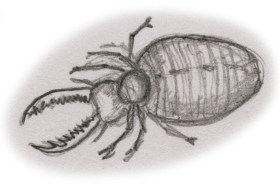
Tales from
Greenland, notably Aasiaat, tell of a gigantic maggot called Quvdlugiarsuaq. It
is so big that the legend of Aqigsiaq tells of a dwelling place that survived
an entire winter on the blubber of one quvdlugiarsuaq.
The Auseq
is a similar creature described as a giant caterpillar. It is dangerous to
humans.
References
Birket-Smith,
K. (1924) Ethnography of the Egedesminde
District. Bianco Lunos Bogtrykkeri, Copenhagen.