Colôrobètch

Variations: Colô Rodje Bètch, Colô Rotje Bètch, Clô Rotje Bètch, Colôrobètche, Colaurobètch, Colaurobètche, Colau-rodje-bètch, Corobètch, Routge Bètch

Colorobetch

Bogeys represent a variety of childhood fears – darkness, retribution, the murky depths of deep ponds… In Wallonia children are menaced by the personification of the bise or icy wind, in the form of a bird with a red beak.

He can be found around Andenne, Bastogne, Dinant, Huy, and Neufchâteau, and Warsage; in On, Oignies, and Stavelot he is simply the “red beak”. The Somme-Leuze redbeak is a monstrous sparrow, the Condroz and Hesbaye variety is a pigeon, while the Namur redbeak is Colôrobètch or Colô Rodje Bètch, the “Red-Beaked Rooster”.

As his name indicates, Colôrobètch has a beak stained red with blood; beyond that, it is unclear whether he is a bird, a human, or a grotesque combination of both. He preys on children unwary enough to walk in the cold without adequate clothing, nipping at their exposed faces and hands until they turn red, dry, cracked, and bleeding. Colôrobètch comes out in the winter to pinch noses and spread frostbite.

In Andenne Colôrobètch becomes a nocturnal water bogey who drags children into the Meuse.

References

Pignolet, M. (1985) La Symbolique du Coq. Le Guetteur Wallon, 61 (3), pp. 81-104.

Tijskens, J. (1965) Les Noms du Croquemitaine en Wallonie. Enquêtes du Musée de la Vie Wallonne, nos. 117-120, tome X, pp. 257-391.

Usilosimapundu

Variations: Ugungqu-kubantwana, Ugunqu-kubantwana
Usilosimapundu

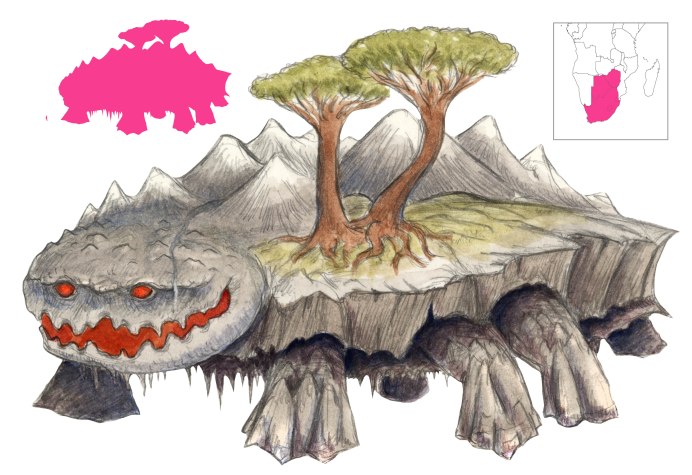
Usilosimapundu, “the rugose beast” or “the nodulated beast”, is a creature of superlatives. There are hills and mountains on his vast body, with rivers on one side, highlands on another, forests on the next, highlands and cliffs on other sides; he is so large that it is winter on one side of him and summer on the other. Two enormous trees, the Imidoni, serve as Usilosimapundu’s officers and servants. Usilosimapundu’s head is a huge rock, with eyes and a broad red mouth. He is a swallower, like many oversized African creatures, but also a force of nature, a personification of landslides and earthquakes.

The sorceress-princess Umkxakaza-wakogingqwayo (“Rattler of weapons of the place of the rolling of the slain”) was promised a great many cattle by her father the king, and the land was scoured for the finest livestock available. Unfortunately the very best cattle proved to be the property of Usilosimapundu. “Take them now”, he warned the soldiers, “but do not expect to get away with it”.

Umkxakaza was greatly pleased by her gift, and Usilosimapundu’s threat was forgotten as the years went by. That is, until the day the earth shook, and Usilosimapundu came to Umkxakaza’s doorstep. Two leaves detached from the Imidoni and took human form before heading for Umkxakaza and ordering her to do their bidding. They forced her to help prepare food for Usilosimapundu to eat – and eat he did, swallowing up everything in town. Finally Usilosimapundu had Umkxakaza climb onto his back, and he lumbered away with his trophy.

Of course, Umkxakaza’s father sent his armies to retrieve his daughter, but what good were the weapons of man against a living continent? Their spears landed in rocks, grass, ponds, trees – none of them had any effect on Usilosimapundu. Umkxakaza’s mother was the only one who continued to follow Usilosimapundu, and the beast obligingly gave her maize and sugarcane to eat while she hurried behind him, but eventually even the queen had to give up. She kissed Umkxakaza, weeping, bidding her to go in peace.

Usilosimapundu dropped Umkxakaza off in a fully furnished cave. “Your father spoiled me by taking my cattle”, he said, “so now I have spoiled him. He will never see you again”. With that Usilosimapundu left and was not seen again.

That was far from the end of Umkxakaza’s adventures, as she was abducted by the Amadhlungundhlebe half-men who fattened her up for eating. She escaped those new captors by summoning a storm, and made her way back to her father’s town, where she was greeted with joy and celebration.

Usilosimapundu has a female counterpart in Ugungqu-kubantwana, the mother of animals. Her name refers to the sound she makes when moving – gungqu, gungqu – rather like that made by a heavy wagon on a bumpy road.

References

Callaway, C. (1868) Nursery Tales, Traditions, and Histories of the Zulus. Trübner and Co., London.
Carcolh

Variations: Lou Carcolh (erroneously)

Carcolh

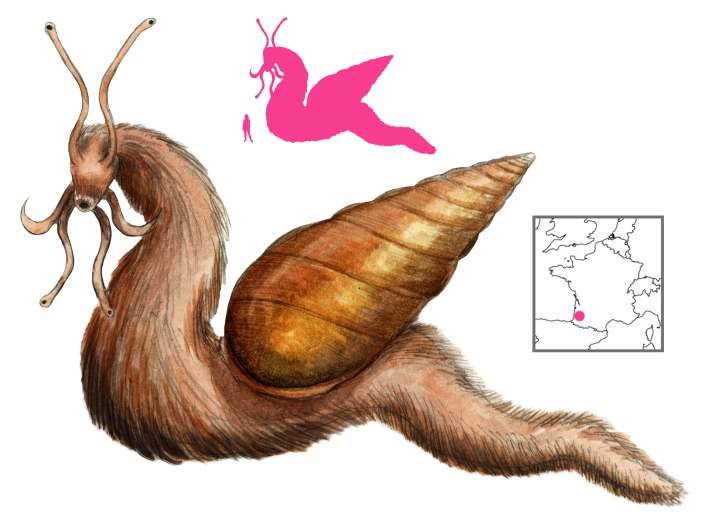
The French town of Hastingues, it is said, is built over an enormous cave honeycombed with entrance tunnels. Deep within that cave dwells the Carcolh (“snail”), also inaccurately known as “lou Carcolh” (“the snail”). The word is itself derived from the Spanish caracol, and does not have any special meaning, as evidenced by the béarnese riddle u houmiot qui s’emporte sa maysou darrè deu cot? Lou carcolh (“A little man who carries his house behind his back? The snail”).

Nobody knows how long the carcolh has lived there, or how old it is. It is a gigantic, slimy, shaggy serpent, with a shell as big as a house, and long prehensile tentacles.

The inhabitants of Hastingues hid their treasures underground before the Spanish invasion. Many have ventured into the cave in search of those treasures, and vanished without a trace. The carcolh does not move much, but its tentacles seize anyone who approaches it, dragging them into its shell to be consumed at leisure. At least one witness saw the carcolh drinking, and managed to escape before it saw him. He then blocked up the tunnel he had entered by, and swore never to return there again.

References

de Charencey, C. (1903) Etymologies Francaises et Provencales. Bulletin de la Société de Linguistique de Paris, v. 12, pp. lix-lxiv.

Foix, V. (1903) Glossaire de la Sorcellerie Landaise. Revue de Gascogne, v. 3, pp. 362-373.

Peyresblanques, J. (1977) Contes et Légendes des Landes. J. Pémartin, Dax.

Rolland, E. (1877) Devinettes ou Enigmes populaires de la France. F. Vieweg, Paris.

Pareas

Variations: Parea, Parias, Paruas, Pharias, Parous, Baron, Pagerina, Anguis Aesculapij, Aesculapian Snake

Pareas

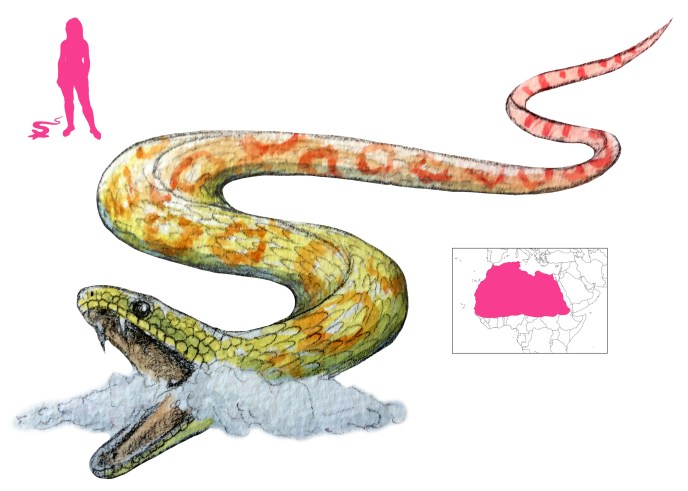
The Pareas is briefly mentioned in the Pharsalia’s catalogue of Libyan serpents. It always travels on its tail, leaving a furrow behind it in the ground. Its bite is harmless and gentle, and so it was consecrated to Asclepius, god of healers. Topsell classifies it among the innocent serpents.

Aelian describes it as being red with sharp eyes and a wide mouth. Topsell, on the other hand, gave its length as four spans, and its color as yellow with two long streaks down its side. Aldrovandi describes the pareas as being yellowish below and black above, with possible variations of green and white along its length. He dismisses the claim that it has a crest.

The tendency of the pareas to travel while holding itself clear of the ground has led to its association with the Eden serpent, which did not creep along the ground prior to being cursed. This claim has been contested by Alexander Neckham and Petrus Comestor, as the pareas very clearly does not conform to that curse. Petrus concluded that the curse must only have affected the individual serpent of Eden, leaving other snakes – including the pareas – uncursed.

References

Aelian, trans. Scholfield, A. F. (1959) On the Characteristics of Animals, vol. II. Harvard University Press, Cambridge, Massachusetts.

Aldrovandi, U. (1640) Serpentum, et Draconum Historiae. Antonij Bernie, Bologna.

Isidore of Seville, trans. Barney, S. A.; Lewis, W. J.; Beach, J. A.; and Berghof, O. (2006) The Etymologies of Isidore of Seville. Cambridge University Press, Cambridge.

Kelly, H. A. (1971) The Metamorphoses of the Eden Serpent during the Middle Ages and Renaissance. Viator, 2, pp. 301-328.

Lucan, trans. Rowe, N. (1720) Pharsalia. T. Johnson, London.

Topsell, E. (1658) The History of Serpents. E. Cotes, London.

Marool

Variations: Angler-fish, Carrachan, Devil-fish, Keddle-man, Kethrie, Kettach, Kilmaddy, Marmaid, Mareillen, Marsgum, Masgum, Meermaid, Merlin-fish, Molly Gowan, Monk-fish, Plucker, Shoemaker, Toad-fish, Weever, Wide-gab

Marool

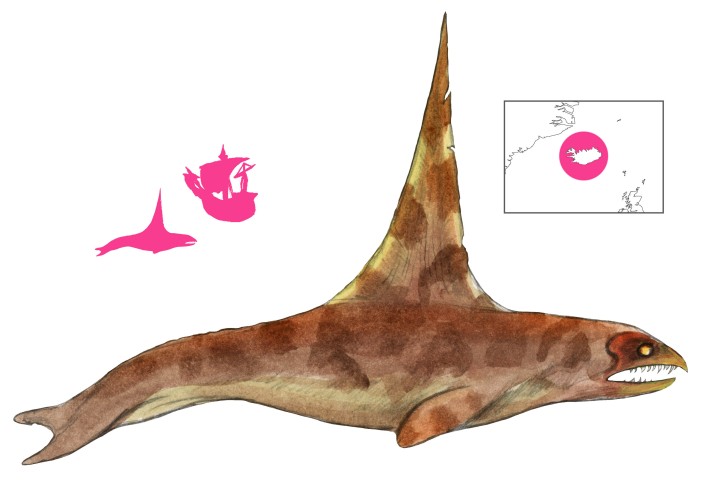
The Marool of Shetland is a malevolent marine devil, appearing in the form of a fish. It has eyes all over its head, and a crest of flame. It can be seen in mareel, or phosphorescent sea-foam. During storms the marool can be heard singing wildly with joy when a ship capsizes.

Marool is only one of a number of names that have been applied to the anglerfish or monkfish.

References

Forbes, A. R. (1905) Gaelic Names of Beasts (Mammalia), Birds, Fishes, Insects, Reptiles, Etc. Oliver and Boyd, Edinburgh.

Saxby, J. M. E. (1932) Shetland Traditional Lore. Grant and Murray Limited, Edinburgh.

It

It

Shetland is home to a number of creatures, some malevolent and some benign, but the most disconcerting of all is the entity known only as It.

Nobody can agree on what It looks like, and It has never appeared in the same form twice. Whether It is a shapeshifter or uses magic to obscure Its true appearance is unknown. Descriptions include a lump of “slub” or jellyfish, a legless animal, a headless human, and a bag of white wool. It could be a large otter or seal, but to those who have seen It, there is no otter or seal that compares. It is legless, but runs faster than any dog; It is wingless, but flies faster than any eagle; It is silent, but people understand what It is saying without hearing a word.

One Shetland house was plagued every Christmas by It. A man living there was alerted to Its presence, Its movement sounding like a mass of dead flesh hitting the floor. The man ran outside armed with an axe and a Bible, and chased It up the cliffs, embedding his axe in Its body while uttering a holy word. It was immobilized before It could dive back into the sea.

When the man called his friends over, they could tell if It was alive or dead, and It looked different to each of them. It was buried in earth and a trench dug around it, but nobody dared check on It. A stranger was brave enough to observe the burial site, but a mist rose, and something emerged from the ground to roll into the ocean. It had escaped.

References

Saxby, J. M. E. (1932) Shetland Traditional Lore. Grant and Murray Limited, Edinburgh.

Mastopogon

Variations: Aegomastus, Egomastus; Houperou, Huperus (erroneously?)

Houperou

The first appearance of the Mastopogon (“breast beard”), also called the Aegomastus, is as a nameless “strange fish” observed by Thevet off the coast of South America. It has a beard resembling a goat’s udder under its chin, and the illustration provided includes a long dorsal spine and pointed fins.

Thevet also describes the Houperou as a large carnivorous fish that eats all other sea creatures, except for one small fish. The carp-like fish remains in the shadow of the houperou and enjoys the protection granted by its larger friend. The houperou has rough sandpapery skin like a dogfish, sharp teeth, and a long spine on its back. It attacks, drowns, and dismembers anyone it catches in the water, and the native people shoot it with arrows on sight. The similarity of this unlikely couple to a shark and pilot fish is clear; in fact, uperu is the local name for “shark”, appropriately converted to French pronunciation by Thevet.

Gesner takes up the descriptions of the houperou and the udder-bearded fish from Thevet, but pictures the houperou or huperus as a large pike. He also coins Mastopogon and Aegomastus for Thevet’s nameless fish.

With time the heraldic mastopogon and houperou blurred together to the point of inextricability, making it necessary to describe them together. Holme describes the mastopogon as a variety of houperou, looking like a salmon with large thorny fins, the dorsal fin reaching all the way to the tail. The houperou, on the other hand, now has the mammary wattle, along with two ear-like knobs on its head, a long-spined dorsal fin, rough scales, and a straight tail.

References

Gessner, C. (1560) Nomenclator aquatilium animantium. Christoph Froschoverus.

Holme, R. (1668) The academy of armory, or, A storehouse of armory and blazon containing the several variety of created beings, and how born in coats of arms, both foreign and domestick. Printed by the author at Chester.

de Souza, G. S. (1851) Tratado Descriptivo do Brazil. Typographia Universal de Laemmert, Rio de Janeiro.

Thevet, A. (1558) Les Singularitez de la France Antarctique. Maurice de la Porte, Paris.

Thevet, A. (1575) La Cosmographie Universelle. Guillaume Chaudiere, Paris.

Sāmm-abraṣ

Variations: Sāmma-abraṣ, Abraṣan (dual); Sawāmm-abraṣ, Sawāmm, Biraṣa, Abariṣ, Abariṣa (plural); Borṣ-sāmm, Abu Braiṣ, Abu Breiṣ, Borṣ, Wazaghah, Gecko

[image pending]

The gecko has long been unfairly associated with leprosy in the Middle East, probably due to its greyish, leprous appearance, translucent, shedding skin, and detachable tail. Its common names of sāmm-abraṣ (“leper poison”) and abu braiṣ (“father of leprosy” or more simply “leper”) reflect the belief that it somehow transmits a deadly poison that causes leprosy.

Al-Qazwini and Al-Damiri describe the sāmm-abraṣ as being a large species of gecko, small-headed, long-tailed, with a leprous, sickly appearance. A sāmm-abraṣ is highly toxic and spreads leprosy by contact, often rolling in salt to transmit the disease. Its unwanted presence can be averted by the smell of saffron.

It is unlawful to eat or sell a sāmm-abraṣ, as one poet reflects “By God, even if I were His entirely, I would not be a slave eating abariṣ”. However, its blood cures alopecia, its liver alleviates toothache, its flesh heals scorpion stings, and its skin destroys hernias.

A sāmm-abraṣ in a dream is believed to represent poverty, anxiety, and toxic slander.

In India it is told that a gecko crawling over a sleeper’s body forebodes their imminent death, and a gecko falling on someone’s face makes them an albino. Ganges water and “gold water” in which gold has been placed counter the gecko’s poison, but it still ruins any food it touches.

The unwarranted evil reputation of the gecko, while deep-rooted, has not always been the case. Geckos feature in ancient Egyptian art in an apotropaic function, protecting the deceased from scavenging insects.

References

al-Damiri, K. (1891) Hayat al-hayawan al-kubra. Al-Matba’ah al-Khayriyah, Cairo.

Fremgen, J. (1996) The Folklore of Geckos: Ethnographic Data from South and West Asia. Asian Folklore Studies, vol. 55, pp. 135-143.

Guilhou, N. (2009) Lézards et geckos dans l’Égypte ancienne. IVe Rencontres archéozoologiques de Lattes, UMR 5140 – CNRS, Université Paul-Valéry
Montpellier 3.

Jayakar, A. S. G. (1908) Ad-Damiri’s Hayat al-Hayawan (A Zoological Lexicon), vol. II, part I. Luzac and Co., London.

Orr, J. (1915) The New Standard Bible Encyclopedia, volume III. The Howard-Severance Company, Chicago.

al-Qazwini, Z. (1849) Zakariya ben Muhammed ben Mahmud el-Cazwini’s Kosmographie. Erster Theil: Die Wunder der Schöpfung. Ed. F. Wüstenfeld. Dieterichsche Buchhandlung, Göttingen.

Prester

Variations: Presteros, Torridus (Torrid), Dipsas (Thirsty)

Prester

The Prester, “bellows-swelling”, “swollen veins”, or “inflater”,  is a deadly species of asp found in the deserts of Libya. Its name is derived from the gruesome effects of its venom, which were experienced firsthand by Lucan’s men. Aldrovandi believed it to be the same as the Dipsas, while Topsell saw it as distinct, since the prester kills by heat while the dipsas uses thirst.

Presters are so torrid that they keep their steaming mouth open to cool off, and foam constantly bubbles out from inside them. Topsell identifies presters with the fiery snakes that plagued the Israelites in the wilderness, but does not describe them beyond their extreme internal heat. They are fast-moving snakes, hurrying from place to place with their panting mouths wide open.

Aelian described the prester’s venom as causing profound lethargy, progressive weakness, loss of memory, inability to urinate, hair loss, choking, and eventually convulsions that lead to death. Flaubert specifies that mere contact with it causes debilitation.

Lucan describes more grotesque symptoms. The unfortunate Nasidius, upon suffering a scorching prester’s bite, feels the flames of the venom coursing through his veins. His entire body starts to swell, inflating and bloating and cutting through his armor, engulfing his limbs. The tumorous swelling ends only once Nasidius is a formless, headless heap. The remains are so disgusting that even the scavengers shun them.

Topsell recommends wild purslane, castoreum or beaver-stones, opoponax and rue in wine, and sprats as a remedy for prester bite.

References

Aelian, trans. Scholfield, A. F. (1959) On the Characteristics of Animals, vol. III. Harvard University Press, Cambridge, Massachusetts.

Aldrovandi, U. (1640) Serpentum, et Draconum Historiae. Antonij Bernie, Bologna.

Batinski, E. (1992) Cato and the Battle with the Serpents. Syllecta Classica, Vol. 3, pp. 71-80.

Eldred, K. O. (2000) Poetry in Motion: the Snakes of Lucan. Helios 27.1, p. 63.

Flaubert, G. (1885) La Tentation de Saint Antoine. Quantin, Paris.

Isidore of Seville, trans. Barney, S. A.; Lewis, W. J.; Beach, J. A.; and Berghof, O. (2006) The Etymologies of Isidore of Seville. Cambridge University Press, Cambridge.

Lucan, trans. Rowe, N. (1720) Pharsalia. T. Johnson, London.

Topsell, E. (1658) The History of Serpents. E. Cotes, London.

Dwarf

Variations: Dvergr, Dvergar, Duergr, Duergar (Old Norse); Dvärgher (Old Swedish); Dweorg, Dweorh (Anglo-Saxon); Twerg (Old High German); Dökkalf, Dökkalfar, Svartalf, Swartalf, Svartalfar, Swartalfar (Dark Elf, Black Elf); Dverge (Norway); Bjergfolk, Troldfolk (Denmark); Dvärg (Sweden)

Dwarf

“Dwarf” is a broad term that has been used to describe any supernatural being of short stature, often stunted and ugly in form, and living under the earth. Here it is used to refer specifically to the Scandinavian dwarfs, the chthonic master craftsmen who emerged from Ymir’s corpse, the personifications of the earth’s might and riches. They are also known as Dark Elves or Black Elves, distinguishing them from the elves living on the surface.

When Odin and his brothers slew the frost giant Ymir, they used his body to make the world. From his blood they made the seas and rivers, from his flesh the land, from his bones the mountains, and from his teeth the stones. The vault of Ymir’s skull was the heavens, and fire from the land of Múspellheim became stars.

Living inside the ruin of Ymir’s body were maggots digging through his flesh. Odin gave them consciousness and human form, but, much like maggots, they continued their existence digging through earth and stone. Odin tasked four dwarfs – North, South, East, and West – with holding up Ymir’s enormous skull.

Dwarfs were twisted, hunchbacked, bearded, short-legged, pallid like corpses, shunning the sun – which turned them to stone. As there were no female dwarfs, they carved new dwarfs out of the rock. While small and ugly by the Aesir’s standards, they were also unequaled as artisans, smiths, and jewelers.

The greatest of the Aesir’s artifacts were made by dwarfs. After Loki cut Sif’s hair as a prank, the other gods forced him under penalty of death to restore her beauty. The trickster god went to the sons of Ívaldi, who not only fashioned perfect golden hair for the goddess, but also the ship Skídbladnir, and Odin’s spear Gungnir. Impressed with their work, Loki dared the dwarfs Brokkr and Sindri to do better, wagering his own head in the process. Despite Loki’s best efforts to stop them, which included turning into a fly and biting them at crucial moments, he was unable to prevent the creation of the golden boar Gullinbursti, the gold ring Draupnir, and Thor’s hammer Mjolnir. All those gifts were presented to the gods, who decided that the hammer was the greatest item made by the dwarfs. Brokkr made for Loki’s head, but was outwitted by the god. “I wagered my head only, and not my neck. You’re welcome to it – if you do so without touching my neck”. Frustrated, Brokkr settled for stitching the impertinent Loki’s lips together.

Dwarfs also made Gleipnir, the silken ribbon that was used to bind the Fenris-wolf. It was made from a cat’s footfall, a woman’s beard, a mountain’s sinews, a rock’s roots, a fish’s breath, and a bird’s spittle. The wolf was immediately suspicious of the fragile-looking thread, and the god Tyr had to put his hand in the wolf’s mouth to humor him. As expected, the dwarfs’ cord held fast and bound the Fenris-wolf, but at the cost of Tyr’s hand.

The dwarf Alvíss, the “all-knowing”, lusted after Thor’s daughter. The god consented to give him her hand in marriage, but only if he could answer the questions he asked. Thor then proceeded to ask Alvíss questions about the world and the universe, which the wise dwarf answered proudly. In fact, Alvíss was so engrossed in showing off his intelligence that he failed to notice the approach of dawn, and the unfortunate dwarf was turned to stone by the rising sun.

Known Eddic dwarf names include Ài, Àlfr, Althjófr, Alvíss, Andvari, Austri, Báfurr, Bifurr, Bömburr, Brokkr, Dáinn, Dólgthvari, Dóri, Draupnir, Dúfr, Durinn, Dvalinn, Eikinskjaldi, Falr, Fidr, Fili, Frosti, Fundinn, Gandálfr, Ginnarr, Glóinn, Hárr, Heptifili, Hledjólfr, Hörr, Hugstari, Ívaldi, Kili, Litr, Mjödvitnir, Módsognir, Náinn, Nár, Nidi, Nípingr, Nordri, Nóri, Nýi, Nýr, Nýrádr, Óinn, Ónarr, Óri, Rádsvidr, Rekkr, Sindri, Skáfidr, Skirfir, Sudri, Svíarr, Thekkr, Thorinn, Thróinn, Thrór, Váli, Vestri, Vídr, Vindálfr, Virfir, Vitr, and Yngvi.

References

Aldington, R. and Ames, D. trans.; Guirand, F. (1972) New Larousse Encyclopedia of Mythology. Paul Hamlyn, London.

Appenzeller, T. and the Editors of Time-Life Books. (1985) Dwarfs. Silver Burdett Company, Morristown.

Dubois, P.; Sabatier, C.; and Sabatier, R. (1992) La Grande Encyclopédie des Lutins. Hoëbeke, Paris.

Edwards, G. (1974) Hobgoblin and Sweet Puck. John Sherratt and Son, Altrincham.

Keightley, T. (1978) The World Guide to Gnomes, Fairies, Elves, and other Little People. Avenel Books, New York.

MacCulloch, J. A. (1964) The Mythology of All Races v. II: Eddic. Cooper Square Publishers, New York.

Sturluson, S. (1916) The Prose Edda. Humphrey Milford, Oxford University Press, London.