Qiongqi

Variations: Thoroughly-Odd, Divine Dog

Qiongqi

Two versions of the Qiongqi, or “Thoroughly-Odd”, are described in the Guideways. The first variant of this Chinese creature is from Mount Gui, and resembles an ox with the quills of a hedgehog, and it howls like a dog. The second lives in the Land of the Demon People, and is a winged tiger. A third variety, referred to as a “divine dog”, is human with a dog’s head.

Qiongqi are carnivorous, and devour their prey head or feet first. They feed on people who wear their hair long, making them a particular threat to shamans and demons. They are evil creatures who devour the loyal and feed the rebellious, but they also eat insect poison.

Qiongqi has also appeared as the son of the thearch Lesser-Brilliance in Zuo’s Narratives, as the offspring of the Northern Desert Wind in Master of Huainan, and one of twelve divinities invoked in the Grand Exorcism.

References

Mathieu, R. (1983) Étude sur la mythologie et l’ethnologie de la Chine ancienne. Collège de France, Paris.

Strassberg, R. E. (2002) A Chinese Bestiary: Strange Creatures from the Guideways Through Mountains and Seas. University of California Press.

Ṣannāja

Variations: Ṣannājah, Ṣunnājah, Sannaja; Nubian Horse (erroneously)

Sannaja

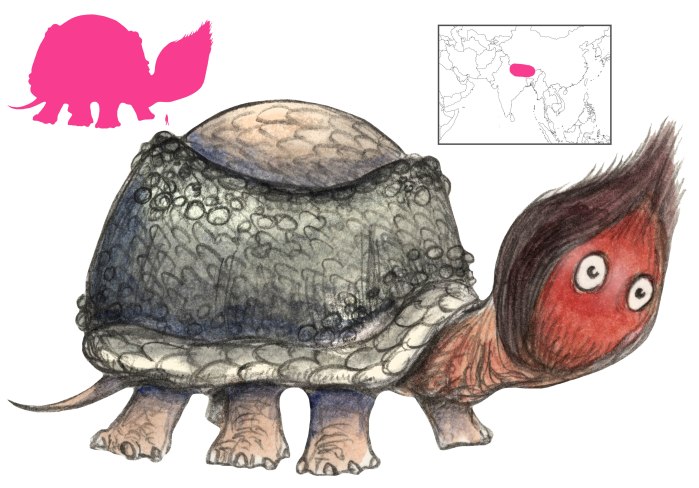
The Ṣannāja, “Cymbalist” (!), is a gigantic, deadly, yet pathetic creature originally described by al-Qazwini. It can be found in the land of Tibet, making it an abominable snowman of sorts, although it has more in common with the Gorgons of Greek myth.

According to al-Qazwini, the ṣannāja is indescribably vast, such that no animal can compare to it in size. This largest of all beasts makes dens one league wide.

Neither al-Qazwini nor al-Damiri describe its appearance, so artistic depictions of ṣannājas vary. As it is described in the same section along with insects and reptiles, the Wasit manuscript shows it with six stubby legs and a segmented, shelled turtle-like body. Its red, vaguely spiderish head is blank except for hair and two large, staring eyes. The artist of the C.1300 manuscript gives the ṣannāja a tusked, leonine head with massive, spotted folds of skin all over its body. A third is more cautious, assigning it the looks of a dragon. Finally, one Egyptian account is a ṣannāja in name only, placing it in African rivers and giving it four duck feet, a horse’s mane, water-buffalo skin, and a huge mouth. Described as the “Nubian Horse” living in water and ruining crops on land, this is the only case where the name has been applied to the hippopotamus.

The most distinctive quality of the ṣannāja is its deadly gaze, which nonetheless has a peculiar quality. Any animal that sees the ṣannāja dies instantly, but if the ṣannāja sees the animal first, it is the one to expire. Thus animals of Tibet come up to ṣannājas with their eyes closed, such that the monster will see them and drop dead, guaranteeing them a feast for weeks to come.

Accounts of mammoth fossils from Central Asia may have inspired the enormous ṣannāja. Traditional Tibetan art and kirttimukha faces may also have had a hand in its genesis.

References

Berlekamp, P. (2011) Wonder, Image, and Cosmos in Medieval Islam. Yale University Press, New Haven.

al-Damiri, K. (1891) Hayat al-hayawan al-kubra. Al-Matba’ah al-Khayriyah, Cairo.

Jayakar, A. S. G. (1908) Ad-Damiri’s Hayat al-Hayawan (A Zoological Lexicon), vol. II, part I. Luzac and Co., London.

Komaroff, L. and Carboni, S. (eds.) (2002) The Legacy of Genghis Khan. Yale University Press, New Haven.

Rapoport, Y. and Savage-Smith, E. (eds.) (2014) An Eleventh-Century Egyptian Guide to the Universe. Brill, Leiden.

al-Qazwini, Z. (1849) Zakariya ben Muhammed ben Mahmud el-Cazwini’s Kosmographie. Erster Theil: Die Wunder der Schöpfung. Ed. F. Wüstenfeld. Dieterichsche Buchhandlung, Göttingen.

Kamaitachi

Variations: Kama-itachi, Kamakaze (“Sickle wind”)

Kamaitachi

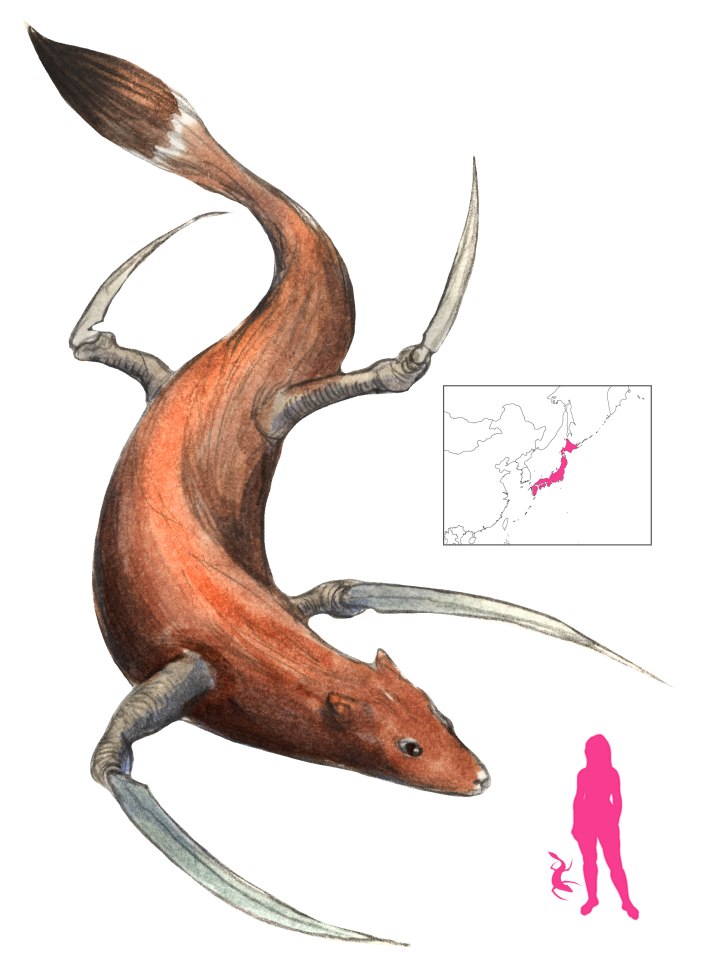
The Kamaitachi, or “sickle weasel”, is the Japanese yokai of unexplained cuts. It is most common in snowy Honshu. The name itself may be alternately derived from kamae-tachi, “poised sword”.

A kamaitachi looks something like a weasel with razor-sharp sickle claws. It travels in whirlwinds, but it is never seen. Instead, the presence of a kamaitachi is known by the cuts it leaves on its victims. It will also cause people to trip and fall, taking malign pleasure in causing injury.

Kamaitachi are useful scapegoats for inconvenient injuries. A woman in Niigata, after injuring herself during a nocturnal tryst, successfully deflected attention by blaming the kamaitachi for her wound.

The kamaitachi was rationalized in a number of ways, including pieces of sharp debris tossed around in whirlwinds. Y. Tanaka suggested that the “kamaitachi disease” was the result of temporary vacuums forming from stray air currents, slicing skin that came in contact with them. Such vacuums would be common in mountainous areas and thunderstorm conditions.

In Gifu the kamaitachi becomes three gods, the first pushing over the victim, with the second cutting with a knife and the third healing the injury.

References

Foster, M. D. (2015) The Book of Yokai. University of California Press, Berkeley.

Griffis, W. E. (1876) The Mikado’s Empire. Harper and Brothers, New York.

Y. Tanaka (1911) An Epitome of Current Medical Literature: Spontaneous Wounds. British Medical Journal, v. 2, p. 37.

Swan Valley Monster

Swan Valley Monster

The Swan Valley Monster made its appearance on August 22, 1868, in the otherwise tranquil locale of Swan Valley, Idaho. Its presence was witnessed and reacted to by an unnamed old-timer crossing the river at Olds Ferry.

The first thing he saw of the monster was an elephant’s trunk rising from below the surface and spouting water. This was followed by a snake-like head the size of a washtub, with a single horn that kept moving up and down, and long black whiskers on both sides of the face. It had ten-inch-long fangs and a red forked tongue that spewed green poison. When it hauled its massive body onto the shore, the old-timer noted that it must have been twenty feet long, and it stank to high heaven. A pair of wing-like fins – or fin-like wings – came out of the sides of its neck. Its forward half was like a snake, the thickness of a calf, greenish-yellow with red and black spots; this in turn led into a fish-like section with hand-sized rainbow scales shining in the sun; finally, the tail was a drab, scaly gray like a crocodile or lizard tail. Shiny black barbed spines, like those of a porcupine, lined its back from head to tail. Finally, it had twelve stubby legs that were easily missed at first glance; the first pair under the fins had hoofs, followed by two pairs of legs with razor-sharp claws, then a pair of hoofed feet, a pair of clawed feet, and another pair of hoofed feet near the tail.

Of course, the old-timer’s first reaction to the abomination slithering up the bank was to fire a slug into its eye. The monster reared up, hissing, bellowing, and spurting poison over its surroundings, so it got shot a second time in its yellow belly, convulsed, and stopped moving. Everything its poison had touched, whether trees or grass or other living beings, withered and died.

As the monster was too large to be carried off by one man, the old-timer returned to town to fetch a wagon and six strapping lads to help him, as well as a tarp to protect them from the poison. They could smell the odoriferous creature a hundred yards away, and one of the men had to stay with the horses to keep them from bolting, while another got sick and refused to come any closer. But when they reached the bank where the monster had fallen, there was nothing but withered vegetation and a trail leading to the water.

Presumably the Swan Valley monster had crawled back into the river to die – or perhaps it didn’t die. Whatever its fate, the old-timer recommended keeping a close watch on the river, as “I’ve hunted an trapped an fished all over the state fer nigh ontuh seventy-five year… but I ain’t never seen nothin tuh compare with that speciment”.

References

Clough, B. C. (1947) The American Imagination at Work. Alfred A. Knopf, New York.

Fisher, V. ed. (1939) Idaho Lore. Federal Writers’ Project, The Caxton Printers, Caldwell.

Lewicki, J. and the editors of LIFE (1960) Folklore of America, part V. LIFE Magazine, Aug. 22, 1960.

Mantabungal

Mantabungal

The Mantabungal is known to the Tagbanua of Palawan, in the Philippines. It is found primarily in the forests of Mount Victoria in Baraki, and is the most feared of the mountain demons.

A mantabungal is like a cow in body and voice, but lacks horns. It has a long coat of shaggy hair that reaches the ground. Its monstrous mouth has two pairs of huge incisors – two above and two below – that it uses to tear its victims to shreds.

One man reported hearing bovine moos while gathering gum in the mountains. Spooked and disoriented in the darkness, he ran aimlessly into the forest as far as he could and spent the night shivering miserably under a tree. When he returned to camp, he found that the mantabungal had destroyed everything he had touched. His hut, gear, and even the firewood had been dismantled and chewed to bits.

References

Fox, R. B. (1982) Religion and Society among the Tagbanuwa of Palawan Island, Philippines. Monograph No. 9, National Museum, Manila.

Ramos, M. D. (1971) Creatures of Philippine Lower Mythology. University of the Philippines Press, Quezon.

Yamabiko

Variations: Yama-biko

Yamabiko

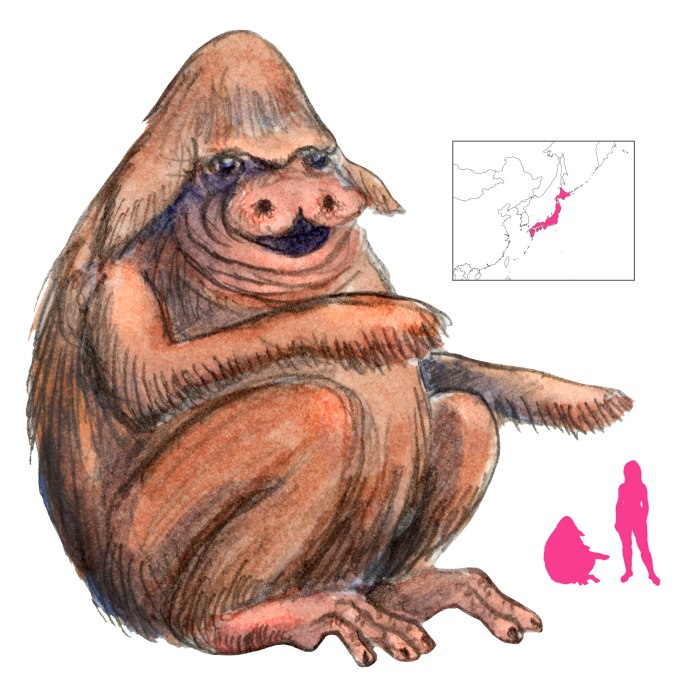
The Yamabiko, “mountain echo” or simply “echo” is heard rather than seen. It is found in the high mountains of Japan, and answers anyone shouting in the mountains with a mocking echo of their voice. While there is no definite version of its appearance, it was depicted by Toriyama Sekien as a rather simian creature.

Its name can also be interpreted as “spirit of valley reverberation”. It is not known if the yamabiko yokai was named for the echo, or if the echo was named for the yokai. The Yamabiko Shinkansen train, on the other hand, is named for the echo and not the yokai.

References

Foster, M. D. (2015) The Book of Yokai. University of California Press, Berkeley.

Agrippa

Variations: Égremont, Vif
Agrippa

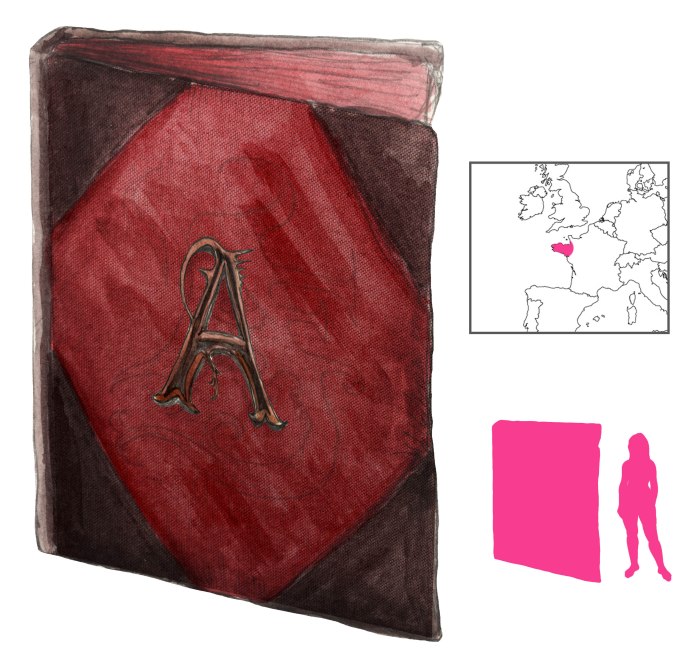
In Brittany, the Agrippa is one of the most feared and malevolent grimoires, a living book with a mind of its own. Its name in Tréguer is derived from that of Heinrich Cornelius Agrippa, but it is also known as Égremont in Châteaulin and Vif (“Alive”) around Quimper.

An agrippa is enormous, standing fully as tall as a man. Its pages are red, while its letters are black – although some variants exist with black pages and red text. It contains the names of all the devils, and how to summon them.

Agrippas are living, malicious creatures, and resent being read. An untamed agrippa will display only blank pages. To get the letters to appear, the agrippa must be battled, thrashed, and beaten like a stubborn mule. A fight with an agrippa can last hours, and victors come out of it exhausted and drenched in sweat. When not in use, an agrippa must be chained to a strong, bent beam.

Only priests can be trusted to keep agrippas, as they have the training and the force of will required to master it. They use it to deduce the fate of the dead by calling upon all the demons in order; if none will admit to having taken the deceased’s soul, then they were saved. Long ago all priests had agrippas, and a newly-ordained priest would inexplicably find one on his table. However, agrippas have since found their way into the hands of laymen, and the temptation to use them can be very strong. A priest will not be able to sleep well as long as one of his parishioners has an agrippa.

Uninitiated readers of the agrippa will always smell of sulfur and brimstone, and walk awkwardly to avoid treading on stray souls. A man with an agrippa will find himself incapable of destroying it – a task that will become increasingly desperate, as possession of an agrippa will prevent entry into Paradise. Loizo-goz, a man from Penvénan, tried to rid himself of his agrippa by dragging it away to Plouguiel on the end of a chain, but came back home to find it had returned to its usual place. He then tried burning it, but the flames recoiled from the book. Finally he dumped the agrippa into the sea with rocks tied to it, only to see it climb out of the water, shake its shackles off, and make a beeline for its suspended perch. Its pages were perfectly dry. Loizo-goz resigned himself to his fate.

Eventually a priest will arrive to save the owner of an agrippa. He will wait until the unfortunate is at death’s door, whereupon he will come to his deathbed. “You have a very heavy burden to carry beyond the grave, if you do not destroy it in this world”, he tells him. The agrippa is untied and brought down, and while it tries to escape, the priest exorcises it, and sets fire to it himself. He then collects the ashes, places them in a sachet, and puts them around the dying man’s neck, telling him “May this weigh lightly upon you!”

Other times a priest will have to save a man whose reading of the agrippa took him too far. A Finistère parson found his sacristan missing, and his agrippa open wide on the table. Understanding that the sacristan had summoned the devils and been unable to dismiss them, he started calling upon them one by one until they released him. The sacristan was blackened with soot and his hair was scorched, and he never told a soul of what had transpired.

References

Le Braz, A. (1893) La Légende de la Mort en Basse-Bretagne. Honoré Champion, Paris.

Luzel, F. M. (1881) Légendes Chrétiennes de la Basse-Bretagne, v. II. Maisonneuve et Cie, Paris.

Seignolle, C. (1964) Les Évangiles du Diable. Maisonneuve et Larose, Paris.

Tosetáx

Variations: Tsamtáx, Tsamtás (pl.)

Tosetax

According to the Nivaklé of Paraguay, dry seasons are exacerbated by the Tsamtás serpents, which lie in the middle of the sky and radiate heat. A tsamtáx will intercept and eat the Fanxás or thunderbirds flying from the south and bringing rain with them. Only the shamans can prevent this state of things by tearing down the tsamtás nest, making them fall to their death and allowing the rainy season to return.

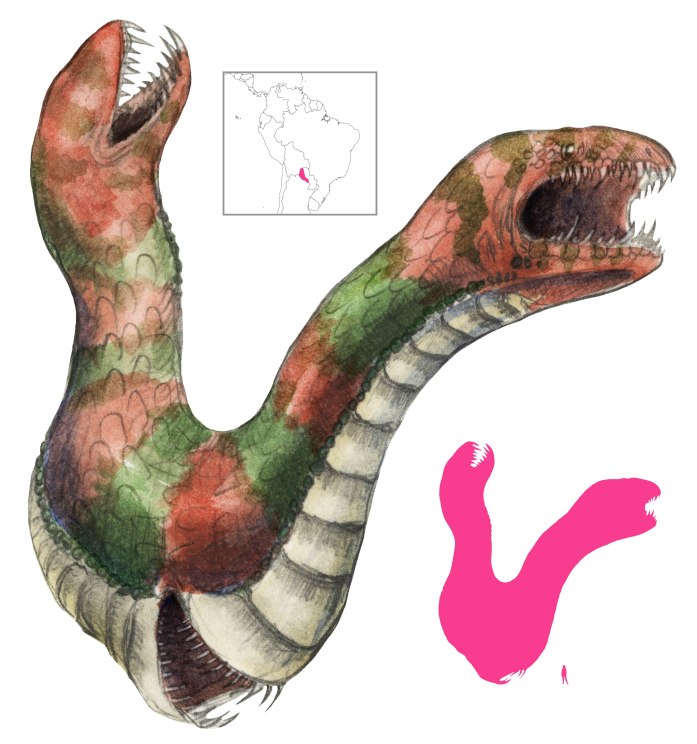
Tosetáx is even more terrifying. He arrived after the tsamtás had been dealt with, and installed himself in the center of the sky. Tosetáx is an enormous green and red snake, with three mouths – one at the head, one at the tail, and one in the middle of his body. As with the tsamtás, Tosetáx was waiting to ambush the returning thunderbirds.

Tosetáx was defeated by five powerful shamans who turned themselves into snakes. One of the shamans coiled himself around Tosetáx and, by turning and coiling, took him to the north out of the thunderbirds’ flight path. There the shamans cut off the serpent’s three mouths and cut him in half, killing him.

References

Chase-Sardi, M.; Costa, M. M.; Mashnshnek, C. O.; Siffredi, A.; Tomasini, J. A.; Wilbert, J. and Simoneau, K. eds. (1987) Folk Literature of the Nivaklé Indians. UCLA Latin American Center Publications, University of California, Los Angeles.

Gremlin

<strong>Variations:</strong> ?

<img class=”alignnone size-full wp-image” src=”https://abookofcreatures.com/wp-content/uploads/2016/04/gremlin.jpg&#8221; width=”451″ height=”612″ />

<img class=”alignnone size-full wp-image” src=”https://abookofcreatures.com/wp-content/uploads/2016/04/gremlin-2.jpg&#8221; width=”451″ height=”612″ />

Gremlin 3

Every unexplained mechanical error, every mysteriously malfunctioning engine, defective wheel, gas leak, fuselage weakness, cockpit damage, and avionics glitch can be blamed on gremlins. These little machine fairies are the modern equivalent of the ancient dwarfs, but they destroy instead of build.

Etymologies for “gremlin” disagree, and are probably all apocryphal. One suggestion holds that it originates from the antiquated Old English gremian, “to vex”. This is related to the Irish Gaelic gruaimin, “grumpy little fellow”, which comes from gruaim, “gloom” or “ill-humor”. Another suggestion is a shortening of grinning goblin. The French grelon or “hailstone” indicates some meteorological confusion. Edwards adds the German gram or “worry” to the mix, from which the diminutive gramlein can be derived. Finally, Fremlins beer may have had a hand in inspiring gremlins.

Similarly there is no consensus on gremlin appearance, but it is generally assumed that they are small, six inches to a foot in height, and humanoid in appearance. They are skinny and nimble enough to move about through complex machinery. Known colors include green and blue-grey. Some have horns, others have pointed ears; webbed feet and suction cups have been suggested for yet others. Clothing is optional, including nudity, pilot gear, breeches and jackets, and even spats and top-hats. They eat treacle and honey, and drink fuel, sucking tanks dry.

Gremlins were first identified by R.A.F. pilots, especially on Maltese airfields in World War I, although there is evidence to suggest that they have been around longer than that. From there tales of the gremlins and their deeds spread throughout the piloting world, until they became a byword for any unexplained mechanical issues.

Gremlin activities range from juvenile pranks to outright destructive cruelty. They view all airplanes as an affront, and do whatever they can to ground them. Some gremlin subspecies specialized in specific forms of mischief. Mole-like Cavity gremlins dug holes in runways, Incisors teethed on wires, Jockeys guided birds into airplane windscreens, and Optics glowed over bomb sights.

While gremlins have faded from the aerial popularity they enjoyed during the war, the preponderance of technology in our modern world has only given them further targets to mess wgsgnslfgnsogdkfjgluiw4v8r93428RQVNWAELIVJWBKkjdhzseuwy5ycjdft3534bsrg5566fgdfgcbvgbc

<strong>References</strong>

Dubois, P.; Sabatier, C.; and Sabatier, R. (1992) La Grande Encyclopédie des Lutins. Hoëbeke, Paris.

Edwards, G. (1974) Hobgoblin and Sweet Puck. John Sherratt and Son, Altrincham.

Jaculus

Variations: Iaculus, Jaculare; Sagitta (Latin); Acontia, Acontias, Saetta (Greek); Cafezati, Cafezasi, Altararat, Acoran, Altinanti (Arabic); Orchilanne (Turkish); Saettone (Calabria and Sicily); Ein Schosse Oder Angelsch Lang (German); Decurtati (Hungary)

Jaculus

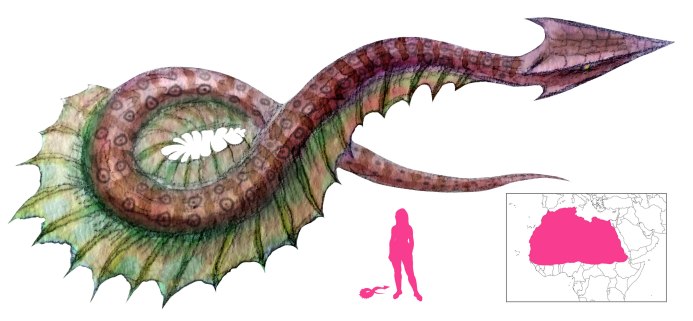
The Jaculus, “javelin” or “dart”, is one of the many snakes that attacked Lucan’s forces during their march through the Libyan desert. While catalogued as a Libyan desert snake, Topsell expanded its range to include Rhodes, Lemnos, Calabria, Sicily, Germany

It can be considered a flying snake, although the “flight” is long-distance leaping over ten to thirty feet. They get into trees and bushes, bunch themselves up in bow and hoop shapes, and fling themselves at high speed onto their prey. Traveling as fast as a thrown javelin, they can puncture clothing and flesh alike. Jaculi are cunning and cruel, and will lie in ambush for human prey, but their presence is given away by the noise they make while coiling in dry plants.

The appearance of the jaculus varies, but it usually has small black ocelli, no bigger than lentils, on its body. The jaculi of Rhodes are ash-colored with a white belly and two black lines running from its head to the tip of its tail; the cafezati or “jumpers” of the Middle East are red, and have been posited as the Biblical fiery serpents. The Hungarian jaculi or decurtati are thick and short-tailed, only two hands long.

A jaculus killed Paulus, one of Lucan’s men, by darting from a distance before it could be seen. It was not venom that felled its victim, but rather the gaping hole left behind after it passed through Paulus’ head at the temples. Topsell believed it was a jaculus that attacked the apostle Paul and bit his hand. Another such snake coiled around the arm of a Zurich peasant; even though it didn’t bite, the arm ended up putrefying and requiring yearly bleeding to drain the black blood inside.

Topsell attests that the same antidotes used for viper venom can be used for jaculus bites. He adds that jaculus gall with Scythian stone yields eye-salve.

References

Aelian, trans. Scholfield, A. F. (1959) On the Characteristics of Animals, vol. II. Harvard University Press, Cambridge, Massachusetts.

Aldrovandi, U. (1640) Serpentum, et Draconum Historiae. Antonij Bernie, Bologna.

Isidore of Seville, trans. Barney, S. A.; Lewis, W. J.; Beach, J. A.; and Berghof, O. (2006) The Etymologies of Isidore of Seville. Cambridge University Press, Cambridge.

Lucan, trans. Rowe, N. (1720) Pharsalia. T. Johnson, London.

Topsell, E. (1658) The History of Serpents. E. Cotes, London.