Each Uisge

Variations: Each-uisge, Water horse

each-uisge

While the kelpie plies the rivers and streams of Scotland, the lochs and seas are home to the far more dangerous Each Uisge, literally the “Water Horse”. Each uisges are carnivorous, and relish human flesh. While other water-horses are content with playing pranks, tossing riders into ponds and laughing at their lot, an each uisge’s actions are always predatory. In addition to hunting humans, they will also reproduce with farm animals, siring foals with flashing eyes, strong limbs, distended nostrils, and an indomitable spirit.

Like kelpies, each uisges are shapeshifters and can assume a wide variety of forms, from sea life to attractive human beings. Their most common guise, however, is that of a fine horse, standing by the waterside and waiting to be mounted. Such horses are always magnificent, sleek, and wild-looking, and their neighs can wake people up all around the mountains.

The each uisge in human form is attractive and charming, but always has some features that give it away – horse’s hooves, for instance, or hair full of sand and seaweed, or a tendency to whinny in pain. In such cases where an each uisge lover was found out, it is usually killed by the girl’s father or brothers before it can devour her. Regardless of the shape it has taken, an each uisge’s carcass will turn into formless jellyfish slime by the next day.

Sometimes the each uisge is a large bird, although this may be confusing it with the boobrie. More worrisome features have been observed, including viciously hooked, 17-inch long beaks, enormous claws, and footprints larger than an elephant’s. An each uisge observed at the Isle of Arran was light grey, with a parrot-like beak and a body longer than an elephant’s.

For all their carnivorous nature, each uisges can be easily tamed by slipping a cow’s cap or shackle onto it, turning it docile and harmless. If the cap or shackle ever falls off, the each uisge immediately gallops off for the safety of the loch, possibly dragging its would-be master with it. Each uisges can also be tamed by stealing their magic bridles. They use them to see fairies and demons, and are vulnerable without them. Finally, like many other evil creatures, each uisges avoid crosses and other religious symbols.

Every loch in Scotland has its own each uisge. Loch Treig was said to have the fiercest each uisges. Loch Eigheach means “Horse Loch” and is home to a much-feared each uisge, with a deadly charm and a silky grey hide. It would yell triumphantly as it bore its prey into the water.

Seven girls and a boy once found an each uisge on a Sunday afternoon near Aberfeldy. It was in the form of a pony, and it continued grazing as the first girl jumped onto its back. One by one, the other girls followed their friend onto the pony, but only the boy noticed that the pony’s back grew longer to accommodate its riders. Finally, the pony tried to get him on as well. “Get on my back!” it said, and the boy ran, hiding in the safety of the rocks. The terrified girls found that their hands stuck to the each uisge’s back, and they could only scream as it dove into the loch. The next day, seven livers floated to the surface.

The son of the Laird of Kincardine encountered an each-uisge near Loch Pityoulish. He and his friends found a black horse with a bridle, reins, and saddle all made of silver. They got onto it and immediately found themselves on a one-way trip to the loch, their hands glued to the reins. Fortunately for the heir of Kincardine, the youth had only touched the reins with one finger, and freed himself by cutting it off, but he could only watch as the water-horse took his friends with it.

While the water-horse legend may be pervasive and universal in northern Europe, some of the each uisge’s appearances may be more prosaic. The beak and large footprints of some each uisges suggest a leatherback turtle more than they do a horse.

References

Fleming, M. (2002) Not of this World: Creatures of the Supernatural in Scotland. Mercat Press, Edinburgh.

Gordon, S. (1923) Hebridean Memories. Cassell and Company Limited, London.

MacKinlay, J. M. (1893) Folklore of Scottish Lochs and Springs. William Hodge & Co., Glasgow.

Parsons, E. C. M. (2004) Sea monsters and mermaids in Scottish folklore: Can these tales give us information on the historic occurrence of marine animals in Scotland? Anthrozoös 17 (1), pp. 73-80.

Behemoth

Variations: Shor Ha-bar (“Wild Ox”), Bahamut, Bahamoot

behemoth

Behemoth is the plural form of the Hebrew behemah, or “animal”; appropriately, the word is used to describe a creature of vast size and bulk.

The best-known reference to Behemoth is offered in the Biblical book of Job (40:15-24), where it is mentioned in God’s whirlwind tour of humbling natural wonders. The Behemoth eats grass like an ox, and its strength is in its muscular loins and tight-knit thigh sinews. Its tail stiffens like a cedar, its bones are like bronze, and its legs like iron bars. Despite its power, it is apparently passive and indolent, lying in marshes under lotus plants, and feeding in the mountains alongside the wild animals. Behemoth does not fear the river when it rushes into its mouth, and cannot be taken with hooks; only God can approach it.

Psalms 50:10 makes reference to “the behemoth on a thousand hills”, nowadays translated to “the cattle on a thousand hills”. The Midrash elaborates on that, making the Behemoth large enough to sit on the thousand mountains it feeds on, and making it drink six to twelve months’ worth of the Jordan River in one gulp.

The Talmud gives the Behemoth further cosmic significance. The behemoth were created male and female, but to prevent them destroying the Earth, God castrated the male and preserved the female in the World-to-Come for the righteous. This vision of the Behemoth has been interpreted as metaphoric, with the Behemoth representing materialism and the physical world.

If Behemoth is an animal known to us today, the primary candidates are the wild ox, the elephant, and the hippopotamus. The wild ox seems dubious, otherwise the Behemoth would not eat grass “like” an ox. The elephant’s trunk may have been the basis for the “tail”, but the description refers to stiffening, something which the hippo’s tail does. Another possibility is that the “tail” is in a fact a euphemism, and the description refers to the virility and vigor of the bull hippopotamus. Further details – living in water, feeding on land, a mouth big enough for the Jordan to rush into, terrifying power – all but prove that the hippopotamus is the subject of Job’s verses. Bochart agreed, heading his discussion of Behemoth with “non esse elephantum, ut volunt, sed hippopotamum“.

The Arabian Bahamut is a further magnification of the already-large Behemoth, turning it into a vast cosmic fish, one of the foundations on which the Earth stands. It is so big that all the seas and oceans of the Earth placed in its nostril would be like a mustard seed in a desert.

Behemoth is now a synonym for any large animal. Buel gives us behemoth as a possible originator of the word “mammoth”, alongside the Latin mamma and the Arabic mehemot.

The suggestion that Behemoth is a late-surviving dinosaur is best left unaddressed.

References

Bochart, S. (1675) Hierozoicon. Johannis Davidis Zunneri, Frankfurt.

Borges, J. L.; trans. Hurley, A. (2005) The Book of Imaginary Beings. Viking.

Buel, J. W. (1887) Sea and Land. Historical Publishing Company, Philadelphia.

Coogan, M. D.; Brettler, M. Z.; Newsom, C.; Perkins, P. (eds.) (2010) The New Oxford Annotated Bible. Oxford University Press, Oxford.

Slifkin, N. (2011) Sacred Monsters. Zoo Torah, Jerusalem.

Qiongqi

Variations: Thoroughly-Odd, Divine Dog

Qiongqi

Two versions of the Qiongqi, or “Thoroughly-Odd”, are described in the Guideways. The first variant of this Chinese creature is from Mount Gui, and resembles an ox with the quills of a hedgehog, and it howls like a dog. The second lives in the Land of the Demon People, and is a winged tiger. A third variety, referred to as a “divine dog”, is human with a dog’s head.

Qiongqi are carnivorous, and devour their prey head or feet first. They feed on people who wear their hair long, making them a particular threat to shamans and demons. They are evil creatures who devour the loyal and feed the rebellious, but they also eat insect poison.

Qiongqi has also appeared as the son of the thearch Lesser-Brilliance in Zuo’s Narratives, as the offspring of the Northern Desert Wind in Master of Huainan, and one of twelve divinities invoked in the Grand Exorcism.

References

Mathieu, R. (1983) Étude sur la mythologie et l’ethnologie de la Chine ancienne. Collège de France, Paris.

Strassberg, R. E. (2002) A Chinese Bestiary: Strange Creatures from the Guideways Through Mountains and Seas. University of California Press.

Kamaitachi

Variations: Kama-itachi, Kamakaze (“Sickle wind”)

Kamaitachi

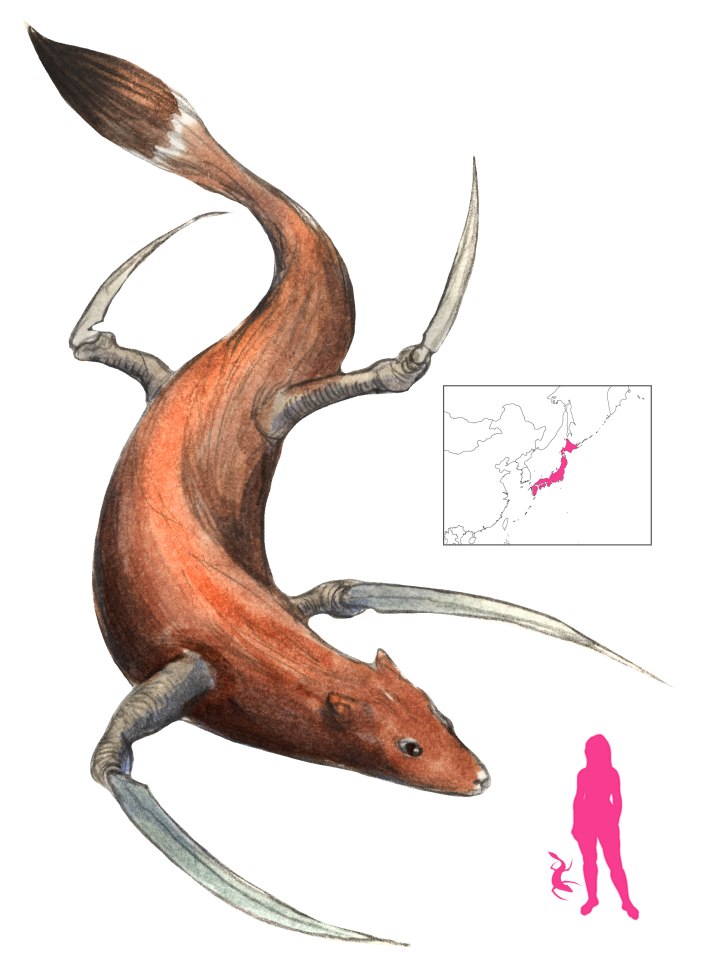
The Kamaitachi, or “sickle weasel”, is the Japanese yokai of unexplained cuts. It is most common in snowy Honshu. The name itself may be alternately derived from kamae-tachi, “poised sword”.

A kamaitachi looks something like a weasel with razor-sharp sickle claws. It travels in whirlwinds, but it is never seen. Instead, the presence of a kamaitachi is known by the cuts it leaves on its victims. It will also cause people to trip and fall, taking malign pleasure in causing injury.

Kamaitachi are useful scapegoats for inconvenient injuries. A woman in Niigata, after injuring herself during a nocturnal tryst, successfully deflected attention by blaming the kamaitachi for her wound.

The kamaitachi was rationalized in a number of ways, including pieces of sharp debris tossed around in whirlwinds. Y. Tanaka suggested that the “kamaitachi disease” was the result of temporary vacuums forming from stray air currents, slicing skin that came in contact with them. Such vacuums would be common in mountainous areas and thunderstorm conditions.

In Gifu the kamaitachi becomes three gods, the first pushing over the victim, with the second cutting with a knife and the third healing the injury.

References

Foster, M. D. (2015) The Book of Yokai. University of California Press, Berkeley.

Griffis, W. E. (1876) The Mikado’s Empire. Harper and Brothers, New York.

Y. Tanaka (1911) An Epitome of Current Medical Literature: Spontaneous Wounds. British Medical Journal, v. 2, p. 37.

Mantabungal

Mantabungal

The Mantabungal is known to the Tagbanua of Palawan, in the Philippines. It is found primarily in the forests of Mount Victoria in Baraki, and is the most feared of the mountain demons.

A mantabungal is like a cow in body and voice, but lacks horns. It has a long coat of shaggy hair that reaches the ground. Its monstrous mouth has two pairs of huge incisors – two above and two below – that it uses to tear its victims to shreds.

One man reported hearing bovine moos while gathering gum in the mountains. Spooked and disoriented in the darkness, he ran aimlessly into the forest as far as he could and spent the night shivering miserably under a tree. When he returned to camp, he found that the mantabungal had destroyed everything he had touched. His hut, gear, and even the firewood had been dismantled and chewed to bits.

References

Fox, R. B. (1982) Religion and Society among the Tagbanuwa of Palawan Island, Philippines. Monograph No. 9, National Museum, Manila.

Ramos, M. D. (1971) Creatures of Philippine Lower Mythology. University of the Philippines Press, Quezon.

Yamabiko

Variations: Yama-biko

Yamabiko

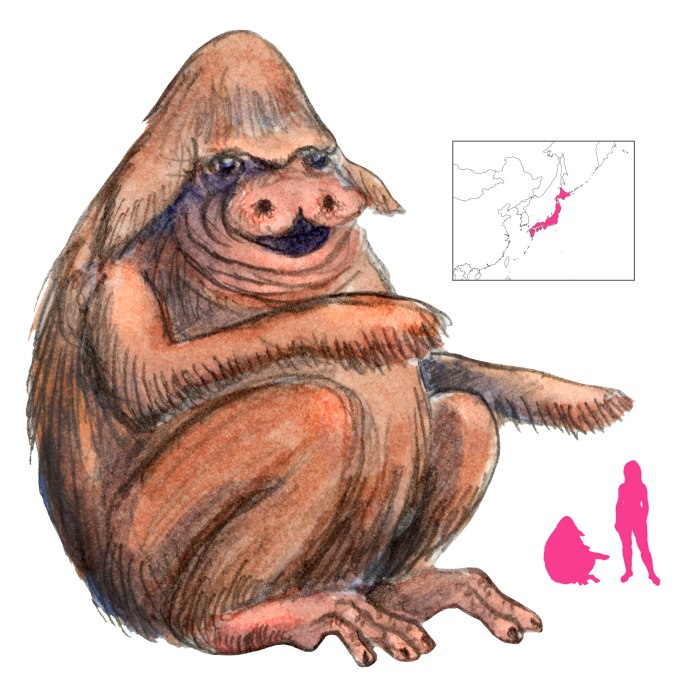
The Yamabiko, “mountain echo” or simply “echo” is heard rather than seen. It is found in the high mountains of Japan, and answers anyone shouting in the mountains with a mocking echo of their voice. While there is no definite version of its appearance, it was depicted by Toriyama Sekien as a rather simian creature.

Its name can also be interpreted as “spirit of valley reverberation”. It is not known if the yamabiko yokai was named for the echo, or if the echo was named for the yokai. The Yamabiko Shinkansen train, on the other hand, is named for the echo and not the yokai.

References

Foster, M. D. (2015) The Book of Yokai. University of California Press, Berkeley.

Brethmechin

Variations: Arabian Breth-mechin, Whale Panther

Brethmechin

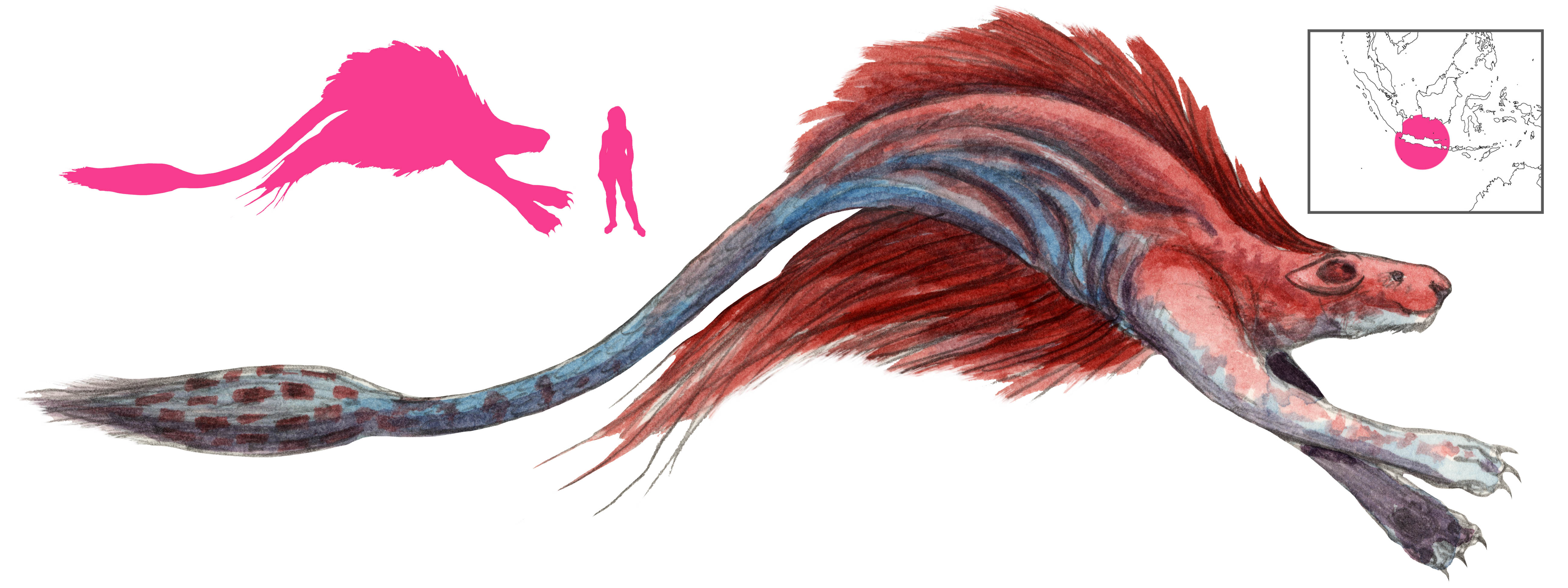
Gessner describes the Brethmechin as an amphibious beast found near the island of Java. He gives the name as being of Arabic etymology, although it is hard to tell what words it derives from. Gessner’s contact was Theodorus Beza, who reported a brethmechin washed up on the Javan shore on April 14, 1551.

A brethmechin is 10 cubits (about 4.5 meters) long and 2 cubits (about 1 meter) high. It has two legs, which allow it to move around on land to some extent. It has a panther’s head and a lion’s claws, with a horse-like tuft of hair on the tip of its pantherine tail. Brethmechins are red in color with blue markings, and have a lighter cerulean tail with red spots. They are well furnished with red dorsal and ventral bristles, with the ventral bristles being particularly long towards the tail.

The brethmechin has seen minor use in heraldry.

References

Gessner, C. (1560) Nomenclator aquatilium animantium. Christoph Froschoverus.

Holme, R. (1668) The academy of armory, or, A storehouse of armory and blazon containing the several variety of created beings, and how born in coats of arms, both foreign and domestick. Printed by the author at Chester.

Xi

Variations: Xi-Rhinoceros; Xiqu (potentially); Si, Si-Rhinoceros (potentially)

Xi

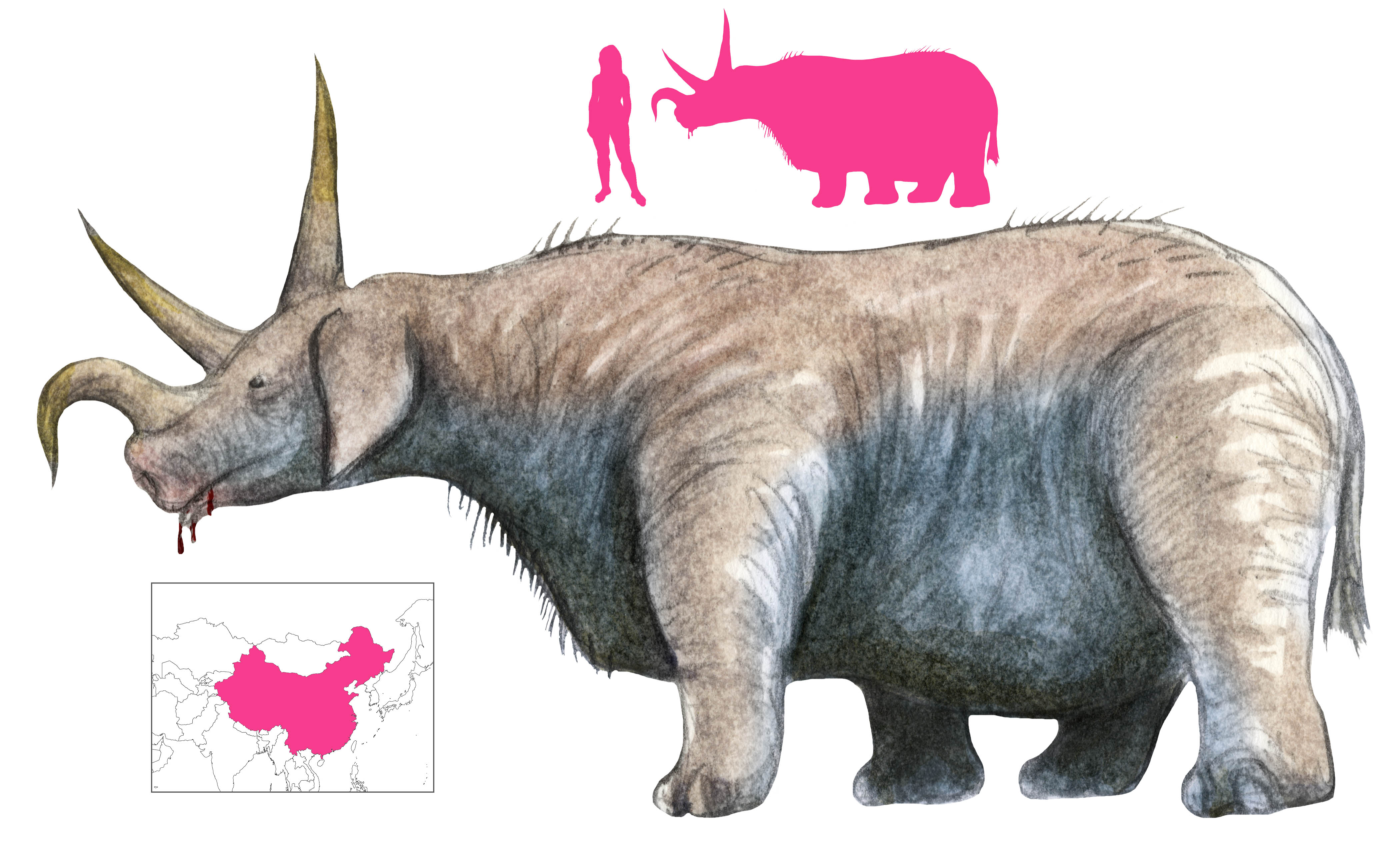
Among the wildlife to be found on Cauldron Mountain, Mount Min and Pray-and-Pass Mountain is the Xi. It is like a black water buffalo with a pig’s head, a large belly, and three-toed elephant’s feet on short legs. It has three horns, found on its nose, forehead, and crown. The nose horn does not fall off and helps it eat. Xi feed primarily on brambles, and therefore often drool blood. It may be the same animal as the Xiqu, which is a man-eating blue-black ox that makes sounds like a baby.

The Si is similar, but blue or green with a single horn weighing 1,333 pounds. Its thick skin could be used as armor.

Guo Pu mocked the Xi for its big nose, and the Si for its tough hide which ironically made it more desirable and vulnerable to human exploitation.

Both Xi and Si have been used interchangeably to refer to a number of large herbivores including oxen, yaks, and buffalo, but they are generally believed to be rhinos.

References

Strassberg, R. E. (2002) A Chinese Bestiary: Strange Creatures from the Guideways Through Mountains and Seas. University of California Press.

Skoffín

Variations: Skoffin; Skuggabaldur, Finngalkn, Fingal; Urdarköttur, Naköttur; Modyrmi

Skoffin

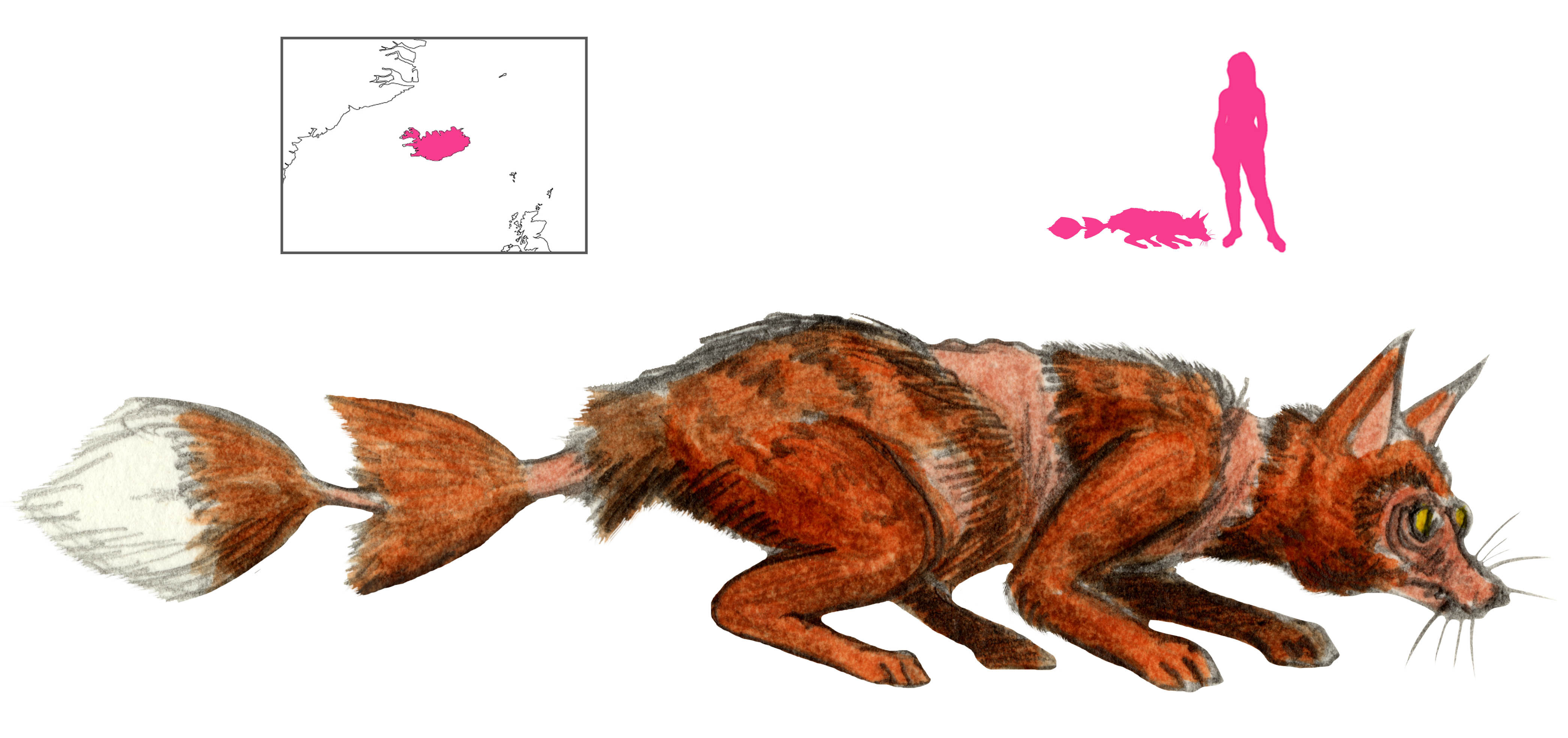
The Skoffín is one of a complex of Icelandic fox-cat hybrids with a lethal gaze, combining the cunning of the fox with the cruelty of the cat. This group also includes the Skuggabaldur, Urdarköttur, and Modyrmi, all of which are variations on the same theme; they are also linked to the “demon harriers”, foxes sent by sorcerers to maul livestock.

A skoffín is born from the union of a male Arctic fox and a female tabby cat, and resembles both of them. Its gaze is so deadly that everything it looks at dies immediately, without needing to see it. Its exact appearance varies; it may even change color with the seasons like the Arctic fox does. Reports suggest that skoffíns are short-haired, with bald patches of skin throughout.

Skoffín kittens are born with their eyes wide open. If not destroyed immediately, they sink into the ground and emerge after 3 years of maturation. It is therefore imperative to kill sighted kittens before they can disappear into the ground. When a litter of three sighted kittens was born at a farm in Súluholt, they were placed in a tub of urine to prevent their descent into the earth, and were drowned by placing turf on top of them. The entire tub was then tossed onto a pile of manure and hay and set on fire. The mother cat was also killed.

Skoffíns are irredeemably vile and malicious, and satisfy their appetite for destruction by killing humans and livestock alike. They are best shot from a safe distance, ideally with a silver bullet and after having made the sign of the cross in front of the barrel, or having a human knucklebone on the barrel. Hardened sheep dung makes equally effective bullets.

Thankfully, skoffíns are not immune to their own gaze. An encounter between two skoffíns will lead to the death of both of them. As with basilisks, mirrors are their bane. Once a skoffín stationed itself on the roof of a church, and the parishioners started dropping dead as they left the building. The deacon understood what was going on, and had the rest of the congregation wait inside while he tied a mirror to a long pole and extended it outside to the roof. After a few minutes he gave the all-clear, and they were able to leave the church safely, as the skoffín had perished immediately upon seeing its reflection.

Eventually, confusion with the basilisk of the mainland muddled the skoffín’s image, leading to some accounts claiming it was hatched from a rooster’s egg.

The skuggabaldur (“shadow baldur”) or finngalkn has the same parentage as the skoffín, but is born of a tomcat and a vixen. It has very dark fur shading to black, sometimes has a deadly gaze, and preys on livestock. It may be killed in the same way as the skoffín. One particularly destructive skuggabaldur in Húnavatnssýslur was tracked down and killed in a canyon; with its last breath, it exhorted its killers to inform the cat at Bollastadir of its death. When a man repeated that incident at a Bollastadir farm, a tomcat – no doubt the skuggabaldur’s father – jumped at him and sank its teeth and claws into his throat. It had to be decapitated to release its hold, but by then the man was dead.

The urdarköttur (“ghoul cat”) or naköttur (“corpse cat”) is of less certain parentage. It may be a hybrid, but other accounts state that any cat that goes feral in Iceland eventually becomes an urdarköttur, and all-white kittens born with their eyes open will sink into the ground and re-emerge after three years in this form. Shaggy, white or black furred, growing up to the size of an ox, these felines kill indiscriminately and dig up corpses in graveyards. It may be killed in the same way, and is attached to the same story as the Bollastadir cat. Gryla’s pet, the Yule Cat, is most likely an urdarköttur.

The modyrmi (“hay wormling”) is a canine variant, created when puppies born with their eyes open sink into the ground and reappear after three years as wretched, virulent monsters. The specifics are the same as with the skoffín.

References

Boucher, A. (1994) Elves and Stories of Trolls and Elemental Beings. Iceland Review, Reykjavik.

Hermansson, H. (1924) Jon Gudmundsson and his Natural History of Iceland. Islandica, Cornell University Library, Ithaca.

Hlidberg, J. B. and Aegisson, S.; McQueen, F. J. M. and Kjartansson, R., trans. (2011) Meeting with Monsters. JPV utgafa, Reykjavik.

Stefánsson, V. (1906) Icelandic Beast and Bird Lore. The Journal of American Folklore, vol. 19, no. 75, pp. 300-308.

Păl-raí-yûk

Pal-rai-yuk

Long ago, the Yukon and Kuskokwim rivers were far warmer than they are today, and the winters shorter, with the snow melting and the birds returning as early as February. This allowed for large stretches of creeks, lakes, and marshland, and the Păl-raí-yûk haunted the waterways between the two rivers. They were most common around the temperate Kuskokwim, and they fed on humans and animals alike.

Păl-raí-yûk was one of Raven’s many creations, one that would lie in wait, submerged, to attack anyone coming to the water’s edge. It would also attack boats that entered its territory. For this reason Raven warned First Man to be cautious about approaching lakes and rivers.

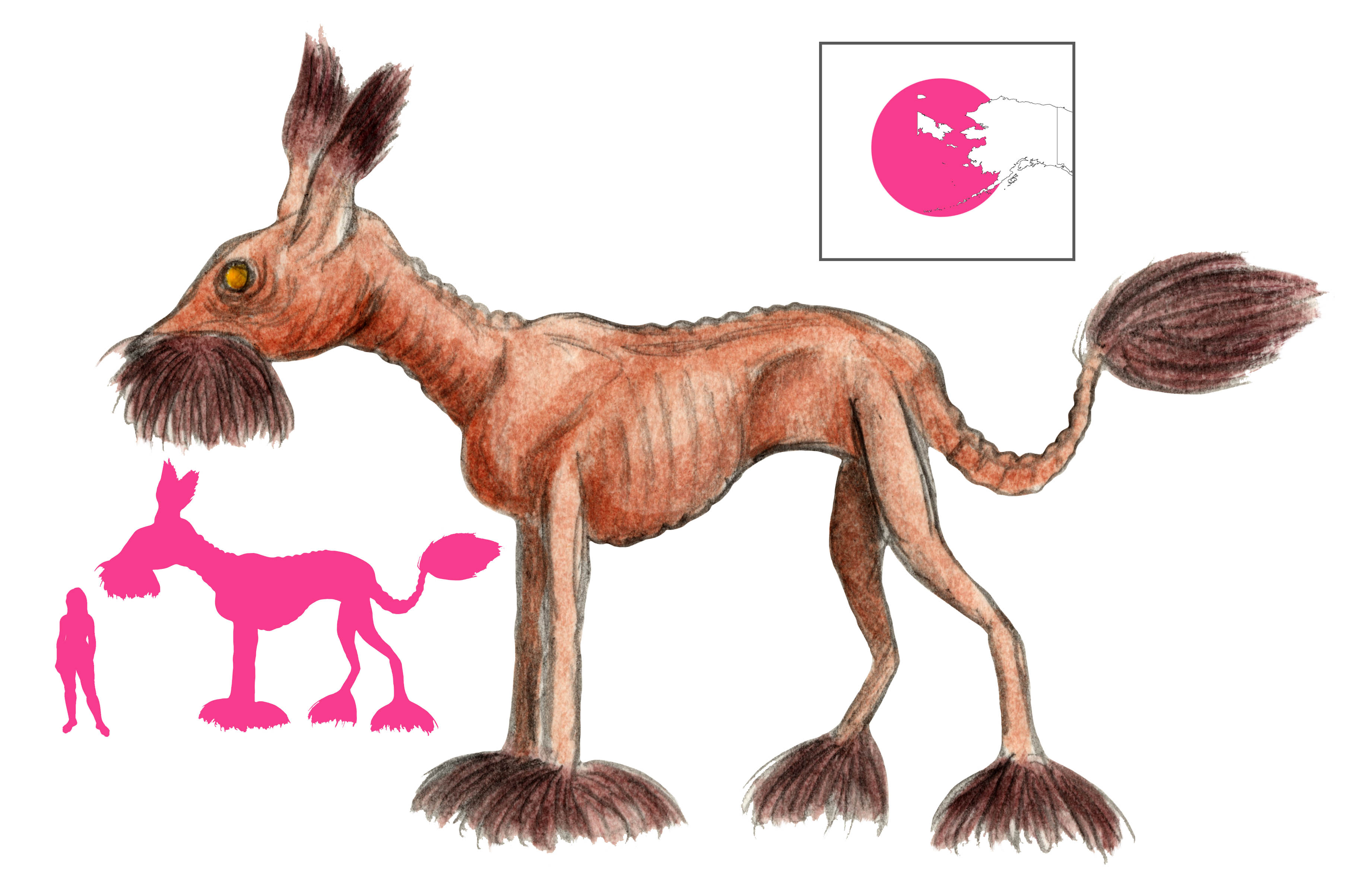
The păl-raí-yûk has been compared to the crocodile or alligator, which it resembles in both form and habit, but it is also very similar to the muskox. It is typically represented on umiaks, masks, and dishes as an elongated, stylized reptilian creature with a long, narrow head and six legs. “Cutaway views” above the legs show human remains, indicating the grisly nature of its meals. One păl-raí-yûk that was killed by the Sky People had six legs, the hind ones long, the fore ones short, and the small middle ones hanging from the abdomen. It had small eyes and fine, dense, very dark fur on its body, like that of a shrew, that was longest on its feet. A pair of horns, extending forward, out, and curving back, are present on the head.

Păl-raí-yûk are large and bulky, but can lie on grass without bending the stems. On the other hand, a dead păl-raí-yûk would become so heavy that its body would sink into the ground if not supported. Many hunters were usually required to kill one, usually by holding it down with logs while smashing its head with clubs.

The last known păl-raí-yûk was slain by a hunter after it killed and ate his wife who was fetching water from a lake.

References

Nelson, E. W. (1900) The Eskimo about Bering Strait. Extract from the Eighteenth Annual Report of the Bureau of American Ethnology, Government Printing Office, Washington.