Mantabungal

Mantabungal

The Mantabungal is known to the Tagbanua of Palawan, in the Philippines. It is found primarily in the forests of Mount Victoria in Baraki, and is the most feared of the mountain demons.

A mantabungal is like a cow in body and voice, but lacks horns. It has a long coat of shaggy hair that reaches the ground. Its monstrous mouth has two pairs of huge incisors – two above and two below – that it uses to tear its victims to shreds.

One man reported hearing bovine moos while gathering gum in the mountains. Spooked and disoriented in the darkness, he ran aimlessly into the forest as far as he could and spent the night shivering miserably under a tree. When he returned to camp, he found that the mantabungal had destroyed everything he had touched. His hut, gear, and even the firewood had been dismantled and chewed to bits.

References

Fox, R. B. (1982) Religion and Society among the Tagbanuwa of Palawan Island, Philippines. Monograph No. 9, National Museum, Manila.

Ramos, M. D. (1971) Creatures of Philippine Lower Mythology. University of the Philippines Press, Quezon.

Yamabiko

Variations: Yama-biko

Yamabiko

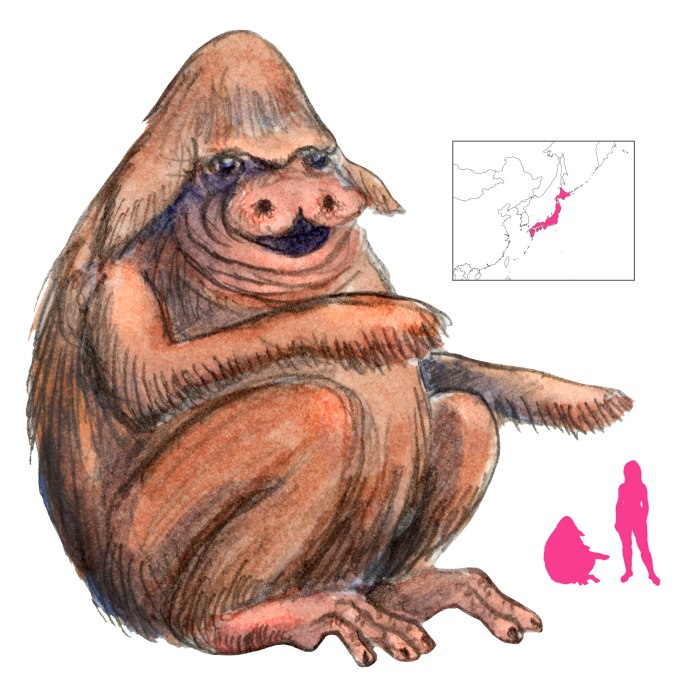
The Yamabiko, “mountain echo” or simply “echo” is heard rather than seen. It is found in the high mountains of Japan, and answers anyone shouting in the mountains with a mocking echo of their voice. While there is no definite version of its appearance, it was depicted by Toriyama Sekien as a rather simian creature.

Its name can also be interpreted as “spirit of valley reverberation”. It is not known if the yamabiko yokai was named for the echo, or if the echo was named for the yokai. The Yamabiko Shinkansen train, on the other hand, is named for the echo and not the yokai.

References

Foster, M. D. (2015) The Book of Yokai. University of California Press, Berkeley.

Agrippa

Variations: Égremont, Vif
Agrippa

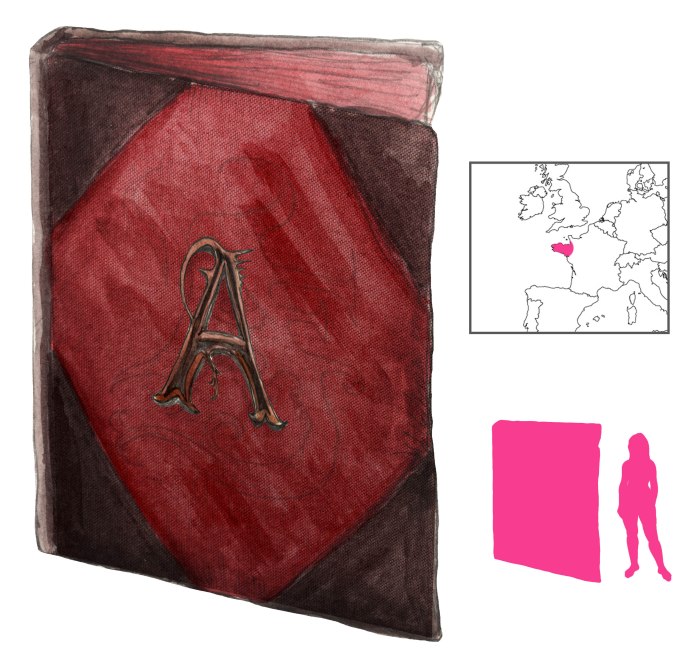
In Brittany, the Agrippa is one of the most feared and malevolent grimoires, a living book with a mind of its own. Its name in Tréguer is derived from that of Heinrich Cornelius Agrippa, but it is also known as Égremont in Châteaulin and Vif (“Alive”) around Quimper.

An agrippa is enormous, standing fully as tall as a man. Its pages are red, while its letters are black – although some variants exist with black pages and red text. It contains the names of all the devils, and how to summon them.

Agrippas are living, malicious creatures, and resent being read. An untamed agrippa will display only blank pages. To get the letters to appear, the agrippa must be battled, thrashed, and beaten like a stubborn mule. A fight with an agrippa can last hours, and victors come out of it exhausted and drenched in sweat. When not in use, an agrippa must be chained to a strong, bent beam.

Only priests can be trusted to keep agrippas, as they have the training and the force of will required to master it. They use it to deduce the fate of the dead by calling upon all the demons in order; if none will admit to having taken the deceased’s soul, then they were saved. Long ago all priests had agrippas, and a newly-ordained priest would inexplicably find one on his table. However, agrippas have since found their way into the hands of laymen, and the temptation to use them can be very strong. A priest will not be able to sleep well as long as one of his parishioners has an agrippa.

Uninitiated readers of the agrippa will always smell of sulfur and brimstone, and walk awkwardly to avoid treading on stray souls. A man with an agrippa will find himself incapable of destroying it – a task that will become increasingly desperate, as possession of an agrippa will prevent entry into Paradise. Loizo-goz, a man from Penvénan, tried to rid himself of his agrippa by dragging it away to Plouguiel on the end of a chain, but came back home to find it had returned to its usual place. He then tried burning it, but the flames recoiled from the book. Finally he dumped the agrippa into the sea with rocks tied to it, only to see it climb out of the water, shake its shackles off, and make a beeline for its suspended perch. Its pages were perfectly dry. Loizo-goz resigned himself to his fate.

Eventually a priest will arrive to save the owner of an agrippa. He will wait until the unfortunate is at death’s door, whereupon he will come to his deathbed. “You have a very heavy burden to carry beyond the grave, if you do not destroy it in this world”, he tells him. The agrippa is untied and brought down, and while it tries to escape, the priest exorcises it, and sets fire to it himself. He then collects the ashes, places them in a sachet, and puts them around the dying man’s neck, telling him “May this weigh lightly upon you!”

Other times a priest will have to save a man whose reading of the agrippa took him too far. A Finistère parson found his sacristan missing, and his agrippa open wide on the table. Understanding that the sacristan had summoned the devils and been unable to dismiss them, he started calling upon them one by one until they released him. The sacristan was blackened with soot and his hair was scorched, and he never told a soul of what had transpired.

References

Le Braz, A. (1893) La Légende de la Mort en Basse-Bretagne. Honoré Champion, Paris.

Luzel, F. M. (1881) Légendes Chrétiennes de la Basse-Bretagne, v. II. Maisonneuve et Cie, Paris.

Seignolle, C. (1964) Les Évangiles du Diable. Maisonneuve et Larose, Paris.
Tosetáx

Variations: Tsamtáx, Tsamtás (pl.)

Tosetax

According to the Nivaklé of Paraguay, dry seasons are exacerbated by the Tsamtás serpents, which lie in the middle of the sky and radiate heat. A tsamtáx will intercept and eat the Fanxás or thunderbirds flying from the south and bringing rain with them. Only the shamans can prevent this state of things by tearing down the tsamtás nest, making them fall to their death and allowing the rainy season to return.

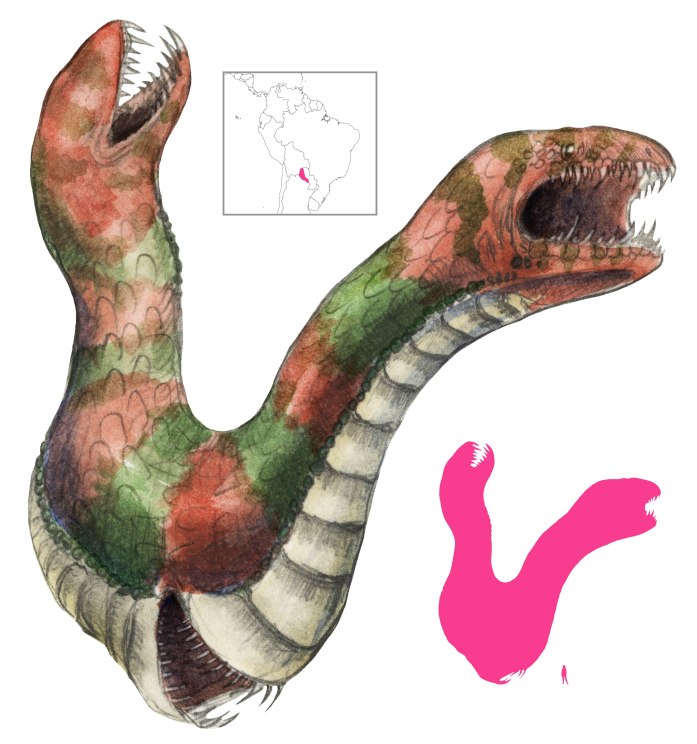
Tosetáx is even more terrifying. He arrived after the tsamtás had been dealt with, and installed himself in the center of the sky. Tosetáx is an enormous green and red snake, with three mouths – one at the head, one at the tail, and one in the middle of his body. As with the tsamtás, Tosetáx was waiting to ambush the returning thunderbirds.

Tosetáx was defeated by five powerful shamans who turned themselves into snakes. One of the shamans coiled himself around Tosetáx and, by turning and coiling, took him to the north out of the thunderbirds’ flight path. There the shamans cut off the serpent’s three mouths and cut him in half, killing him.

References

Chase-Sardi, M.; Costa, M. M.; Mashnshnek, C. O.; Siffredi, A.; Tomasini, J. A.; Wilbert, J. and Simoneau, K. eds. (1987) Folk Literature of the Nivaklé Indians. UCLA Latin American Center Publications, University of California, Los Angeles.

Gremlin

<strong>Variations:</strong> ?

<img class=”alignnone size-full wp-image” src=”https://abookofcreatures.com/wp-content/uploads/2016/04/gremlin.jpg&#8221; width=”451″ height=”612″ />

<img class=”alignnone size-full wp-image” src=”https://abookofcreatures.com/wp-content/uploads/2016/04/gremlin-2.jpg&#8221; width=”451″ height=”612″ />

Gremlin 3

Every unexplained mechanical error, every mysteriously malfunctioning engine, defective wheel, gas leak, fuselage weakness, cockpit damage, and avionics glitch can be blamed on gremlins. These little machine fairies are the modern equivalent of the ancient dwarfs, but they destroy instead of build.

Etymologies for “gremlin” disagree, and are probably all apocryphal. One suggestion holds that it originates from the antiquated Old English gremian, “to vex”. This is related to the Irish Gaelic gruaimin, “grumpy little fellow”, which comes from gruaim, “gloom” or “ill-humor”. Another suggestion is a shortening of grinning goblin. The French grelon or “hailstone” indicates some meteorological confusion. Edwards adds the German gram or “worry” to the mix, from which the diminutive gramlein can be derived. Finally, Fremlins beer may have had a hand in inspiring gremlins.

Similarly there is no consensus on gremlin appearance, but it is generally assumed that they are small, six inches to a foot in height, and humanoid in appearance. They are skinny and nimble enough to move about through complex machinery. Known colors include green and blue-grey. Some have horns, others have pointed ears; webbed feet and suction cups have been suggested for yet others. Clothing is optional, including nudity, pilot gear, breeches and jackets, and even spats and top-hats. They eat treacle and honey, and drink fuel, sucking tanks dry.

Gremlins were first identified by R.A.F. pilots, especially on Maltese airfields in World War I, although there is evidence to suggest that they have been around longer than that. From there tales of the gremlins and their deeds spread throughout the piloting world, until they became a byword for any unexplained mechanical issues.

Gremlin activities range from juvenile pranks to outright destructive cruelty. They view all airplanes as an affront, and do whatever they can to ground them. Some gremlin subspecies specialized in specific forms of mischief. Mole-like Cavity gremlins dug holes in runways, Incisors teethed on wires, Jockeys guided birds into airplane windscreens, and Optics glowed over bomb sights.

While gremlins have faded from the aerial popularity they enjoyed during the war, the preponderance of technology in our modern world has only given them further targets to mess wgsgnslfgnsogdkfjgluiw4v8r93428RQVNWAELIVJWBKkjdhzseuwy5ycjdft3534bsrg5566fgdfgcbvgbc

<strong>References</strong>

Dubois, P.; Sabatier, C.; and Sabatier, R. (1992) La Grande Encyclopédie des Lutins. Hoëbeke, Paris.

Edwards, G. (1974) Hobgoblin and Sweet Puck. John Sherratt and Son, Altrincham.

Jaculus

Variations: Iaculus, Jaculare; Sagitta (Latin); Acontia, Acontias, Saetta (Greek); Cafezati, Cafezasi, Altararat, Acoran, Altinanti (Arabic); Orchilanne (Turkish); Saettone (Calabria and Sicily); Ein Schosse Oder Angelsch Lang (German); Decurtati (Hungary)

Jaculus

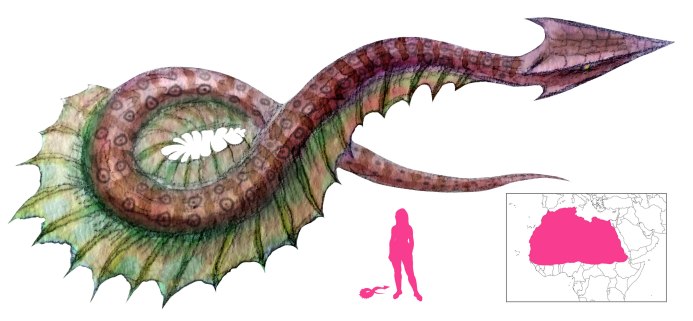
The Jaculus, “javelin” or “dart”, is one of the many snakes that attacked Lucan’s forces during their march through the Libyan desert. While catalogued as a Libyan desert snake, Topsell expanded its range to include Rhodes, Lemnos, Calabria, Sicily, Germany

It can be considered a flying snake, although the “flight” is long-distance leaping over ten to thirty feet. They get into trees and bushes, bunch themselves up in bow and hoop shapes, and fling themselves at high speed onto their prey. Traveling as fast as a thrown javelin, they can puncture clothing and flesh alike. Jaculi are cunning and cruel, and will lie in ambush for human prey, but their presence is given away by the noise they make while coiling in dry plants.

The appearance of the jaculus varies, but it usually has small black ocelli, no bigger than lentils, on its body. The jaculi of Rhodes are ash-colored with a white belly and two black lines running from its head to the tip of its tail; the cafezati or “jumpers” of the Middle East are red, and have been posited as the Biblical fiery serpents. The Hungarian jaculi or decurtati are thick and short-tailed, only two hands long.

A jaculus killed Paulus, one of Lucan’s men, by darting from a distance before it could be seen. It was not venom that felled its victim, but rather the gaping hole left behind after it passed through Paulus’ head at the temples. Topsell believed it was a jaculus that attacked the apostle Paul and bit his hand. Another such snake coiled around the arm of a Zurich peasant; even though it didn’t bite, the arm ended up putrefying and requiring yearly bleeding to drain the black blood inside.

Topsell attests that the same antidotes used for viper venom can be used for jaculus bites. He adds that jaculus gall with Scythian stone yields eye-salve.

References

Aelian, trans. Scholfield, A. F. (1959) On the Characteristics of Animals, vol. II. Harvard University Press, Cambridge, Massachusetts.

Aldrovandi, U. (1640) Serpentum, et Draconum Historiae. Antonij Bernie, Bologna.

Isidore of Seville, trans. Barney, S. A.; Lewis, W. J.; Beach, J. A.; and Berghof, O. (2006) The Etymologies of Isidore of Seville. Cambridge University Press, Cambridge.

Lucan, trans. Rowe, N. (1720) Pharsalia. T. Johnson, London.

Topsell, E. (1658) The History of Serpents. E. Cotes, London.

Colôrobètch

Variations: Colô Rodje Bètch, Colô Rotje Bètch, Clô Rotje Bètch, Colôrobètche, Colaurobètch, Colaurobètche, Colau-rodje-bètch, Corobètch, Routge Bètch

Colorobetch

Bogeys represent a variety of childhood fears – darkness, retribution, the murky depths of deep ponds… In Wallonia children are menaced by the personification of the bise or icy wind, in the form of a bird with a red beak.

He can be found around Andenne, Bastogne, Dinant, Huy, and Neufchâteau, and Warsage; in On, Oignies, and Stavelot he is simply the “red beak”. The Somme-Leuze redbeak is a monstrous sparrow, the Condroz and Hesbaye variety is a pigeon, while the Namur redbeak is Colôrobètch or Colô Rodje Bètch, the “Red-Beaked Rooster”.

As his name indicates, Colôrobètch has a beak stained red with blood; beyond that, it is unclear whether he is a bird, a human, or a grotesque combination of both. He preys on children unwary enough to walk in the cold without adequate clothing, nipping at their exposed faces and hands until they turn red, dry, cracked, and bleeding. Colôrobètch comes out in the winter to pinch noses and spread frostbite.

In Andenne Colôrobètch becomes a nocturnal water bogey who drags children into the Meuse.

References

Pignolet, M. (1985) La Symbolique du Coq. Le Guetteur Wallon, 61 (3), pp. 81-104.

Tijskens, J. (1965) Les Noms du Croquemitaine en Wallonie. Enquêtes du Musée de la Vie Wallonne, nos. 117-120, tome X, pp. 257-391.

Usilosimapundu

Variations: Ugungqu-kubantwana, Ugunqu-kubantwana

Usilosimapundu

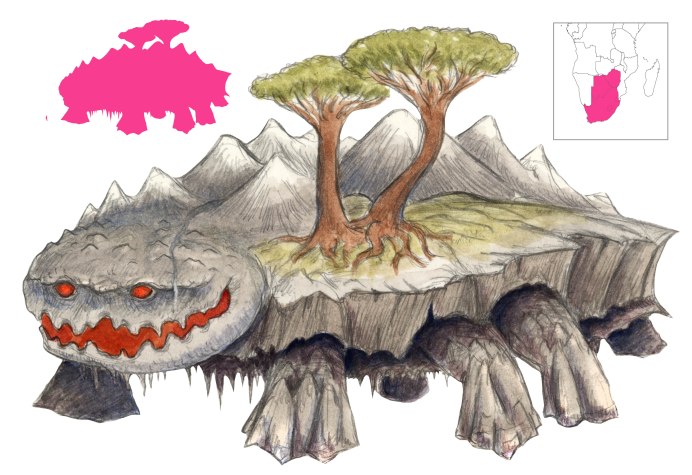
Usilosimapundu, “the rugose beast” or “the nodulated beast”, is a creature of superlatives. There are hills and mountains on his vast body, with rivers on one side, highlands on another, forests on the next, highlands and cliffs on other sides; he is so large that it is winter on one side of him and summer on the other. Two enormous trees, the Imidoni, serve as Usilosimapundu’s officers and servants. Usilosimapundu’s head is a huge rock, with eyes and a broad red mouth. He is a swallower, like many oversized African creatures, but also a force of nature, a personification of landslides and earthquakes.

The sorceress-princess Umkxakaza-wakogingqwayo (“Rattler of weapons of the place of the rolling of the slain”) was promised a great many cattle by her father the king, and the land was scoured for the finest livestock available. Unfortunately the very best cattle proved to be the property of Usilosimapundu. “Take them now”, he warned the soldiers, “but do not expect to get away with it”.

Umkxakaza was greatly pleased by her gift, and Usilosimapundu’s threat was forgotten as the years went by. That is, until the day the earth shook, and Usilosimapundu came to Umkxakaza’s doorstep. Two leaves detached from the Imidoni and took human form before heading for Umkxakaza and ordering her to do their bidding. They forced her to help prepare food for Usilosimapundu to eat – and eat he did, swallowing up everything in town. Finally Usilosimapundu had Umkxakaza climb onto his back, and he lumbered away with his trophy.

Of course, Umkxakaza’s father sent his armies to retrieve his daughter, but what good were the weapons of man against a living continent? Their spears landed in rocks, grass, ponds, trees – none of them had any effect on Usilosimapundu. Umkxakaza’s mother was the only one who continued to follow Usilosimapundu, and the beast obligingly gave her maize and sugarcane to eat while she hurried behind him, but eventually even the queen had to give up. She kissed Umkxakaza, weeping, bidding her to go in peace.

Usilosimapundu dropped Umkxakaza off in a fully furnished cave. “Your father spoiled me by taking my cattle”, he said, “so now I have spoiled him. He will never see you again”. With that Usilosimapundu left and was not seen again.

That was far from the end of Umkxakaza’s adventures, as she was abducted by the Amadhlungundhlebe half-men who fattened her up for eating. She escaped those new captors by summoning a storm, and made her way back to her father’s town, where she was greeted with joy and celebration.

Usilosimapundu has a female counterpart in Ugungqu-kubantwana, the mother of animals. Her name refers to the sound she makes when moving – gungqu, gungqu – rather like that made by a heavy wagon on a bumpy road.

References

Callaway, C. (1868) Nursery Tales, Traditions, and Histories of the Zulus. Trübner and Co., London.

Carcolh

Variations: Lou Carcolh (erroneously)

Carcolh

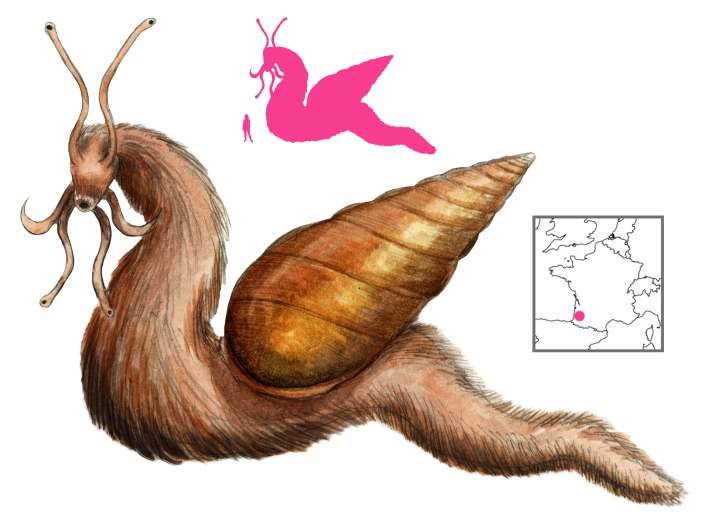
The French town of Hastingues, it is said, is built over an enormous cave honeycombed with entrance tunnels. Deep within that cave dwells the Carcolh (“snail”), also inaccurately known as “lou Carcolh” (“the snail”). The word is itself derived from the Spanish caracol, and does not have any special meaning, as evidenced by the béarnese riddle u houmiot qui s’emporte sa maysou darrè deu cot? Lou carcolh (“A little man who carries his house behind his back? The snail”).

Nobody knows how long the carcolh has lived there, or how old it is. It is a gigantic, slimy, shaggy serpent, with a shell as big as a house, and long prehensile tentacles.

The inhabitants of Hastingues hid their treasures underground before the Spanish invasion. Many have ventured into the cave in search of those treasures, and vanished without a trace. The carcolh does not move much, but its tentacles seize anyone who approaches it, dragging them into its shell to be consumed at leisure. At least one witness saw the carcolh drinking, and managed to escape before it saw him. He then blocked up the tunnel he had entered by, and swore never to return there again.

References

de Charencey, C. (1903) Etymologies Francaises et Provencales. Bulletin de la Société de Linguistique de Paris, v. 12, pp. lix-lxiv.

Foix, V. (1903) Glossaire de la Sorcellerie Landaise. Revue de Gascogne, v. 3, pp. 362-373.

Peyresblanques, J. (1977) Contes et Légendes des Landes. J. Pémartin, Dax.

Rolland, E. (1877) Devinettes ou Enigmes populaires de la France. F. Vieweg, Paris.

Pareas

Variations: Parea, Parias, Paruas, Pharias, Parous, Baron, Pagerina, Anguis Aesculapij, Aesculapian Snake

Pareas

The Pareas is briefly mentioned in the Pharsalia’s catalogue of Libyan serpents. It always travels on its tail, leaving a furrow behind it in the ground. Its bite is harmless and gentle, and so it was consecrated to Asclepius, god of healers. Topsell classifies it among the innocent serpents.

Aelian describes it as being red with sharp eyes and a wide mouth. Topsell, on the other hand, gave its length as four spans, and its color as yellow with two long streaks down its side. Aldrovandi describes the pareas as being yellowish below and black above, with possible variations of green and white along its length. He dismisses the claim that it has a crest.

The tendency of the pareas to travel while holding itself clear of the ground has led to its association with the Eden serpent, which did not creep along the ground prior to being cursed. This claim has been contested by Alexander Neckham and Petrus Comestor, as the pareas very clearly does not conform to that curse. Petrus concluded that the curse must only have affected the individual serpent of Eden, leaving other snakes – including the pareas – uncursed.

References

Aelian, trans. Scholfield, A. F. (1959) On the Characteristics of Animals, vol. II. Harvard University Press, Cambridge, Massachusetts.

Aldrovandi, U. (1640) Serpentum, et Draconum Historiae. Antonij Bernie, Bologna.

Isidore of Seville, trans. Barney, S. A.; Lewis, W. J.; Beach, J. A.; and Berghof, O. (2006) The Etymologies of Isidore of Seville. Cambridge University Press, Cambridge.

Kelly, H. A. (1971) The Metamorphoses of the Eden Serpent during the Middle Ages and Renaissance. Viator, 2, pp. 301-328.

Lucan, trans. Rowe, N. (1720) Pharsalia. T. Johnson, London.

Topsell, E. (1658) The History of Serpents. E. Cotes, London.