The slopes
of Exceedingly Lofty Mountain in China are home to the Chouyu. It is like a
rabbit but has a bird’s beak, owl’s eyes, and the tail of a snake. It falls
asleep (i.e. plays dead) when it sees people. If a chouyu is seen it is an omen
of a locust plague.
Mathieu
identifies this animal as the armadillo, but admits with impressive
understatement that China is a bit far from the neotropics…
References
Mathieu, R.
(1983) Étude sur la mythologie et l’ethnologie de la Chine ancienne.
Collège de France, Paris.
Strassberg, R. E. (2002)
A Chinese Bestiary: Strange Creatures from the Guideways Through Mountains
and Seas. University of California Press.
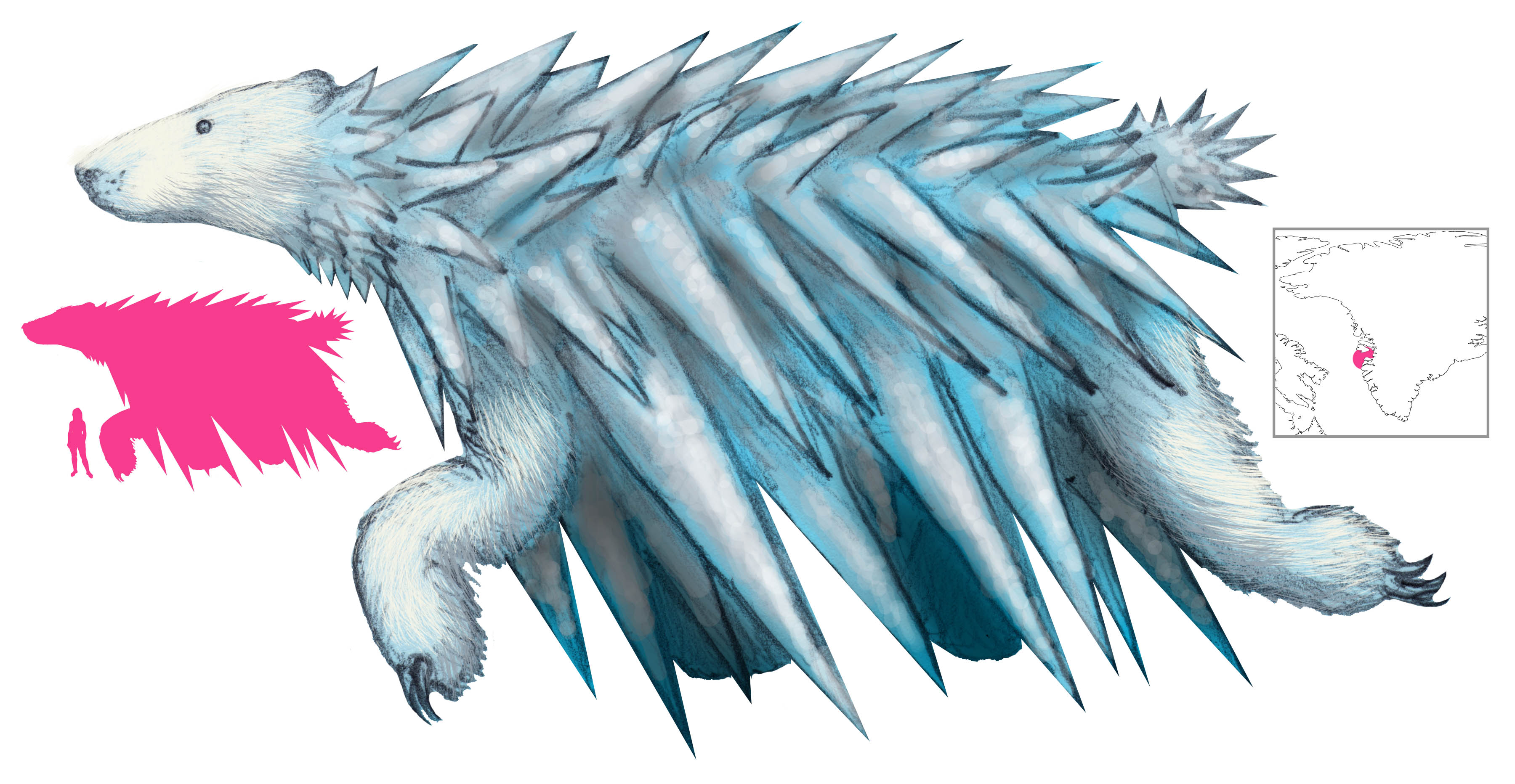
The Sermilik, “ice-clad”, is an enormous and highly dangerous polar bear found in the seas around Aasiaat in Greenland. Unlike the bears it resembles, it has very long fur completely covered with ice. Four lumps of ice at the surface are in fact the four paws of a sermilik lying in wait, and young hunters are warned never to paddle near those.
References
Birket-Smith,
K. (1924) Ethnography of the Egedesminde
District. Bianco Lunos Bogtrykkeri, Copenhagen.
The Dingonek is a creature that lives in the Maggori River in Kenya, as well as in Lake Nyanza (Victoria). Our primary source for the dingonek comes from big-game hunter John Alfred Jordan, as recorded by Edgar Beecher Bronson. As a tale told by one big-game hunter to another, there is no reason to believe there was any embellishment or exaggeration involved.
Legends of aquatic monsters predate Jordan’s account, but they describe a generic large water python. Clement Hill claimed to have seen one in Lake Nyanza that attempted to seize a man on the prow of his boat. It had a dark, roundish head.
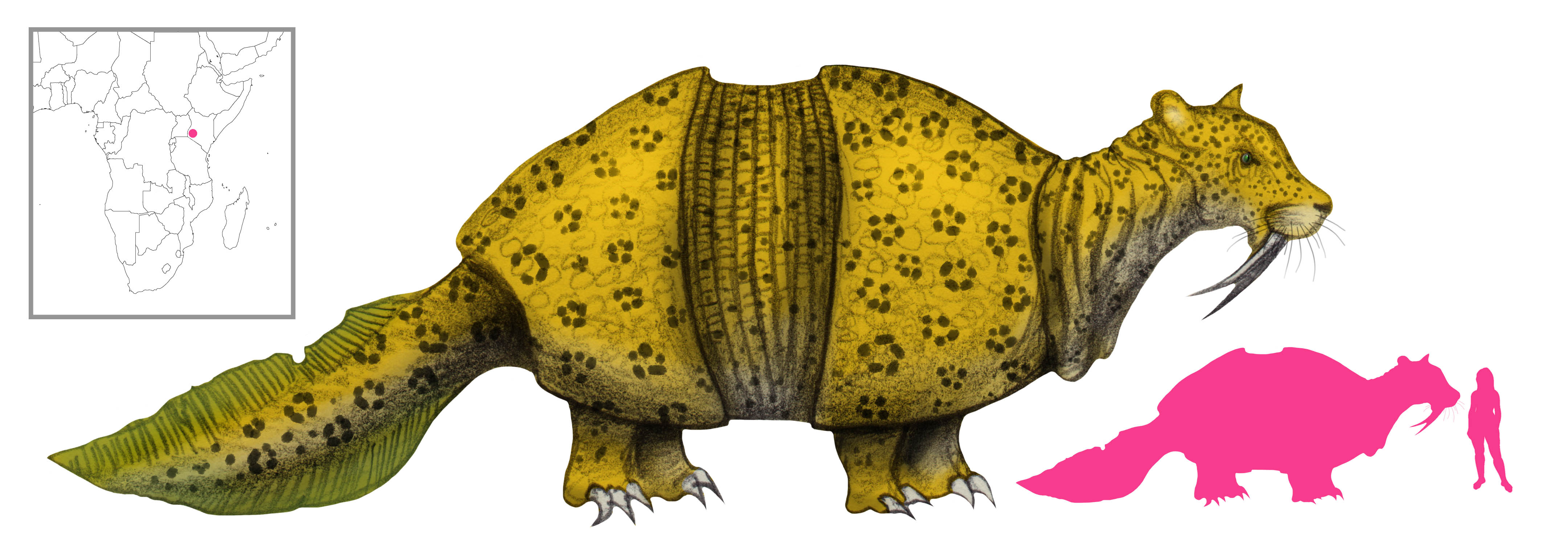
The dingonek as described by Jordan is a cross between a sea serpent, a leopard, and a whale. It is fourteen or fifteen feet long. Its head is similar in shape and markings to that of a leopard, but is the size of a lioness’ head. There are two long white fangs protruding downwards from the upper jaw. The back is broad like that of a hippo, patterned and colored like a leopard, and “scaled like an armadillo”. The tail, used for aquatic propulsion, is broad and finned. When ashore, the dingonek leaves behind prints as wide as a hippo’s but with reptilian claw-marks.
A .303 shot behind the ear had no effect on the dingonek. It reared straight up out of the water, and Jordan ran for his life. The dingonek was not seen again.
Hobley tells of another man who swears he saw a dingonek. When the Mara River was in flood, the eyewitness said he saw a creature floating down the river on a big log. It had its tail in the water, but its length was estimated to be sixteen feet. It had scales, spots like a leopard, and a head like an otter, but no long fangs. When shot at, it slipped into the water and disappeared. Apart from the (surely inaccurate) length given, this is a good account of a Nile monitor lizard.
Finally, rock art from a cave in Brakfontein Ridge, South Africa, has been claimed to depict a walrus-like dingonek, but the location is far from the dingonek’s habitat, and the association is arbitrary.
Heuvelmans initially believed the dingonek to be an odd species of prehistoric crocodile. Later he revised this to create an aquatic saber-toothed cat whose wet fur clumped and gave the appearance of scales.
As armadillos are New World animals, modern reconstructions have assumed the armadillo “scales” to be those of a pangolin instead. Other recent additions include a single horn and a stinger tail, neither of which have any basis.
Cryptozoologists have equated the dingonek with a number of other creatures, including the far better known Lukwata, the Ndamathia, and the Ol-umaina or Ol-maima of the Mara River. This is known to the Masai and has been described by Hobley as fifteen feet in length and scaly with a dog-like or otter-like head, leopard spots, small ears “marked somewhat after the fashion of a puff adder”, a short neck, short legs with claws. It may be seen sunning itself on logs and riverbanks, and dives into the water when threatened. Hobley’s ol-umaina account is copied by Heuvelmans, who expresses some confusion at the “ears” comment but otherwise affirms that the dingonek and the ol-umaina are one and the same. Shuker corrects the name to ol-maima.
All of this is moot. Ol-maima (or, more correctly ɔl-máɨ́má) is the Maa term for a cripple or a Nile monitor lizard (owing to its waddling movement on land). The descriptions are exaggerated but recognizable accounts of monitor lizards – as the dingonek itself almost certainly is.
References
Bronson, E. B. (1910) In Closed Territory. A. C. McClurg & Co., Chicago.
Bryant, A. T. (1948) The Zulu People. Shuter and Shooter, Pietermaritzburg.
Conway, J.; Kosemen, C. M.; and Naish, D. (2013) Cryptozoologicon Vol. I. Irregular Books.
Heuvelmans, B.; Garnett, R. trans. (1958) On the Track of Unknown Animals. Rupert Hart-Davis, London.
Hobley, C. W. (1913) On Some Unidentified Beasts. The Journal of the East Africa and Uganda Natural History Society, III(6), pp. 48-52.
Oswald, F. (1915) Alone in the Sleeping-Sickness Country. Kegan Paul, Trench, Trubner & Co., London.
Payne, D. L. and Ole-Kotikash, L. (2008) Maa Dictionary. University of Oregon, accessed online.
Shuker, K. P. N. (1995) In Search of Prehistoric Survivors. Blandford, London.
Stow, G. W. and Bleek, D. F. (1930) Rock-paintings in South Africa. Methuen & Co. Ltd., London.
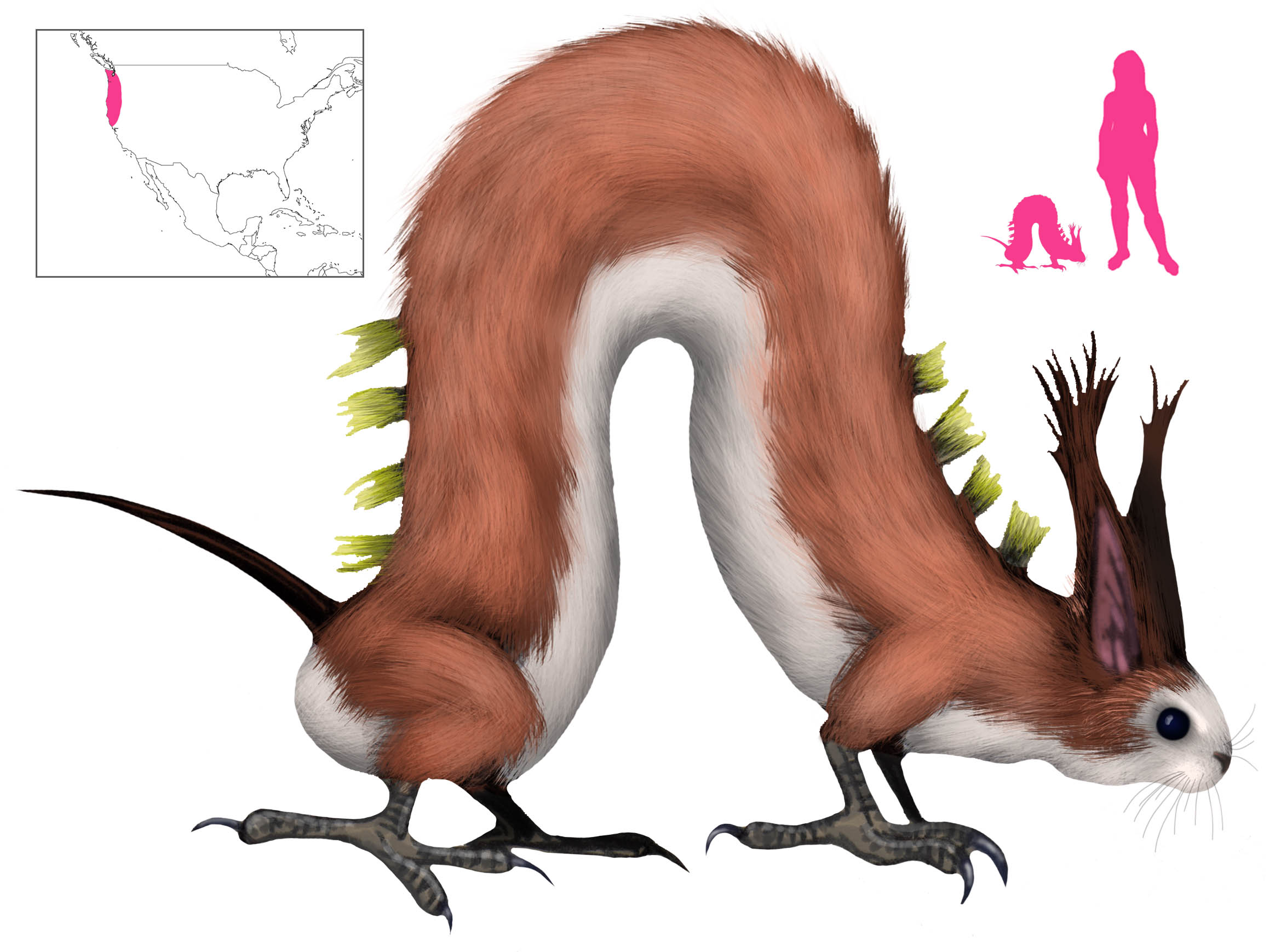
Wapaloosies are found in Pacific Coast forests, and appear to be the mammalian answer to the inchworm. A wapaloosie is as big as a dachshund, with velvety fur, woodpecker-like feet, and a spike-tipped tail that aids in its caterpillarish climbing. And climb a wapaloosie does, moving effortlessly up the tallest of trees to feed on bracket fungus.
The wapaloosie drive to climb continues long after death. One lumberjack in Washington shot a wapaloosie and made a pair of fur mittens out of it. When he grabbed an axe, the mittens immediately shimmied up the handle to the top. They proceeded to do so with everything the lumberjack tried to hold, so he was forced to discard them. The mittens were last seen clambering over lumber slash.
References
Cox, W. T. (1910) Fearsome Creatures of the Lumberwoods with a Few Desert and Mountain Beasts. Judd and Detweiler, Washington D. C.
Among Aristotle’s many references to the elephant, we are told that its five toes are not perfectly jointed, its forelegs are larger than its hind ones, and its hind legs have short ankles. It has a trunk that it can use as a hand, drinking and eating with it, pulling up trees with it, and using it to breathe when walking through water. This remarkable appendage is cartilaginous and jointless.
The 1220 Latin translation of Aristotle by Michael Scot was based off an Arabic translation from the Greek. Scot retained various Arabic words in his text, and hence Aristotle’s passage on the elephant’s appendicular anatomy became et habet duo cahab parva respect magnitudinis corporis sui – here, cahab is Arabic for “ankle”, and the phrase reads “and [the elephant] has two ankles that are short relative to the size of its body”. Scot used cahab consistently to refer to the ankle or the talus bone.
Thomas de Cantimpré did not recognize the word cahab and assumed it to be the subject of the verb habet. From that the sentence became Caab animal marinum est, ut dicit Aristotiles, parvos habens pedes respectu corporis sui, quod utique magnum est, “Caab is a sea animal, as says Aristotle, whose legs are small in proportion to its body, which is huge”. Based on that and the remainder of the Aristotelian description, Thomas says that the caab has one leg that is long and which it uses as a hand to bring vegetation to its mouth; this leg is made of cartilage. Thomas also misreads the behavior of the elephant in water and makes his caab a fully aquatic marine animal, one that breathes underwater and then, upon reaching the surface, spouts the water it swallowed while breathing. Finally, he spontaneously gives his animal the feet of a cow.
In turn, Albertus Magnus “borrows” Thomas’ account, dropping the reference to Aristotle. This time it is called cahab, and now all of its legs are cartilaginous and resemble those of a calf. Albertus also makes a logical association with the cetacean act of spouting; his cahab holds its breath underwater and spouts at the surface sicut delfinus et cetus.
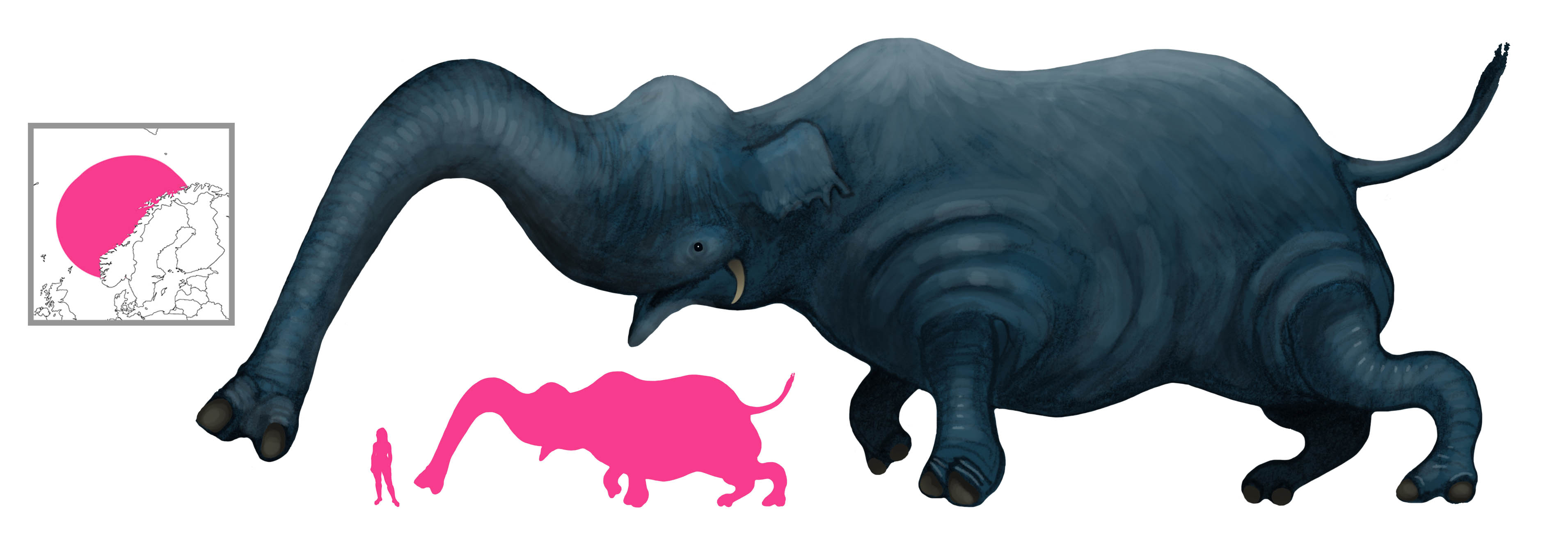
The last iteration of the cahab is provided by Olaus Magnus, who transposes this odd cartilage-legged sea creature into Scandinavia. He tactfully compares the cartilaginous feet to those of both cows and calves (vaccae, aut vituli). Olaus cites Albertus Magnus as the source of the cahab in the Latin version of his Historia, but the French and English translations omit this crucial citation.
Finally, the English translation misreads the name of the cahab as “sahab”, decisively casting this elephant adrift in a sea of translation errors.
References
Aristotle, Cresswell, R. trans. (1862) Aristotle’s History of Animals. Henry G. Bohn, London.
de Cantimpré, T. (1280) Liber de natura rerum. Bibliothèque municipale de Valenciennes.
Cuba, J. (1539) Le iardin de santé. Philippe le Noir, Paris.
Gauvin, B.; Jacquemard, C.; and Lucas-Avenel, M. (2013) L’auctoritas de Thomas de Cantimpré en matière ichtyologique (Vincent de Beauvais, Albert le Grand, l’Hortus sanitatis). Kentron, 29, pp. 69-108.
Magnus, A. (1920) De Animalibus Libri XXVI. Aschendorffschen Verlagbuchhandlung, Münster.
Magnus, O. (1555) Historia de gentibus septentrionalibus. Giovanni M. Viotto, Rome.
Magnus, O. (1561) Histoire des pays septentrionaus. Christophle Plantin, Antwerp.
Magnus, O. (1658) A compendious history of the Goths, Swedes, and Vandals, and other Northern nations. J. Streater, London.
Unknown. (1538) Ortus Sanitatis. Joannes de Cereto de Tridino.
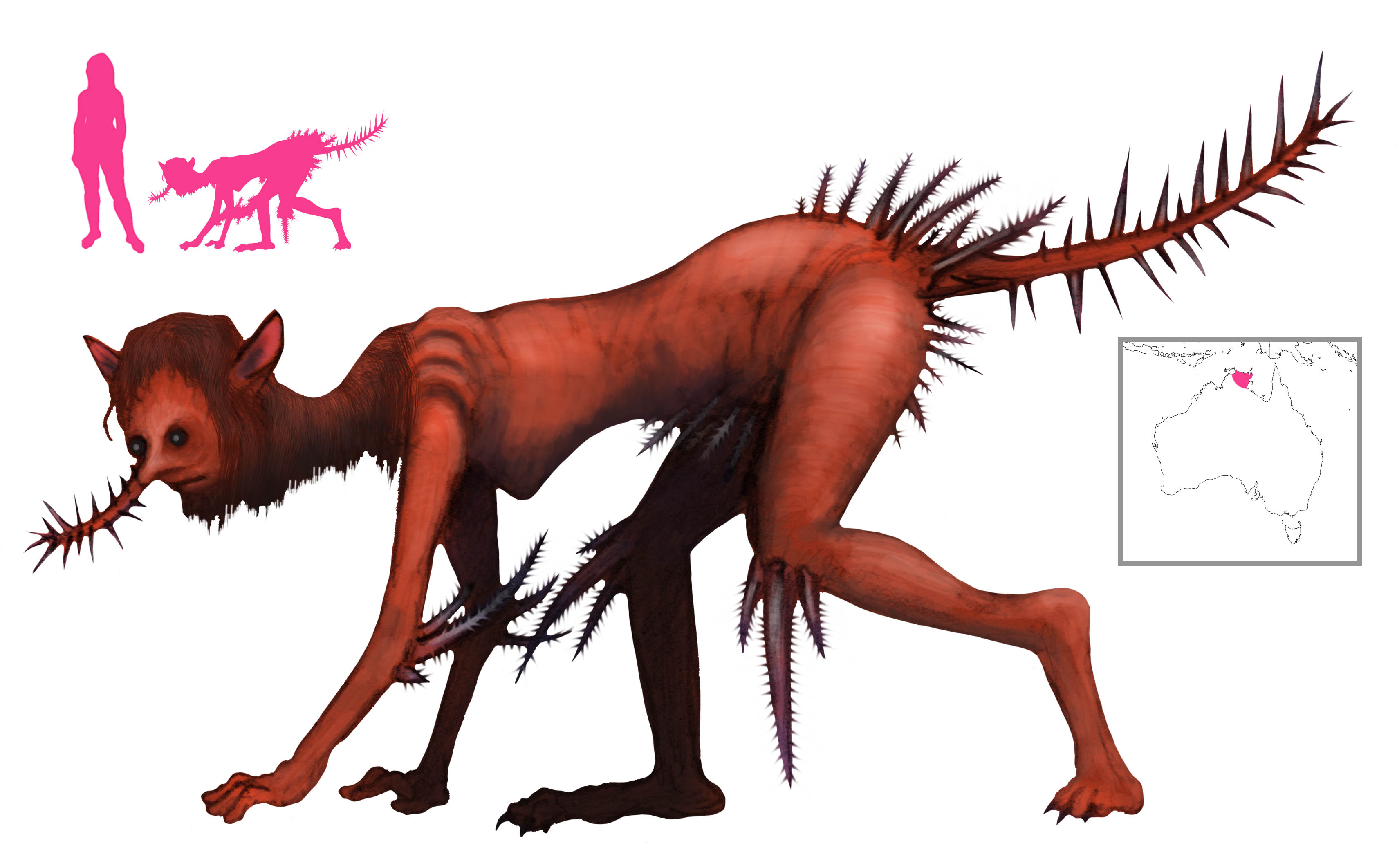
The Nadubi is one of a variety of evil nocturnal spirits that haunt Australia. Nadubi may be found on the rocky plateau of Arnhem Land. They serve as a warning against traveling alone in the bush during the chilly hours of night.
Nadubi are a spirit people similar to humans in appearance but with barbed spines sprouting from their elbows and knees. Cave paintings at Oenpelli show a nadubi woman with spines on several areas of her body, including her elbows and vulva. Another cave painting at Sleisbeck shows a kangaroo-like creature with a spiny tail and spiny projections on its mouth and rear; this may also be a depiction of a nadubi.
A nadubi will creep up on a lone traveler and project a spine into his or her body. The victim can only be saved by the timely removal of the spine by a medicine man; usually this aid is administered too late, and the unfortunate sufferer sickens and dies. As only medicine men can see nadubi, it falls onto them to drive those malignant spirits away from encampments.
Despite their best efforts, every now and then the vigilance of the medicine men slips, and a scream in the night testifies to the fate of another solitary wanderer.
References
Johnson, D. (2014) Night Skies of Aboriginal Australia. Sydney University Press, Sydney.
Mountford, C. P. (1957) Aboriginal Bark Paintings from Field Island, Northern Territory. Records of the South Australian Museum, v. XIII, no. 1, pp. 87-89.
Mountford, C. P. (1958) Aboriginal Cave Paintings at Sleisbeck, Northern Australia. Records of the South Australian Museum, v. XIII, no. 2, pp. 147-155.
Roberts, A. R. and Mountford, C. P. (1975) The Dawn of Time. Rigby Limited, Adelaide.
The long journey of the Ahuna begins in Aristotle, where the cestreus (mullet) is described as the most greedy of all fish, with a frequently distended abdomen. It is edible only when its belly is empty. When threatened it hides its head, convinced that its whole body is hidden that way. In the same sentence Aristotle then mentions the sinodon (dentex) that is carnivorous and eats squid, and the following sentence deals with the channa (grouper) that lacks an oesophagus and whose mouth opens directly into its stomach.
Michael Scot’s translation from the Arabic gives fastaroz for the mullet, theaidoz for dentex, and hahanie for grouper. He also mistranslates the phrase “the dentex is carnivorous and eats squid”, instead assuming that the adjective “carnivorous” applies to the previously-mentioned mullet – not only that, but it becomes self-carnivorous. Now the mullet hides its head when frightened, and consumes itself. Another lapse creates the hahune or ahuna, which exists only as a comparison to the mullet (“the mullet is more voracious than the other fishes and especially that which is known as ahuna”).
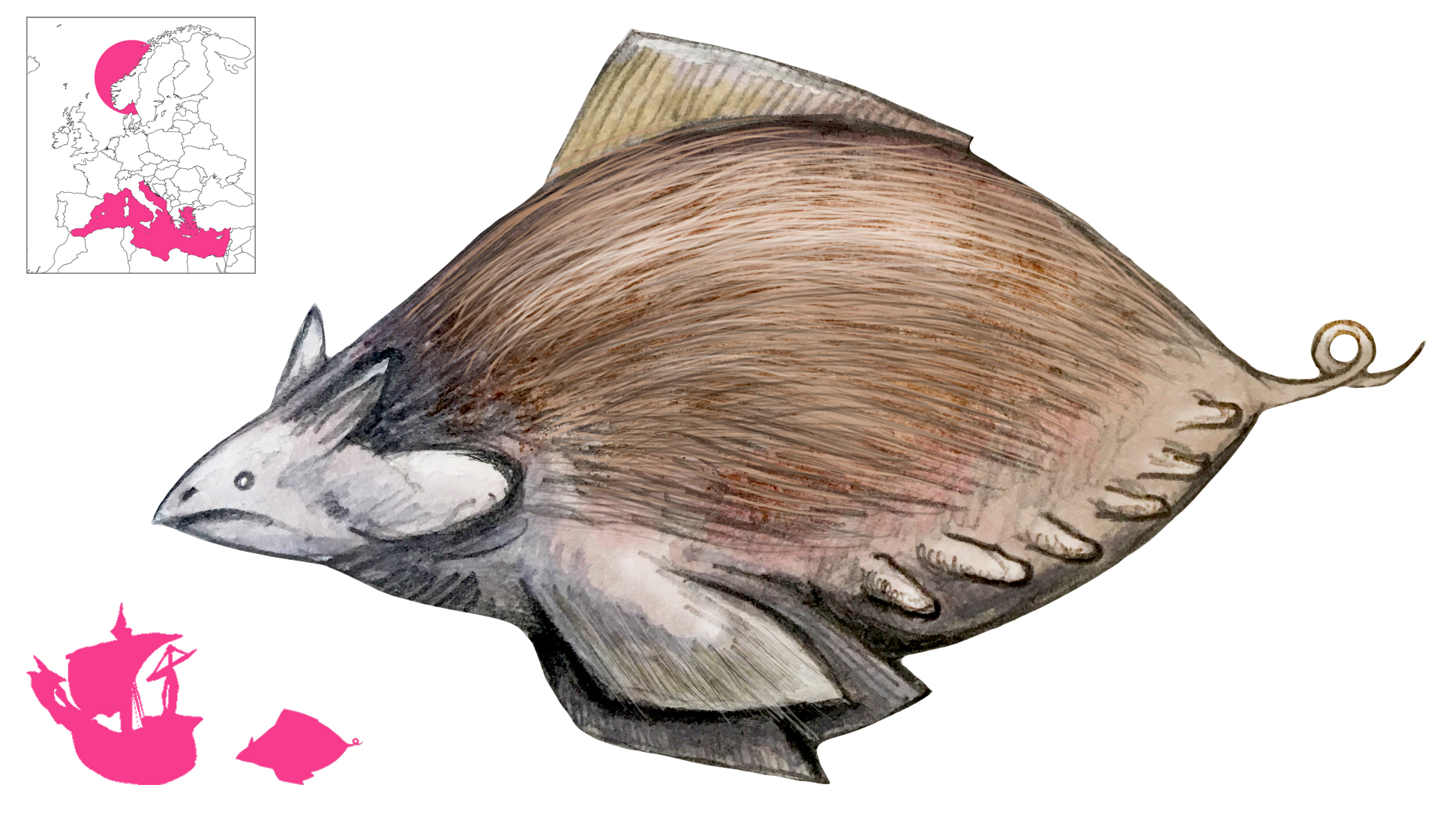
By the time Cantimpré compiled his bestiary, mullet, dentex, and grouper were all combined into one creature, the ahuna or hahuna. This sea monster is highly voracious and will feed until its belly swells beyond the size of its own body. Its mouth connects directly to its stomach; in fact, it has no neck or stomach to speak of. When attacked it tucks its head and limbs away in its body like a hedgehog, folding its skin and tissues over itself. It will remain like this until the danger goes away. If hunger strikes while the ahuna is curled up, it will be forced to eat part of itself to assuage its insatiable gluttony.
We are not given any physical description of the ahuna besides its chubbiness. One of Cantimpré’s depictions gives it an avian beak and horizontal wavy stripes; the Ortus Sanitatis, on the other hand, makes the ahuna a literal sea-hedgehog, complete with a curly tail.
The swamfisk described by Olaus Magnus appears off the coast of Norway and otherwise follows the exact description given by Cantimpré. It is much less common than cetaceans and is frequently hunted for its fat and oil, used primarily for treating leather and providing light during the long winter months. If Olaus Magnus was plagiarizing wholesale, the name he uses is unique.
De Montfort, unaware of its origins, believed the swamfisk to be a giant octopus.
References
Aristotle, Cresswell, R. trans. (1862) Aristotle’s History of Animals. Henry G. Bohn, London.
de Cantimpré, T. (1280) Liber de natura rerum. Bibliothèque municipale de Valenciennes.
Cuba, J. (1539) Le iardin de santé. Philippe le Noir, Paris.
Gauvin, B.; Jacquemard, C.; and Lucas-Avenel, M. (2013) L’auctoritas de Thomas de Cantimpré en matière ichtyologique (Vincent de Beauvais, Albert le Grand, l’Hortus sanitatis). Kentron, 29, pp. 69-108.
Magnus, A. (1920) De Animalibus Libri XXVI. Aschendorffschen Verlagbuchhandlung, Münster.
Magnus, O. (1555) Historia de gentibus septentrionalibus. Giovanni M. Viotto, Rome.
Magnus, O. (1561) Histoire des pays septentrionaus. Christophle Plantin, Antwerp.
de Montfort, P. D. (1801) Histoire Naturelle, Générale et Particuliere des Mollusques, Tome Second. F. Dufart, Paris.
Swan, J. (1643) Speculum Mundi. Roger Daniel, Cambridge.
Unknown. (1538) Ortus Sanitatis. Joannes de Cereto de Tridino.
The Ichisonga is a pachyderm-slayer from the folklore of the Lambas of Zambia, usually found in the Kafue River. It is a herbivorous water beast that resembles a rhinoceros and has a horn on its forehead.
Although a grass-eater, the ichisonga has a special hatred for the hippopotamus. If an ichisonga hears a hippo, it leaves the Kafue River, traveling along the bank so the hippo does not scent it. Then it re-enters the water, goes for the largest bull hippo, and stabs it to death with its horn.
If an elephant is killed nearby, the ichisonga will roar and drive the hunters away from the carcass. It then stays near the elephant’s remains for days until the carcass rots. The ichisonga is motivated by uŵulwishya – jealousy.
References
Doke, C. M. (1931) The Lambas of Northern Rhodesia. George G. Harrap and Company Ltd., London.
There is a common misconception that “owl pellets” are left behind by owls. This belief, spread by highfalutin scientists, is a load of hooey. Any lumberjack can tell you that those pellets are wadded-up clumps of clothing, the only remains of unfortunate greenhorns who approached a Rumptifusel.
Rumptifusels are big, vicious animals covered in a fine pelt not unlike mink. They are flat and very flexible and not too fast. Much like the anglerfish and the alligator snapping turtle, the rumptifusel lures prey within reach by appealing to greed. A rumptifusel catches its prey by draping its thin body over a stump or log in plain sight, looking for all the world like an abandoned expensive fur coat. When a greedy tenderfoot approaches for a better look, the rumptifusel – moving with deceptive speed – engulfs its victim. The underside of the critter is lined with tiny sucking pores, and its prey is thoroughly drained off its bones.
References
Brown, C. E. (1935) Paul Bunyan Natural History. Madison, Wisconsin.
Tryon, H. H. (1939) Fearsome Critters. The Idlewild Press, Cornwall, NY.
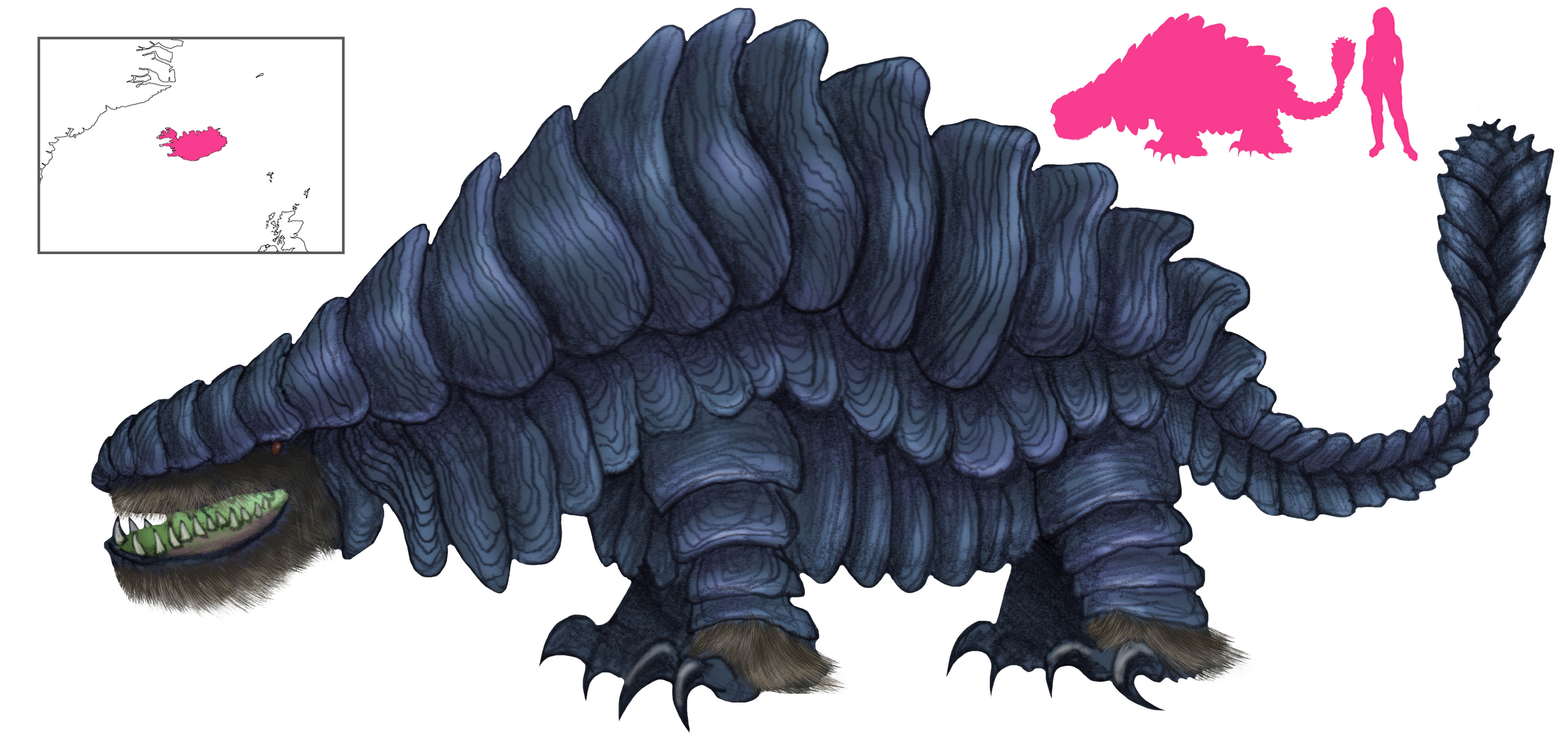
The name Skeljaskrímsli, “shell monster”, refers to a number of Icelandic shore animals known by a variety of names. Consistent among the accounts are the association with the beach, a hump on the back, and a coat of shells that rattle as the creature walks. Shell monsters have been sighted on the coasts of all the main regions of Iceland, and at least one report (the Glúmsstaðir farm’s in Fljótavík, Hornstrandir) describes a freshwater specimen.
As specified by Hlidberg and Aegisson, the skeljaskrímsli proper is a quadrupedal marine creature, bulky and powerfully built. It is the size of a winter’s old bull calf or a huge horse. The neck is broad, the jaws and teeth impressive, and the eyes reddish. There may be a phosphorescent glow coming from the mouth. The skeljaskrímsli’s tail is long and armed with a lump at the end. The short, strong legs end in circular feet armed with large claws.
The skeljaskrímsli earns its name from the thick reflective coat of shells (or flaky scales) that covers its body. These rattle and scrape against each other as the creature moves, giving warning of its arrival. As the shell monster approaches, its powerful stench also becomes apparent. There is little good to say about the shell monster – even its blood is toxic.
Skeljaskrímslis live in the sea and haul themselves onto shore in the dark moonless nights of the northern winter. Often they can be seen before or after spells of bad weather and storms. They are attracted to light and will leave deep gouges in farmhouse doors. Suffice to say that anyone who encounters one of these surly brutes will be in for a bad time.
Most weapons are useless against a skeljaskrímsli’s formidable defenses. One farmer who battled a skeljaskrímsli managed to keep it at bay until the monster tired and returned to the sea; the farmer was stricken with leprosy for his trouble. Another farmer managed to wound a skeljaskrímsli, but some of its poisonous blood spattered onto him, and he died in agony soon after.
To harm a skeljaskrímsli one must resort to alternative ammunition. Shooting silver buttons, grey willow catkins, or lamb droppings from a gun are the only ways to injure and kill this beast.
The Fjörulalli is the best-known variant of the skeljaskrímsli. It is also the size of a winter’s old bull calf, and has been reported as being smaller, about as big as a dog. A tail may or may not be present, and the head is a small, rounded outgrowth. It is covered with shells or lava fragments that scrape together as it moves. Unlike the larger shell-monsters, these smaller ones are usually harmless. They will, however, tear the udders off sheep, and pregnant women should avoid them lest they negatively affect their unborn babies.
References
Hlidberg, J. B. and Aegisson, S.; McQueen, F. J. M. and Kjartansson, R., trans. (2011) Meeting with Monsters. JPV utgafa, Reykjavik.



 A Book of Creatures