Mi-ni-wa-tu

Mi-ni-wa-tu

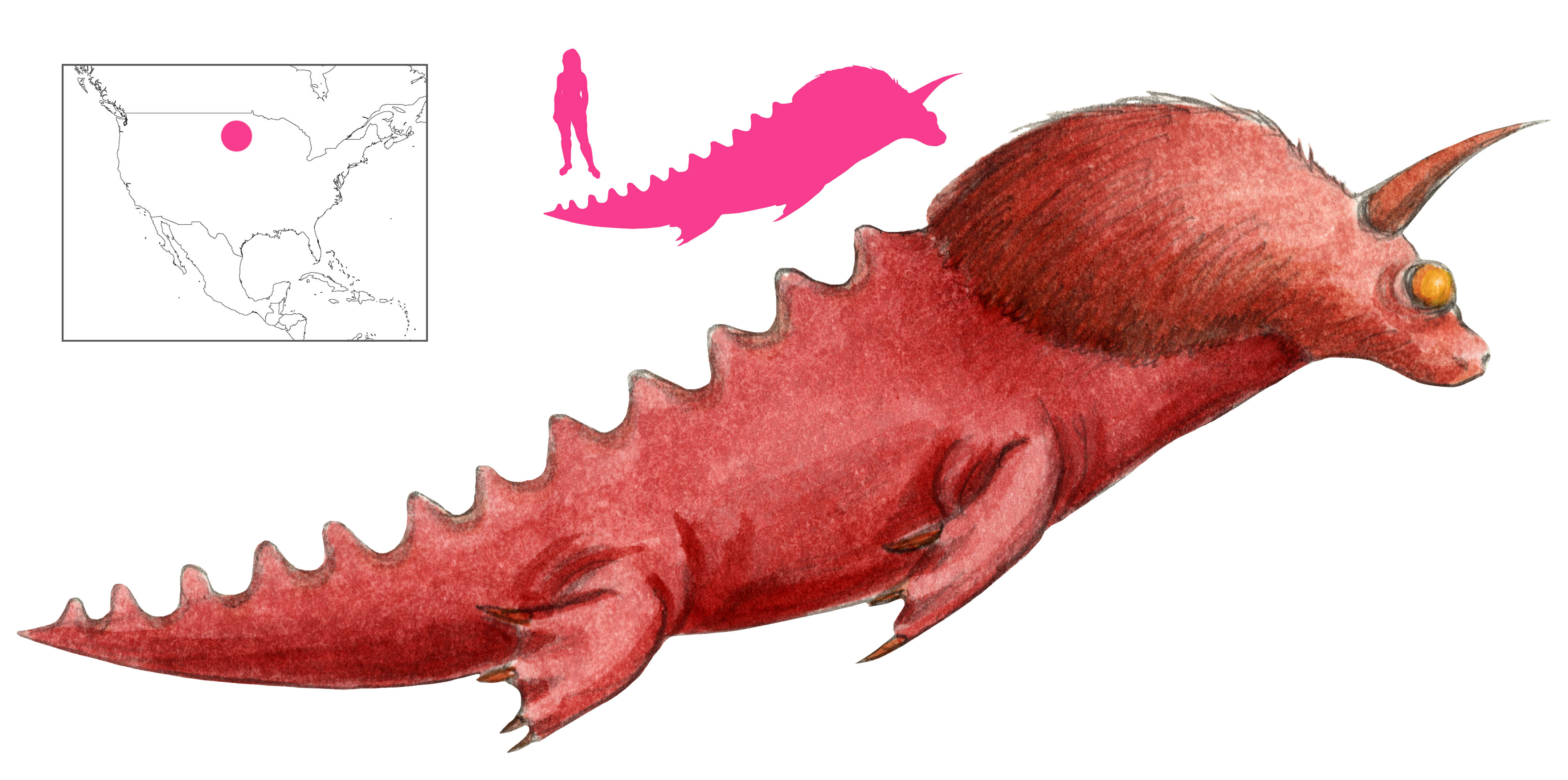
The Mi-ni-wa-tu, or “sea monster”, is known from the folklore of the Tetons, and may be found in the Missouri River.

A mi-ni-wa-tu is an amphibious creature with a body like that of a buffalo, and covered with red hair. It has a single horn in its forehead, and a single eye. Its back is notched like a saw or gear.

The mi-ni-wa-tu may be safely seen at night when it swims powerfully up the river, churning the water and glowing like fire; in the spring, it breaks up river ice. Seeing a mi-ni-wa-tu during the day causes confusion and loss of sight. Madness sets in; after a day of convulsions, the unfortunate victim dies.

References

Dorsey, J. O. (1889) Teton Folklore Notes. Journal of American Folklore, Vol. II, No. IV, pp. 133-139.

Malebête

Variations: Malbête, Malebàete, Malebeste (archaic), Bête d’Angles (Beast of Angles), Troussepoil
Malebete

Visitors to the French town of Angles, in the Vendée, are drawn to the beautiful church of Notre-Dame-des-Anges (Our Lady of the Angels). There, at the top of the bell tower, stands a monstrous stone bear glaring down on the city. Those visitors would be well advised to steer clear of its line of sight.

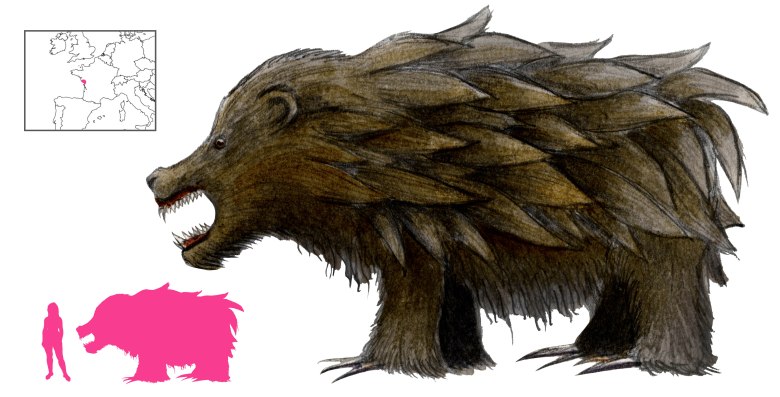
Long ago, it is said that a terrible beast ravaged the countryside of Angles. It was in the form of a great black bear, with shaggy, matted fur, and it became known as the Malebête – the “Evilbeast” or “Illbeast”. This monster had a predilection for young maidens, glutting itself almost exclusively on women. After feeding it would then wash itself in the nearby river, causing its hair to clump and stick out and granting the river the name of Troussepoil (“Hair-Raiser”, more or less).

The depredations of this demonic creature led to increasing concern. The river was running red with blood, and the female population was dwindling. None dared approach it, as its strength was greater than any knight’s. As it was an incarnation of the Devil himself, it became clear that only a sufficiently holy man would be capable of defeating it. The abbots of Fontaines and Talmont both went to face the beast, only to scurry away in terror when it charged them. The Pope’s envoy fasted for two days before confronting the Malebête, but barely escaped with his life and swore never to return.

Was there any man holy enough to destroy the Malebête? The answer came in the form of Father Martin, an old monk from the Angles cloister who spent most of his time isolated in contemplation of God. Perhaps out of desperation, he was begged to do something about this.

Leaning on a walking stick, dressed only in his ecclesiastical robes, Father Martin walked out to where the Malebête awaited him. To everyone’s amazement, the beast lowered its gaze in front of the hermit. “Follow me”, he said simply, and the Malebête did – as did the entire population of Angles. They followed Father Martin all the way back to the church, where he told the Malebête to climb the bell tower. Once at the top, it froze in place, and turned to stone.

Despite the rejoicing over the Malebête’s defeat, there were still a few voices of dissent in the form of a few girls who taunted Father Martin. “Since when are you the Devil’s shepherd?” they sneered. Father Martin merely smiled and looked up at the Malebête. “Henceforth, you shall feed only on the beauty of the girls of Angles”, he stated. And instantly all the women present became ugly and ran home in shame.

Since then, the resourceful women of Angles have found ways of avoiding the Malebête’s hungry gaze, and sneak safely into the church via a back door. Today the Malebête’s primary sustenance comes through the tourist industry.

This tale was first told by Benjamin Fillon, a dubious character who seems to have created the story out of whole cloth, making it a neo-myth of sorts. For one thing, the statue of the Malebête is of pre-Christian origin, predating its own legend; it was originally in a seated position, and was mutilated into its current shape. The Malebête’s story is also a familiar one, echoing many others told of anthropophagous monsters slain by righteous men.

References

Chaigne, L. (1942) La Vendée. F. Lanore, Paris.

Dillange, M. (1983) Eglises et Abbayes Romanes En Vendée. Jeanne Laffitte, Marseille.

Dubourg-Noves, P. (1996) Notre-Dame d’Angles. in Vendée. Congrès Archéologique de France, 151e Session. Musée des Monuments Francais, Paris.

Le Quellec, J. (1988) Le légendaire du Sud-Vendée: organisation spatio-mythique. Etuderies 3-4.

Trébucq, S. (1912) La chanson populaire et la vie rurale des Pyrénées à la Vendée. Feret et fils, Bordeaux.
Múshveli

Variations: Mushveli, Mousewhale; Hafmús, Hafmus (“Sea-mouse”)

Mushveli

The chimaera, ratfish, or rabbitfish (Chimaera monstrosa) is a small and completely harmless deep-sea fish. Evidently its legendary counterpart the Múshveli, or “mousewhale”, is enormous and highly dangerous. As one of the illhveli (“evil whales”) of Iceland, it is inedible and delights in causing death and destruction.

Múshvelis are mostly mouth, ear, and tail. The gaping, deeply split mouth is large enough to swallow a rowboat in a single gulp, and the large, prominent ears stick out like sails while the animal swims. A long whiplike tail without a fin allows the múshveli to swim at terrifying speeds, so fast that the sea churns ahead of it. Instead of fins, there are two stumpy hoofed legs. These animals are over ten meters long, and light gray or brownish-black in color.

Múshvelis sink ships by ramming them or rearing up, placing their feet on the gunwales, and pushing down until the ship capsizes. If a múshveli is sighted, the best course of action is usually to make for shore as fast as possible, and once there make for higher ground. Unlike most other evil whales, múshvelis can clamber onto the beach with their stubby legs, but they are out of their element and give up quickly. One múshveli ran a boat aground and followed the sailors as far as it could. It easily shrugged off three bullets, and eventually returned to the sea with the next high tide.

Large boats are usually impregnable to múshvelis. In one account, two Icelandic fishermen on a small boat were alerted to the presence of a múshveli by the roar of the foaming sea. It was making right for their boat, and terror made them freeze up. Fortunately, the crew of a French fishing schooner saw their plight, and steered their boat into the múshveli’s path. The sea-mouse rammed the ship so hard that it listed to one side, but remained afloat. The múshveli continued to take its rage out on the French schooner while the fishermen were taken aboard to safety, and eventually the monstrous whale gave up and disappeared.

References

Davidsson, O. (1900) The Folk-lore of Icelandic Fishes. The Scottish Review, October, pp. 312-332.

Hlidberg, J. B. and Aegisson, S.; McQueen, F. J. M. and Kjartansson, R., trans. (2011) Meeting with Monsters. JPV utgafa, Reykjavik.

Mbielu-mbielu-mbielu

Mbielu3

The Mbielu-mbielu-mbielu, or “animal with planks growing out of its back”, is a little-known creature restricted to the Likouala-aux-Herbes in the Congo.

It has only ever been seen in the water with only its back protruding, exposing large “planks” with algal growth between them. What it looks like underwater remains unknown. The mbielu-mbielu-mbielu does not show any aggressive behavior and is presumably herbivorous.

Mbielu3 sketch

The suggestion that it is a late-surviving stegosaur is dubious at best, considering that stegosaurs went extinct long before the end of the Cretaceous (with the possible exception of the disputable Dravidosaurus).

References

Mackal, R. (1987) A living dinosaur? E. J. Brill, New York.

Weishampel, D. B.; Dodson, P.; and Osmolska, H. (2004) The Dinosauria, 2nd Edition. University of California Press, Berkeley.

Mi’raj

Variations: Al-Mi’raj (usually erroneously), Miraj (lacking the ‘ayn), Mirag (see previous, also Egyptian pronunciation)

Miraj

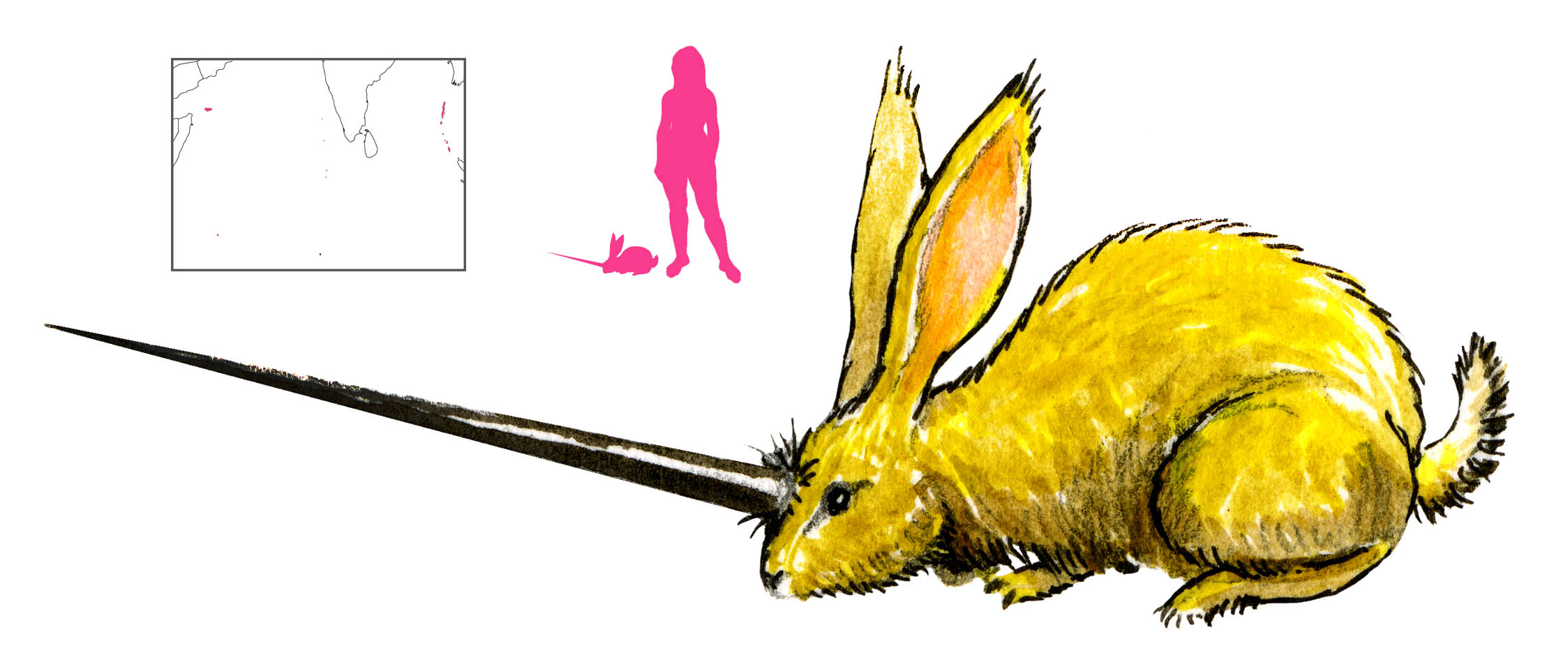
When Alexander the Great visited Jazirat al-Tinnin – the Dragon’s Island – he was immediately presented with an opportunity to play the hero. The inhabitants of this unspecified island in the Indian Ocean were terrorized by a fire-breathing dragon, which would exact a tribute of two oxen a day to be left at the opening of its lair. Ever the tactician, Alexander stuffed two ox-skins with pitch, sulfur, and other unpalatable substances, and had them dropped off for the dragon; the reptile perished soon after eating them.

Among the gifts Alexander was given for this sauroctonous feat was a Mi’raj, a creature resembling a yellow rabbit with a single black horn on its forehead. It was apparently so aggressive that wild animals would flee at the sight of it – a feature it shared with the karkadann, and which may have arisen from confusion between the two unicorns. It certainly wasn’t fierce enough to avoid being captured (alive or dead).

The exact pronunciation of the name is unclear, as with the absence of diacritics, “mi’raj” may as well be “mu’raj”. It is sometimes rendered as Al-mi’raj, literally “The mi’raj”; this is unnecessary in English, and any usage of this term preceded with “the” or “an” is redundant. Bochart (and by extension Flaubert) refers to it as “mirag”, which is correct in Egyptian Arabic but drops the difficult ‘ayn.

Al-Qazwini was the first to report the story of Alexander and the mi’raj. Al-Damiri describes the mi’raj as “great [and] marvelous”.

If there is any factual basis for the existence of the mi’raj, it may well have been a rabbit with facial tumors caused by papillomaviruses. The same has been used to explain the origin of the jackalope, a North American hybrid used to fool tourists and usually created by grafting horns on a jackrabbit skin.

References

Bochart, S. (1675) Hierozoicon. Johannis Davidis Zunneri, Frankfurt.

Al-Damiri, K. (1891) Hayat al-hayawan al-kubra. Al-Matba’ah al-Khayriyah, Cairo.

Ettinghausen, R. (1950) The Unicorn. Studies in Muslim Iconography, Freer Gallery of Art Occasional Papers Vol. 1, No. 3, Washington.

Al-Qazwini, Z. (1849) Zakariya ben Muhammed ben Mahmud el-Cazwini’s Kosmographie. Erster Theil: Die Wunder der Schöpfung. Ed. F. Wüstenfeld. Dieterichsche Buchhandlung, Göttingen.

Seznec, J. (1943) Saint Antoine et les Monstres: Essai sur les Sources et la Signification du Fantastique de Flaubert. PMLA, Vol. 58, No. 1, pp. 195-222.

Zimmer, C. (2011) A Planet of Viruses. University of Chicago Press.

Munuanë

Variations: Munuane, Munuani

Munuane

Munuanë is either a single entity or an entire species of ogres native to the Guahibo people of Colombia and Venezuela. Many stories end with him being outsmarted and killed, which would be slightly inconvenient if he was one person.

Munuanë plies the waterways of the jungle on a makeshift raft. He is tall and powerful, with long grey hair, but his mouth is as toothless as a turtle’s. He loves eating human flesh, but his lack of teeth forces him to prepare his meals before eating them. Munuanë lacks eyes in his head, instead having them in his knees. Those eyes are his weak spot, as he is invulnerable everywhere but his knees. His wife is called Matasoropapénayo, or “Little-bone-of-the-crown”, and they live together in a hut in the deepest part of the jungle.

He is the “grandfather of fish”, and claims ownership over all the fish in the river. Fishermen are advised to bring in their catch as quickly as possible and not fish more than they need, as Munuanë hates greed, and mesmerizes overfishers into walking off ravines. Other times he shoots offenders with his arrow – Munuanë always carries around only one arrow, as he never misses his target. He is also an insatiable sexual predator, and his victims turn into termites.

It is said that a man once met Munuanë while out fishing, and did not manage to escape in time. Fortunately, Munuanë is not particularly bright, and accidentally shot the man’s reflection in the water instead of the man himself. By the time Munuanë had retrieved the arrow, his quarry had managed to swim away. Munuanë chased after the man and followed him to his village, where he ran rampant. But the man realized what Munuanë’s weakness was, shot him in the eye, and killed him instantly.

Such are the tales of Munuanë. Sometimes he is outsmarted by a powerful shaman. At other times a friendly spirit – Banajuli or Banaxuruni – is there to reveal his weak spot. Sometimes he is transformed into a rotten tree stump when he dies, with the arrow that killed him still embedded in the trunk. The entire forest cries out upon his death; he may be an ogre, but he also cares for the jungle and the fish of the river.

References

Kondo, R. L. W.; Kondo, V. F.; Maltoni, R.; Gómez, F. O.; Queixalós, F.; and Vargas, E.; Wilbert, J. and Simoneau, K. eds. (1992) Folk Literature of the Sikuani Indians. UCLA Latin American Center Publications, University of California, Los Angeles.