Brethmechin

Variations: Arabian Breth-mechin, Whale Panther

Brethmechin

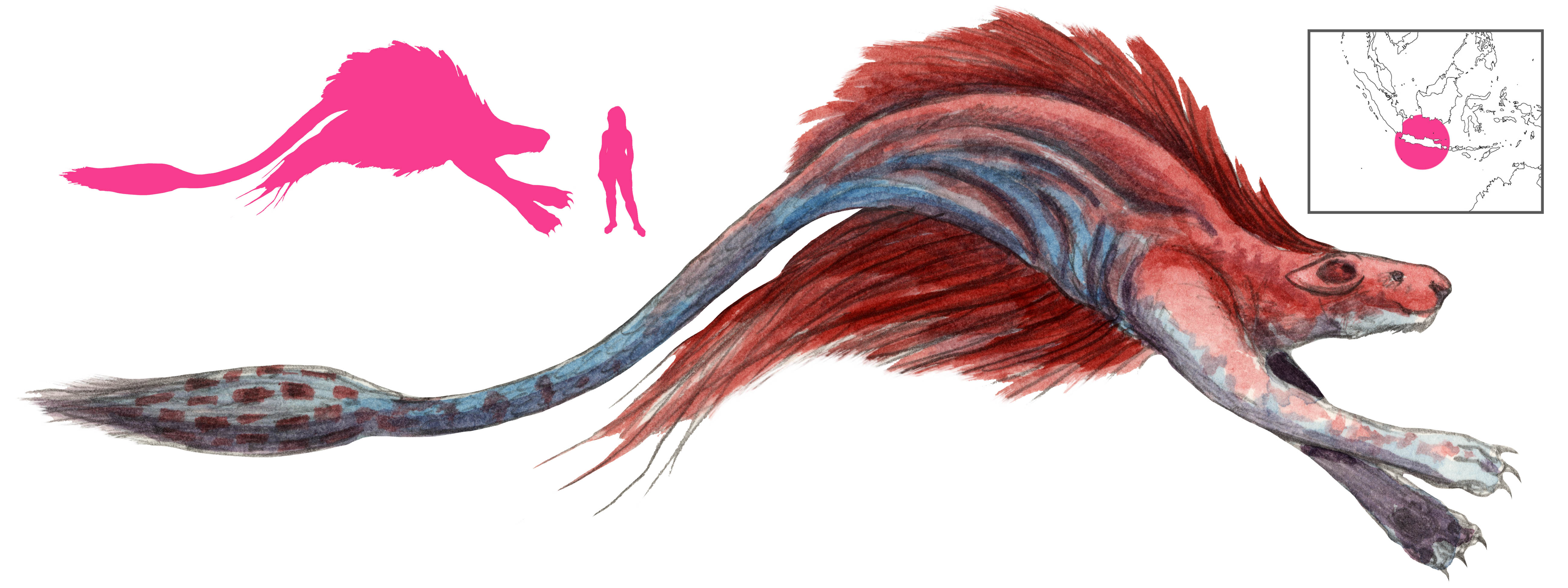
Gessner describes the Brethmechin as an amphibious beast found near the island of Java. He gives the name as being of Arabic etymology, although it is hard to tell what words it derives from. Gessner’s contact was Theodorus Beza, who reported a brethmechin washed up on the Javan shore on April 14, 1551.

A brethmechin is 10 cubits (about 4.5 meters) long and 2 cubits (about 1 meter) high. It has two legs, which allow it to move around on land to some extent. It has a panther’s head and a lion’s claws, with a horse-like tuft of hair on the tip of its pantherine tail. Brethmechins are red in color with blue markings, and have a lighter cerulean tail with red spots. They are well furnished with red dorsal and ventral bristles, with the ventral bristles being particularly long towards the tail.

The brethmechin has seen minor use in heraldry.

References

Gessner, C. (1560) Nomenclator aquatilium animantium. Christoph Froschoverus.

Holme, R. (1668) The academy of armory, or, A storehouse of armory and blazon containing the several variety of created beings, and how born in coats of arms, both foreign and domestick. Printed by the author at Chester.

Cherruve

Variations: Cheruvoe, Cheurvoe, Cheurvue, Cherufe

Cherruve

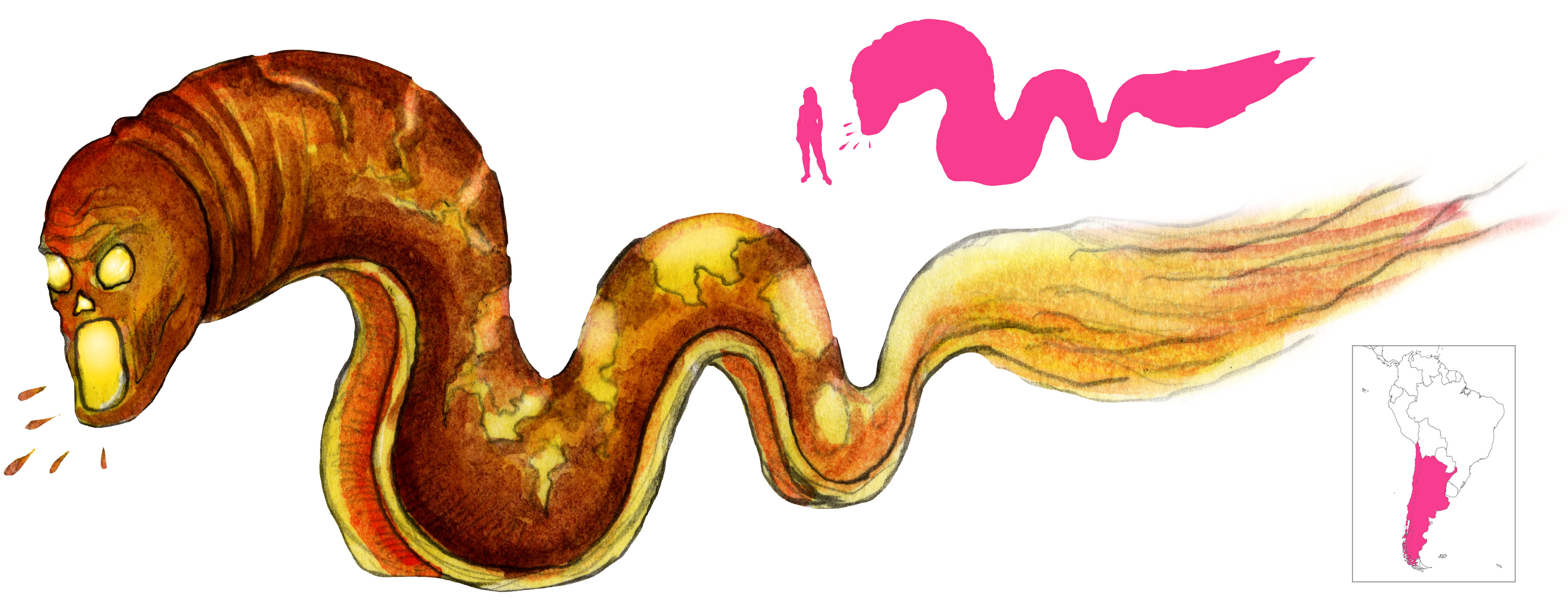
The Cherruve is the Chilean spirit of comets and asteroids. Originally no more than the Araucanian meteorite, the cherruve’s role has since expanded to include lava, volcanoes, fiery exhalations, will-o-the-wisps, whirlwinds, and animate stone axes.

Cherruve appearance varies from area to area, but it is usually described as a comet, or a great serpentine creature with a human head and lava dribbling from its mouth. Its appearance has been anthropomorphized to various degrees and conflated with aspects of European mythology; in the Andes it becomes a huge seven-headed dragon; elsewhere it is confused with dragons, devils, and giants, or bipedal goats with flaming eyes.

Cherruves live underground and in volcanoes, and streak across the sky by night. The appearance of a cherruve in the sky heralds the spread of an epidemic, the death of a great leader, or other misfortunes, while the cherruve’s vomit is lava and its movements underground cause earthquakes. They make thunder by tossing human heads. The more dragon-like cherruves may demand the sacrifice of Mapuche maidens, and will withhold the flow of rivers if their demands are not met.

Comets, asteroids, and meteors are all cherruves, as are meteorites and oddly-shaped volcanic rocks. Cherruve rocks are collected by sorcerers, who use them to carry out their evil purposes by sending them at their enemies. They are ordered to suck blood and inflict death and disease, and can operate on their own, returning diligently to their masters after performing their duties.

Cherruves are also capable of feeling more human emotions. One cherruve married a Cloud, and their beautiful daughter, ethereal and pale, was Snow. Despite the cherruve’s jealous attempts to keep his wife under lock and key, she was abducted by his mortal enemy Wind. Every now and then Wind would blow Cloud over the volcano, and her tears became rain, while the cherruve’s own despair turned into destructive eruptions. The cherruve redoubled his efforts to protect Snow, and kept her from leaving the mountain during the daylight hours. Snow’s curiosity about the world outside continued to grow, and one day she finally managed to escape her father and climb out into the light. She marveled at the sun, the songs of birds, the colors, all infinitely beautiful and unknown to her. The longer she stayed outside, the happier she was, and yet the weaker she felt. Her mother tried to protect her, but the spiteful Wind carried the Cloud away. When Snow sat down, exhausted, the love-stricken Sun came down to give her a kiss. When the cherruve finally caught up with his daughter, he found nothing but a puddle of crystalline water.

References

Faron, L. C. (1964) Hawks of the Sun. University of Pittsburgh Press, Pittsburgh.

Guevara, T. (1908) Psicolojia del pueblo araucano. Imprenta Cervantes, Santiago de Chile.

Latcham, R. E. (1924) La organización social y la creencias religiosas de los antiguos araucanos. Imprenta Cervantes, Santiago de Chile.

Lenz, R. (1897) Estudios Araucanos. Imprenta Cervantes, Santiago de Chile.

Pino-Saavedra, Y.; Gray, R. (trans.) (1967) Folktales of Chile. The University of Chicago Press, Chicago.

Soustelle, G. and Soustelle, J. (1938) Folklore Chilien. Institut International de Coopération Intellectuelle, Paris.

Yedua

Variations: Jeduah, Jidoa, Feduah, Fedoui, Fadua, Adne Hasadeh, Adnei Ha-sadeh, Adne Sadeh, Abne Hasadeh, Avnei Ha-sadeh, Bar Nash D’tur, Jidra (erroneously)

yedua

The Talmudic equivalent of the Barometz, the Barnacle Goose, and other zoophytes is the Yedua. This name was used by Rabbi Meir, and these creatures are the yidoni of Leviticus 19:31, often translated to “wizards” in English. The exact pronunciation of the name is debatable, although one variation (“Jidra”) appears to be a misreading of Jidoa as used by Lewysohn. The yedua is also known as Adne Hasadeh (“lords of the field” or “men of the field”), Abne Hasadeh (“stones of the field”), or Bar Nash D’Tur (“man of the field”).

The size of the yedua is unspecified, but it has a human shape, having a face, body, arms, and feet.  However, Rabbi Jochanan, following Moses Chusensis of Ethiopia on the authority of Rabbi Simeon, believed the yedua to be a vegetable lamb, perhaps after confusion with the barometz. This wild man of the mountains lives through its navel, which connects it to the ground with a stem like that of a gourd or pumpkin. If this umbilicus is cut or uprooted the yedua dies. It will maul and kill any living thing within the radius of its stem, and will eat all vegetation within that circle. It is impure, and its body causes spiritual impurity in buildings.

It is valuable in witchcraft, as its bones placed in the mouth, along with certain incantations, allow one to see the future. Yedua hunters killed their quarry by shooting arrows into the navel-stem from a safe distance.

The account of the yedua can be read as an early observation of apes. Rabbi Lipschutz believed the yedua to be inspired by relict populations of chimpanzees or orangutans in the Lebanese cedar forests. The origin of the creature appears to have come about by a simple misspelling that turned tur (“field”) into tavur (“navel”).

References

Coogan, M. D.; Brettler, M. Z.; Newsom, C.; Perkins, P. (eds.) (2010) The New Oxford Annotated Bible. Oxford University Press, Oxford.

Laufer, B. (1915) The Story of the Pinna and the Syrian Lamb. The Journal of American Folk-lore, vol. XXVIII, no. CVIII, pp. 103-128.

Lee, H. (1887) The Vegetable Lamb of Tartary. Sampson Low, Marston, Searle, and Rivington, London.

Lewysohn, L. (1858) Die Zoologie des Talmuds. Joseph Baer, Frankfurt.

Ley, W. (1959) Exotic Zoology. The Viking Press, New York.

Slifkin, N. (2011) Sacred Monsters. Zoo Torah, Jerusalem.

Yuanat

Yuanat

The Yuanat is a type of serpent reported by Thevet from the island of Hispaniola, or Cuba. It lives in trees, on land, and in the water, making it fish, fowl, and land beast.

This greatly terrifying creature is about the size of a rabbit and is frightful to behold. It has the tail of a lizard, and four weak bird’s legs, with the forelegs longer than the hindlegs and long claws on each toe. Its teeth are sharp. It has a spine running down its back like the fin of a fish. Underneath its throat there is a colorful flap of skin reaching down to its belly, its varied hues making it hard to tell which color is dominant. It can swim well, and is completely mute.

Despite its horrifying appearance, the yuanat tastes excellent, and its flesh is more highly prized than that of rabbits. It is also so gentle and harmless that the natives would keep a yuanat on a leash for ten or twelve days before eating it, and it would never attempt to harm them. However, Thevet notes that yuanat meat is harmful to those who have had the pox, as it causes the disease to return in full force.

References

Thevet, A. (1575) La Cosmographie Universelle. Guillaume Chaudiere, Paris.

Númhyalikyu

Variations: Númhyělekum

Numhyalikyu

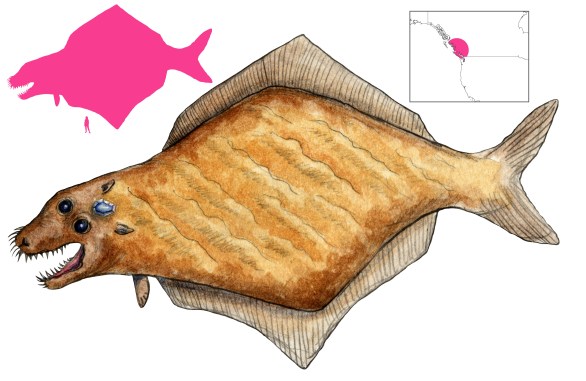
Númhyalikyu, “one chief one”, is an enormous, monstrous halibut of Pacific Northwest Kwakwaka’wakw folklore. Its back looks like a beach, complete with ripples left behind by the waves. It has the head of a seal, with a shining spot that gleams like fire.

If a númhyalikyu is killed, its head can be stabbed and its gleaming ornament extracted, revealing it to be a hard and shiny crystalline object. This is known as tlúgwi, and it is highly valuable. It is hard to pinpoint the location of a númhyalikyu, however, as it makes a deep humming sound that reverberates through water and air and rumbles through the trees, seeming to come from everywhere at once.

Númhyalikyu brings bad weather and storms. When it comes to the surface, it creates treacherous shallows that wreck canoes. Its rippled back, often just below the surface of the water, can be easily mistaken for a small island.

Númhyalikyu’s dance is númkahl, “personification of númhyalikyu”. The initiate playing the part of númhyalikyu wears a face mask, and is caught on the beach after metaphorically leaving the sea.

References

Curtis, E. S. (1915) The North American Indian, v. X. The Plimpton Press, Norwood.

Isiququmadevu

Variations: Usiququmadevu (flattering); Isikqukqumadevu, Usikqukqumadevu; Unomabunge; O’gaul’-iminga; O-nsiba-zimakqembe

Isiququmadevu

When Untombinde, the king’s daughter, set out for the mythical Ilulange River, she took with her two hundred maidens to be her escorts. She was determined to bathe in one of its pools despite her parents’ warnings of dire consequences. Once there, she and her handmaidens undressed and played in the water, but when they came back out their clothes, their beautiful bracelets and jewels and finery were all gone. Isiququmadevu had taken them.

Isiququmadevu, “Smelly Whiskers”, is a mountainous “swallowing monster” from Bantu and Zulu folklore. She is bearded, bloated, hairless, and squatting, with an enormous mouth capable of engulfing entire villages. Other clues as to her appearance are given in her many epithets, which include Unomabunge (“Mother of Beetles”), O’gaul’-iminga (“Feller of Lofty Thorn-trees”), and O-nsiba-zimakqembe (“She Whose Feathers are Long and Broad”).

Naturally the royal cortège was mortified, and entreated the isiququmadevu to return their belongings. “Untombinde, the king’s daughter, brought us here, she is to blame”. One by one they recuperated their effects, until Untombinde was left. “Beseech Usiququmadevu”, they told her, using a more personal and flattering name for the monster. But Untombinde – perhaps miffed by her companions’ accusations – refused. “I am the king’s daughter”, she said haughtily, “and I will never entreat the isiququmadevu”. Whereupon the monster seized her and took her into the pool.

King Usikulumi despaired for his daughter, fearing she was lost forever, and ordered his troops to slay the isiququmadevu. But the monster hauled herself onto the bank, and swallowed the entire army in one gulp. She then followed their trail back to the village, and swallowed the men, the women, the children, the dogs, the cattle, every living thing she found there.

Among her victims were two adorable twin children whose father was the only villager who escaped the isiququmadevu’s attack. He resolved to kill the creature, arming himself with his assagai and following her back into the woods. First he met a herd of buffaloes. “Where has Usiququmadevu gone? She has taken my children”. Acknowledging his plight, the buffaloes told him he was on the right track with a “forward, forward!” Next he met some leopards and an elephant, who advised him to keep on going. Finally he found the isiququmadevu herself, replete and squatting. “I seek Usiququmadevu, who has taken my children!” he announced. “Forward, forward!” said the isiququmadevu, but the man was not as dimwitted as she had hoped, and he stabbed her with his spear until she died. Then all her victims climbed out, none the worse for wear, with Untombinde, defiant and proud, coming out last.

In another isiququmadevu story, it is Usitungusobenthle, a young woman who had been abducted by pigeons to be their queen, who brings about the creature’s demise. She returns to her village after escaping her captors only to find it empty, with the isiququmadevu sleeping nearby. She cut it open with a knife, and released all its victims.

Another princess, Uluthlazase, actually stood up to an isiququmadevu and tried to wrest her clothes from the monster. She held on so firmly that the isiququmadevu could not remove her, and the two fought each other to a stalemate. When it left to get assistance from other isiququmadevu, Uluthlazase collected her effects and wisely escaped.

References

Callaway, C. (1868) Nursery Tales, Traditions, and Histories of the Zulus. Trübner and Co., London.

Koopman, A. (2002) Zulu Names. University of Natal.

Werner, A. (1968) Myths and legends of the Bantu. Frank Cass and Co. Ltd., London.

Orabou

Variations: Orobon (erroneously)

Orabou

Mount Marzouan, once known as Mount Orabou, was described by Thevet in his Cosmographie. It is home to a small population of Arabs, and the waters of the sea there house a fish known as Orabou, for which the mountain was once named.

Not much is known of the orabou’s appearance. Thevet only states that it is nine to ten feet long, and is plated with armor like a brigandine, although its scales are not as tough as a crocodile’s hide. The depiction of the orabou provided gives it a humpbacked, rather feline appearance.

Orabou flesh is particularly foul-tasting, and Thevet believed that old camel meat and Livonian mastiff were preferable to the execrable orabou. Eating it also results in kidney and bladder stones. Despite that, the inahabitants of Mount Marzouan eat it anyway, treating their stones with a diuretic concoction of orabou fat, two handfuls of false gold dust, and cyclamen.

Paré takes the orabou from Thevet, but misspells its name as the phonetically-similar “orobon” and its locality as “Mount Mazouan”. Ever the embellisher, he also adds that it is extremely ferocious towards other fish.

The orabou may have been inspired by crocodiles, although Thevet makes a distinction between the two. Another possibility is a monitor lizard, like a similar creature encountered by Sir Andrew de Toulongeon and Pierre de Vaudrei in the desert of Palestine. It was a three-foot-long green lizardlike animal covered with sturgeon-like scales, having feet like the hands of a child, a head like a hare’s, and a long lizard’s tail. It made sounds like a cat, and was feared by the Arabs accompanying the knights. Naturally this affront to the natural order was promptly slain.

References

Butazzoni, F. (1997) Los Ensayos del Orobon. Ariel, Montevideo.

Paré, A. (1614) Les Oeuvres d’Ambroise Paré. Nicolas Buon, Paris.

Thevet, A. (1575) La Cosmographie Universelle. Guillaume Chaudiere, Paris.

Wright, T. (1848) Early Travels in Palestine. Henry G. Bohn, London.

Xuangui

Variations: Twisting-Turtle, Round-Turtle, Xuan-Turtle

Xuangui

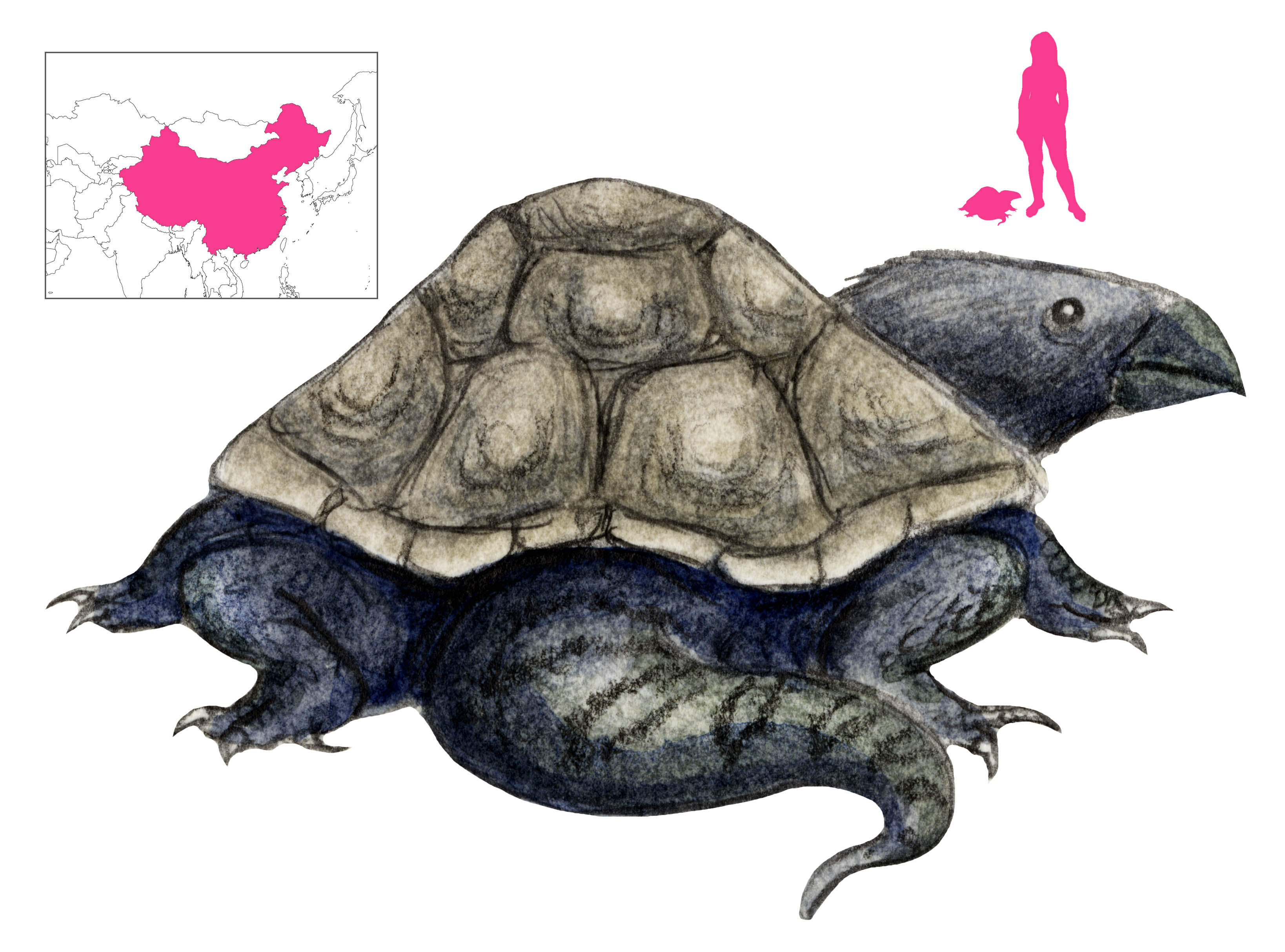
Xuangui, or Twisting-Turtles, are found in the Strange River, east of the Niu-Trees Mountain. They are black turtles with a bird’s head and a viper’s tail, and they make sounds like that of splitting wood. Wearing a piece of xuangui from the belt protects from deafness and calluses. Mathieu compares it to the Japanese water turtle Clemmys japonica.

It is unclear what, exactly, is strange about the river.

References

Mathieu, R. (1983) Étude sur la mythologie et l’ethnologie de la Chine ancienne. Collège de France, Paris.

Strassberg, R. E. (2002) A Chinese Bestiary: Strange Creatures from the Guideways Through Mountains and Seas. University of California Press.

Xi

Variations: Xi-Rhinoceros; Xiqu (potentially); Si, Si-Rhinoceros (potentially)

Xi

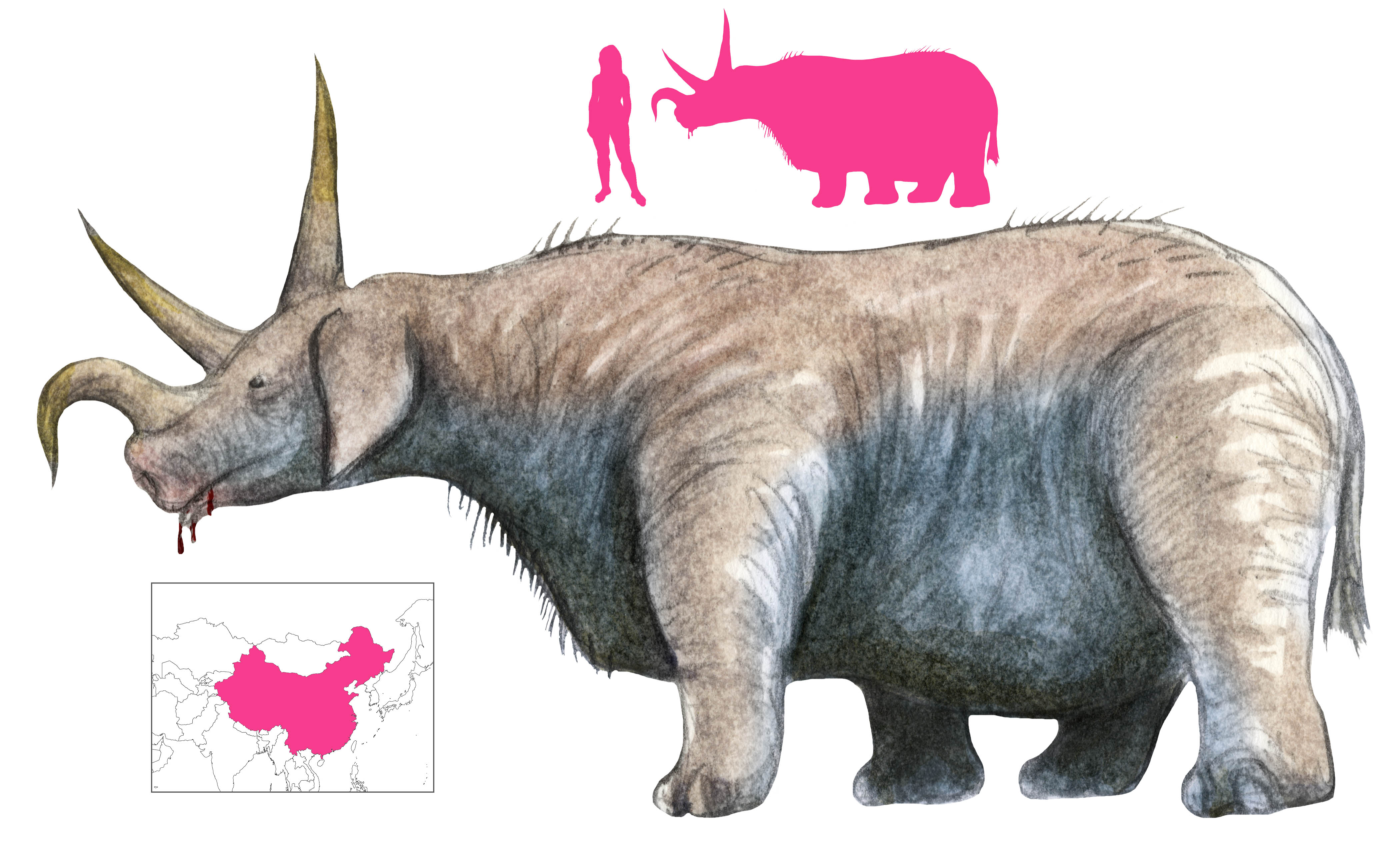
Among the wildlife to be found on Cauldron Mountain, Mount Min and Pray-and-Pass Mountain is the Xi. It is like a black water buffalo with a pig’s head, a large belly, and three-toed elephant’s feet on short legs. It has three horns, found on its nose, forehead, and crown. The nose horn does not fall off and helps it eat. Xi feed primarily on brambles, and therefore often drool blood. It may be the same animal as the Xiqu, which is a man-eating blue-black ox that makes sounds like a baby.

The Si is similar, but blue or green with a single horn weighing 1,333 pounds. Its thick skin could be used as armor.

Guo Pu mocked the Xi for its big nose, and the Si for its tough hide which ironically made it more desirable and vulnerable to human exploitation.

Both Xi and Si have been used interchangeably to refer to a number of large herbivores including oxen, yaks, and buffalo, but they are generally believed to be rhinos.

References

Strassberg, R. E. (2002) A Chinese Bestiary: Strange Creatures from the Guideways Through Mountains and Seas. University of California Press.

Skoffín

Variations: Skoffin; Skuggabaldur, Finngalkn, Fingal; Urdarköttur, Naköttur; Modyrmi
Skoffin

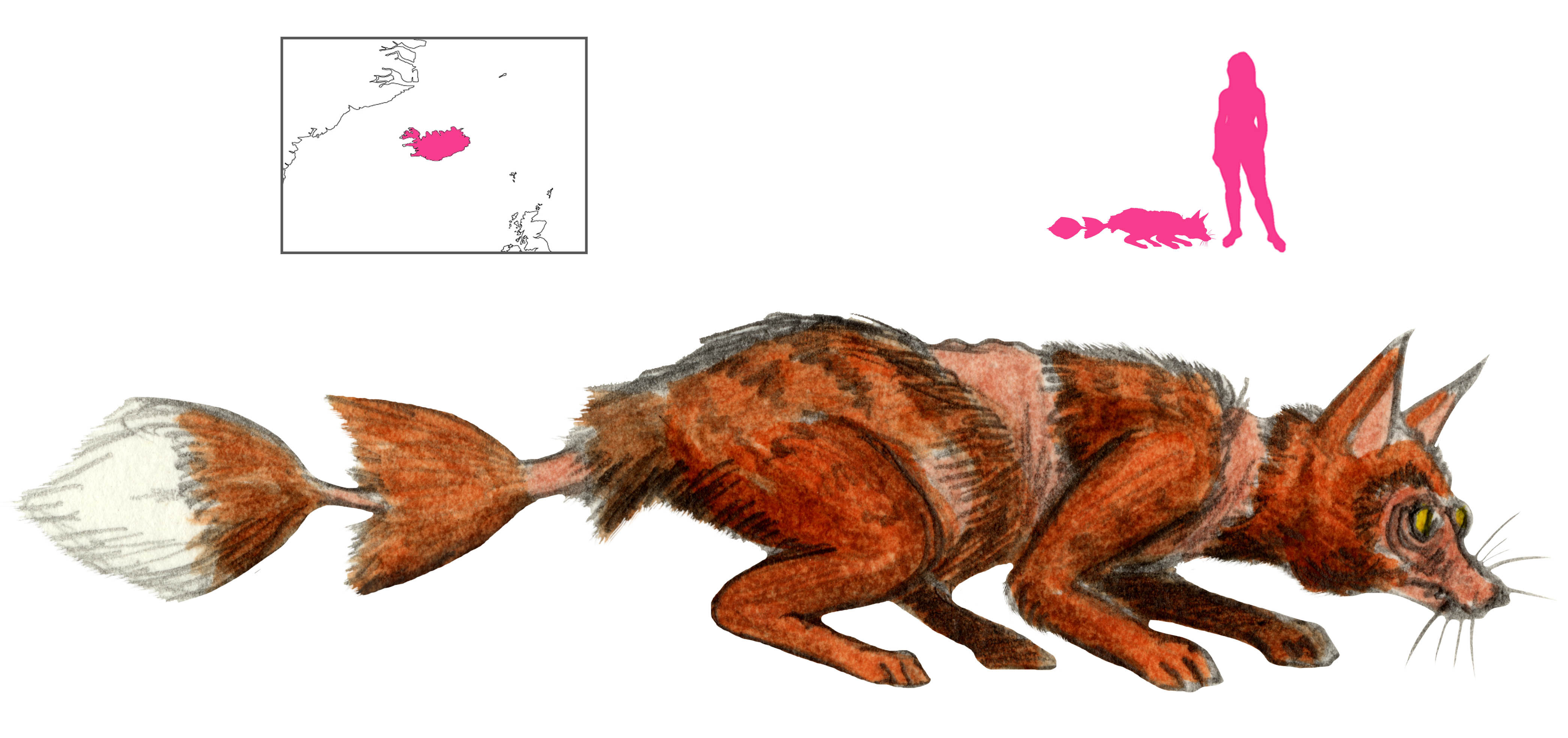
The Skoffín is one of a complex of Icelandic fox-cat hybrids with a lethal gaze, combining the cunning of the fox with the cruelty of the cat. This group also includes the Skuggabaldur, Urdarköttur, and Modyrmi, all of which are variations on the same theme; they are also linked to the “demon harriers”, foxes sent by sorcerers to maul livestock.

A skoffín is born from the union of a male Arctic fox and a female tabby cat, and resembles both of them. Its gaze is so deadly that everything it looks at dies immediately, without needing to see it. Its exact appearance varies; it may even change color with the seasons like the Arctic fox does. Reports suggest that skoffíns are short-haired, with bald patches of skin throughout.

Skoffín kittens are born with their eyes wide open. If not destroyed immediately, they sink into the ground and emerge after 3 years of maturation. It is therefore imperative to kill sighted kittens before they can disappear into the ground. When a litter of three sighted kittens was born at a farm in Súluholt, they were placed in a tub of urine to prevent their descent into the earth, and were drowned by placing turf on top of them. The entire tub was then tossed onto a pile of manure and hay and set on fire. The mother cat was also killed.

Skoffíns are irredeemably vile and malicious, and satisfy their appetite for destruction by killing humans and livestock alike. They are best shot from a safe distance, ideally with a silver bullet and after having made the sign of the cross in front of the barrel, or having a human knucklebone on the barrel. Hardened sheep dung makes equally effective bullets.

Thankfully, skoffíns are not immune to their own gaze. An encounter between two skoffíns will lead to the death of both of them. As with basilisks, mirrors are their bane. Once a skoffín stationed itself on the roof of a church, and the parishioners started dropping dead as they left the building. The deacon understood what was going on, and had the rest of the congregation wait inside while he tied a mirror to a long pole and extended it outside to the roof. After a few minutes he gave the all-clear, and they were able to leave the church safely, as the skoffín had perished immediately upon seeing its reflection.

Eventually, confusion with the basilisk of the mainland muddled the skoffín’s image, leading to some accounts claiming it was hatched from a rooster’s egg.

The skuggabaldur (“shadow baldur”) or finngalkn has the same parentage as the skoffín, but is born of a tomcat and a vixen. It has very dark fur shading to black, sometimes has a deadly gaze, and preys on livestock. It may be killed in the same way as the skoffín. One particularly destructive skuggabaldur in Húnavatnssýslur was tracked down and killed in a canyon; with its last breath, it exhorted its killers to inform the cat at Bollastadir of its death. When a man repeated that incident at a Bollastadir farm, a tomcat – no doubt the skuggabaldur’s father – jumped at him and sank its teeth and claws into his throat. It had to be decapitated to release its hold, but by then the man was dead.

The urdarköttur (“ghoul cat”) or naköttur (“corpse cat”) is of less certain parentage. It may be a hybrid, but other accounts state that any cat that goes feral in Iceland eventually becomes an urdarköttur, and all-white kittens born with their eyes open will sink into the ground and re-emerge after three years in this form. Shaggy, white or black furred, growing up to the size of an ox, these felines kill indiscriminately and dig up corpses in graveyards. It may be killed in the same way, and is attached to the same story as the Bollastadir cat. Gryla’s pet, the Yule Cat, is most likely an urdarköttur.

The modyrmi (“hay wormling”) is a canine variant, created when puppies born with their eyes open sink into the ground and reappear after three years as wretched, virulent monsters. The specifics are the same as with the skoffín.

References

Boucher, A. (1994) Elves and Stories of Trolls and Elemental Beings. Iceland Review, Reykjavik.

Hermansson, H. (1924) Jon Gudmundsson and his Natural History of Iceland. Islandica, Cornell University Library, Ithaca.

Hlidberg, J. B. and Aegisson, S.; McQueen, F. J. M. and Kjartansson, R., trans. (2011) Meeting with Monsters. JPV utgafa, Reykjavik.

Stefánsson, V. (1906) Icelandic Beast and Bird Lore. The Journal of American Folklore, vol. 19, no. 75, pp. 300-308.