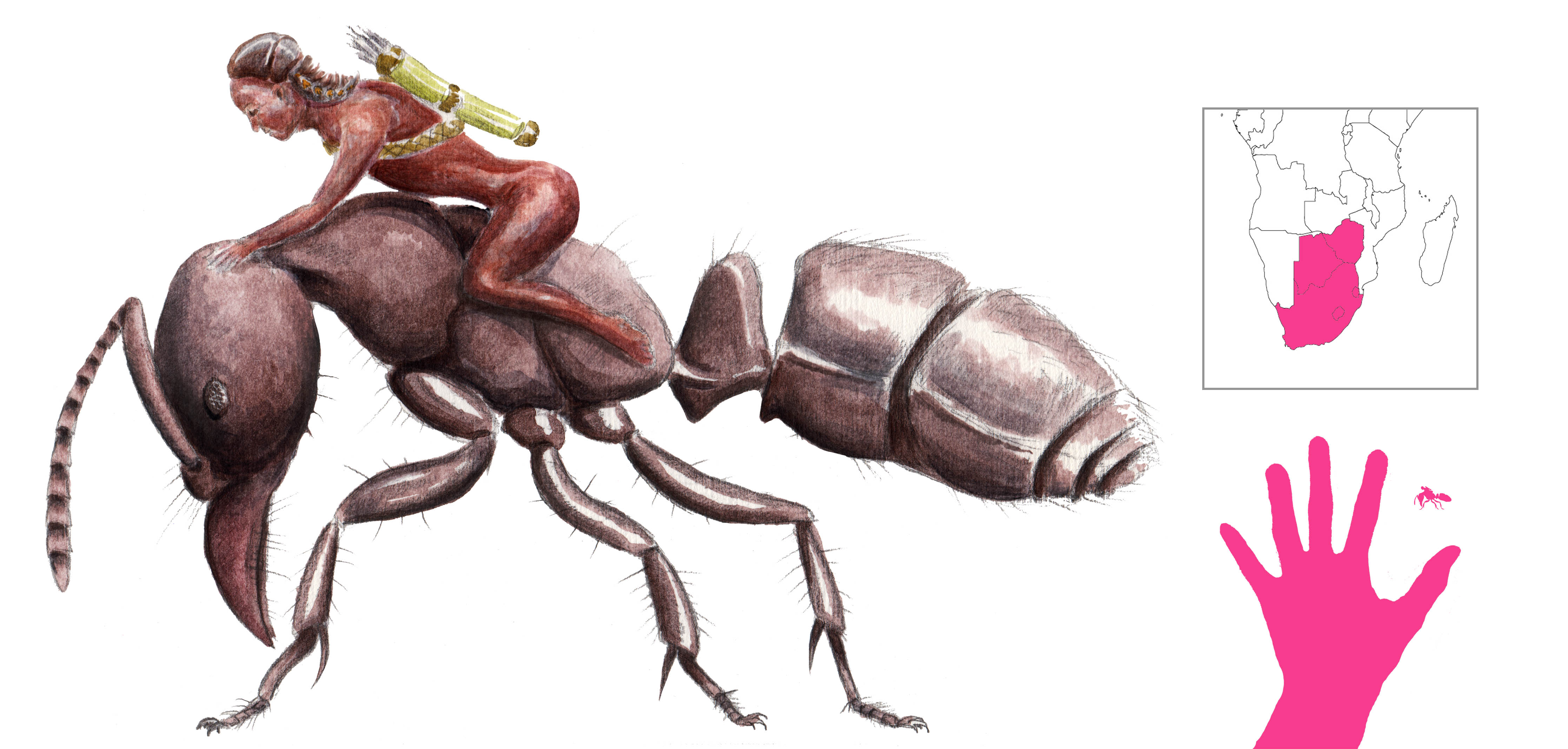
Dodo

Variations: Kadindi, Kaddodi, Kadda, Swallower-of-Men

Dodo

The Dodo is a monstrous humanoid creature from the folklore of the Hausa people. He can be found lurking in the deep forests and swamps of sub-Saharan West Africa, with a range including Sudan, Ghana, Nigeria, and the Côte d’Ivoire. The dodo has nothing in common with the extinct flightless bird of the same name, and probably was derived from tales of giant snakes.

Not much is known about a dodo’s appearance. He – for the dodo is always male – is the King of Beasts, and can just as easily be the lion, the python, the elephant, or the rhinoceros. A dodo is humanoid in appearance and large in size, as he has to stoop to get through doors. He has long, shaggy black hair. He has a keen sense of smell, and can detect meat from far away. He has some degree of magic powers, but cannot cross running water (paradoxically, dodos also live in ponds and streams). Most importantly, the dodo has a vast mouth glowing red from the inside, a seemingly infinite stomach capacity, and a taste for human flesh. As one of the African “swallowing monsters”, a dodo can easily engulf an entire village.

A dodo is often a self-invited guest, eating more and more until there is nothing left. This is not always a bad thing. Once a miser and his son were preparing to butcher a freshly-slaughtered ox in the forest, far from prying eyes. They decided to cook it in a nearby fire – a fire which turned out to be a dodo’s glowing, cavernous mouth.

“Well well”, said the dodo. “Who has invited me?” The miser, hoping to placate him, said “I did!” and gave him a leg of beef, which the dodo put away in his bag. “Does a man invite a friend to a feast for such a small morsel?” said the dodo. In response, the miser gave him another leg. “Does a man invite a friend to a feast for such a small morsel?” The next two legs followed, then half the bull, then the remainder of the bull. “Does a man invite a friend to a feast for such a small morsel?” “But there is nothing left!” protested the man. “You are also meat”, came the response. Terrified, the miser shoved his son forward, and the dodo tossed him into his bag. Finally, he grabbed the miser himself. “What about you?” he said, throwing him into his bag as well. The dodo went to collect firewood, but in the meantime the father and son managed to cut their way out of the bag and made their escape. The dodo returned, shrugged, and got a meal of roast beef. The miser vowed he would never be greedy again, and devoted the rest of his life to sharing his food and wealth with others.

While dodos readily eat meat, they are also fond of taking human women as their wives, sometimes fathering repulsive half-dodo children with them. Dodos like to strike bargains with prospective spouses, promising to help them for the price of marriage; sometimes those “bargains” are more straightforward, consisting of “Would you like me to eat you or marry you?” Such unions are never happy, and the wife will always try to escape her captor.

One dodo story tells of a young woman, pregnant with her first child, drawing water from a stream. Another woman, jealous of her companion and looking to get her scolded, threw dirt in her pot before leaving. But as the pregnant woman tried to carry her water pot, a dodo came out of the water and helped her with her load. Before she could protest, he stated “If you give birth to a boy, he will be my friend. If your child is a girl, she will be my wife”. And with that, he disappeared back into the water.

The mother soon gave birth, and her jealous rival was prompt to report the news to the dodo. “She gave birth to a girl”, she announced, and the dodo was immensely pleased. He was content to wait over the years, until the girl had become a woman as beautiful as her mother. On the day of the girl’s wedding, the jealous woman once more reported the news to the dodo, and he decided to show up uninvited.

“Kadindi has arrived”, he boomed, as everyone stared at him. “I have come to collect the payment I am due”. The daughter was obviously unhappy about marrying the monster, so instead her father gave the dodo a horse, part of the bride’s dowry. “Here is the payment for your debt”, he said, and the dodo swallowed the horse. But that was not enough. Next he ate all of the cattle, all of the wedding feast, all of the guests, and finally the father and mother. There was only the daughter left, and in desperation she prayed to the heavens. “Dodo has come to demand payment”, she implored. In response to her prayer, a knife fell out of the sky, and it was promptly swallowed as well – killing the dodo, cutting open his belly, and causing all the livestock, food, guests, and parents to come out unharmed. The wedding went on as planned.

References

Tremearne, A. J. N. (1913) Hausa Superstitions and Customs. J. Bale and Sons and Danielsson, Ltd., London.

Eintykára

Variations: Tapezu’á, Honey Man

Eintykara multiple

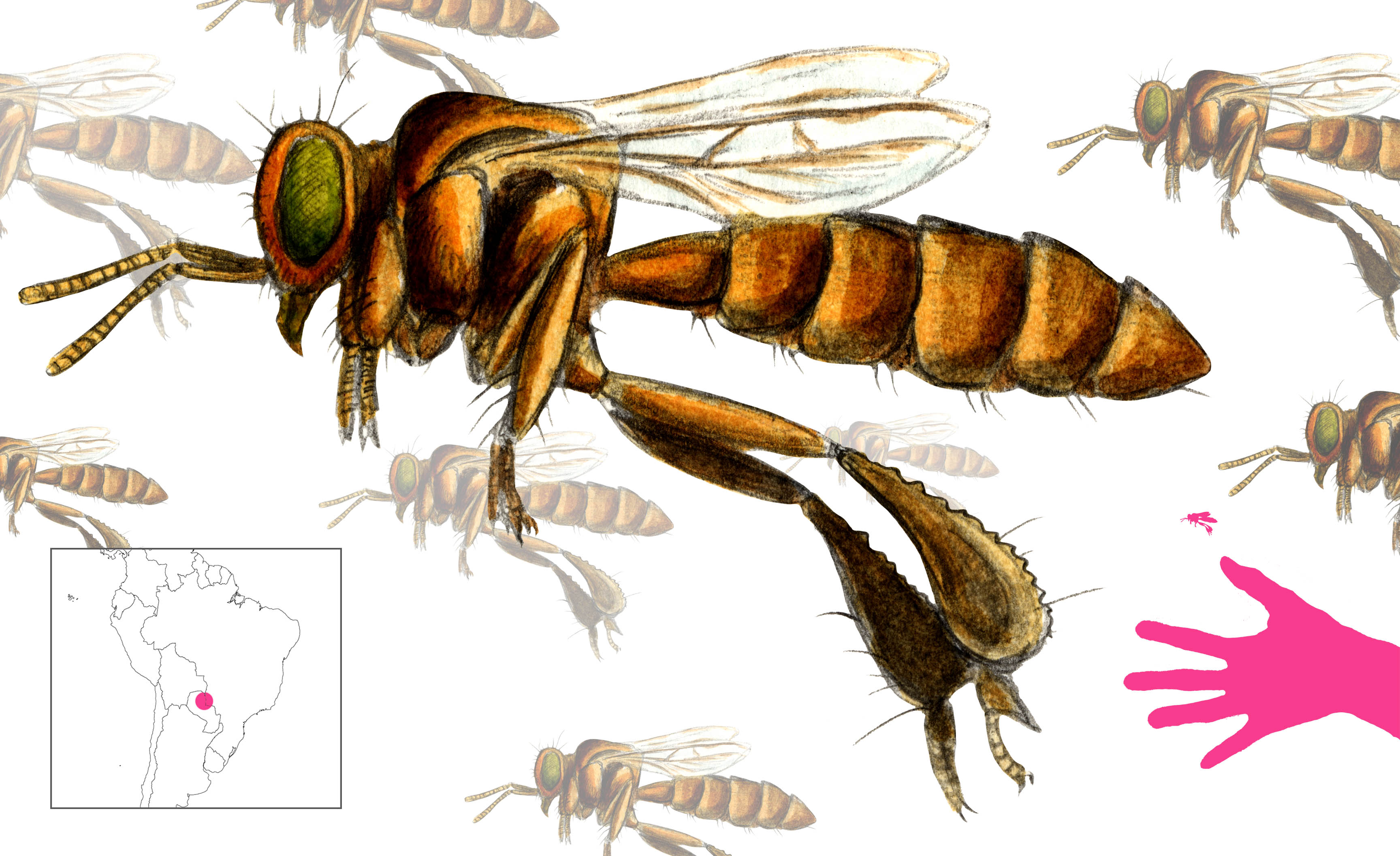
The Eintykára stingless bees, as told by the Chamacoco of Paraguay, are those that produce the golden honey. This honey can induce mild hallucinogenic effects, due to the presence of an ergot fungus on the plants the bees visit. But even more remarkable is their ability to swarm together and shapeshift into a man.

Eintykára hives have long, tubular wax entrances through which the bees enter and leave. An older single woman used to pass by such a hive every day, and its suggestive appearance made her mind wander. “Oh, what a beautiful eintykára hive!” she would say. “If only it were a handsome man who would make love to me…”

She continued to fantasize about the phallic hive, day in and day out. Eventually she started referring to it as her husband. “Ah, there is my husband again. He’s still there. If only he were a man, I would marry him on the spot”.

Finally, one night she was visited by a stranger. He was unlike any man she had seen – his skin was milky white, and his hair was as golden as honey. “Who are you?” she asked, stunned by his beauty. “I am Eintykára, the hive you desired and talked to for so long. I wish to take you as my wife, and support you and your people”.

And so it came to pass that the woman married Eintykára, and they had children together. He was unnaturally intelligent, and a diligent, tireless worker admired by the entire village. He never seemed to eat; instead, he would go into the forest, transform into a swarm of bees, and then reintegrate after collecting enough nectar. His “waste” was beeswax and eintykára honey, which he would distribute to all. That is why some of the Chamacoco are fair-skinned, for they are among his descendants.

Another eintykára was also known to have joined a Chamacoco village, but he and his adopted people were tragically killed in a raid by a neighboring tribe. They set fire to the houses, and though he tried to turn into an eintykára swarm and fly away, enough of his bees were incinerated to kill him.

References

Cañedo, J. A.; Belaieff, J.; Cordeu, E. J.; Frič, A. V.; Métraux, A.; and Pittini, R.; Wilbert, J. and Simoneau, K. eds. (1992) Folk Literature of the Chamacoco Indians. UCLA Latin American Center Publications, University of California, Los Angeles.

Baxbakwalanuxsiwae

Variations: Baxbaxwalanuksiwe, Baxbakualanuxsi’wae, Baqbakualanusi’uae, Baqbakualanosi’uae, Baqbakualanuqsi’uae, Baqbakua’latle, Cannibal-at-the-North-End-of-the-World, He-Who-First-Ate-Man-at-the-Mouth-of-the-River, He-Who-First-Ate-Humans-on-the-Water, Ever-More-Perfect-Manifestation-of-the-Essence-of-Humanity, Man-Eater

Baxbaxwalanuksiwe

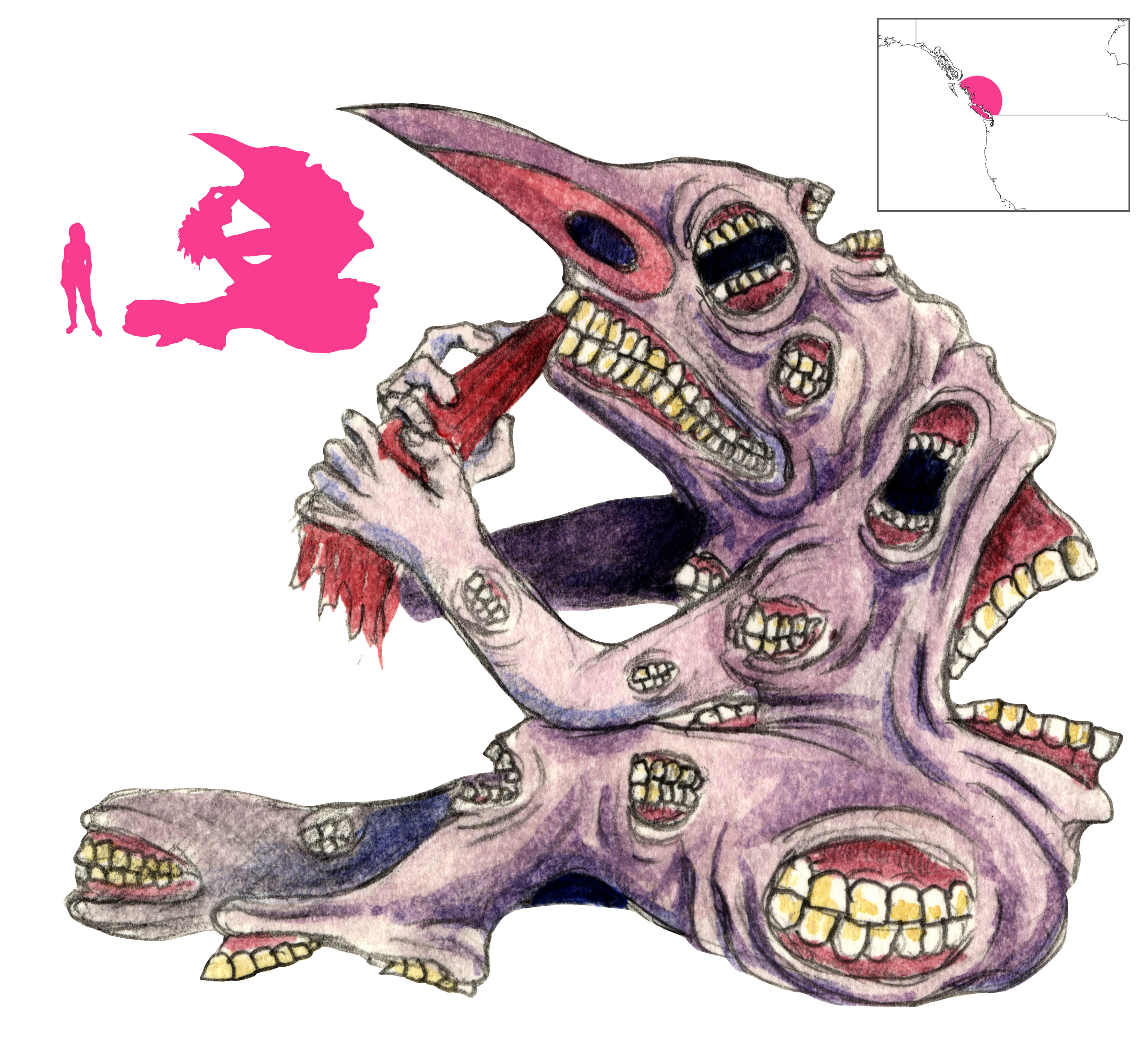
Baxbakwalanuxsiwae is the greatest and most terrifying of beings in Kwakwaka’wakw folklore. His name is alternately translated as “Cannibal-at-the-North-End-of-the-World” and “He-Who-First-Ate-Man-at-the-Mouth-of-the-River”; “Ever-More-Perfect-Manifestation-of-the-Essence-of-Humanity” is a more sanitized and euphemistic version. “Man-Eater” succinctly describes him. He is the central figure of the enigmatic Hamatsa, or “Cannibal” ceremony.

The appearance of Baxbakwalanuxsiwae is horrifying. He is anthropomorphic or bearlike in appearance. His entire body is covered in gaping, snapping, bloody mouths, and his call is “hap, hap, hap” (“eat, eat, eat”). His house is covered in red cedar bark, with blood-red smoke pouring out of the chimney.

He is attended by a number of equally vile creatures. His wife Qominaga, wearing red and white cedar bark, and his slave Kinqalalala, bring him his human meals. Qoaxqoaxualanuxsiwae, the “Raven-at-the-North-End-of-the-World”, pecks out his victims’ eyes. Hoxhogwaxtewae, “Hoxhok-of-the-Sky”, a giant crane, cracks skulls with its very long beak and devours the brains. Gelogudzayae (“Crooked-Beak-of-the-Sky”) and Nenstalit (“Grizzly-Bear-of-the-Door”) stand guard. These monstrous bird-ogres are all an extension of Baxbakwalanuxsiwae himself; they are his eyes and ears, and nothing can hide from them.

A wise shaman once encountered Baxbakwalanuxsiwae while hunting in the mountains. He was captured by Qominaga, who shouted to Baxbakwalanuxsiwae “come and devour him!” The man managed to squirm out of Qominaga’s grip, losing all his hair in the process, and was chased by Baxbakwalanuxsiwae through forests and caves. Eventually he tricked Baxbakwalanuxsiwae, luring him into a pit trap. The ogre and his wife fell into the pit and were incinerated; the shaman blew into the ashes, and they became the bloodthirsty mosquitoes of the Earth.

The Hamatsa ceremony itself tells the tale of Baxbakwalanuxsiwae possessing the young initiate, making him go into a frenzy where he gnashes, bites, and shouts “hap, hap, hap”. He is then symbolically exorcised, tamed, and inducted into the society. Baxbakwalanuxsiwae and his attendants are represented with spectacular, ornately carved masks worn by the Hamatsa dancers.

References

Boas, F. (1897) The Social Organization and the Secret Societies of the Kwakiutl Indians. Government Printing Office, Washington.

Bouchard, R. and Kennedy, D.; Bertz, D. trans. (2002) Indian Myths and Legends from the North Pacific Coast of America. Talonbooks.

Hays, H. R. (1975) Children of the Raven: The Seven Indian Nations of the Northwest Coast. McGraw-Hill Book Company, New York.

McDowell, J. (1997) Hamatsa: The Enigma of Cannibalism on the Pacific Northwest Coast. Ronsdale Press.

Yara-ma-yha-who

Yara ma ya who

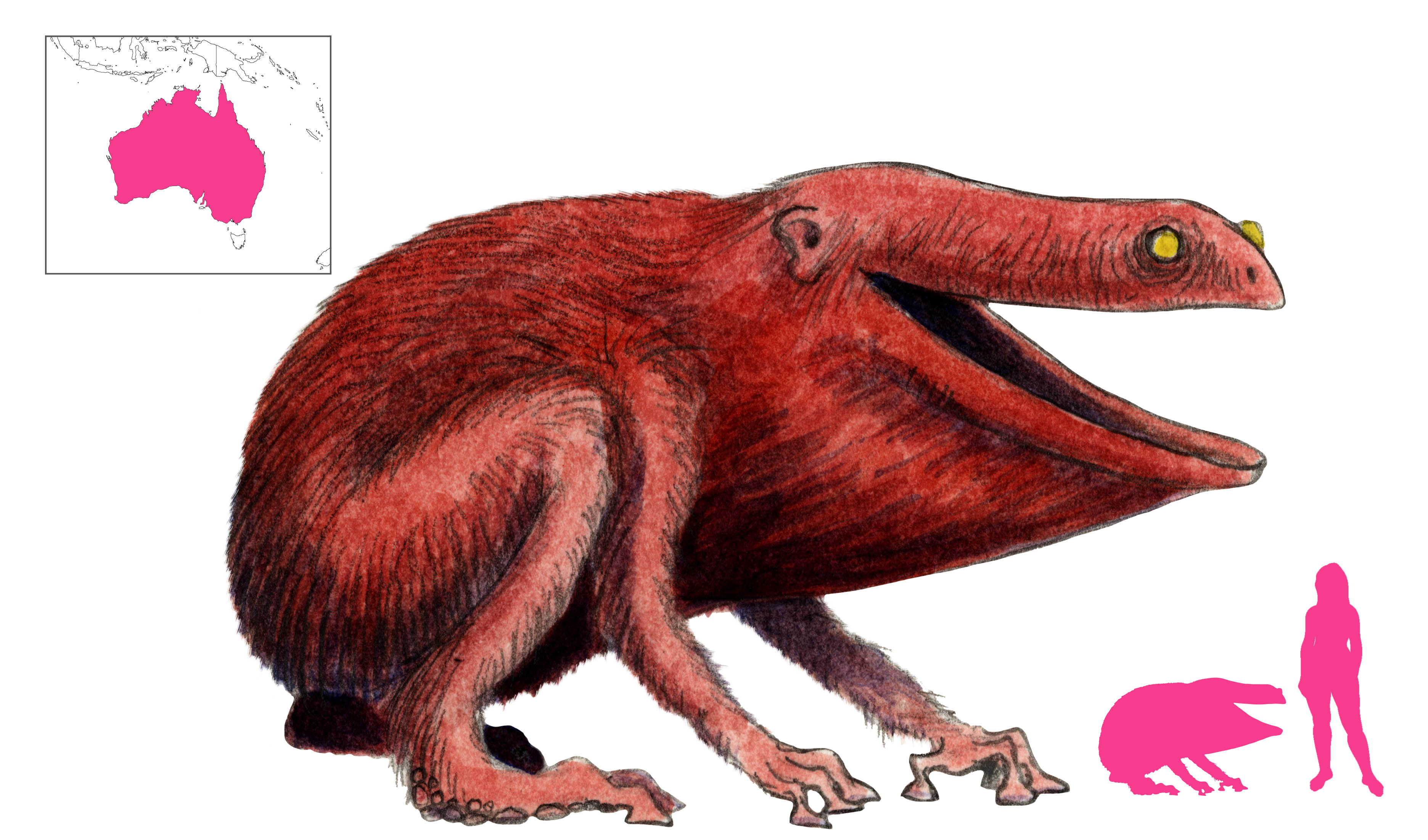
The Yara-ma-yha-who of Australia are restricted to the forests of the Pacific coast, and their absence elsewhere should be considered a blessing. They are primarily nursery bogies, dissuading children from frequenting dangerous areas.

A yara-ma-yha-who is a grotesque sight, and would be amusing were it not for its ghastly habits. Not more than four feet tall, red, and covered with fur, a yara-ma-yha-who has a disproportionately large head. It can open its toothless mouth like a snake, and its throat and belly are similarly distensible. An adult man can be easily swallowed by a yara-ma-yha-who without discomfort. Its fingers and toes are equipped with suction cups. Yara-ma-yha-who are good climbers, but can only waddle like cockatoos on land.

Thick-leaved fig trees are the yara-ma-yha-who’s favorite haunt. They can wait for days in the branches until some hapless traveler, perhaps seeking shelter from sun or rain, lies under the tree. Lone children are their favorite prey.

When a yara-ma-yha-who attacks, it attaches its hands and feet on its victim’s body, using the suction cups to drain the blood out of them. It does not empty them entirely, but only enough to make them faint. It then leaves its victim for a while, eventually returning to swallow them whole, head first. A little dance lets the food slide down, the meal is washed down with water, and the yara-ma-yha-who takes a nap.

After waking up, the yara-ma-yha-who vomits its prey out. The human is almost always alive and playing dead; there is no reason to fight back as the creature can overpower the strongest man. The yara-ma-yha-who takes five paces, then returns and pokes his victim’s sides with a stick. Then it walks away ten paces before returning to tickle the human under the arm or neck. A fifty-yard stroll is followed up by more tickling, then the yara-ma-yha-who goes behind a bush and sleeps.

This ritual is always repeated. The yara-ma-yha-who know that if they fail to carry out these actions, the spirit of the fig tree will mumble in their ears, causing them to transform into glowing tree mushrooms.

For this reason it is safest to play dead until this point, when you get to your feet and run. “Where have you gone, my victim?” calls the yara-ma-yha-who if it hears you escaping, but its awkward gait makes it easy to outrun. After failing to recapture prey, a spiteful yara-ma-yha-who will drink up all the water in nearby wells and water-holes, leading people to seek liquid from tree sap – and thus end up exposed to yara-ma-yha-who attack.

It is important not to let a yara-ma-yha-who swallow you multiple times. The second time you are swallowed and regurgitated, you become shorter and completely hairless. By the third time you are shorter still, and thick hair grows over your body. Eventully, after enough cycles of swallowing and vomiting, you become a yara-ma-yha-who yourself.

Heuvelmans believed the yara-ma-yha-who was inspired by tarsiers. Furry, big-eyed, and with suction-cup fingers, it is more a mammalian frog than anything else.

References

Heuvelmans, B. (1958) On the Track of Unknown Animals. Rupert Hart-Davis, London.

Smith, W. R. (2003) Myths and Legends of the Australian Aborigines. Dover Publications, Mineola.

Davalpa

Variations: Devalpa, Dawal-bay, Himantopus, Himantopode, Sciratae, Shaikh al-Bahr, Old Man of the Sea, Tasma-pair, Nasnas (erroneously)

Davalpa

“Would you be so kind as to carry me across the river?” The Davalpa, or “strap-leg”, looks up at you as he begs in a wheedling voice. It’s hard to deny the old man this one favor. He’s hunched, frail, and withered, dressed in rags which cover his entire body. It can’t hurt to help him, and you easily lift him up onto your shoulders. It is then that his legs appear – long, leathery straps that burst out of his clothes and wrap themselves around your neck. You find yourself barely able to breathe, staggering under your charge’s weight, all while the davalpa cackles and whips you, ordering you to move where he wishes. You’re his prisoner now, and will remain so until your death.

That is how davalpas catch their victims. Their legs, while 3 meters long and powerful, do not let them move around normally, and so they use unwilling humans as their mounts. Sometimes they have multiple long snakelike legs that erupt out of their belly, and a tail they use to whip their mounts. Sometimes they constrict their victims to death, a merciful fate compared to the slavery they impose.

Davalpas can be found in the Iranian deserts and on uncharted islands in the Indian Ocean, where they sit by the side of the road and wait for potential rides to show up. The most famous davalpa was the Old Man of the Sea, which Sindbad the Sailor met on his fifth voyage. The Old Man successfully enslaved Sindbad, forcing him to do his bidding, but Sindbad managed to escape the creature’s clutches by fermenting grape juice and offering it to him. After getting drunk, the Old Man’s grip loosened and he fell off; Sindbad smashed his head with a rock.

Sindbad’s adventure with the Old Man of the Sea is almost an exact copy of previous accounts. Al-Qazwini locates the davalpas on Saksar Island, which they share with the cynocephali. A sailor tells the story of how a strange person wrapped his legs around his neck and enslaved him, forcing him to pick fruits. He escaped by fermenting grapes and inebriating the davalpa; the experience left him with scars on his face.

Al-Jahiz refers to the creature as dawal-bay in Arabic. As with the Waq-waq, he believes it to be a cross between plants and animals.

Oddly enough, the davalpa is not of Persian origin. The earliest mention of davalpas is from Alexander’s Romance, where they are called the “savage Himantopodes” and share their land with Cynocephali, Blemmyes, Troglodytes, and other strange races. Himantopus means “strap foot”, and is currently in use today for the black-winged stilt, a shorebird with long slender legs. Pliny specifies that those strap-foots are incapable of walking, and get around by crawling; later he describes the snub-nosed, bandy-legged Sciratae, which seem to be one and the same.

One possibility is that the davalpa was inspired by apes, which can cling tightly and whose shorter legs might be less apparent at first glance. More intriguingly, Tornesello suggests that the various monstrous races of Hellenic myth arose from recollections of foreign soldiers during the Greco-Persian wars. The Sagartians in Xerxes’ army rode horses and used twisted leather lariats to entangle and kill enemies. The parallels with them and the davalpas include the leather-strap weapon, its use in strangling people, and the apparent incapability of walking (the Sagartians were always on horseback). Sagartioi can also be seen as the linguistic ancestor of Skiratoi.

Thus the davalpa concluded its journey. Inspired by Greek distortions of Persian warriors, it found its way back to Persia where it had lost all of its previous subtext and gained entirely new meaning. Today modern Iranian satirists and cartoonists have used the davalpa to represent greedy, parasitic institutions – especially helpful if those institutions disapprove of direct criticism.

References

Browne, E. G. (1893) A Year Amongst the Persians. Adam and Charles Black, London.

Christensen, A. (1941) Essai sur la Démonologie Iranienne. Ejnar Munksgaard, Copenhagen.

del Hoyo, J.; Elliott, A.; Sargatal, J.; Christie, D.A.; & de Juana, E. (eds.) (2013) Handbook of the Birds of the World Alive. Lynx Edicions, Barcelona.

Al-Jahiz, A. (1966) Kitab al-Hayawan. Mustafa al-Babi al-Halabi wa Awladihi, Egypt.

Marashi, M. (1994) Persian Studies in North America. Iranbooks, Bethesda.

Masse, H. (1954) Persian Beliefs and Customs. Behavior Science Translations, Human Relations Area Files, New Haven.

Al-Qazwini, Z. (1849) Zakariya ben Muhammed ben Mahmud el-Cazwini’s Kosmographie. Erster Theil: Die Wunder der Schöpfung. Ed. F. Wüstenfeld. Dieterichsche Buchhandlung, Göttingen.

Ricks, T. M. (1984) Critical Perspectives on Modern Persian Literature. Three Continents Press, Washington D. C.

Tornesello, N. L. (2002) From Reality to Legend: Historical Sources of Hellenistic and Islamic Teratology. Studia Iranica 31, p. 163-192.

Pilou

Variations: Er-pilour-lann

Pilou

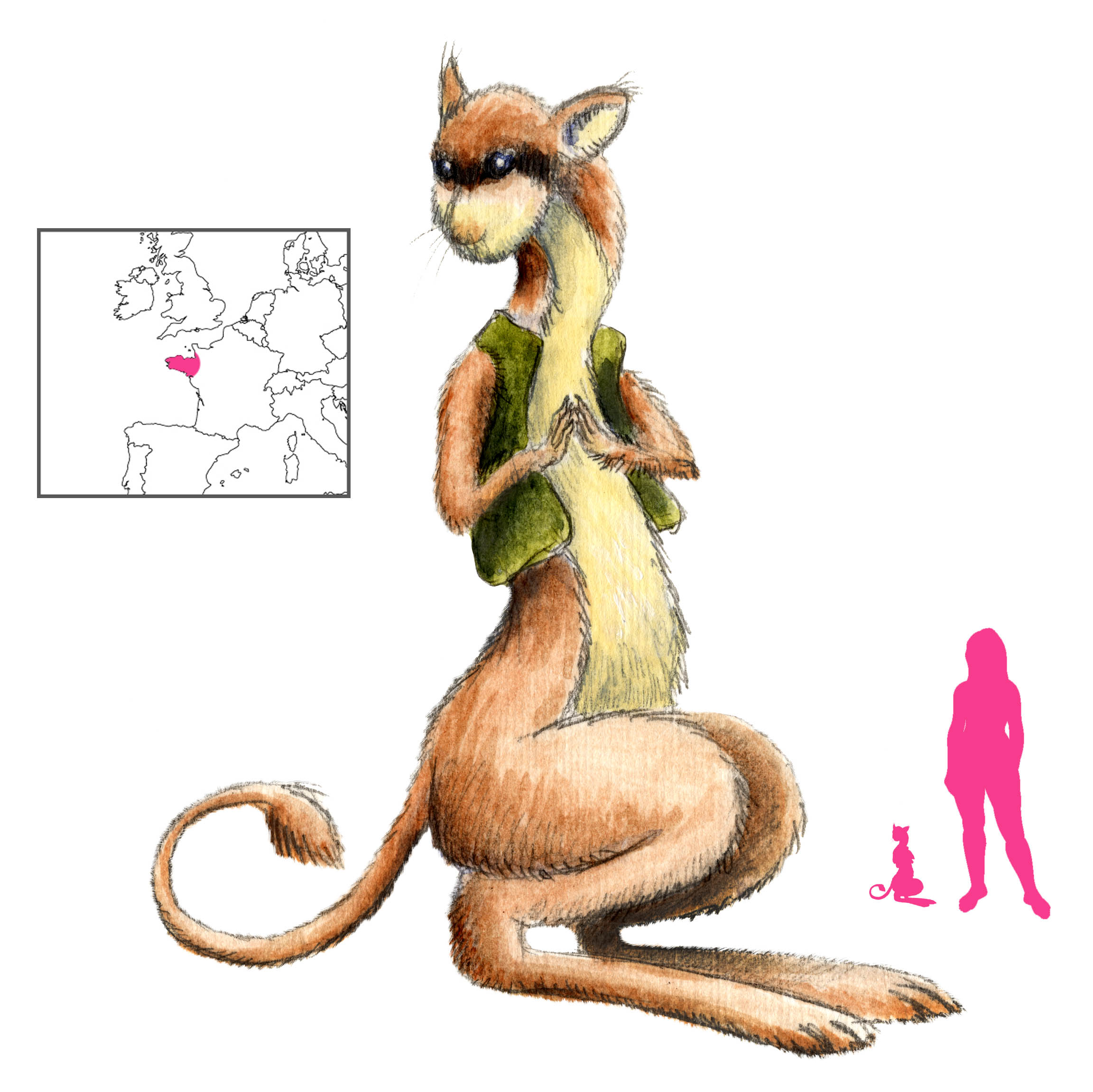
Pilous are always heard and never seen. While their name suggests soft fur – pilou in its modern expression refers to a type of cotton – it actually refers to the men who pound apples into cider, using wooden pilons. Pilous walk with a regular, stomping tread, making a rhythmic sound like that of apples being mashed, and that is all anyone knows of them. Nevertheless, Dubois fancifully describes these lutins as resembling large garden dormice, and that is as good a description as any.

Pilous are native to the northwestern tip of France, specifically Brittany and Ile-et-Vilaine. They come out at night in the attic, in the rafters, in the walls, and start marching. They are not evil but mischievous, and delight in the noise they make. In Brittany, where they become Er-pilour-lann, they wield mallets with which they pound the walls of old houses.

Most encounters with them are about their disregard for human comfort. A farmhand once went into the barn to fetch some hay when the thumping begin, the din seemingly coming from everywhere. He called his uncle, who implored the pilous “Would you, please, stop your noise so I could get some hay for my mare?” They stopped, but the moment the uncle stepped into the barn they started up again, louder than ever.

Another time a group of men were in a barn when a pair of pilous started: one, two, one, two. “I’d like it better if there were three of you!” yelled one of the men, and sure enough a third pilou joined in. Other men started requesting more and more, and the number of pilous increased accordingly. The same stunt was later attempted by three bored young girls, but they requested too many, and soon the pilous were rattling their bed and knocking at their walls. The girls wisely went quiet, and the creatures eventually left.

Attempts to put pilous to use have failed. One miser left oakum fibers behind in the attic in hopes that the pilous would stomp them flat, but he returned in the morning to find the material shredded and scattered all over the attic.

References

d’Amézeuil, C. (1863) Récits Bretons. E. Dentu, Paris.

Dubois, P.; Sabatier, C.; and Sabatier, R. (2005) The Complete Encyclopedia of Elves, Goblins, and Other Little Creatures. Abbeville Press.

Orain, A. (1899) Le Monde des Ténèbres en Ile-et-Vilaine. Revue de Bretagne, de Vendée et d’Anjou, XXI, Paris.

Orain, A. (1901) Contes de L’Ile-et-Vilaine. J. Maisonneuve, Paris.

Le Rouzic, Z. (1924) Carnac: Légendes – Traditions – Coutumes et Contes du Pays. LaFolye Frères et Cie, Vannes.

Polevik

Variations: Polevoi, Polievik, Poludnitsa, Poludnica

Polevik

The Polevik or Polevoi (from pole, “field”) is the Russian spirit of fields, plains, and noontime.

His appearance varies considerably. In Belozersk District and the northern forest regions he is a man dressed in white. In Iaroslavl Province he is an ugly little old man. In Orel Province he is black as the earth, his head covered with green grass, and he wears no clothing. In Tula Province he looks like a shaggy-furred Leshy. Sometimes his eyes are different colors. His skin and hair mirror the soil and vegetation of the fields, and his height grows and shrinks with the crops.

Unlike some of the other spirits, the polevik can be benevolent or evil. A polevik is primarily seen at noon. He likes to lead peasants astray, losing them in endless yellow golden stalks of grain. He disapproves of laziness, and will strangle drunkards sleeping in the fields. Poleviks are capable of seeing the future, and in Iaroslavl Province their appearance is an ill omen. Poleviks are also accomplished horsemen and will ride horses across the fields at breakneck speed, running over anyone in their path.

The female equivalent of the polevik, sometimes replacing him entirely, is the Poludnitsa, Poludnica, or Midday Spirit (from poluden or polden, “noon”). She can be a tall, beautiful woman in white; in Siberia she is an old curly-haired crone dressed in rags, while she has horses’ hoofs in Moravia. In summer, during harvest time, she walks through the fields, protecting the grain. If she sees someone working at midday she pulls their hair violently, twists their heads, and breaks their bones. Other times she quizzes people on agriculture, inflicting disease upon them if they fail to answer correctly. She enjoys misleading children in cornfields.

Polevik children run around the fields catching birds for their parents to eat. They will smother anyone sleeping on the edges of the field.

While poleviks can be destructive, a happy polevik will aid with the harvest, and crops will always be successful under a polevik’s patronage. To earn a polevik’s good will one must leave an offering of two eggs and an old rooster who can no longer crow, in a ditch when nobody is around. Traditional observances must also be followed, and nobody should work at noon.

With the advent of Christianity, poleviks and poludnitsas became mere bogeys, monsters used to frighten children out of cornfields.

References

Aldington, R. and Ames, D. trans.; Guirand, F. (1972) New Larousse Encyclopedia of Mythology. Paul Hamlyn, London.

Dubois, P.; Sabatier, C.; and Sabatier, R. (1992) La Grande Encyclopédie des Lutins. Hoëbeke, Paris.

Ivanits, L. J. (1989) Russian Folk Belief. M. E. Sharpe, Inc., Armonk, New York.

MacCulloch, J. A. and Machal, J. (1918) The Mythology of All Races v. III: Celtic and Slavic. Marshall Jones Company, Boston.

Kayeri

Variations: Kayéri, Cayeri

Kayeri

When it rains, the Kayeri are sure to appear. These creatures from the folklore of the Cuiva of Colombia and Venezuela are seasonal beings, seen in the rainy season and especially after a recent rainfall. In drier seasons they remain underground or underneath the roots of a tree, and use the holes made by ants to reach the surface. The presence of anthills in the rainy season is a sure sign of kayeri presence.

The appearance of a kayeri is nebulous at best. He is clearly humanoid in shape, and acts as such; he also has a yellow or blue-green hat. All the mushrooms of the forest are kayeri. The agouti, the broad-leaved unkuaju plant, and the Ficus vine are also kayeri, and dragonflies can become Kayeri. The coyoweri fruit is their invention. The only word in their vocabulary is “mu” or “mü“.

Kayeri are strong and run fast. They feed exclusively on cows, and they can easily pick up a cow and run away with it. When they eat a cow, they devour flesh, entrails, horn, hoof, and bone in one sitting, leaving nothing behind. The virile kayeri are bigamous by nature, and have two wives each, but they are fond of human females as well, whom they entrance and bewitch into coming to them. In addition to decimating herds of cattle, they rob, murder, kidnap, rape, and cause all sorts of evil.

The best way to kill a kayeri is to shoot it in the kidneys with a bone-tipped arrow, as they are quite invulnerable elsewhere. Once dead, the kayeri turns into a harmless stone.

One story is told of a hunter whose two daughters were abducted by a kayeri. The father managed to catch up with him and shoot him with a bone-tipped arrow before he could harm the daughters, and the kayeri fell into the river and became a pebble. As the family made for safety they could hear the ominous “mu, mu, mu” of kayeri beating trees with sticks, as they do when they are upset. “He fell out of his hammock and broke his back!” yelled the father, and they reached home without further trouble.

References

Arcand, B.; Coppens, W.; Kerr, I.; and Gómez, F. O.; Wilbert, J. and Simoneau, K. eds. (1991) Folk Literature of the Cuiva Indians. UCLA Latin American Center Publications, University of California, Los Angeles.

Jetin

Variations: J’tin, Crion

Jetin

Jetins (from jeter, “to throw”) are tiny lutins native to the seaside caves of Brittany. Their appearance is uncertain; Dubois suggests they are hirsute and rough-looking, with silver shoes. Despite their size – ranging from thumb-sized to 1.5 feet tall – they are incredibly strong, capable of lifting and tossing huge boulders with ease.

Always looking for a chance to show off their strength, jetins amuse themselves by throwing rocks around, sometimes over great distances. Standing stones, menhirs, all manner of megaliths; such stones are discarded playthings of the jetins.

Rock-throwing was not the only pastime the jetins enjoyed. They were also fond of tying knots in horse tails and releasing livestock, and, like any good fairy, they often exchanged human babies for one of their own. The ugly, wrinkled changelings they leave behind are never weaned and never grow. Jetins can be convinced to return stolen children by carrying the changeling to a jetin hole and threatening to kill it. The human baby will quickly be returned and swapped with the impostor.

The jetins shared their territory with the even tinier Fions and the secretive Fées des Houles (“Fairies of the Sea Caves”). Due to their size and their reclusive natures, none of these have been observed in great detail, although the Fées have been benevolent towards humans. The Crions, perhaps the same as jetins, were tiny dwarfs who carried the stones of Carnac on their shoulders.

Elsewhere, the discobolous function of the jetins is fulfilled by Gargantua and other giants, whose size is more proportionate to their strength, and the fairies known as Fileuses (“Weavers”).

References

Dubois, P.; Sabatier, C.; and Sabatier, R. (1992) La Grande Encyclopédie des Lutins. Hoëbeke, Paris.

Morvan, F. (1998) Vie et mœurs des lutins bretons. Actes Sud.

Sébillot, P. (1905) Le Folk-lore de France, Tome Deuxième: La Mer et les Eaux Douces. Librairie Orientale et Américaine, Paris.

Sébillot, P. (1907) Le Folk-lore de France, Tome Quatrième: Le Peuple et L’Histoire. Librairie Orientale et Américaine, Paris.

Lavandière de Nuit

Variations: Lavandière, Laveuse de Nuit (French); Kannerez Noz, Cannerez Noz, Gannerez Noz (Breton); Bean nighe, Bhean Nighe, Caoineachag, Nigheag Bheag a Bhroin (Gaelic); Washerwoman, Night Washerwoman, Washer of the Ford, Little Washer of Sorrow (English)
Lavandiere

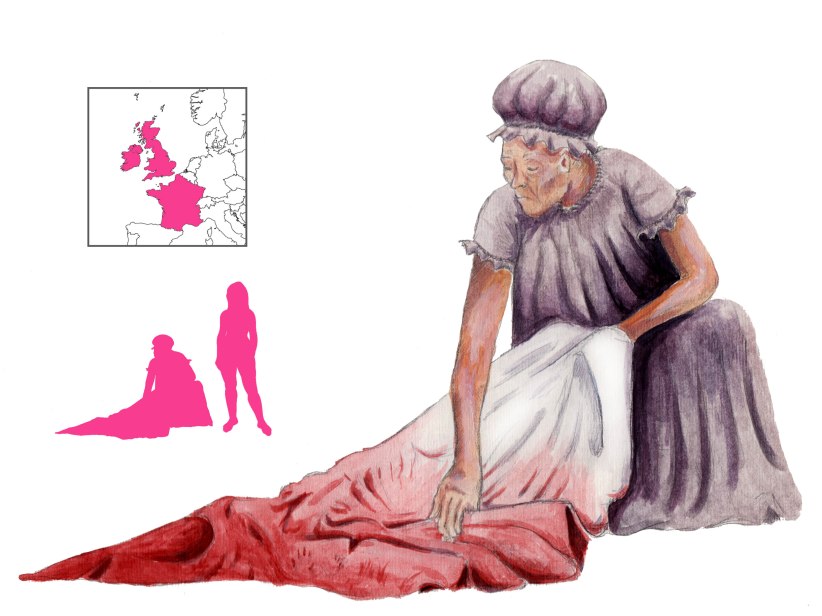
The lavandières de nuit (“washerwomen of the night”) are present in some form or other from Scotland to Provence. Their exact nature is uncertain; sometimes they are ghosts, other times members of the fairy kingdom. Their best-documented haunt is Brittany.

Lavandières are female, and can be seen washing laundry in the odd hours of the night. They usually take the form of tall, gaunt, and withered crones, but the Gollières a Noz of Romandie are as beautiful as they are cruel. Some of them sing as they wash, earning them the name of kannerez noz (night singers). Their song is sadder than a De Profundis. Those of Morbihan have had their song recorded as follows:

Tors la guenille, tors // Le suaire des épouses des morts.

(Wring the rags, wring // the shroud of the wives of the dead).

Often a lavandière is condemned to wash a shroud in atonement for a sin committed in life. Some merely did laundry on Sunday. Others were greedy misers who denied decent clothing to the poor. The grimmest were those guilty of infanticide. The outline of a baby’s corpse could be seen in their blood-soaked sheets; try as they might, the blood never washed out, and the bones never whitened.

The bean nighe of the British Isles are women who died in childbirth before their time, and who are doomed to wash the clothes of those fated to drown until the day when they were meant to die. Their appearance foretells death. Some are aligned with the Morrigan, and wash the corpses of the dead. Cú Chulainn saw one, the daughter of Bodhbh, washing bloodstained clothes and weeping; he died in battle not long after.

In France, especially in Brittany, they call passers-by to help them wring out the laundry. This isn’t a choice – those who accept out of ill will get their arms broken, and those who refuse are drowned. To escape their clutches, one must wring in the same direction they do, turning clockwise when they turn clockwise and vice versa. But this has to be kept up all night, and the lavandières never tire. One false move and the unfortunate victim is crushed, wrung out, their corpse mangled beyond recognition. Even the strongest man is no match for a lavandière, who wrings humans out as easily as a pair of tights.

Another way of escaping their clutches is to tell them Diwasket ho poan ha me diwasko ma hini (“wring out your sins, and I will wring out mine”). Running away at top speed always helps, and lavandières cannot cross recently-ploughed fields. Finally, making the sign of the cross or reciting Biblical verses is always helpful.

The lavandière of Chantepie was a stingy woman who buried her husband in a dirty shroud. She continues to wash it every night.

The lavandières of Fond-de-Fond hold up the bodies of the recently-deceased.

In Landéda, the lavandières are powerless against the goodhearted, but tie the sinful into knots.

The lavandière of Noes Gourdais, near Dinan, appeared early in the morning and had a skull for a head.

The Mille-Lorraines of Lower Normandy form fairy circles around ponds.

Several lavandières gather in the pond of Roc-Reu, and drown anyone who tries to touch them.

Around Dinan, the teurdous (“twister”) is a rare male counterpart. He does not wash, but instead offers to help washerwomen wring out their laundry. If they accept, he breaks their arms.

The true nature of the lavandières is more prosaic. Unfamiliar sounds have been invoked – the croaking of frogs or toads, for instance, might have suggested the sound of washboards. The lavandières themselves may have had nothing supernatural about them. A number of flesh-and-blood women may have had reason to do laundry at night: those who worked during the day, those who did not wish to be seen doing menial work, those who wanted to clean the clothes of their illicit lovers… Anyone coming upon them could be forgiven for seeing them as ghosts.

Others managed to exploit the superstitious fear of lavandières. A garde-champêtre in Vaucluse once stumbled upon a pair of lavandières in spectral white clothes. “Wring the laundry!” they cackled, grabbing him by the collar. And wring he did, all night long. He also noted the fine quality of the cloth they were washing, but did not dare stop until morning, when they left. Only later did the warden find out that a nearby castle had been robbed of various items of clothing. He had spent the whole night helping the thieves wash their ill-gotten gains.

References

Dubois, P.; Sabatier, C.; and Sabatier, R. (1996) La Grande Encyclopédie des Fées. Hoëbeke, Paris.

Giraudon, D. La lavandière de nuit Ar gannerez-noz. In Loddo, D. and Pelen, J. (eds.) (2001) Êtres fantastiques des régions de France. L’Harmattan, Paris.

Kilfeather, A. (2003) Legend and wetland landscape in Ireland. Journal of Wetland Archaeology, 3, pp. 37-50.

Le Quellec, J. (1988) Le légendaire du Sud-Vendée: organisation spatio-mythique. Etuderies 3-4.

MacPhail, M. (1898) Folklore from the Hebrides III. Folklore, Vol. 9, No. 1, pp. 84-93.

Sand, G. (1877) Légendes Rustiques. Ancienne Maison Michel Lévy Frères, Paris.

Sébillot, P. (1881) Littérature orale de la Haute-Bretagne. Maisonneuve et Cie, Paris.

Sébillot, P. (1904) Le Folk-Lore de France, Tome Premier: Le Ciel et la Terre. Librairie Orientale et Américaine, Paris.

Sébillot, P. (1905) Le Folk-Lore de France, Tome Deuxième: La Mer et les Eaux Douces. Librairie Orientale et Américaine, Paris.

Sébillot, P. (1968) Le folklore de la Bretagne. Éditions G. P. Maisonneuve et Larose, Paris.