Romŝiwamnari’

Variations: Romŝiwamnare’

Romsiwamnari

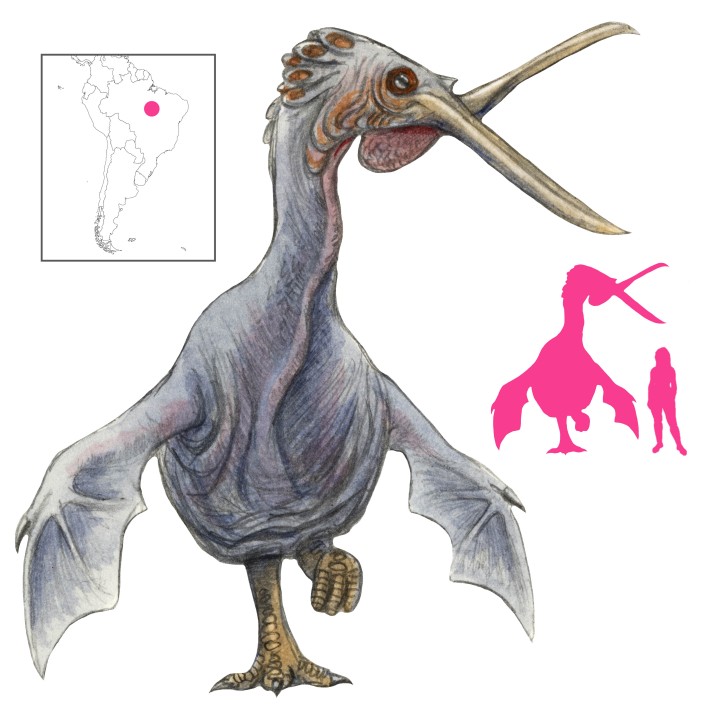
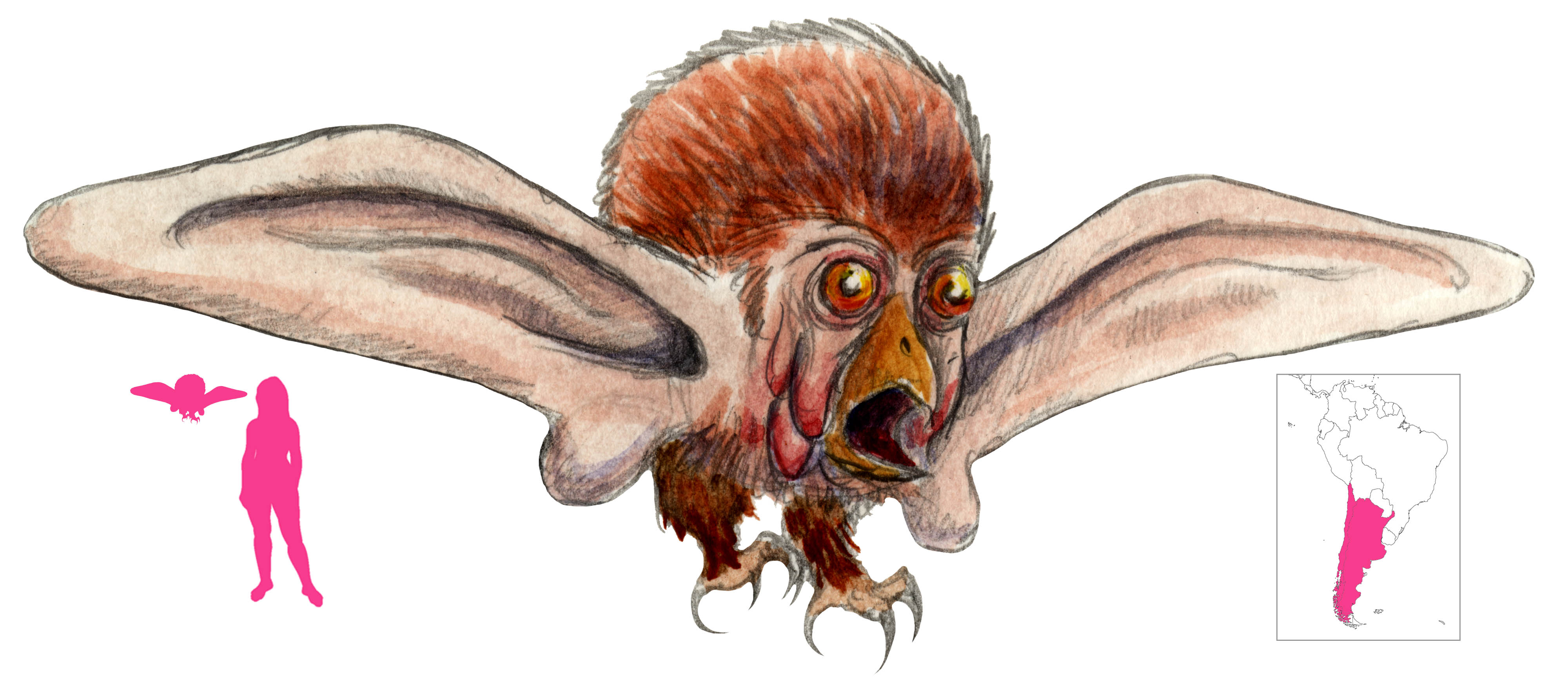
The Romŝiwamnari’ are forest and cave demons, known to the Šerente people of Tocantins, Brazil. They look like large birds with flabby, flightless bat’s wings, armed with beaks like scissors. Their call is an eerie whistle. Romŝiwamnari’ also appear as tapirs, or as stout humans with prominent teeth and a howler monkey’s tail. When in human guise, a romŝiwamnari’ resembles the Pope – a relic of missionary activity in Brazil.

Romŝiwamnari’ not only prey upon the living, but also ambush and consume the souls of the dead. A sufficiently powerful shaman can kill them while in the realm of death, but other souls are greedily devoured.

A man of the krara’ society and his pregnant wife once encoutered a pair of romŝiwamnari’ in a cave. The man held the monsters off as long as he could while his wife escaped, but he was outmatched and decapitated by the romŝiwamnari’. The woman brought the news to the rest of the village, and the other krara’ launched an assault on the romŝiwamnari’ cave. Three of the villagers were killed in the battle, but they slew the two romŝiwamnari’ – unaware that there were two more in hiding. However, the boy the woman gave birth to grew into a mighty hero in less than a year, and he avenged his father by burning the romŝiwamnari’ bones and killing the other two demons. The romŝiwamnari’ were not seen again in that area.

References

Crocker, W. H.; Giaccaria, B.; Heide, A.; Lea, V.; Melatti, J. C.; Nimuendajú, C.; Seeger, A.; Verswijver, G.; Vidal, L.; Wilbert, J. and Simoneau, K. (eds.) (1984) Folk Literature of the Gê Indians, v. 2. UCLA Latin American Center Publications, University of California, Los Angeles.

Nimuendajú, C.; Lowie, R. H. (trans.) (1942) The Šerente. The Southwest Museum, Los Angeles.

Peteu

Variations: Peteu de Vergisson, Bête Faramine, Oiseau de Vergisson, Esiau de Vregesson, P’teu, Pteu

Peteu

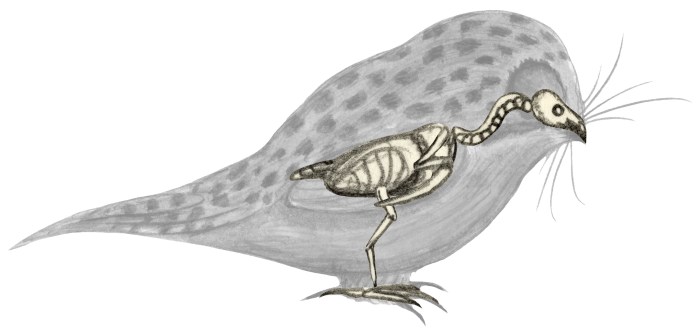
The picturesque town of Vergisson, in France’s Saône-et-Loire, was once home to the Peteu. This was a great and monstrous bird, with broad wings and whiplike feathers surrounding its razor-sharp beak. It was spiritually descended from the emouchet or kestrel (Falco tinnunculus), but also of the humble kinglet, whose name in the Maconnais dialect is répteret, répeteret, or repteu, which in turn is shortened to pteu.

The peteu would fly from the Rock of Solutré to the Rock of Vergisson, soaring over its domain in search of prey. When it spotted something, it folded its wings, dove, and carried off its prize. The peteu devoured sheep, pigs, goats, cows, horses and their carts! Its loud wingbeats terrified livestock and sent them running all the way back to their stables. Most heinous of all, it dove at Mr. Bruys de Serrières, who was quietly writing his History of the Popes, and defecated onto his manuscript before flying away. There was no end to the peteu’s evil.

It was Émilien Protat who organized a hunting party to rid Vergisson of the bird’s tyranny. The small but courageous group of men made for the Rock of Solutré where the peteu was last seen. When the raptor flew over their heads, blocking out the sun, the quick-thinking Émilien fired his rifle into it. The peteu fell to the ground, but would have taken Émilien’s head off had he not rammed his rifle into its mouth and fired.

The hunters returned to Vergisson in triumph to have their quarry plucked and roasted. Imagine their surprise when the peteu, stripped of its feathers, weighed no more than four ounces!

Peteu skeleton

References

Ducrost, A. (1888) Le P’teu ou L’Esiau de Vregesson Qu’ere ine Bête Faramine. Annales de l’Academie de Macon, s. II, t. VI, pp. 379-397.

Protat, G. (1966) Le Peteu de Vergisson ou la Bête Faramine. Protat Frères, Macon.

Xuangui

Variations: Twisting-Turtle, Round-Turtle, Xuan-Turtle

Xuangui

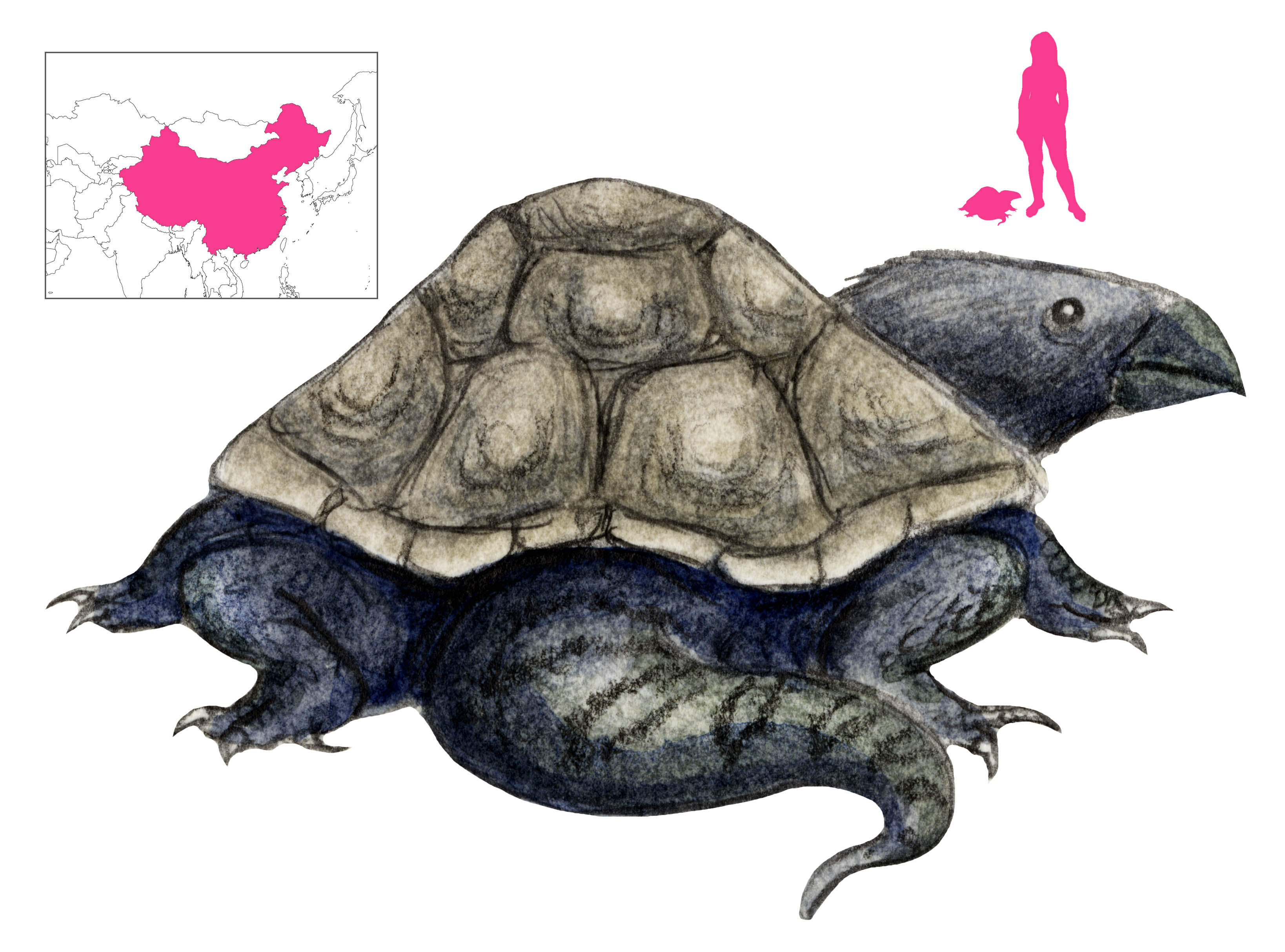
Xuangui, or Twisting-Turtles, are found in the Strange River, east of the Niu-Trees Mountain. They are black turtles with a bird’s head and a viper’s tail, and they make sounds like that of splitting wood. Wearing a piece of xuangui from the belt protects from deafness and calluses. Mathieu compares it to the Japanese water turtle Clemmys japonica.

It is unclear what, exactly, is strange about the river.

References

Mathieu, R. (1983) Étude sur la mythologie et l’ethnologie de la Chine ancienne. Collège de France, Paris.

Strassberg, R. E. (2002) A Chinese Bestiary: Strange Creatures from the Guideways Through Mountains and Seas. University of California Press.

Caladrius

Variations: Charadrius, Caradrius, Caladres, Kladrius, Icterus, Galgulus, Stone-curlew

Caladrius

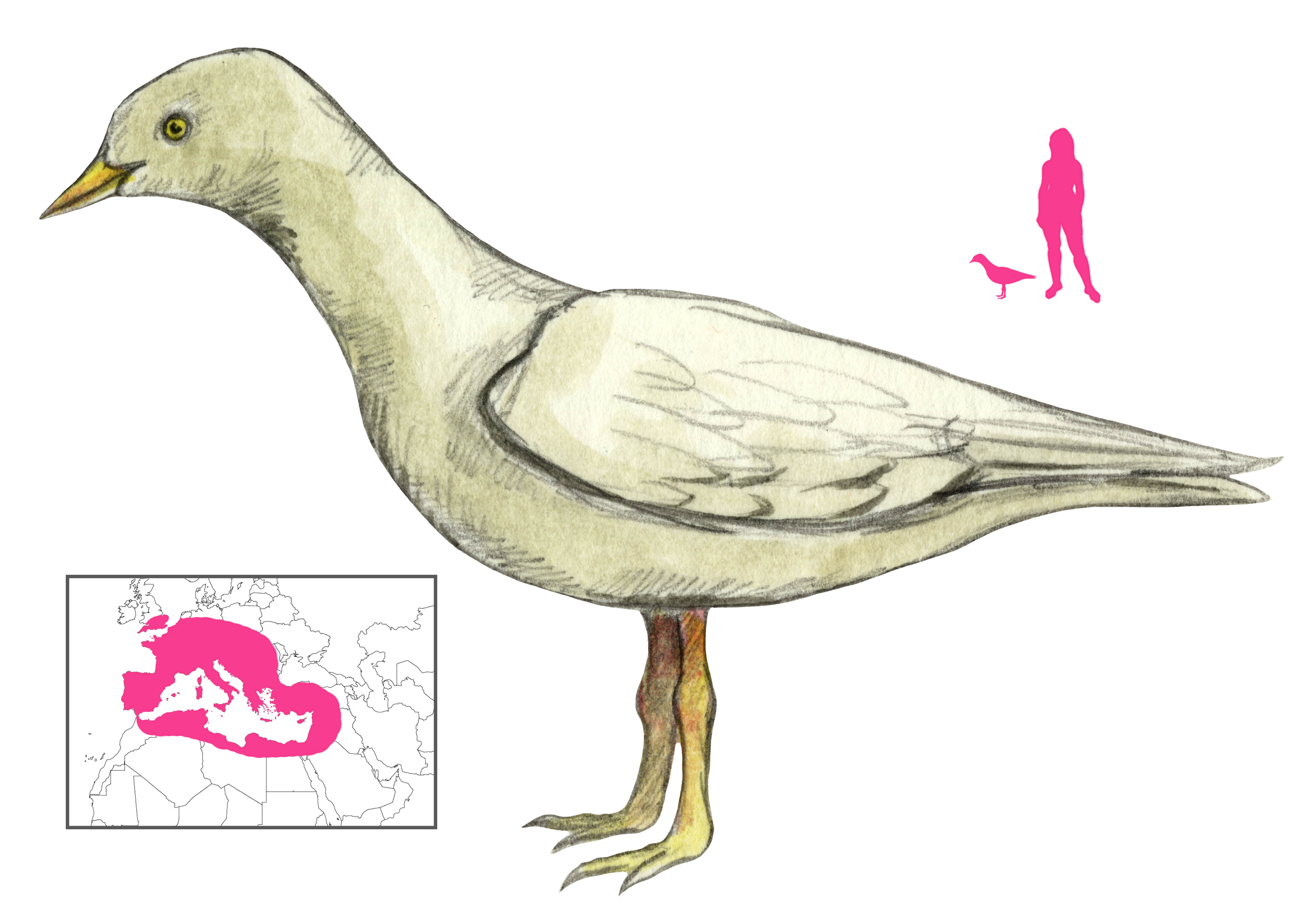
The Caladrius is a miraculous healing bird, believed to range from Europe to Jerusalem. It is generally believed to have originated from the stone-curlew, with other influences including seagulls, falcons, herons, ibises, owls, and any of a number of plovers (Charadriidae).

A caladrius is a waterbird the size of a hen or dove. It has immaculately white plumage, with a long neck, yellow eyes, beak, and legs, and rarely straight goat’s horns. Earlier accounts refer to it as being yellow, while others grant it reddish wings, spots, and a yellow-tinged dark color. It is an unclean bird and must not be eaten.

In its simplest form, the caladrius will cure jaundice by returning the stare of a patient who gazes intently at it. This connection to jaundice was inspired by the striking, staring yellow eyes of the stone-curlew. Its dung and the marrow of its thigh-bones will cure blindness.

A caladrius knows if a patient will live or die. It will look at someone who will be cured, and look away from someone doomed to die. Sometimes all it takes to be cured is touching the caladrius. The caladrius touches its beak to the patient’s mouth, taking disease and sickness into itself, and flies into the sky, where the sun burns the illness into oblivion.

This equates the pure and flawless caladrius with Christ, as it looks at and heals the faithful, granting them life, taking sins away in the process. The caladrius was iconographically represented in the role of a healer, sitting on the bedstead of a sick person and either looking to or away from the patient.

It was often kept in the court of kings for its curative powers. The sale of live caladrius was a potentially lucrative business, but merchants had to hide their specimens to avoid having people come in to see them and get cured for free.

References

Aelian, trans. Scholfield, A. F. (1959) On the Characteristics of Animals, vol. III. Harvard University Press, Cambridge, Massachusetts.

de Beauvais, P.; Baker, C. ed. (2010) Le Bestiaire. Honoré Champion, Paris.

Druce, G. C. (1912) The Caladrius and its Legend, Sculptured upon the Twelfth-Century Doorway of Alne Church, Yorkshire. Archaeological Journal, vol. 69, pp. 381-416.

del Hoyo, J.; Elliott, A.; Sargatal, J.; Christie, D.A.; & de Juana, E. (eds.) (2013) Handbook of the Birds of the World Alive. Lynx Edicions, Barcelona.

White, T. H. (1984) The Book of Beasts. Dover Publications, New York.

Wright, T. (1845) The Archaeological Album. Chapman and Hall, London.

Rukh

Variations: Rokh, Rukhkh, Roc, Ruc; Griffon, Griffin, Gryphon

Rukh

The lineage of the Rukh (or, less correctly, Roc) is an ancient and venerable one, with tales of enormous birds stretching back into ancient Egypt. Generally believed to live in Madagascar (or possibly at the top of Mount Qaf), it is another iteration of the Arabian ‘Anqa, the Persian Simurgh, and the Indian Garuda and Cyena. The name rukh itself may have come about by a corruption of simurgh, which in turn came from cyena.

There is little defining the appearance of the rukh; it is a gigantic bird of prey, but what exactly that entails has varied from artist to artist. The only indisputable feature is that it is enormous. A rukh is as big as the storyteller needs it to be, leading to accounts of a hatchling rukh with wings a thousand fathoms (over 1800 meters) in length!

Rukhs are uncontested predators capable of feeding on the largest and most dangerous land animals. They have a particular fondness for giant serpents, elephants, and karkadanns or rhinoceroses. Sindbad observed that when a karkadann spears an elephant on its horn, the elephant’s fat runs into the rhino’s eyes and blinds it; a rukh will then swoop down and carry both combatants off to feed its chicks. Rukhs also appear to have some degree of intelligence, using boulders to smash prey.

The best-known interactions with rukhs were those of Sindbad the Sailor, who encountered them on his second and fifth voyages. The first time around, Sindbad found himself alone on a deserted island – not an uncommon occurrence in his life – and discovered a strange white dome, some fifty paces in circumference. As he pondered what the structure might be, the sky darkened as a huge rukh appeared. The dome was none other than its egg. Fortunately for Sindbad, it showed no interest in him as it sat on the egg and dozed off, and Sindbad tied himself to its leg with his turban, figuring that it might fly him to more civilized lands. In time the rukh awoke, screeched, and took off on the most terrifying ride of Sindbad’s life. When it finally landed he untied himself as fast as he could and ran for cover, while the rukh busied itself seizing a giant serpent in its talons and flying off with its prey.

Sindbad’s fifth voyage was even more catastrophic. This time, Sindbad’s crew went ashore without him and found the white dome of a rukh’s egg. Despite Sindbad’s warnings, they broke the egg and killed the chick inside. As they butchered the chick, the two parent rukhs appeared, their angry calls louder than thunder. When the sailors tried to flee in their ship, the birds returned with enormous boulders in their talons. The male’s rock narrowly missed the ship, but the female scored a direct hit, sinking the vessel. All sailors on board died with the exception of Sindbad, who drifted off towards further adventures.

In the tale of Aladdin, the evil necromancer attempts to convince Aladdin to demand a rukh egg to hang from the ceiling, a request which infuriates the genie. “You want me to hang our Liege Lady for your pleasure?” he roared, before informing them that such a wicked request could only have come from their enemy. In this case the author combined the rukh with the ineffably pure and holy simurgh.

Abd al-Rahman the Maghrebi, who had travelled far and wide across the world, obtained a rukh chick’s feather quill capable of holding a goatskin’s worth of water. He and his companions obtained it from a rukh chick that they cut out of an egg a hundred cubits long. The parent rukh flew after them and dropped a rock on their ship, but unlike Sindbad’s crew they successfully avoided it and went on their way. All those who had eaten the baby rukh’s flesh remained youthful and never grew old.

Ibn Battuta saw a rukh soaring over the China Seas. It was sufficiently far away to be mistaken for a flying mountain, and he and his companions were thankful that it did not notice them.

Marco Polo had the opportunity to observe rukhs on Madagascar; he believed them to be griffons, and specified that they were not half lion and half bird as he was led to believe, but simply enormous eagles. They had wings 30 paces long with feathers 12 paces long, and would pick up elephants and carry them into the air, dropping them onto the ground from great heights and feeding on the pulverized remains. A rukh feather was brought as a gift to the Great Khan, who was greatly pleased with it.

The rukh is not to be confused with al-Marwazi’s camel-like urine-spouting animal of the same name, described as zabraq by al-Mas’udi and as phalmant by Bochart. This grounded rukh may also be related to the rook chess piece, but both are far removed from the giant raptor.

The giant elephant bird Aepyornis of Madagascar, or its remains, was feasibly the origin of the rukh. It was, however, flightless, harmless, and non-elephantivorous. The rukh feathers that circulated as curiosities during the Middle Ages were fronds from the Madagascan Raphia vinifera palms.

References

Adler, M. N. (1907) The Itinerary of Benjamin of Tudela. Oxford University Press, London.

Bianconi, G. G. (1862) Degli scritti di Marco Polo e dell’uccello ruc da lui menzionato. Tipi Gamberini e Parmeggiani, Bologna.

Burton, R. F. (1885) The Book of the Thousand Nights and a Night, vol. V. Burton Club, London.

Burton, R. F. (1887) Supplemental Nights to the Book of the Thousand Nights and a Night, vol. III. Kamashastra Society, London.

Casartelli, L. C. (1891) Cyena-Simurgh-Roc: Un Chapitre d’Evolution Mythologique et Philologique. Compte Rendu du Congres Scientifique International des Catholiques, Alphonse Picard, Paris.

al-Damiri, K. (1891) Hayat al-hayawan al-kubra. Al-Matba’ah al-Khayriyah, Cairo.

Golénischeff, W. (1906) Le Papyrus No. 1115 de l’Ermitage Impérial. Recueil de Travaux Relatifs a la Philologie et a l’Archéologie Egyptiennes et Assyriennes, v. 12, pp. 73-112.

Kruk, R. (2001) Of Rukhs and Rooks, Camels and Castles. Oriens, vol. 36, pp. 288-298.

Payne, J. (1901) The Book of the Thousand Nights and One Night, vol. V. Herat, London.

Yule, C. B. (1875) The Book of Ser Marco Polo. John Murray, London.

Chonchón

Variations: Chonchon, Chonchoñ, Chon Chón, Chuncho, Chucho, Chuchu, Chaihue; Chonchones (pl.); Cocorote, Corocote (Venezuela); Cuscungo (Ecuador); Tecolote, Telocote (Mexico)

Chonchon

The Chonchón is a bird of ill omen from Chile and Argentina; it originally hails from Araucanian Mapuche folklore. Chonchón is also the name of a kind of kite.

In its simplest form it is a bird of the night, an owl (Strix rufipes) that flies on silent wings during the night to announce illness, death, or some other unwelcome event. When its croaking is heard it is advised to throw ash into the air and utter a few prayers in the hopes of turning away its evil.

The chonchón is also said to be a calcu or evil sorcerer in disguise. It resemble a human head, with oversized wing-like ears that allow it to fly. During the night, these sorcerers’ heads detach themselves from their bodies and fly around to cause mischief, invisible to most, their ominous tué, tué, tué call announcing misfortune. They have the same powers as sorcerers do, and have been known to suck the blood of sleepers.

In order to repel chonchones, several methods are recommended. These include drawing a Solomon’s seal on the ground, laying out a waistcoat in a specified manner, or reciting certain phrases or hymns such as the Magnificat, the Doce Palabras Redobladas, “Saint Cyprian goes up, Saint Cyprian goes down, Saint Cyprian goes to the mountain, Saint Cyprian goes to the valley”, or “Jesus goes ahead, follow him behind”. Doing any of these actions forces the chonchón to leave, or even fall to the ground where it can be destroyed. If the headless body of a chonchón sorcerer is found, turning it onto its stomach prevents the chonchón from returning to it. Finally, a more humane means of dealing with a chonchón is to yell “Come back tomorrow for some salt!” The next day, the chonchón in its human guise will show up and sheepishly request the promised salt. Except perhaps for the last method, most interference with the ways of chonchones will eventually incur the revenge of the chonchón or its friends.

One chonchón was reportedly grounded in Limache when someone made a Solomon’s seal, causing a large bird with red wattles to fall out of the sky. It was decapitated and its head fed to a dog, whose belly swelled up as though it had eaten a human head. Later the local gravedigger told that unknown persons had come to bury a headless body.

Not all chonchones are irredeemably evil, however. A Mapuche man in Galvarino once woke up early in the morning to find his wife’s body without her head. He immediately realized that she was a chonchón, and turned the body onto its stomach to prevent the head from reattaching. As expected, a chonchón soon flew heavily into the house, flapping and staggering as though blind. It then turned into a dog and whined pleadingly to be reunited with its body. The man took pity on it and allowed it to do so, and it became his wife once more. “Every night I leave, without you knowing, and visit distant lands”, she explained. She begged him not to tell anyone, and swore she would never harm him, and both kept their word; the story became known only after the wife died of natural causes.

Some authorities separate the chonchón from the chuncho, with the former being the sorcerous flying head and the latter the owl. Their calls are also different, with the chuncho hooting chun, chun, chun. They have further owl equivalents in the Venezuelan cocorote, the Ecuadorian cuscungos, and the Mexican tecolote. It is also compared to the myth of the voladora, a witch who flies while cackling loudly.

All this is quite unfair to the owls themselves, which benefit the farmers by eating mice, rats, and other vermin.

References

Aguirre, S. M. (2003) Mitos de Chile. Random House, Editorial Sudamericana Chilena.

Borges, J. L.; trans. di Giovanni, N. T. (1969) The Book of Imaginary Beings. Clarke, Irwin, & Co., Toronto.

Cifuentes, J. V. (1947) Mitos y supersticiones (3rd Ed.). Editorial Nascimento, Santiago, Chile.

Coluccio, F. and Coluccio, S. (2006) Diccionario Folklórico Argentino. Corregidor, Buenos Aires.

Rodríguez, Z. (1875) Diccionario de Chilenismos. El Independiente, Santiago.

Soustelle, G. and Soustelle, J. (1938) Folklore Chilien. Institut International de Coopération Intellectuelle, Paris.

Danghu

Variations: Danghu-bird

Danghu

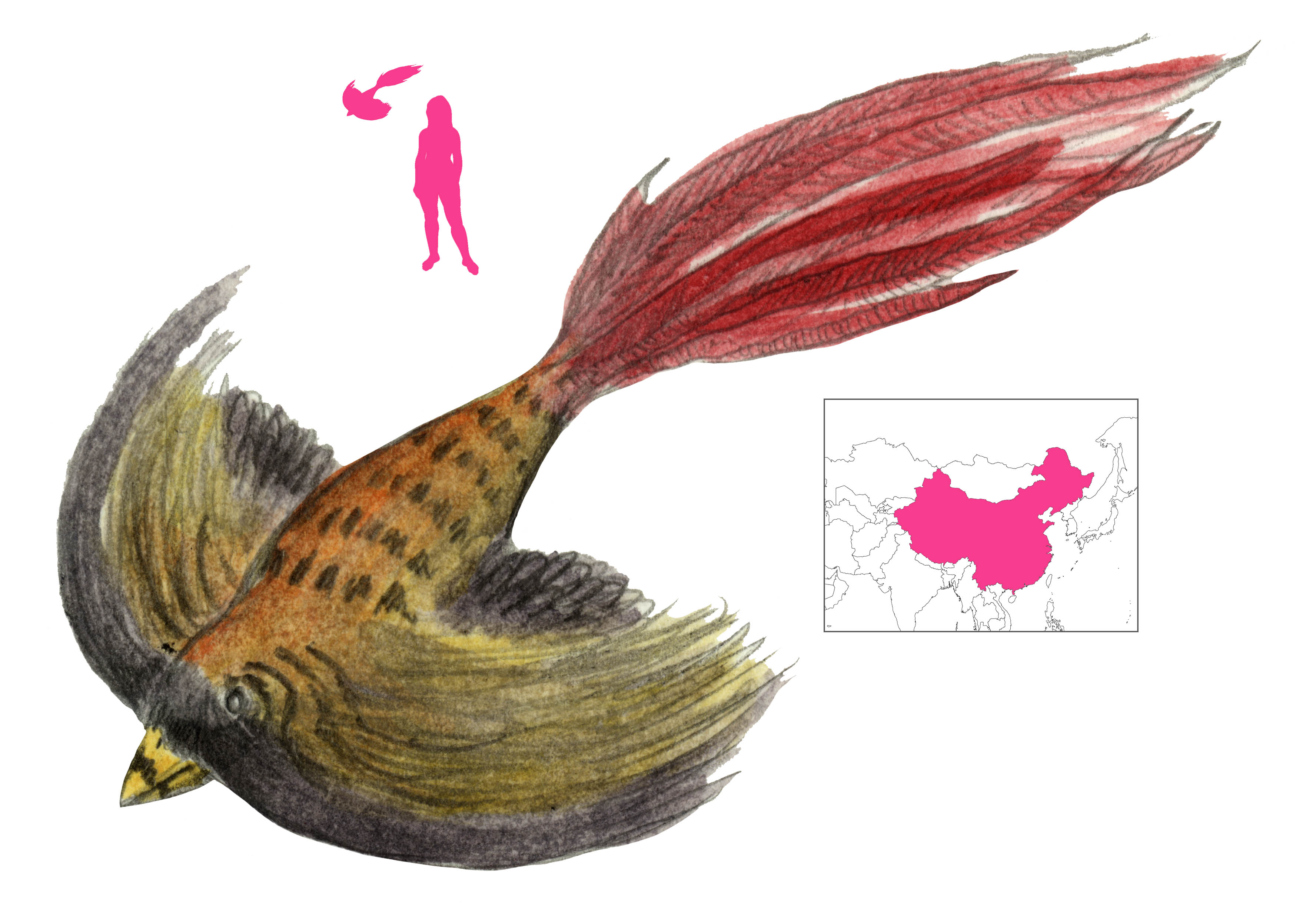
Upper-Shen Mountain or Shangshen is a rugged, rocky peak with no vegetation on it, but there are hazelnut groves at its base. There, Danghu birds can be seen flying from branch to branch. A danghu looks like a pheasant, but it flies using its hypertrophied whiskers and throat feathers. Consuming a danghu protects from and cures myopia. Guo Pu extolled the virtues of the danghu, using it as a metaphor for the economical mindset of Daoism as it makes do with what it has.

Mathieu suggests that this bird is the masked Japanese grosbeak (Eophona personata), which is nonetheless unwhiskered and unpheasantlike.

References

Mathieu, R. (1983) Étude sur la mythologie et l’ethnologie de la Chine ancienne. Collège de France, Paris.

Strassberg, R. E. (2002) A Chinese Bestiary: Strange Creatures from the Guideways Through Mountains and Seas. University of California Press.

Aloés

Aloes

The Aloés is a large fish from the Caribbean around Hispaniola, reported by Thevet. It looked like a goose in general shape, with the top of its skull in the shape of a bon-chrétien (Williams) pear. It had four underslung fins, a fish-like tail, and no scales on its plump body. Several could be observed swimming alongside the boats, along with shoals of fish, and they looked remarkably like geese diving in and out of the waves.

References

Paré, A. (1614) Les Oeuvres d’Ambroise Paré. Nicolas Buon, Paris.

Thevet, A. (1575) La Cosmographie Universelle. Guillaume Chaudiere, Paris.

Codrille

Variations: Cocadrille, Cocodrille, Coquadrille, Cocatris

Codrille

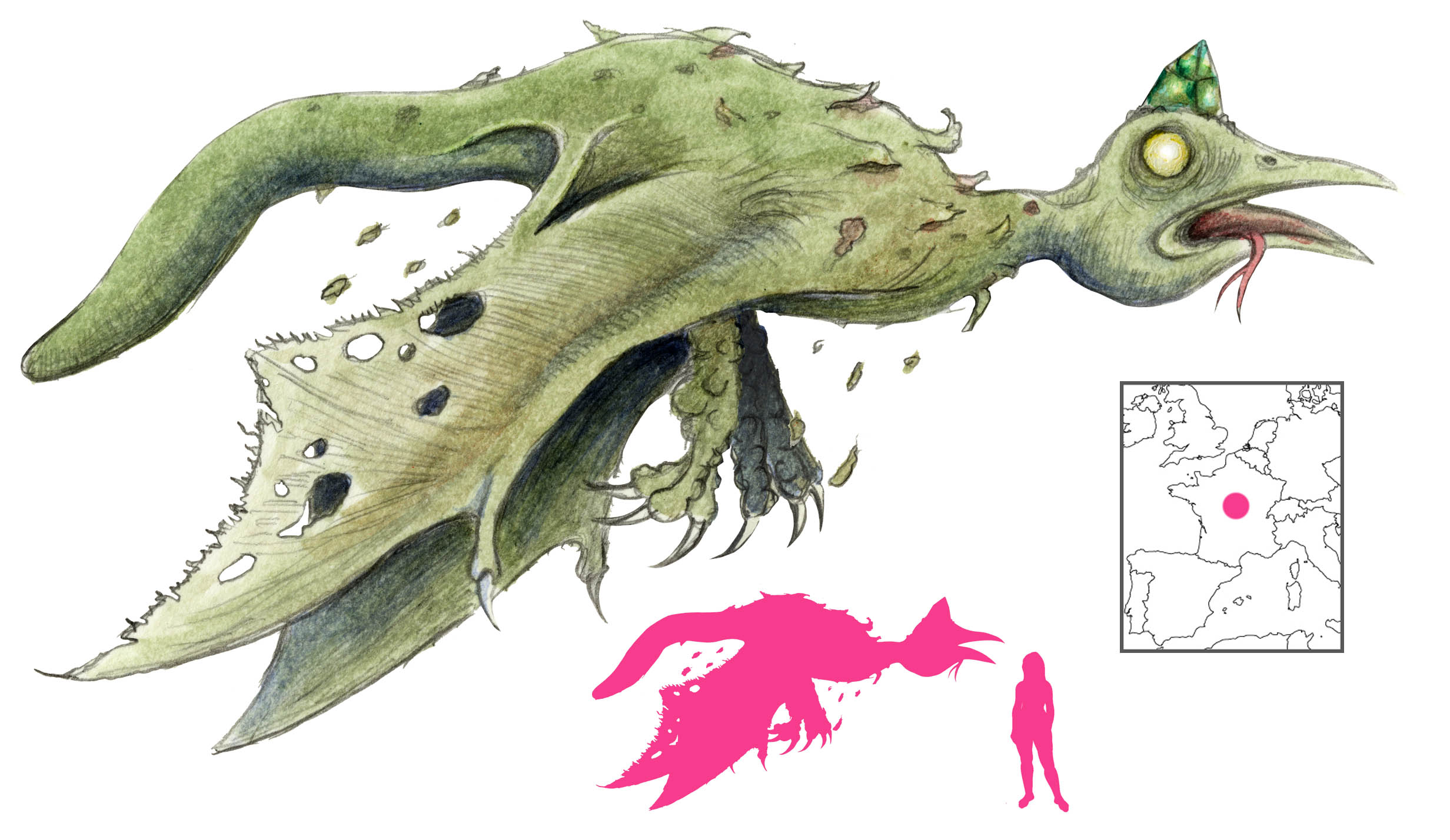
The Codrille, Cocadrille, or Codrille is a variety of basilisk or dragon native to central France, notably Berry, Maine, Poitou, Sologne, and Vendée. It combines features of basilisks and vouivres but without the redeeming aspects of either.

The name of the codrille was derived from the same etymological confusion that spawned the “cockatrice”. Starting with Crocodylus, the crocodile, practically a mythical creature in its own right, the name became progressively more garbled, becoming Cocodrillus, Cocodrille, Cocadrille, and Codrille. However, de la Salle derives it from coco and drille, meaning “rooster’s child”.

Unlike true basilisks, codrilles can grow to impressive size, becoming leathery-winged dragons at the last stage of their life cycle. The “crown” characteristic of basilisks manifests in the form of a brilliant gem on top of the codrille’s head. Codrilles can kill merely by looking at their victims, and emit an aura of disease and plague.

A codrille’s life is a complicated succession of metamorphoses. It hatches from a yolkless egg laid by a rooster, and incubated by the heat of the sun or of manure. To prevent those eggs from hatching, one must plant sprigs of ash in potential codrille breeding grounds. This should be done on the first day of May. Having other roosters around also helps, as they will devour the offspring of a codrille.

The codrille starts out its life as a very long, string-like snake. It is capable of killing right out of the egg – anyone who cracks a codrille egg and is seen by the newborn codrille dies instantly, but if they see the snake first, it dies instead. After a while, the juvenile codrille sprouts legs and becomes a salamander. During this stage of its life it will still die if seen first by humans, so it hides in deep wells, ruined tombs, and the masonry of houses, bringing bad luck to everyone living there and whistling ominously at night. It can debilitate a bull merely by crawling under it.

At the end of seven years the codrille reaches the adult stages. It grows spectacularly, sprouts wings, and metamorphoses into an enormous dragon. It spreads its wings and migrates towards the Tower of Babylon, breathing death and pestilence along its way. Its passage in the air dims the sun, and epidemics and plagues follow in its wake.

References

Sainéan, L. (1921) L’histoire naturelle et les branches connexes dans l’oeuvre de Rabelais. E. Champion, Paris.

de la Salle, L. (1875) Croyances et légendes du centre de la France, Tome Premier. Chaix et Cie., Paris.

Sébillot, P. (1906) Le Folk-lore de France, Tome Troisième: La Faune et la Flore. Librairie Orientale et Américaine, Paris.

Basilisk

Variations: Cockatrice, Basilisco, Basiliscos, Basiliscus, Basili-coc, Basilicok, Regulus (Small Prince), Codrille, Cocodrille, Cocadrille, Coquatrix, Harmena, Sibilus (Hisser), King of Serpents, Crested Crowing Cobra (potentially)

Basilisk

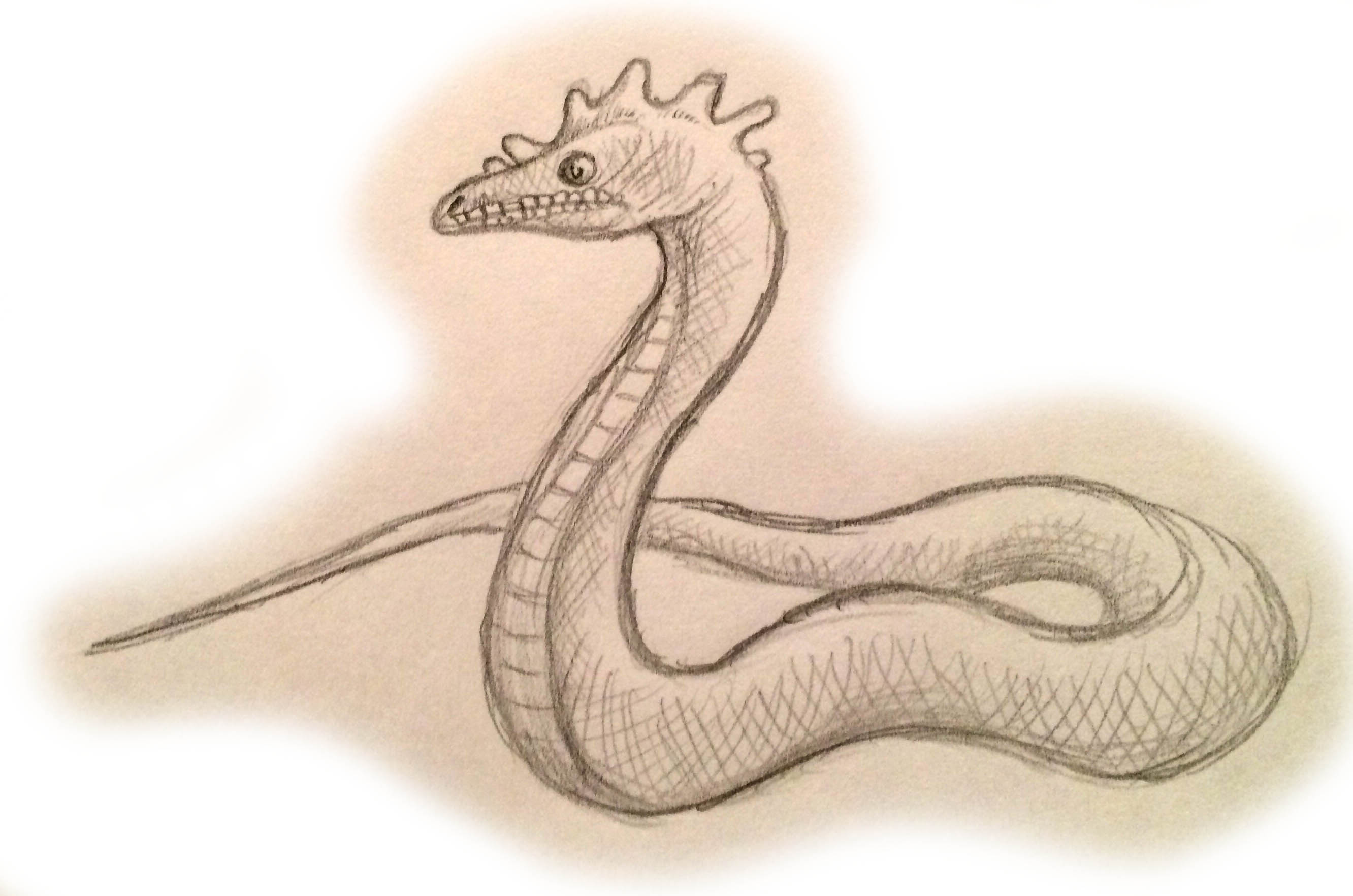
The Basilisk, the “little king” or “king of snakes”, is best known as a creature whose looks kill. Its primary claim to fame is a gaze that instantly kills anyone who sees it, or even anyone it looks at. The basilisk has appeared under a number of guises throughout the centuries, but there are at least a few constants. It is always deceptively small. It is a snake, or at least part snake, with or without rooster characteristics. It always has a crown – whether a white mark, a ring of hornlets, a rooster’s comb, or even a literal crown on its head. And finally, it is always extraordinarily virulent.
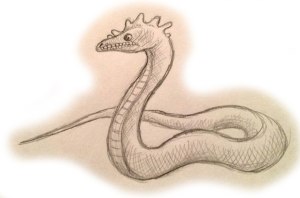
bas 1The basilisk is first and foremost a snake, born from the blood of Medusa as were all venomous snakes. It is found in the North African deserts – its very presence causes the desert, and it becomes frantic in the presence of water. At half a foot long, it is far from the biggest snake, but it is the king of snakes, traveling proudly with its head off the ground. It has a white spot or a crown on its head, and white markings down its back.

The exact nature of the basilisk’s deadliness is uncertain, as it is known to kill via venom, odor, and gaze. Murrus, one of Lucan’s soldiers, transfixed a basilisk with his spear, only to see the venom travel up his weapon and start corroding his hand. He survived by amputating his arm before the venom could reach his body. A basilisk can spit its venom skyward, frizzling up birds in flight. Its very gaze is deadly, as it can kill a man merely by looking at him with its gleaming red eyes. The regal nature of the basilisk and its propensity for projecting its venom suggest that cobras or spitting cobras were the origin of the legend.

Basilisks feared only three things: weasels, the crowing of roosters, and their own lethal gaze. The weasel was the only animal immune to the basilisk’s gaze and venom, making it the only natural predator of the king of snakes. Weasels were often sent into caves believed to harbor basilisks. This interaction also recalls that of the cobra and the mongoose. Basilisks also convulsed and died instantly upon hearing the crowing of a rooster. Travelers in the Libyan desert would be well advised to bring a rooster along with them. Topsell denied the possibility of basilisks perishing upon seeing each other, as “it is unpossible that any thing should hurt itself”; nonetheless, a basilisk in Vienna was killed by showing it a mirror.

With the passing of time the nature of the basilisk grew more and more confused. Various Biblical serpents were translated as basilisks. The basilisk gained more avian characteristics, including an origin in rooster eggs, and was confused with Cocodrillus (the crocodile); both of them were dangerous reptiles with small adversaries (the weasel for the basilisk, the hydrus for the crocodile). Further garbling of “cocodrillus” resulted in “cockatrice”. Wycliffe’s Bible had “cockatrice” as a translation of “basilisk”. Chaucer referred to the “basilicok”. With the accumulation of translation, grammar, and etymological errors, the basilisk (or cockatrice) became a hybrid of snake and rooster, with clawed wings, a rooster’s head, and a long serpentine tail (sometimes with an additional head at the end). This is the familiar cockatrice (or basilisk) of bestiaries, and an incarnation of the Devil himself. It further evolved into the alchemical cockatrice, holding its tail in its mouth, symbolizing the alchemical cycle and its mixed nature. The same nomenclatural confusion also gave rise to the Codrille, a basilisk from central France.

Despite efforts to separate the basilisk and the cockatrice – for example, making the basilisk a snake or lizard and the cockatrice a snake-rooster hybrid, or making them both snake-rooster hybrids, one with a snake head and the other with a rooster head – the fact remains that the names basilisk and cockatrice are interchangeable, and refer to the same animal. It is best to accept T. H. White’s statement that the cockatrice is “a medieval muddle” and leave it at that.
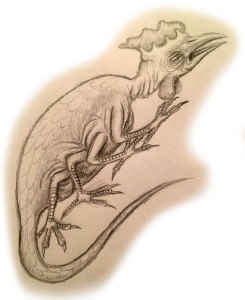
bas 2Cardano reported a basilisk found in the ruins of a demolished building in Milan. This particular specimen was wingless and featherless, with an egg-sized head that looked too large for its body. It had viper fangs, a bulky lizard-like body similar to that of the stellion, and only two stubby legs with catlike claws. The tail was as long as the body, with a swelling at its tip the size of the head. When standing up, it looked like a leathery, naked rooster.

Aldrovandi was apparently inspired by this animal for one of his images of the basilisk, helpfully giving it six more legs. Based on the description and appearance, it appears to have been inspired somewhat by scorpions. Ironically, while this eight-legged depiction has proven particularly enduring, Aldrovandi himself was apparently doubtful of its authenticity, placing this presumed African creature just before a couple rays preserved in the shape of basilisks. The true, snake-like basilisk is given a full-page spread. Aldrovandi also produces a couple of purported basilisk eggs.

Flaubert, taking considerable creative liberties, describes the basilisk as a huge violet snake with a three-lobed crest and two teeth, one on each jaw. It speaks to Saint Anthony, warning him that “I drink fire. I am fire – and I breathe it in from mists, pebbles, dead trees, animal fur, the surface of swamps. My temperature sustains volcanos; I bring out the gleam of gems and the color of metals.”

Finally, Hichens’ “crowing crested cobra” of sub-Saharan Africa appears to be some kind of basilisk. It resembles a cobra, but with a crest on its head and the call of a rooster.
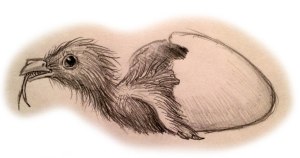
bas 3The life cycle of the basilisk is involved and complicated. The Egyptians believed it to be born from the egg of the ibis, while Neckham blames chickens. Basilisks are born from round shell-less eggs laid by old roosters in the summer (on a dungheap, in some accounts). Those eggs have to be incubated by a snake, a toad, or the rooster itself, eventually producing little terrors ready to kill at birth. As roosters may develop concretions that resemble eggs, and hens may look like roosters, any such fowl that seemed to be a male chicken laying an egg was immediately put to death. In 1474, one such heretical chicken was burned at the stake in Basle, in front of a large crowd.

The only plant immune to the withering gaze of the basilisk is rue, which is consumed by weasels to protect themselves from their enemies. Remedies for basilisk envenomation will always contain rue. A dead basilisk will ward away spiders, and one such basilisk carcass in Diana’s temple kept swallows at bay.

Borges quotes Quevedo as giving the paradox of the basilisk: its existence cannot be proven, as anyone who sees it and survives is a liar, and anyone who sees it and dies will not tell the tale.

The basilisk of biology, or Jesus Christ Lizard (Basiliscus) is a completely harmless South American lizard, known for walking on water. The lethal powers of the basilisk were also transposed by European settlers onto rattlesnakes, and the Mexican West Coast rattlesnake still bears the name of Crotalus basiliscus.

References

Aelian, trans. Scholfield, A. F. (1959) On the Characteristics of Animals, vol. I. Harvard University Press, Cambridge, Massachusetts.

Aldrovandi, U. (1640) Serpentum, et Draconum Historiae. Antonij Bernie, Bologna.

Barber, R. (1993) Bestiary. The Boydell Press, Woodbridge.

Borges, J. L.; trans. Hurley, A. (2005) The Book of Imaginary Beings. Viking.

Breiner, L. A. (1979) The Career of the Cockatrice. Isis, vol. 70, no. 1, pp. 30-47.

Breiner, L. A. (1979) Herbert’s Cockatrice. Modern Philology, vol. 77, no. 1, pp. 10-17.

Brown, T. (1658) Pseudodoxia Epidemica. Edward Dod, London.

Bulfinch, T. (1997) The Age of Fable. Macmillan, New York.

Cardano, G.; le Blanc, R. trans. (1556) Les Livres de Hierome Cardanus Médecin Milannois. Guillaume le Noir, Paris.

Evans, E. P. (1987) The Criminal Prosecution and Capital Punishment of Animals. Faber and Faber, London.

Flaubert, G. (1885) La Tentation de Saint Antoine. Quantin, Paris.

Hargreaves, J. (1983) The Dragon Hunter’s Handbook. Armada.

Hichens, W. (1937) African Mystery Beasts. Discovery (Dec): 369-373.

Isidore of Seville, trans. Barney, S. A.; Lewis, W. J.; Beach, J. A.; and Berghof, O. (2006) The Etymologies of Isidore of Seville. Cambridge University Press, Cambridge.

Lemnius, L. (1658) The Secret Miracles of Nature. Jo. Streater, London.

Liss, A. R. (1987) A Basilisk by Any Other Name… Teratology 35, pp. 277-279.

Lucan, trans. Rowe, N. (1720) Pharsalia. T. Johnson, London.

Pliny; Holland, P. trans. (1847) Pliny’s Natural History. George Barclay, Castle Street, Leicester Square.

de la Salle, L. (1875) Croyances et légendes du centre de la France, Tome Premier. Chaix et Cie., Paris.

Sax, B. (1994) The Basilisk and Rattlesnake, or a European Monster Comes to America. Society and Animals, vol. 2, no. 1.

Topsell, E. (1658) The History of Serpents. E. Cotes, London.

White, T. H. (1984) The Book of Beasts. Dover Publications, New York.