Tuyango

Variations: Tagänogók

tuyango

The Tuyango is a carnivorous swamp bird from Argentinian folklore. The Mocoví know it as Tagänogók, while “tuyango” is of Guaraní origin. These birds are currently believed to have been hunted to extinction.

A tuyango looks a lot like a rhea, but it has a distinctive yellow neck. It preys on humans, which it kills and drags back to its lair to devour.

The hawk had a particular vendetta against the tuyangos, and sought to avenge their cannibalism of humans. One tuyango returned to his home with two dead men only to find his four children clubbed to death. The tuyango cried, ejeeejee, before heading out with his mate to find the hawk. But the hawk asked for fire, and he flew in and out of the smoke until the tuyangos were exhausted and thoroughly confused; only then did he club and kill them. He returned to widespread joy; when his daughter told him “Daddy, a cannibal bird is coming”, he reassured her that he had already killed the tuyango, and all were happy.

References

Cipolletti, M. S.; Guevara, J.; Lehmann-Nitsche, R.; Terán, B. R. D.; and Tomasini, J. A.; Wilbert, J. and Simoneau, K. eds. (1988) Folk Literature of the Mocoví Indians. UCLA Latin American Center Publications, University of California, Los Angeles.

Impundulu

Variations: Lightning-bird, Intakezulu; Chimungu; Ingqungqulu (Bateleur), Insingizi (Ground Hornbill), Inyoni Yezulu (Bird of Heaven), Isivolovolo (White-necked Fish Eagle), Izulu (Sky)

impundulu

The Lightning-bird, spirit of storms and clouds, takes a number of forms in southern Africa. Several familiar birds are associated with storms: the ground hornbill, the hamerkop, the bateleur, various birds of prey. The Amandebele refer to both the “bird of heaven” and the white-necked fish eagle as Isivolovolo, which flies at great altitude and whose droppings are potent magical ingredients. To the Baronga it is a hawk called Chimungu, which buries itself in the ground with every stroke of lightning. The Tumbuka lightning-bird is black with a curling tail like that of a rooster, scars people with its claws, and leaves little scarlet insects behind after a storm. In Buziba it is a whole flock of glittering red birds whose flashing feathers cause lightning and their wingbeats thunder.

The Impundulu or Intakezulu of the Xhosa is probably the best-known of the lightning-birds. It may appear as a human, but only women can see it in its true form, which is white with red wings, red legs, and a short red tail. Various remains have been identified as belonging to an impundulu, including a ground hornbill’s skull, a dead wandering albatross, a cattle egret, a peacock’s tail feather, and a strange avian skull with the penguinlike lower mandible protruding beyond the upper mandible. The last is not identified, but the description leaves little doubt that the African skimmer Rynchops flavirostris is to blame. Altocumulus clouds have also been identified as impundulu.

The beating of the impundulu’s wings causes thunder, although it only starts thundering after the appearance of the large mushrooms in the wet season. Lightning is caused by an impundulu rushing to the earth to lay a single large egg underground. These eggs must be found and destroyed by shamans before they hatch, lest more impundulus be brought into the world. Throwing assagais into the air also helps dissuade impundulus from landing.

Impundulus are vampiric, sucking human blood until their victims die. They will also carry off unprotected children. Milk is another substance impundulus are fond of, and poisoned milk can be used to exterminate them. Witches are believed to have impundulus who do their dirty work, sending them out to kill men; the fat of an impundulu can also be used in sorcery. Impundulus in human form will impregnate women, and their children will be birds. Tuberculosis is caused by an impundulu sucking away sufferers’ breath, and goes by the same name in West Pondoland.

A person with a nosebleed can be described: wanyiwa yimpundulu, “he has been sucked by impundulu”. Another proverb, “he/she has caught the chicken of impundulu”, refers to one having a stroke of good luck.

In more modern times impundulu has become the name of an electric tram-car.

References

Cook, P. A. W. (1931) Social Organisation and Ceremonial Institutions of the Bomvana. Juta and Co. Ltd., Cape Town and Johannesburg.

Godfrey, R. (1941) Bird-lore of the Eastern Cape Province. Bantu Studies, Monograph Series, No. 2, Witwatersrand University Press, Johannesburg.

del Hoyo, J., Elliott, A., Sargatal, J., Christie, D.A. & de Juana, E. (eds.). Handbook of the Birds of the World Alive. Lynx Edicions, Barcelona.

Werner, A. (1968) Myths and legends of the Bantu. Frank Cass and Co. Ltd., London.

Qasoǵonaǵa

Variations: Gasogonaga, Kasogonagá, Kasogongá, QasoGonaGa; Lightning; Owner of Storms/Lightning

qasogonaga

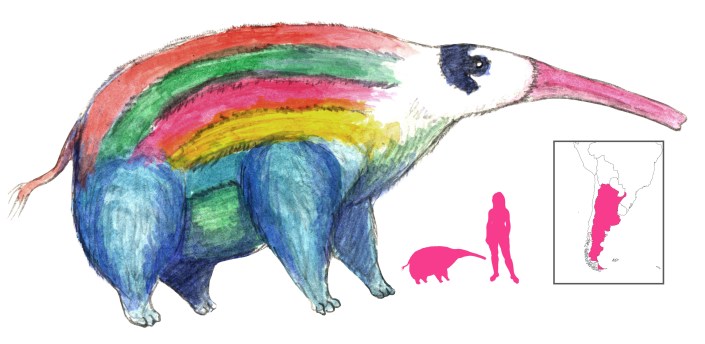
For the Toba of Argentina, lighning takes the form of a small, hairy creature called Qasoǵonaǵa, the Owner of Storms. It is an anteater, or perhaps an elephant, with a long snout, long rainbow-colored hair, and four tiny feet. Qasoǵonaǵa can also appear in human form, retaining a small head and shaggy body. As Qasoǵonaǵa has been referred to by both male and female pronouns, there are probably more than one of these beings.

Qasoǵonaǵa, as the Owner of Storms, lives in the skies and is responsible for storms and other meteorological conditions. Lightning comes out of its mouth, while its angry roars become thunder. It is responsible for rain, or lack thereof.

While Qasoǵonaǵa may be a mighty force of nature, it can be quite friendly and grateful for help granted it by the Toba. Often a Qasoǵonaǵa falls to the earth, and has to be returned there by human intervention, as it is too small to return there on its own. In such cases a bonfire must be built, and Qasoǵonaǵa placed on top before it is ignited. The rising smoke will carry Qasoǵonaǵa back into the sky, and the happy anteater will reward its benefactor with powerful shamanic powers. Qasoǵonaǵa will also cause or stop torrential rain if its helper requests it.

References

Cordeux, E. J.; Karsten, R.; Lehmann-Nitsche, R.; Mětraux, A.; Newbery, S. J.; Palavecino, E.; and Terán, B. R. D.; Wilbert, J. and Simoneau, K. eds. (1982) Folk Literature of the Toba Indians. UCLA Latin American Center Publications, University of California, Los Angeles.

Wright, P. G. A semantic analysis of the symbolism of Toba mythical animals. In Willis, R. (Ed.) (1990) Signifying Animals: Human Meaning in the Natural World. Unwin Hyman, London.

Wright, P. G. Dream, Shamanism, and Power among the Toba of Formosa Province. In Langdon, E. J. M. and Baer, G. (Eds.) (1992) Portals of Power. University of New Mexico Press.

Wright, P. G. (2008) Ser-en-el-sueño. Editorial Biblos, Buenos Aires.

Kamaitachi

Variations: Kama-itachi, Kamakaze (“Sickle wind”)

Kamaitachi

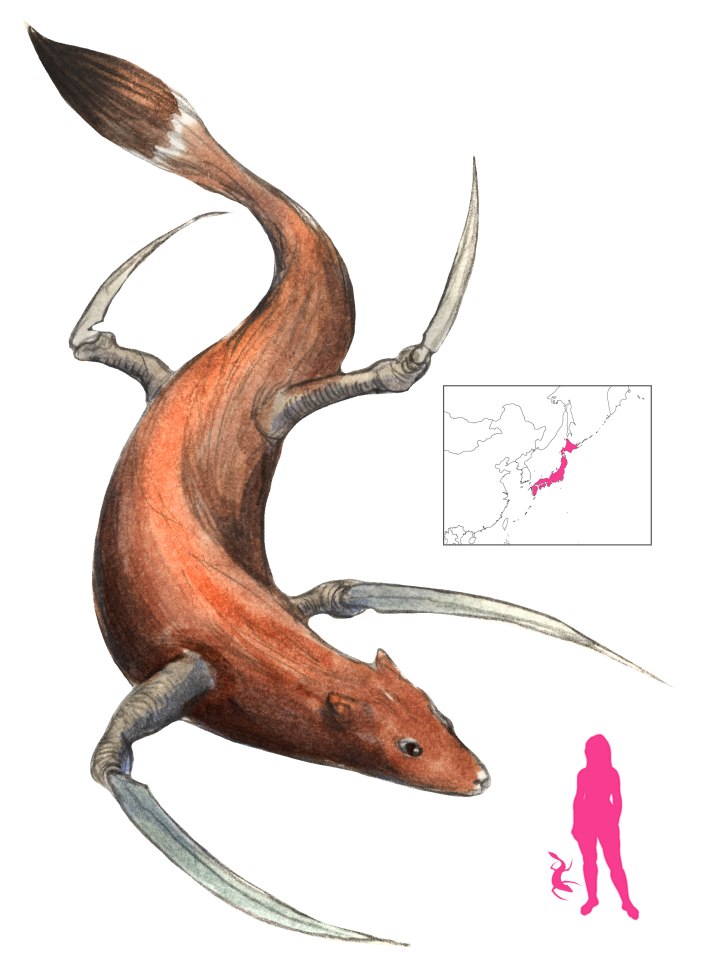
The Kamaitachi, or “sickle weasel”, is the Japanese yokai of unexplained cuts. It is most common in snowy Honshu. The name itself may be alternately derived from kamae-tachi, “poised sword”.

A kamaitachi looks something like a weasel with razor-sharp sickle claws. It travels in whirlwinds, but it is never seen. Instead, the presence of a kamaitachi is known by the cuts it leaves on its victims. It will also cause people to trip and fall, taking malign pleasure in causing injury.

Kamaitachi are useful scapegoats for inconvenient injuries. A woman in Niigata, after injuring herself during a nocturnal tryst, successfully deflected attention by blaming the kamaitachi for her wound.

The kamaitachi was rationalized in a number of ways, including pieces of sharp debris tossed around in whirlwinds. Y. Tanaka suggested that the “kamaitachi disease” was the result of temporary vacuums forming from stray air currents, slicing skin that came in contact with them. Such vacuums would be common in mountainous areas and thunderstorm conditions.

In Gifu the kamaitachi becomes three gods, the first pushing over the victim, with the second cutting with a knife and the third healing the injury.

References

Foster, M. D. (2015) The Book of Yokai. University of California Press, Berkeley.

Griffis, W. E. (1876) The Mikado’s Empire. Harper and Brothers, New York.

Y. Tanaka (1911) An Epitome of Current Medical Literature: Spontaneous Wounds. British Medical Journal, v. 2, p. 37.

Tosetáx

Variations: Tsamtáx, Tsamtás (pl.)

Tosetax

According to the Nivaklé of Paraguay, dry seasons are exacerbated by the Tsamtás serpents, which lie in the middle of the sky and radiate heat. A tsamtáx will intercept and eat the Fanxás or thunderbirds flying from the south and bringing rain with them. Only the shamans can prevent this state of things by tearing down the tsamtás nest, making them fall to their death and allowing the rainy season to return.

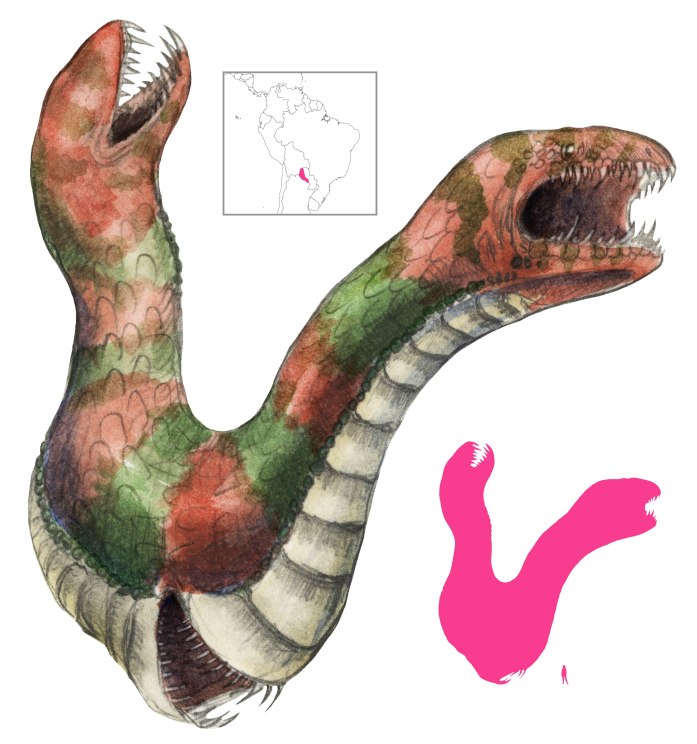
Tosetáx is even more terrifying. He arrived after the tsamtás had been dealt with, and installed himself in the center of the sky. Tosetáx is an enormous green and red snake, with three mouths – one at the head, one at the tail, and one in the middle of his body. As with the tsamtás, Tosetáx was waiting to ambush the returning thunderbirds.

Tosetáx was defeated by five powerful shamans who turned themselves into snakes. One of the shamans coiled himself around Tosetáx and, by turning and coiling, took him to the north out of the thunderbirds’ flight path. There the shamans cut off the serpent’s three mouths and cut him in half, killing him.

References

Chase-Sardi, M.; Costa, M. M.; Mashnshnek, C. O.; Siffredi, A.; Tomasini, J. A.; Wilbert, J. and Simoneau, K. eds. (1987) Folk Literature of the Nivaklé Indians. UCLA Latin American Center Publications, University of California, Los Angeles.

Gremlin

<strong>Variations:</strong> ?

<img class=”alignnone size-full wp-image” src=”https://abookofcreatures.com/wp-content/uploads/2016/04/gremlin.jpg&#8221; width=”451″ height=”612″ />

<img class=”alignnone size-full wp-image” src=”https://abookofcreatures.com/wp-content/uploads/2016/04/gremlin-2.jpg&#8221; width=”451″ height=”612″ />

Gremlin 3

Every unexplained mechanical error, every mysteriously malfunctioning engine, defective wheel, gas leak, fuselage weakness, cockpit damage, and avionics glitch can be blamed on gremlins. These little machine fairies are the modern equivalent of the ancient dwarfs, but they destroy instead of build.

Etymologies for “gremlin” disagree, and are probably all apocryphal. One suggestion holds that it originates from the antiquated Old English gremian, “to vex”. This is related to the Irish Gaelic gruaimin, “grumpy little fellow”, which comes from gruaim, “gloom” or “ill-humor”. Another suggestion is a shortening of grinning goblin. The French grelon or “hailstone” indicates some meteorological confusion. Edwards adds the German gram or “worry” to the mix, from which the diminutive gramlein can be derived. Finally, Fremlins beer may have had a hand in inspiring gremlins.

Similarly there is no consensus on gremlin appearance, but it is generally assumed that they are small, six inches to a foot in height, and humanoid in appearance. They are skinny and nimble enough to move about through complex machinery. Known colors include green and blue-grey. Some have horns, others have pointed ears; webbed feet and suction cups have been suggested for yet others. Clothing is optional, including nudity, pilot gear, breeches and jackets, and even spats and top-hats. They eat treacle and honey, and drink fuel, sucking tanks dry.

Gremlins were first identified by R.A.F. pilots, especially on Maltese airfields in World War I, although there is evidence to suggest that they have been around longer than that. From there tales of the gremlins and their deeds spread throughout the piloting world, until they became a byword for any unexplained mechanical issues.

Gremlin activities range from juvenile pranks to outright destructive cruelty. They view all airplanes as an affront, and do whatever they can to ground them. Some gremlin subspecies specialized in specific forms of mischief. Mole-like Cavity gremlins dug holes in runways, Incisors teethed on wires, Jockeys guided birds into airplane windscreens, and Optics glowed over bomb sights.

While gremlins have faded from the aerial popularity they enjoyed during the war, the preponderance of technology in our modern world has only given them further targets to mess wgsgnslfgnsogdkfjgluiw4v8r93428RQVNWAELIVJWBKkjdhzseuwy5ycjdft3534bsrg5566fgdfgcbvgbc

<strong>References</strong>

Dubois, P.; Sabatier, C.; and Sabatier, R. (1992) La Grande Encyclopédie des Lutins. Hoëbeke, Paris.

Edwards, G. (1974) Hobgoblin and Sweet Puck. John Sherratt and Son, Altrincham.

Colôrobètch

Variations: Colô Rodje Bètch, Colô Rotje Bètch, Clô Rotje Bètch, Colôrobètche, Colaurobètch, Colaurobètche, Colau-rodje-bètch, Corobètch, Routge Bètch

Colorobetch

Bogeys represent a variety of childhood fears – darkness, retribution, the murky depths of deep ponds… In Wallonia children are menaced by the personification of the bise or icy wind, in the form of a bird with a red beak.

He can be found around Andenne, Bastogne, Dinant, Huy, and Neufchâteau, and Warsage; in On, Oignies, and Stavelot he is simply the “red beak”. The Somme-Leuze redbeak is a monstrous sparrow, the Condroz and Hesbaye variety is a pigeon, while the Namur redbeak is Colôrobètch or Colô Rodje Bètch, the “Red-Beaked Rooster”.

As his name indicates, Colôrobètch has a beak stained red with blood; beyond that, it is unclear whether he is a bird, a human, or a grotesque combination of both. He preys on children unwary enough to walk in the cold without adequate clothing, nipping at their exposed faces and hands until they turn red, dry, cracked, and bleeding. Colôrobètch comes out in the winter to pinch noses and spread frostbite.

In Andenne Colôrobètch becomes a nocturnal water bogey who drags children into the Meuse.

References

Pignolet, M. (1985) La Symbolique du Coq. Le Guetteur Wallon, 61 (3), pp. 81-104.

Tijskens, J. (1965) Les Noms du Croquemitaine en Wallonie. Enquêtes du Musée de la Vie Wallonne, nos. 117-120, tome X, pp. 257-391.

Peteu

Variations: Peteu de Vergisson, Bête Faramine, Oiseau de Vergisson, Esiau de Vregesson, P’teu, Pteu

Peteu

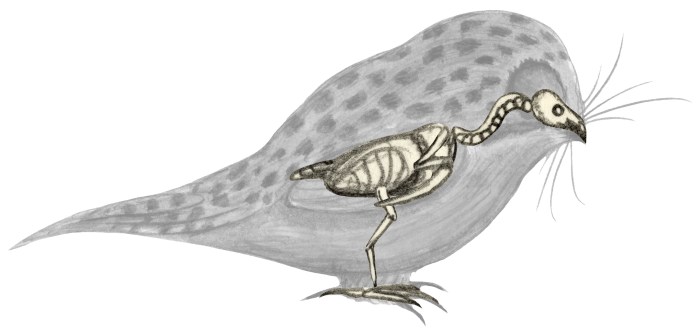
The picturesque town of Vergisson, in France’s Saône-et-Loire, was once home to the Peteu. This was a great and monstrous bird, with broad wings and whiplike feathers surrounding its razor-sharp beak. It was spiritually descended from the emouchet or kestrel (Falco tinnunculus), but also of the humble kinglet, whose name in the Maconnais dialect is répteret, répeteret, or repteu, which in turn is shortened to pteu.

The peteu would fly from the Rock of Solutré to the Rock of Vergisson, soaring over its domain in search of prey. When it spotted something, it folded its wings, dove, and carried off its prize. The peteu devoured sheep, pigs, goats, cows, horses and their carts! Its loud wingbeats terrified livestock and sent them running all the way back to their stables. Most heinous of all, it dove at Mr. Bruys de Serrières, who was quietly writing his History of the Popes, and defecated onto his manuscript before flying away. There was no end to the peteu’s evil.

It was Émilien Protat who organized a hunting party to rid Vergisson of the bird’s tyranny. The small but courageous group of men made for the Rock of Solutré where the peteu was last seen. When the raptor flew over their heads, blocking out the sun, the quick-thinking Émilien fired his rifle into it. The peteu fell to the ground, but would have taken Émilien’s head off had he not rammed his rifle into its mouth and fired.

The hunters returned to Vergisson in triumph to have their quarry plucked and roasted. Imagine their surprise when the peteu, stripped of its feathers, weighed no more than four ounces!

Peteu skeleton

References

Ducrost, A. (1888) Le P’teu ou L’Esiau de Vregesson Qu’ere ine Bête Faramine. Annales de l’Academie de Macon, s. II, t. VI, pp. 379-397.

Protat, G. (1966) Le Peteu de Vergisson ou la Bête Faramine. Protat Frères, Macon.

Cherruve

Variations: Cheruvoe, Cheurvoe, Cheurvue, Cherufe

Cherruve

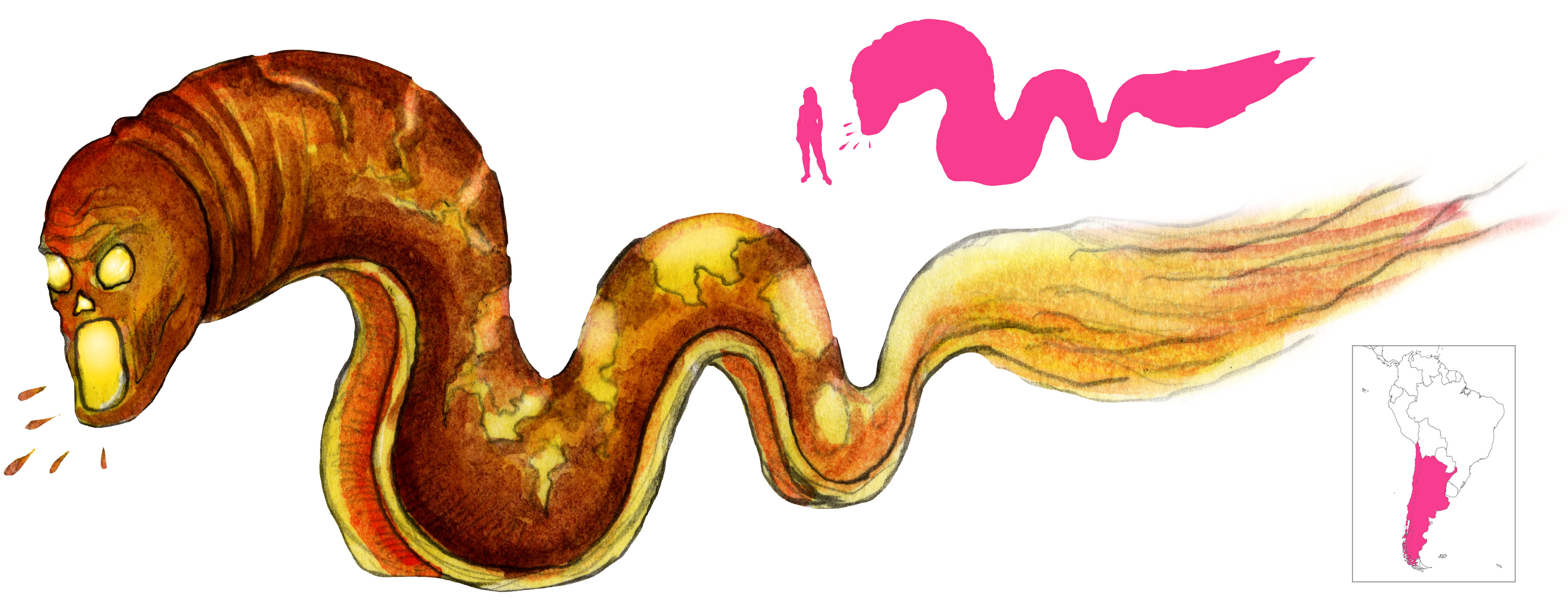
The Cherruve is the Chilean spirit of comets and asteroids. Originally no more than the Araucanian meteorite, the cherruve’s role has since expanded to include lava, volcanoes, fiery exhalations, will-o-the-wisps, whirlwinds, and animate stone axes.

Cherruve appearance varies from area to area, but it is usually described as a comet, or a great serpentine creature with a human head and lava dribbling from its mouth. Its appearance has been anthropomorphized to various degrees and conflated with aspects of European mythology; in the Andes it becomes a huge seven-headed dragon; elsewhere it is confused with dragons, devils, and giants, or bipedal goats with flaming eyes.

Cherruves live underground and in volcanoes, and streak across the sky by night. The appearance of a cherruve in the sky heralds the spread of an epidemic, the death of a great leader, or other misfortunes, while the cherruve’s vomit is lava and its movements underground cause earthquakes. They make thunder by tossing human heads. The more dragon-like cherruves may demand the sacrifice of Mapuche maidens, and will withhold the flow of rivers if their demands are not met.

Comets, asteroids, and meteors are all cherruves, as are meteorites and oddly-shaped volcanic rocks. Cherruve rocks are collected by sorcerers, who use them to carry out their evil purposes by sending them at their enemies. They are ordered to suck blood and inflict death and disease, and can operate on their own, returning diligently to their masters after performing their duties.

Cherruves are also capable of feeling more human emotions. One cherruve married a Cloud, and their beautiful daughter, ethereal and pale, was Snow. Despite the cherruve’s jealous attempts to keep his wife under lock and key, she was abducted by his mortal enemy Wind. Every now and then Wind would blow Cloud over the volcano, and her tears became rain, while the cherruve’s own despair turned into destructive eruptions. The cherruve redoubled his efforts to protect Snow, and kept her from leaving the mountain during the daylight hours. Snow’s curiosity about the world outside continued to grow, and one day she finally managed to escape her father and climb out into the light. She marveled at the sun, the songs of birds, the colors, all infinitely beautiful and unknown to her. The longer she stayed outside, the happier she was, and yet the weaker she felt. Her mother tried to protect her, but the spiteful Wind carried the Cloud away. When Snow sat down, exhausted, the love-stricken Sun came down to give her a kiss. When the cherruve finally caught up with his daughter, he found nothing but a puddle of crystalline water.

References

Faron, L. C. (1964) Hawks of the Sun. University of Pittsburgh Press, Pittsburgh.

Guevara, T. (1908) Psicolojia del pueblo araucano. Imprenta Cervantes, Santiago de Chile.

Latcham, R. E. (1924) La organización social y la creencias religiosas de los antiguos araucanos. Imprenta Cervantes, Santiago de Chile.

Lenz, R. (1897) Estudios Araucanos. Imprenta Cervantes, Santiago de Chile.

Pino-Saavedra, Y.; Gray, R. (trans.) (1967) Folktales of Chile. The University of Chicago Press, Chicago.

Soustelle, G. and Soustelle, J. (1938) Folklore Chilien. Institut International de Coopération Intellectuelle, Paris.

Vouivre

Variations: Vaivre, Givre, Guivre, Wivre
Vouivre

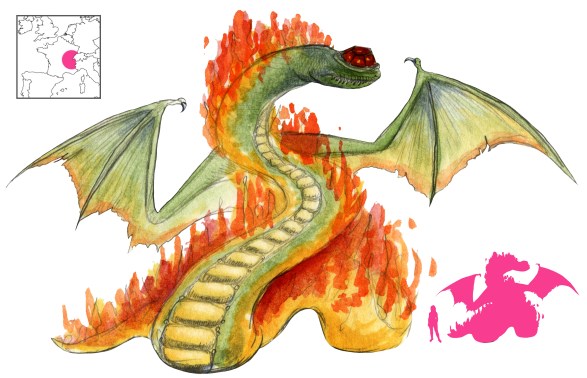
Vouivres, the great fiery serpents of France, have been reported primarily from remote, mountainous regions, where they haunt springs, wells, caves, deep ponds, and ruined castles. They are known from Bourgogne, Franche-Comté, Savoie, the Jura mountains, and neighboring areas, with possible relatives in the Aosta Valley and Switzerland.

The word “vouivre” is derived from the Latin vipera, or “viper”. Vouivres themselves are the spiritual descendants of Mélusine, stripped of her human features. They have been described as dragons, serpents, and fairies in the form of great reptiles; they are always the guardians of priceless treasures.

In its most simple definition, a Vouivre is a female dragon. Vouivres vary wildly in appearance, but are always female and associated with fire and water. The classic vouivre, as observed in Faverges, Fleury-la-Tour, Mont-Beuvray, Rosemont, Solutré, and Thouleurs, is an immense winged serpent covered with fire. Instead of eyes, a vouivre has a single large diamond or ruby in its head that guides it through the air. She removes it when bathing, leaving it blind and vulnerable to theft. Possession of a vouivre’s eye-stone would bring riches and happiness to anyone who stole it. The immense vouivre of Boëge guards treasure and wears a priceless golden necklace. In La Baume she is 4 meters long and covered in gems and pearls. She sometimes leaves gems behind where she lands. The Lucinges vouivre is a glowing red viper that whistles eerily in flight. The Gemeaux vouivre, which appeared between 2 and 3 in the afternoon, was hooded like a cobra.

In Brizon, she is equally likely to appear as a bird or a winged beech marten with a brilliant necklace as she is to have the form of a great serpent with wings and a diamond on its tail. Vouivres may not even look like animals. In Chevenoz she appears as a burning fireball streaking across the sky, in Saint-Jean-d’Aulps and Vallorcine she is a single-eyed tongue of fire, and in Le Biot she is a star whose appearance foretells war and strife. The Orgelet Castle vouivre looks like a red-hot iron bar in flight, and the vouivre of Sixt-Fer-À-Cheval is a plumed golden necklace that flies through the air.

One of the more effective ways of slaying a vouivre has been making a spiked barrel to hide in. At Condes, a man managed to steal a vouivre’s diamond and hide in a nail-studded washtub; the infuriated, blinded dragon killed herself trying to get to him. While another man at the Aosta Valley slew a vouivre in a similar manner, other prospective thieves have not been so lucky. The vouivre of Reyvroz had a necklace of great value, which was stolen by a man in a spiked barrel; she died and the thief died soon after. The vouivre of Samoëns had her pearl necklace stolen in the same manner, but she constricted the barrel anyway and made the thief return the necklace; she then disappeared and was never seen again. In Manigod, where grass would not grow for a couple of years after the vouivre’s passage, a man who stole her diamond was killed, his barrel smashed, and the gem retrieved.

Finally, as with all dragons, vouivres are vulnerable to the power of saints and other holy persons. The vouivre of Saint-Suliac was cast into a deep cave by Saint Suliac after she killed one of his monks. The location became known as the Trou de la Guivre, the Guivre’s Hole.

In Thollon-Les-Mémises, among other places, “vouivre” has become a byword for an unpleasant, nasty woman.

Modern versions of the vouivre, perhaps conflating her with Mélusine, have embellished with her the features of a seductive woman. Marcel Aymé makes her a wild girl of the forest with an entourage of vipers, and Dubois makes her a beautiful fairy who sheds her dragon skin when bathing.

References

Aymé, M. (1943) La Vouivre. Gallimard.

Dontenville, H. (1966) La France Mythologique. Tchou, Paris.

Dubois, P.; Sabatier, C.; and Sabatier, R. (1996) La Grande Encyclopédie des Fées. Hoëbeke, Paris.

Joisten, C. (2010) Êtres fantastiques de Savoie. Musée Dauphinois, Grenoble.

Monnier, D. (1819) Essai sur L’Origine de la Séquanie. Gauthier, Lons-Le-Saunier.

Sébillot, P. (1905) Le Folk-Lore de France, Tome Deuxième: La Mer et les Eaux Douces. Librairie Orientale et Américaine, Paris.