Xiao

Variations: Raucous-Bird

Xiao

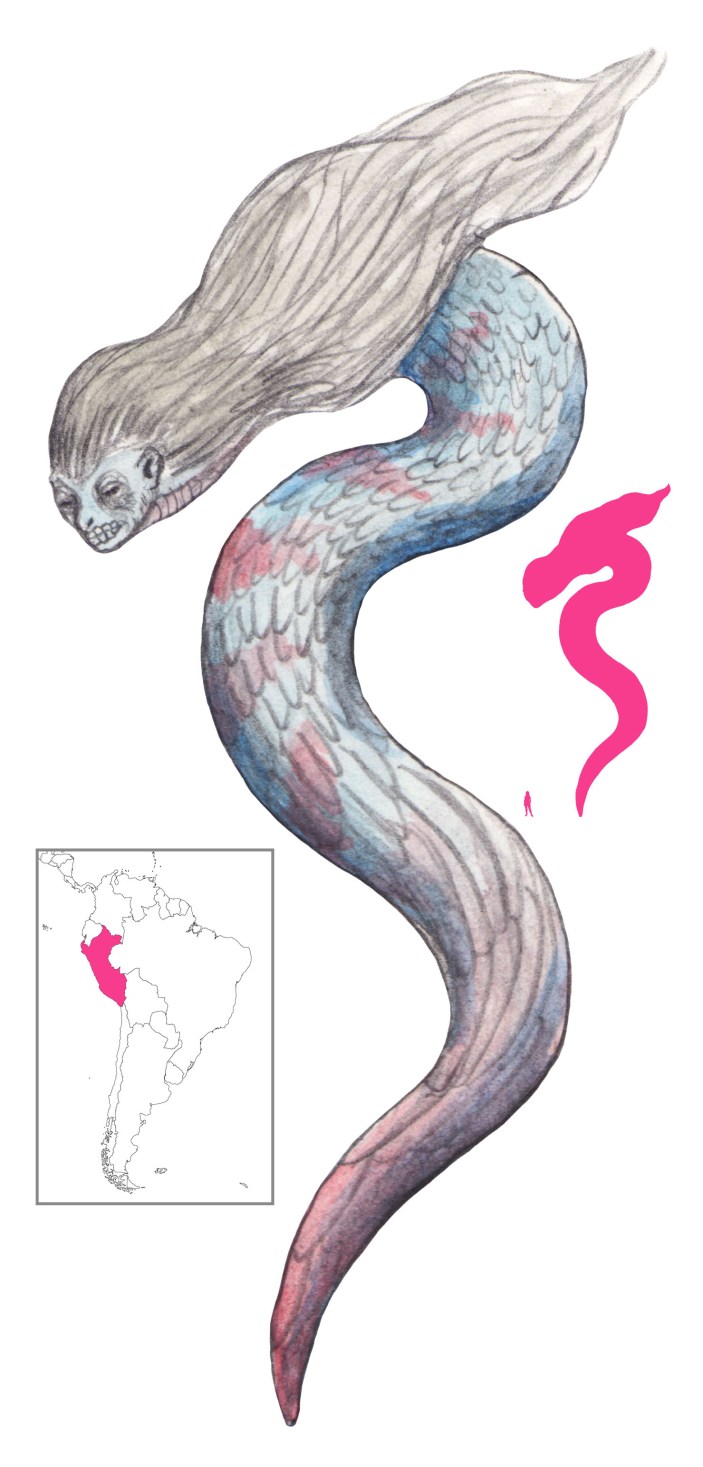
The Xiao or Raucous-Bird dwells on China’s Bridge-Channel Mountain. It is a bird with four wings, one eye, and a dog’s tail. It makes sounds like a magpie. Eating it cures abdominal pain and diarrhea. The Shan Hai Jing assures us that it resembles Kuafu the Boaster, which it does not.

It shares its name with an unrelated simian creature that resembles a Yu-Ape with longer arms.

References

Strassberg, R. E. (2002) A Chinese Bestiary: Strange Creatures from the Guideways Through Mountains and Seas. University of California Press.

One-Eyed One-Horned Flying Purple People Eater

Happy April Fool’s!

Variations: Flying Purple People Eater, Purple People Eater

OEOHFPPE

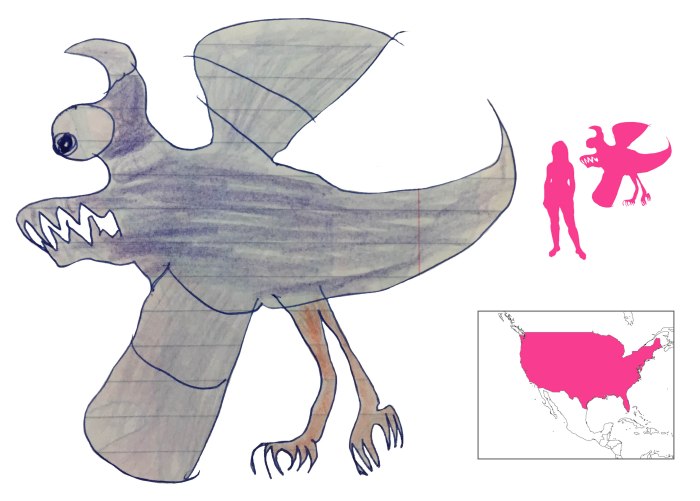
The One-Eyed, One-Horned, Flying Purple People Eater is a creature from North American folklore. The primary source for it comes from Wooley, who describes its activities from a purported first-hand encounter.

Unfortunately descriptions of the purple people eater are vague. It is evident that it is one-eyed, one-horned, and flying (presumably to distinguish it from the dreaded Three-Eyed Two-Horned Swimming Turquoise People Eater), and it may also be pigeon-toed and under-growed, but it is unclear whether the “purple” refers to its coloration or its diet. Equally unclear is whether or not it is a threat to humans. Wooley refers to the purple eater as feeding on purple people, but it also states that it would not eat Wooley due to his “toughness”. Unless Wooley himself is a purple person, it can be safely assumed that the purple people eater’s primary provender includes people and purple people alike. Furthermore, it is not improbable that a diet of high-pigment purple people would render the purple people eater purple itself; after all, flamingos dye themselves pink with shrimp, and the Four-Eyed Three-Horned Crawling Cobalt People Eater is a rich blue color owing to its primary diet of smurfs.

Either way, it is clearly some kind of trickster spirit, as, despite its proclivities for people-eating, it is capable of intelligent speech and desires to play in a rock and roll band. The vaunted horn (still collected to this day for traditional Chinese medicine – the unfortunate Five-Eyed Nineteen-Horned Plodding Orange People Eater was driven to extinction in this way) is actually hollow, and serves as an amplifier for its mellow trumpeting vocalizations. The purple people eater also likes short shorts, but it remains uncertain whether it is referring to its preferred clothing or – more worryingly – its choice in victims.

References

Poisson, A. (1994) Color me surprised: people eaters around the world. Bob’s Printers and Convenience Store, Topeka.

Wooley, S. F. (1958) The Purple People Eater. MGM, New York.

Aderyn y Corph

Variations: Aderyn y Corff, Aderyn y Cyrff, Corpse-bird

Aderyn y Corph

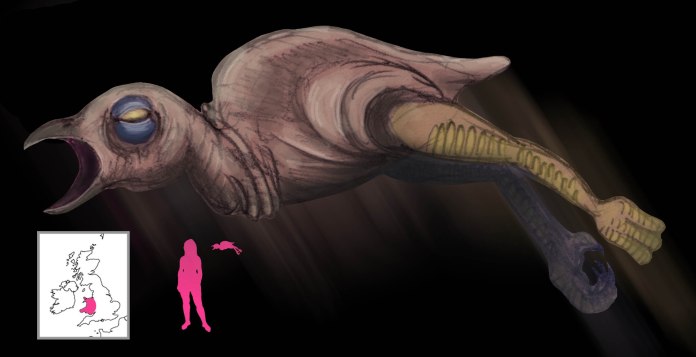
The Aderyn y Corph or corpse-bird chirps at the door of a dying person in Wales. Its call is dewch, dewch (“come, come”). It has no feathers or wings and can soar easily without them. When not presaging death it lives in the land of illusion and fantasy.

It is a variant of the screech owl whose call portends death. Aderyn y corph is also Welsh for the screech owl or brown owl.

References

Evan, D. S. (1858) An English and Welsh Dictionary. Thomas Gee, Denbigh.

Sikes, W. (1880) British Goblins. Sampson Low, Marston, Searle, & Rivington, London.

Nguluka

Variations: Siani

Nguluka

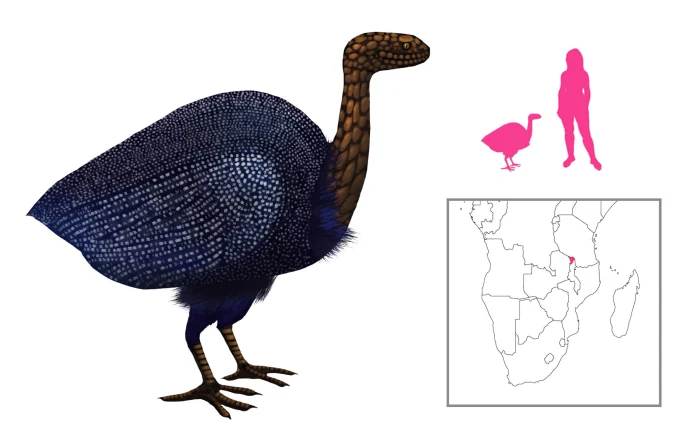
The Nguluka or Siani can be found in Malawi’s Chitipa district, specifically in the Mafinga Ridge and the Matipa Forest in the Misuku Hills. Anyone who sees it dies.

A nguluka is a flying snake that looks like a guineafowl, complete with feathers and wings. In fact, only its fanged head is that of a snake. It makes a crowing call that sounds like “yiio, yiio”.

Ngulukas live in caves and tree branches in the deep forest. Their lairs are strewn with the bones of their victims. These snakes feed on figs and like to roost in fig trees. They are most active at night, especially on moonlit nights when the figs ripen.

References

Hargreaves, B. J. (1984) Mythical and Real Snakes of Chitipa District. The Society of Malawi Journal, Vol. 37, No. 1, pp. 40-52.

Bifang

Variations: Bifang-bird

Bifang

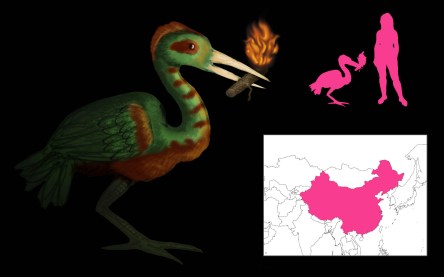
The Bifang can be found on barren Mount Zhang’e in China. It looks like a crane but has only one leg; it has a white beak and red markings on a green background. Its call sounds like its name.

A bifang is an omen of inexplicable fire starting in town. This is probably connected to its red color. It was not always an evil omen, however, as it appears as a benevolent attendant of the Yellow Thearch in the Master Hanfei, and is the divine essence of wood in the Master of Huainan.

Some sources have the bifang itself as the arsonist, using fire it carries in its beak. Mathieu equates it with the Chinese crane, whose habit of standing on one leg may have inspired the bifang’s appearance.

References

Mathieu, R. (1983) Étude sur la mythologie et l’ethnologie de la Chine ancienne. Collège de France, Paris.

Strassberg, R. E. (2002) A Chinese Bestiary: Strange Creatures from the Guideways Through Mountains and Seas. University of California Press.

Qinyuan

Variations: Qinyuan-bird, Yuanyuan, Zhiyuan

Qinyuan

Mount Kunlun is the Pillar of Heaven, a place of great energy and endowed of a fiery brilliant aura. Four rivers – Black, Red, Yellow, and Oceanic – flow from Mount Kunlun, and the mountain is administered by the god Luwu, or the Queen Mother of the West Xi-Wangmu in later texts.

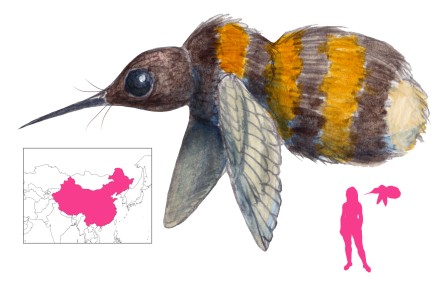
Many wonderful birds and beasts dwell on Mount Kunlun, including the Qinyuan or Qinyuan-bird. It looks like a bee, but is the size of a mandarin duck. Its sting is venomous enough to kill other animals and to wither trees.

Despite the classification as a “bird”, Mathieu believes it to be simply a large stinging insect.

References

Mathieu, R. (1983) Étude sur la mythologie et l’ethnologie de la Chine ancienne. Collège de France, Paris.

Strassberg, R. E. (2002) A Chinese Bestiary: Strange Creatures from the Guideways Through Mountains and Seas. University of California Press.

Bakunawa

Variations: Baconaua (Hiligaynon)

Bakunawa

The Asian eclipse monster has analogues in China, India, Malaysia, Mongolia, Thailand, and the South Sea Islands. In the Philippines, where the legend is widespread, it is usually a dragon or serpent or even an enormous bird. Bakunawa, “Eclipse”, is one of the best-known.

The Bakunawa of the Cebuano, or Baconaua as it is known to the Hiligaynon, is a colossal, fishlike dragon as large as the Negros and Cebu islands. It resembles a shark, with gills, a lake-sized mouth, and a striking red tongue. Whiskers one palmo long adorn its mouth. In addition to its powerful ash-gray wings, it has smaller wings along its sides.

Long ago there were seven moons in the sky. Bakunawa gobbled them up one by one until it came to the last and largest moon. It failed to swallow it, and tried to bite it into manageable chunks, sinking its teeth deep into the moon’s surface. To this day the bakunawa’s teeth-marks can still be seen on the moon. Every now and then the bakunawa will take to the sky and attempt to finish the job it started by swallowing the moon, causing an eclipse. To make it release the moon, utensils are clanged loudly together to startle it.

The bakunawa’s den is in the deepest parts of the sea. In January, February, and March its head faces north and its tail south; in April, May, and June its head faces west and its tail east, in July, August, and September its head points south and its tail north; and in October, November, and December its head is east and its tail west. The positions of the bakunawa during those four phases are used to divine the best time to build houses.

A children’s game called Bakunawa for 10 or more players involves one player as Buan, the moon, while another is Bakunawa. The remainder form a circle, holding hands and facing inwards. The moon starts inside the circle and Bakunawa is outside. The goal of the children in the circle is to prevent Bakunawa from entering the circle and capturing the moon – the moon itself cannot leave the circle. Bakunawa can ask individual players “What chain is this?” and they can answer that it is an iron, copper, abaca, or any material they can think of. When Bakunawa captures the moon, the players exchange roles or swap with players in the circle.

References

Jocano, F. L. (1969) The Traditional World of Malitbog. Bookman Printing House, Quezon City.

de Lisboa, M. (1865) Vocabulario de la Lengua Bicol. Establecimento Tipografico del Colegio de Santo Tomas, Manila.

Ramos, M. D. (1971) Creatures of Philippine Lower Mythology. University of the Philippines Press, Quezon.

Ramos, M. D. (1973) Filipino Cultural Patterns and Values. Island Publishers, Quezon City.

Ramos, M. D. (1990) Tales of Long Ago in the Philippines. Phoenix Publishing House, Quezon City.

Reyes-Tolentino, F. and Ramos, P. (1935) Philippine Folk Dances and Games. Silver, Burdett and Company, New York.
Huayramama

Huayramama

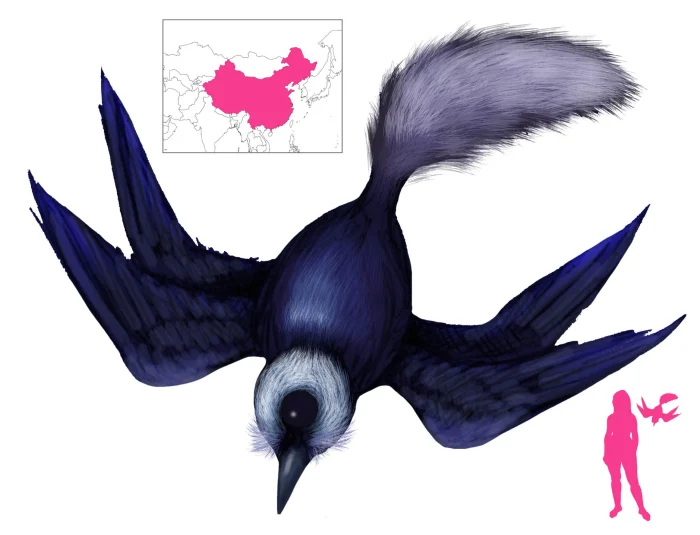
Huayramama, “Mother of the Wind”, is one of the three ancient snake mothers of the Peruvian Amazon. She has no direct biological counterpart, but is believed to be an enormous boa with an old woman’s face and very long hair that tangles in the clouds – in comparison, her counterparts the Sachamama and the Yakumama are the boa constrictor and the anaconda, respectively.

The guardian of the air and the daughter of the red huayracaspi or “wind tree”, she is herself the mother of all the good and evil winds. Huayramama also grants power to deserving healers and shamans, giving them control over the weather.

Don Emilio Shuña was one such man. After fasting for nine days and drinking ayahuasca tea brewed from the huayracaspi, he was rewarded by the appearance of Huayramama, her long body billowing in the sky and her hair trailing behind her. She landed on his house and proclaimed “OK, man, here I am. What is it you wish?” “I want to control the wind, the rain, and anything from the sky”, said Don Emilio. Huayramama granted him his wish on condition he fasted for an additional forty-five days. At the end of that period of fasting, Don Emilio gained the magical powers he asked for, and was taught songs by the Huayramama herself. He could control weather, heal those afflicted by evil winds, return crops to life, and revitalize dying fisheries. When the Huayramama’s malevolent children tried to stir up trouble, he drove those winds under the trees through fasting, singing, drinking huayracaspi tea and blowing tobacco smoke. Huayramama would touch his head to strengthen him in times of need. He also used his powers for simpler blessings, such as preventing rain to allow local boys to play football in peace.

At the end of a long and charmed life, Don Emilio finally died. Perhaps it was rival sorcerers who murdered him, or perhaps the evil winds finally won. All who knew him wept. He was buried under the huayracaspi in the middle of the forest, for as he said, “that tree is my mother”.

References

Galeano, J. G.; Morgan, R. and Watson, K. trans. (2009) Folktales of the Amazon. Libraries Unlimited, Westport.

Balbal

balbal

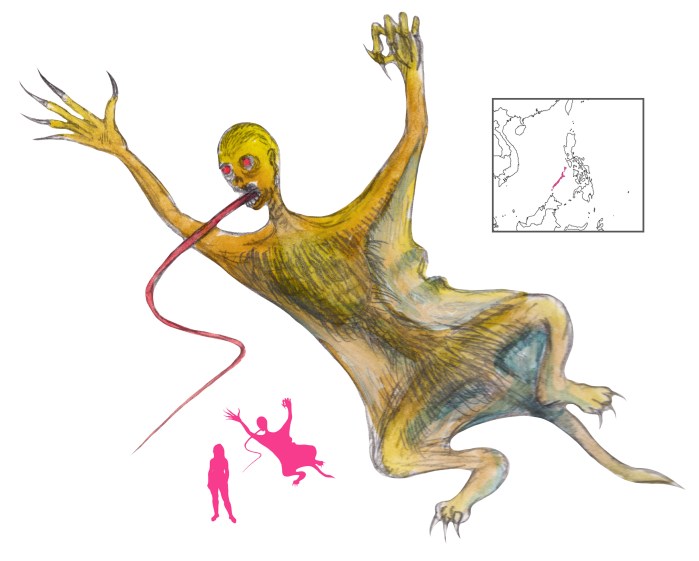
Hooked nails, gliding flight, and a long, long tongue are the hallmarks of the Balbal. While its depredations are described in Tagbanua folklore, it is itself accused of hailing from predominantly Muslim Moro country. They have also been described as friendly with and indistinguishable from crocodiles.

Balbals appear before a corpse is buried. Gliding like flying squirrels or bats, these humanoid creatures land on thatched roofs and use their curved claws to rip their way through the straw. Once a hole has been cleared, the long tongue is used to lick up the corpse, skin, flesh, bones, and all. The corpse is then replaced by a banana stalk, identical to the deceased in every way except for a telltale lack of fingerprints.

Light and loud noises scare off balbals. Branches of Blumea balsamifera, known in the Philippines as sambong, sobosob, and gabon, will keep them away from a bedside. Finally, prompt burial is always effective.

References

Fox, R. B. (1982) Religion and Society among the Tagbanuwa of Palawan Island, Philippines. Monograph No. 9, National Museum, Manila.

MacClintock, S. (1903) The Philippines: A Geographical Reader. American Book Company, New York.

Ramos, M. D. (1971) Creatures of Philippine Lower Mythology. University of the Philippines Press, Quezon.

Kranokolaptes

Variations: Kephalokroustes, Sklerokephalon

kranokolaptes

Nicander classified the Kranokolaptes, the “Head Striker”, as a phalangion or spider. This is all the more puzzling because the description has nothing arachnoid about it. No doubt its deadly bites were seen as reason enough to list it after wolf spiders and malmignattes.

The kranokolaptes is an insect found in Egypt, and which develops in the persea tree (perhaps Mimusops). It has the appearance of a moth, with four downy felt-textured wings that leave an ashy dust behind. Philoumenos described it as green in color, but that is apparently a misreading of Nicander. The head of the kranokolaptes is hard, heavy, and nodding; its abdomen is thick and fat. It has a deadly stinger located below its head.

A kranokolaptes will use its stinger to attack the heads and necks of humans and cause instant death. Kranokolaptes stings are deadly unless victims are treated with its antidote – a kranokolaptes drowned in oil.

It has been suggested that hawkmoths (Sphingidae), with their impressive sizes, thick abdomens, and prominent probosces, are at the root of the kranokolaptes tale. The vampire moth Calyptra thalictri is even more compelling. Having evolved from fruit-piercing moths, vampire moths use the same methods to puncture skin and drink blood – and they rock their heads back and forth as they penetrate, explaining the “nodding” aspect. The similarities end here, however, as a bite from Calyptra merely causes swelling and irritation.

References

Beavis, I. C. (1988) Insects and other Invertebrates in Classical Antiquity. Alden Press, Osney Mead, Oxford.

Kitchell, K. F. (2014) Animals in the Ancient World from A to Z. Routledge, Milton Park, Abingdon, Oxon.