Agrippa

Variations: Égremont, Vif
Agrippa

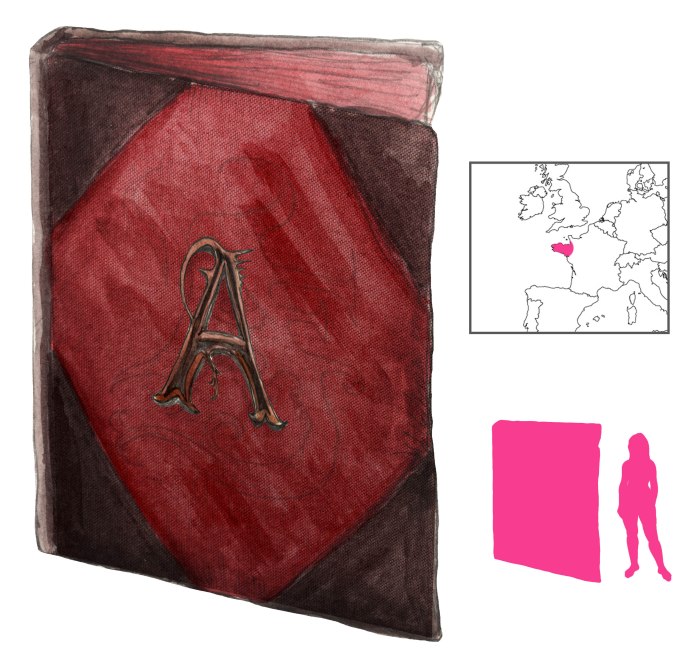
In Brittany, the Agrippa is one of the most feared and malevolent grimoires, a living book with a mind of its own. Its name in Tréguer is derived from that of Heinrich Cornelius Agrippa, but it is also known as Égremont in Châteaulin and Vif (“Alive”) around Quimper.

An agrippa is enormous, standing fully as tall as a man. Its pages are red, while its letters are black – although some variants exist with black pages and red text. It contains the names of all the devils, and how to summon them.

Agrippas are living, malicious creatures, and resent being read. An untamed agrippa will display only blank pages. To get the letters to appear, the agrippa must be battled, thrashed, and beaten like a stubborn mule. A fight with an agrippa can last hours, and victors come out of it exhausted and drenched in sweat. When not in use, an agrippa must be chained to a strong, bent beam.

Only priests can be trusted to keep agrippas, as they have the training and the force of will required to master it. They use it to deduce the fate of the dead by calling upon all the demons in order; if none will admit to having taken the deceased’s soul, then they were saved. Long ago all priests had agrippas, and a newly-ordained priest would inexplicably find one on his table. However, agrippas have since found their way into the hands of laymen, and the temptation to use them can be very strong. A priest will not be able to sleep well as long as one of his parishioners has an agrippa.

Uninitiated readers of the agrippa will always smell of sulfur and brimstone, and walk awkwardly to avoid treading on stray souls. A man with an agrippa will find himself incapable of destroying it – a task that will become increasingly desperate, as possession of an agrippa will prevent entry into Paradise. Loizo-goz, a man from Penvénan, tried to rid himself of his agrippa by dragging it away to Plouguiel on the end of a chain, but came back home to find it had returned to its usual place. He then tried burning it, but the flames recoiled from the book. Finally he dumped the agrippa into the sea with rocks tied to it, only to see it climb out of the water, shake its shackles off, and make a beeline for its suspended perch. Its pages were perfectly dry. Loizo-goz resigned himself to his fate.

Eventually a priest will arrive to save the owner of an agrippa. He will wait until the unfortunate is at death’s door, whereupon he will come to his deathbed. “You have a very heavy burden to carry beyond the grave, if you do not destroy it in this world”, he tells him. The agrippa is untied and brought down, and while it tries to escape, the priest exorcises it, and sets fire to it himself. He then collects the ashes, places them in a sachet, and puts them around the dying man’s neck, telling him “May this weigh lightly upon you!”

Other times a priest will have to save a man whose reading of the agrippa took him too far. A Finistère parson found his sacristan missing, and his agrippa open wide on the table. Understanding that the sacristan had summoned the devils and been unable to dismiss them, he started calling upon them one by one until they released him. The sacristan was blackened with soot and his hair was scorched, and he never told a soul of what had transpired.

References

Le Braz, A. (1893) La Légende de la Mort en Basse-Bretagne. Honoré Champion, Paris.

Luzel, F. M. (1881) Légendes Chrétiennes de la Basse-Bretagne, v. II. Maisonneuve et Cie, Paris.

Seignolle, C. (1964) Les Évangiles du Diable. Maisonneuve et Larose, Paris.
Araǵanaqlta’a

Variations: AraGanaqlta’a, AraGanaGalta’a; AraGanaqlate’e, AraGanaGalate’e; Owner of the Snakes, Father of the Snakes

Araganaqltaa

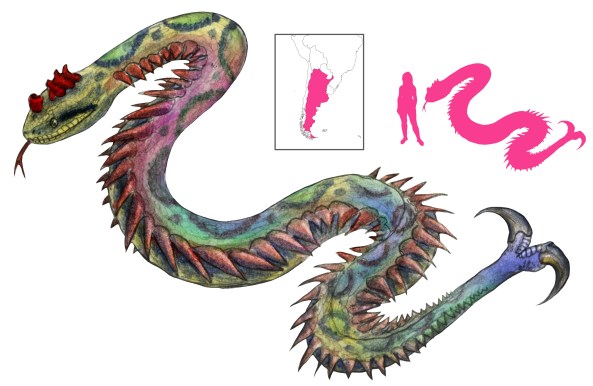
Araǵanaqlta’a is the father or owner of the snakes in Argentinian Toba folklore. It can be found in a range of habitats, but usually likes rivers and deep caves with access to water. In addition to snakes, which are all under its command, it is associated with water, rainbows, and storms.

The araǵanaqlta’a appears as a large, multicolored snake, 10 meters or more in length, resembling a bushmaster or fer-de-lance. It has a red crest, its “sign” (ndage), on top of its head, and a sawlike structure on either side of its body that allows it to move. An araǵanaqlta’a’s tail ends in two hooks which it uses to hold prey. The females are known as araganaqlate’e, the mother of the snakes.

Araǵanaqlta’a are shapeshifters, adjusting to fit their environment, and are also known in the form of four-legged snakes, as humans in elegant business attire, or as rheas with colorful necks. No matter what shape it takes, however, the araǵanaqlta’a always has its characteristic ndage, which identifies it as a powerful mythical creature.

Araǵanaqlta’a are intelligent and enjoy human conversation. These snakes will punish desecrators of nature and persecutors of snakes, but will reward those who they find worthy. After a hunter treated an araǵanaqlta’a with respect and obeisance, the snake promised him that he would have all he would ever need, and taught him how to heal the sick with his words.

References

Wilde, G. and Schamber, P. (2006) Simbolismo, Ritual, y Performance. Paradigma Indicial, Buenos Aires.

Wright, P. G. A semantic analysis of the symbolism of Toba mythical animals. In Willis, R. (Ed.) (1990) Signifying Animals: Human Meaning in the Natural World. Unwin Hyman, London.

Wright, P. G. (2008) Ser-en-el-sueño. Editorial Biblos, Buenos Aires.

Abúhukü

Variations: Abúhuwa (pl.)

Abuhuwa

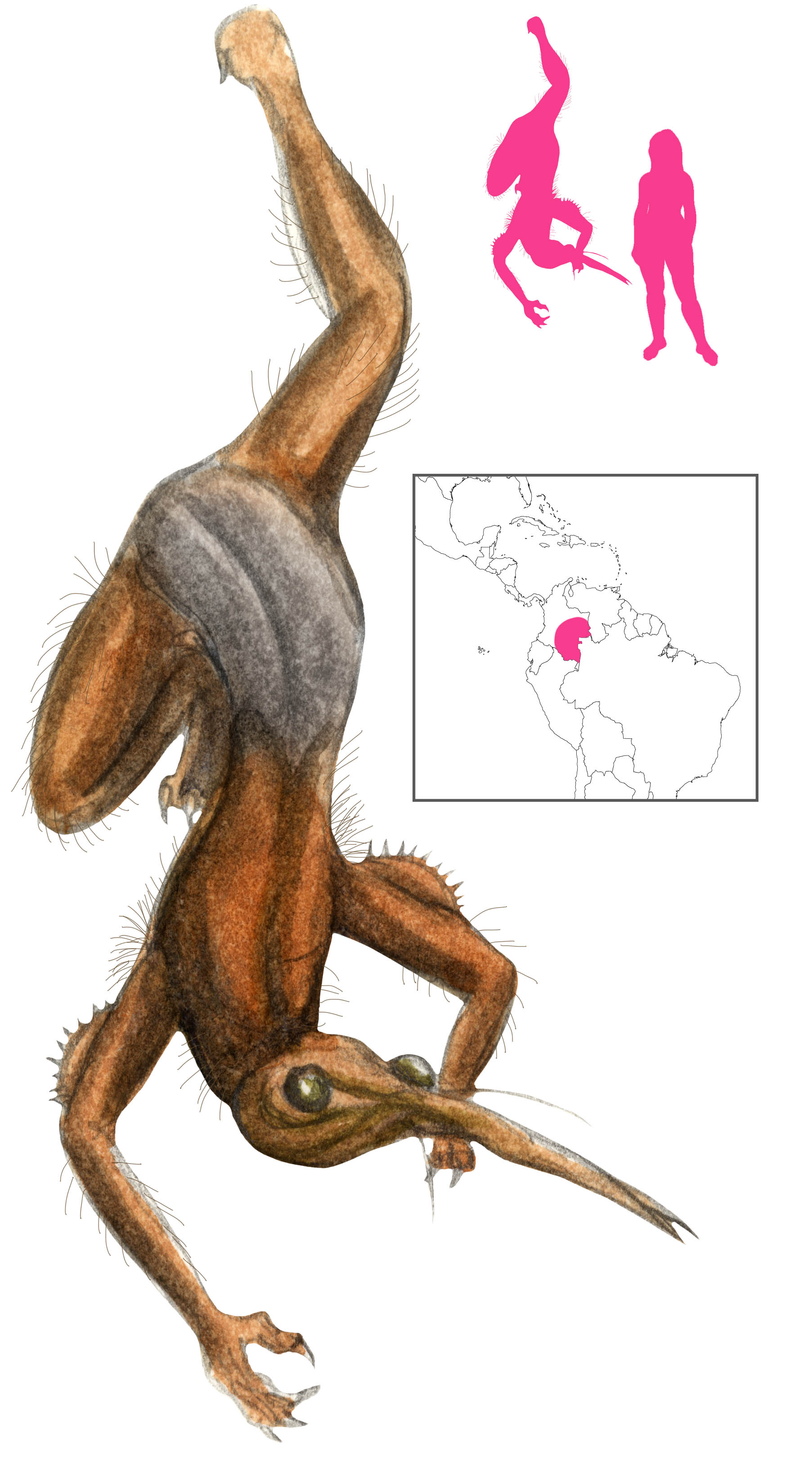
The victims of the Abúhuwa, the rainforest demons of the Cubeo people of the Colombian Amazon, are easily recognized. An abúhukü will cut a hole in the skull before sucking out the contents of the body. Sometimes prey is rolled in palm leaves and tenderized. Either way, they leave an empty skin hanging from a branch.

Abúhuwa are nocturnal creatures who embody disease, death, and all that is evil. They associate with the spirits of dead poisoners, murderers, and male adulterers, and are described as misty creatures from the realm of darkness. Their name is derived from “whiteness”, or the foaming of rapids. Like almost all other Amazonian ogres, the abúhuwa are hairy and foul-smelling, associating them with bestial sexuality and death respectively. In addition to that, they have an extra face in the back of their head, and sticky bodies that make escape from their embrace impossible. The females have long pendulous breasts and prefer to kill men, while the males attack women, often killing mothers and abducting their children to raise as their own. Such abúhuwa changelings become cannibals themselves.

The abúhuwa were once far more common, and were allied with a race of evil jaguars that worked with them to decimate human populations. Humanity got a respite after a series of floods and fires that reduced the numbers of both predators.

Abúhuwa are fortunately quite stupid, and can easily be outwitted by children. They are relegated to the status of nursery bogies, reflected in a sort of tag game where one child plays the part of the abúhukü. The grotesqueness of the abúhuwa makes them easier to confront and mock.

Armpit hair from an abúhukü makes a potent ingredient in poisons. To obtain it, an abúhukü must be caught during a lunar eclipse, and the hair from its left armpit must be cut with a corn husk, reduced to ash, mixed with water and turned into paste, and left to dry. It keeps well in a gourd sealed with beeswax.

Capsicum smoke is toxic to abúhuwa, and they can be easily driven away by burning peppers. When killed, they turn into sloths.

References

Goldman, I. (1979) The Cubeo Indians of the Northwest Amazon. University of Illinois Press, Urbana.

Goldman, I. (2004) Cubeo Hehénewa Religious Thought. Columbia University Press, New York.

Smith, N. J. H. (1996) The Enchanted Amazon Rain Forest. University Press of Florida, Gainesville.

Az’-i-wû-gûm Ki-mukh’-ti

Variations: Walrus Dog

Aziwugum

Az’-i-wû-gûm Ki-mukh’-ti, the “Walrus Dog”, can be found roaming the rugged coastlines of Alaska. While not walrus-like, it lives with herds of walrus and acts as a protector of sorts. It is one of Raven’s many creations.

An az’-i-wû-gûm ki-mukh’-ti is rather like a large dog in general appearance, smaller than a walrus, elongate and slender, with a long, powerful rounded tail. Its body is covered with tough black scales which make it impervious to all but the best spears.

Walrus hunters in the Bering strait fear the az’-i-wû-gûm ki-mukh’-ti. Its muscular tail can easily kill a man, and at least one case is known of a walrus dog attacking an umiak and killing all aboard.

References

Nelson, E. W. (1900) The Eskimo about Bering Strait. Extract from the Eighteenth Annual Report of the Bureau of American Ethnology, Government Printing Office, Washington.

Auñ Pana

Variations: Pehiwetinome

Aun Pana

The Auñ Pana are evil man-eating fish from the folklore of the Yanomami of Brazil and Venezuela. They are large, have arms, and are covered with hair. Apparently they also have some degree of magical power. The auñ pana live in deep water and school with Pehiwetinome, which are equally large and anthropophagous.

A group of auñ pana and pehiwetinome once tore down a bridge that the Yanomami were crossing by biting through its wood. The bridge collapsed and became a raft, and the surviving Yanomami were turned into monkeys and pigs.

References

Albert, B.; Becher, H.; Borgman, D. M.; Cocco, L.; Colchester, M. E. M.; Finkers, J.; Knobloch, F.; Lizot, J.; and Wilbert, J.; Wilbert, J. and Simoneau, K. eds. (1990) Folk Literature of the Yanomami Indians. UCLA Latin American Center Publications, University of California, Los Angeles.

Aloés

Aloes

The Aloés is a large fish from the Caribbean around Hispaniola, reported by Thevet. It looked like a goose in general shape, with the top of its skull in the shape of a bon-chrétien (Williams) pear. It had four underslung fins, a fish-like tail, and no scales on its plump body. Several could be observed swimming alongside the boats, along with shoals of fish, and they looked remarkably like geese diving in and out of the waves.

References

Paré, A. (1614) Les Oeuvres d’Ambroise Paré. Nicolas Buon, Paris.

Thevet, A. (1575) La Cosmographie Universelle. Guillaume Chaudiere, Paris.

Aíǰe

Variations: Aíge, Spirit-Tadpole

Aige

The Aíǰe is associated with the Bororo of Brazil and Bolivia, and in particular the Páiwoe and Aróroe clans. It is a gigantic tadpole, somewhat like a hippopotamus.

Rubúgu of the Páiwoe first found the aíǰe while walking through a swamp. He liked the little animal and decided to keep it, taking it home in a vessel of water. Rubúgu had great plans for his little pet, and wanted it to become something great and amazing, so before covering its container with a fan he told it “Grow for me; thrive and become an extraordinary creature”.

And grow the aíǰe did. It became larger, and stronger, and it could sing a loud, buzzing song. Rubúgu had to keep switching it to increasingly large containers to support its bulk, and eventually he had nowhere left to put it. He tried doing a dance for the aíǰe, but the tadpole rejected Rubúgu’s mediocre talents. Instead, Chief Baitogógo of the Aróroe took the aíǰe, and honored it with a macaw-feather headdress and a marvelous dance, both of which pleased the tadpole greatly. Baitogógo told the aíǰe that it had to live in ponds, swamps, and lakes away from the Bororo, for it was so big and the magic of its song so powerful, it could pose a serious threat.

The aíǰe accepted, and before leaving it told Baitogógo that if the Bororo missed it, then they should fashion little tadpole sculptures in remembrance. Those figurines could be tied to a stick and swung in the air, making an amphibian buzzing much like aíǰe did. Thus the aíǰe went on to become one of the totems of the Bororo.

References

Albisetti, C.,; Colbacchini, A.; and Venturelli, A. J.; Wilbert, J. and Simoneau, K. eds. (1983) Folk Literature of the Bororo Indians. UCLA Latin American Center Publications, University of California, Los Angeles.

A-mi’-kuk

Variations: Ă-mi’-kuk, Ä-mi’-kuk

A-mi-kuk

Kayakers in the cold seas of the Arctic Circle are the A-mi’-kuk’s favorite prey. The last thing they see are the a-mi’-kuk’s prehensile tentacles exploding from under the surface and wrapping around them, dragging both kayaker and boat under.

The a-mi’-kuk is large, leathery-skinned, and slimy. Its four long tentacular arms are used for seizing prey and swimming rapidly through the water. There is no escaping it – it will follow prey taking refuge on ice by swimming below it and bursting out onto the surface. Making for land is equally futile, as the a-mi’-kuk can swim through the earth with as much ease as it does through water.

A-mi’-kuks around St. Michael, Alaska, are known to migrate underground to inland lakes. The presence of one is a good sign for the lake. When an a-mi’-kuk leaves its lake, the channel it digs drains it dry, but when it returns the sea returns with it.

Nelson proposed the octopus as the origin of the a-mi’-kuk. He also gives ä-mi’-kuk as the name of the sea otter; what bearing this has on the legendary creature is unknown.

References

Nelson, E. W. (1887) Report upon Natural History Collections Made in Alaska Between the Years 1877 and 1881. Arctic Series of Publications Issued in Connection with the Signal Service, Government Printing Office, Washington.

Nelson, E. W. (1900) The Eskimo about Bering Strait. Extract from the Eighteenth Annual Report of the Bureau of American Ethnology, Government Printing Office, Washington.

Alicanto

Alicanto

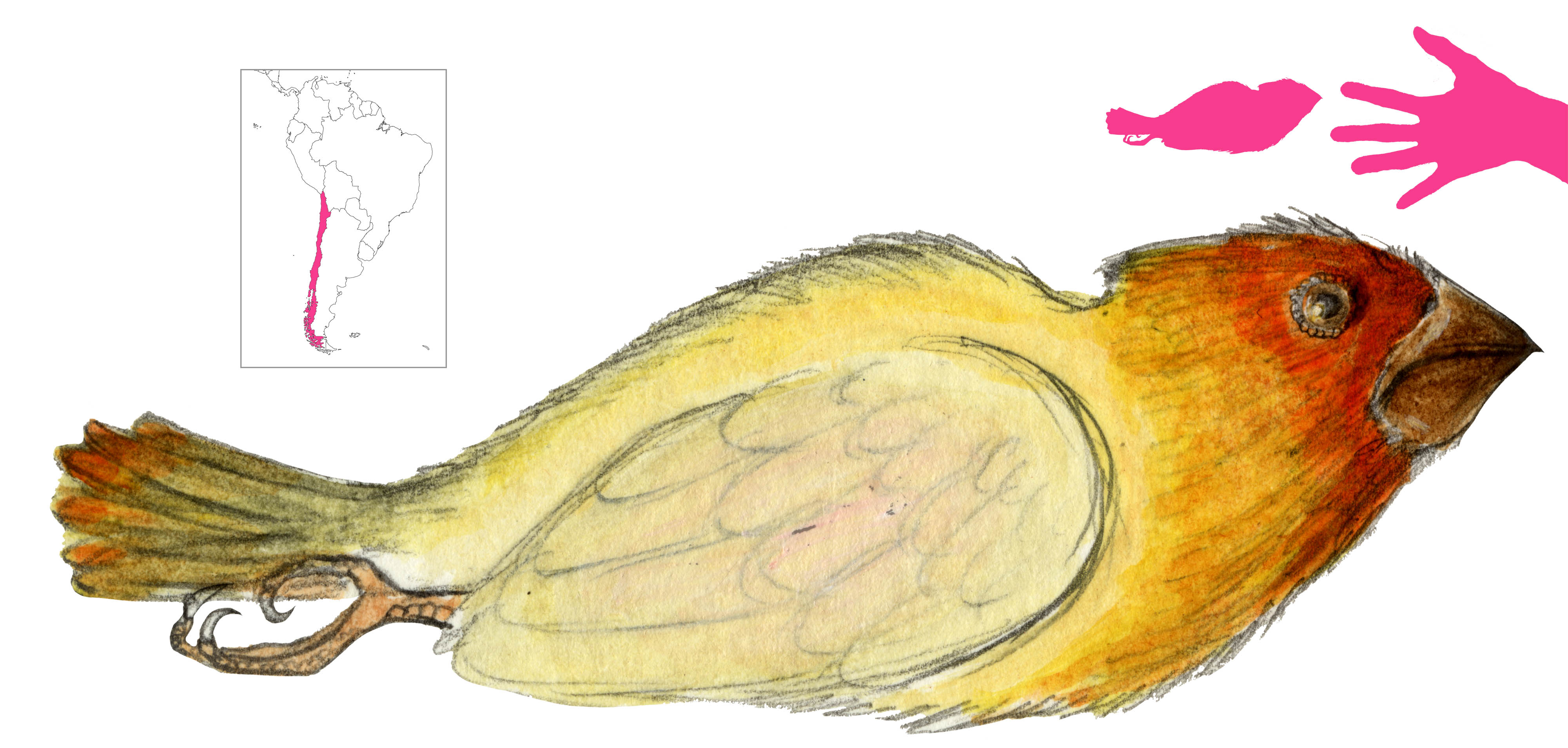
The Alicanto is a glowing nocturnal bird comparable to the Carbuncle, perhaps sharing the same folkloric origin. It is  known to inhabit Chile, and has been reported from Atacama, San Bernardo, Santiago, Talagante, and Tarapacá.

Alicantos feed exclusively on metal ores, and take on the color of the metal they ingest – a gold-eating alicanto emits a golden light, while the silver-eating variety glows a cold metallic gray. The rare copper-eating alicanto is greenish, with large wings, a hooked beak, long legs, and sharp claws. Due to its phosphorescence, an alicanto does not cast a shadow. The eyes are bright and gleam silver.

These birds are flightless, but their wings are perfectly functional. They will often gorge themselves on metal, filling their crop so much that they cannot fly. At best they run fast with their wings held open; a full alicanto can barely drag itself along the ground.

Alicantos live around mines and hidden treasure, and nest in small caves. The female always lays two eggs, the shells of which are made of the metal she eats.

As an alicanto indicates the presence of precious metal, finding one can be highly lucrative. For that reason they are sought out by prospectors, engineers, miners, and unscrupulous looters hoping that the birds will lead them to rich veins. However, an alicanto is highly protective of its food sources, and if it knows it’s being followed, it will stop glowing and disappear into the darkness – or worse, lead its pursuers to a cliff.

References

Aguirre, S. M. (2003) Mitos de Chile. Random House, Editorial Sudamericana Chilena.

Cifuentes, J. V. (1947) Mitos y supersticiones (3rd Ed.). Editorial Nascimento, Santiago, Chile.

Aksar

Aksar

Among the cavalcade of creatures Anthony faces in the Temptation is Aksar, described as “the python Aksar, sixty cubits long, who terrified Moses”. Thompson, drawing heavily from Flaubert, uses the basilisk of the Temptation for the appearance of Aksar, describing him as seventy cubits long, violet-colored, with a three-lobed crest and a single tooth in each jaw. He repeats Moses’ fear of Aksar, making him “the avatar of God’s red justice flaming far” and “the visible embodiment of all that is horrible, the incarnation of a desolation not merely physical, but of the soul.”

Flaubert derived Aksar from Bochart’s Hierozoicon. The original Aksar is far stranger than Flaubert leads us to believe.

Aksar is a monster of the apocalypse from Arabian legend. He is sixty cubits (almost 30 meters) long, and has the head of an ox, the eyes of a pig, the ears of an elephant, the antlers of a stag, the neck of an ostrich, the forequarters of a lion, the hindquarters of a cat, the tail of a ram, the legs of a camel, and the color of a leopard. There is no mention of any python characteristics.

God dragged Aksar out from his lair and brought him before Moses, who was greatly alarmed and requested the beast be removed from his sight. At the end of days, it is said Aksar will fly out with Moses’ staff, using it to mark people’s faces as “believers” or “unbelievers”.

There are some who say there is more than one of these creatures. Those people are hopefully mistaken.

References

Bochart, S. (1675) Hierozoicon. Johannis Davidis Zunneri, Frankfurt.

Flaubert, G. (1885) La Tentation de Saint Antoine. Quantin, Paris.

Seznec, J. (1943) Saint Antoine et les Monstres: Essai sur les Sources et la Signification du Fantastique de Flaubert. PMLA, Vol. 58, No. 1, pp. 195-222.

Thompson, J. W. (1921) The Lost Oracles: a Masque. W. M. Mill, Chicago.