Geluchart

Variations: Animal Monstrueux (Monstrous Animal) (Paré); Testudo Polypus (Gesner)

Geluchart

Iambulus the Greek sailor saw many marvels on the Islands of the Sun. One of those is an unnamed animal, small, round, and similar to a tortoise. It has two diagonal yellow stripes on its body, with an eye and a mouth at each end of the stripes, giving it four eyes and four mouths around its body. It eats with all four mouths, which all lead into a single gullet and stomach; its inner organs are likewise single. This creature also has many feet which allow it to move in any direction it wishes. Most miraculous of all is its blood, which is endowed with such healing power that it can instantly reattach severed body parts. As long as the cut is fresh and the body part is not vital (a hand, a foot, a limb, and so on), the animal’s blood will glue it back on again.

The adventures of Iambulus were recalled by Diodorus Siculus and cheerfully dismissed by Lucian as “obviously quite untrue” but a highly entertaining story nonetheless.

Temporal’s 1556 French translation of Leo Africanus’ works appends the travels of Iambulus and other seafaring yarns, lending them more credibility by association (or giving Leo’s accounts less credibility in the same manner). Translation errors have already set in, considering the adventures of Iambulus were translated into French by way of Tuscan. In Temporal’s version, the unnamed round animal now has two lines on its back in the form of a golden cross, and one eye and one ear at the end of each line, allowing it to hear and see in four directions. There is only one mouth through which the animal feeds. Its blood can cause any dismembered, still living body to come back together. The account is accompanied with a memorable image of the creature, with a long, thin tail ending in a tuft; the number of legs is fixed at twelve in the picture. Severed limbs surround the animal.

Is this the same as the Geluchart of the Caspian Sea? Thevet’s Cosmographie describes an animal called the geluchart, named after a nearby lake where it is also found in abundance. It has a head like a turtle’s (but much bigger), a small rat’s tail, and eight legs (four on each side). It is covered with scales and mottled with red and black spots. Thevet affirms that it is the tastiest fish in existence.

Thevet may have had the Iambulus creature in mind – specifically the illustration in the Temporal translation, as Thevet mentions the rat’s tail present in the image but not in the text. Either way, Vallot lumps them together, along with Gesner’s Testudo Polypus (“Many-legged Turtle”). For lack of a better term “geluchart” has been adopted as a title for this entry.

Paré’s unnamed “monstrous animal” is taken directly from Temporal’s Iambulus, with an image copied from that account. Paré erroneously credits Leo Africanus with describing the “very monstrous animal” but otherwise repeats the attributes given to it, including blood capable of sealing any wound. The description mentions several legs as well as establishing a “rather long” tail, “the end of which is heavily tufted with hair”. Its location is moved from Iambulus’ mythical island; it is now “born in Africa”.

Vallot attributes the ocellated pufferfish as the origin of this creature, but surely its origin in ancient Greek utopian fiction makes such association futile? Its wondrous properties cause Paré to wax poetic. “But who is it who would not marvel greatly on contemplating this beast, having so many eyes, ears, and feet, and each doing its office? Where can be the instruments dedicated to such operations? Truly, as for myself I lose my mind, and would not know what else to say, other than that Nature has played a trick to make the grandeur of its works be admired”.

References

Diodorus; Oldfather, C. H. trans. (1967) Diodorus of Sicily in Twelve Volumes, v. II. Harvard University Press, Cambridge.

Gessner, C. (1586) Historiae Animalium Liber II: Quadrupedibus Oviparis. Johannes Wecheli, Frankfurt.

Leo Africanus; Temporal, J. trans. (1556) De l’Afrique. Jean Temporal, Lyon.

Leo Africanus; Temporal, J. trans. (1830) De l’Afrique. Gouvernement de France, Paris.

Lucian; Turner, P. trans. (1961) Satirical Sketches. Penguin Books, London.

Paré, A. (1614) Les Oeuvres d’Ambroise Paré. Nicolas Buon, Paris.

Paré, A. (1996) Des Monstres et Prodiges. Fleuron, Paris.

Thevet, A. (1575) La Cosmographie Universelle. Guillaume Chaudiere, Paris.

Vallot, D. M. (1834) Mémoire sur le Limacon de la Mer Sarmatique. Mémoires de L’Académie des Sciences, Arts, et Belles-Lettres de Dijon, Partie des Sciences, Frantin, Dijon.

Mokele-mbembe

Variations: Mokéle-mbêmbe, Mokele Mbembe, Monstrous Animal; Nsanga; Emela-ntouka, Emia-ntouka, Aseka-moke, Ngamba-namae, Killer of Elephants, Water Elephant; Nguma-monene, Badigui, Ngakoula Ngou, Diba, Songo; Mbielu-mbielu-mbielu
Mokele-mbembe

Tales of the Mokele-mbembe, “One Who Stops the Flow of Rivers” (or, more simply, “River-Shutter”), come from the Congo River Basin, around the Ikelemba, Sanga, and Ubangi rivers and Lake Tele. It is the most discussed and well-known of the “African mystery beasts” primarily due to the cryptozoological interpretation that defines it as a surviving sauropod dinosaur. It – or its unnamed predecessor, at any rate – was initially described as hailing from Rhodesia (Zimbabwe).

There is nothing unique about the mokele-mbembe. It is at least four notable mythic creatures: the river-shutter, the pachyderm slayer, the unicorn, and the giant reptile. River-shutters are sub-Saharan creatures with an aptitude for withholding or releasing a river’s water; in communities dependent on life-giving water, this can mean the difference between life and death. The pachyderm slayer – a creature so mighty and dangerous that it routinely kills the biggest and scariest animals known – is a far broader category that has been famously applied to the dragon and the unicorn. The presence of a single horn is a recurring feature of monsters, most notably the unicorn. Finally, giant reptiles (often irresponsibly called “dragons”) are a worldwide theme.

The first to suggest the existence of a large dinosaurian creature was big-game hunter and zoo supplier Carl Hagenbeck. Hagenbeck reports a huge animal, half elephant and half dragon, from deep within Rhodesia (not the Congo, where the mokele-mbembe eventually took up residence). He said that there are drawings of it on Central African caves but provides no further detail on that angle. All in all it is “seemingly akin to the brontosaurus [sic]”. Hans Schomburgk, one of Hagenbeck’s sources, stated that the lack of hippos on Lake Bangweulu was due to a large animal that killed hippos. An expedition sent by Hagenbeck to investigate the creature’s existence found nothing. Tantalizing as it may be, the entire episode with the nameless saurian is no more than an aside in Hagenbeck’s book, an attempt to attract potential investors by capitalizing on the contemporary “dinomania” sweeping the globe.

The first decade of the twentieth century saw a vast increase in public interest in dinosaurs. In 1905 the mounted skeleton of Apatosaurus was unveiled at the American Museum of Natural History and London’s Natural History Museum inaugurated its Diplodocus. Soon museums across the world were receiving their own gigantic sauropod skeletons courtesy of Andrew Carnegie, industrialist and patron of the sciences. In 1907 the skeletons of enormous sauropods emerged in German East Africa; these eventually formed a hall of titans in Berlin’s Natural History Museum. Hagenbeck’s account of a living sauropod was not written in a vacuum, but was – consciously or not – drawing on contemporary massive interest in massive reptiles.

E. C. Chubb of the Rhodesia Museum dismissed Hagenbeck’s claim. To him, this creature was no more than another example of the “land edition of the Great Sea Serpent”. He received further accounts of the Rhodesian creature, a large beast with flippers, rhinoceros horns, a crocodile’s head, a python’s neck, a hippo’s body, and a crocodile’s tail; a three-horned creature from Lake Bangweulu, Zambia, that killed hippos.

The next step came with Lieutenant Paul Graetz in 1911. He wrote about the Nsanga of Lake Bangweulu, a “degenerate saurian” like a crocodile but without scales and armed with claws on its feet. Graetz supposedly came by strips of nsanga skin but saw nothing more tangible.

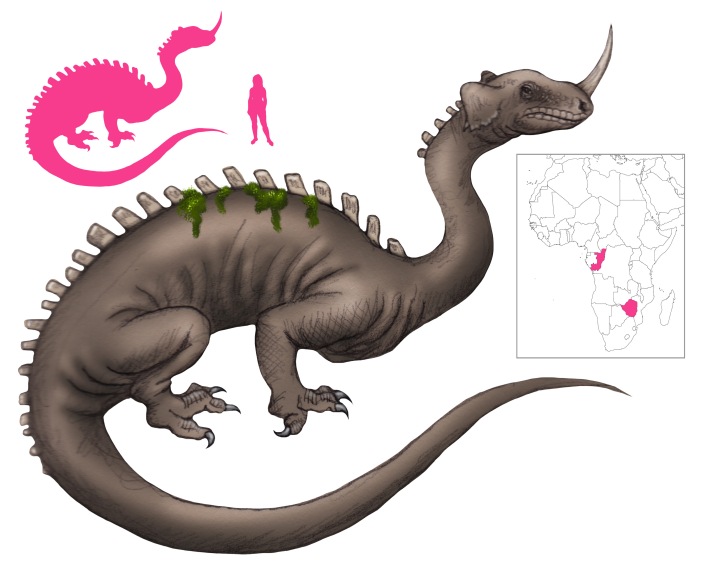
The account that concretized the mokele-mbembe and gave it its name was that of German officer Ludwig Freiherr von Stein zu Lausnitz. His report places the mystery beast firmly in the Congo, around the Likouala rivers. The mokele-mbembe has smooth, brownish-grey skin. It is approximately the size of an elephant, or a hippopotamus at the smallest. Its neck is long and flexible. It has only one tooth, but that tooth is very long; “some say it is a horn” adds Stein (this feature is usually ignored, as it does not conform to the sauropod narrative). It has a long, muscular tail like a crocodile’s. It attacks canoes and kills its occupants without eating them. The mokele-mbembe is vegetarian and it feeds on a type of liana, leaving the water to do so. It lives in caves dug out by the sharp bends in the river. Stein was shown a supposed mokele-mbembe trackway but could not make it out among the elephant and hippo tracks.

Stein’s account is the basis for the modern mokele-mbembe legend. The report was never officially published, but was publicized by Willy Ley (who inexplicably linked the mokele-mbembe to the dragon of the Ishtar Gate).

This in turn led to successive expeditions to the Congo by James H. Powell Jr. and Roy Mackal. Mackal determined the mokele-mbembe to be 5 to 10 meters long, most of which is neck and tail. It has smooth brown-grey skin and a very long neck with a snakelike head on the end. Sometimes there is a frill, like a rooster’s comb, on the back of the head. The legs are short and stout, with three claws on the hind legs, and leave 30-centimeter-wide prints. The malombo plant is the staple of the creature’s diet. While herbivorous, the mokele-mbembe is very aggressive and will destroy any canoes that approach it. It does so by tipping the vessels, then biting and lashing out with its tail.

In addition to the mokele-mbembe, Mackal is responsible for bringing to light a whole menagerie of prehistoric survivors and some unusually-sized modern reptiles as well. The Emela-ntouka, for instance, is larger than an elephant. Its skin is smooth, hairless, and wrinkly, brown to grey in color. Its legs are thick and columnar to support its weight. The tail is heavy and similar to a crocodile’s. There is a single horn on the front of the head. These creatures are herbivorous and kill buffaloes and elephants by goring them with their single horns. If all this sounds familiar, it’s because none of it is distinguishable from what has been said about the mokele-mbembe (including the horn, no longer an inconvenient detail). Mackal optimistically proposes that the emela-ntouka is a late-surviving ceratopsian dinosaur.

Nguma-monene, “large python” (from nguma, “python”, and monene, “large”) is reported from the Dongou-Mataba river area. It is a large, serpentine reptile, some 40 to 60 meters long, with a saw-toothed ridge down its back. The head is snake-like with a forked tongue that flicks in and out. It is greyish-brown like just about every other large reptilian cryptid. It is indistinguishable from the badigui, ngakoula ngou, diba, or songo of the Ubangi-Shari. All of these are giant snakes which kill hippos and browse on tree branches without leaving the water. They leave tracks behind like those of a lorry. All of them are indistinguishable from the mokele-mbembe. Mackal describes them as enormous monitor lizards.

The Mbielu-mbielu-mbielu, or “animal with planks growing out of its back”, is restricted to the Likouala-aux-Herbes in the Congo. It is known solely as a large animal that has large “planks” on its back with algae growing between them. The rest of its appearance is unknown. Only one informant reported the mbielu-mbielu-mbielu. Mackal makes a surviving stegosaur out of it.

Finally there is the Ndendecki (a giant turtle), the Mahamba (a giant crocodile), and the Ngoima (a giant eagle). None of these are any more believable than the mokele-mbembe and its host of synonyms.

It would be tedious to list all subsequent expeditions (all unsuccessful) or the anthropological procedures used (all unprofessional). It should however be noted that the hunt for the mokele-mbembe has been coopted by the creationist movement. For some reason these people have decided that the discovery of the mokele-mbembe will be enough to destroy the entire theory of evolution (it won’t) because a surviving dinosaur would be a lethal paradox to science (it isn’t).

There is nothing unique about the mokele-mbembe, but as a vaguely defined reptilian river-shutter it is a sort of Rorschach test that viewers can project their preconceptions onto. Far from a detailed local legend, the myth of the mokele-mbembe evolved to suit the needs of the visitors who sought it, whether zoo suppliers, colonialists, cryptozoologists, or creationists. Any underlying folklore about river-shutting reptiles has long been abandoned and discarded, relegated to an etymological footnote. It does not fit the narrative.

References

Hagenbeck, C., Elliot, S. R. and Thacker, A. G. trans. (1911) Beasts and Men. Longmans, Green, And Co., London.

Ley, W. (1959) Exotic Zoology. The Viking Press, New York.

Loxton, D. and Prothero, D. R. (2013) Abominable Science! Origins of the Yeti, Nessie, and other Famous Cryptids. Columbia University Press, New York.

Mackal, R. (1987) A living dinosaur? E. J. Brill, New York.

Naish, D. (2016) Hunting Monsters: Cryptozoology and the Reality Behind the Myths. Arcturus, London.

Weishampel, D. B.; Dodson, P.; and Osmolska, H. (2004) The Dinosauria, 2nd Edition. University of California Press, Berkeley.

Markupo

Variations: Macupo, Marcupo

Markupo

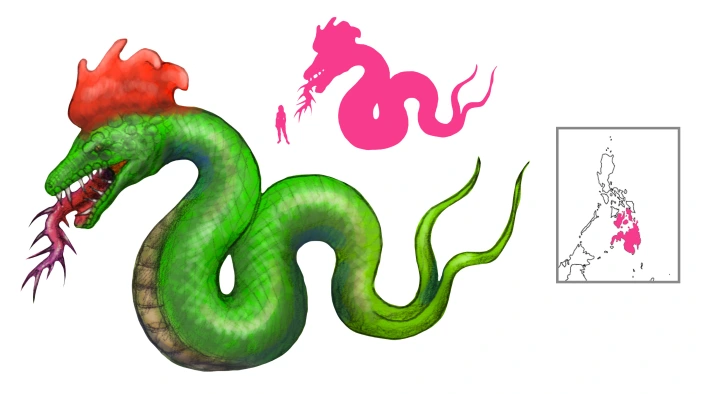
The Markupo is a serpent known to the Hiligaynon of the Philippines. It lives in the highest mountains of the historical province of Bulgas, between Marapara and Canlaon.

In appearance the markupo is a huge snake with a distinctive red crest. Its long tongue has thornlike hairs. It has sharp tusks and a forked tail.

The markupo sings sonorously on clear days. Its exhaled poison is instantly lethal to the touch. If sprinkled on plants, this poison withers the plant, kills any birds that land on it, and kills any beast touched by its shadow.

References

Ramos, M. D. (1971) Creatures of Philippine Lower Mythology. University of the Philippines Press, Quezon.

Ramos, M. D. (1973) Filipino Cultural Patterns and Values. Island Publishers, Quezon City.

Tompondrano

Variations: Tòmpondràno, Tompon-drano, Tompoudrano

Tompondrano final

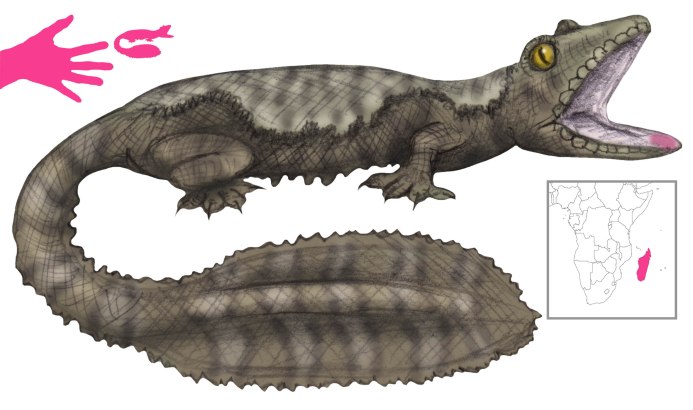
Tompondrano, “lord of the water” or “master of the water”, applies to multiple concepts within the folklore of Madagascar. For our purposes, it refers to at least two types of water snake – one which was commonly encountered in day-to-day life, and an undefined marine monster. Whales, sharks, and crocodiles are also known as tompondrano; the Sakalava proverb “the amby never leaves the master of the water” apparently refers to the pilotfish. The alternative spelling of tompoudrano is phonetically identical to tompondrano in French.

The tompondrano is a water-snake blessed by the Vazimba, a mythical ancient race that lived in the center of Madagascar. For this reason it is respected as a sacred animal. It should not be killed, and dead tompondranos are wrapped in red silk in the same way as human corpses. Tompondranos are good swimmers, often seen crossing ponds and rivers in the forest, but they are not notably large (the largest snake in Madagascar, the akoma or Madagascar ground boa, is some 2.7 meters long).

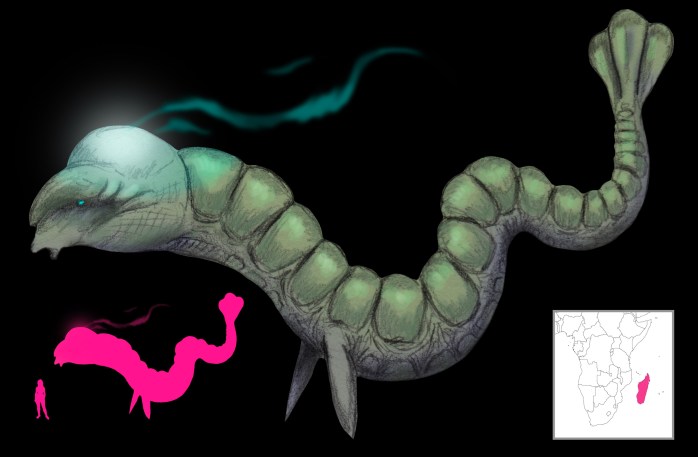
A very different tompondrano was seen by G. Petit in 1926, on the night a cyclone was announced. He describes seeing bright and fleeting lights produced intermittently every few seconds, something like a much weaker signal beacon of a ship. They were emitted by a large aquatic body rolling on its axis and leaving an indefinitely long phosphorescent trail behind it. Petit was later told by Vezo informants that he had seen a tompondrano a creature 20 to 25 meters long, large and flattened, with hard plates on its body and a tail like that of a shrimp. It is the tompondrano’s head that is luminous. Its mouth is ventrally located, and the creature turns itself upside down to attack targets on the surface. There is a retractable fleshy hood that protects the eyes. It is either legless or has appendages like those of whales. To ward off its unwelcome attentions, an axe and a silver ring are suspended at the bows of boats.

References

Birkeli, E. (1924) Folklore Sakalava. Bulletin de l’Academie Malgache, IV, pp. 185-417.

Jourdran, E. (1903) Les Ophidiens de Madagascar. A. Michalon, Paris.

Romanovsky, V.; Francis-Boeuf, C.; and Bourcart, J. (1953) La Mer. Larousse, Paris.

Sibree, J. (1896) Madagascar Before the Conquest. Macmillan, New York.

Dard

Dard

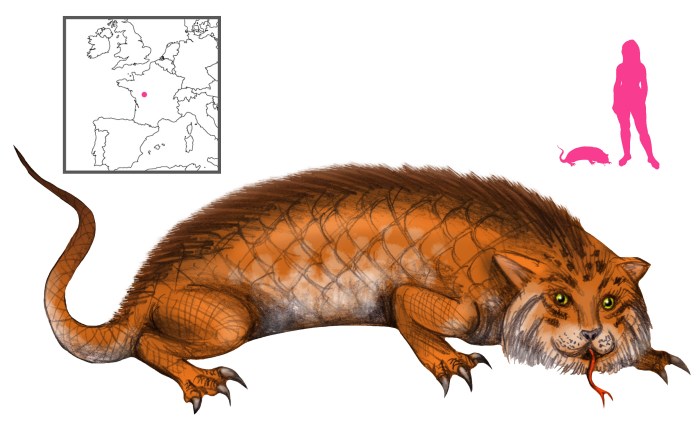
The Dard is peculiar to the department of Vienne in France, but its physiognomy recalls that of the alpine dragons – and, like them, it probably evolved from mustelid accounts. It is a serpent with four legs and a short viper’s tail. It has the head of a cat and a mane running down its dorsal spine.

Dards drink milk from cows and can produce a terrifying whistle. They are nonvenomous, but bite viciously when provoked.

Peasants in Vienne claimed to recognize the dard’s likeness in the carvings of certain churches.

References

Ellenberger, H. (1949) Le Monde Fantastique dans le Folklore de la Vienne. Nouvelle Revue des Traditions Populaires, 1(5), pp. 407-435.

Arassas

Arassas

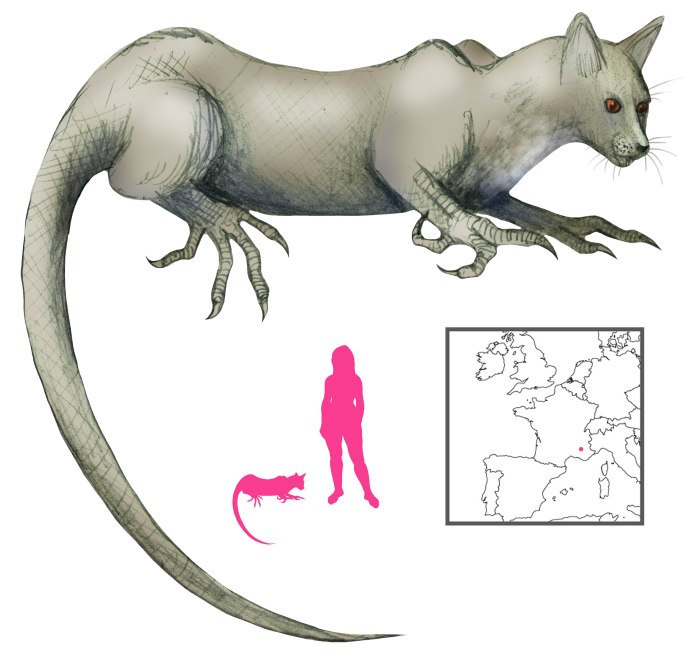
The Arassas hails from the folklore of Lagrand in the Hautes-Alpes region of France. It is a greyish-colored animal with the head of a cat and the body of a lizard. It lives in ruined houses and old crumbling walls. Its gaze kills immediately.

Like other European mountain dragons, it is likely derived from superstitions about otters and martens.

References

van Gennep, A. (1948) Le folklore des Hautes-Alpes, Tome II. J. P. Maisonneuve et Cie, Paris.

Cathach

Variations: Cáthach

Cathach

Ireland’s three dragon sisters Dabran, Farbagh, and Cathach were the offspring of the gatekeeper of Hell and the all-devouring sow; they were nursed by the red demon of West Ireland. Cathach, the youngest of the three, made her home on Inis Cathaig (now Scattery Island).

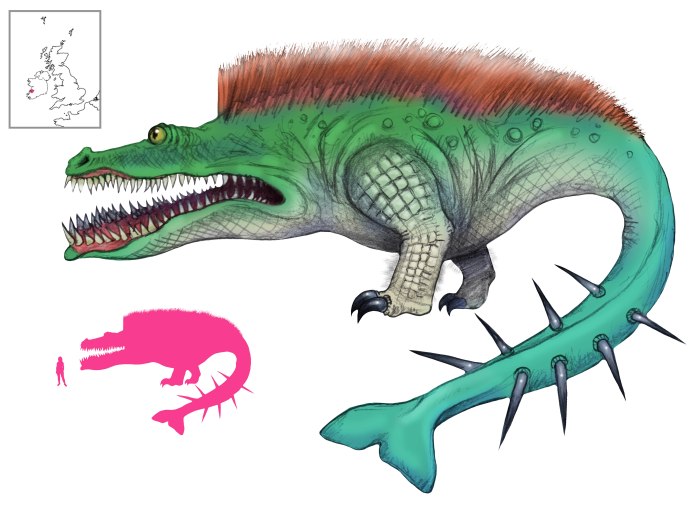
A horrible sight she was to see, a great dragon bigger a small isle, with a back like a round island covered with scales and shells. A rough bristly mane like a boar’s covered her foreparts. When she opened her cavernous mouth filled with a double row of sharp teeth, her entrails could be seen. A cruel eye gleamed in her head. Her body stood on two short, thick, hairy legs armed with iron nails that struck sparks on the rocks as she moved. Her belly was like a furnace. The tail of a whale she had, a tail with iron claws on it that ploughed furrows in the ground behind her. Cathach could move on land and swim with equal ease, and the sea boiled around her.

Farbagh was slain by Crohan, Sal, and Daltheen, the three sons of Toraliv M’Stairn, and Dabran was killed by Diarmuid O’Duibhne after the three brothers set her to protect their forts. When Cathach sensed the loss of her siblings, she went on a rampage, laying waste to the lands around the Shannon Estuary from Limerick to the sea, sinking ships and paralyzing commerce for a year. When the three brothers returned and saw the destruction wreaked by Cathach, they were so distraught that they flung themselves into the sea to their deaths.

Cathach herself was defeated by a far more humble and unassuming hero. When Saint Senan made landfall on Inis Cathaig, Cathach prepared to devour him whole. But the holy man made the sign of the cross in front of her face, and she was quieted. “In the name of the Father, the Son, and the Holy Ghost, leave this island, and hurt no one here or wherever you leave to”. And Cathach did as she was told. She disappeared into the estuary and went to Sliab Collain without harming anyone; and if she is still alive, she has remained obedient to Senan’s command.

The ruins of the church of Saint Senan can still be seen to this day on Scattery Island.

References

Hackett, W. (1852) Folk-lore – No. I. Porcine Legends. Transactions of the Kilkenny Archaeological Society, 2(1), pp.

O’Donovan, J. (1864) The Martyrology of Donegal. Alexander Thom, Dublin.

Stokes, W. S. (1890) Lives of Saints from the Book of Lismore. Clarendon Press, Oxford.

Stokes, W. (1905) The Martyrology of Oengus the Culdee. Harrison and Sons, London.

Watts, A. A. (1828) The Literary Souvenir. Longman, Rees, Orme, Brown, & Green, London.

Famocantratra

Variations: Famocantraton (Dapper)

Famocantratra

The Famocantratra (as Flacourt describes it) or Famocantraton (in Dapper and subsequent works) is a small lizardlike animal found in Madagascar. Its name means “leaper at the chest”.

The famocantratra’s back, chin, and top of its neck, legs, and tail are made of small paws or claws which allow it to adhere to trees like glue. It is almost impossible to see as it sticks to trunks. Its mouth is always open to capture insects and other small invertebrates.

It will leap onto the chest of anyone who passes by, and it holds on so fast that the skin has to be sliced off with a razor. For this reason it is feared and avoided by the natives of Madagascar.

References

Dapper, O. (1686) Description de l’Afrique. Wolfgang, Waesberge, Boom, & van Someren, Amsterdam.

de Flacourt, E. (1661) Histoire de la Grande Isle Madagascar. Francois Clouzier, Paris.

Angont

Angont

According to the Huron, the Angont is the source of death, disease, and all the misfortunes of the world. It is a monstrous snake that lives in a number of dark and secluded areas, including lakes, rivers, deep woods, under rocks, and in caves.

When sorcerers wish to kill someone, they rub items – hair, splinters, animal claws, wheat leaves, and so on – with angont flesh. Any such object becomes malevolent, penetrating deep into a victim’s vitals down to bone marrow, and bringing with it agonizing pain and sickness that eventually consumes and kills its host. Only the discovery and removal of the cursed object can prevent and cure this.

References

Vimont, B. (1858) Relations des Jésuites, v. II. Augustin Coté, Quebec.

Akampeshimpeshi

Variations: Lightning

Akampeshimpeshi

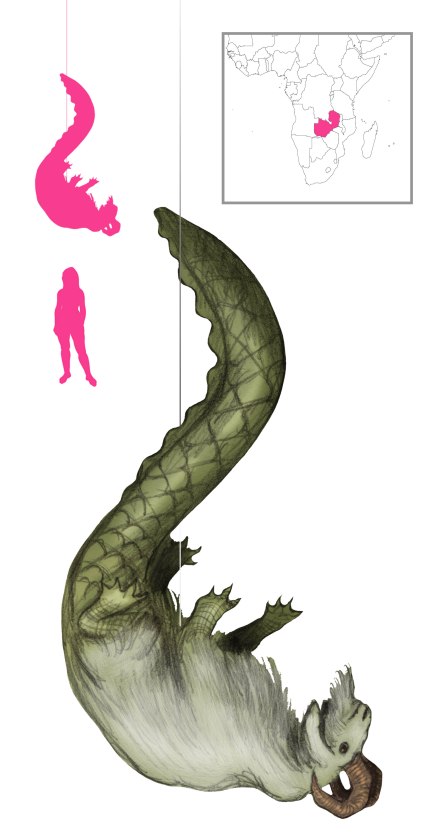
According to the Lamba people of Zambia, there is a great lake of water above the dome of the sky. This lake is held back by a weir protected by guardians appointed by Lesa (God). Sometimes Lesa appoints children to guard it, and their irresponsible playing makes holes in the weir and allow the water to spill to earth as rain. When Lesa appoints grown men to guard the weir, then there is no rain.

Lightning (akampeshimpeshi) is caused by the guardians of the weir swinging and tossing their knives (imyele). The knives do not fall – if they did, the earth would be destroyed.

When a flash of lightning hits the ground, an animal descends to the ground on the end of a long cobweb. It looks like a goat, with beard and horns, but has the feet and tail of a crocodile. Usually it returns to the sky on its string of web; if the cobweb breaks, the animal will be trapped on the ground and cry like a goat. In this state it is very dangerous and might kill people, so it is mobbed, killed, and burned by the Lambas. Anyone trying to slay this beast must have protective medicine (ubwanga bwayamba) to avoid being killed themselves.

References

Doke, C. M. (1931) The Lambas of Northern Rhodesia. George G. Harrap and Company Ltd., London.