Cenchris

Variations: Cenchros, Cenchrines, Cenchridion, Cenchrites, Cenchria; Millet; Milliaris (from millet); Punter-schlang, Berg-schlang (German); Lyon (due to its color and ferocity); Famusus, Aracis, Falivisus (Topsell gives those last three as barbarous versions)

Cenchris

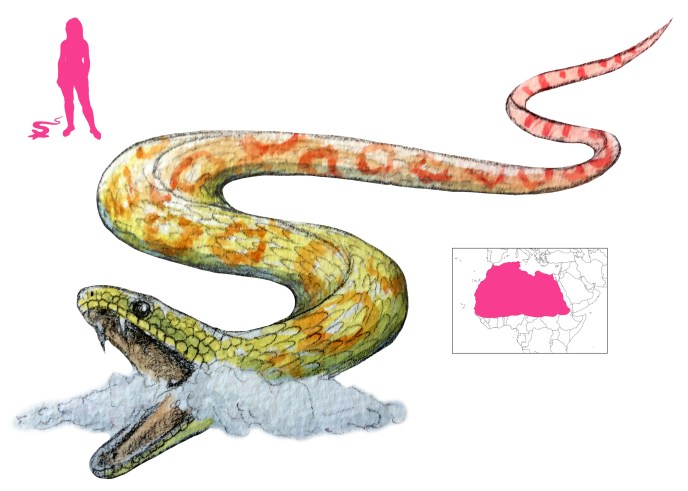
The Cenchris or Millet is one of the many venomous snakes spawned from the blood of Medusa that live in the Sahara desert. It was listed in the catalog of serpents assailing Cato and his men, but did not receive a separate account describing the effects of its deadly venom. Situated in Libya according to Lucan, Topsell stated it to hail from Lemnus and Samothracia.

The most obvious characteristic of a cenchris is that it always move in a straight line, and does not coil or flex its body. For this reason it can travel fast in a straight line, but cannot make sharp turns. In color it is a dusky yellow, looking like the color of millet seed, but Aldrovandi suggests it to be at least partly green. Regardless of the color, the cenchris is attractively spotted and speckled, bringing to mind millet or marbled columns. The pointed tail is turned upwards, like a lion’s. A cenchris grows to two cubits (about one meter) long.

The cenchris is most active and aggressive when millet is at the peak of its growth, and head to the mountains in the summer. Unlike other venomous snakes, it will use its entire body when attacking, wrapping around its victim and beating it; meanwhile, it fastens its fangs in its prey and sucks its blood out.

Cenchris venom rots and putrefies flesh, causing lethargy, stomachache, and death within two days if left untreated. Lettuce, flax-seed, savory, rue, betony, and daffodil in three cups of wine, followed by two drams of centaury, gentian, hartwort, nosewort, or sesame, makes a good antidote.

While not easy to narrow to a single species, the rectilinear locomotion suggests the cenchris to be inspired by large, heavy-bodied vipers such as the puff adder.

References

Aldrovandi, U. (1640) Serpentum, et Draconum Historiae. Antonij Bernie, Bologna.

Isidore of Seville, trans. Barney, S. A.; Lewis, W. J.; Beach, J. A.; and Berghof, O. (2006) The Etymologies of Isidore of Seville. Cambridge University Press, Cambridge.

Lucan, trans. Rowe, N. (1720) Pharsalia. T. Johnson, London.

Topsell, E. (1658) The History of Serpents. E. Cotes, London.

Margot la Fée

Variations: Margot-la-Fée, Margot, La Bonne Femme Margot (The Good Woman Margot), Ma Commère Margot (My Godmother Margot), Fée Morgant
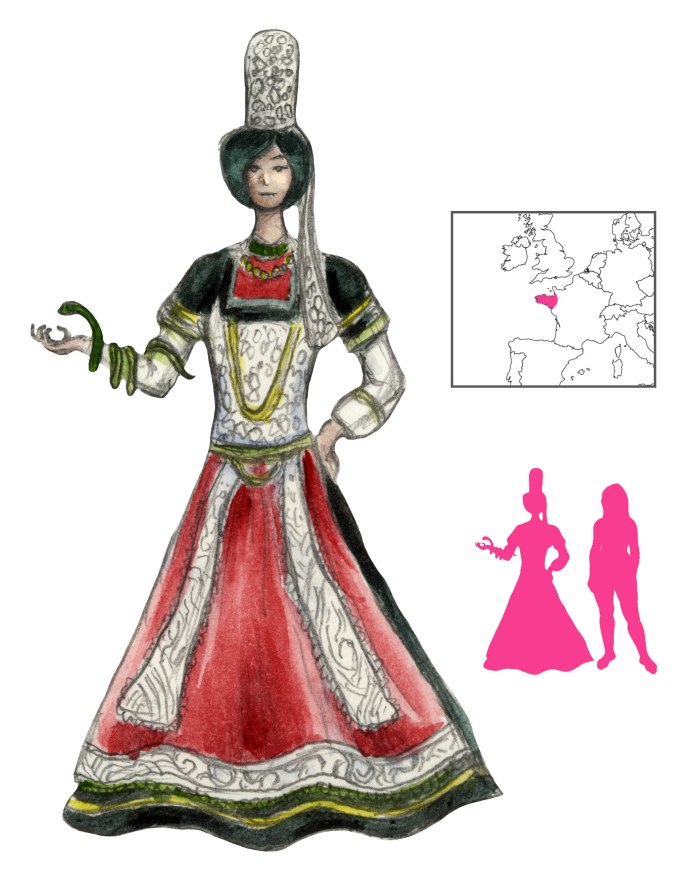
Margot

The Margot la Fée, “Margot the Fairy”, or more simply Margot, are fairies native to Brittany, particularly Collinée, Lamballe, Moncontour, and most of the Côtes-d’Armor. They are generally seen as benevolent and protective, but capable of deadly violence when provoked. The name of Margot – also used for magpies – is probably derived from Morgan or Morgana, as evidenced by the alternative name of Morgant; most local names are placatory terms of affection. Margot fairies are closely associated with megaliths, caves, treasures, and snakes, leaving the beaches to the Fées des Houles and the Groac’h.

Like most fairies, Margot fairies vary a lot in appearance, appearing as both young and old women as well as animals. They spend part of their time as snakes, both willingly and against their will, in which form they are most vulnerable. They possess considerable magical powers, dance in circles at night, haunt dolmens, swap babies with voracious changelings, and flee religious symbols.  Sometimes a Margot would take a fancy to a handsome young shepherd and choose to keep him in a cave for herself. In those cases time itself would seem to slow down, such were the pleasures that the fairy offered.

Margot fairies happily care for the livestock of their neighbors, even going so far as to feed them in the caverns while their owners were away. The Margot’s own livestock remained in the caves, emerging only to feed. On the other hand, hungry Margot fairies will tear a cow to pieces and devour it, only to restore it to life by the next morning, missing only any pieces that had been eaten by humans during the feast.

Margot fairies are often the guardians of fabulous riches. They will handsomely reward those who aid them, and punish any who take advantage of their generosity. If they tell you to take a certain amount of treasure and no more than that, you would be wise to follow their instructions to the letter. One man who took more gold from the Crokélien Hill fairies than he was instructed to had his son taken away from him, never to be seen again.

Other gifts of the Margot are more prosaic. They will offer piping hot loaves of bread to the hungry – loaves that never get smaller, no matter how many slices are cut from them. But if a piece is offered to someone else deemed unworthy by the fairies, the loaf will no longer regenerate.

Small acts of compassion are looked on with great favor. Two harvesters, resting after scything wheat, encountered a little grass snake eating the breadcrumbs they left behind. One tried to kill it, while the other stopped him, saying it would be wrong to kill a small, harmless animal. In the evening a Margot appeared to the second man and thanked him for protecting her daughter. She gave him two belts, one for him and one for his friend, telling him not to mix them up. His was of pure gold, while the other he tied to an oak tree, which wilted overnight.

Another man working near the hill of Crokélien encountered a Margot, who asked a favor of him. “Bring a large washtub with you”, she said, “and go to the Planchettes Bridge at sunrise. There you will find a grass snake. Put the washtub over it and sit on top. If anybody asks you why you’re there, tell them you’re waiting for the blacksmiths to fix the tub. At sundown, remove the tub, and you shall be richly rewarded for your help”. The man did as he was told, and sure enough, the snake was there at the bridge as the fairy had said. He covered it with the washtub and sat patiently there for the rest of the day, weathering the taunts and jeers of passers-by with aplomb. At sunset he removed the tub to find a beautiful maiden underneath. She was the Margot’s daughter, who transformed into a snake one day every year, and would have been killed had it not been for the man’s intervention. As promised, he never wanted for gold or silver for the rest of his life.

Human midwives will also be recruited by Margots to aid them in childbirth, gifting them with the power of second sight for the occasion. But woe to her if she let on that she could still see the fairies! A vindictive Margot would gouge her eye out, or spit in her face and blind her.

References

Dubois, P.; Sabatier, C.; and Sabatier, R. (1996) La Grande Encyclopédie des Fées. Hoëbeke, Paris.

Sébillot, P. (1887) Légendes Locales de la Haute-Bretagne: Les Margot la Fée. Maisonneuve et Ch. Leclerc, Paris.

Sébillot, P. (1904) Le Folk-Lore de France, Tome Premier: Le Ciel et la Terre. Librairie Orientale et Américaine, Paris.

Sébillot, P. (1905) Le Folk-Lore de France, Tome Deuxième: La Mer et les Eaux Douces. Librairie Orientale et Américaine, Paris.

Sébillot, P. (1906) Le Folk-lore de France, Tome Troisième: La Faune et la Flore. Librairie Orientale et Américaine, Paris.

Sébillot, P. (1968) Le folklore de la Bretagne. Éditions G. P. Maisonneuve et Larose, Paris.

Swan Valley Monster

Swan Valley Monster

The Swan Valley Monster made its appearance on August 22, 1868, in the otherwise tranquil locale of Swan Valley, Idaho. Its presence was witnessed and reacted to by an unnamed old-timer crossing the river at Olds Ferry.

The first thing he saw of the monster was an elephant’s trunk rising from below the surface and spouting water. This was followed by a snake-like head the size of a washtub, with a single horn that kept moving up and down, and long black whiskers on both sides of the face. It had ten-inch-long fangs and a red forked tongue that spewed green poison. When it hauled its massive body onto the shore, the old-timer noted that it must have been twenty feet long, and it stank to high heaven. A pair of wing-like fins – or fin-like wings – came out of the sides of its neck. Its forward half was like a snake, the thickness of a calf, greenish-yellow with red and black spots; this in turn led into a fish-like section with hand-sized rainbow scales shining in the sun; finally, the tail was a drab, scaly gray like a crocodile or lizard tail. Shiny black barbed spines, like those of a porcupine, lined its back from head to tail. Finally, it had twelve stubby legs that were easily missed at first glance; the first pair under the fins had hoofs, followed by two pairs of legs with razor-sharp claws, then a pair of hoofed feet, a pair of clawed feet, and another pair of hoofed feet near the tail.

Of course, the old-timer’s first reaction to the abomination slithering up the bank was to fire a slug into its eye. The monster reared up, hissing, bellowing, and spurting poison over its surroundings, so it got shot a second time in its yellow belly, convulsed, and stopped moving. Everything its poison had touched, whether trees or grass or other living beings, withered and died.

As the monster was too large to be carried off by one man, the old-timer returned to town to fetch a wagon and six strapping lads to help him, as well as a tarp to protect them from the poison. They could smell the odoriferous creature a hundred yards away, and one of the men had to stay with the horses to keep them from bolting, while another got sick and refused to come any closer. But when they reached the bank where the monster had fallen, there was nothing but withered vegetation and a trail leading to the water.

Presumably the Swan Valley monster had crawled back into the river to die – or perhaps it didn’t die. Whatever its fate, the old-timer recommended keeping a close watch on the river, as “I’ve hunted an trapped an fished all over the state fer nigh ontuh seventy-five year… but I ain’t never seen nothin tuh compare with that speciment”.

References

Clough, B. C. (1947) The American Imagination at Work. Alfred A. Knopf, New York.

Fisher, V. ed. (1939) Idaho Lore. Federal Writers’ Project, The Caxton Printers, Caldwell.

Lewicki, J. and the editors of LIFE (1960) Folklore of America, part V. LIFE Magazine, Aug. 22, 1960.

Jaculus

Variations: Iaculus, Jaculare; Sagitta (Latin); Acontia, Acontias, Saetta (Greek); Cafezati, Cafezasi, Altararat, Acoran, Altinanti (Arabic); Orchilanne (Turkish); Saettone (Calabria and Sicily); Ein Schosse Oder Angelsch Lang (German); Decurtati (Hungary)

Jaculus

The Jaculus, “javelin” or “dart”, is one of the many snakes that attacked Lucan’s forces during their march through the Libyan desert. While catalogued as a Libyan desert snake, Topsell expanded its range to include Rhodes, Lemnos, Calabria, Sicily, Germany

It can be considered a flying snake, although the “flight” is long-distance leaping over ten to thirty feet. They get into trees and bushes, bunch themselves up in bow and hoop shapes, and fling themselves at high speed onto their prey. Traveling as fast as a thrown javelin, they can puncture clothing and flesh alike. Jaculi are cunning and cruel, and will lie in ambush for human prey, but their presence is given away by the noise they make while coiling in dry plants.

The appearance of the jaculus varies, but it usually has small black ocelli, no bigger than lentils, on its body. The jaculi of Rhodes are ash-colored with a white belly and two black lines running from its head to the tip of its tail; the cafezati or “jumpers” of the Middle East are red, and have been posited as the Biblical fiery serpents. The Hungarian jaculi or decurtati are thick and short-tailed, only two hands long.

A jaculus killed Paulus, one of Lucan’s men, by darting from a distance before it could be seen. It was not venom that felled its victim, but rather the gaping hole left behind after it passed through Paulus’ head at the temples. Topsell believed it was a jaculus that attacked the apostle Paul and bit his hand. Another such snake coiled around the arm of a Zurich peasant; even though it didn’t bite, the arm ended up putrefying and requiring yearly bleeding to drain the black blood inside.

Topsell attests that the same antidotes used for viper venom can be used for jaculus bites. He adds that jaculus gall with Scythian stone yields eye-salve.

References

Aelian, trans. Scholfield, A. F. (1959) On the Characteristics of Animals, vol. II. Harvard University Press, Cambridge, Massachusetts.

Aldrovandi, U. (1640) Serpentum, et Draconum Historiae. Antonij Bernie, Bologna.

Isidore of Seville, trans. Barney, S. A.; Lewis, W. J.; Beach, J. A.; and Berghof, O. (2006) The Etymologies of Isidore of Seville. Cambridge University Press, Cambridge.

Lucan, trans. Rowe, N. (1720) Pharsalia. T. Johnson, London.

Topsell, E. (1658) The History of Serpents. E. Cotes, London.

Pareas

Variations: Parea, Parias, Paruas, Pharias, Parous, Baron, Pagerina, Anguis Aesculapij, Aesculapian Snake

Pareas

The Pareas is briefly mentioned in the Pharsalia’s catalogue of Libyan serpents. It always travels on its tail, leaving a furrow behind it in the ground. Its bite is harmless and gentle, and so it was consecrated to Asclepius, god of healers. Topsell classifies it among the innocent serpents.

Aelian describes it as being red with sharp eyes and a wide mouth. Topsell, on the other hand, gave its length as four spans, and its color as yellow with two long streaks down its side. Aldrovandi describes the pareas as being yellowish below and black above, with possible variations of green and white along its length. He dismisses the claim that it has a crest.

The tendency of the pareas to travel while holding itself clear of the ground has led to its association with the Eden serpent, which did not creep along the ground prior to being cursed. This claim has been contested by Alexander Neckham and Petrus Comestor, as the pareas very clearly does not conform to that curse. Petrus concluded that the curse must only have affected the individual serpent of Eden, leaving other snakes – including the pareas – uncursed.

References

Aelian, trans. Scholfield, A. F. (1959) On the Characteristics of Animals, vol. II. Harvard University Press, Cambridge, Massachusetts.

Aldrovandi, U. (1640) Serpentum, et Draconum Historiae. Antonij Bernie, Bologna.

Isidore of Seville, trans. Barney, S. A.; Lewis, W. J.; Beach, J. A.; and Berghof, O. (2006) The Etymologies of Isidore of Seville. Cambridge University Press, Cambridge.

Kelly, H. A. (1971) The Metamorphoses of the Eden Serpent during the Middle Ages and Renaissance. Viator, 2, pp. 301-328.

Lucan, trans. Rowe, N. (1720) Pharsalia. T. Johnson, London.

Topsell, E. (1658) The History of Serpents. E. Cotes, London.

Sāmm-abraṣ

Variations: Sāmma-abraṣ, Abraṣan (dual); Sawāmm-abraṣ, Sawāmm, Biraṣa, Abariṣ, Abariṣa (plural); Borṣ-sāmm, Abu Braiṣ, Abu Breiṣ, Borṣ, Wazaghah, Gecko

[image pending]

The gecko has long been unfairly associated with leprosy in the Middle East, probably due to its greyish, leprous appearance, translucent, shedding skin, and detachable tail. Its common names of sāmm-abraṣ (“leper poison”) and abu braiṣ (“father of leprosy” or more simply “leper”) reflect the belief that it somehow transmits a deadly poison that causes leprosy.

Al-Qazwini and Al-Damiri describe the sāmm-abraṣ as being a large species of gecko, small-headed, long-tailed, with a leprous, sickly appearance. A sāmm-abraṣ is highly toxic and spreads leprosy by contact, often rolling in salt to transmit the disease. Its unwanted presence can be averted by the smell of saffron.

It is unlawful to eat or sell a sāmm-abraṣ, as one poet reflects “By God, even if I were His entirely, I would not be a slave eating abariṣ”. However, its blood cures alopecia, its liver alleviates toothache, its flesh heals scorpion stings, and its skin destroys hernias.

A sāmm-abraṣ in a dream is believed to represent poverty, anxiety, and toxic slander.

In India it is told that a gecko crawling over a sleeper’s body forebodes their imminent death, and a gecko falling on someone’s face makes them an albino. Ganges water and “gold water” in which gold has been placed counter the gecko’s poison, but it still ruins any food it touches.

The unwarranted evil reputation of the gecko, while deep-rooted, has not always been the case. Geckos feature in ancient Egyptian art in an apotropaic function, protecting the deceased from scavenging insects.

References

al-Damiri, K. (1891) Hayat al-hayawan al-kubra. Al-Matba’ah al-Khayriyah, Cairo.

Fremgen, J. (1996) The Folklore of Geckos: Ethnographic Data from South and West Asia. Asian Folklore Studies, vol. 55, pp. 135-143.

Guilhou, N. (2009) Lézards et geckos dans l’Égypte ancienne. IVe Rencontres archéozoologiques de Lattes, UMR 5140 – CNRS, Université Paul-Valéry
Montpellier 3.

Jayakar, A. S. G. (1908) Ad-Damiri’s Hayat al-Hayawan (A Zoological Lexicon), vol. II, part I. Luzac and Co., London.

Orr, J. (1915) The New Standard Bible Encyclopedia, volume III. The Howard-Severance Company, Chicago.

al-Qazwini, Z. (1849) Zakariya ben Muhammed ben Mahmud el-Cazwini’s Kosmographie. Erster Theil: Die Wunder der Schöpfung. Ed. F. Wüstenfeld. Dieterichsche Buchhandlung, Göttingen.

Prester

Variations: Presteros, Torridus (Torrid), Dipsas (Thirsty)

Prester

The Prester, “bellows-swelling”, “swollen veins”, or “inflater”,  is a deadly species of asp found in the deserts of Libya. Its name is derived from the gruesome effects of its venom, which were experienced firsthand by Lucan’s men. Aldrovandi believed it to be the same as the Dipsas, while Topsell saw it as distinct, since the prester kills by heat while the dipsas uses thirst.

Presters are so torrid that they keep their steaming mouth open to cool off, and foam constantly bubbles out from inside them. Topsell identifies presters with the fiery snakes that plagued the Israelites in the wilderness, but does not describe them beyond their extreme internal heat. They are fast-moving snakes, hurrying from place to place with their panting mouths wide open.

Aelian described the prester’s venom as causing profound lethargy, progressive weakness, loss of memory, inability to urinate, hair loss, choking, and eventually convulsions that lead to death. Flaubert specifies that mere contact with it causes debilitation.

Lucan describes more grotesque symptoms. The unfortunate Nasidius, upon suffering a scorching prester’s bite, feels the flames of the venom coursing through his veins. His entire body starts to swell, inflating and bloating and cutting through his armor, engulfing his limbs. The tumorous swelling ends only once Nasidius is a formless, headless heap. The remains are so disgusting that even the scavengers shun them.

Topsell recommends wild purslane, castoreum or beaver-stones, opoponax and rue in wine, and sprats as a remedy for prester bite.

References

Aelian, trans. Scholfield, A. F. (1959) On the Characteristics of Animals, vol. III. Harvard University Press, Cambridge, Massachusetts.

Aldrovandi, U. (1640) Serpentum, et Draconum Historiae. Antonij Bernie, Bologna.

Batinski, E. (1992) Cato and the Battle with the Serpents. Syllecta Classica, Vol. 3, pp. 71-80.

Eldred, K. O. (2000) Poetry in Motion: the Snakes of Lucan. Helios 27.1, p. 63.

Flaubert, G. (1885) La Tentation de Saint Antoine. Quantin, Paris.

Isidore of Seville, trans. Barney, S. A.; Lewis, W. J.; Beach, J. A.; and Berghof, O. (2006) The Etymologies of Isidore of Seville. Cambridge University Press, Cambridge.

Lucan, trans. Rowe, N. (1720) Pharsalia. T. Johnson, London.

Topsell, E. (1658) The History of Serpents. E. Cotes, London.

Vouivre

Variations: Vaivre, Givre, Guivre, Wivre

Vouivre

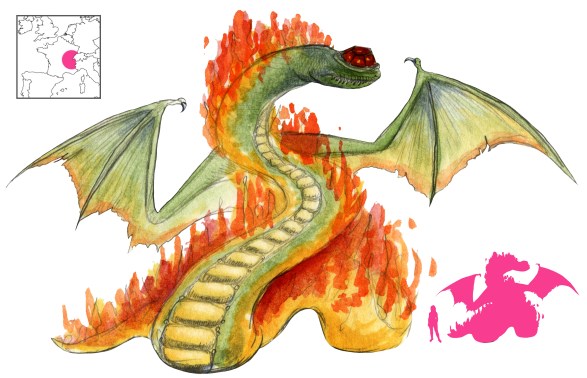
Vouivres, the great fiery serpents of France, have been reported primarily from remote, mountainous regions, where they haunt springs, wells, caves, deep ponds, and ruined castles. They are known from Bourgogne, Franche-Comté, Savoie, the Jura mountains, and neighboring areas, with possible relatives in the Aosta Valley and Switzerland.

The word “vouivre” is derived from the Latin vipera, or “viper”. Vouivres themselves are the spiritual descendants of Mélusine, stripped of her human features. They have been described as dragons, serpents, and fairies in the form of great reptiles; they are always the guardians of priceless treasures.

In its most simple definition, a Vouivre is a female dragon. Vouivres vary wildly in appearance, but are always female and associated with fire and water. The classic vouivre, as observed in Faverges, Fleury-la-Tour, Mont-Beuvray, Rosemont, Solutré, and Thouleurs, is an immense winged serpent covered with fire. Instead of eyes, a vouivre has a single large diamond or ruby in its head that guides it through the air. She removes it when bathing, leaving it blind and vulnerable to theft. Possession of a vouivre’s eye-stone would bring riches and happiness to anyone who stole it. The immense vouivre of Boëge guards treasure and wears a priceless golden necklace. In La Baume she is 4 meters long and covered in gems and pearls. She sometimes leaves gems behind where she lands. The Lucinges vouivre is a glowing red viper that whistles eerily in flight. The Gemeaux vouivre, which appeared between 2 and 3 in the afternoon, was hooded like a cobra.

In Brizon, she is equally likely to appear as a bird or a winged beech marten with a brilliant necklace as she is to have the form of a great serpent with wings and a diamond on its tail. Vouivres may not even look like animals. In Chevenoz she appears as a burning fireball streaking across the sky, in Saint-Jean-d’Aulps and Vallorcine she is a single-eyed tongue of fire, and in Le Biot she is a star whose appearance foretells war and strife. The Orgelet Castle vouivre looks like a red-hot iron bar in flight, and the vouivre of Sixt-Fer-À-Cheval is a plumed golden necklace that flies through the air.

One of the more effective ways of slaying a vouivre has been making a spiked barrel to hide in. At Condes, a man managed to steal a vouivre’s diamond and hide in a nail-studded washtub; the infuriated, blinded dragon killed herself trying to get to him. While another man at the Aosta Valley slew a vouivre in a similar manner, other prospective thieves have not been so lucky. The vouivre of Reyvroz had a necklace of great value, which was stolen by a man in a spiked barrel; she died and the thief died soon after. The vouivre of Samoëns had her pearl necklace stolen in the same manner, but she constricted the barrel anyway and made the thief return the necklace; she then disappeared and was never seen again. In Manigod, where grass would not grow for a couple of years after the vouivre’s passage, a man who stole her diamond was killed, his barrel smashed, and the gem retrieved.

Finally, as with all dragons, vouivres are vulnerable to the power of saints and other holy persons. The vouivre of Saint-Suliac was cast into a deep cave by Saint Suliac after she killed one of his monks. The location became known as the Trou de la Guivre, the Guivre’s Hole.

In Thollon-Les-Mémises, among other places, “vouivre” has become a byword for an unpleasant, nasty woman.

Modern versions of the vouivre, perhaps conflating her with Mélusine, have embellished with her the features of a seductive woman. Marcel Aymé makes her a wild girl of the forest with an entourage of vipers, and Dubois makes her a beautiful fairy who sheds her dragon skin when bathing.

References

Aymé, M. (1943) La Vouivre. Gallimard.

Dontenville, H. (1966) La France Mythologique. Tchou, Paris.

Dubois, P.; Sabatier, C.; and Sabatier, R. (1996) La Grande Encyclopédie des Fées. Hoëbeke, Paris.

Joisten, C. (2010) Êtres fantastiques de Savoie. Musée Dauphinois, Grenoble.

Monnier, D. (1819) Essai sur L’Origine de la Séquanie. Gauthier, Lons-Le-Saunier.

Sébillot, P. (1905) Le Folk-Lore de France, Tome Deuxième: La Mer et les Eaux Douces. Librairie Orientale et Américaine, Paris.

Hrökkáll

Variations: Hrökk-áll

Hrokkall

A malicious Icelandic wizard once revived a dead, half-rotted eel, giving rise to an evil and toxic creature. It was the first Hrökkáll, or “coil-eel”. The wizard may be long dead, but the eel’s descendants went on to infest polluted waters.

A hrökkáll is two feet long, and resembles an eel in appearance. It lives in still ponds and stagnant water, and occasionally in running rivers. It has flexible, iron-hard scales, and sharp saw-toothed fins. As with many Icelandic fishes, it secretes corrosive venom and its meat is poisonous. Captured hrökkálls have been known to melt their way through earth and rock to squirm back into the water.

Hrökkálls lie in wait until someone steps in the water. Then they coil around the person’s leg and constrict it, slicing into flesh and bone alike and amputating the limb. It is unknown whether hrökkálls use their acidic venom or their bladed fins (or both) to do this. They will dismember humans and horses in this way, but sheep are safe as their legs are too narrow for the hrökkáll to gain a hold.

Hrökkáll in common parlance has since evolved to mean electric eels.

References

Davidsson, O. (1900) The Folk-lore of Icelandic Fishes. The Scottish Review, October, pp. 312-332.

Zoëga, G. T. (1911) English-Icelandic Dictionary, Second Edition. Sigurdur Kristjansson, Reykjavik.

Codrille

Variations: Cocadrille, Cocodrille, Coquadrille, Cocatris

Codrille

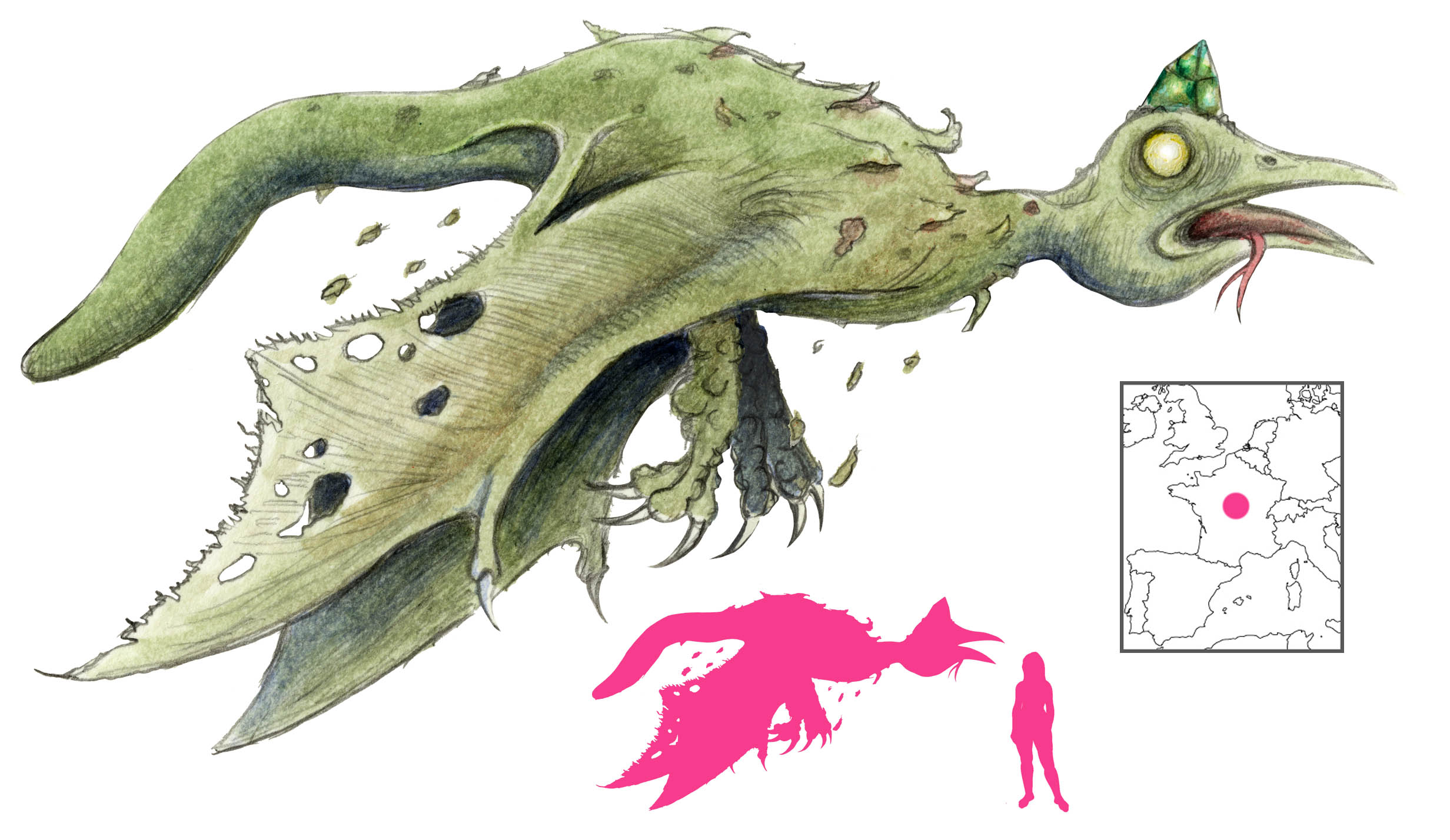
The Codrille, Cocadrille, or Codrille is a variety of basilisk or dragon native to central France, notably Berry, Maine, Poitou, Sologne, and Vendée. It combines features of basilisks and vouivres but without the redeeming aspects of either.

The name of the codrille was derived from the same etymological confusion that spawned the “cockatrice”. Starting with Crocodylus, the crocodile, practically a mythical creature in its own right, the name became progressively more garbled, becoming Cocodrillus, Cocodrille, Cocadrille, and Codrille. However, de la Salle derives it from coco and drille, meaning “rooster’s child”.

Unlike true basilisks, codrilles can grow to impressive size, becoming leathery-winged dragons at the last stage of their life cycle. The “crown” characteristic of basilisks manifests in the form of a brilliant gem on top of the codrille’s head. Codrilles can kill merely by looking at their victims, and emit an aura of disease and plague.

A codrille’s life is a complicated succession of metamorphoses. It hatches from a yolkless egg laid by a rooster, and incubated by the heat of the sun or of manure. To prevent those eggs from hatching, one must plant sprigs of ash in potential codrille breeding grounds. This should be done on the first day of May. Having other roosters around also helps, as they will devour the offspring of a codrille.

The codrille starts out its life as a very long, string-like snake. It is capable of killing right out of the egg – anyone who cracks a codrille egg and is seen by the newborn codrille dies instantly, but if they see the snake first, it dies instead. After a while, the juvenile codrille sprouts legs and becomes a salamander. During this stage of its life it will still die if seen first by humans, so it hides in deep wells, ruined tombs, and the masonry of houses, bringing bad luck to everyone living there and whistling ominously at night. It can debilitate a bull merely by crawling under it.

At the end of seven years the codrille reaches the adult stages. It grows spectacularly, sprouts wings, and metamorphoses into an enormous dragon. It spreads its wings and migrates towards the Tower of Babylon, breathing death and pestilence along its way. Its passage in the air dims the sun, and epidemics and plagues follow in its wake.

References

Sainéan, L. (1921) L’histoire naturelle et les branches connexes dans l’oeuvre de Rabelais. E. Champion, Paris.

de la Salle, L. (1875) Croyances et légendes du centre de la France, Tome Premier. Chaix et Cie., Paris.

Sébillot, P. (1906) Le Folk-lore de France, Tome Troisième: La Faune et la Flore. Librairie Orientale et Américaine, Paris.