Catoblepas

Variations: Katoblepas, Catablepon, Katoblepon, Catobleponta, Gorgon (erroneously)

Catoblepas

The Catoblepas, “that which looks downwards”, is probably the most hideous and repulsive of living things, so horrid that its mere glance is lethal. Pliny locates it in Ethiopia, around the source of the Nile, Aelian puts it in Libya, and Topsell gives a range of Hesperia and Lybia.

According to Pliny, the body of a catoblepas is of small size, and its limbs are heavy, but its massive head is too heavy to be held up and always looks downwards. This is a good thing, as anyone who saw the eyes of a catoblepas died.

Aelian gives more detail, describing it as the size of a bull, but with a grim expression, shaggy eyebrows, and small bloodshot eyes. It looks downwards, and has a horselike mane that starts on its head and covers its face. The catoblepas feeds on poisonous plants; when threatened, it shudders and raises its mane in warning before opening its mouth and belching a foul, toxic gas. This gas poisons the air around it, and anything that breathes it loses its voice, collapses in convulsions, and dies. Other animals give it a wide berth because of this. There is no mention of a deadly gaze.

Topsell combines the catoblepas with the Gorgon, stating that the myth of Perseus originated from a war with African Amazons led by Medusa. The snake-hair of the gorgons was inspired by the catoblepas’ messy mane. His fanciful description borrows liberally from gorgons and adds thick eyelids, scales like a dragon, tusks like a boar, no hair on the head, wings, human hands, and a size between that of a bull and a calf. He also denies that a catoblepas can kill with its breath, which is unheard of in the animal world; it is far more likely to kill with its eyes like the well-known cockatrice. He gives as proof an anecdote of Marius’ soldiers encountering a catoblepas and thinking it a sheep, only to die immediately when it looked up at them. It was eventually killed in an ambush by spear-men, and its skin was sent to the temple of Hercules in Rome.

It is in Flaubert’s Temptation that we get the most nightmarish vision of the catoblepas. Here it is a sprawling, long-maned black buffalo with the head of a pig dragging on the ground. Its neck is long and thin like an emptied intestine. It is also granted the power of speech, addressing Anthony. “Fat, melancholy, wild, I perpetually feel the warmth of mud under my belly, hiding infinite rot under my armpit. My skull is so heavy that I cannot lift it. I roll it around me, slowly; – and, jaws opened, I tear with my tongue poisonous herbs watered with my breath. Once, I ate my paws by accident. No-one, Anthony, has ever seen my eyes, or those who have seen them are dead. If I lifted my eyelids – my pink and swollen eyelids, straight away, you would die”.

Cuvier suggested that this maned, hoofed, and downward-looking abomination of nature was inspired by the harmless gnu or wildebeest.

References

Aelian, trans. Scholfield, A. F. (1959) On the Characteristics of Animals, vol. II. Harvard University Press, Cambridge, Massachusetts.

Borges, J. L.; trans. Hurley, A. (2005) The Book of Imaginary Beings. Viking.

Flaubert, G. (1885) La Tentation de Saint Antoine. Quantin, Paris.

Pliny; Holland, P. trans. (1847) Pliny’s Natural History. George Barclay, Castle Street, Leicester Square.

Topsell, E. (1658) The History of Four-footed Beasts. E. Cotes, London.

Bingfeng

Variations: Ping-feng, Pingpeng, Chuti/Ch’ou-t’i

Bingfeng final

The Bingfeng is an odd creature from the Guideways Through Mountains and Seas. It looks like a black pig with an elongate, tubular body, and it has two heads, one at each end. It may be found in the land of Shaman Xian. Borges, who referred to it as the Ping-feng and sourced it from the T’ai Kuang Chi, located it in the land of Magical Water.

Guo Pu speculated that the presence of two heads would have made the bingfeng extremely stubborn. Wen Yiduo, on the other hand, believed the heads were symbolic of hermaphroditism, representing the separate sexes.

A number of other two-headed Chinese animals have been recorded, but they have not been described in much detail. Their symbolism is assumed to be the same.

The Pingpeng, found on the mountain of Aoaoju in the Great Wilds to the West, is very similar but has two heads left and right, instead of front and back. It is probably the same animal as the Bingfeng.

The Chuti, or Ch’ou-t’i according to Borges, is found in the Great Wilds to the South between the Red River and the Desert of Shifting Sands. It also has two heads left and right, and is depicted with doglike features.

References

Borges, J. L.; trans. Hurley, A. (2005) The Book of Imaginary Beings. Viking.

Strassberg, R. E. (2002) A Chinese Bestiary: Strange Creatures from the Guideways Through Mountains and Seas. University of California Press.

Polevik

Variations: Polevoi, Polievik, Poludnitsa, Poludnica

Polevik

The Polevik or Polevoi (from pole, “field”) is the Russian spirit of fields, plains, and noontime.

His appearance varies considerably. In Belozersk District and the northern forest regions he is a man dressed in white. In Iaroslavl Province he is an ugly little old man. In Orel Province he is black as the earth, his head covered with green grass, and he wears no clothing. In Tula Province he looks like a shaggy-furred Leshy. Sometimes his eyes are different colors. His skin and hair mirror the soil and vegetation of the fields, and his height grows and shrinks with the crops.

Unlike some of the other spirits, the polevik can be benevolent or evil. A polevik is primarily seen at noon. He likes to lead peasants astray, losing them in endless yellow golden stalks of grain. He disapproves of laziness, and will strangle drunkards sleeping in the fields. Poleviks are capable of seeing the future, and in Iaroslavl Province their appearance is an ill omen. Poleviks are also accomplished horsemen and will ride horses across the fields at breakneck speed, running over anyone in their path.

The female equivalent of the polevik, sometimes replacing him entirely, is the Poludnitsa, Poludnica, or Midday Spirit (from poluden or polden, “noon”). She can be a tall, beautiful woman in white; in Siberia she is an old curly-haired crone dressed in rags, while she has horses’ hoofs in Moravia. In summer, during harvest time, she walks through the fields, protecting the grain. If she sees someone working at midday she pulls their hair violently, twists their heads, and breaks their bones. Other times she quizzes people on agriculture, inflicting disease upon them if they fail to answer correctly. She enjoys misleading children in cornfields.

Polevik children run around the fields catching birds for their parents to eat. They will smother anyone sleeping on the edges of the field.

While poleviks can be destructive, a happy polevik will aid with the harvest, and crops will always be successful under a polevik’s patronage. To earn a polevik’s good will one must leave an offering of two eggs and an old rooster who can no longer crow, in a ditch when nobody is around. Traditional observances must also be followed, and nobody should work at noon.

With the advent of Christianity, poleviks and poludnitsas became mere bogeys, monsters used to frighten children out of cornfields.

References

Aldington, R. and Ames, D. trans.; Guirand, F. (1972) New Larousse Encyclopedia of Mythology. Paul Hamlyn, London.

Dubois, P.; Sabatier, C.; and Sabatier, R. (1992) La Grande Encyclopédie des Lutins. Hoëbeke, Paris.

Ivanits, L. J. (1989) Russian Folk Belief. M. E. Sharpe, Inc., Armonk, New York.

MacCulloch, J. A. and Machal, J. (1918) The Mythology of All Races v. III: Celtic and Slavic. Marshall Jones Company, Boston.

Teelget

Variations: Teel get, Teelgeth, Delgeth

Teelget

As one of the Anaye, the “Alien Gods” of Navajo folklore, Teelget was born from a human woman who resorted to unnatural and evil practices. In this case, his “father” was an antler. The creature born was round, hairy, and headless, and was cast away in horror; it was this creature that grew into the monster known as Teelget.

The origin of Teelget’s name is not known with certainty, but the “tê” makes reference to his horns. He is like an enormous, headless elk or antelope, rounded in shape, hairy like a gopher, with antlers he uses as deadly weapons. Coyote was his spy, and between him and the other Anaye they laid waste to the land, slaughtering many.

It was Nayenezgani, “Slayer of Alien Gods”, who finally put an end to Teelget’s reign of terror. Armed with his lightning arrows, the hero tracked Teelget down, finding the monster resting in the middle of a wide open plain.

How was Nayenezgani to sneak up on Teelget without being noticed? The grass offered no cover, and Teelget was sure to detect him and retaliate. As he considered his options, he was greeted by Gopher. “Why are you here?” said Gopher. “Nobody comes here, for all are afraid of Teelget”. When Nayenezgani explained that he was here to destroy Teelget, Gopher was more than happy to help. He said that he could provide a way to reach Teelget, and all he asked for as payment was the monster’s hide.

Gopher then excavated a tunnel that led right under the sleeping Teelget’s heart, and dug four tunnels – north, south, east, and west – for Nayenezgani to hide in after Teelget woke up. He even gnawed off the hair near Teelget’s heart, under the pretext that he needed it to line his nest.

That was all Nayenezgani needed. He crawled to the end of the tunnel and fired a chain-lightning arrow into Teelget’s heart, then ducked into the east tunnel. Enraged and in agony, Teelget gouged the east tunnel open with his antlers, only to find that Nayenezgani had moved to the south tunnel. He destroyed that, then the west tunnel, but he only managed to put an antler into the north tunnel before succumbing to his injury.

Nayenezgani couldn’t tell if Teelget had died or not, so Ground Squirrel volunteered to inspect. “Teelget never pays attention to me”, he explained. “If he is dead, I will dance and sing on his antlers”. Sure enough, Ground Squirrel celebrated on top of the fallen monster, and painted his face with Teelget’s blood; ground squirrels still have streaks on their face after that day. In some retellings Chipmunk fills this role, painting stripes down his back.

A chunk of antler and a piece of liver were taken by Nayenezgani as trophies, but Gopher went to work at once skinning Teelget. “I will wear his skin, so that when humans increase once more, they will be reminded of Teelget’s appearance”. And to this day, rounded, hairy gophers still wear the skin that Teelget once wore.

References

Alexander, H. B. (1916) The Mythology of All Races v. X: North American. Marshall Jones Company, Boston.

Locke, R. F. (1990) Sweet Salt: Navajo folktales and mythology. Roundtable Publishing Company, Santa Monica.

Matthews, W. (1897) Navaho legends. Houghton Mifflin and Company, New York.

O’Bryan, A. (1956) The Diné: Origin Myths of the Navaho Indians. Bulletin 163 of the Smithsonian Institution, Washington, D. C.

Jetin

Variations: J’tin, Crion

Jetin

Jetins (from jeter, “to throw”) are tiny lutins native to the seaside caves of Brittany. Their appearance is uncertain; Dubois suggests they are hirsute and rough-looking, with silver shoes. Despite their size – ranging from thumb-sized to 1.5 feet tall – they are incredibly strong, capable of lifting and tossing huge boulders with ease.

Always looking for a chance to show off their strength, jetins amuse themselves by throwing rocks around, sometimes over great distances. Standing stones, menhirs, all manner of megaliths; such stones are discarded playthings of the jetins.

Rock-throwing was not the only pastime the jetins enjoyed. They were also fond of tying knots in horse tails and releasing livestock, and, like any good fairy, they often exchanged human babies for one of their own. The ugly, wrinkled changelings they leave behind are never weaned and never grow. Jetins can be convinced to return stolen children by carrying the changeling to a jetin hole and threatening to kill it. The human baby will quickly be returned and swapped with the impostor.

The jetins shared their territory with the even tinier Fions and the secretive Fées des Houles (“Fairies of the Sea Caves”). Due to their size and their reclusive natures, none of these have been observed in great detail, although the Fées have been benevolent towards humans. The Crions, perhaps the same as jetins, were tiny dwarfs who carried the stones of Carnac on their shoulders.

Elsewhere, the discobolous function of the jetins is fulfilled by Gargantua and other giants, whose size is more proportionate to their strength, and the fairies known as Fileuses (“Weavers”).

References

Dubois, P.; Sabatier, C.; and Sabatier, R. (1992) La Grande Encyclopédie des Lutins. Hoëbeke, Paris.

Morvan, F. (1998) Vie et mœurs des lutins bretons. Actes Sud.

Sébillot, P. (1905) Le Folk-lore de France, Tome Deuxième: La Mer et les Eaux Douces. Librairie Orientale et Américaine, Paris.

Sébillot, P. (1907) Le Folk-lore de France, Tome Quatrième: Le Peuple et L’Histoire. Librairie Orientale et Américaine, Paris.

Mi’raj

Variations: Al-Mi’raj (usually erroneously), Miraj (lacking the ‘ayn), Mirag (see previous, also Egyptian pronunciation)

Miraj

When Alexander the Great visited Jazirat al-Tinnin – the Dragon’s Island – he was immediately presented with an opportunity to play the hero. The inhabitants of this unspecified island in the Indian Ocean were terrorized by a fire-breathing dragon, which would exact a tribute of two oxen a day to be left at the opening of its lair. Ever the tactician, Alexander stuffed two ox-skins with pitch, sulfur, and other unpalatable substances, and had them dropped off for the dragon; the reptile perished soon after eating them.

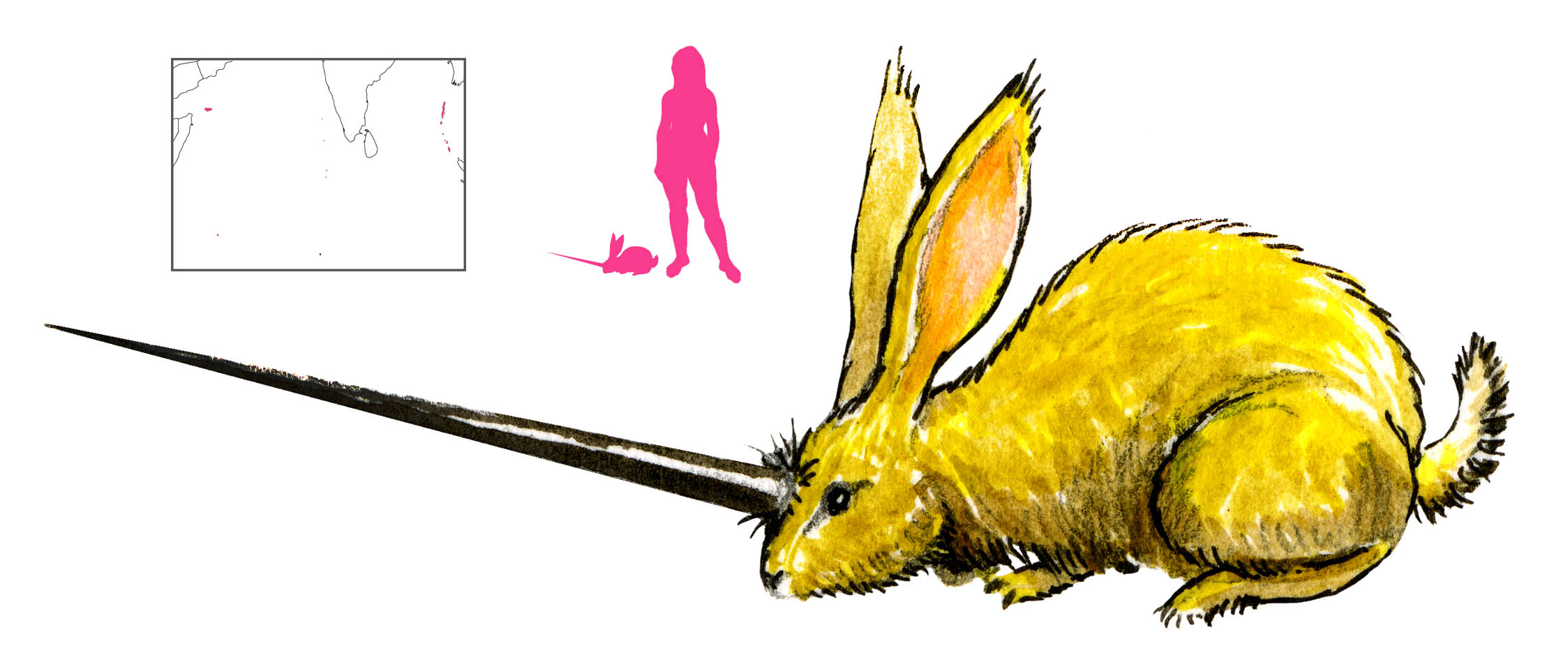
Among the gifts Alexander was given for this sauroctonous feat was a Mi’raj, a creature resembling a yellow rabbit with a single black horn on its forehead. It was apparently so aggressive that wild animals would flee at the sight of it – a feature it shared with the karkadann, and which may have arisen from confusion between the two unicorns. It certainly wasn’t fierce enough to avoid being captured (alive or dead).

The exact pronunciation of the name is unclear, as with the absence of diacritics, “mi’raj” may as well be “mu’raj”. It is sometimes rendered as Al-mi’raj, literally “The mi’raj”; this is unnecessary in English, and any usage of this term preceded with “the” or “an” is redundant. Bochart (and by extension Flaubert) refers to it as “mirag”, which is correct in Egyptian Arabic but drops the difficult ‘ayn.

Al-Qazwini was the first to report the story of Alexander and the mi’raj. Al-Damiri describes the mi’raj as “great [and] marvelous”.

If there is any factual basis for the existence of the mi’raj, it may well have been a rabbit with facial tumors caused by papillomaviruses. The same has been used to explain the origin of the jackalope, a North American hybrid used to fool tourists and usually created by grafting horns on a jackrabbit skin.

References

Bochart, S. (1675) Hierozoicon. Johannis Davidis Zunneri, Frankfurt.

Al-Damiri, K. (1891) Hayat al-hayawan al-kubra. Al-Matba’ah al-Khayriyah, Cairo.

Ettinghausen, R. (1950) The Unicorn. Studies in Muslim Iconography, Freer Gallery of Art Occasional Papers Vol. 1, No. 3, Washington.

Al-Qazwini, Z. (1849) Zakariya ben Muhammed ben Mahmud el-Cazwini’s Kosmographie. Erster Theil: Die Wunder der Schöpfung. Ed. F. Wüstenfeld. Dieterichsche Buchhandlung, Göttingen.

Seznec, J. (1943) Saint Antoine et les Monstres: Essai sur les Sources et la Signification du Fantastique de Flaubert. PMLA, Vol. 58, No. 1, pp. 195-222.

Zimmer, C. (2011) A Planet of Viruses. University of Chicago Press.

Sinad

Variations: Sinād, Sénad, Senad

Sinad 2

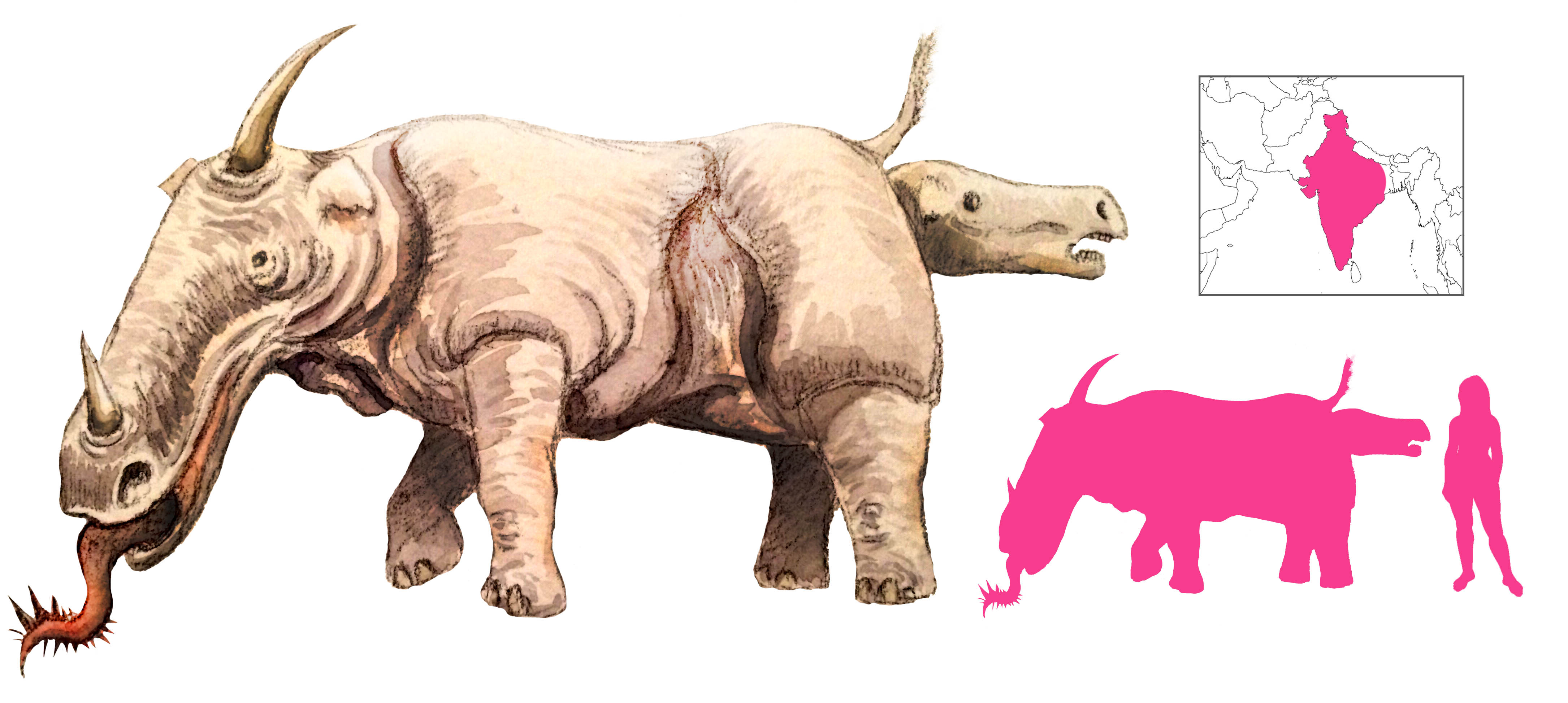
The Sinad is an Indian creature of uncertain appearance and dubious maternal instinct, described by Al-Jahiz, Al-Qazwini, and a number of other Muslim authors. Its primary characteristics – also attributed to the karkadann – were its sharp, thorny tongue and its unusual method of giving birth.

Al-Qazwini describes the sinad as similar to but smaller than an elephant, and larger than an ox. When the female is ready to give birth, the young sinad would stick its head out of its mother’s womb, feeding on grass and waiting until it was mature enough to run away. This was because the mother sinad, following her parental instincts, would attempt to lick her calf clean – in the process flaying the flesh off its bones. Once it was large enough, the calf would squirm out and gallop to safety.

This lethal tongue was also associated with the karkadann, and representations of them became blurred. Some images of the sinad are elephantine, while others came to follow the established iconography of the karkadann, giving it one or two horns. Al-Gharnati stated that the kings of China tortured people by having a karkadann lick them. Marco Polo, in his disillusioned report on the unicorn, said that its deadliest weapon was its tongue.

Flaubert, in his Temptation of Saint Anthony, makes an allusion to the Sénad as a three-headed bear that tears its cubs apart with its tongue. Here he conflates the sinad as described by Bochart with Pliny’s description of the bear licking its amorphous newborn cubs into shape. The three heads are a Flaubertian flourish.

References

Ettinghausen, R. (1950) The Unicorn. Studies in Muslim Iconography, Freer Gallery of Art Occasional Papers Vol. 1, No. 3, Washington.

Flaubert, G. (1885) La Tentation de Saint Antoine. Quantin, Paris.

Pliny; Holland, P. trans. (1847) Pliny’s Natural History. George Barclay, Castle Street, Leicester Square.

Polo, M. (1965) The Travels. Penguin Classics, London.

Al-Qazwini, Z. (1849) Zakariya ben Muhammed ben Mahmud el-Cazwini’s Kosmographie. Erster Theil: Die Wunder der Schöpfung. Ed. F. Wüstenfeld. Dieterichsche Buchhandlung, Göttingen.

Seznec, J. (1943) Saint Antoine et les Monstres: Essai sur les Sources et la Signification du Fantastique de Flaubert. PMLA, Vol. 58, No. 1, pp. 195-222.

Umutwa

Variations: Abatwa (pl., often used as singular), Chitowe, Katsumbakazi, Maithoachiana, Mkonyingo, Mumbonelekwapi, Wabilikimo

Umutwa

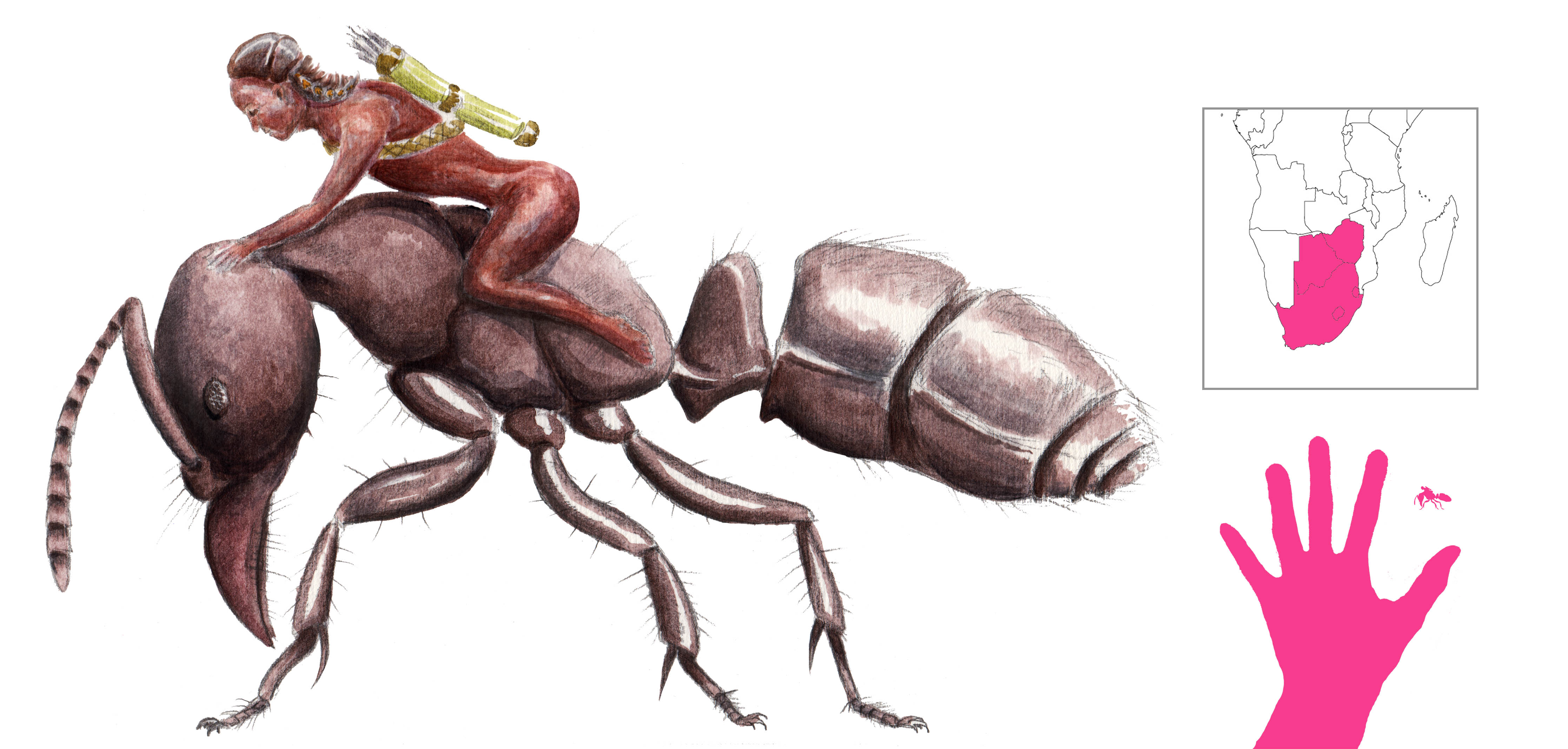
First contact between different people is never easy. Sometimes one group ends up exaggerated, romanticized, altered until they are virtually unrecognizable. It was this process that turned Saracens into malevolent mountain goblins, and which caused the San bushmen to shrink to near-microscopic size in Zulu folklore, resulting in the Abatwa. The term is still used in Zulu to refer to bushmen, and some identify as Abatwa, but the Abatwa of folklore are supernatural and unmistakeable.

The Abatwa, Umutwa in the singular, are the smallest of all fairies. They live in the rugged uplands, where they use blades of grass as shelters and sleep in anthills. Abatwa have no fixed village apart from their bivouacs in the anthills. The only times they are sedentary are when they kill game; even then they stay around the carcass only as long as it takes to fully consume it. Sometimes the Abatwa ride horses in search of game. In such cases, dozens of the tiny warriors sit atop one horse, in a line from head to tail. If their hunt is unsuccessful, they do the next best thing and eat the horse.

Despite their size, they are deadly hunters, armed with poisoned arrows that can kill even elephants. Being stalked and killed by Abatwa is a nightmare, as you face foes too small to see; they are like driver ants, or puff adders, virtually invisible, yet disproportionately deadly. However, they are also self-conscious about being tiny, to the point of being very touchy about it. This insecurity is outweighed by an enormous ego. Abatwa are vulnerable to flattery.

When one meets an Umutwa and hails him with the traditional Sa-ku-bona (“I have seen you”), the Umutwa is immediately suspicious. “Where did you see me?” If you answer “I haven’t seen you before”, “Just now”, or words to that effect, the Umutwa, furious about this slight on his size, will immediately draw his bow and shoot you dead.

Clearly a more diplomatic approach is in order. Creativity is vital here, as is exaggeration and, above all, sincere delivery. “I last saw you on my way here. See that mountain on the horizon? I was on top of it when I saw you, I couldn’t mistake you for anyone else”. Then the Umutwa smiles with pride, secure in the knowledge that despite being tiny, he is still a towering and respected figure.

The motif of tiny warriors with height insecurity is widespread in sub-Saharan Africa. All of these creatures, associated with different cultures, can be dealt with in the same way as the Abatwa, and respond negatively (and lethally) to going unnoticed.

If you flatter the Katsumbakazi of the Giryama, something lucky will happen to you.

The Maithoachiana of the Akikyu in Dagoreti are a cannibal race that are rich and skilled in metalworking.

The Wabilikimo of the Swahili live four days’ journey from Chaga, and are only twice the length from the middle finger to the elbow.

The Itowe (singular Chitowe) of the Machinga Yao rob gardens, rot pumpkins, turn fruits bitter, and leave footprints everywhere. Putting some of your crops at cross-roads will help placate them. They are like men but run on all fours. The related Mumbonelekwapi have long beards.

The Wakonyingo (singular Mkonyingo) of the Wachaga have enormous, misshapen heads and hide on Mount Kilimanjaro; none are bigger than a little boy. They have ladders that reach into the sky. They never lie down but lean against a wall, as getting up is hard with their top-heavy build. Wakonyingo take pity on people in trouble and will help them if they are lost. They leave bits of meat when sacrificing to their ancestors; the meat rolls down the mountain and turns into white-necked ravens. They are somewhat less touchy than the others mentioned, but can still exact terrible vengeance.

References

Ananikian, M. H. and Werner, A. (1964) The Mythology of All Races v. VII: Armenian and African. Cooper Square Publishers, New York.

Callaway, C. (1868) Nursery Tales, Traditions, and Histories of the Zulus. Trübner and Co., London.

Isitwalangcengce

Isitwalangcengce

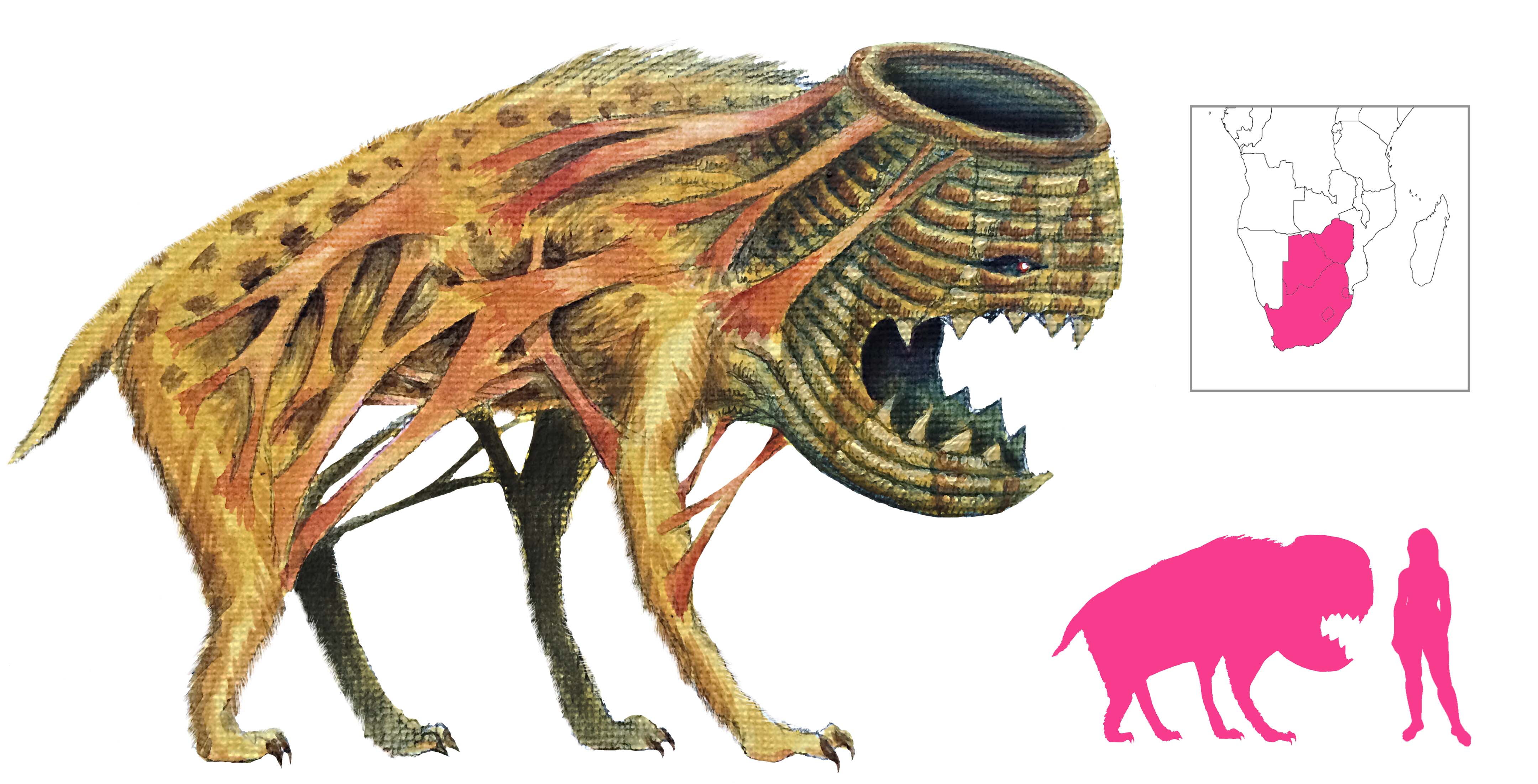
The Isitwalangcengce, or “Basket-bearer”, is hardly seen these days. Which is all the better, as this monster known to the Zulu people is a dedicated man-eater. Somewhat like a hyena in appearance, an Isitwalangcengce’s most notable feature is its basket-shaped head, complete with an opening in the top for carrying its prey.

Isitwalangcengces are powerful, and can easily overcome the bravest of men. They wait around villages during feast days, when children carrying freshly butchered meat go from house to house. They hide beside the doorway, and quickly stuff their victims into their head, carrying them off to eat. Isitwalangcengces do not actually eat all of their prey, but eat only the brain. An Isitwalangcengce will have a favorite rock to smash human heads on and lap up the contents.

If the Isitwalangcengce is strong, it is also dimwitted. This fact was exploited by one Zulu man who was being carried off in the basket. When the Isitwalangcengce passed through bushy terrain, the man reached out of the basket and pulled branches off, stuffing them into the cavity with him. Once he had filled the Isitwalangcengce’s head with sufficient branches, he grabbed onto a tree and hauled himself out. The Isitwalangcengce, meanwhile, noticed no difference in weight. By the time it reached the rocks and poured out a clump of branches and twigs, the man was long gone.

When the man returned to his village, he made sure to narrate his escapade in detail. News of that spread. Soon everyone knew to fill an Isitwalangcengce’s head with branches, and predation dropped drastically.

Now the Isitwalangcengce are mere nursery bogeys, good only for intimidating children. “If you aren’t good, the Isitwalangcengce will carry you off!” And the children smile to themselves, knowing that there’s always an easy way out.

References

Callaway, C. (1868) Nursery Tales, Traditions, and Histories of the Zulus. Trübner and Co., London.