Lakúma

Variations: Lucooma

lakuma

According to the Yamana, the Lakúma are the most dangerous sea creatures of Tierra del Fuego. These water spirits have been known to tip canoes over, pull their occupants out, and drag them under to consume, leaving their entrails to float to the surface. They can also create huge waves, summon whirlpools, and whip up storms to damage larger vessels.

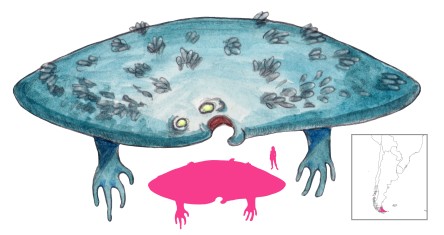
Lakúma have been compared to whales, squids, and giant worms, making their exact appearance hard to pin down. What is known is that they like to flatten themselves out on the water’s surface, letting their back protrude like a small island. Their broad and flat backs are covered with encrustations of unusually large mussels.

Sometimes there are so many lakúma in one spot that they can be used as stepping-stones. A group of Yamana on a desert island saw countless wide, flat lakúma rise to the surface, forming a living bridge to a bountiful island. “If we run quickly, we’ll get to the other side!” said one man, running over the backs of the lakúma and reaching the other shore. But the others were too slow, and the lakúma dove, taking them to a watery grave. The one survivor recruited enough men to slay many lakúma in retaliation, and their bodies can still be seen today in the form of large, flat stones at the bottom of the sea.

Lakúma will also attack people breaking taboos. It is known that a menstruating girl or túrikipa should not eat berries, but one girl thought she could circumvent the rule by sucking out the juices and spitting the solid outer part. Alas, her canoe was attacked by a lakúma, and it refused the offerings tossed at it until it took the girl and devoured her. It then flattened itself out on the surface and rested. The túrikipa’s people went onto the lakúma’s back, took some of the mussels, and used their sharp shells to dismember the lakúma. But that was small comfort for the túrikipa, whose entrails served as a grisly reminder of her fate.

For all their malevolence, lakúma can be tamed by a powerful yékamuš or shaman, and can become obedient servants. One yékamuš was with his wife in their canoe while she scolded him. “I thought you were a powerful yékamuš, but you can’t even strand a whale, or fetch birds to eat!” In response the yékamuš slept and summoned two lakúma, who raised the canoe’s bow up in the air. “Wake up! Help me!” cried his wife, and the yékamuš stirred and spoke nonchalantly. “I thought you said I was powerless”, he taunted, before telling her to paint the lakúma with white paint. She did as she was told, and the lakúma did not resist. Then they dove and created a good breeze to send the canoe effortlessly to its destination. “I had always made fun of you”, admitted the wife, “but now I know you are truly a capable yékamuš!”

References

Gusinde, M.; Schütze, F. trans. (1961) The Yamana; the life and thought of the water nomads of Cape Horn. Human Relations Area Files, New Haven.

Gusinde, M.; Wilbert, J. ed. (1977) Folk Literature of the Yamana Indians. University of California Press, University of California, Los Angeles.

Dulhath

Variations: Dulhama (al-Damiri); Duhlak, Dulhak, Dulchaph (Bochart)

dulhath

The Dulhath has had a muddled history, with authors disagreeing with each other on the exact name, let alone the appearance. It is first mentioned by al-Qazwini, who refers to the dulhath, but al-Damiri describes it under the name of dulhama, and Bochart reports on the duhlak. Here al-Qazwini’s name has been given priority.

While the original description appears to be al-Qazwini’s, the dulhath’s pedigree probably goes back to jinn who appear as animals – in this case, an ostrich jinni. This in turn led to al-Qazwini’s dulhath as a demon found on certain desert islands, and which resembles a man riding an ostrich. It eats the flesh of humans who have been cast alive or dead into its territory. A dulhath will also invade ships to seek its prey, and when attacked by sailors it speaks loudly in a boastful voice, causing them to prostrate themselves before it. Bochart believed the “boastful voice” to have been some translation error derived from tales of sirens.

The best description of a dulhath is found in the tale of Aboulfaouaris the sailor. Sadly it is all but certifiable, as the creature in question remained unnamed, but its behavior is compellingly close to al-Qazwini’s broad outline. The dulhath that plagued Aboulfaouaris looked like a man of about 40. He had a monstrous shape, a big head, short bristly hair, and an excessively large mouth filled with sharp teeth. Eyes like those of a tiger glared above a flat nose with large nostrils. His arms were nervous, his hands large, and his fingers equipped with viciously hooked claws.

Aboulfaouaris and his crew encountered a dulhath near the island of Java. They saw a naked man clinging to a plank of wood in the sea, calling for help; accordingly the sailors rescued him and brought him aboard ship, where his appearance caused much consternation. When told that he had been narrowly rescued from drowning, the odd man smiled and said “I could have stayed for years in the sea without being bothered; what torments me most is hunger. I have not eaten in twelve hours. Please bring me something to eat, anything, I’m not particular”. An attempt was made to bring him clothing, but the dulhath explained that he always went naked. “Don’t worry, you’ll have lots of time to get used to it”, he added ominously, stamping his foot impatiently. Enough food was presented to him to feed six starving men. The dulhath polished it off and asked for more; the same amount was brought to him and disappeared in short order, and a third helping was called for. One of the slaves, shocked by the creature’s insolence, made to strike him, but the dulhath grabbed him both both shoulders and tore him in half.

All hell broke loose. Aboulfaouaris, sailors, slaves, all descended on the dulhath with sabers drawn, determined to kill the monster. But the dulhath’s skin was harder than diamond. Swords broke and arrows bounced uselessly off his hide. Then they tried to drag him off the ship, but the dulhath sank his claws into the deck, anchoring himself immovably. The sailors were utterly incapable of harming the dulhath. The dulhath, on the other hand, had no such problems as he took one of the sailors and ripped him to pieces with his claws. “My friends, you had better obey me. I’ve tamed worse people than you, and I will have no qualms about having you share the fate of your two shipmates”.

With that the reign of terror began. The dulhath was in full control of the ship, and ate his fourth course while the crew stared in terrified silence. Aboulfaouaris hoped that food and conversation might cause the monster to doze off, but the dulhath smugly reminded him that he had no need for sleep, and none of the soporific tales they told him would have any effect.

All hope seemed lost until deliverance came from the sky. The sailors looked up to see a rukh soaring overhead, and they scattered in fear. The dulhath, however, was unaware of the huge bird, and was standing confidently in the middle of the deck. An easy target! The rukh dove and carried the dulhath off before he could cling to the ship. But the intended prey wasn’t giving up without a fight, and he began tearing and biting into the rukh’s belly. The rukh responded by gouging out the dulhath’s eyes with its talons, and the demon retaliated by eating his way to the rukh’s heart. As it expired, the rukh caught the dulhath’s head in its beak and crushed it like an eggshell. Both monsters plummeted into the waves and vanished.

References

Bochart, S. (1675) Hierozoicon. Johannis Davidis Zunneri, Frankfurt.

al-Damiri, K. (1891) Hayat al-hayawan al-kubra. Al-Matba’ah al-Khayriyah, Cairo.

de Lacroix, P. (1840) Les Mille et Un Jours: Contes Persans. Auguste Desrez, Paris.

al-Qazwini, Z. (1849) Zakariya ben Muhammed ben Mahmud el-Cazwini’s Kosmographie. Erster Theil: Die Wunder der Schöpfung. Ed. F. Wüstenfeld. Dieterichsche Buchhandlung, Göttingen.

Smith, W. R. (1956) The Religion of the Semites: the Fundamental Institutions. Meridian Books, New York.

Muirdris

Variations: Muirgris (erroneously); Sínach, Sinech; Píast Uiscide (“Water Beast”); Úath (“Horror”)

muirdris

Fergus mac Léti, the King of Ulster, was an inveterate swimmer. Captured while sleeping by water-spirits, the lúchorpáin or “small bodies” (actually the first appearance of leprechauns), he was awoken by the cold water they tried to carry him into. This allowed him to turn the tables on his would-be captors, and he seized three of the lúchorpáin. Fergus demanded that the sprites grant him three wishes: the ability to breathe underwater in seas, pools, and lakes.

The sprites granted him his wish, in the form of enchanted earplugs and a tunic to wear around his head. But like all wishes granted by the Fair Folk, it came with a caveat. Fergus was not to use his gifts at Loch Rudraige (Dundrum Bay) in his own land of Ulster.

Of course, Fergus arrogantly disregards the rule and swims underwater at Loch Rudraige anyway. There he encounters the Muirdris, the “Sea Bramble” or “Sea Briar”, a huge, mysterious, undefined horror that inflates and deflates, expands and contracts like a bellows. It has features of a thorn-bush, with branches and stings, and its appearance alone is deadly.

Fergus does not take well to his encounter with the muirdris, and he is horribly disfigured after seeing it, with his mouth moving to the back of his head. His courtiers are dismayed, as a man with a blemish cannot be king, but they somehow keep this defacement a secret from Fergus for seven years. They prevent him from accessing mirrors, and surround him only with people who will protect the king’s deformity. He finds out only after Dorn, a highborn slave, taunts him about it after he strikes her with a whip. She is bisected for her troubles, and Fergus goes to face his nemesis alone.

The battle between Fergus and the muirdris lasts a day and a night, during which the water of the loch bubbles like a giant cauldron. Finally Fergus slays the monster with his bare hands, and emerges from the loch holding its head in triumph – only to collapse and die from the ordeal.

A thirteenth-century retelling of Fergus’ tribulations renames the monster sínach or sinech. In this version, it is the king’s wife who reveals his secret after an argument.

The muirdris is a monster, but is it rooted in fact? Surely the expansion and contraction, the comparison to a thornbush, and the disfiguring stings strongly suggest a large jellyfish, perhaps the lion’s mane jellyfish.

References

Borsje, J. (1996) From Chaos to Enemy: Encounters with Monsters in Early Irish Texts. Brepols Publishers, Turnhout.

MacKillop, J. (2005) Myths and Legends of the Celts. Penguin Books, London.

Skötumóðir

Variations: Skate Mother; Fluxuskrímsl (Flake Monster); Vatnsandi (Water Spirit); Vatnaskratti (Water Devil)

skotumodir

Skate in Iceland are mystical creatures. Saint Peter recognized them as the holiest fish in the sea, and they are intimately connected with the number nine. A skate has nine good qualities and nine bad. It will watch over a drowned man for nine nights, and spend the next nine nights eating him. A skate will carry its young within her for nine months, then lie upon them for nine weeks, during which a stone grows within them. This stone, the “skate-stone”, could make a man invisible for one hour, or relieve labor pangs. Empty mermaid’s purses, or “Peter’s purses” as they are known, have lost their skate-stones.

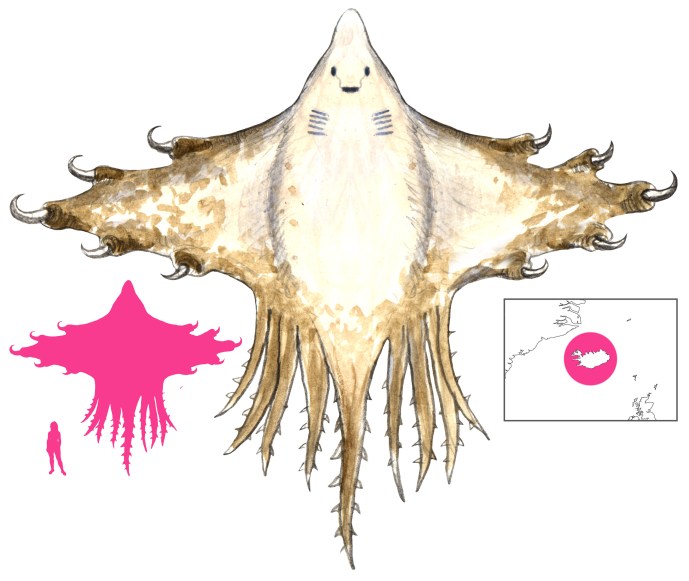
Most terrifying of all is the Skötumóðir, or “Skate Mother”. Like the other Icelandic “fish mothers”, they are not necessarily skate themselves; in fact, some accounts describe them as evil whales that resemble skates. They are enormous and toxic to eat, with backs like mud-covered islands, and sport nine tails. Unlike regular skate, they have been found inland, in freshwater, and even on dry land.

There is always a swarm of skate swimming around a skötumóðir. As they are caught by fishermen, the sea seems to get shallower as the skötumóðir rises to the surface. Finally, the vengeful skate mother hooks its wings onto the gunwales of the boat, and drags it below the waves.

To evade a skötumóðir, prompt action is required. When the huge ray latches its wings onto the boat, they must be immediately chopped off with whatever sharp implement is handy. This will effectively neutralize the threat.

An enormous skate, no doubt a skötumóðir, was one of three monsters terrorizing people around Lagarfljót, lying in wait at ferry crossings. It was transfixed to the bottom of the river by a powerful sorcerer, and unless it has escaped, it is there still.

References

Davidsson, O. (1900) The Folk-lore of Icelandic Fishes. The Scottish Review, October, pp. 312-332.

Hlidberg, J. B. and Aegisson, S.; McQueen, F. J. M. and Kjartansson, R., trans. (2011) Meeting with Monsters. JPV utgafa, Reykjavik.

Selamóðir

Variations: Seal Mother

selamodir

The Selamóðir, or “Seal Mother”, is the protector of the harbor seals and grey seals of Iceland. It is called by seals when persecuted, or it may appear of its own accord to defend its charges. Unlike most seals, it can be found inland as well as at sea, in freshwater and saltwater.

Seal mother or not, a selamóðir is a monstrous sight. It is like a seal in general appearance, but of “unusual dimensions”, “terrifying size”, or simply the size of a large foreign dog with short legs. It is reddish-pink in color (perhaps with a red neck), with flashing eyes and a back like an island. There is a tuft of hair, like brushwood or heather, between its eyes.

Seal mothers may be found wherever seals gather, and ferociously attack anything that approaches their “children”. There is one report of a selamóðir charging out of the sea to scare off would-be seal hunters, and others of selamóðirs swimming upriver.

A selamóðir was also one of the three monsters inhabiting the Lagarfljót river. It slept under the waterfall, and was much feared until it was vanquished and transfixed to a rock.

References

Hlidberg, J. B. and Aegisson, S.; McQueen, F. J. M. and Kjartansson, R., trans. (2011) Meeting with Monsters. JPV utgafa, Reykjavik.

Each Uisge

Variations: Each-uisge, Water horse

each-uisge

While the kelpie plies the rivers and streams of Scotland, the lochs and seas are home to the far more dangerous Each Uisge, literally the “Water Horse”. Each uisges are carnivorous, and relish human flesh. While other water-horses are content with playing pranks, tossing riders into ponds and laughing at their lot, an each uisge’s actions are always predatory. In addition to hunting humans, they will also reproduce with farm animals, siring foals with flashing eyes, strong limbs, distended nostrils, and an indomitable spirit.

Like kelpies, each uisges are shapeshifters and can assume a wide variety of forms, from sea life to attractive human beings. Their most common guise, however, is that of a fine horse, standing by the waterside and waiting to be mounted. Such horses are always magnificent, sleek, and wild-looking, and their neighs can wake people up all around the mountains.

The each uisge in human form is attractive and charming, but always has some features that give it away – horse’s hooves, for instance, or hair full of sand and seaweed, or a tendency to whinny in pain. In such cases where an each uisge lover was found out, it is usually killed by the girl’s father or brothers before it can devour her. Regardless of the shape it has taken, an each uisge’s carcass will turn into formless jellyfish slime by the next day.

Sometimes the each uisge is a large bird, although this may be confusing it with the boobrie. More worrisome features have been observed, including viciously hooked, 17-inch long beaks, enormous claws, and footprints larger than an elephant’s. An each uisge observed at the Isle of Arran was light grey, with a parrot-like beak and a body longer than an elephant’s.

For all their carnivorous nature, each uisges can be easily tamed by slipping a cow’s cap or shackle onto it, turning it docile and harmless. If the cap or shackle ever falls off, the each uisge immediately gallops off for the safety of the loch, possibly dragging its would-be master with it. Each uisges can also be tamed by stealing their magic bridles. They use them to see fairies and demons, and are vulnerable without them. Finally, like many other evil creatures, each uisges avoid crosses and other religious symbols.

Every loch in Scotland has its own each uisge. Loch Treig was said to have the fiercest each uisges. Loch Eigheach means “Horse Loch” and is home to a much-feared each uisge, with a deadly charm and a silky grey hide. It would yell triumphantly as it bore its prey into the water.

Seven girls and a boy once found an each uisge on a Sunday afternoon near Aberfeldy. It was in the form of a pony, and it continued grazing as the first girl jumped onto its back. One by one, the other girls followed their friend onto the pony, but only the boy noticed that the pony’s back grew longer to accommodate its riders. Finally, the pony tried to get him on as well. “Get on my back!” it said, and the boy ran, hiding in the safety of the rocks. The terrified girls found that their hands stuck to the each uisge’s back, and they could only scream as it dove into the loch. The next day, seven livers floated to the surface.

The son of the Laird of Kincardine encountered an each-uisge near Loch Pityoulish. He and his friends found a black horse with a bridle, reins, and saddle all made of silver. They got onto it and immediately found themselves on a one-way trip to the loch, their hands glued to the reins. Fortunately for the heir of Kincardine, the youth had only touched the reins with one finger, and freed himself by cutting it off, but he could only watch as the water-horse took his friends with it.

While the water-horse legend may be pervasive and universal in northern Europe, some of the each uisge’s appearances may be more prosaic. The beak and large footprints of some each uisges suggest a leatherback turtle more than they do a horse.

References

Fleming, M. (2002) Not of this World: Creatures of the Supernatural in Scotland. Mercat Press, Edinburgh.

Gordon, S. (1923) Hebridean Memories. Cassell and Company Limited, London.

MacKinlay, J. M. (1893) Folklore of Scottish Lochs and Springs. William Hodge & Co., Glasgow.

Parsons, E. C. M. (2004) Sea monsters and mermaids in Scottish folklore: Can these tales give us information on the historic occurrence of marine animals in Scotland? Anthrozoös 17 (1), pp. 73-80.

Flyðrumóðir

Variations: Flyðrumóðirin (pl.), Halibut Mother; Laxamóðir (Salmon Mother), Laxamóðirin (pl.); Silungamóðir (Trout Mother), Silungamóðirin (pl.)

Flydrumodir

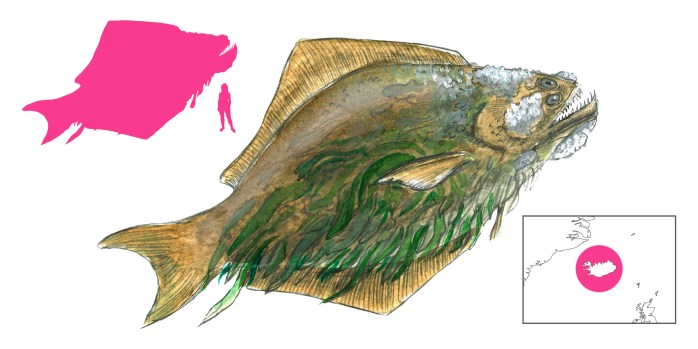
The Flyðrumóðir, or “Halibut Mother”, is fairly representative of the Icelandic móðirin, the “mothers” of certain species of fishes. These creatures look like huge, monstrous versions of their namesakes, and they protect their smaller kin fiercely.

A flyðrumóðir looks like the halibut it protects, but it is much larger, growing to the size of a fishing boat. Its body, which turns grey on both sides with age, is covered with shells, barnacles, and seaweed, making it look like a small island when it surfaces.

While the flyðrumóðir has been said to be the mother of all fishes in the sea, its true “children” are the halibut. It is followed by schools of halibut out at sea, and it protects them if they are persecuted. A schooner in Faxaflói attracted (and escaped) the attention of a flyðrumóðir after it hauled up 40 halibuts. Another fishing boat owned by Archdeacon Hannes Stephensen was less lucky; it caught a flyðrumóðir on a coffin-nail hook, but was capsized by the halibut mother with all hands lost.

Even catching a flyðrumóðir is not necessarily a good thing. After the halibut mother of Breiðafjörður was snagged on a golden hook and filleted, the waters of the area ceased to produce fish, and the angler who caught the giant halibut never again caught a fish in his life.

Similar fish mothers include the freshwater Laxamóðir, “Salmon Mother” and Silungamóðir, “Trout Mother”. Both of these resemble oversized salmon and trout, respectively. Salmon mothers will swim out of salmon-rich rivers, tearing through fishing nets along their way. The big-headed trout mothers are bad luck to catch, and should be released whenever possible.

References

Hlidberg, J. B. and Aegisson, S.; McQueen, F. J. M. and Kjartansson, R., trans. (2011) Meeting with Monsters. JPV utgafa, Reykjavik.

Marool

Variations: Angler-fish, Carrachan, Devil-fish, Keddle-man, Kethrie, Kettach, Kilmaddy, Marmaid, Mareillen, Marsgum, Masgum, Meermaid, Merlin-fish, Molly Gowan, Monk-fish, Plucker, Shoemaker, Toad-fish, Weever, Wide-gab

Marool

The Marool of Shetland is a malevolent marine devil, appearing in the form of a fish. It has eyes all over its head, and a crest of flame. It can be seen in mareel, or phosphorescent sea-foam. During storms the marool can be heard singing wildly with joy when a ship capsizes.

Marool is only one of a number of names that have been applied to the anglerfish or monkfish.

References

Forbes, A. R. (1905) Gaelic Names of Beasts (Mammalia), Birds, Fishes, Insects, Reptiles, Etc. Oliver and Boyd, Edinburgh.

Saxby, J. M. E. (1932) Shetland Traditional Lore. Grant and Murray Limited, Edinburgh.

It

It

Shetland is home to a number of creatures, some malevolent and some benign, but the most disconcerting of all is the entity known only as It.

Nobody can agree on what It looks like, and It has never appeared in the same form twice. Whether It is a shapeshifter or uses magic to obscure Its true appearance is unknown. Descriptions include a lump of “slub” or jellyfish, a legless animal, a headless human, and a bag of white wool. It could be a large otter or seal, but to those who have seen It, there is no otter or seal that compares. It is legless, but runs faster than any dog; It is wingless, but flies faster than any eagle; It is silent, but people understand what It is saying without hearing a word.

One Shetland house was plagued every Christmas by It. A man living there was alerted to Its presence, Its movement sounding like a mass of dead flesh hitting the floor. The man ran outside armed with an axe and a Bible, and chased It up the cliffs, embedding his axe in Its body while uttering a holy word. It was immobilized before It could dive back into the sea.

When the man called his friends over, they could tell if It was alive or dead, and It looked different to each of them. It was buried in earth and a trench dug around it, but nobody dared check on It. A stranger was brave enough to observe the burial site, but a mist rose, and something emerged from the ground to roll into the ocean. It had escaped.

References

Saxby, J. M. E. (1932) Shetland Traditional Lore. Grant and Murray Limited, Edinburgh.

Mastopogon

Variations: Aegomastus, Egomastus; Houperou, Huperus (erroneously?)

Houperou

The first appearance of the Mastopogon (“breast beard”), also called the Aegomastus, is as a nameless “strange fish” observed by Thevet off the coast of South America. It has a beard resembling a goat’s udder under its chin, and the illustration provided includes a long dorsal spine and pointed fins.

Thevet also describes the Houperou as a large carnivorous fish that eats all other sea creatures, except for one small fish. The carp-like fish remains in the shadow of the houperou and enjoys the protection granted by its larger friend. The houperou has rough sandpapery skin like a dogfish, sharp teeth, and a long spine on its back. It attacks, drowns, and dismembers anyone it catches in the water, and the native people shoot it with arrows on sight. The similarity of this unlikely couple to a shark and pilot fish is clear; in fact, uperu is the local name for “shark”, appropriately converted to French pronunciation by Thevet.

Gesner takes up the descriptions of the houperou and the udder-bearded fish from Thevet, but pictures the houperou or huperus as a large pike. He also coins Mastopogon and Aegomastus for Thevet’s nameless fish.

With time the heraldic mastopogon and houperou blurred together to the point of inextricability, making it necessary to describe them together. Holme describes the mastopogon as a variety of houperou, looking like a salmon with large thorny fins, the dorsal fin reaching all the way to the tail. The houperou, on the other hand, now has the mammary wattle, along with two ear-like knobs on its head, a long-spined dorsal fin, rough scales, and a straight tail.

References

Gessner, C. (1560) Nomenclator aquatilium animantium. Christoph Froschoverus.

Holme, R. (1668) The academy of armory, or, A storehouse of armory and blazon containing the several variety of created beings, and how born in coats of arms, both foreign and domestick. Printed by the author at Chester.

de Souza, G. S. (1851) Tratado Descriptivo do Brazil. Typographia Universal de Laemmert, Rio de Janeiro.

Thevet, A. (1558) Les Singularitez de la France Antarctique. Maurice de la Porte, Paris.

Thevet, A. (1575) La Cosmographie Universelle. Guillaume Chaudiere, Paris.